
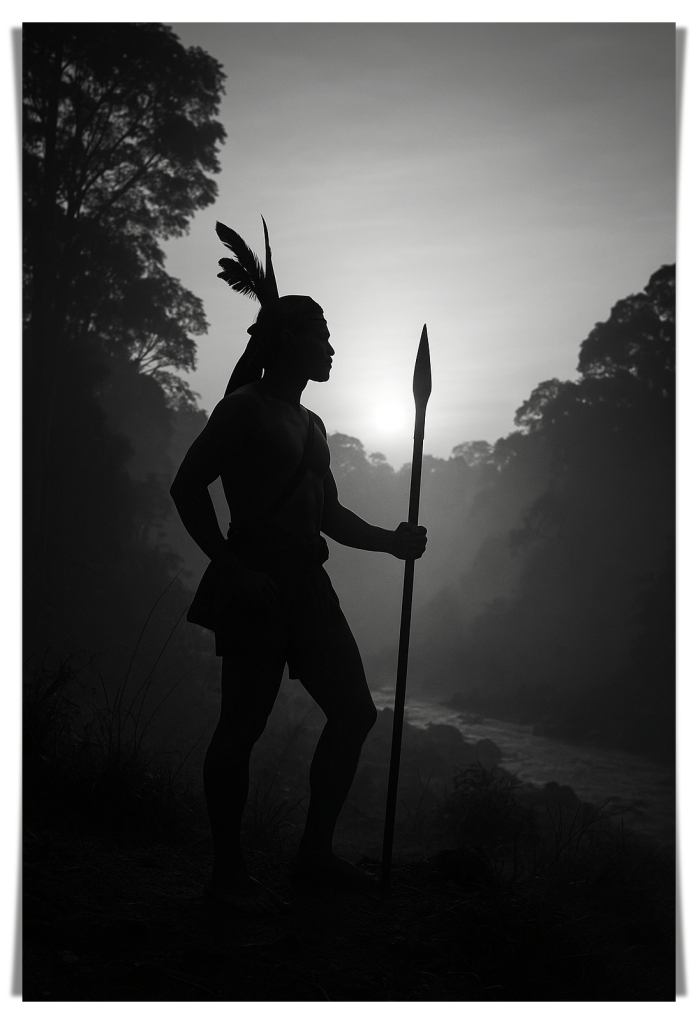
The night sky stretched out like a thick dark veil that would never end. The stars blinked, their usual brightness faded, seemingly taking the brunt of the choice I had to make. My warriors remained silent. Their eyes were full of trust in me. And yet, my heart roared with doubt.
The dream from the night before clung to me like a second skin. Kumang had appeared. Her face sorrowful and her voice clear: “Do not strike at dawn. To do so would mean your death.”
I was raised to heed such signs. Dreams are not dismissed in our way of life. They come from the realm above the sky, Panggau Libau and Gelong, where spirits still keep watch and gods whisper their warnings to those willing to listen.
But how could I pause now? I am Aji Apai Limpa, son of Dana Bayang. I carry the weight of my lineage and the blood of warriors. I have a duty to protect our land from those orang putih who pretend to come in peace but seek to conquer it. The White Rajah’s men moved through our rivers and jungles like relentless mold beneath the rotten bark. I had promised my people to fight back.
Doubt wound around me like a snake, growing tighter with each passing second. I thought about each consequence carefully. If I held back, people might think I was weak and couldn’t handle the challenges of war. And yet, to march forward meant possibly embracing the death that Kumang had warned me of. It’s not just my life but the lives of those who depended on me for safety.
The fire beside me crackled softly, radiating out small bursts of warmth that couldn’t reach the cold in my bones. I thought of my father and the things he taught me. I could almost hear his voice now. “Son, a leader’s strength isn’t measured by how loud he yells or how many people he kills, but by how deeply he listens to the land and the spirits.”
There was only silence tonight.
I stared into the embers and saw our longhouse. The ruai filled with children’s laughter. I saw the old ones with rheumy eyes by the bedilang, telling stories even as war crept closer. I saw my people, worn out and wounded but still holding on. Could I really ask them to wait and trust in the dreams and omens that only I heard and saw?
I thought of Kumang’s face again. Her expression softened and a gentle acceptance shone in her eyes. Was she trying to test me? Did she see the path that I couldn’t? Or was this simply the fate of every leader to make choices in the shadows?
I looked to the heavens for answers but none came. There was only an unrelenting silence. The river sprang to mind. It doesn’t resist the earth but bends and curves, following the land it loves. Maybe this was the lesson Kumang wanted to teach me. Sometimes strength is not found in striking but in knowing when not to.
Still, I couldn’t look away from what the morning would bring. I couldn’t stop seeing flames that had burned our longhouses and fields. I’m haunted by the blood and the lifeless bodies of my warriors. I couldn’t ask my warriors to retreat into silence when everything within them was ready to rise.
I gripped my sangkuh, finding strength on its solid surface. Death is never far from a warrior. If Kumang’s vision was true, my demise awaited me at daybreak. But what about it? My life has never been mine alone. It belongs to this land, the spirits, and the people who look to me for courage.
Still, doubt gnawed at me. Would my death make any difference? Would it make my men fight harder, or would it break their spirits, making them vulnerable to the enemy’s advances? Such questions couldn’t be answered tonight.
I closed my eyes and prayed for the strength to choose. I got up when the horizon began to pale with the morning sun. My men stirred and looked at me. No one said a word. They only waited for my voice.
I took a deep breath, letting the air of our land fill me one last time.
“Kitai mupuk udah makai pagi,” I said. The words tasted bitter. It carried the sorrow of defying a goddess. But these words were mine and the resolve of a man who had chosen.
I looked up at the sky one more time as the warriors were getting their weapons ready. I half-expected to see Kumang’s face among the clouds. But there was only the rising sun shining over the land I loved.
I would meet it standing, no matter if it marked my beginning or my end.
Footnote:
This flash fiction is inspired by the life of my great-great-great-grandfather, Aji Apai Limpa, a well-known war leader of the Iban people of Borneo in the mid-nineteenth century. From 1854 to 1858, Aji commanded his warriors in resistance to the White Rajah’s forces. He died in a fierce battle at Sg. Langit (Langit River) in 1858. Aji’s courage and valor have been immortalized in Iban poetry, which is passed down through generations by bards.
The Iban people of Borneo were traditionally animists, believing that spirits, animals, nature, and other aspects of the earth are living and interrelated. Even though most Ibans are now Christians or Muslims, animist ideas are still very much a part of our traditional beliefs and customs. One of these traditions is augury, which is the practice of interpreting god’s signs based on the behavior of certain birds that are thought to be divine messengers. Along with dream interpretation, augury is an important part of Iban divination. These practices are based on a way of thinking that sees the sacred in nature and gives guidance and warnings to those who can read its signs.
Translation of Iban words
- Ruai: the communal open area or covered verandah that runs along the length of a traditional longhouse.
- Bedilang – hearth
- Sangkuh – spear
- “Kitai mupuk udah makai pagi” – we make a move after breakfast
- Kumang – a supreme goddess of the Iban from the realm above the sky, Panggau Libau and Gelong
- Orang putih – white men
 Olivia's Atelier
One thought on “Flash Fiction | Before the Sun Takes Me”