Painting an Iban Woman in Ngepan Indu Iban | Between Chaos and Colour

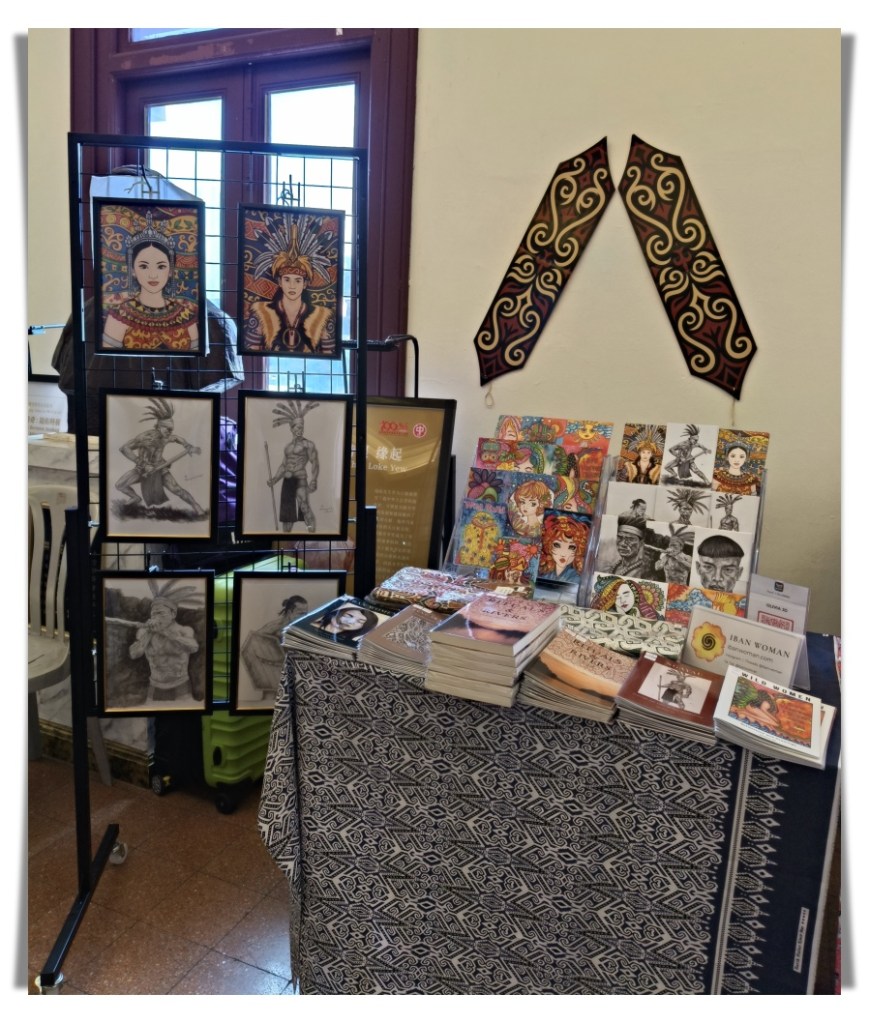
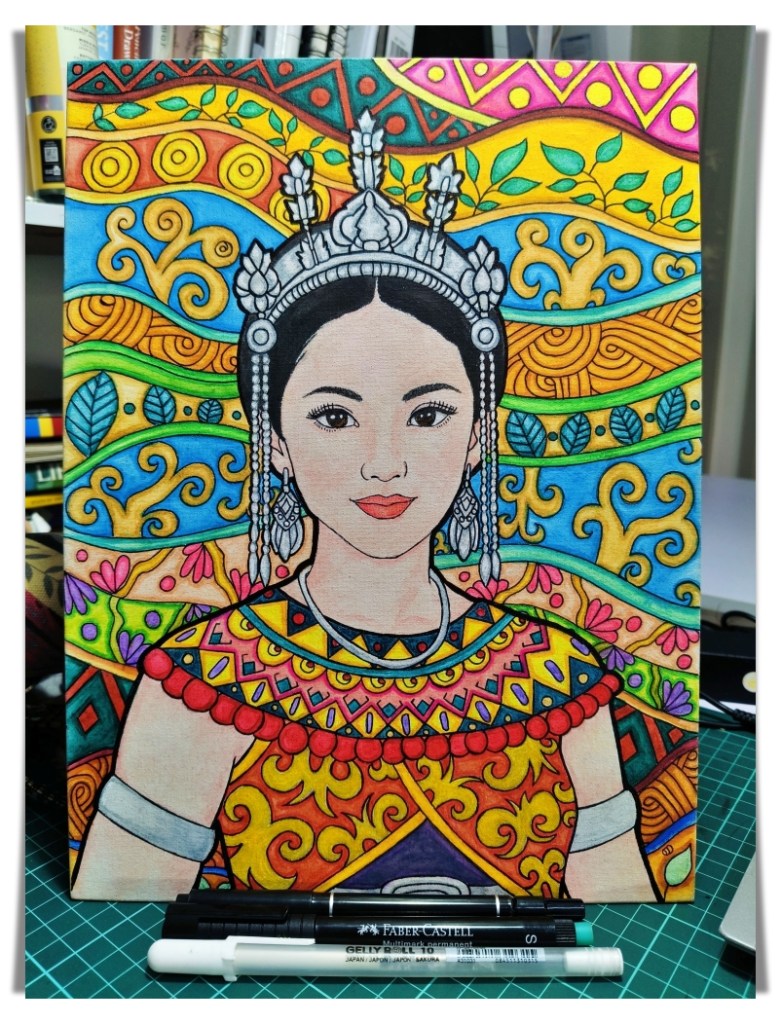
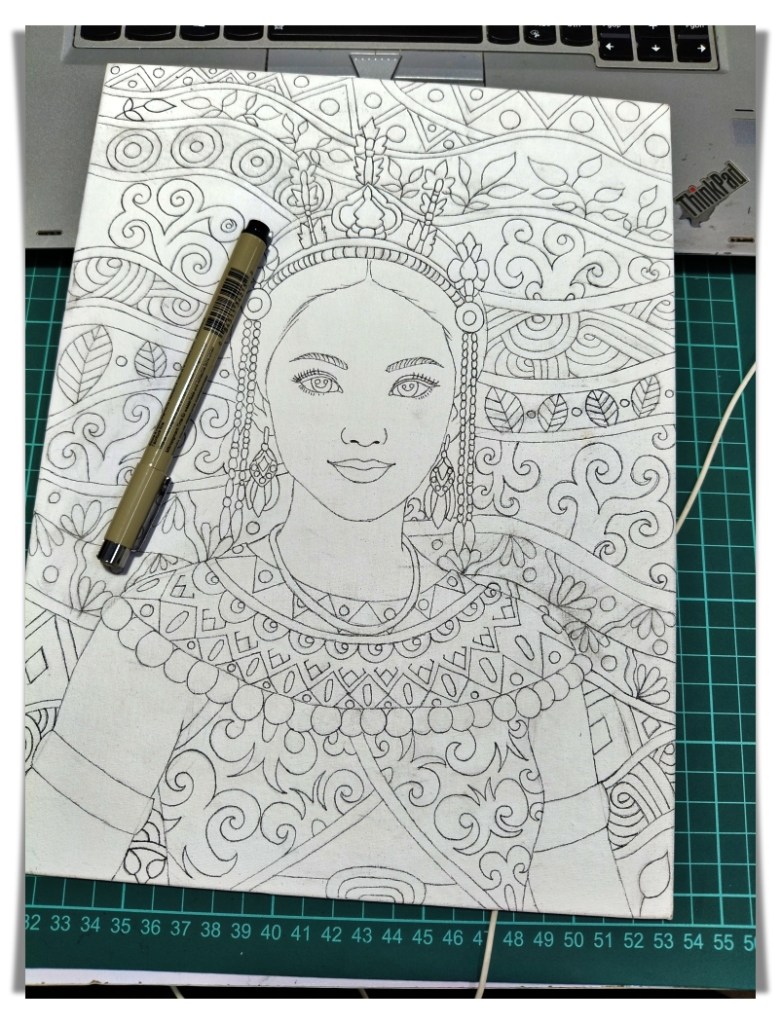
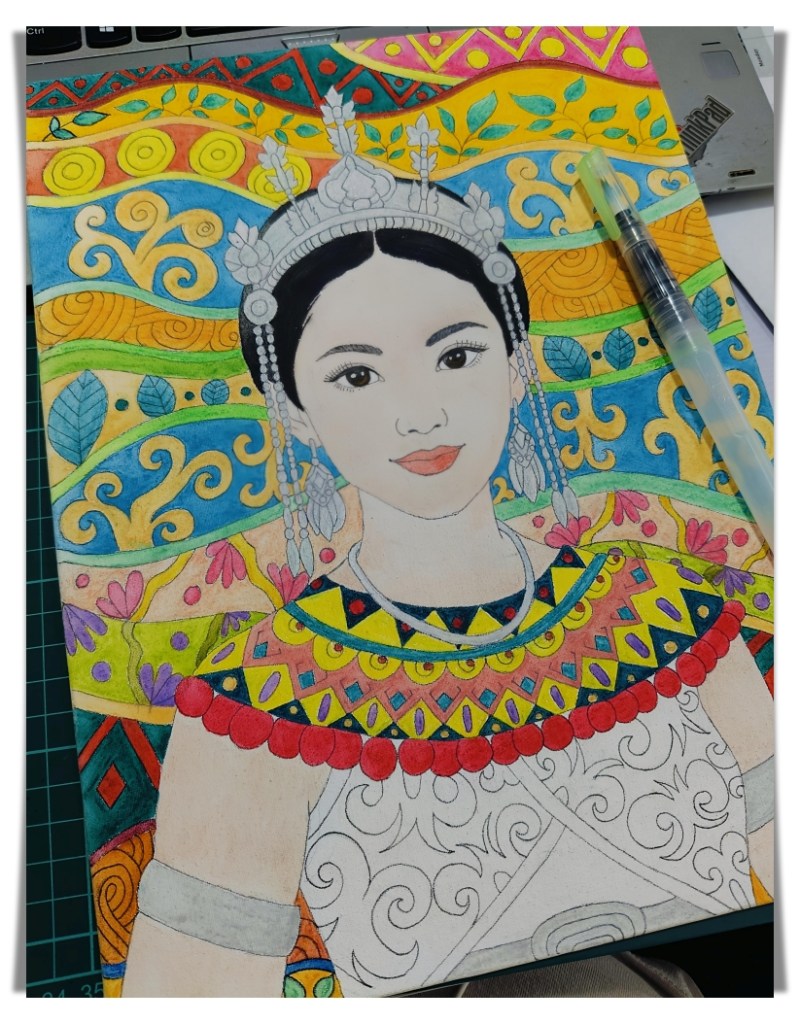
I have been working on this mixed media painting for the past ten days. It is of an Iban woman wearing a traditional costume called “ngepan indu Iban.” The piece has elements such as the sugu tinggi headpiece, the marik empang or tangu worn across the shoulders, the selampai crossing the chest, the tumpa on the arms, and the lampit around the waist. Instead of creating an accurate historical painting, I wanted to reinterpret these traditional elements in my visual language of doodle patterns, flowing lines, and brilliant colors. 

At first, I thought this painting would simply take a few days. But after a while, it just became part of my routine. And life kept interfering in between coloring little sections and drawing patterns. My car broke down and I had to have it fixed at the mechanic’s. One of my molars chipped after I accidentally chewed on a tiny piece of chicken bone, so I had to go to an emergency dentist appointment. There was still housework, my son’s schoolwork, and the usual weariness that comes with adulthood. Some days I just worked on the painting for an hour or two. And there were other days when I sat with it late into the night, hours after everyone went to bed. Even so, I kept returning to it. 

After a while, the painting stopped feeling like just an art project. It became an exercise in finishing something. I tend to jump around between ideas too fast and I find it hard to finish them. But this time I worked on one artwork for ten days straight until it was finished.

And I wanted the picture to be alive and not historical or “museumy.” Perhaps that’s why I tend to choose vivid, vibrant colors rather than subtle earth tones. I wanted the background to feel crowded and flowing behind her. Some designs were influenced by traditional themes and others were instinctual throughout the process itself.

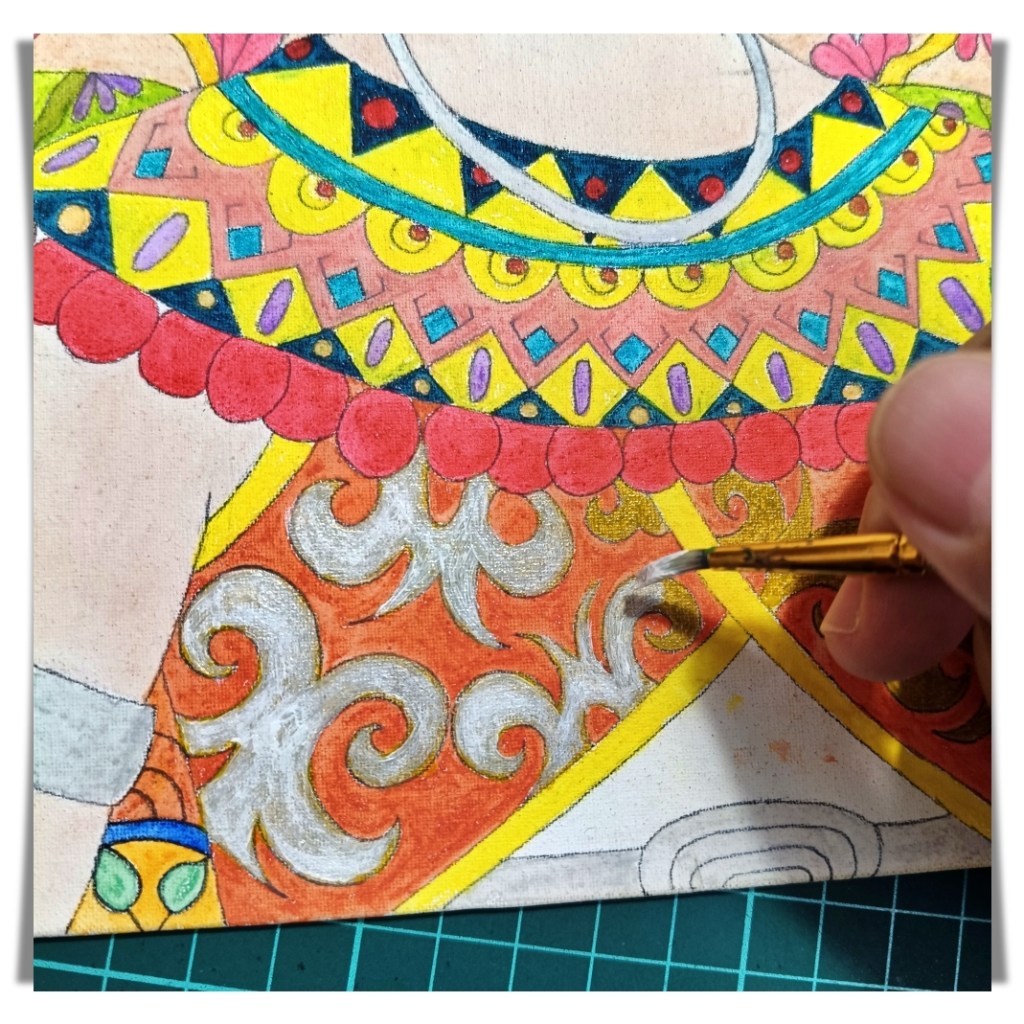
There was one point during the painting process when I really feared I’d botched the whole thing. The patterns on the selampai were meant to be golden yellow, but I layered the wrong colors together and it turned into murky bronze. I tried to fix it with acrylic paint and regretted it instantly. I remember looking at it in utter frustration, totally convinced that I had messed up the painting after days of work. Finally, I walked away from it, let it dry, came back later, and repaired it painstakingly, layer by layer. Looking back, that mistake turned out to be part of the process. I thought those sections turned out great, but they weren’t the main lesson. The actual lesson was that I didn’t ditch the work halfway through.

The finished artwork was created using mixed media materials such as colored pencils, markers, acrylic paint, fine liners, and gel pen highlights. I mostly used non-archival materials, but I actually liked working with them instead of waiting for things to be perfect. In the end, the painting reflects the ten days it took to finish it: color, frustration, interruptions, patience, and finally getting it done. 


I write about Iban culture, ancestral rituals, creative life, emotional truths, and the quiet transformations of love, motherhood, and identity. If this speaks to you, subscribe and journey with me.
Creating Ngayau | An Iban Headhunting Zine

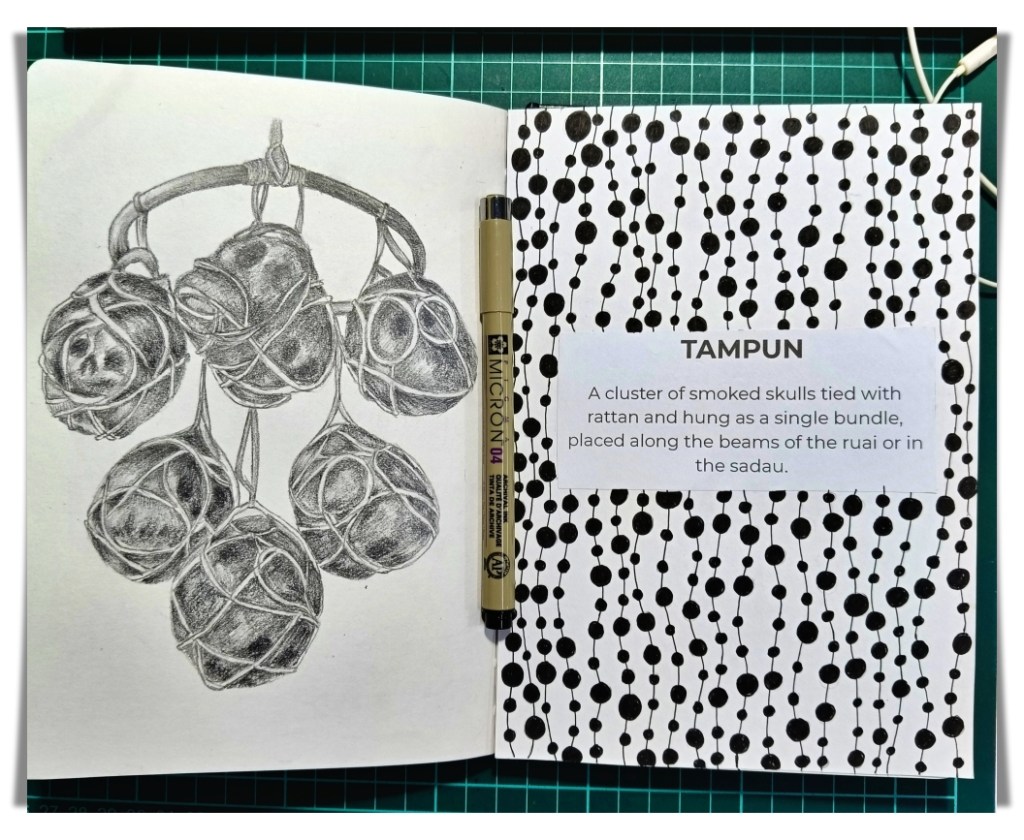
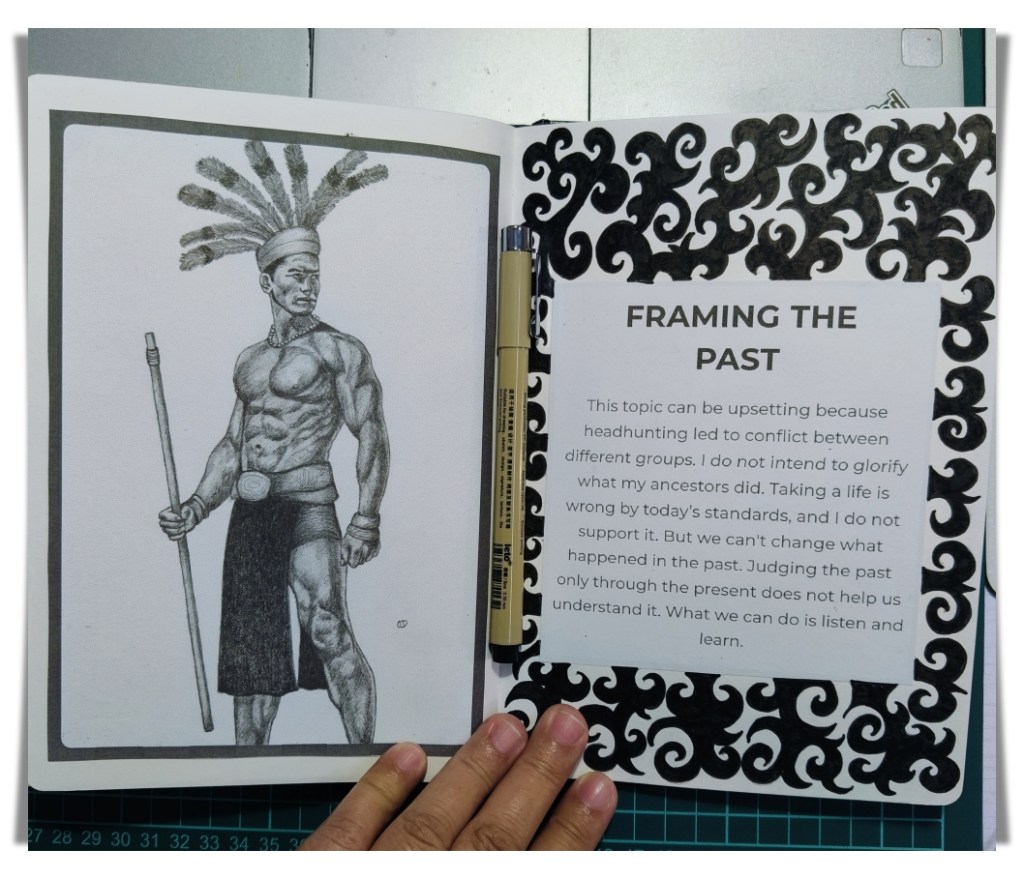
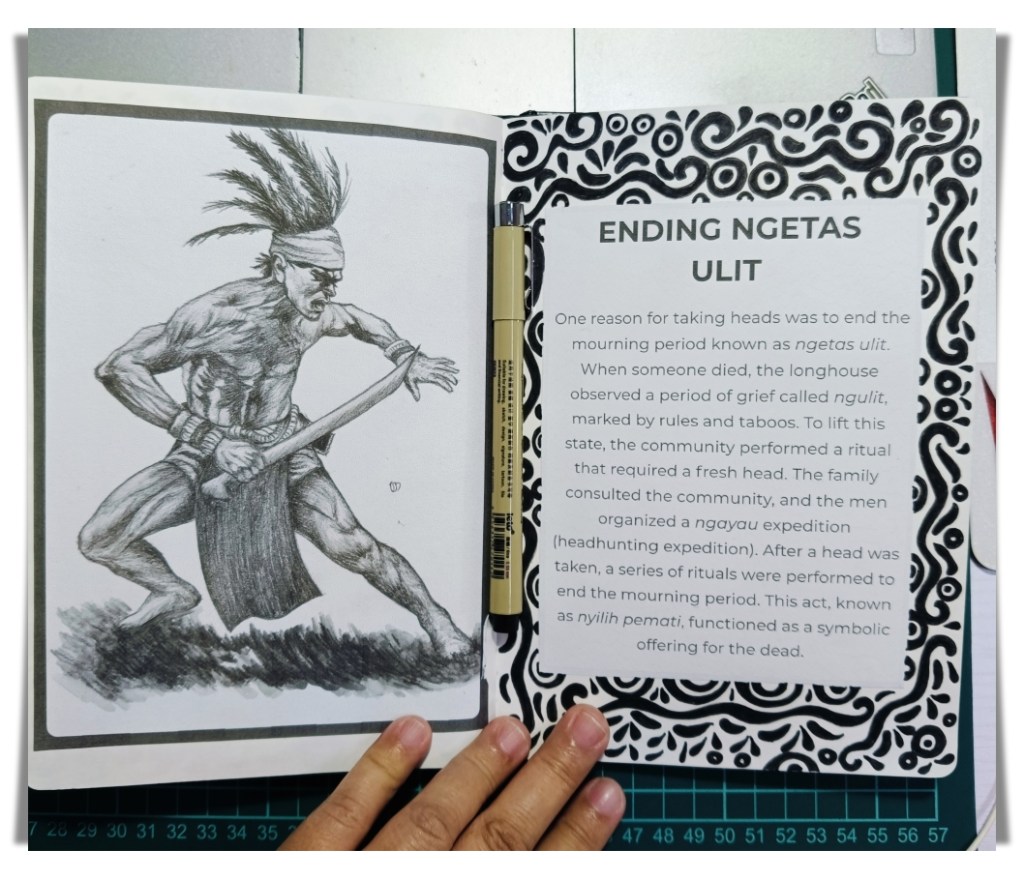
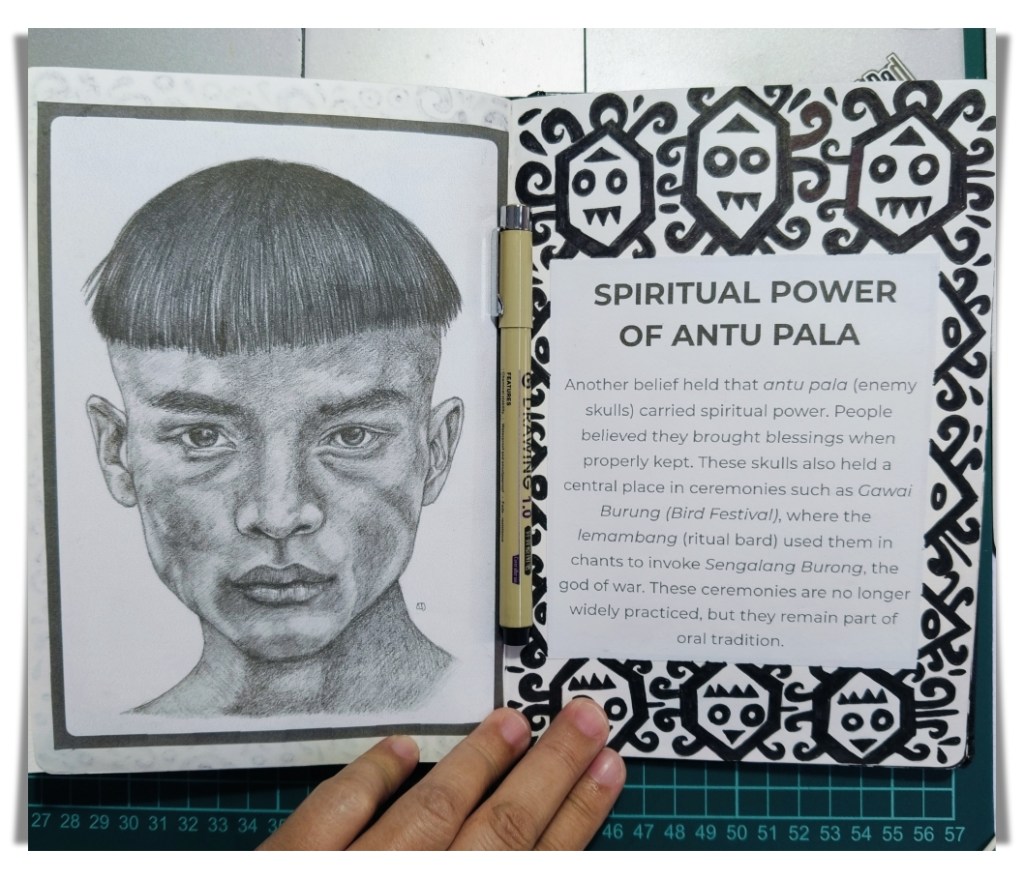
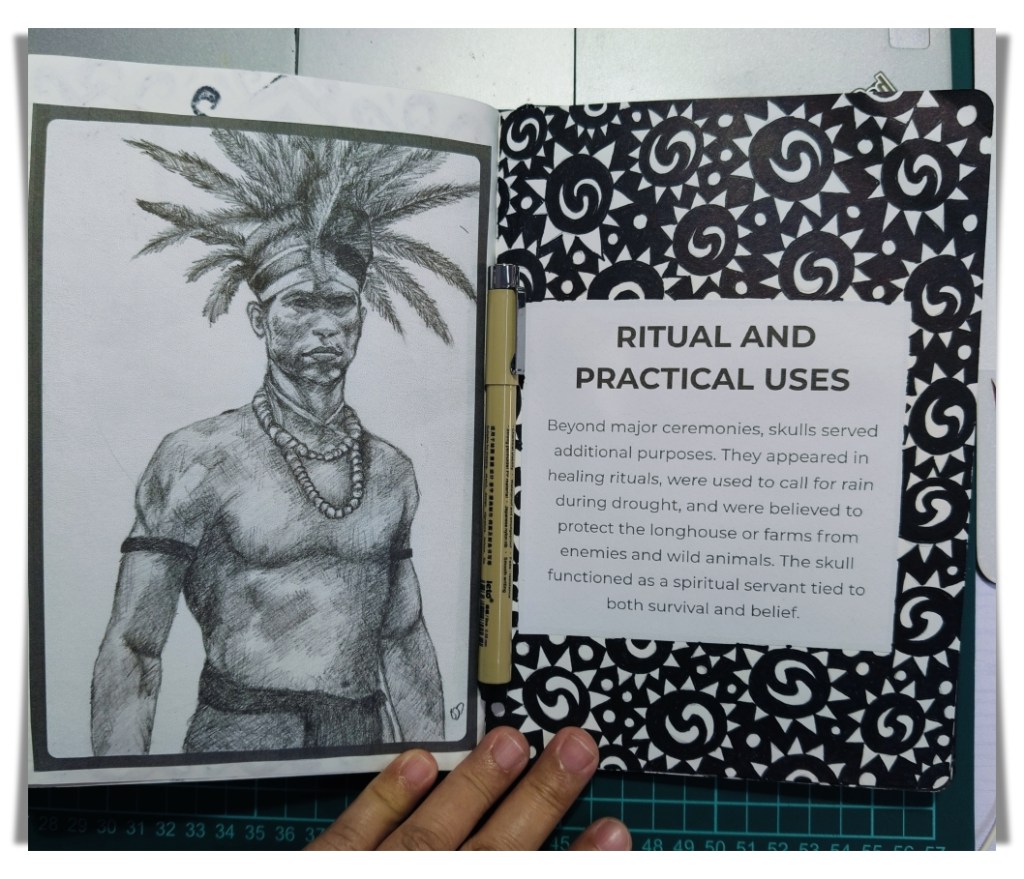
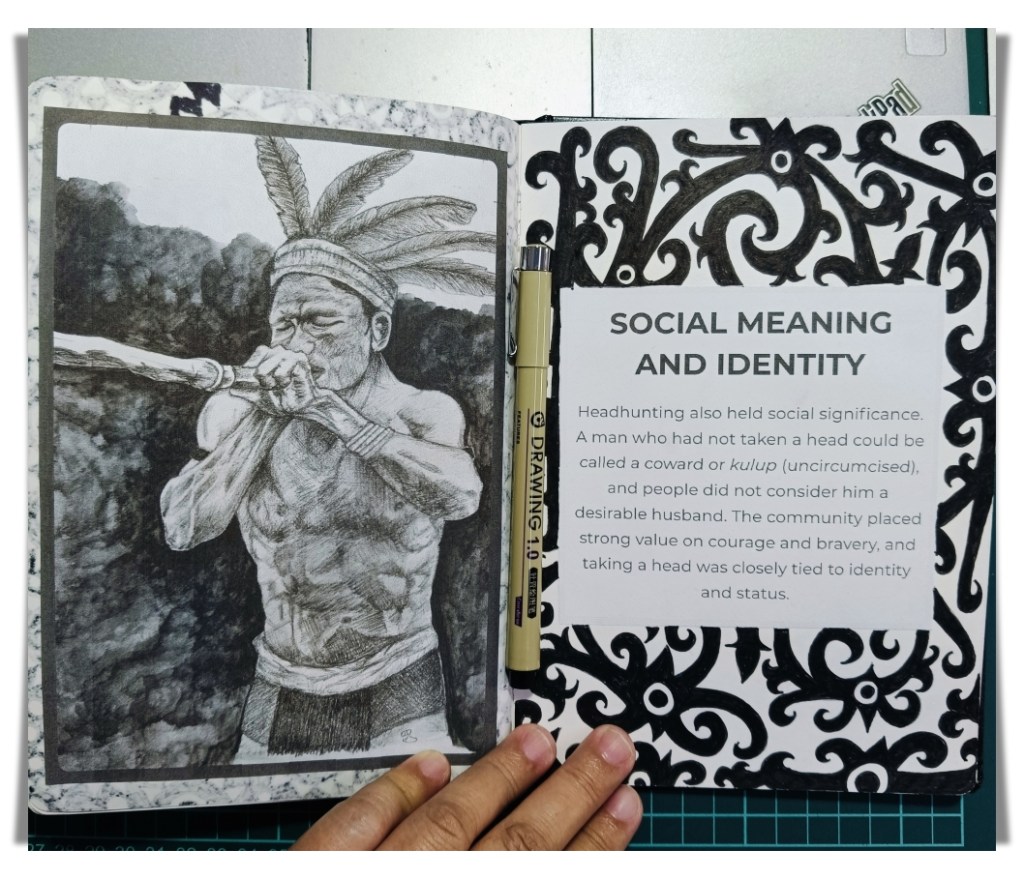
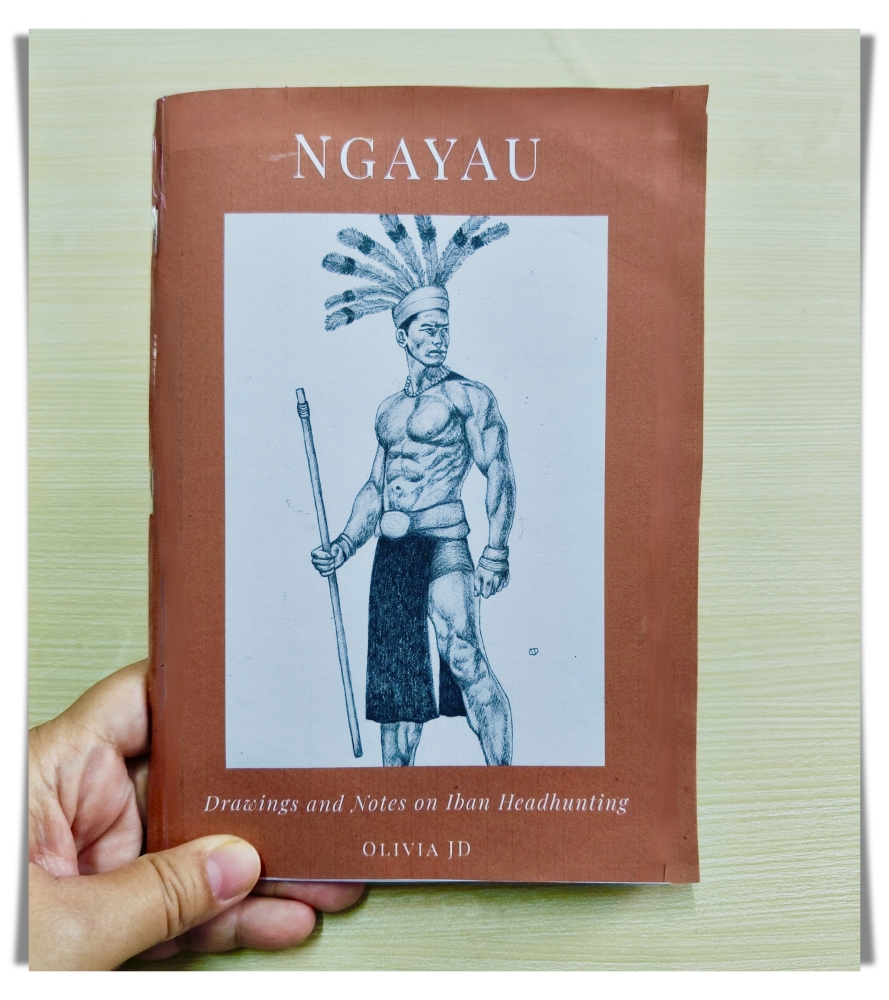
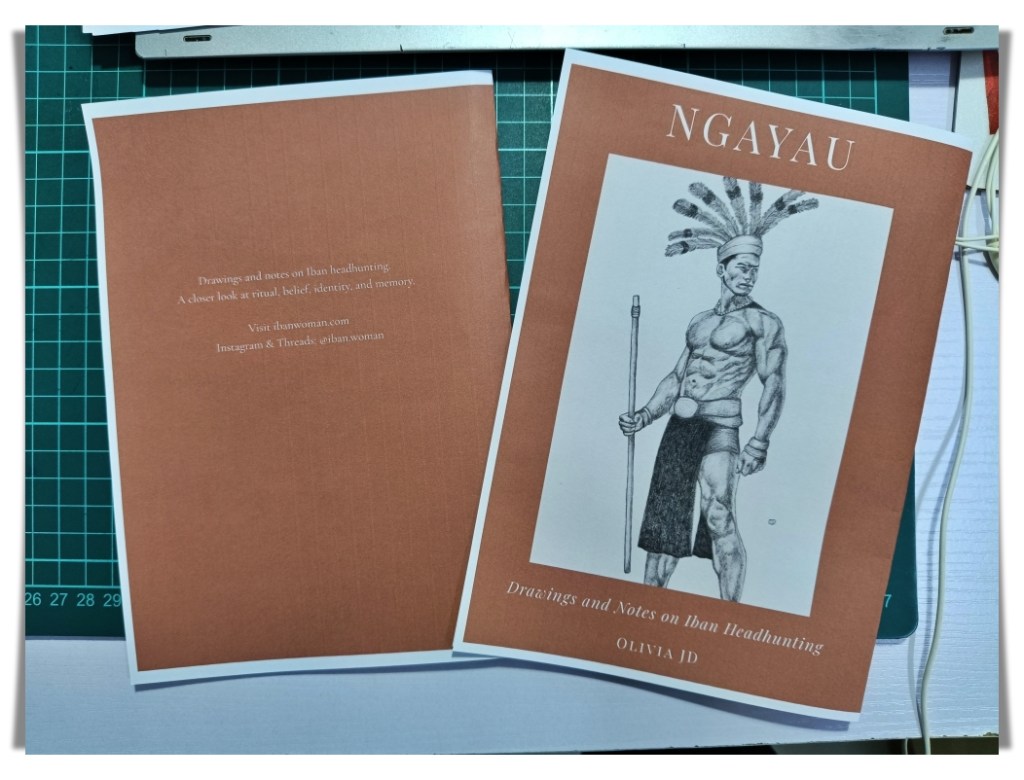
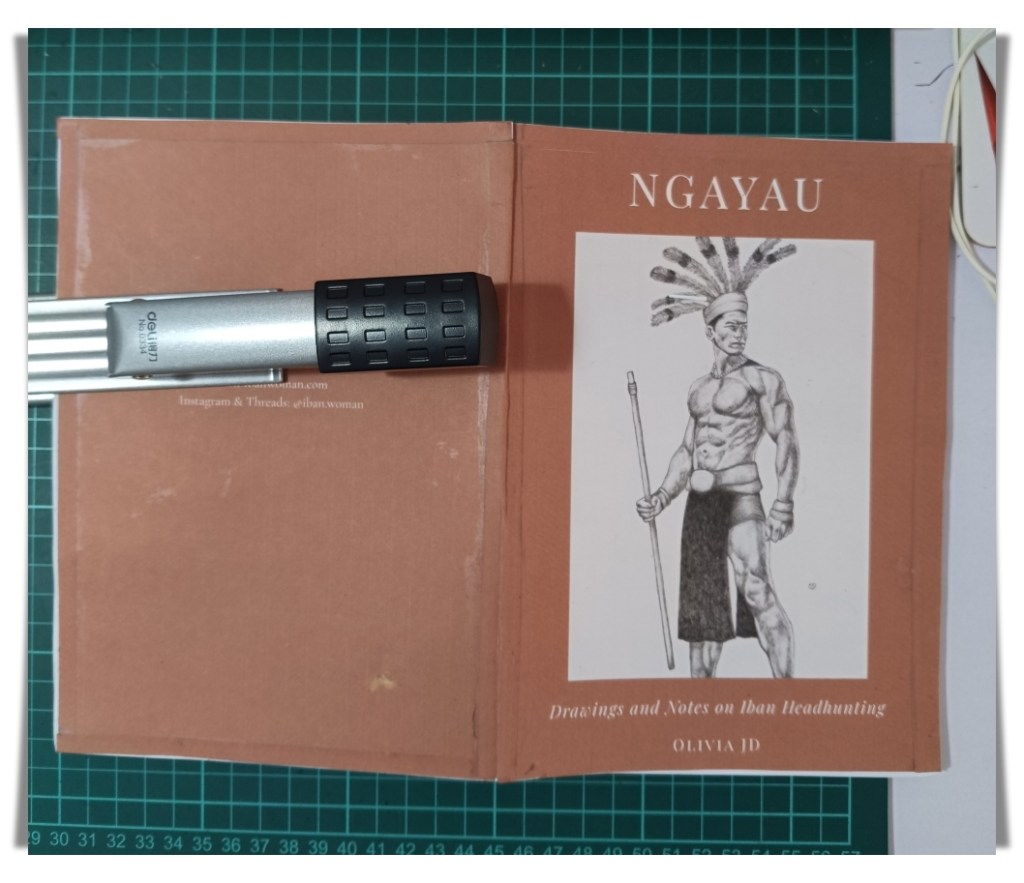
A few weeks ago I started putting together the first physical prototype of Ngayau, a small zine that explores Iban headhunting through drawings and short notes. At first it was just pencil drawings scattered on my desk. These drawings were of warriors and handwritten notes of research I made regarding the subject. At some point these materials began to form a real booklet. 

There’s satisfaction after seeing your own work in booklet form for the first time. A PDF on a screen may looks good but it feels temporary and obviously untouchable. But after the pages are printed and folded and cut and glued together, the work suddenly has weight. It becomes a tangible thing that you can put on a shelf, forget for years, and rediscover again.

I wanted Ngayau to feel simple and homemade. Not shiny or over-designed. The process itself was messier than I had thought. I adjusted margins repeatedly, reprinted pages after noticing tiny alignment issues, and spent hours arranging drawings beside explanatory texts. My desk gradually disappeared under graphite drawings, patterned layouts, failed prints, paper trimmings, and coffee mugs. 

Some of the drawings were made years before the zine was even in my mind. Seeing them all at once hit me more than I thought, like pieces from different times of my life had finally met. What interests me most about this subject is not violence for the sake of spectacle. I am more fascinated by the worldview surrounding it, grieving rituals, spiritual beliefs, protection, courage, sorrow, memory, and the way Iban culture interpreted the interaction between the living and the unseen world. 

Modern discussions about Iban headhunting often reduce it to a caricature. The Ibans of old are seen as savage, primitive, and brutal. But history is rarely simple. The more I explore and create, the more I see how much ritual, spirituality, and community importance were embedded in activities that outsiders typically dismiss as shock value. This zine is not an attempt to glorify the past. My goal is to see it as it is without dismissing it as barbaric, understand the reasons behind this practice, and finally pass the knowledge to others. I felt content when I had finished the prototype. It felt like coming home to something that was meant to be held and shared after sitting in my mind for months.


I write about Iban culture, ancestral rituals, creative life, emotional truths, and the quiet transformations of love, motherhood, and identity. If this speaks to you, subscribe and journey with me.
What is a Lemambang? The Iban Ritual Bard

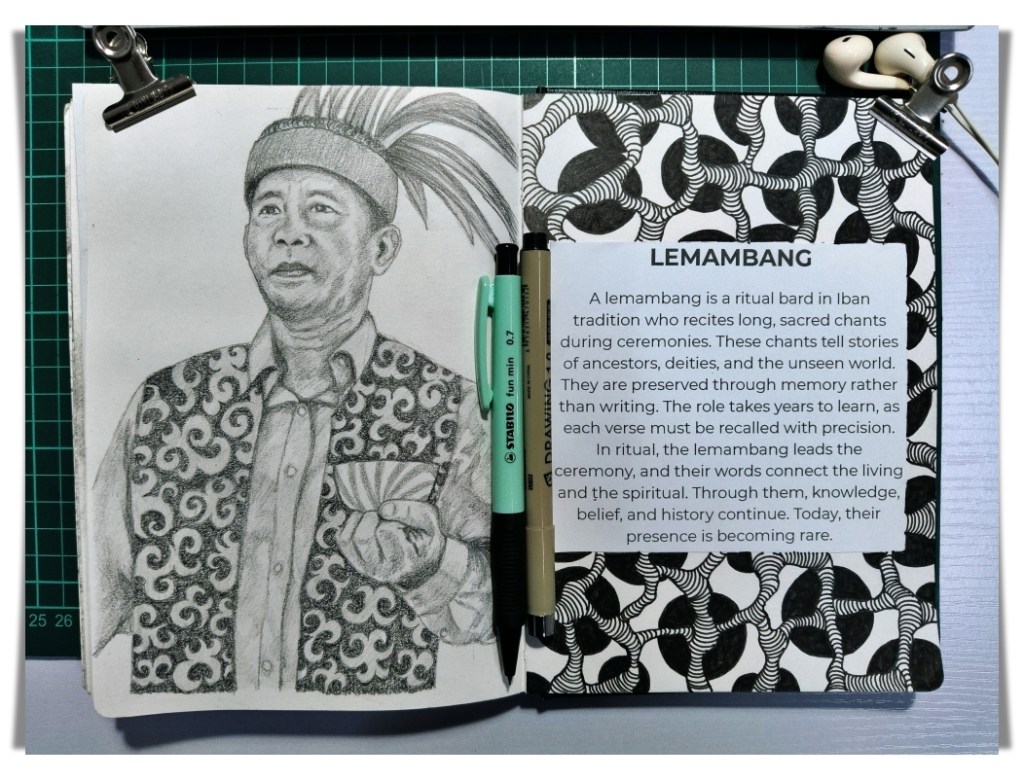
The Iban lemambang is a ritual bard who recites long, sacred chants or invocations at ceremonies or rituals. These chants are the stories of ancestors, deities, and the unseen realm. They are preserved through memory and passed down from one generation to the next. 

The role of a lemambang takes years to learn. Each verse must be remembered with care and precision. During a ritual, the lemambang guides the ceremony through these chants that become part of the process that bridges the seen and the unseen. In some cases, papan turai was used as a guide. They are wooden boards carved to help the lemambang remember the sequence of their chants. These papan turai are memory aids, reinforcing what has previously been taught and internalized.

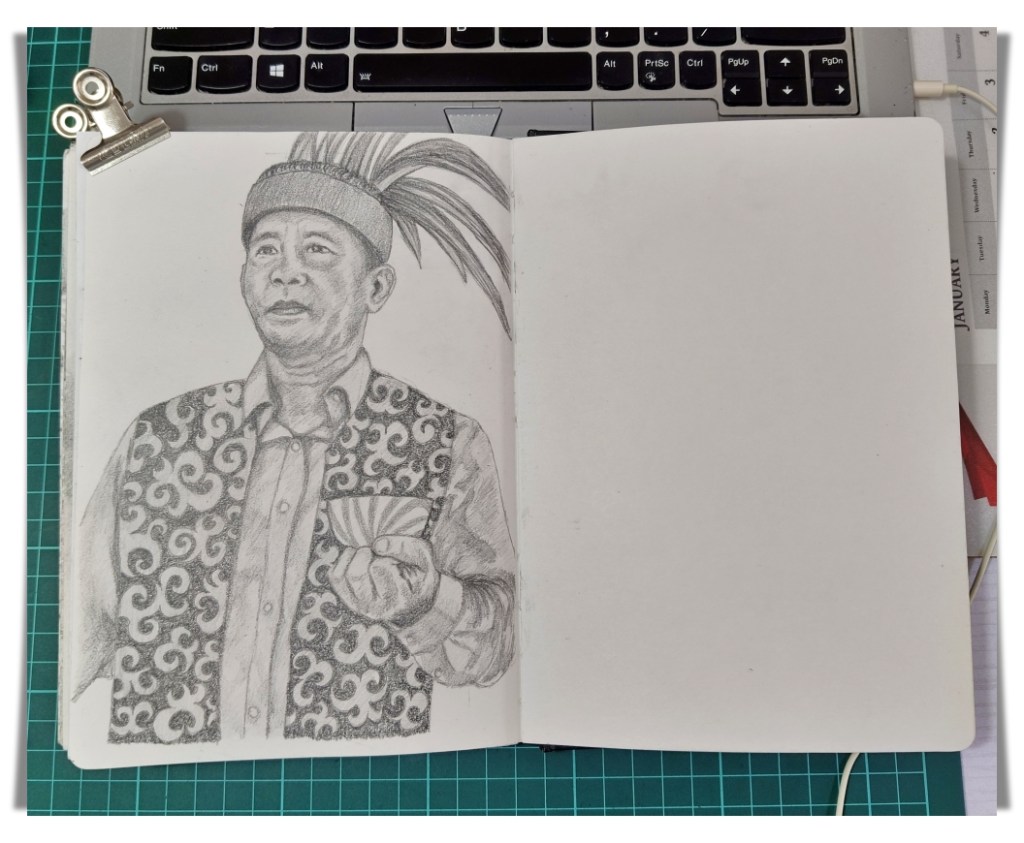
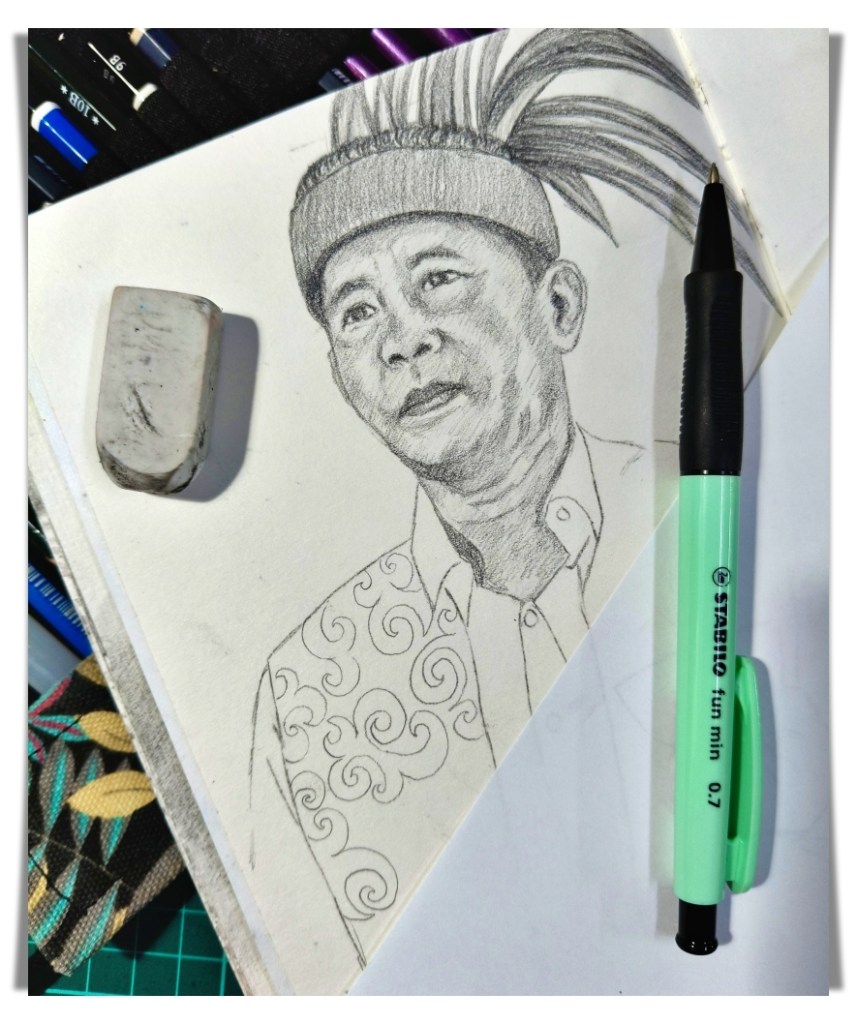
I drew this while working on a zine about Iban headhunting and its cultural origins. As I moved from one page to the next, I realized the zine was also about those who passed the knowledge forward. One of those figures was the group of people known as the lemambang. I wanted to place him (who represents this group) among the pages to acknowledge their big contribution as the guardian of Iban culture and heritage. 

This way of preserving knowledge is different from how we learn today. It depends on discipline, repetition, and memory rather than written records. It also depends on a faith and trust that what is handed down will be remembered and passed on accurately.  

Today the number of lemambang is getting smaller. The number of people who are learning to become lemambang is dwindling, and much of this knowledge is at risk of being lost with time. What remains are fragments, memories, and the efforts of those who persist in holding on to them. Writing and illustrating this page is a small way for me to honor them. 

Here’s a video of a group of lemambang chanting during Gawai Antu or Festival of the Dead.


I write about Iban culture, ancestral rituals, creative life, emotional truths, and the quiet transformations of love, motherhood, and identity. If this speaks to you, subscribe and journey with me.
The Tortoise Who Broke Its Shell | A Classic Iban Folktale

In the old days, it is said that the tortoise was not small like it is today. It was very large back then. If it stood up, it would be almost as tall as a person. It had a smooth, polished shell, unlike the patterned or segmented one we see now. The tortoise was also quite smart and could talk well, but it had one bad trait: it liked to make fun of and trick other animals. Because of this, its wicked nature often got it into problems.

At one time, a long drought struck the land. Plants in the forest dried out and could hardly grow. The animals struggled to find food because many trees had withered or died. The tortoise had the worst time since it moved so slowly. It got thinner, its stomach shrank, and its eyes got dull because it was so thirsty. It gave in to fate and thought its end was near since it was so weak. It crept slowly in search of water, using up the last of its strength while it waited for death.

The tortoise crawled for a long time before reaching a small river. It drank as much as it could because it was so thirsty, and then it fell asleep from being so tired. It looked like it was already dead since its body was motionless and its eyes were closed. A short time later, a flock of birds came to bathe in the river. The tortoise could still hear the commotion around it, even though it was feeble. It pretended to be dead. Unfortunately, at that moment, it had to fart. It attempted to hold it in to keep up the charade. But the longer it kept it, the more it wanted to let it out, and finally it did so with a loud bang.

The explosion stirred the river water and caused the tortoise to flip onto its back. The birds were startled. They turned and saw the tortoise on its back and assumed it had died.

“Oh, how pitiful. The tortoise is dead and didn’t get to fly with us high up into the sky to visit the King of the Sky,” the birds lamented, and the tortoise could hear them clearly.

The birds then prepared to leave. The tortoise quickly got up and decided to go with them to visit the King of the Sky. It opened its eyes wide, gathered all of its might, and crawled as swiftly as it could toward the group. When it reached them, it expressed its wish to follow them into the sky.

“We don’t know how to bring you along because you don’t have wings,” the birds said.

“Oh, it’s not that difficult,” said the tortoise. “Each of you can donate a feather so I can build wings and fly.”

“We refuse to give you our feathers because you are known as a liar. We do not want to be deceived by you,” one of the birds replied.

“Hah! All of you are stupid and narrow-minded,” the tortoise said. “There are many kinds of tortoises. There are deceitful tortoises, hard-shelled tortoises, spiny tortoises, hermit tortoises. In your eyes, what kind of tortoise am I? I am not a deceitful tortoise,” it continued.

The birds fell silent upon hearing its words. They looked at one another and discussed among themselves. In the end, each agreed to contribute one feather to build wings for the tortoise. Even the larger birds such as the peacock, hornbill, eagle, and rhinoceros hornbill agreed. When the wings were completed, they all flew to visit the King of the Sky.

After a long journey, they finally arrived in the realm of the King of the Sky. At that time, the King was hosting a grand gawai festival. The tortoise and the group of birds cleaned themselves in preparation to attend the feast. While they were getting ready, they could smell the rich aroma of delicious food.

Seeing this, the tortoise whispered to itself, “It’s been a long time since I’ve had anything good to eat. I thought I would starve to death during this drought. But I know I’ll live if I get to eat the food at the feast.”

Once they were ready, they lined up to enter the house of the King of the Sky. But before they went up, the tortoise announced, “According to local custom, before entering the house here, guests must change their names to new ones.”

The birds believed that the tortoise was knowledgeable because it had been to many places. They all agreed to change their names, including the tortoise. Various names were chosen. The tortoise announced right away, “My new name is… ‘All of You.’ From now until we return, all of you must call me by my new name: All of You.”

Then they all went into the house, with the tortoise in the lead. When they arrived, they were invited to sit in the ruai. The King of the Sky invited the tortoise to sit in the center, assuming it was the leader of the group. Once everyone was comfortable in their seats, all kinds of food were served. The King of the Sky delivered a speech before the guests started eating to say how happy he was to have visitors from far away. When he was done, he asked them to eat. But the tortoise spoke up before anyone could begin.

“Your Majesty, before anyone eats, since our group is quite large, who do you intend to give this food to?”

“Oh! This food is served for all of you,” replied the King of the Sky.

Hearing the words “all of you,” the tortoise turned to the birds.

“Did you all hear what the King said? Don’t say I have bad intentions,” said the tortoise. “I do want all of you to eat, but the King said this food is only for me because my new name is ‘All of You,'” it added.

The tortoise started to eat right away. It devoured the food greedily because it hadn’t had anything delicious to eat throughout the drought. The birds could only look on in shock as the tortoise enjoyed the feast. Only after it was completely full did it invite the birds to eat the leftovers. However, they refused because they were outraged that they had been lied to. The Eagle was the only one who was willing to eat the scraps, while the others would rather be hungry than humiliated. They were so angry that they ripped off all the feathers that made the tortoise’s wings and flew away, leaving the tortoise and the Eagle behind.

Seeing the birds abandon it, the tortoise panicked. It had lost all of its feathers, save for the Eagle’s. When the Eagle finished eating, it too flew away. Before it left, the tortoise begged the Eagle to alert its dear friend, the Mousedeer, to make a big soft bed for it to land on when it jumped from the sky.

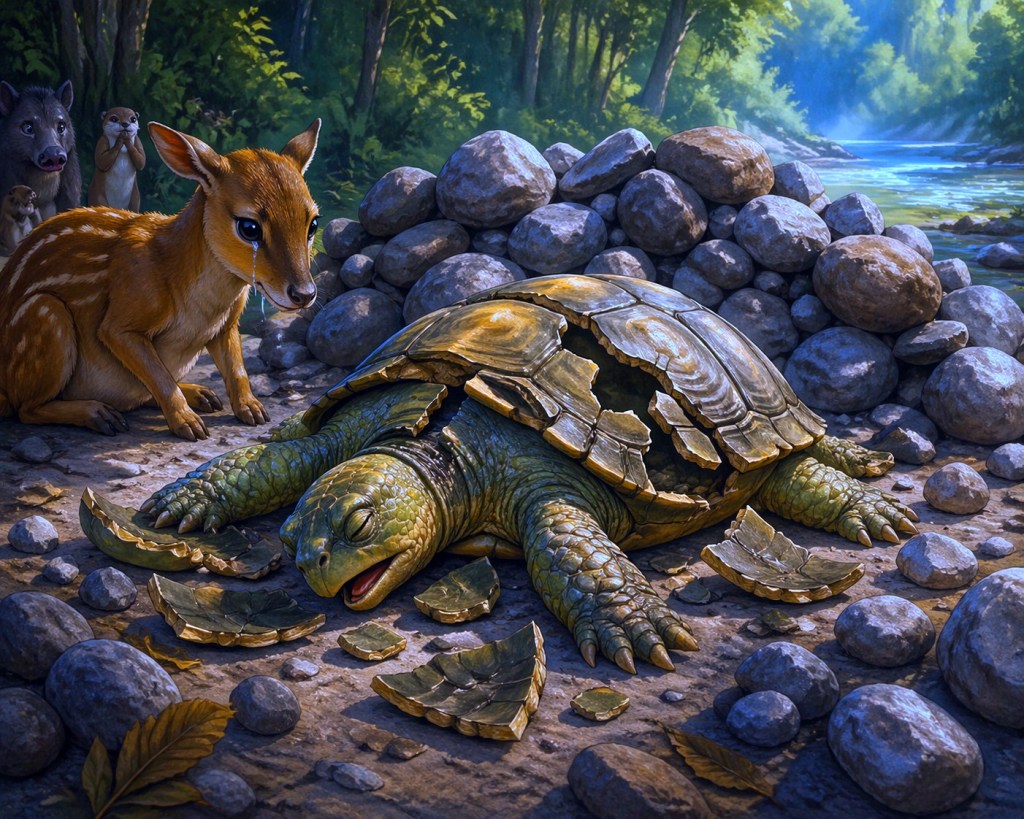
When the Eagle landed, it delivered the message. The Mousedeer immediately called all the creatures in the forest when it heard it. They worked together to make a place to land. But sadly, instead of a mattress, they made a mound of stones because the Eagle delivered the wrong message.

Once everything was ready, the tortoise leapt from the sky. Without wings, it fell rapidly and crashed onto the pile of stones. The sound of the impact was deafening. Hearing it, the Mousedeer rushed over and found the tortoise’s shell shattered into pieces. The tortoise lay unconscious. The Mousedeer cried when it saw this, thinking that the tortoise was beyond help. After crying, it gathered the scattered pieces of shell and carried the tortoise home for treatment.

At home, the Mousedeer sought help from the Lizard Shaman to heal the tortoise. That evening, the shaman conducted a ritual in which he used his wisdom to put the fractured shell back together. But not all of the pieces could be found since they had broken too finely. It took a long time, but the shell was finally reassembled.

The rebuilt shell was a lot smaller than the original. The tortoise itself became smaller because of this. This is why tortoises are smaller now and not as big as they used to be. Their shells are no longer smooth as they once were. Instead, they are patterned and segmented, as if they were put together.

Note:

I translated and adapted this story into Malay (shared on Threads) and English (here on my blog), based on the Iban version originally shared by Gregory Nyanggau Mawar on the Iban Cultural Heritage website.


I write about Iban culture, ancestral rituals, creative life, emotional truths, and the quiet transformations of love, motherhood, and identity. If this speaks to you, subscribe and journey with me.
Writing About Iban Culture Without Taking the Easy Way Out

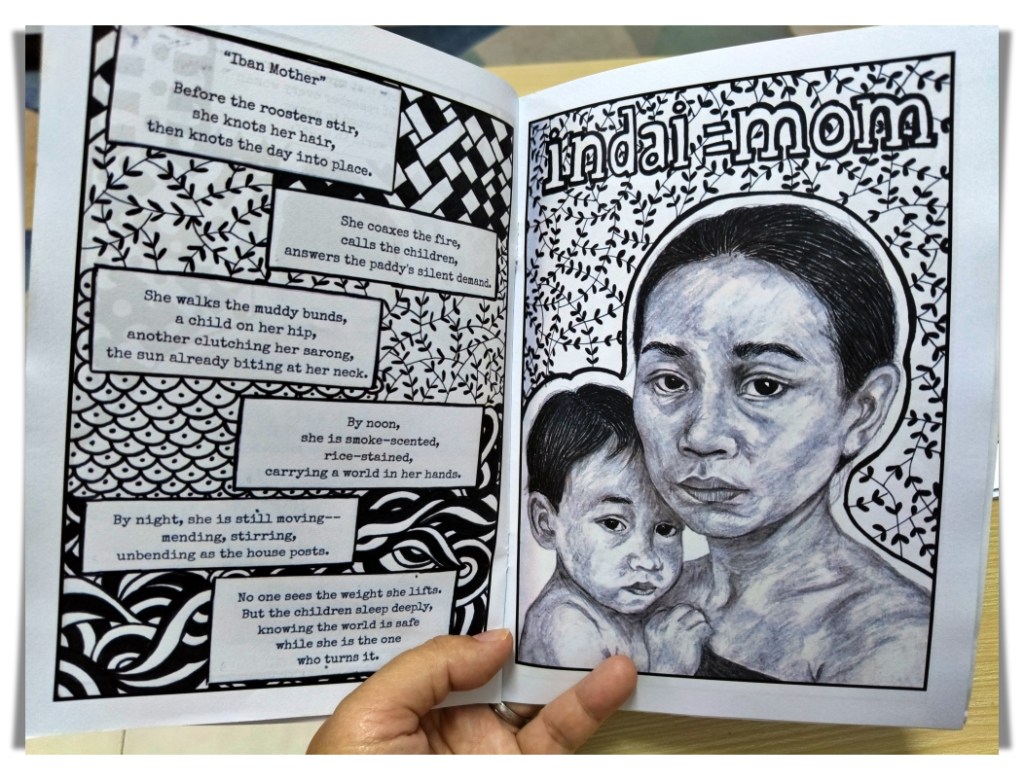
Indu Iban
A spread from Iban Women zine

When I first read the CBC article on AI-generated Indigenous content, my stomach tightened. Not because I generated my content with AI, which I don’t, but because I understood how easy it would be for someone looking for Iban culture to find made-up “elders’ teachings” or made-up Iban phrases and think they were the real thing. I am an Iban woman living far from Sarawak and raising children of mixed heritage. While I utilize AI to assist in my writing process, I don’t generate it using an algorithm. My sources are from my family history and lived experiences. These are the datasets I train on. They are living memory and not predictive text.

The article quotes Michael Sherbert saying generative AI is “optimized for fluency, not for truth or for ethical or cultural responsibility.” I think about this every time I sit down to write a poem or draw cultural art. Cultural truth is difficult to tell and requires effort to check for accuracy. Telling cultural truth also means admitting I don’t know many things and need to learn from those who are more knowledgeable. I read all kinds of academic resources and cross-check my facts with family members before I post them on my blog or publish a new cultural zine. I avoid making assumptions, and when I am not sure of the accuracy, I admit that I don’t know and encourage others to share their experiences or information so we can all learn from one another.

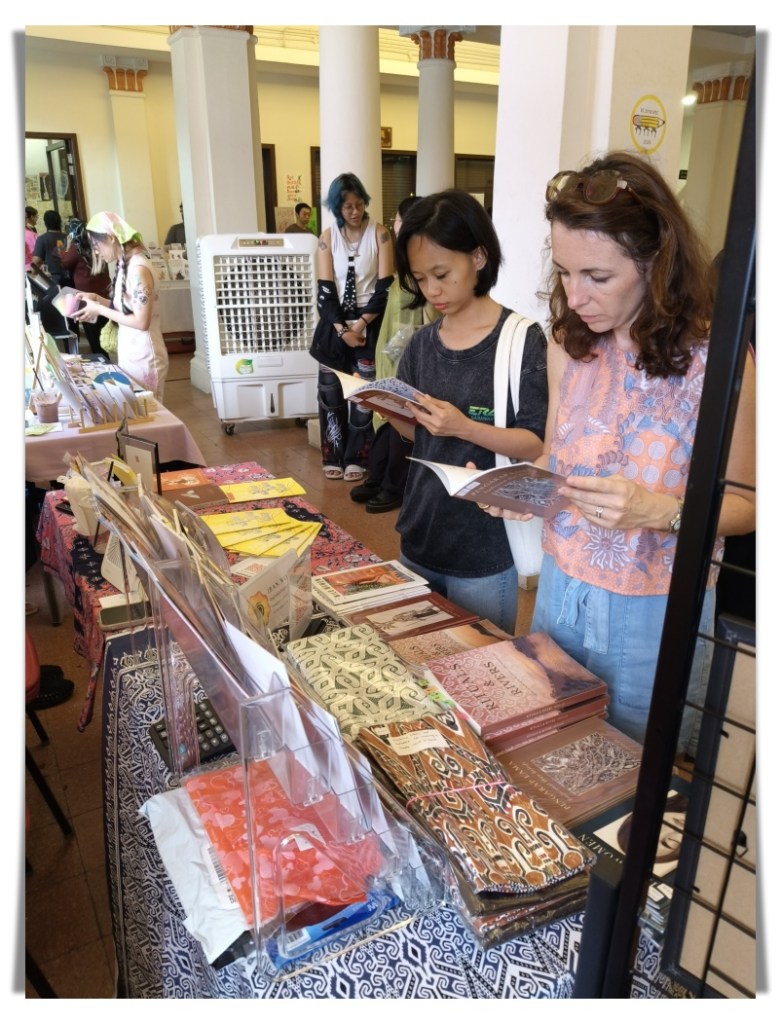
Kaitlyn Lazore from the Mohawk community said something that stayed with me: “There’s no easy way to learn the language or gain culture without getting out in your community.” She is right. Still, I am raising my children far away from my homeland. I can’t take my children to a local social gathering to hear native speakers speak Iban. I can’t take them to Sungai Stambak and let the mud cling at their ankles like it did mine. So what do I do? I write and I draw. I make zines like Rituals and Rivers, Iban Women, and Iban Headhunters. I know that all these things are not substitutes for community. But they can turn into a perau, a small boat that will wait for them until they are ready to learn about their roots. They can launch it whenever they want. They can find their way to their roots through the names I’ve kept alive in my writings and art.

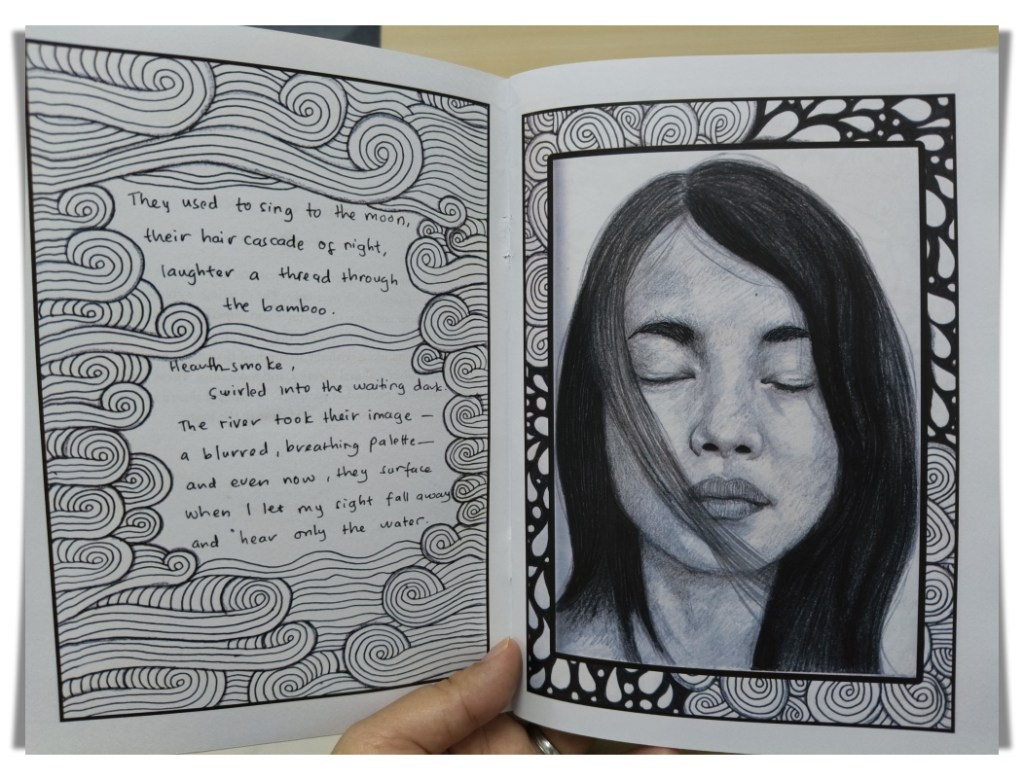
Budaya Iban
A spread from Iban Women zine

But I also do what the article emphasized: I am transparent. I include Iban words with definitions in most of the cultural poems I wrote. Every story distinguishes between traditional knowledge and my personal interpretation. I do not claim to be an elder. I am a mother and a learner who is learning to preserve her culture in her own ways.

The article talks about “pan-Indigenous representations that flatten distinct nations into one interchangeable identity.” This is very important to me. I am Iban, not a generic “Borneo culture” or simply an “Indigenous” group. When I write about details like the bungai terung tattoo motif, I name it instead of being vague. When I describe perau pengayau, I explain that they are tied to certain histories. My children are of mixed heritage, and I don’t want their Iban side becoming a blur; thus, I need to be more precise. Brian Ritchie of kama.ai said, “It can be difficult for any user to understand how responsible or accurate or authentic the information is.” That’s why I always mention my sources. I write down who my sources are: my family histories and Iban cultural experts or academicians. I don’t believe in vague statements like “tradition said this and this, so…”

My children may not grow up speaking Iban fluently. Some days, that thought breaks my heart. But they will know that their mother didn’t take the easy way out. She didn’t ask ChatGPT for a “traditional Iban sampi” and then copy and paste it. She had to deal with the pain of forgetting, so she read and conducted her own research to learn the real truth and facts.

Iban culture
A spread for an upcoming zine (still in progress)

At the end of the article, there is a reminder to use your judgment and ask for community vetting. This is what I would add: If you like my work, my poems, my art, or my zines, please also look for Iban elders or experts in Iban studies. Please use my work as an invitation to explore further. It should not be a replacement. I am just one voice who is trying to preserve my culture for the future generations. 

My children observe me write. They see me struggle with information, memory, and the pain of being far away from my homeland. And I hope that when they are adults, they will know the difference between something that is made up and something that is real. The difference between a perau that really floats on water and one that only exists in a machine’s algorithm. I will keep making perau until then: one article, one poem, one drawing, and one zine at a time.

When They Are Ready
for the ones I raise far from home

We build our lives on foreign soil,
where rivers have no stories
and the wind sighs emptily.
My children’s tongues are borrowed,
their laughter shaped by cities
that have never heard a gong.

I tell them of the longhouse glow,
the smell of rain,
the river bends like an elder.
They listen, but cannot feel
the ancient soil that holds their roots.

So I write these rivers into words,
each poem a small perau waiting.
When they are ready,
they will launch them,
navigate by the names I’ve kept alive
and find, at the source,
a home that never stopped calling.

(a poem from Rituals and Rivers)


I write about Iban culture, ancestral rituals, creative life, emotional truths, and the quiet transformations of love, motherhood, and identity. If this speaks to you, subscribe and journey with me.
On Making and Keeping | Iban Cultural Preservation

People typically consider cultural preservation to be something that is conducted on a large scale. It is generally placed in the context of institutions, archives, or official documents. But it can also happen on a smaller, personal scale.

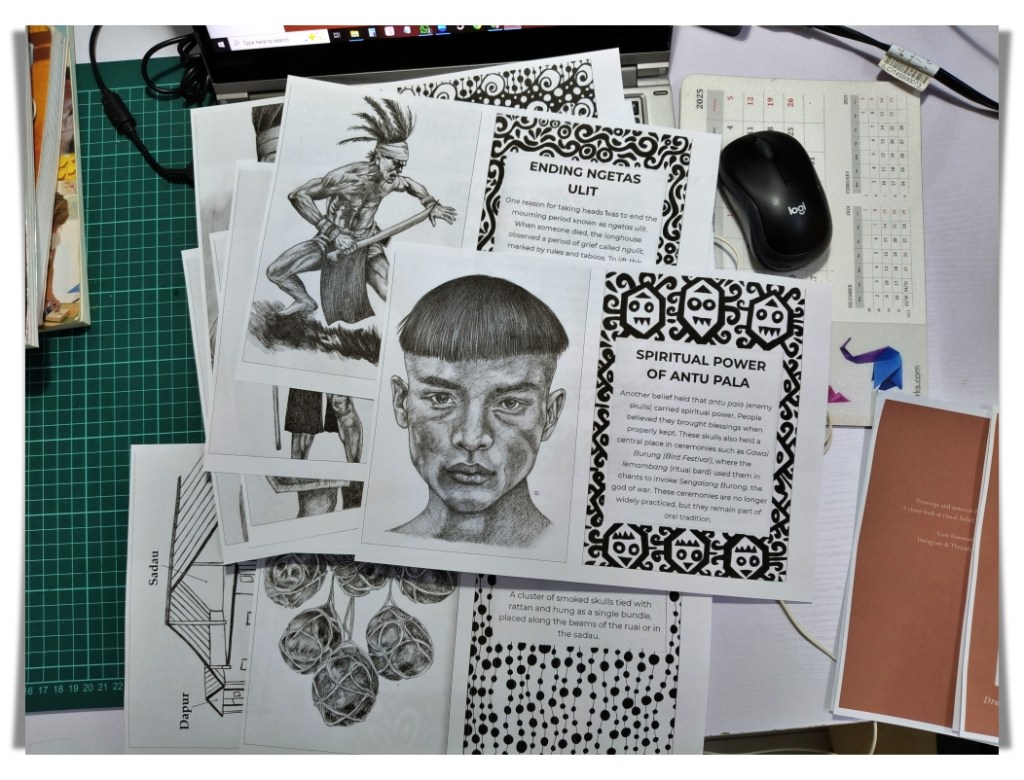
I have been making a series of handmade zines that are based on Iban culture and history. Each page of these zines pairs a drawing with a text of information or a poem. The drawings are hand-drawn, and the pages are put together painstakingly, one at a time. Every decision, from picture placement to word space, needs to be carefully considered. The whole thing is done entirely by hand.

While working on these pages, I learned that preservation is more than just keeping information intact. It also has to do with how that information is passed on. The information in these zines is not new. They have been told before, and they exist in oral histories, family accounts, and old literature. What I do is simply place them into a different form.

For instance, in these sketchbook pages, I talked about why the Ibans practiced headhunting in the past. It’s a difficult topic that people often misunderstand or only see one side of. I give it context instead of simplifying it. Each section describes a specific reason or belief and is paired with a hand-drawn drawing of an Iban warrior instead of an abstract idea. When I draw, it influences how I feel about the subject. When I sketch a figure, I pay attention to details that I would otherwise overlook. 

This zine doesn’t attempt to be a full record of the Iban history. It keeps some parts of it. The imperfections in the pages are part of that process. They show that it was created by hand, with time and care. In this regard, preservation isn’t only about accuracy or completeness. It’s also about continuity, working with it, and allowing it to exist again in the present.


I write about Iban culture, ancestral rituals, creative life, emotional truths, and the quiet transformations of love, motherhood, and identity. If this speaks to you, subscribe and journey with me.
Antu Ngarung | The Guardian Spirit That Shapes My Iban Identity

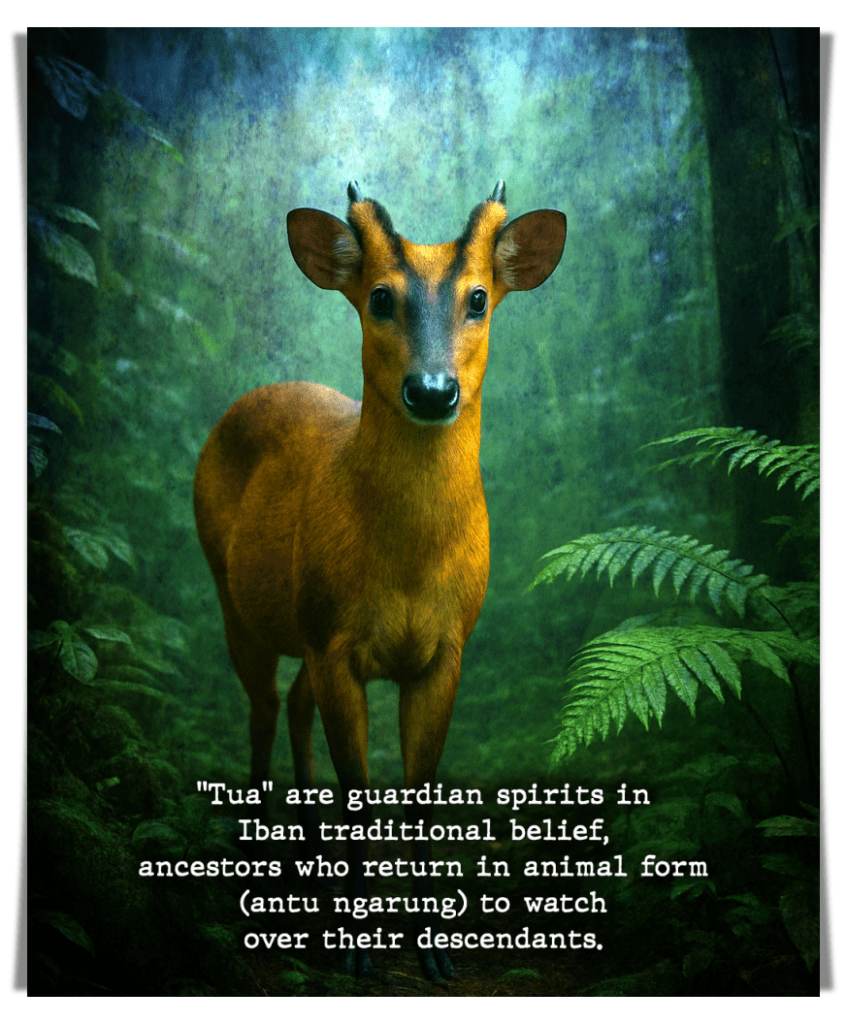
In Iban belief, the souls of those who die go to Sebayan, the afterworld. Some remain there permanently, but certain individuals are believed to return. These are people who lived with exceptional courage or accomplishment during their lifetime. When these ancestors come back, they do not appear as humans. They come ngarung, meaning concealed, taking the form of animals. These returning spirits are called tua, or guardian spirits.

In the Saribas region, guardian spirits are often seen as snakes such as cobras or pythons. They move quietly, stay in the shadows, and leave without drawing attention. When I picture antu ngarung, I always imagine a cobra coiled in the dark corner of a house or at the edge of the forest. It stays still for a long time and slips away the moment it decides to leave. To many people, it would be just an ordinary animal. To us, it can be an ancestor paying a visit.

A guardian spirit usually belongs to an entire lineage. Because of that connection, the family must never harm or eat the animal that represents their guardian. This is a form of respect. The belief is straightforward: the guardian protects the family, and the family must protect the guardian’s form on earth.

In my family, our guardian is the kijang, the Bornean yellow muntjac. When I was four or five, my late grandparents reminded us repeatedly never to harm, kill, or eat kijang. They did not offer long explanations, but the message was clear. Someone in our line was once a brave person, and that ancestor is believed to return as the kijang to watch over us.

That instruction frightened me growing up. I was afraid I might break the rule by accident. I used to remind myself to always ask what kind of meat was being served when we visited people. At that age, it felt like a tremendous responsibility. Over time, the fear changed. I started to feel that my life was connected to something older and larger than myself. I also realised that this experience was not common among many non-Iban communities, which made me value my heritage even more.

The belief in the kijang has shaped the way I understand myself. It gives me a sense of courage. I am still afraid of many things, but this belief keeps me steady. It reminds me that my ancestors lived through hardship, violence, and uncertainty. My problems today are nothing like what they endured. I often tell myself to live in a way that does not dishonor the people who came before me. I exist today because they survived so much. That thought helps me face difficult moments.

When I imagine the kijang watching me now, I think it sees a woman who lives differently from the Iban women of earlier generations. My lifestyle and interests are not the same. Yet I believe it recognises my effort to understand my roots. It may also encourage me to continue forging my own path even when no one else in my family is doing this kind of work. Many women in my family excel in traditional crafts like beadwork and weaving, but none of them are writers. I have to accept that I may be the first woman in my family to preserve our heritage through writing. Someone younger in the future may look at my work the way I once looked at my namesake, the master weaver. Remembering this keeps me going, even when the work feels lonely.

This leads to something important.

We risk losing our identity when we do not learn about our heritage. The loss does not happen suddenly. It happens slowly. We begin identifying more with other cultures. We forget the meaning behind our names, our customs, and our stories. When we fail to protect what we inherit, we leave an empty space that can be filled by influences that do not reflect who we are. This is happening in many communities around the world, and the Iban are no exception.

Iban identity will not endure by chance. It survives because someone chooses to learn, write, document, and share it. It stays alive when people believe their heritage is worth protecting. It continues when people care enough to ask questions and remember the stories their elders passed down.

Our ancestors returned as antu ngarung for a reason. We owe it to them to honor the heritage they entrusted to us.


I write about Iban culture, ancestral rituals, creative life, emotional truths, and the quiet transformations of love, motherhood, and identity. If this speaks to you, subscribe and journey with me.
What Beserara’ Bungai Taught Me About Letting Go

I used to think that rituals like beserara’ bungai were just old traditions that had no place in today’s world. Growing up, I believed they belonged to the past. I thought the Iban needed to leave them behind to move forward. Whenever elders talked about these beliefs, I felt restless. My world revolved around progress, education, and the principles of organized religion. I didn’t see the value of rituals, and I never took the time to understand what they really meant.

That mindset began to shift—slowly at first, then more clearly—as I read more about the Iban worldview. It wasn’t emotion or nostalgia that changed me, but understanding. I began to see that the Iban learned about life by watching the natural world. They noticed patterns in nature and connected them to how we live. For example, they saw how bamboo and banana plants grow in clusters. Each shoot is part of a single root system underground. If one shoot is unhealthy, it affects the others. When one dies, the root still supports new life. Death was not an ending but part of the cycle. This wasn’t superstition, but wisdom based on careful observation.

The bungai, the “plant-image” that represents each Iban person in the cosmic realm of Menjaya (the god of healing), began to make sense to me. I understood how it symbolized family and community. Each person is like a shoot, but we all come from the same root. When someone passes, the rest carry on, still connected. New life can grow from the same source. It’s a way of seeing life that is deeply connected and respectful of nature. The ancestors weren’t imagining things—they were describing the interconnected world they knew.

As I learned more, I started to feel a quiet pride in where I come from. I discovered that my ancestors included warriors and raja berani, people whose stories are still told in my family. I began to understand that even though I live far from my homeland, I am still part of that root system. This connection also extends to my children. They may not know all the customs or speak the language well, but the roots are still there. They are part of something that has been passed down through generations.

When I learned about beserara’ bungai, the ritual that separates the living from the dead, I felt something shift in me. This ritual is about care—not forgetting what we have lost. It helps both the living and the dead let go so they don’t hold each other back. The living need to keep moving forward, and the dead need peace on their journey to Sebayan. It’s a ritual of compassion that affirms the connection with the dead even as they journey on to the otherworld.

This understanding arrived at a time when I was wrestling with my own spiritual ties. I had been part of the same church community for many years. It shaped how I saw God, faith, and morality. But as I grew older, those teachings started to feel burdensome. I found myself questioning doctrines that encouraged separation from people who did not meet certain standards of spirituality. I began noticing the tension between fear-based expectations and the compassion-centered teachings of Jesus in the Gospels. As I continued to question, the burden of belonging to a system that no longer aligned with my conscience intensified.

Learning about beserara’ bungai gave me words for what I was feeling. I realized I was trying to protect my spirit. I wasn’t leaving faith behind—I was returning to what felt true. Jesus became the real rootstock. I wanted a faith grounded in his teachings: kindness, justice, presence, love, and compassion—not fear or guilt. I needed space to grow without feeling judged by a community that often equated questions with spiritual instability.

In a way, I’m experiencing my own kind of separation from the church rootstock. It is not a rejection of my past or of the people who have been a huge part of my life for the past two decades. It is a necessary separation so I can continue growing without feeling suffocated by expectations that no longer fit the life I am trying to build. I’m holding onto what still nourishes me and letting go of what drains me. The Iban worldview helped me understand that letting go can be a way of protecting both myself and the things I want to keep alive.

The more I reflect on it, the more I hope my children learn something different from what I learned in my early years of faith. I hope they are not afraid to ask questions. I hope they do not feel inferior in front of people who sound knowledgeable but speak without warmth. I want them to grow into a faith that welcomes curiosity, thoughtfulness, and conscience. I want them to recognize that their connection to God is direct, personal, and rooted in compassion—not fear. I want them to inherit a sense of strength that comes from understanding where they come from, both culturally and spiritually.

As I learn more about rituals like beserara’ bungai, I’ve come to understand that my ancestors didn’t divide life into “spiritual” and “ordinary.” Everything was connected. Life, death, nature, community, and spirit were all part of one whole. That way of seeing the world teaches me to live with care and humility. It shows me that letting go can be a loving act, and returning to our roots can take courage.


I write about Iban culture, ancestral rituals, creative life, emotional truths, and the quiet transformations of love, motherhood, and identity. If this speaks to you, subscribe and journey with me.
The Bungai: Ancestry, Identity, and the Iban Connection to Nature

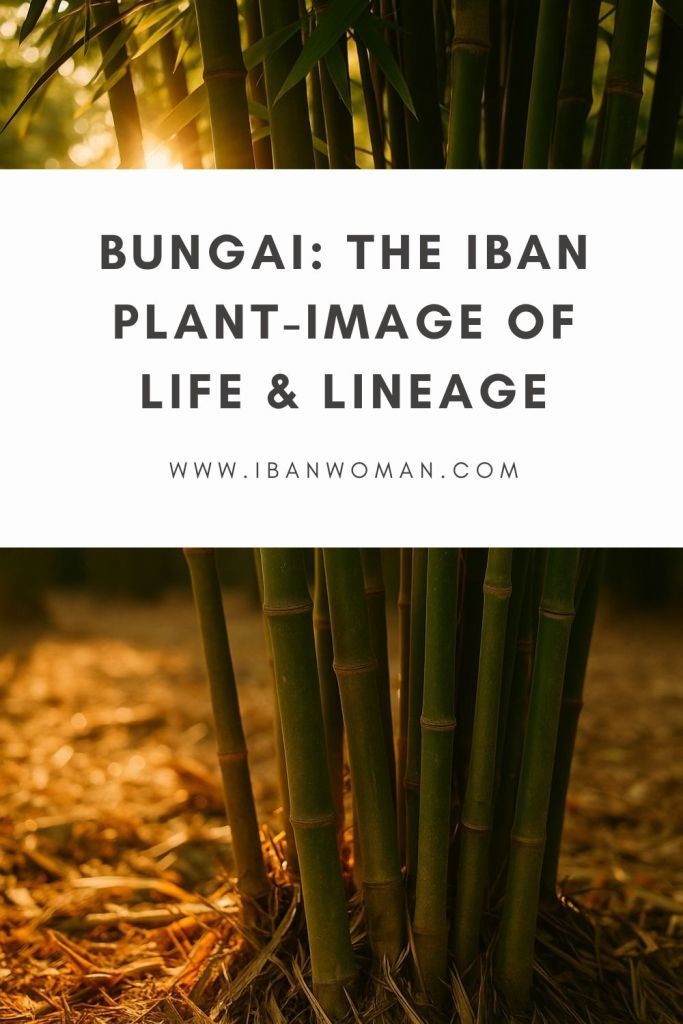
The Iban believe that the self is not limited to the body or the soul that wanders in dreams. Our ancestors believed that each person has a bungai, which is a plant-image that lives in the invisible world of Manang Menjaya, the god of healing. This plant-image takes the form of bamboo or banana and grows in clumps from a single rootstock. It is a powerful way of understanding human life. The bungai grows, strengthens, weakens, dies, and falls to the ground, just as a person does.

When I first heard about this idea, it stuck with me for days. It helped me see the forest differently and understand why the Iban imagine the community the way they do. In this worldview, no one grows alone. We rise from the same source. Relationships, ancestry, and connections we can’t see hold us together in ways that go far beyond our personal stories. This belief feels very grounding at a time when many of us feel adrift or disconnected.

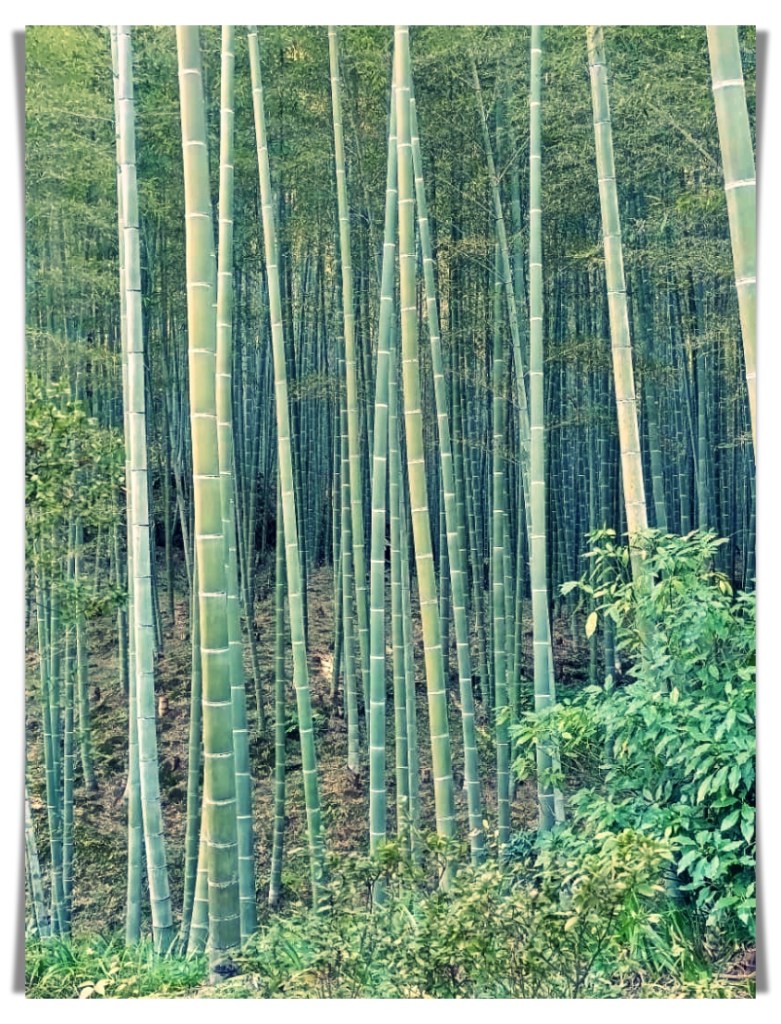
The choice of bamboo and banana is meaningful. These plants do not grow by themselves. They grow in clumps, called bepumpun. A single shoot is part of a larger body that gets its nutrients from the same soil and root. Every shoot has its own height, shape, and direction, but they all come from the same source. This is how the Iban once understood family. A family is one clump. A longhouse community is made up of many clumps. The forest itself becomes a reflection of the social world.

This is not a metaphor for the sake of beauty. People who live close to the land learn its pattern by observing it daily. The Iban watched how plants behave, how they survive storms, and how they keep growing new shoots even after the old ones fall off. The Iban were shaped by the rainforest, and it was a teacher, a mirror, and a guide.

The bungai makes this idea clearer. It shows us that each person is both unique and part of a lineage. A child is a new shoot from an old rootstock. The state of one shoot affects the whole clump. The well-being of the entire garden reflects the condition of the longhouse. No one exists apart from the others who stand beside them. Even in the unseen world, the Iban imagined people living bepumpun, connected through generations, place, memory, and spiritual obligations. 

I find this comforting. There were times in my life when I felt distant from my roots. Leaving home for school, work and marriage created gaps I did not understand at the time. I lived away from Sarawak for many years. I felt as though I was a shoot attempting to thrive in soil that was not my own. Learning about the bungai made me see that the rootstock never disappears. The connection stays even after we leave. We are still held by the unseen garden. It doesn’t matter how far someone travels; the lineage remains.

Another thing I appreciate about the bungai is how it reflects emotional and spiritual states. The bungai becomes weaker when a person is sick. It withers when the soul wanders. This worldview recognizes how closely the body, mind, and emotions are connected. It respects how complicated it is to be human. A withered feeling is not seen as weakness but as a sign that the self needs care, grounding, or healing. Manang Menjaya is responsible for this realm, taking care of the gardens of human life like a healer tends to the sick. It is a gentle belief shaped by compassion.

The idea that the bungai falls when someone dies is also meaningful. The clump remains alive and ready to push a new shoot upward for the next generation. The rootstock stays strong. The lineage continues. There is sorrow, but there is also continuity. The living remain connected to those who came before them.

When I reflect on this, I see how the bungai offers us a way to think about community in today’s world.  Many of us live far from home. Some grow up with mixed heritage, navigating several identities at once. Some people don’t feel connected to their language, their land, or their family’s history. The bungai concept reminds us that belonging isn’t just about being close to someone physically. It also has to do with our shared ancestry, memories, and the unseen ties that still hold us together.

The forest shows us that we can’t survive alone. Bamboo stands because the clump stands. A community stays together because its roots are strong. Long before the words “ecology” or “sustainability” were even used, our ancestors knew this. They practiced it when they built longhouses, shared food, and worked the land. They lived in a world where the rhythms of nature and community supported each other.

Writing about the bungai feels like returning to a memory I never knew I had. It combines culture, spirituality, and nature in a way that feels very Iban. It makes me think of how our people used to observe the forest, learn its patterns, and keep it in balance. The bungai is more than just a spiritual idea. It is a way of looking at life that sees it as connected, continuous, and held by something greater than the self.

I want to honor this understanding as I continue working on my cultural projects. I want the Iban in the diaspora, those growing up with mixed heritage, and those rediscovering their language again to know that our roots are still alive, even when we feel far from them. The bungai reminds us that we come from the same source, and the clump endures.

One Clump
If we were bamboo,
we would be one rootstock.
Two shoots from the same source
fed by the same unseen tenderness
running under everything.

You would lean into me
when the wind turns,
and I would hold fast
with a strength drawn
from the ground we share.

A clump is a world.
A home where no stalk stands alone.
Each one rises
because the others do.
The root simply refuses
to forget a single one.

I want that with you—
a belonging without effort.
Our lives rising
from the same dark earth,
so that even Menjaya
counting lives in his garden,
would find us together.

If you falter, I stand closer.
If you bend, I become your spine.
We are two lives
shaped by each other’s nearness.

If we are a clump, love,
then we are one living thing—
one root,
one anchor,
one quiet refusal
to ever rise alone.


I write about Iban culture, ancestral rituals, creative life, emotional truths, and the quiet transformations of love, motherhood, and identity. If this speaks to you, subscribe and journey with me.
Iban Augury | The Language of Birds and the Art of Listening

Prior to the coming of Christianity and Islam, the Iban people had a sophisticated system of animistic beliefs. The world was believed to be filled with spirits—some friendly, others unpredictable—who lived in jungles, rivers, animals, and dreams. The desire to live in harmony with these invisible forces influenced many aspects of life, from farming and hunting to warfare and family decisions. 

Augury, or “beburong” in Iban, was one of the most intricate systems in this belief. It is a sacred form of divination that uses the movements and sounds of certain birds known as burung mali (omen birds) to seek direction. The practice was said to have been taught to humans by Sengalang Burong, the Iban God of War and divine messenger. He taught that the gods do not speak directly but send their messages through the natural world.

Every omen bird has a specific meaning. The interpretation of their cries, flight paths, and actions guides important decisions, such as whether to start planting paddy, go on a journey, or go to war.  The tuai burong, an augur who can read and understand the language of birds, is responsible for figuring out what these signs mean. This cultural duty used to be a big part of Iban life because it was a way for people to connect spiritually and keep their conduct in line with God’s will.

Oral history states that Sengalang Burong and his wife, Endu Sudan Berinjan Bungkong, had seven daughters and one son. Each daughter married a nobleman who became one of the seven omen birds: Ketupong (Rufous Piculet), Beragai (Scarlet-Rumped Trogon), Bejampong (Crested Jay), Pangkas (Maroon Woodpecker), Embuas (Banded Kingfisher), Kelabu Papau (Diard’s Trogon), and Burung Malam, which literally means “night bird” but is a cricket. The eighth omen bird, Nendak (White-Rumped Shama), is Sengalang Burong’s faithful messenger. All of these are real, common bird species that live in the Borneo rainforest.

Sengalang Burong passed down the knowledge of augury to his grandson, Sera Gunting. Sera Gunting is the son of Sengalang Burong’s eldest daughter, Endu Dara Tinchin Temaga, and her second husband, a man named Menggin. Sera Gunting also learned the omens of war when he joined a ngayau (headhunting) expedition with his seven uncles—the noblemen who married Sengalang Burong’s daughters. He later passed his knowledge to his descendants. Linggir Mali Lebu, Orang Kaya Pemancha Dana Bayang, and Unggang Lebor Menoa were among the subsequent generations of Iban war leaders who observed and practiced the war omens he had learned.

Sengalang Burong also taught Sera Gunting about the different stages of Gawai Burong, the festival that war leaders had to hold to invite him and his followers to attend. That is a story and post for another time.

All the omen birds mentioned above can still be found in Borneo’s rainforests. I have never seen them in the wild or heard their calls in person, but last month, when I visited the Borneo Cultures Museum, I had the opportunity to hear recorded calls from Beragai and Embuas. I could hear the sound of wind, insects, and other birds in the distance along with their calls in the recordings. It was difficult to tell which bird made which sound. It reminded me that to practice augury, you needed to believe and have an attentive ear to pay close attention to the different bird calls.

Those recordings brought back a memory from my childhood. When I was nine years old, my parents decided to adopt the baby son of a relative. They had everything ready: a small bassinet, baby clothes, and the trip to the longhouse where the child was staying. They had to walk through the jungle for three hours to reach the place. 

Along the way, they encountered an omen bird. I don’t know which one it was, but a tuai burong was consulted to explain the sign. He advised my parents not to continue. He said that if they went through with the adoption, the boy would grow up to “overrule” me and my siblings, which means he would prosper more than us and that we might fall into misfortune. My parents took the advice and chose not to go through with it. The baby stayed with his other relatives, and that was the end of it.

Looking back, I understand that moment not as superstition but as a reflection of how much faith my parents had in the way things were meant to be. They thought that signs meant something and that the natural world could warn or guide us through nature’s language. It was a way of life built on attention, not control. However, it didn’t stop me from wondering, what if the boy experienced a difficult childhood filled with poverty and hardship and was denied the chance to live a better life due to the bird’s signs?

Today I realized how rarely I listen. The world around me is full of noise—machines, traffic, and incessant messages devoid of meaning. Even in silence, my mind is busy with thoughts, endless scrolling, or work. Listening feels like a lost art. I no longer know how to hear what my forefathers intuitively understood: that signs came quietly, without noise or spectacle.

I’m not sure if anyone still practices augury today. Perhaps a few elders still possess fragments of that knowledge. Even if it is no longer practiced, I hope that Ibans, particularly the younger generation, understand its origins and significance. Beburong was once central to how our people made decisions and understood their relationship with nature. It influenced how they approached the world—with respect, patience, and a willingness to listen. Perhaps I’ll never see those birds in the wild or hear their true calls across the forest. But I’d like to believe they’re still there, their voices blending with the wind, delivering guidance that once guided entire communities.


I write about Iban culture, ancestral rituals, creative life, emotional truths, and the quiet transformations of love, motherhood, and identity. If this speaks to you, subscribe and journey with me.