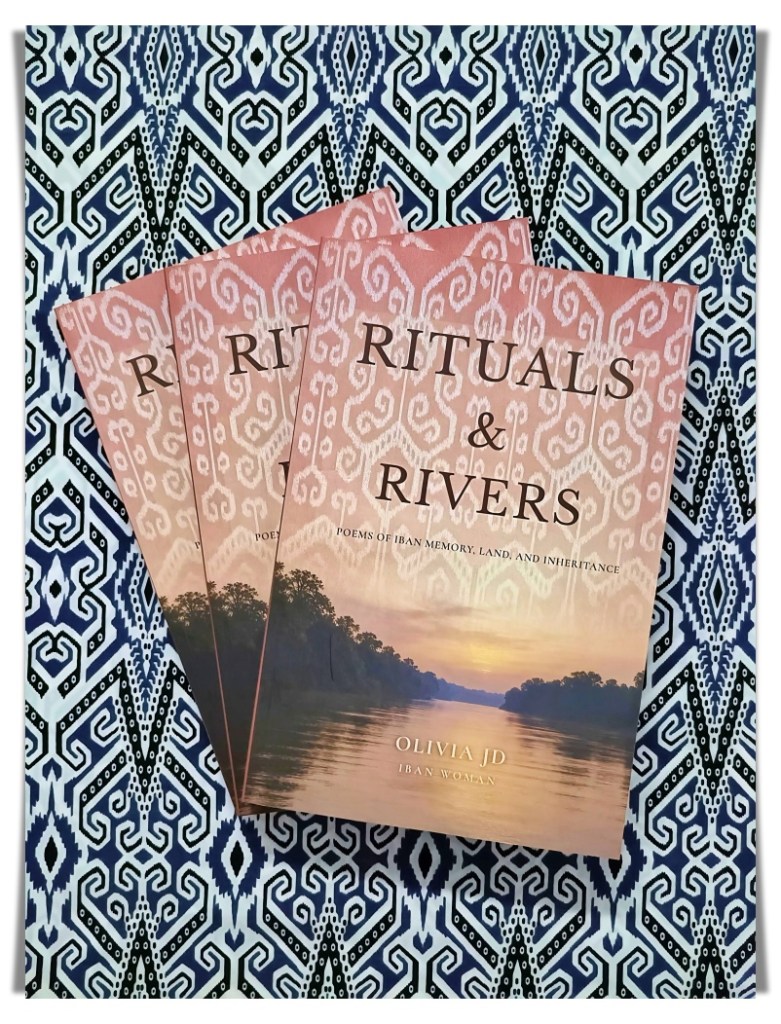
Rituals and Rivers: The Story Behind My First Poetry Collection 

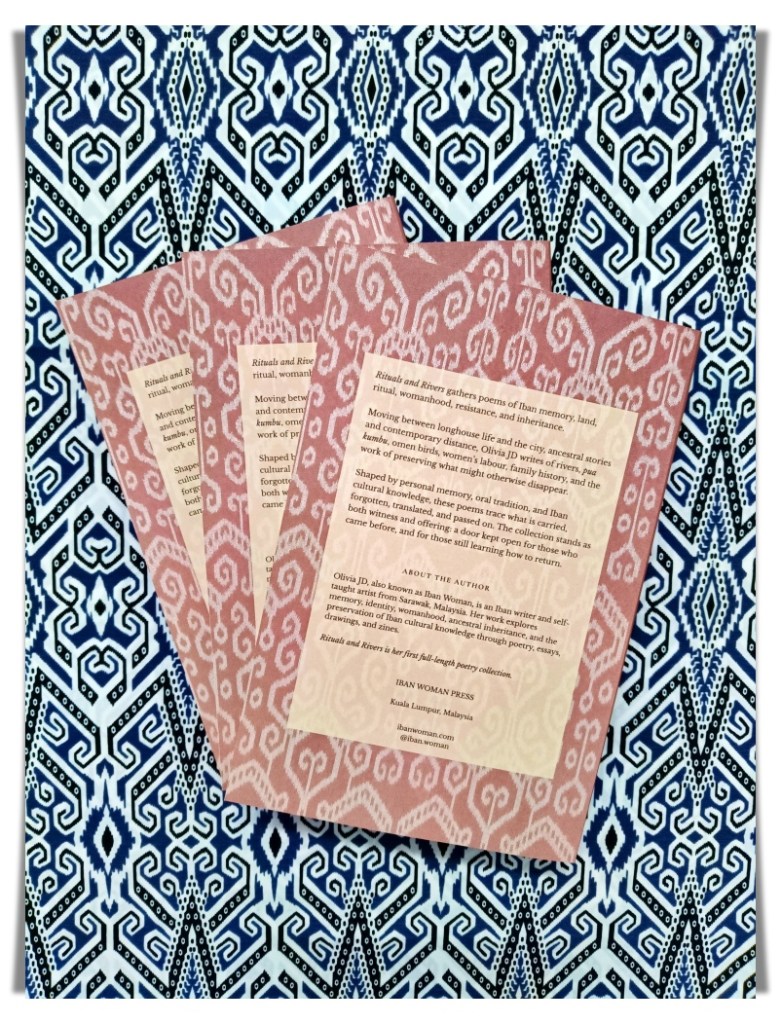
I published my first poetry collection in August, brought it with me to KL Zine Etc. Festival, read from it in public, sold copies of it, and somehow never wrote about it here.

The reason is simple. Shortly after the festival, I became very ill. It was not the kind of illness that passes after a couple of days of rest. I was hospitalised a couple of times and was at risk of developing sepsis. I am not going to disclose the actual illness, but it was serious enough that I was unwell for almost two months. I had to stop writing and making artwork. I disappeared from this blog and from most other things while I recuperated. The book, however, did not disappear. It existed quietly while I was recovering and waiting for my return.

Now that I am blogging again, I have realised that Rituals & Rivers has never had a proper post of its own. So here we are. This is not a launch announcement because that ship sailed in August. I just want to introduce my book to my blog readers and visitors.

Where The Book Came From

Rituals & Rivers began with a simple fear: that what I remembered would not be enough. I grew up with fragments of Iban life around me: my family history, tales of my ancestors, old songs and omens, rituals, family names, women’s work and remembered journeys. Many of the things that shaped me were never written down. They lived in memory, in work and warning, in speech and in gesture. They were part of my life and I didn’t think of recording any of them.

However, as I grew older and lived away from Sarawak, I became more aware of what I had taken for granted. The Iban language that I grew up with is not part of my everyday life. The stories I heard as a child became fragmented or forgotten. As a mother raising children far from ancestral land, I learned that inheritance does not always pass down by itself. Sometimes we have to be intentional in researching, recording, and passing that knowledge down to the next generation. 

The fear of forgetting is really the seed of this collection.

What The Book Became

What began with personal memory eventually grew into a collection of 69 poems across six sections. However, the more I wrote, the wider the scope became. I realised I was no longer only writing about myself. I started to write about language, longhouse life, women, rituals, spiritual beliefs, family history, colonial resistance, land and environmental change, and eventually about what happens when cultural knowledge is no longer passed down naturally.

The poems are organised into six sections that together form a journey of sorts. They begin with questions of belonging and move backwards into childhood, longhouse life, and the women who shaped that world. From there, the collection goes deeper into Iban rituals and spiritual beliefs before turning to my family history, colonial resistance and eventually the question that rests underneath much of this book: what remains, and what do we pass on? 

The six sections are:

  • The Question of Belonging
  • The Longhouse Remembers
  • Women Who Hold the House
  • Rituals, Signs, and the Unseen
  • War, Resistance, and Inherited Courage
  • What Remains, What We Pass On

Four Poems and Why I Wrote Them

I want to feature four different poems and the story behind each of them.

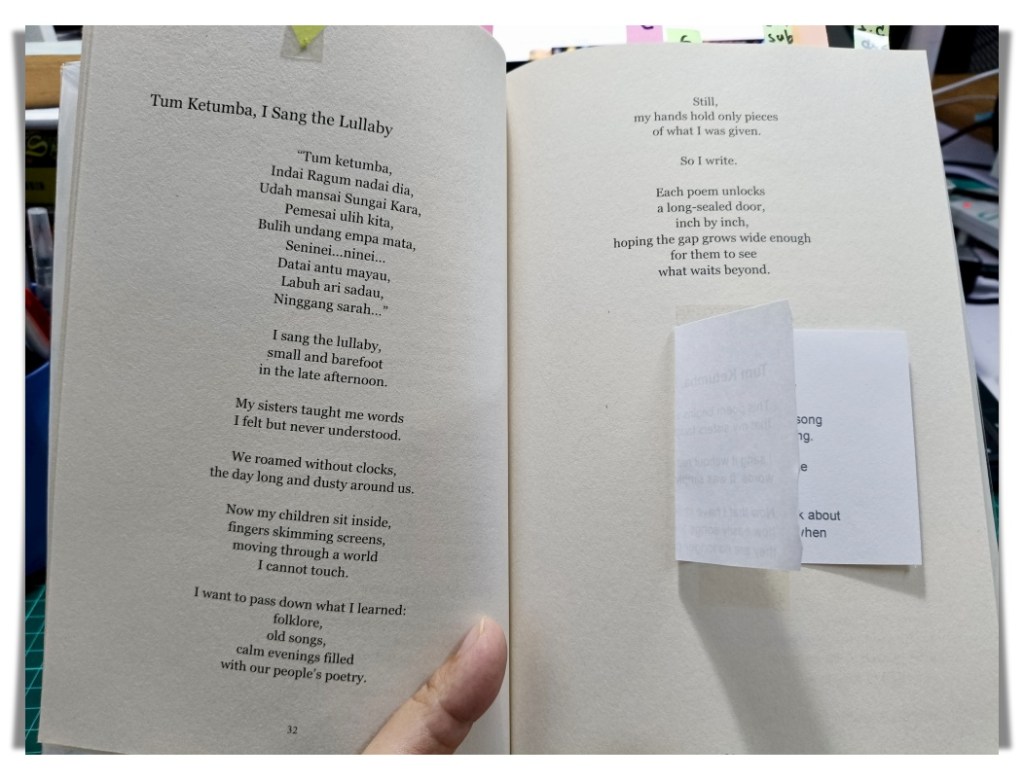
a) Tum Ketumba, I Sang the Lullaby

This poem is about a childhood song my sister taught me when I was small. I remember the lyrics even though much of the world around them has mostly vanished. I tried to preserve whatever I still recall of that world. Hopefully, through writing, I can pass it down to my children. 
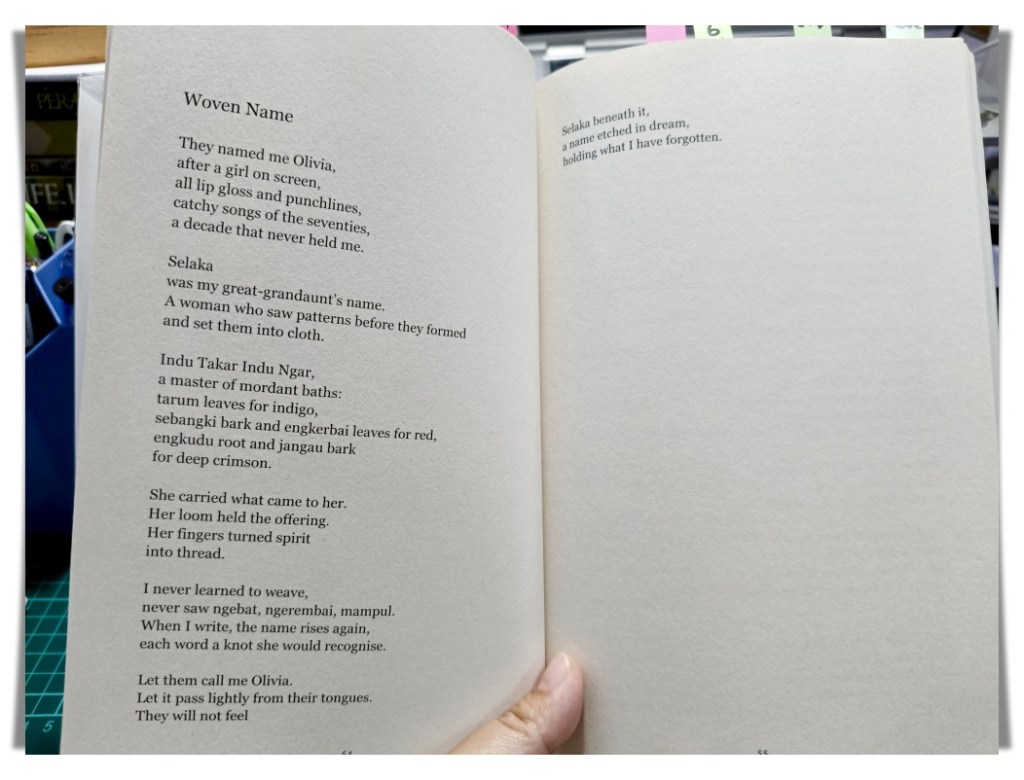
b) Woven Name

This poem is about my great-grandaunt, Selaka, who was a master weaver of pua kumbu, and also about me. Even though I never learned to weave, when I write, I feel connected to what she did. She wove her pua kumbu from dreams, signs, and patience, whereas I write and make art from memory and words. 
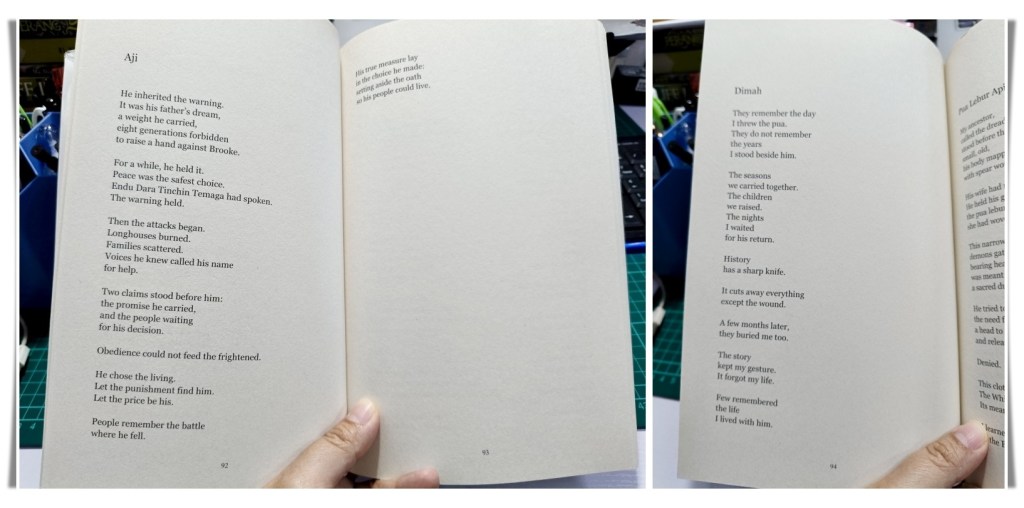
c) Aji and Dimah (Two Poems)

These poems were inspired by my family history. Aji Apai Limpa was my great-great-great-grandfather, an Iban war leader who resisted the Brooke government and died in battle at Sungai Langit in 1858. Dimah was his wife, often remembered for one tragic incident before the battle. Writing about them was not simply a matter of saying “my ancestor was a warrior.” I was trying to understand them as people, but I was also thinking about what happens when a name you have heard within your family becomes someone you are trying to see clearly. 
Research and Uncertainty

Some of these poems came directly from memory, while others required me to research things I remembered only partially. I read ethnographic and historical sources as much as I could. I revisited family histories and tried to understand practices I had grown up around.

I want to be clear that this collection is not presented as a definitive record of Iban culture. It is a personal offering, drawing from memory, family history, oral tradition, and cultural knowledge.

There are gaps and uncertainties in it, and I have allowed those gaps to stay rather than fill them in with something I cannot honestly claim.

Why Rituals & Rivers?

The title came to mind because those two words seemed large enough to contain the entire collection.

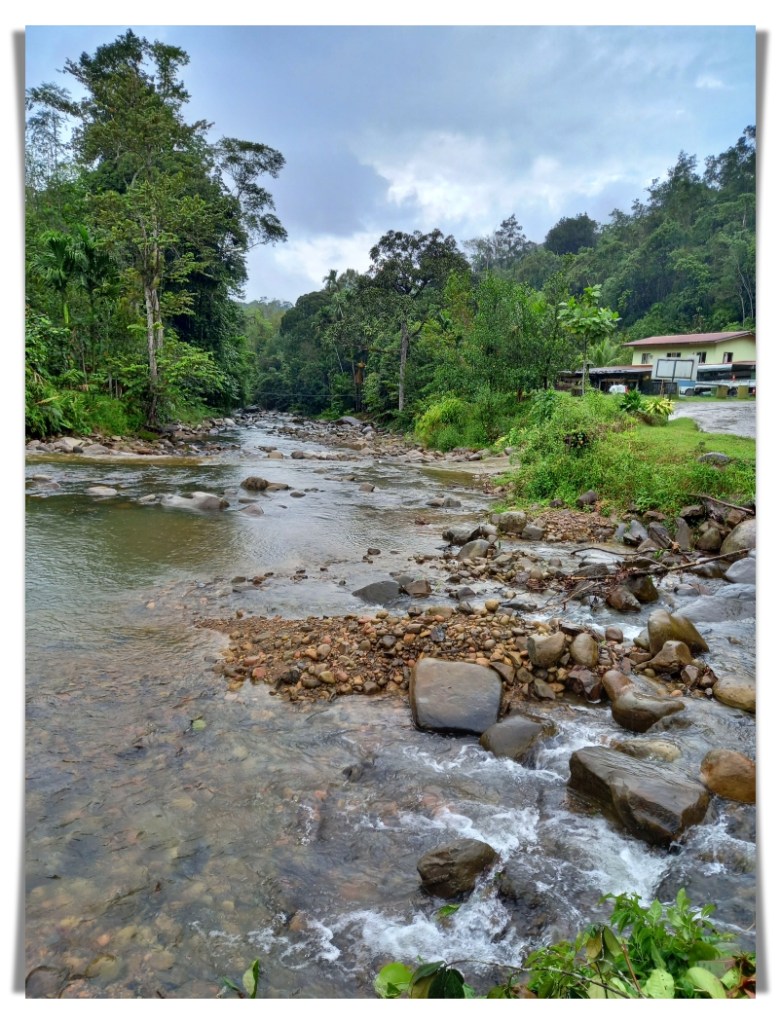
The poems are full of rivers. Sungai Layar is the river connected to my ancestral longhouse. Its water carried people and news to and from home before roads existed. Rivers appear as routes, witnesses, and places where history is laid down and life continues.

Rituals are an important part of traditional Iban life. Healing rites, funeral laments, child naming ceremonies, and wedding customs: these are communal rituals that sustain and strengthen a community. They are how we mark what matters and how we pass it on.

Together, rituals and rivers describe what this collection is trying to achieve. Rivers carry things across distance and rituals hold everything together. I am trying to do both.

Dedication

This book is dedicated to my children. The final poem, “When They Are Ready”, emphasises that idea. In it, I describe the poems in this collection as perau, or small boats that will carry my children to the things that can reveal their roots. 

“… So I write these rivers into words,
each poem a small perau waiting.

When they are ready,
they will launch them,
follow the names I have kept alive,
and find, at the source,

a home that never stopped calling.”

Final Thoughts

After years of working on this collection, the book is finally here. I sold copies during the festival and have continued selling them since. I have read from it publicly, and only now am I sitting down to write about it here. 

I am back and writing again. The book exists, waiting for whoever needs it. 


Rituals & Rivers is my first full-length poetry collection. If you would like a copy, you can purchase it from my Shopee online store.

I write about Iban culture, ancestral rituals, creative life, emotional truths, and the quiet transformations of love, motherhood, and identity. If this speaks to you, subscribe and journey with me.
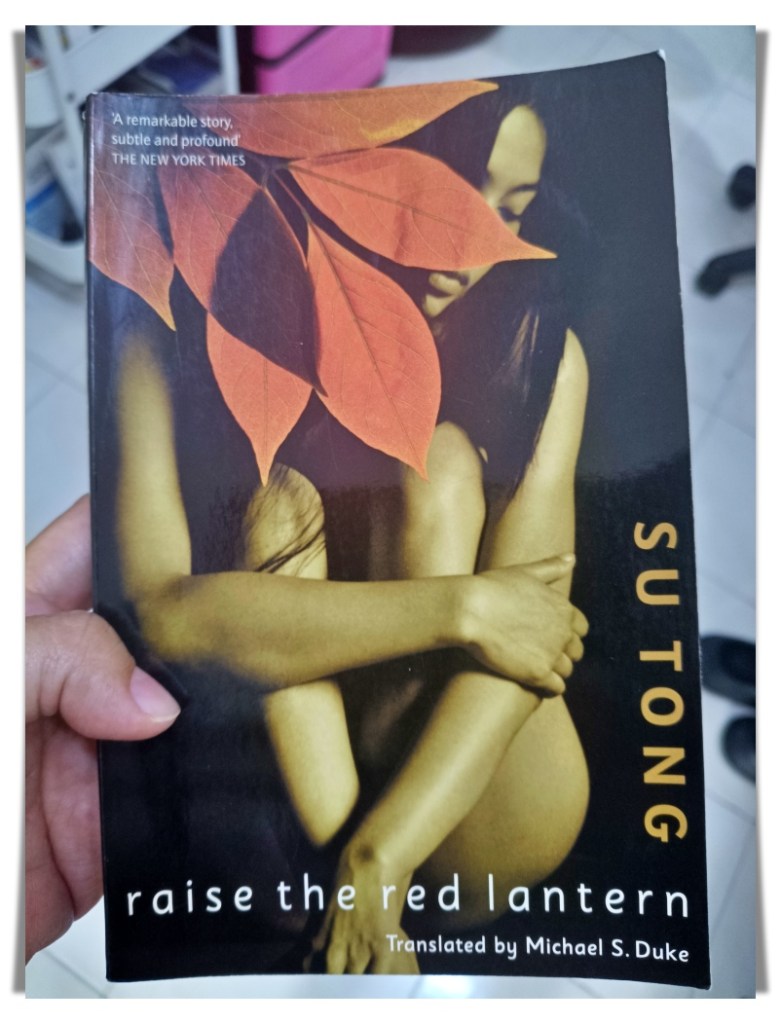
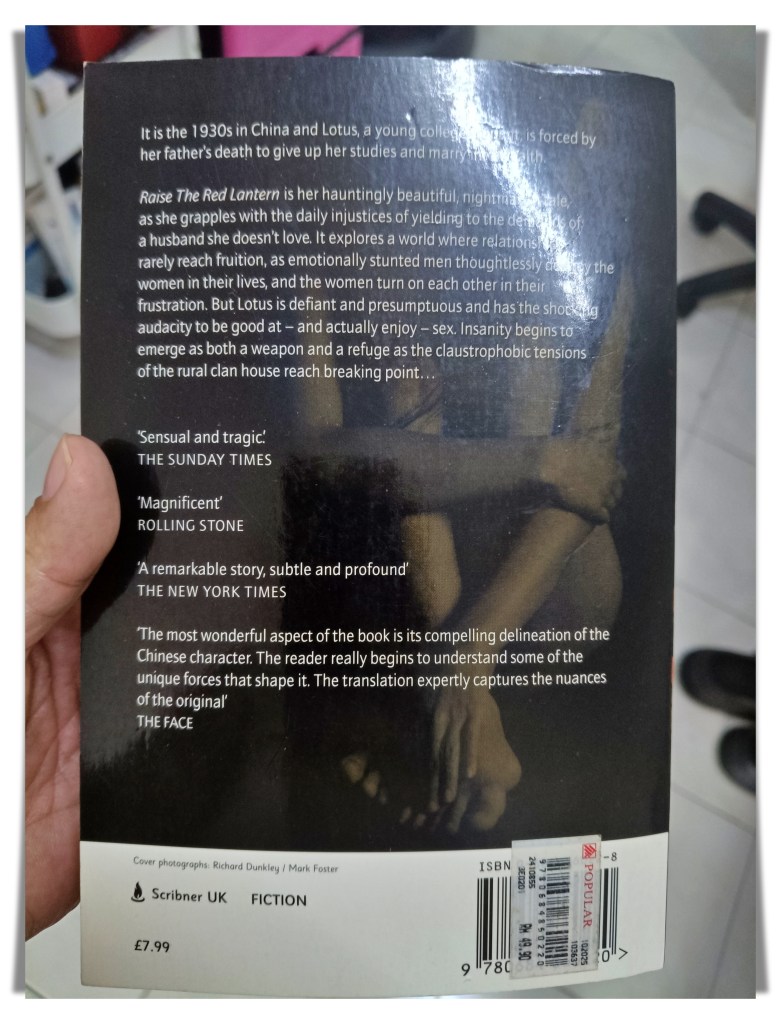
The Price of Being Chosen | Reading Su Tong’s Raise the Red Lantern

I found Su Tong’s Raise the Red Lantern while rummaging through books at Bookaholics’s Jom Baca! RM5 Book Fair. I have been reading Asian literature lately and this book naturally went home with me.

When I finished reading it, my first reaction was something like: what the hell did I just read? The story is almost unassuming, very ordinary and plain on the surface. A young woman named Lotus marries a wealthy fifty-year-old man, Chen Zuoqian, as his fourth wife. She enters his household and finds three women already there: Joy, Cloud, and Coral. What follows is a story of jealousy, rivalry, deceit, and eventually death and madness.

There is nothing particularly elaborate about Su Tong’s prose but I kept stopping while reading, going back to certain scenes and asking myself: why did he do that? Why is Lotus so emotional? Why are these wives organising their entire emotional lives around whether this ageing old man visits them tonight?

That is when I realised the story was doing something clever. It was showing me a system and letting me figure out the rules.

The Novella vs Zhang Yimou’s Film Adaptation

I was fairly new to Su Tong’s work even though I came across his books several times in the past. I wasn’t aware that the novella was originally titled Wives and Concubines. It was published as Raise the Red Lantern in some editions following Zhang Yimou’s film adaptation.

In the film adaptation, the red lanterns were raised outside a wife’s quarters when she was being chosen for the night. The whole household can see who has favour and who does not. Those lanterns don’t exist in the novella. In the original story, Chen Zuoqian simply goes to whichever wife’s room he fancies for the night.

The Wives Are Not Waiting for Sex

I admit my first reaction to the wives’ conniving and petty behaviours was disgust. These women spend their waking hours scheming, competing and humiliating each other. They wait around for an old man who, by the end of the story, is struggling with impotence.

That reaction was too simple and easy. They are not just waiting for sex. In that household, Chen Zuoqian’s favour determines everything. If he visits you, you get better food, better treatment from servants and more respect from others. If he doesn’t, you become invisible and lose ground. Sexual favour becomes status.

In other words, sex has become currency and they did not design the world in which they are living. Take away women’s choices, their money, their freedom to leave, their control over their own futures. And put them under one powerful man and make his attention the only path to comfort and dignity, then watch them compete.

The system can point at the result and say: look how petty and vicious women are. It is easy to blame the person rather than the conditions they are living in. The system created those conditions. Chen Zuoqian doesn’t need to actively oppress anyone every minute of the day. Because once the hierarchy exists, the women police themselves and each other.

Lotus and Her Impossible Position

Lotus is the most tragic character because she enters the household believing she made a choice. After her father dies and her circumstances change dramatically, she decides to become a rich man’s concubine rather than marry an ordinary man. She thinks she’s choosing Chen Zuoqian and a life of comfort. She doesn’t realise that she is actually choosing the Chen household.

Once she’s inside, almost every relationship becomes contaminated by hierarchy. She can’t be friends with the other wives because they are competitors. She can’t trust the servants because they gossip and have ulterior motives of their own. Even her own body becomes a site of conflict. She is young and her husband is old enough to be her father. She has desires and eventually Chen Zuoqian cannot satisfy them. When he asks something of her sexually that she finds degrading and she refuses him, his resentment becomes punishment and he withdraws his affection.

Her descent into madness happens through accumulation. She fears that her servant, Swallow, is being used against her. She becomes obsessed with the mysterious well where women of the household who violated the sexual order were disposed of.

Lotus is also drawn towards Feipu, Chen Zuoqian’s eldest son, who is older than her. Feipu fascinates me because Su Tong never gives a proper explanation of his character. Lotus tries to seduce him but he refuses her advances. Is he a homosexual? Is he frightened of his father? Has he been so overshadowed by his father that even his desires have become inhibited? Or is Feipu himself still confused about what he wants? 

Coral’s Crime

Coral’s fate makes the double standard absolutely clear. Chen Zuoqian can marry Joy, Cloud, Coral, Lotus, and fondle servants. He eventually marries a fifth wife even when he is impotent. His sexual plurality is institutionalised and society sees no issue with that.

But when Coral seeks a lover outside the household, she is thrown into the mysterious well. Coral and the women accused of adultery in Chen’s family history are punished because their sexuality belongs to the patriarch, while his sexuality belongs solely to himself. Coral’s crime is to exercise sexual autonomy.

Lotus witnesses that and she understands the danger. The possibility that she might someday desire someone else is not out of the ordinary. What is extraordinary is living in a world where acting upon that desire could kill her. Lotus knows on some level that she might end up in that well herself.

Swallow’s Tragedy

Lotus’s descent into madness also appears more complex than simple jealousy. She lives in a household where paranoia is often warranted. The wives plot against and undermine one another while the servants gossip. Alliances change, and so does their position in the hierarchy. 

Lotus’s fears are not unfounded when she discovers that Swallow has made a doll bearing her name and pierced it with needles. However, Swallow is just a lowly servant, beneath Lotus in the hierarchy.

There are many things beyond Lotus’s control. Chen Zuoqian’s favour. His other wives. The structure that imprisoned her. But she can control Swallow; therefore her fear travels downward.

She humiliates and punishes Swallow. When Swallow dies, Lotus must live with the consequences and her guilt. This is one of the distressing things in the story. The person on top doesn’t have to be the one performing every violent act for an oppressive system to work. Once a hierarchy is established, those lower down may start hurting each other.

Cloud’s Cunning

The character I found myself admiring, almost against my will, is Cloud. Amid the vicious competition between the wives, Cloud survives through social intelligence. She knows when to use her charm, when to appear harmless, when to gather information, and when to act accordingly. She works through whatever channels are available to her instead of brute confrontation. She doesn’t act dramatically, but she becomes very good at living in Chen Zuoqian’s little kingdom. 

This Is Still Happening

Here is what makes Raise the Red Lantern feel contemporary rather than like a story about a distant past. We still see these things today. Women undermine other women everywhere. Working mothers versus stay-at-home mothers. Married women versus single women. Women with children versus women without. Women who abort versus women who keep the pregnancy. The list goes on and on. There is no winner when we argue over which version of womanhood deserves approval.

It makes me think of the term “pick-me.” Originally, it describes a woman who presents herself as ‘not like other women’ and therefore more deserving of male approval. However, when women start using “pick-me” to police other women, we create another category of performing femininity incorrectly.

But I have to tread carefully here because not every disagreement between women is caused by patriarchy. Women have free will and we can be selfish, judgemental, competitive, prejudiced, and cruel for all the ordinary reasons human beings can.

However, it is undeniable that patriarchy has historically created systems in which women gain security and social legitimacy through their relationships to men. Under those conditions, it’s not surprising that female competition thrives.

Feminism Is Not a Dirty Word

And that is why I think feminism is not a dirty word, though somehow it has become one for some women. I find that odd because many choices women now take for granted exist partly because women before us fought for them. The right to education, to work, to own property, to enter politics, to divorce, to have children. Those rights are incomplete and not the same everywhere in the world.

Feminism does not have to mean that every woman makes the same liberated choice. A woman who chooses marriage and children is not necessarily less free than a woman who chooses neither. A woman who stays home is not necessarily oppressed, just as a woman with a career is not necessarily liberated.

It all comes down to one thing: choice. And Raise the Red Lantern made me think about what that word means. Lotus made a choice. She chose concubinage over marrying an ordinary man. But how meaningful was that choice when the alternatives were already so constrained? How free is a woman who can choose between one form of dependence and another?

Those questions are not confined to Lotus’s world. I am an Iban woman reading this story in Malaysia, many decades after the world Su Tong depicts. My life is infinitely freer than Lotus’s. My circumstances, culture, and time are different from hers. I don’t want to iron out those differences by assuming that all women’s experiences are the same.

There is a bigger question: How much of what women call choice is genuinely ours and how much of it is dictated by what our families, cultures, religions, and societies have taught us to believe a woman should be?

After finishing Raise the Red Lantern, I no longer found those women pathetic for waiting for Chen Zuoqian.  I found their situation tragic. They had been placed in a world where their status, their security and eventually their survival might be determined by one man’s attention.

And while our world is radically different from theirs, women are still arguing about who among us is doing femininity right. Maybe the more pertinent issue is why we are still being expected to prove it at all.


I write about Iban culture, ancestral rituals, creative life, emotional truths, and the quiet transformations of love, motherhood, and identity. If this speaks to you, subscribe and journey with me.
A Weekend at KL Zine Etc Festival

I meant to write about this sooner, but I was seriously unwell over the past couple of months and had to put a few things aside. Now that I feel a lot better, I am returning to some of the things I wanted to share, including my weekend at KL Zine Etc Festival, or KLZE.

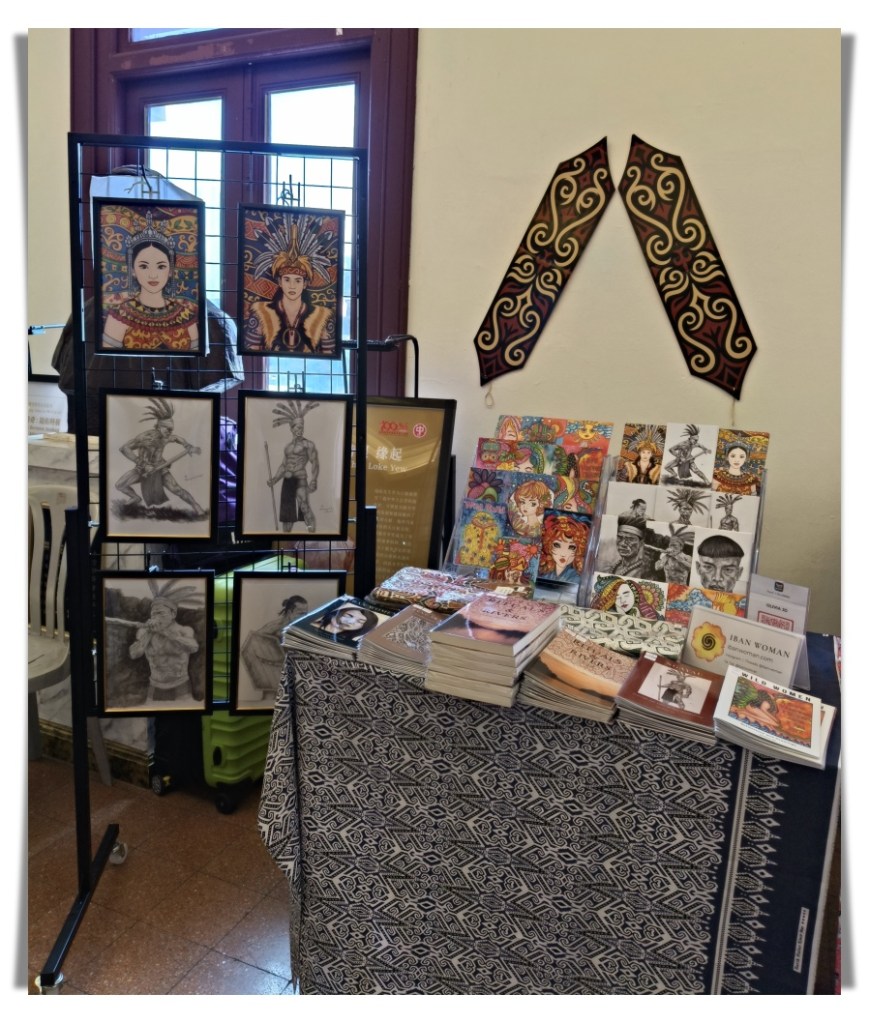
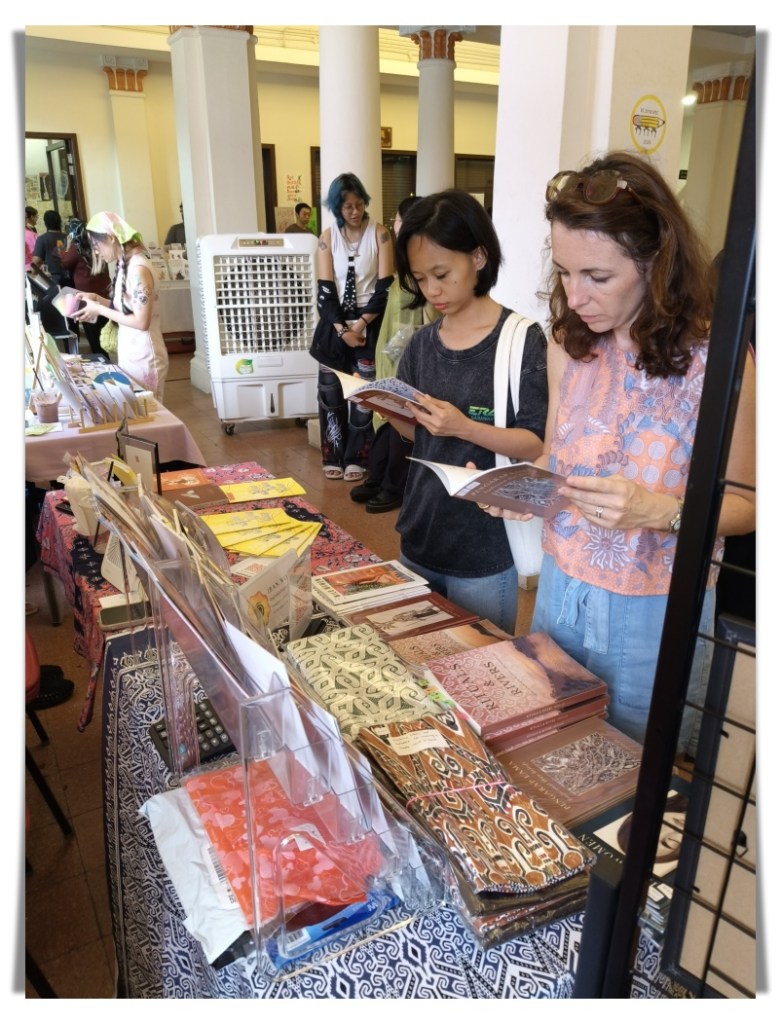
From 7 to 9 August, I took part in KLZE at the Kuala Lumpur and Selangor Chinese Assembly Hall. It was my first zine festival as an exhibitor, so I was eager, worried and a little overwhelmed by everything.

I had half a table, sharing it with another exhibitor, Not Just Love Stories from Taiwan. I brought my newly published poetry collection, Rituals and Rivers, together with several of my zines, art prints and drawings.

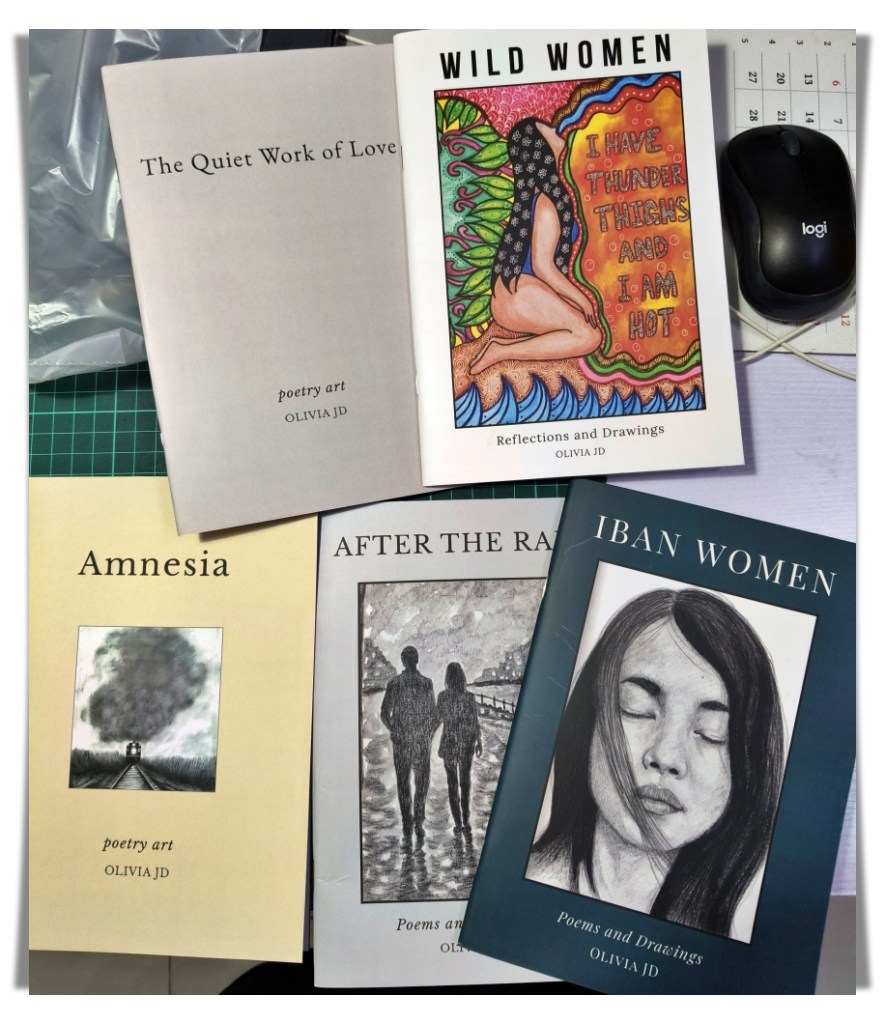
Much of this work began at home, long before I decided to publish any of it. My handwritten drafts and drawings had filled countless notebooks and sketchbooks over the years. Over the past few years, some of those pages gradually became books.

Preparing for the festival meant dealing with the less romantic part of making things: printing, pricing, packing and deciding what would fit on the table. By the time everything was laid out, I could see how much I had made.

It was a strange experience watching strangers look through my books, turn the pages carefully, ask questions about Iban culture and even buy them to take home. These things had existed privately for so long, as ideas, scribbles and files in my notebooks and on my computer. Suddenly, they were travelling home with other people. For the first time, I felt that people outside my immediate circle were supporting my work.

My work often returns to my Iban heritage. At KLZE, those stories could reach people who might never have come across my blog or found my work online, especially Iban people living away from Sarawak and those of mixed heritage. I have always wanted to share Iban culture through simple forms such as zines, particularly with younger people of Iban descent who grew up away from Sarawak.

I liked that directness. The work was there for them to look through, and I was there if they wanted to ask about it.

Selling my work was part of why I was there, of course. Independent publishing costs money, and every purchase helps me continue. I am grateful to everyone who bought something, whether it was a card, a zine or the poetry collection.

I also appreciated the chance to see people encounter the work in person. Publishing online gives me very little sense of what happens after someone reads a poem or looks at a drawing. A festival offers a different kind of contact, even if it is only a brief conversation across a table.

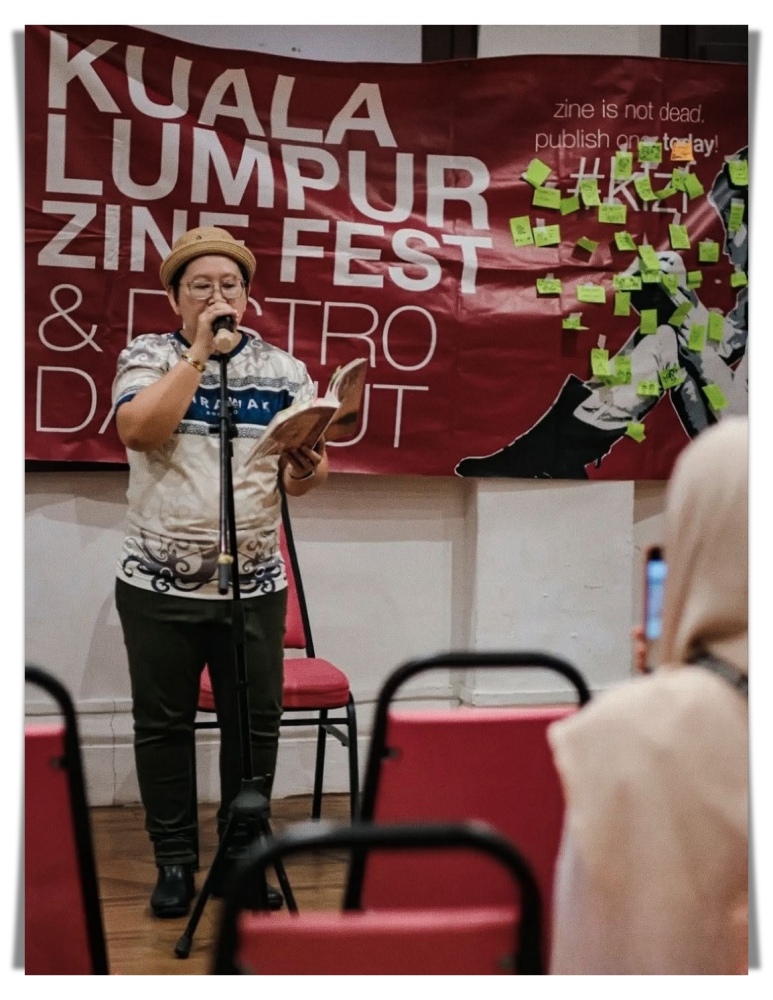
On Saturday, 8 August, I also gave a poetry reading from Rituals and Rivers. It was my first public reading.

Before the festival, the organisers invited anyone interested to give a talk or a public reading. I jumped at the chance without thinking too much about it. I was not nervous and had no hesitation about doing it, even knowing there was a chance no one would turn up to listen.

Writing a poem and reading it aloud to an audience are quite different experiences. On the page, I can take my time and revise in private. At a reading, I have to give the words a voice and let people hear them. I am glad I took that step and grateful to those who sat and listened.

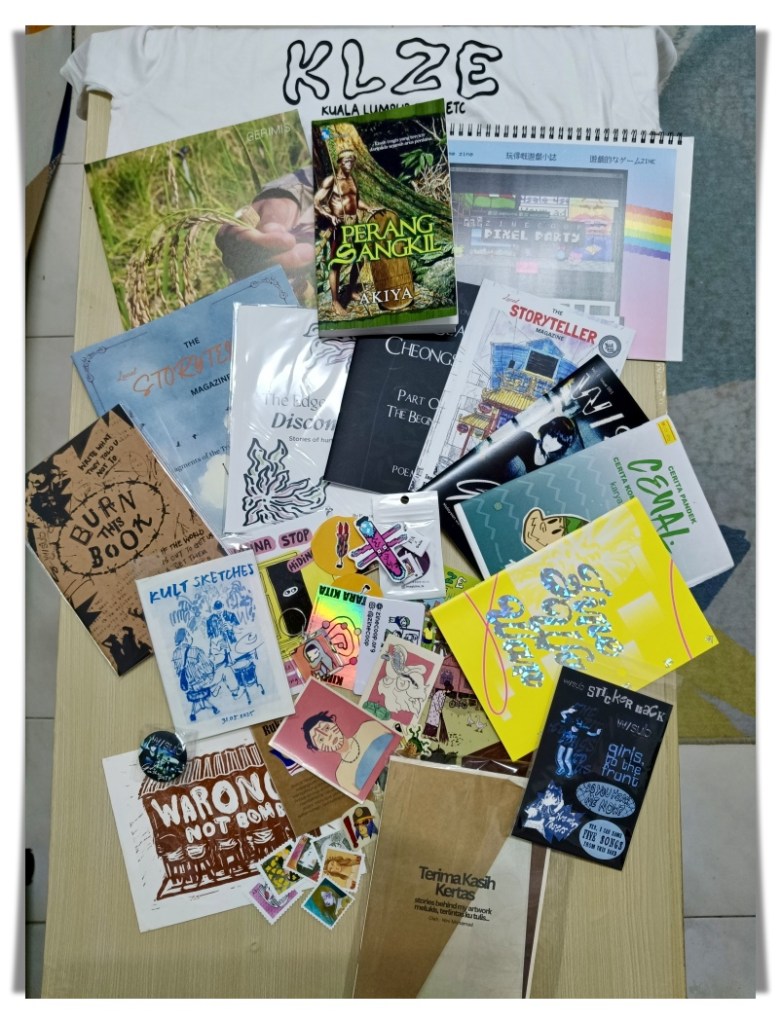
I also came home with work by other makers. Part of the pleasure of a festival like this is being able to browse what everyone else has brought and take some of it home. Being an exhibitor did not stop me from being a reader and a buyer too.

Looking back, KLZE gave me a chance to bring together parts of my creative life that usually happen quietly at home. The writing, drawing and making became something I could share across a table, and the poems became something I could read aloud.

Thank you to the organisers, everyone who stopped by, and those who supported my work. This post is late, but I still wanted to give that weekend a place here.


I write about Iban culture, ancestral rituals, creative life, emotional truths, and the quiet transformations of love, motherhood, and identity. If this speaks to you, subscribe and journey with me.
What the Dead Leave Behind

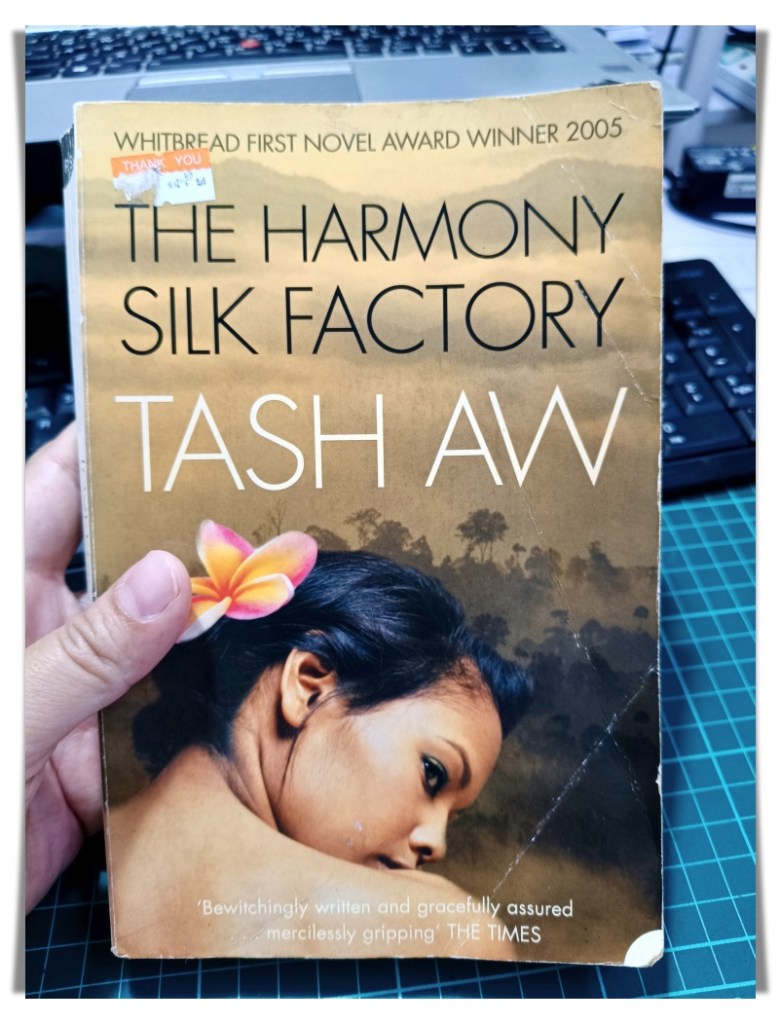
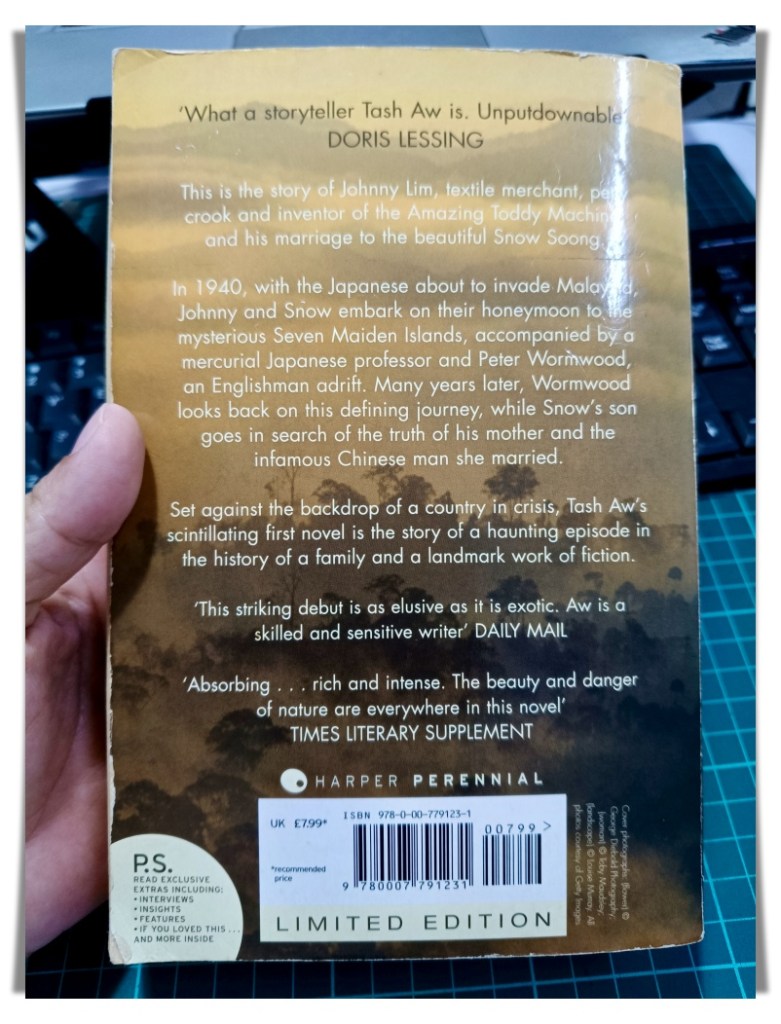
I finished Tash Aw’s The Harmony Silk Factory thinking about the characters and people in my life. Johnny Lim, Snow Soong, Peter Wormwood and Mamoru Kunichika had occupied far too much space in my head by the time I finished the novel. I was thinking about my family too. My parents, my grandparents and, eventually, my ancestors.

One idea keeps getting emphasised throughout the book: death erases all traces, all memories of lives that once existed, completely and forever. Different characters in the book express it in different ways. Jasper heard it from his father, Johnny. Johnny most probably heard it from his wife, Snow. Snow writes about it in her diary, and Peter repeats it in his own narrative.

I honestly think it is not that simple. I don’t think death erases everything. It leaves fragments: what we can see, hear or touch. Photographs, diaries, houses, objects, newspaper reports, rumours and memories. All these things survive long after someone is gone. The problem is that each object is just a fragment. It is not the same thing as a person.

The novel gives us three narrators trying to understand Johnny Lim through their unique perspectives. Jasper sees his father through his research, family history and resentment. Snow sees her husband from inside a disconnected marriage that neither of them seems capable of fully inhabiting. Peter remembers Johnny from the distance of old age, guilt, friendship and secrets. Each of them is convinced they know something important about him, but none of them knows him completely.

In an interview included at the back of my copy, Tash Aw explains that Jasper, Snow and Peter project their own insecurities and aspirations onto Johnny. In the end, no one truly knows who Johnny was. He simply becomes a construction made from other people’s memories of him.

That idea made me think about the people in my own life. How much do I really know my parents? I know them as my parents, but who were they before I existed? Who were they before they met each other? What were their fears, disappointments and ambitions when they were growing up? What about my grandparents and my ancestors? I will never know any of these things, but eventually I learned about my ancestors through family stories, oral history, genealogy and scattered historical accounts. 

Recently, I followed a long discussion on Facebook concerning two of my ancestors, Panglima Nakhoda Budin “Gerasi” and the anti-colonial fighter, Aji Apai Limpa. The accusation was about the practice of taking heads during the era of ngayau (head hunting). The discussion became increasingly tangled, moving through questions of warfare, adat (customary law), historical context and how acts committed in another century should be understood today.

Much of the discussion itself did not interest me. After a while, it seemed to become disagreement for the sake of disagreement. But it led me to this question: how much can any of us really know about people who died generations before we were born?

We certainly can learn about them through oral traditions, family accounts and colonial records. We can also learn about the social structure and adat that shaped their world. We can distinguish between warfare and murder, between the norms of an earlier society and modern legal categories.

We must keep in mind that historical context and evidence are important before pronouncing any moral judgement. We don’t have the complete picture of the past, but that does not mean every interpretation is equally convincing. 

At the same time, The Harmony Silk Factory reminded me how easily we construct people from fragments. As a direct descendant of Budin and Aji, I naturally want my ancestors to be honourable. But I also recognise that family pride can shape the way descendants interpret the past, just as assumptions, inherited stories and modern perspectives can shape other interpretations. A colonial official may interpret Iban warfare through assumptions formed somewhere in Great Britain. A modern reader may judge the actions of my ancestors entirely through twenty-first-century perspectives. Even the details of family stories can change depending on who tells them.

And I am not exempt from this. I have my own emotional investment in these people. They belong to my family history and I want to understand them fairly. Naturally, I feel offended when they are reduced to crude stories about violence or headhunting.

However, I don’t deny that family pride can also become a lens. Perhaps the best I can do is remain curious, keep asking questions, keep reading, keep learning from those who are qualified, understand the historical world in which these people lived and accept uncertainty where certainty no longer exists. And resist the temptation to put labels on complicated human beings. 

I think that may be what affected me most about The Harmony Silk Factory. No character remains fixed once another person begins telling their story. In another person’s eyes, Johnny is a gangster, husband, father, businessman, survivor, traitor, protector and coward. Snow is a wife, daughter, lover, diarist, observer and intellectual. Peter has his own secrets. Mamoru writes a memoir that totally ignores his involvement with the Kempeitai and turns his experience in Malaya into something pleasant. Everyone constructs a version of the past they can live with.

And maybe we all do this too. We remember our parents according to how they treated us. We remember our ancestors through genealogies and stories that survived because someone considered them worth telling. But what about everything that disappeared? Who did they love? What frightened them? What did they regret? What things did they enjoy doing?

History often preserves the dramatic things like wars, migrations, marriages and conflicts. But a human life is mostly made from ordinary things. We inherit what survives and build a person from it because traces do remain. It’s melancholy and oddly beautiful too.

One day, the same thing will happen to us. Our children, descendants, friends may inherit photographs, social media posts, messages, objects we once touched and stories told by people who knew us. They will construct us from those fragments. They may get some things right or wrong. But we will no longer be around to correct them. That’s what The Harmony Silk Factory ultimately left me thinking about. We spend our lives trying to understand the dead from what they left behind while slowly becoming the fragments from which somebody else will one day try to understand us.


I write about Iban culture, ancestral rituals, creative life, emotional truths, and the quiet transformations of love, motherhood, and identity. If this speaks to you, subscribe and journey with me.
Who Gets to Choose Simple Living? A Reflection on The Abundance of Less

I finished The Abundance of Less today. I don’t think I’ll read this book from start to finish again. There are parts of the book that I might read again because some of the people in it have inspired me one way or another. Their lives were at peace and consistent over time. That has remained with me.

What I liked most was how some of them lived without separating things. There was no separation between work, art, and everyday life. Making meals, growing food, making art or writing, or carving wood all come from the same place. There was no clear line between survival and meaning and I can see why that might be appealing because it feels solid and complete.

Some of the people in the book choose to live with less. They kept their needs minimal. They worked with their hands and they were aware of their surroundings. Living that way takes discipline but it brings clarity. You know what you need and what you don’t. However, a tension that was hard to ignore grew as I read on.

In the Afterword chapter, the author mentioned one of his book reading sessions when someone asked if these people were just surviving at a basic level of survival. That question lingered because it sounded familiar. Where I come from, many people already live that way. It’s not a philosophy or a decision made after reflecting on it. That’s just how life is.

I come from an Iban background. My grandparents were paddy farmers who lived in longhouses. They grew their own food and they depended on the land. Life in the longhouse community was close and practical. It wasn’t considered meaningful or spiritual. It was simply necessary and it wasn’t easy. Farming is hard work and the yield is sometimes uncertain. There are limits to what you can access, especially education and healthcare. Many people in these communities wish to have a stable income. They need money to send their kids to school or pay for healthcare. They want to repair their homes or build new ones. They want to help their elderly parents. These concerns are genuine and constant.

When I read about people who want to live a simpler life, I see two separate realities. Some people choose to live with less. And some people have always lived with less. The difference is in the choosing. Choice allows you to choose that life and leave whenever you want to. Choice lets you regard it as meaningful. If something goes wrong, it allows you to return to a system that supports you. But without that choice, that same life would look very different. 

In the Afterword, the author asks if small “green” changes to one’s lifestyle are really meaningful. They say that these changes let people stay comfortable while calling it sustainability. The concern is real, especially when certain changes are made more for show than for a good reason. But this perspective doesn’t take into account that not everyone can make big adjustments to their lives. Some people can’t move away from the city, change jobs, or move closer to nature. They can’t make those kinds of adjustments because of their jobs, finances, and other circumstances in their lives.

For them, small changes let them do things within their limits. Making small changes like consuming less, being more mindful, or doing less harm to the environment can still reflect a genuine effort to live with awareness. These decisions may not seem like enough from the outside, but they are based on what a person can realistically change at that point in their life.

This doesn’t mean that the people in the book are wrong. I understand what they’re attempting to achieve. I can see the benefits of living with purpose and cutting back on things I don’t need. I can see they care about the land and their communities. But I can’t ignore the other side either. Moving to a city or looking for a job that pays cash does not mean giving up on values. People are just responding to their circumstances. They are trying to make their life more stable by making decisions based on what they need.

Both ways of living arise from different needs and situations and are shaped by different circumstances. One is often chosen and can be left behind. The other is lived without the option to leave. That difference should not be overlooked. To be frank, this book did not give me a model to follow. It just offered me another perspective to consider and it made me think more about my own life and what I already value. It also made me think about how some ways of living are described and seen in a higher regard.

I will remember certain chapters of this book. The chapters about Asha Amemiya, Akira Ito, Koichi Yamashita, and Wakako Oe are worth reading. They are not offering answers, but rather something that can fuel my inspiration. I will return to those chapters when I need a reminder of some kind of discipline or attention. I will also give my perspective the same weight because it also means something important to me.


I write about Iban culture, ancestral rituals, creative life, emotional truths, and the quiet transformations of love, motherhood, and identity. If this speaks to you, subscribe and journey with me.
A Word for Living Between Places

I came across The Dictionary of Obscure Sorrows several years ago. I found the Youtube channel first. I remember watching one video late at night. It was called Sonder: The Realization That Everyone Has A Story. The narrator’s voice was calm and unhurried. He described the word “sonder,” and I knew I had felt that feeling before but I couldn’t describe it. Here’s an excerpt taken from the book that describes sonder:

SONDER (the awareness that everyone has a story):

You are the main character. The protagonist. The star at the center of your own unfolding story. You’re surrounded by your supporting cast: friends and family hanging in your immediate orbit. Scattered a little further out, a network of acquaintances who drift in and out of contact over the years. 

But there in the background, faint and out of focus, are the extras. The random passersby. Each living a life as vivid and complex as your own. They carry on invisibly around you, bearing the accumulated weight of their own ambitions, friends, routines, mistakes, worries, triumphs, and inherited craziness.

When your life moves on to the next scene, theirs flickers in place, wrapped in a cloud of backstory and inside jokes and characters strung together with countless other stories you’ll never be able to see. That you’ll never know exist. In which you might appear only once. As an extra sipping coffee in the background. As a blur of traffic passing on the highway. As a lighted window at dusk.

That word stayed in my mind and every time I’m out in the crowd watching strangers passing by, I would think of sonder.

Just like sonder, the rest of the words in that book describe small and specific experiences. They do not refer to objects or actions. They name moments that are easy to overlook because they do not demand attention. Reading them made me more aware of how much I move through life without naming what I feel.

Today’s prompt asks what I would want named after me. I thought about it for a while. I could not think of any place or object that felt right. Those things feel distant from how I experience my life day to day. And I do not relate to them in a meaningful way.

And I thought about the book. I would love to be an entry in such a book. A word feels closer because it can hold something that is lived but not always spoken. It can remain small and still carry meaning. It does not need visibility to exist.

I have been writing about living between places. I am Iban. I grew up in Sarawak, and I have lived in Kuala Lumpur for many years now. My life is here and I am raising my family here. I know the places, the roads, the routines, and the pace of this city.

When I return to the longhouse, I notice the difference. I’m fluent in Iban, but sometimes I pause to find the right word. The rhythm is familiar, but I am not fully inside it anymore. I am received with warmth, but there is also a sense that I have come from somewhere else. 

That experience has remained with me, but it does not belong to a single location. It moves with me wherever I go. It shows up in small, ordinary moments like in the food I cook. In the stories I tell my children. In the way I think about the place where I come from.

Over time, I have come to see this as a connection that continues across distance. It is not always visible, but it is present. If I were to name that experience, I would keep it simple.

livselaka (n.)
the quiet state of living between places, where connection remains even when belonging is incomplete


I write about Iban culture, ancestral rituals, creative life, emotional truths, and the quiet transformations of love, motherhood, and identity. If this speaks to you, subscribe and journey with me.
A Return

What is one word that describes you? Just one word? If it’s only a word, then I feel it seems too narrow for something that changes as much as a person. One word makes it sound like something is set in stone. I don’t think I’ve ever been that. I sat with it for a while to find the right word. Finally, the word that came to mind was “return”. 

It’s less about a return to something untouched and more about picking up something I set down for a while. I’ve found myself reaching for my sketchbooks again in the past few weeks.

I go through old paintings, rewrite poetry, change the margins, and print pages. The tasks are simple but they require my full attention. Every little decision affects the outcome and time passed by silently as I focused on each task.

I recently blogged about the process of producing my zines and art cards. These are real and tangible things and unlike digital work, this is a slower way of working and nothing happens instantly. That post was a result of sitting at the table and crafting the zines, whereas this post is when I start to let them go and release them to the world. It’s been a while since I last put my work out on Etsy. I went on a hiatus when other things in life got in the way.

However, my art sat there waiting for me to return and produce something for the shop. It feels odd to come back to it now. I need time to readjust and relearn how to do some of the things, like working on Canva. I don’t want to make everything at once. I’m putting together one zine at a time, assembling each one carefully. I don’t force myself or think too far ahead on future projects. It is enough to just work on what is in front of me. So, I launched my Etsy shop again today.

It sits there quietly for now with five simple listings. All of them are the printable versions of my zines. They sit there waiting for the algorithm to index them and finally appear on the search results. No matter how excited and proud I am about them, I don’t feel the need to announce it loudly to the world. The act of listing them on the shop and making them public is enough for me. 

I realized how familiar the process felt as I worked on the listings. The tasks of writing descriptions, picking titles, and putting pages in order are the things I have done in the past. However, I’m doing things now with a different way of thinking. There is less doubt while making small decisions and I go through them without overthinking.

The work itself hasn’t changed much. It is still made of the same things: words, ink, graphite, and paper. What has changed is my approach to it. I’m not trying to make something big and complicated. I’m just working on one zine at a time, finishing it, and moving on to the next.

There are still certain things that are unclear. I don’t know how people will react to it or how often I will add more listings. Right now, I’m not trying to answer those questions. I just let it be and do not stress myself about the outcome. For now, I am here again, sitting at the table, working on my art and poems. The shop is open and life flows on. It all feels like a “return” or homecoming, somehow.


I write about Iban culture, ancestral rituals, creative life, emotional truths, and the quiet transformations of love, motherhood, and identity. If this speaks to you, subscribe and journey with me.
The Essence of a Smaller Life

Daily writing prompt
If you could be someone else for a day, who would you be, and why?

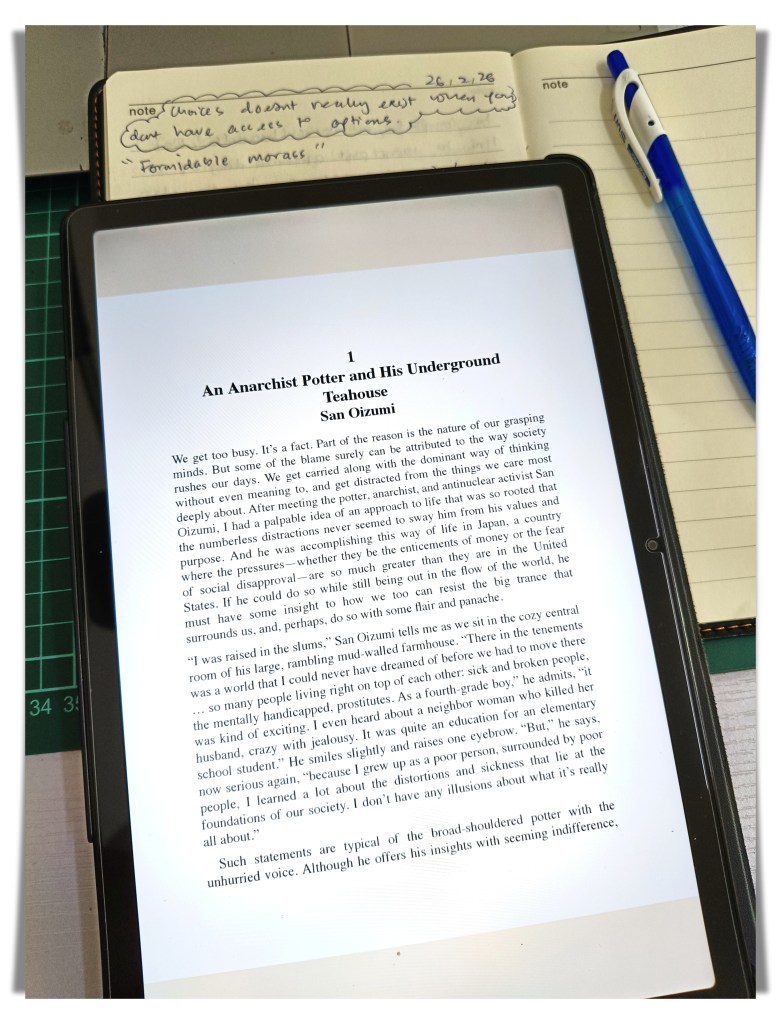
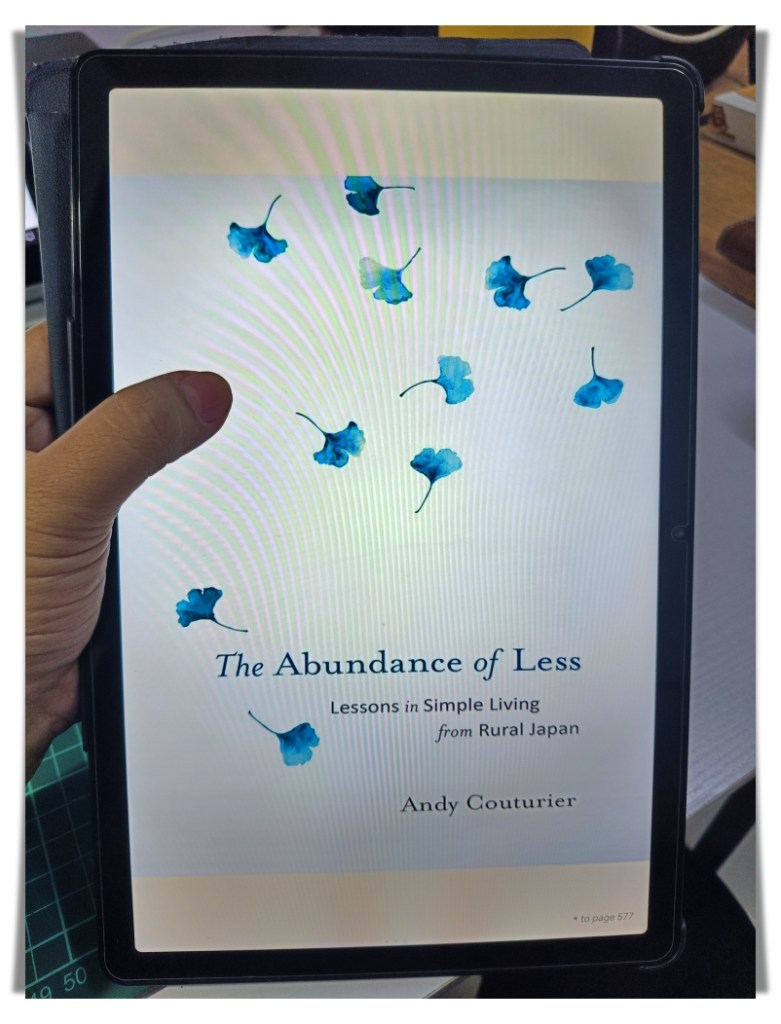
I have been reading The Abundance of Less by Andy Couturier. I’m only on the first few chapters, but the people he writes about stay with me long after I’ve put the book down. They live in the countryside of Japan, far away from the fast pace of cities and the demands of the digital world. The scenery isn’t what draws me in. What attracts me is how gracefully they go about their days. For anyone curious about the author’s thinking, his interview with Kyoto Journal offers a thoughtful look into the ideas behind the book: https://kyotojournal.org/conversations/making-a-life-not-merely-a-living/#top

Here are some of the people featured in this book:

San Oizumi is a potter who makes tea bowls, builds small structures, and allows his work to take the time it needs. His life unfolds at its own pace, shaped by intentional choices rather than external pressure.

Osamu Nakamura is a woodblock craftsman who carves slowly and on purpose keeps his world small. He rereads the same books for years. He commits to depth and does so quietly.

Atsuko Watanabe is an activist and mother who plans her days around what she can accommodate, not what she accumulates. 

Kogan Murata, a Zen practitioner, sings the same songs repeatedly to make him more at ease with himself.  

The artist Akira Ito studies ordinary objects and folk art. He sees the beauty in the work of unknown hands and in the little things that life leaves behind.

Gufu Watanabe, a traveler and journal keeper, writes down mundane things like a meal, a corner of a room, or the light on a plant just because they are there.

Koichi Yamashita, the gardener, understands how long one meal actually takes when you follow its beginnings back to the soil. Everything slows when traced back to its true starting point.

And throughout his life, Masanori Oe keeps asking the same questions, letting the act of asking change him instead of expecting clear answers.

They all live in different ways, but there is something that connects them. That connection doesn’t come from a common rule or way of thinking. It is a way of being with one’s own life. Their choices are calm and measured. They follow a rhythm that is shaped by staying focused. Everyone has a small world inside them, and their interior lives feel wide.

As I read, I have no desire to replace my life with theirs. What I want is the core of their choices: a way to get through the day without rushing to the next thing. It is a way of working that doesn’t require you to prove the worth of your work or put on a show for anyone else. I am drawn to the inner posture that lies beneath their rural setting.

I live in a city where I am surrounded by noise and responsibilities. My days are shaped by family, work, and all the challenges of living in a city. Sometimes I experience something similar to what these people embody, like when I go back to writing or my art without the need to explain myself. I sense it when I commit to my small routines and when I choose to keep my world manageable. The external environment may be different, but the intention seems to be the same.

The essence I admire exists independently of place. It has more to do with how time is held, what is noticed, and what is allowed to matter. I have no intention of becoming these people. A quieter rhythm has begun to take shape in my days, influencing how I move through the life I already inhabit.


I write about Iban culture, ancestral rituals, creative life, emotional truths, and the quiet transformations of love, motherhood, and identity. If this speaks to you, subscribe and journey with me.
Reading at My Own Pace

Some months I read with hunger. Other times, a book sits unopened for weeks, waiting for me to catch up to whatever it’s trying to say. I used to feel guilty about it, for not finishing or for moving too slowly. Now, I treat it like a ritual. The book finds me when I’m ready or it doesn’t. It doesn’t matter. I’m not competing with anyone. 

This year, my to-read shelf is more invitation than obligation. I don’t care about finishing stacks. I want each page to be a gentle interruption, like rain on my balcony while I’m working or the way dusk slips through the window when I’m too busy to notice it.

Fiction

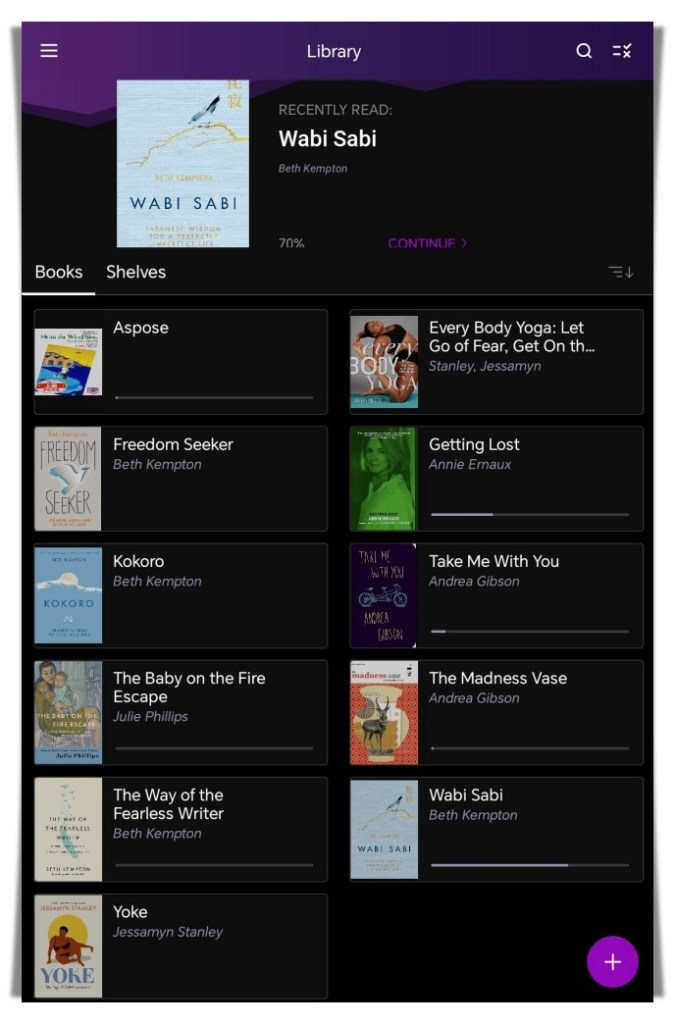
Hear the Wind Sing by Haruki Murakami
This is Murakami’s first novel. It is short and understated. Some people said it wasn’t as good as the rest, but I don’t care. I’m drawn to where his work began, long before the fame. I expect quiet nights, music, and empty spaces. 

Getting Lost by Annie Ernaux
I love Ernaux. Her writing style is very clinical.’ This book is a raw diary of obsession and doubt. Ernaux writes with clarity about longing and uncertainty. The subject matter is personal and direct. 

Poetry

Take Me With You by Andrea Gibson
I started to pay attention to Gibson’s work after discovering her on Instagram. She was bravely battling cancer and was very public about her struggles, but it was her message that touched me the most. This collection opens into pain, love, and vulnerability. Gibson doesn’t disguise what hurts. I want to spend time with poems that stay close to real feeling.

The Madness Vase by Andrea Gibson
Another book by Gibson. These poems circle fear, survival, and tenderness. The language stays plain, even when the emotions are complex and raw. 

Yoga & Body

Every Body Yoga by Jessamyn Stanley
I return to yoga after abandoning my practice several years ago. I figured I need a gentler form of exercise so my perimenopausal body can cope. And since I am struggling with my larger body, I naturally gravitate to Jessamyn Stanley. Stanley welcomes every level of experience. Her voice stays grounded and open. I’m looking for guidance that doesn’t expect perfection.

Yoke: My Yoga of Self-Acceptance by Jessamyn Stanley
A collection of essays on making peace with your own body. Stanley is candid about what that process has looked like for her.

Japanese Philosophy & Non-Fiction

Wabi Sabi by Beth Kempton
I’m reading this now. I have gravitated to Eastern philosophy since I began to deconstruct my Christian faith. Kempton explores imperfection and beauty in ordinary life. Reading this book gives me a peaceful feeling.

Kokoro by Beth Kempton
This book considers “heart” and spirit in Japanese culture. She writes with clarity and restraint.

Freedom Seeker by Beth Kempton
Kempton traces the slow return to self beneath noise and duty. I love her, Wabi Sabi, so I think this book will resonate with me as a dogmatic religious dissenter. 

The Way of the Fearless Writer by Beth Kempton
A book on writing with less fear and more presence. I’m curious what she sees that I don’t yet.

The Baby on the Fire Escape by Julie Phillips

I am so looking forward to reading this one. I think this is the first book I found on this subject. It’s a study of women who made art while raising children. It gathers stories of how creativity and care live beside each other.

I am a slow reader because I want to savor the text and let the message sink into my heart. There are days I chase after answers, but sometimes I just want to reflect on the beauty of a good line. I know these books will keep me company. They will remind me I’m not the only one who desires or questions things. 

Maybe you read like this too, like a habit. If you do, I hope you find something on your shelf that waits for you and meets you quietly, without asking you to be anywhere else.


I write about Iban culture, ancestral rituals, creative life, emotional truths, and the quiet transformations of love, motherhood, and identity. If this speaks to you, subscribe and journey with me.
Passing Stories Along | A Visit to BFBW Subang Parade

Books are expensive in Malaysia. Anyone who reads a lot already know this. A single paperback can cost as much as a meal for two people at times. And when you’re trying to pay your bills, parenting, buy groceries, or just get through the month, buying a new book feels like a luxury that’s easy to postpone.

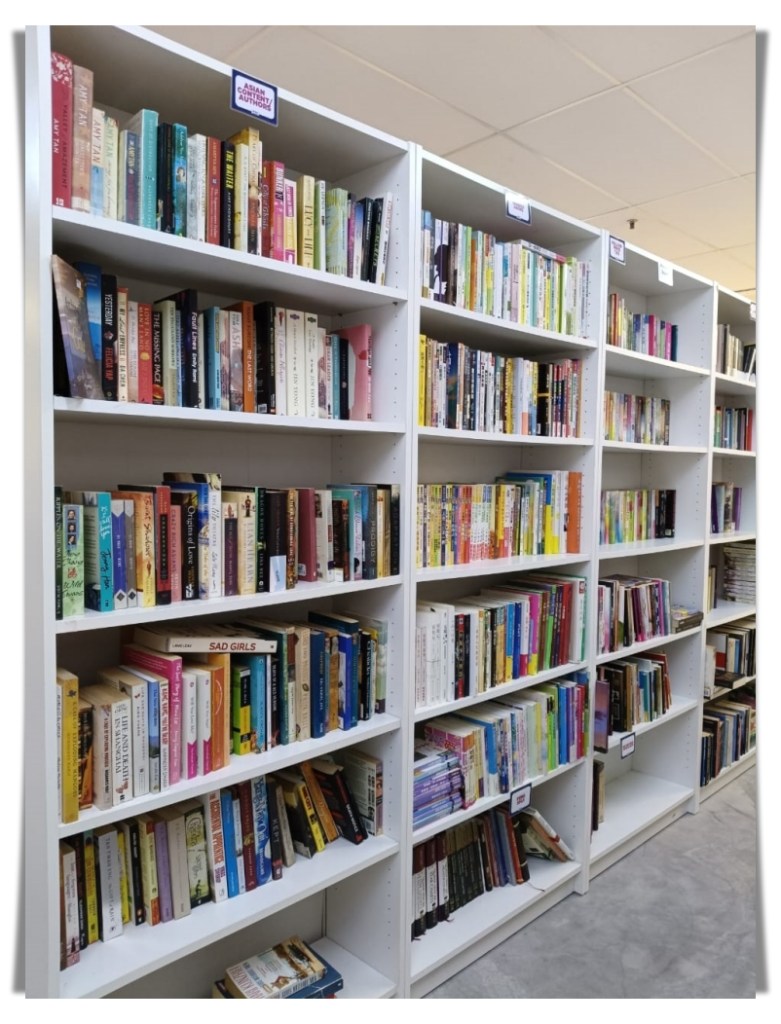
That’s why I’ve always liked used bookstores. Yesterday I went to a small, quiet bookstore in Subang Parade called BFBW – Books for a Better World. I wrote a short post about it on Threads, but the visit stayed with me. The variety of titles and the reasonably priced books weren’t the only factors. It was the mood and what the place stands for.

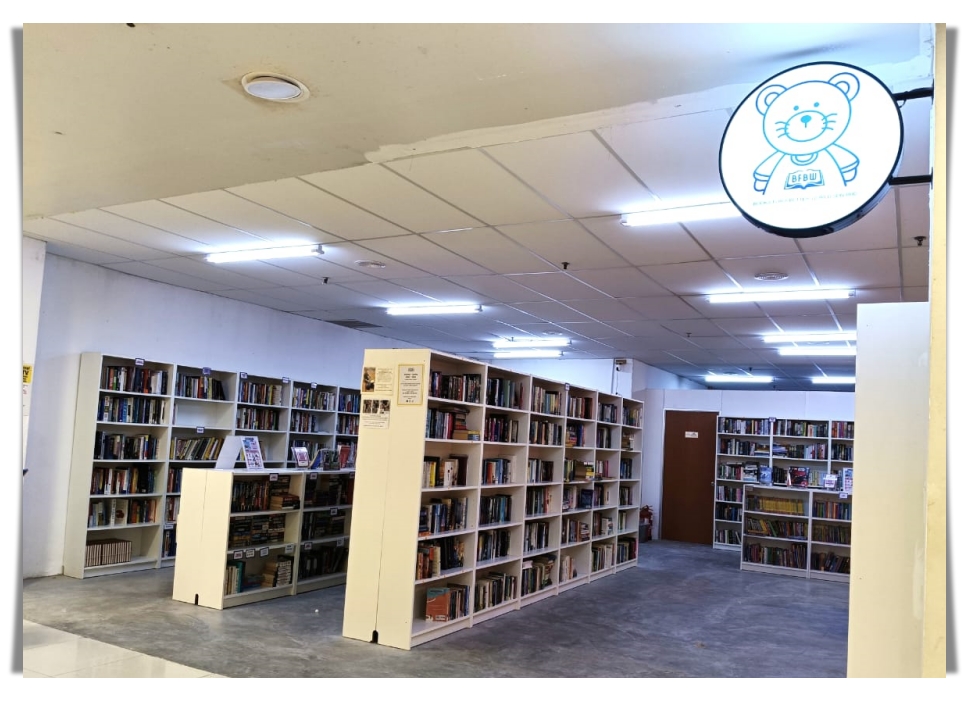
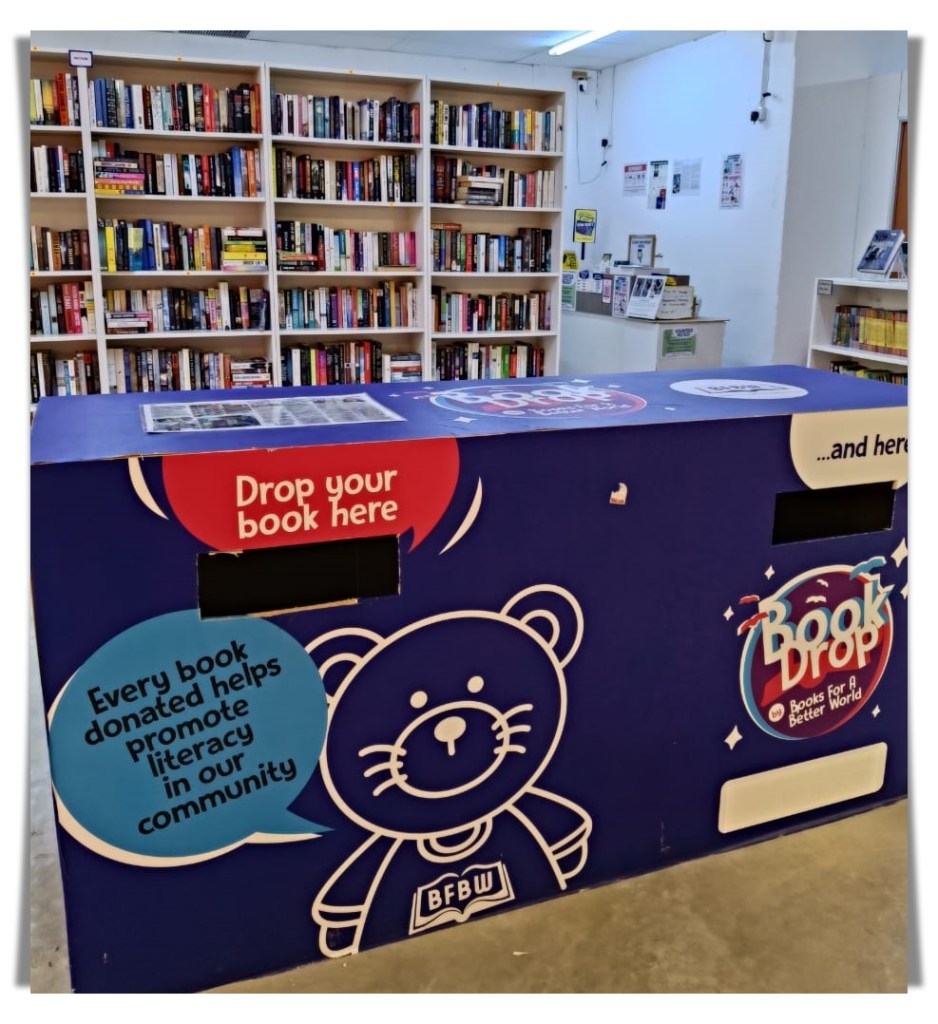
The bookstore is small. There aren’t any cozy corners or mood lighting for photos. There were just clean white shelves, a blue donation box with a cartoon bear on it, and fluorescent lights above. There were no frills in the room, and the floor was just cement. But it still felt good, simple, welcoming, and real.

What made it feel meaningful was the sense that every book had already lived a life. Each one had been read, or maybe left unread, carried in someone’s bag, or left waiting on a nightstand. They were now waiting for someone else to bring them home. That continuity, stories passed from person to person, makes used books unique and special.

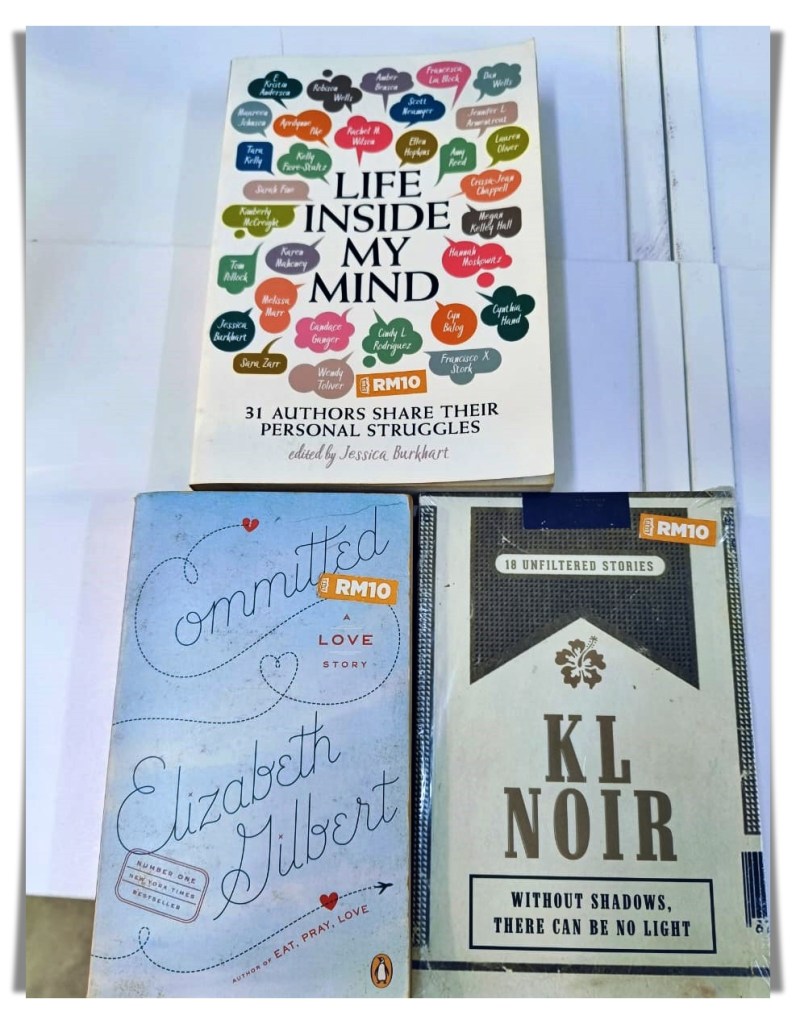
I ended up buying three books for RM10 each. One was Committed by Elizabeth Gilbert, which I’ve wanted to read for a long time. KL Noir was another one that caught my eye because of its subtitle: “Without shadows, there can be no light.” The last one was Life Inside My Mind, a book of essays by different writers about mental health. That one hit home.

These books weren’t in perfect shape. One had corners that were folded. The edges of the other one had faded. But that didn’t matter. I liked that they had been somewhere before me. Someone else had opened these pages and read them, or maybe they didn’t. It’s possible that the book was passed on without being read. It had traveled in any case.

That’s one of the little things that make used bookstores so nice. When you buy a book, you’re getting more than just a book; you’re getting a piece of someone else’s journey. It gives the book a deeper meaning that new books don’t always have.

At the front of the store, BFBW also has a donation box where people can leave books they don’t need anymore. The donated books aren’t just sold again; they’re also given to literacy programs and charities. Communities, schools, and small libraries benefit directly. It’s a simple system that supports access to reading.

While standing there, I reflected on my own bookshelves at home and the books I have kept but no longer read. Some of those books meant something to me at one time, but now they’re ready to go. I also bought books on a whim and never read them all the way through. I realized that giving them away could give them a new life.

It reminded me that sharing stories is more than just writing and publishing. It’s also about letting go and letting a book continue its journey by giving it to someone else. By letting go, we are passing on what helped us in the past or what we never got around to reading.

As a mother and a writer/artist, I often think about the kind of legacy I want to leave behind. This includes not only my own work but also the values I pass on. I want my kids to grow up in a world where they can get their hands on books. Where knowledge and imagination aren’t limited by price and where stories travel. Bookstores like BFBW make that vision feel possible.

If you live in the Klang Valley and have books that are in good shape, whether they are fiction, nonfiction, or children’s books, think about giving them away. Or take a little time to look around and pick up a few. You might find something you didn’t expect. You might rediscover the joy of reading without pressure.

I’m glad I stopped by. I left with three books and the feeling that I was part of something bigger. You are not just a reader but a link in a generous chain of people passing stories along. It really is that simple sometimes.


Olivia Atelier offers printables, templates, and art designed to inspire reflection, healing, and creativity. Visit Olivia’s Atelier for more.