The Tortoise Who Broke Its Shell | A Classic Iban Folktale

In the old days, it is said that the tortoise was not small like it is today. It was very large back then. If it stood up, it would be almost as tall as a person. It had a smooth, polished shell, unlike the patterned or segmented one we see now. The tortoise was also quite smart and could talk well, but it had one bad trait: it liked to make fun of and trick other animals. Because of this, its wicked nature often got it into problems.

At one time, a long drought struck the land. Plants in the forest dried out and could hardly grow. The animals struggled to find food because many trees had withered or died. The tortoise had the worst time since it moved so slowly. It got thinner, its stomach shrank, and its eyes got dull because it was so thirsty. It gave in to fate and thought its end was near since it was so weak. It crept slowly in search of water, using up the last of its strength while it waited for death.

The tortoise crawled for a long time before reaching a small river. It drank as much as it could because it was so thirsty, and then it fell asleep from being so tired. It looked like it was already dead since its body was motionless and its eyes were closed. A short time later, a flock of birds came to bathe in the river. The tortoise could still hear the commotion around it, even though it was feeble. It pretended to be dead. Unfortunately, at that moment, it had to fart. It attempted to hold it in to keep up the charade. But the longer it kept it, the more it wanted to let it out, and finally it did so with a loud bang.

The explosion stirred the river water and caused the tortoise to flip onto its back. The birds were startled. They turned and saw the tortoise on its back and assumed it had died.

“Oh, how pitiful. The tortoise is dead and didn’t get to fly with us high up into the sky to visit the King of the Sky,” the birds lamented, and the tortoise could hear them clearly.

The birds then prepared to leave. The tortoise quickly got up and decided to go with them to visit the King of the Sky. It opened its eyes wide, gathered all of its might, and crawled as swiftly as it could toward the group. When it reached them, it expressed its wish to follow them into the sky.

“We don’t know how to bring you along because you don’t have wings,” the birds said.

“Oh, it’s not that difficult,” said the tortoise. “Each of you can donate a feather so I can build wings and fly.”

“We refuse to give you our feathers because you are known as a liar. We do not want to be deceived by you,” one of the birds replied.

“Hah! All of you are stupid and narrow-minded,” the tortoise said. “There are many kinds of tortoises. There are deceitful tortoises, hard-shelled tortoises, spiny tortoises, hermit tortoises. In your eyes, what kind of tortoise am I? I am not a deceitful tortoise,” it continued.

The birds fell silent upon hearing its words. They looked at one another and discussed among themselves. In the end, each agreed to contribute one feather to build wings for the tortoise. Even the larger birds such as the peacock, hornbill, eagle, and rhinoceros hornbill agreed. When the wings were completed, they all flew to visit the King of the Sky.

After a long journey, they finally arrived in the realm of the King of the Sky. At that time, the King was hosting a grand gawai festival. The tortoise and the group of birds cleaned themselves in preparation to attend the feast. While they were getting ready, they could smell the rich aroma of delicious food.

Seeing this, the tortoise whispered to itself, “It’s been a long time since I’ve had anything good to eat. I thought I would starve to death during this drought. But I know I’ll live if I get to eat the food at the feast.”

Once they were ready, they lined up to enter the house of the King of the Sky. But before they went up, the tortoise announced, “According to local custom, before entering the house here, guests must change their names to new ones.”

The birds believed that the tortoise was knowledgeable because it had been to many places. They all agreed to change their names, including the tortoise. Various names were chosen. The tortoise announced right away, “My new name is… ‘All of You.’ From now until we return, all of you must call me by my new name: All of You.”

Then they all went into the house, with the tortoise in the lead. When they arrived, they were invited to sit in the ruai. The King of the Sky invited the tortoise to sit in the center, assuming it was the leader of the group. Once everyone was comfortable in their seats, all kinds of food were served. The King of the Sky delivered a speech before the guests started eating to say how happy he was to have visitors from far away. When he was done, he asked them to eat. But the tortoise spoke up before anyone could begin.

“Your Majesty, before anyone eats, since our group is quite large, who do you intend to give this food to?”

“Oh! This food is served for all of you,” replied the King of the Sky.

Hearing the words “all of you,” the tortoise turned to the birds.

“Did you all hear what the King said? Don’t say I have bad intentions,” said the tortoise. “I do want all of you to eat, but the King said this food is only for me because my new name is ‘All of You,'” it added.

The tortoise started to eat right away. It devoured the food greedily because it hadn’t had anything delicious to eat throughout the drought. The birds could only look on in shock as the tortoise enjoyed the feast. Only after it was completely full did it invite the birds to eat the leftovers. However, they refused because they were outraged that they had been lied to. The Eagle was the only one who was willing to eat the scraps, while the others would rather be hungry than humiliated. They were so angry that they ripped off all the feathers that made the tortoise’s wings and flew away, leaving the tortoise and the Eagle behind.

Seeing the birds abandon it, the tortoise panicked. It had lost all of its feathers, save for the Eagle’s. When the Eagle finished eating, it too flew away. Before it left, the tortoise begged the Eagle to alert its dear friend, the Mousedeer, to make a big soft bed for it to land on when it jumped from the sky.

When the Eagle landed, it delivered the message. The Mousedeer immediately called all the creatures in the forest when it heard it. They worked together to make a place to land. But sadly, instead of a mattress, they made a mound of stones because the Eagle delivered the wrong message.

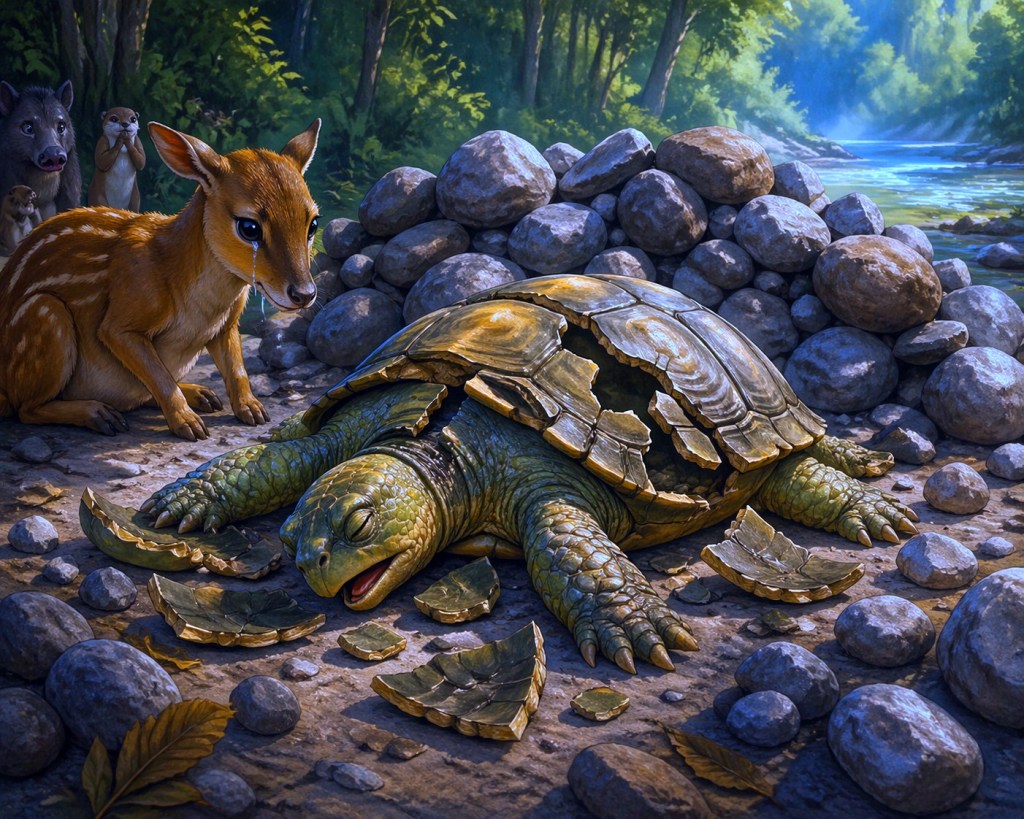
Once everything was ready, the tortoise leapt from the sky. Without wings, it fell rapidly and crashed onto the pile of stones. The sound of the impact was deafening. Hearing it, the Mousedeer rushed over and found the tortoise’s shell shattered into pieces. The tortoise lay unconscious. The Mousedeer cried when it saw this, thinking that the tortoise was beyond help. After crying, it gathered the scattered pieces of shell and carried the tortoise home for treatment.

At home, the Mousedeer sought help from the Lizard Shaman to heal the tortoise. That evening, the shaman conducted a ritual in which he used his wisdom to put the fractured shell back together. But not all of the pieces could be found since they had broken too finely. It took a long time, but the shell was finally reassembled.

The rebuilt shell was a lot smaller than the original. The tortoise itself became smaller because of this. This is why tortoises are smaller now and not as big as they used to be. Their shells are no longer smooth as they once were. Instead, they are patterned and segmented, as if they were put together.

Note:

I translated and adapted this story into Malay (shared on Threads) and English (here on my blog), based on the Iban version originally shared by Gregory Nyanggau Mawar on the Iban Cultural Heritage website.


I write about Iban culture, ancestral rituals, creative life, emotional truths, and the quiet transformations of love, motherhood, and identity. If this speaks to you, subscribe and journey with me.
The Mouse-Deer and the Crocodile | A Classic Iban Folktale

One day, the mouse-deer (pelanduk) went out to look for food. After walking for about an hour, he reached a swamp covered in tall grass (madang melai) and water plants. Not far from there, an old Malay man named Pak Dollah was busy clearing the area to prepare it for farming.

The mouse-deer wanted to eat the fallen fruits of the simpur tree (pun buan) that grew nearby, but he was afraid Pak Dollah might see him. He moved carefully, one step at a time, hoping to stay unnoticed. But his fear was unnecessary, Pak Dollah was too focused on his work to notice anything around him. So the mouse-deer went ahead and ate the fallen fruits to his heart’s content.

When he was full, he turned to leave. Just as he was about to walk away, a female crocodile (baya indu) suddenly shouted at him.

“Hey, Mouse-Deer!” she called.

“Oh, Crocodile! You scared me!” he replied.

“You ate my eggs, didn’t you?” she accused.

“What? Of course not!” said the mouse-deer.

“Don’t lie! I saw your footprints near my nest. All my eggs are broken because of you!” the crocodile shouted angrily.

“You can’t just accuse me like that. What proof do you have?” asked the mouse-deer.

“I saw your footprints, that’s proof enough!” she insisted.

The mouse-deer tried to stay calm. “I didn’t eat your eggs. Maybe they broke because Pak Dollah accidentally cut through your nesting spot while clearing the grass. Look over there, he’s still working.”

But the crocodile didn’t believe him. “Don’t try to trick me. I know your sly ways, Mouse-Deer,” she said. “You’re so small that even if I swallowed you whole, I wouldn’t be full.”

“Alright,” she continued. “If you really didn’t eat my eggs, prove it. Let’s have a tug-of-war. If you lose, that means you’re guilty. If you win, I’ll believe you’re innocent.”

The mouse-deer pretended to think for a moment, then agreed. “Big body, small brain,” he muttered under his breath. He asked for three days to prepare, and the crocodile agreed.

When he got home, the mouse-deer sat quietly, trying to come up with a plan. He knew he could never win against the crocodile by strength alone, so he decided to use his wits. He called his friend, the tortoise (tekura), for help.

“Oh, Tortoise,” he sighed. “I’m doomed. The crocodile challenged me to a tug-of-war because she thinks I ate her eggs.”

“Don’t worry, my friend, I’ll help you,” said the tortoise calmly.

“Do you have an idea?” asked the mouse-deer.

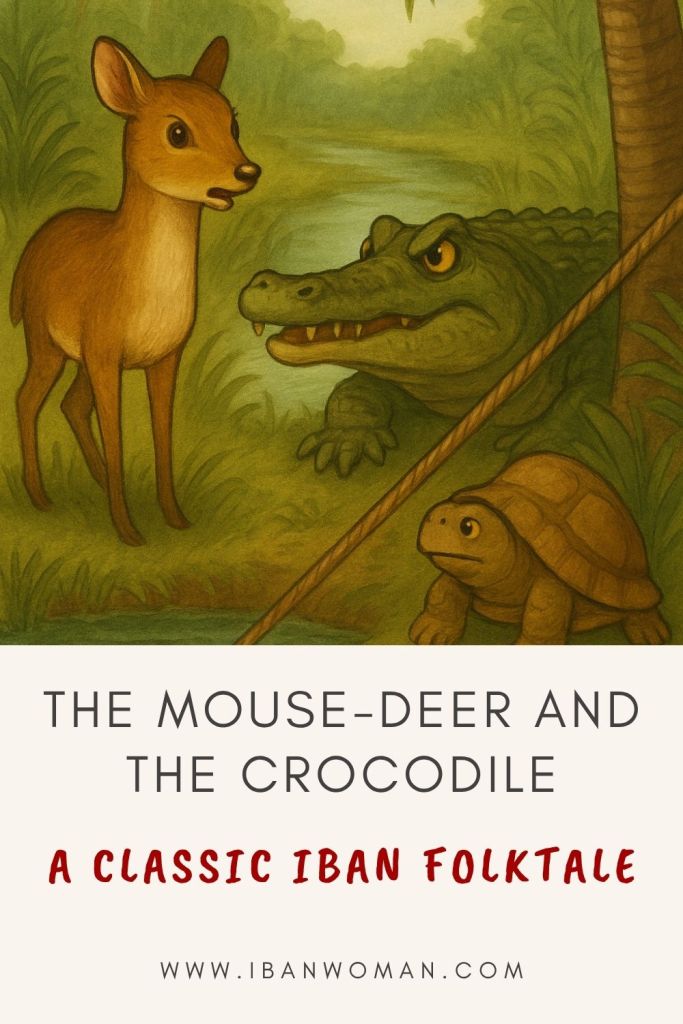
“I do,” said the tortoise. “When the contest starts, tie your end of the rope to the coconut tree by the swamp. The crocodile won’t see it since she’ll be in the water.”

“That’s brilliant. Thank you, Tortoise,” said the mouse-deer, feeling relieved.

Three days later, the crocodile waited by the swamp.

“Hey, Mouse-Deer! Are you here yet?” she called out.

“I came earlier than you,” the mouse-deer replied.

“Are you ready?”

“I am. But before we start, we need a referee,” said the mouse-deer.

Right on cue, the tortoise appeared slowly from behind a tree. Seeing him, the crocodile quickly appointed him as referee. The tortoise pretended to be surprised but accepted.

He set the rules. “Crocodile, if your feet touch the land, you lose. Mouse-Deer, if your feet touch the water, you lose. I’ll go back and forth to make sure both of you obey the rules.”

The crocodile went into the water, holding one end of the rope in her mouth. The mouse-deer stood by the coconut tree, holding the other end. Once the crocodile was ready, the tortoise hurried to help the mouse-deer tie his rope tightly to the tree.

“Alright,” said the tortoise. “One! Two! Three! Pull!”

The crocodile pulled with all her might. Her tail whipped through the water, splashing high into the air. But no matter how hard she pulled, the mouse-deer did not move an inch. On the bank, the mouse-deer pretended to pull back with great effort, squinting and swaying from side to side as if truly struggling.

The contest went on for hours, until late afternoon. The crocodile grew exhausted and finally released the rope, gasping for breath as she crawled onto the shore. The mouse-deer still sat there, holding his end of the rope, calm and unbothered.

The tortoise approached them. “The match is over. Since the crocodile let go of the rope first and came onto land, the winner is the mouse-deer. This proves he didn’t eat your eggs. They were broken because Pak Dollah accidentally cut through your nesting ground while clearing the area. You were the one at fault for laying eggs on his land.”

“See, I told you I’m not afraid of you on land,” said the mouse-deer. “Next time, don’t accuse others without proof.”

The crocodile said nothing. Embarrassed, she quietly slipped back into the water. The mouse-deer and the tortoise looked at each other and smiled before heading home, pleased with how things turned out.

Note:

I translated and adapted this story into Malay (shared on Threads) and English (here on my blog), based on the version originally shared by Gregory Nyanggau Mawar on the Iban Cultural Heritage website.


I write about Iban culture, ancestral rituals, creative life, emotional truths, and the quiet transformations of love, motherhood, and identity. If this speaks to you, subscribe and journey with me.

Iban Folktale | The Tale of Tekuyong and Pelandok

A long time ago, when animals could talk like we do, the river snail, Tekuyong, was slowly moving across a wide rock by the riverbank. His body glistened in the morning light as he licked moss off the stone and nibbled quietly.

Pelandok, the mousedeer, came along. He was light-footed and couldn’t sit still. He was sniffing the ground for soft buan leaves to chew. He stopped and yelled, “Oi, Sambi Tekuyong!” when he saw Tekuyong stuck to the rock with his head bowed. (Sambi means “friend or pal.”) “Why are you sitting there so still? You’re not moving at all.”

Tekuyong lifted his feelers. “I’m not idle, Sambi. I’m eating the moss by licking the stone. That is my food.”

Pelandok tossed his head back and chuckled as he heard this. He laughed until his little body shook. He laughed until his eyes welled up with tears, and his bladder gave way, soaking the ground.

Tekuyong watched silently. When Pelandok finally caught his breath, Tekuyong asked, “What is so funny, Sambi? Why are you laughing at me?”

Pelandok, however, pointed to Tekuyong’s sluggish, gliding body and continued to laugh. Shame burned at Tekuyong’s heart. “Enough, Sambi,” he finally said. “Since you find me so amusing, gather all the animals together to watch us race. We’ll find out who is actually faster in a week.”

Pelandok clapped his hoofs in delight at this. “A race? Against you? Ha! I will surely win.”

They decided that the course would run from the foot of the hill where they were standing to the great rock by the sea. 


Pelandok trotted through the jungle that evening to tell everyone about the race. “Come on, everyone! Watch me, the fastest creature in the forest, defeat Tekuyong the snail!” The monkeys shrieked with laughter, and the birds spread the news with their calls. Soon, the whole jungle was buzzing with excitement.

Tekuyong, on the other hand, crept home with a heavy heart. He called his family together and said, “I challenged Pelandok, but I wish I hadn’t. How can I ever outrun him? He runs as fast as lightning, but I crawl slower than a feather in the wind.”

Some of his family members whispered and shook their heads. One person said, “Why didn’t you think before you spoke? It is better to accept shame than to face certain defeat.”

But Tekuyong stood up straight and said, “If you won’t help me think, then I must think for myself.” He paused for a moment before revealing his plan.

Apai (Father), Aya (Uncle), and Aki (Grandfather), I need you.” You must wait at different points along the racecourse and pretend to be me. Aki, wait upon the rock by the shore. Aya, take your place at the midpoint. Apai, sit beneath the big tree near the finishing line. You all have to shout when Pelandok passes so he thinks I’m ahead of him. As for me, I’ll start the race next to him and then hide.”

The older snails nodded slowly. “It is cunning,” Aki said.  “Let us see if arrogance can be taught a lesson.”


The week went by quickly. On the appointed day, all the animals in the forest came together. Monkeys hung from branches, hornbills flew overhead, kendawang (red headed krait) snakes slithered on the ground, and wild boars dug around the edge of the clearing. The air was full of excitement.

At the starting line, Tekuyong and Pelandok stood next to each other. They picked rhinoceros to start the race. As he counted “One! Two! Three! Run!” his deep voice shook the ground. 

Pelandok shot forward like a dart from a blowpipe, his hooves hitting the ground like drums. Dust flew in his wake. While everyone was busy admiring Pelandok’s speed, Tekuyong moved slightly, then silently rolled into the grass and vanished from view.

The crowd cheered for Pelandok’s speed. “Look how fast he is!” the monkeys yelled. “The poor snail will never make it to the end.”

But when Pelandok reached the rocky shore, there sat Aki Tekuyong, waiting calmly.

Apu! (Oh no!)” Pelandok gasped in disbelief. “How can Tekuyong already be here?” He pushed himself harder.

At the midpoint, Aya Tekuyong called out cheerfully, “I’m ahead, Sambi! Why are you so slow?”

Pelandok’s heart raced. “Apu! Apu! He has beaten me again!” He ran until sweat streamed down his body and his breath tore at his chest.

Near the finish line, his legs trembling, he looked up, and there was Apai Tekuyong, waiting under the big tree! Pelandok collapsed, his sides heaving, his body drenched in sweat. “Apu! I am defeated,” he admitted.

Apai Tekuyong smiled gently. “Why are you so slow, Sambi? I’ve been waiting here for a long time.”

Pelandok bowed his head in shame. “Yes, I have lost.”

“Let this be your lesson, Sambi,” Apai Tekuyong said with a smile. “Don’t ever laugh at other people or think you’re better than them. Each of us has our strength, even the least of us.”

So Pelandok never mocked Tekuyong again. And all the animals who were there that day took the story home with them. That’s why the Iban people still say malu tekuyong today. It means shyness, which comes from respect. For example, when someone invites you to dance the ngajat (Iban traditional dance) or speak in front of the elders, you feel both honored and somewhat uncomfortable or embarrassed. We call that feeling malu tekuyong.

And that is how the snail taught the mousedeer and gave us a saying that we still use today.

Note:
I translated this folktale from Iban into English and Malay. The Malay version is available on my Threads. The original story was written by Gregory Nyanggau Mawar and published on the Iban Cultural Heritage website.


I write about Iban culture, ancestral rituals, creative life, emotional truths, and the quiet transformations of love, motherhood, and identity. If this speaks to you, subscribe and journey with me.

The Tale of Endu Engkejemu and Endu Engkejuang

This is an Iban folktale I grew up with. I translated this old Iban folktale in my pursuit to preserve the Iban oral literature in my own little way. The Iban version is available online, but as far as I know, no English translation has been made. I translated this in hope I can share my obscure culture with the world. I didn’t profit from this work, and I plan to translate more stories in the future and make them available on this blog. This is the story of two women, one patient and one impulsive, and how their choices led them down very different paths.


Long ago, in a place called Lubok Meram, near Lansar Kerangan Betumpu Man and Rantau Rutan, the sacred domain of Raja Ganali (King Ganali) and Bunsu Ikan, the fish god – there lived two young women named Endu Engkejemu and Endu Engkejuang.

Both were beautiful, but Endu Engkejemu’s beauty stood out. She was graceful and brilliant. Aside from her beauty, she was wise, skilled, and thoughtful. Her calmness and ability to do things well were her strengths. Endu Engkejuang, on the other hand, was full of life and quick-tongued. She was usually the first to welcome guests and try new things. She hated being second, but her impatience showed in the fact that she didn’t always do things right. For her, how quickly something was completed was more important than the quality.

One day, as they were bathing at the river, Endu Engkejuang admired her friend’s long, beautiful hair and asked, “Wai (dear), your hair is so lovely. What’s your secret?”

Endu Engkejemu replied, “Eh, no secret, wai sulu (dear friend). I just use tilan fish bones to comb my hair.”

That evening, Endu Engkejuang found a tilan fish bone and combed her hair while chanting, “Comb my hair, oh tilan fish bones, comb it to the very end.”

But she had not spoken the request properly. The bones obeyed her words exactly, and by the time they finished, she was completely bald! Crying, she ran to Endu Engkejemu for help. Her friend gently explained, “You must ask kindly. Say, “Oh, bones of the tilan, I ask you to comb my hair well so it will grow long and thick.”

Endu Engkejuang followed her advice, and slowly, her hair began to grow again.


Not long after that, Endu Engkejuang saw a handsome man sitting at Endu Engkejemu’s ruai, the communal space of the longhouse. Curious, she rushed to her friend and asked, “Wai, who is that handsome man?”

“He appeared after I pounded some rangan lime leaves,” Endu Engkejemu replied.

Without hesitation, Endu Engkejuang gathered some leaves but picked them carelessly, including old and rotten ones. She pounded them, hoping to summon someone like the man her friend had met. Instead, an old, wrinkled, and scarred man with warts appeared!

Horrified, she ran to her friend again. “Why is yours so handsome and mine so ugly?”

Endu Engkejemu answered simply, “Because you didn’t choose the leaves properly. Only pick the young and nicest leaves. Good things come from good intentions, wai.”


Later, while working in the paddy fields, the two friends were swarmed by mosquitoes. Irritated, Endu Engkejemu said aloud, “There are so many of you! If you love me so much, why not take me as your wife?”

To her surprise, the mosquitoes lifted her gently and carried her to Raja Nyamok, the Mosquito King. There, she became his wife.

Life in the mosquito kingdom was difficult. The mosquitoes fed on blood, and Endu Engkejemu could not eat what they ate. But she never complained. She continued to treat her husband with kindness and respect, even though she was silently suffering.

Eventually, she pretended to be ill. Raja Nyamok, concerned, summoned a manang (shaman) to heal her, but she only became worse. Finally, she pretended to die.

Heartbroken, Raja Nyamok arranged a grand funeral for her. He ordered her body to be placed on a high altar, as was the custom for royal family members. He provided her with new clothes, jars, traditional musical instruments like setawak, dumbak, bendai, menyarai, engkerumong, and gong. There were many other valuable items to accompany her in the afterlife.

When the mourners returned home, Endu Engkejemu quietly unwrapped herself and took everything back with her to her longhouse. Her return amazed everyone. No one could believe what she had brought home.

Endu Engkejuang heard that she was back and she was filled with burning envy. Determined not to be left behind, she hastily went to the paddy fields and let herself be bitten by the swarming mosquitoes. “Take me as your wife if you want me so badly!” she yelled.

The mosquitoes carried her to Raja Nyamok, who accepted her as his wife. But unlike Endu Engkejemu, Endu Engkejuang couldn’t hide her disgust. At the sight of blood everywhere, she whined and complained, “My father never raised me to drink blood like this. I could never be married to someone like you!”

Insulted, Raja Nyamok declared, “You have humiliated me in front of my people and insulted our food and our way of life.”

He ordered his followers to tie her hands and feet and leave her in a part of the jungle where no one would find her. Alone in the middle of the jungle and covered in bruises and mosquito bites, Endu Engkejuang eventually freed herself and stumbled back to her longhouse.

Her family was shocked to see her when she arrived. She looked terrible: her face was swollen, her clothes were ripped, and she was crying pitifully.

Endu Engkejemu, on the other hand, lived on with quiet dignity. Her story, which has been passed down through the generations, reminded everyone that being wise, patient, humble, and caring pays off, while being envious, petty, and rushing often leads to disaster.

Note:

I translated and adapted this story into Malay (shared on Threads) and English (here on my blog), based on the version originally shared by Gregory Nyanggau Mawar on the Iban Cultural Heritage website.


I write about Iban culture, ancestral rituals, creative life, emotional truths, and the quiet transformations of love, motherhood, and identity. If this speaks to you, subscribe and journey with me.