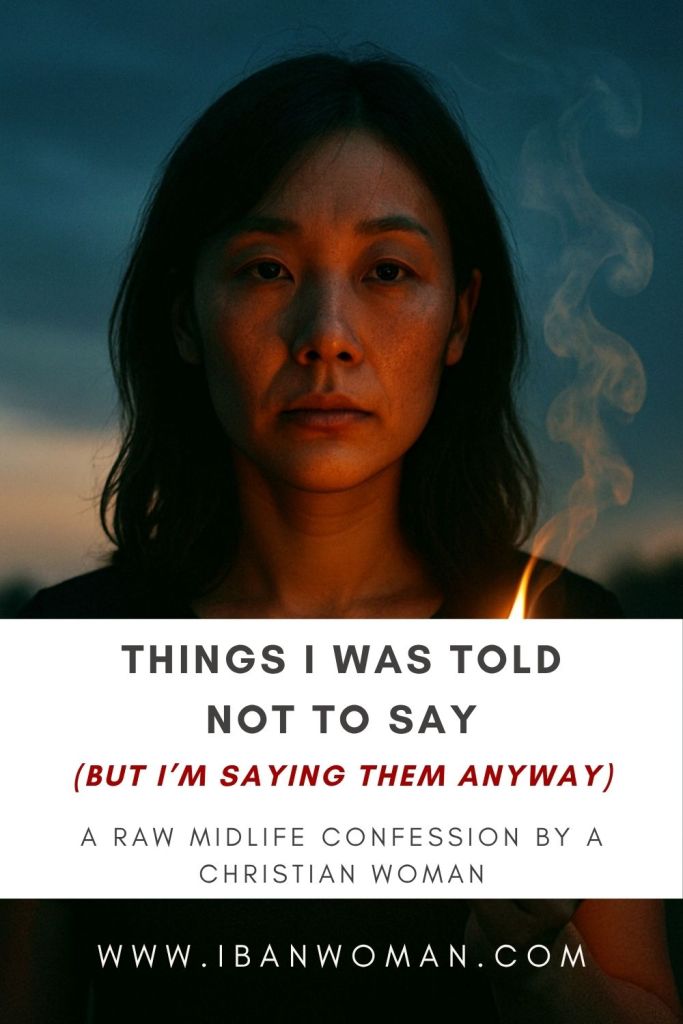
Things I Was Told Not to Say (But I’m Saying Them Anyway)

Like everyone else, I was raised to be polite, to lower my gaze, and to keep my mouth shut before it bleeds arrogance or truth. But truth doesn’t always need to wait for permission and I’m done looking for it. 

This is a list of things I was told not to say because they are deemed shocking and inappropriate. But I’m saying them anyway, because being silent isn’t always safe. It was a slow suffocation and death.

I was told not to say:

  1. “I’m tired of being the emotional one, the one who feels things.”

But I am. It’s draining carrying the burden of my own feelings and everyone else’s. You say I’m too touchy. I say you need to be more sensitive.

  1. “Sometimes I don’t want to be a mother.”

It doesn’t mean I don’t love my children. It means I want to disappear sometimes. To be free of endless burdens and responsibilities. I want to just be me without being attached to roles and expectations, even just for a while. Just long enough to find myself again.

  1. “Marriage is lonely.”

Yes, even the good ones. Especially the good ones; when you’ve been together long enough, you know each other too much there are barely any surprises anymore. 

  1. “I still think about the one who left.”

No, I don’t want him back. But he lives in the hallways of my memory, like when I stop to think about certain songs or street names or places. That’s not being unfaithful. It’s my memory and the only way to forget it is if I lost my memories to dementia or brain damage. Otherwise the memory remains. And I’m allowed to carry it.

  1. “I don’t want to go to this church anymore.”

I believe in God. But I don’t believe in being controlled and being silenced. I don’t want to pretend everything’s fine when my spirit is clearly not. I’m not giving up on faith; I’m moving toward the truth.

  1. “I feel ugly on some days.”

No amount of affirmations makes it disappear. There are days when I can’t stand my body. Some days I don’t even notice it at all. Both truths exist.

  1. “I envy women who get to choose their identity.”

Because I never did. I was born into roles before I could choose which ones I liked. Wife and mother. Good girl. Christian. I played every one of them. But now I want to rewrite the script where the real me can finally be set free. 

  1. “I don’t want to be grateful all the time.”

Gratitude is holy. But forced gratitude is performance. I don’t owe anyone a smile when I’m breaking inside. I can be grateful and grieving at the same time.

  1. “I want more.”

More silence. More passion. More space to create without guilt. More people who see me without needing me to explain myself. I want more than I was told I should ask for.

And yes, sometimes I want to be desired and not just needed. There’s a difference. And I feel it every time I’m touched with obligation instead of longing. 

I was told not to say all of this. They are taboo and a good Christian woman, a wife and a mother, shouldn’t entertain these sinful thoughts. 

I was told to play it safe. To keep my life neat, soft, godly. I was told not to stumble others in their faith.

But truth isn’t always soft. Truth can hurt and burn sometimes. And I’d rather burn than spend another decade in silence.

Call me whatever you want. A premenopausal woman in the heat of a midlife crisis. A delusional Christian woman being lured by the devil. These are some of my truths and I’ll not stop writing about them and shrink myself for others’s comfort. I’m so done with being prim and proper and always saying the right things all the time. I’m done with lying. It’s time for me to proclaim my truths and make them known to others. 

The Things That Undid Me

I cooked my love down to tar,
a black syrup in the bottom of the pot.
It taste like a lie
but I said nothing.
I was raised to chew my
tongue for supper.

I sewn myself into the good wife’s dress,
blessed and above reproach,
but I swallowed my own teeth
like communion wafers.

My children pressed their ears to my palms
and heard singing.
But some nights,
my fingers were fists
full of burnt letters.
I’m no witch,
only a woman
who learned too late
that silence is murder.

The pastor preached be pure.
But I loved the smell of rain
in my dirty hair,
my body wanting
without shame.

God, forgive me–
not for sinning
but for the way I loved it:
the unwashed sheets,
the stains on the hymns,
the animal in me
that refused to kneel.

I’m not sorry for the smoke,
or the fire I’ve become.
I’m sorry it took me
this long to strike the match.

© 2025 Olivia JD


Olivia Atelier offers printables, templates, and art designed to inspire reflection, healing, and creativity. Visit Olivia’s Atelier for more.

The Other Me | The Woman Behind the Poem

When I wrote the poem “The Other Me,” I wasn’t trying to sound bold or dramatic. I was just being honest by telling my truth. 

People often assume they know me. They see a woman who is quiet. A wife. A mom. A Christian. Someone who shows up, serves, nods politely, and doesn’t cause trouble or controversy. I’m familiar with this image because I’ve lived inside it for most of my adult life. It’s not that it’s wrong. It’s just incomplete.

There has always been a deeper current under the surface. Beneath all that facade of neatness, there is someone who asks harder questions or feels hurt when silenced. There is someone that remembers who I was before all the roles and expectations started to pile up on me.

“The Other Me” is not a fictional character. She is a real person who has always been by my side. I put her away, hidden, so that I could make room for acceptance, safety, and community. In religious communities, women are often praised for being quiet, gentle, and obedient. Where doubt must be neatly dressed in submission, and discomfort is treated like rebellion.

The poem came from the grief of hiding and of living a half-truth because the whole truth felt like too much.

I was taught to be agreeable as a child or to be well-liked. I learned that being difficult was the same as being rejected. That if you had questions, you lacked faith. That wanting more, like more closeness, more freedom, and more honesty, was wrong or selfish.

So I stayed small. I stayed quiet. I played the role so well I almost forgot I was acting. But staying quiet has a price.

When you’re around people who only know the version of you that makes them comfortable, a certain kind of loneliness grows. They love that safe version of you and they honor her because she embodies the values they approved. But you start to wonder if they would still love you if you said something out of character. What if I stopped editing myself for the sake of their comfort? What if I let the fire show?

And then one day you write a poem.

You write it because you have things you want to say but can’t. Your body remembers what your mind tries to bury. Because there is a woman inside you who is sick of bending over backwards to meet other people’s expectations.

You don’t even know if you’ll share it when you write it. But that is beside the point because the truth is you need to see this woman and say to her, “I haven’t forgotten you.”

“The Other Me” is about the version of myself that doesn’t fit into polite spaces. She is the one who laughs too loudly, writes about God and desire in the same line, and asks questions about things she was told not to touch. She loves deeply but won’t let anyone else control her.

In the past, I was scared of her.

But now I know she isn’t a threat. She isn’t being defiant just to be dramatic. She is just being honest. She is the version of me that lived and survived. And I owe her more than just silence.

When I say I feel alone sometimes, I mean it in a specific way. I don’t mean that I don’t have anyone around me. What I mean is that I don’t have a place that feels like home and where I belong. I don’t quite fit in with the local creative community, where the type of poetry that gets attention is usually light, easy to read, and trendy. I write differently. I write deeply. And sometimes, that depth becomes a wall between me and the world I want to reach. 

At the same time, the people who connect with my work often live far away. They have different cultures, different worldviews. We connect through words, but we live in different worlds. That, too, feels like a dislocation.

But still, I write.

Because this is how I heal, and this is how I remember. This is how I get back the parts of myself that I’ve tried to hide for a long time.

The Other Me is not a rebellion. It is a way for me to return to the version of me that I’ve neglected.

And maybe, just maybe, if I keep writing her into existence, someone else out there who also feels out of place, half-formed, and unseen, will recognize themselves in my words. And that recognition will feel like belonging.

We might not need to fit in to be complete. Maybe we just need to be honest.

And that is what this poem gave me. A little more honesty. A little more light. A little more room to breathe.

And to the version of me that is still hiding: I see you. We’re coming home.

Note: This poem is not published yet, but you can read a short excerpt on my Threads post.


Olivia Atelier offers printables, templates, and art designed to inspire reflection, healing, and creativity. Visit Olivia’s Atelier for more.

Nights Beneath the Mosquito Net

It’s a memory so soft, so far away, it almost feels like I dreamed it. But it was real.

I was ten, maybe eleven. We were back at the longhouse, in our bilik, the apartment that was our family’s space within the longhouse. There were no bedrooms, no separate rooms. Just us, rolling out our mats, hanging mosquito nets, settling down for the night. There was no electricity then, so nights came early. A single oil lamp flickered in the middle of the room, casting shadows that danced along the wooden walls.

And this was when my grandmother would start telling her stories.

She didn’t sit up to tell them. She lay down, just as we did, her voice weaving through the silence. She spoke of people she had known, incidents long past, things that had happened when the world was younger. Her words filled the dark, mingling with the sounds of the jungle outside. We’d listen as sleep slowly pulled us under, her voice becoming part of our dreams.

I don’t remember the details of her stories. Decades have passed. But I remember the feeling. The peace. The comfort. The sense of being anchored to something larger, older, gentler.

Sometimes I wonder if my children will ever have moments like that. Moments where stories are not read from books or screens but spoken softly in the dark, meant only for their ears.

That memory, fragile as it is, is one of my favorites. Because in that moment, I felt safe. I felt home.


Visit Olivia’s Atelier for printables, reel templates, and planners made to support overwhelmed moms with gentle, soulful tools.
🕊️ Enjoy 50% off everything until June 30.

When Passion Feels Like Work

Today I felt as if I were running in place. Not because I’m lost, but because the journey is long.

I’ve recently been devoting a lot of time to my Etsy shop. Learning, doing, testing, improving, failing, and adjusting. And doing it all again. This is not my first venture. I’ve had multiple internet stores on different sites that have generated passive income for years. But Etsy is a completely different beast. A new challenge for growth.

I’ve been building digital shops while raising my children for over a decade. There is no nanny or assistant. Just me, showing up every day, struggling to balance the invisible weight of being a parent and ambition with whatever strength I can muster. My capital is limited. My energy was often stretched thin. Everything is hands-on.

I’m not saying this to complain.

I say this because we need to recognize what it takes to create something from nearly nothing.

People talk a lot about passion but rarely about what happens when passion becomes a career. When inspiration alone is not enough. It demands stamina, fortitude, and faith in the unseen.

This isn’t a glamorous path. But it is mine.

And I am still walking it. Still deciding to show up. Still believe that slow is not the same as stagnant. I’m still discovering that perseverance doesn’t have to be loud. It is often quiet, exhausting, and unchanging.

If you’re there, I see you. And if you aren’t there yet, you will understand one day, when your heart is totally invested in something that also leaves you drained.

This is what it means to care.

This is what it means to keep striving.


✨ Visit Olivia’s Atelier for printables, reel templates, and planners made to support overwhelmed moms with gentle, soulful tools.
🕊️ Enjoy 50% off everything until June 30.

Marriage Traditions of the Iban of Sarawak, Borneo

Marriage is a timeless union that binds two souls together. It also functions as a mirror, reflecting the core of a community’s culture and identity. My people, the Iban of Sarawak, Borneo, fill their traditional wedding rituals with deep meanings based on ancestral traditions. However, these traditional ceremonies are gradually disappearing as time passes.

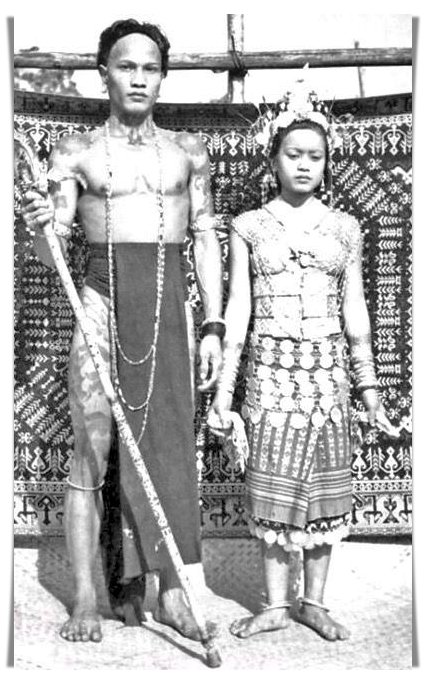
For the Iban, marriage was not just a bond between two individuals but a communion of families and communities. Traditionally, the groom’s parents carefully planned this arranged marriage. Ties of kinship often influence their choice of wife. Cousins were preferred matches because they preserved familial relationships while also reflecting the Iban’s value of unity within their extended network. When a bride was chosen, the groom’s parents would leave a rawai (silver girdle) or an ilang (sword) at her family’s home as proof of their dedication and intention.

Image source

The longhouse is the heart of Iban community life. During weddings, it becomes a lively epicenter. It was here that life and celebration collided, and the community joined together to honor the union. Careful planning is required days or weeks before the ceremony. This includes making tuak (rice wine) in enormous vats, preparing traditional buns and cookies, and selecting livestock for slaughter. Guests were invited with knotted strings to tally down the days till the celebration.

On the wedding day, the groom’s journey to the bride’s longhouse was a ceremony unto itself. The groom’s party traveled to the bride’s longhouse either by boat or on foot through the jungle. Guests were expected to dress in traditional ngepan (intricate traditional costumes), with women donning corsets or rawai (silver girdles) and men wearing armlets and feathers, among other traditional pieces. The groom’s party arrived to a joyous clash of gongs and the firing of brass cannons.

However, underneath the surface of celebration were rituals with deeper meanings. One of the most remarkable customs was the use of poetry or poetic language to provide the ceremony a sense of artistry and depth. When the official ceremony started, the host’s representative would offer the guest a drink, followed by a formal recitation inquiring about their purpose:

“I hesitate and feel nervous to talk in front of you all,
The reason I say so is because I realize that you are the mothers of porcupines,
Covered with cross-stripped white quills,
Pointed like bradawls.
I notice that you are the mothers of hornbills,
With tails striped,
crossing at right angles,
Which claim that they can fly to Brunei and return the same day.
I see that you are the mothers of bears,
Which have stout arms to make holes on the trunks of iron-wood trees.”

“We, therefore, have been sitting next to each other.
I would like to ask,
Which one of you is the mother of the hornbill?
For I am about to ask you to spit out the seeds of the belili tree,
In order that they can be picked up by a tall, unmarried lady,
So that they can be turned into the tusks of a pig,
As charms for the unripe ears left till the last in reaping,
With which we fill our padi bins.”
Poem source

These exchanges were rich in metaphor and eloquence. The poetic recitations continued throughout the ceremony, including a betusut (genealogical recitation) by an expert who detailed the bride and groom’s genealogy. This ritual not only validated the union but also ensured that the marriage respected cultural taboos and norms in order to avoid misfortune.

Image source

Elders sealed the union with feasting and storytelling, bestowing blessings and wisdom on the pair. They discussed respect, understanding, and the delicate balance required to navigate life together. Complex traditions and customs infused every action, from seating arrangements to gift exchange.

Today, such ceremonies are a rarity. The Iban embraced Christianity and Islam, abandoning many of their traditional practices in the process. The vibrant rituals of traditional Iban weddings now exist mostly in memory or retellings.

The ceremonies detailed here are not simply rituals. They depict a way of life that places a high priority on community, heritage, and balance. They remind us of the beauty of traditions that once connected people to their past while celebrating the present. The decline of this tradition is a loss not only for the Iban but also for the universal human story of connection, identity, and belonging.

The significance of the Iban wedding customs strikes me as I reflect on them. Marriage was never just about two people; it was about integrating their lives into the larger fabric of their community. It was about love, shared responsibility, and the power of a collective spirit.

Perhaps that is the true power of these traditions: their ability to touch something deep within us while also reminding us of the fragility and beauty of cultural heritage. And as we look forward, perhaps we have a tenacious hope that even as the old ways fade, their spirit will continue to shape the future in ways we may not fully comprehend.

Modern Iban weddingImage source.

This Is Not the Mother I Meant to Be

I could name only one, but that wouldn’t be honest.

A lot of times in my early years as a mother haunted me quietly like background static in an otherwise happy song. The yelling, harsh words, and unwarranted anger all fell directly on little shoulders. I wrote a poem about it once. It’s titled This Is Not the Mother I Was Meant to Be. It is now available in my Etsy shop, which can be found here.

The poem is more than just a piece of text. This is my confession. A gentle, timid apology. A mirror I held up to my own face on days when I thought I had failed in the most important duty.

I meant to be gentler. I wanted to listen more. But there were times when I snapped, yelled when I should have breathed deeply, spanked when I should have paused, gave them junk food and called it dinner and said things I wish I could take back. Things like, “Be quiet. Enough. Just stop.” When all I truly wanted to say was, “I am exhausted, honey. I am trying. I love you so much, it hurts.”

Even now, the guilt weighs heavy. But, with time, I’ve realized that remorse isn’t supposed to tie me to the past. It is meant to teach me, then let me go.

As the kids grew older, I began having open conversations with them. I apologized. Not in grand speeches, but in quiet moments together: during car rides, at bedtime, or while having a meal. To my astonishment, they forgiven me. Completely, freely. As children frequently do when love triumphs over regret.

Their forgiveness was a balm. But can I forgive myself? This is still a work in progress.

What comforts me now is the realization that motherhood is not a destination. It is a process of growing. Every mistake I made was the result of a version of myself doing my best with what I knew. And I understand better now. I pause longer. I listen more carefully. I still make mistakes, but I’m more aware of them. I grow together with them.

So, if you’re a parent who’s been lugging guilt about like a hidden stone, maybe it’s time to let it go. Perhaps you can let the softer part of yourself speak. The one who continues to show up, try, and love with each broken, beautiful step.

Because this is not the mother I meant to be. But I’m still evolving to be a better version of myself.


Visit Olivia’s Atelier for printables, reel templates, and planners made to support overwhelmed moms with gentle, soulful tools.
🕊️ Enjoy 50% off everything until June 2.

A Mother’s Day Reflection

I didn’t grow up imagining myself as a mother.

Not as other girls did, pretending to cradle dolls or writing baby names in the margins of their schoolbooks. I wasn’t opposed to becoming a parent; it simply didn’t feel urgent, like something I needed to pursue or prepare for. And yet, I am here. It’s been years. A mother. With gentle hands and a heart that is always rearranging itself around little lives.

Mother’s Day used to pass with little thought. A day spent playing cards and making phone calls. Of seeing my own mother from a distance, attempting to decipher the aspects of her that I could never fully grasp. I had no idea she felt so invisible at the time. When you’ve given everything to others and lost yourselves, silence may be deafening.

Now I do.

Mother’s Day is now a quiet occasion in our family. The kids sometimes remember and sometimes they don’t. My hubby asks what I want to eat. I fold the laundry and do the dishes anyway. Life does not stop simply because it’s May. However, a part of me always wishes for a pause, if only for a moment. A pause that says, “We see you. It is not simply what you do, but who you are underneath it all.”

This year, I didn’t request flowers or breakfast in bed.

What I desire cannot be purchased or arranged.

I want someone to acknowledge my effort. How I manage to show up even when I’m very exhausted. How I manage to kiss their foreheads at night despite carrying the weight of invisible things like schedules, fears, and guilt. I want someone to say, “I see the woman you are, not just the mother you have become.”

Because I’m both.

A woman who once had aspirations that did not involve diaper bags or parent-teacher meetings. A woman who still longs for quiet mornings and uninterrupted thoughts. Also, a mother who has dedicated her body, sleep, and time to love so profound that it has utterly transformed her.

So, on Mother’s Day, I gave myself what the world frequently forgets to give: grace.

Grace for the things that remain undone.

Grace for the yelling I regret doing.

Grace for the dreams I’ve placed on hold.

Grace for the ways I am still learning to parent myself.

And maybe that’s all it needed.

Happy Belated Mother’s Day to the quiet mothers, the tired ones, the fierce ones. The ones who feel like they’re failing but keep showing up anyway.

I see you.
And I’m learning to see me, too.


Mother

They see
lunchboxes prepares,
schoolwork signed,
clothing neatly arranged into piles.

But they don’t see
the woman who forgot who she was
before responding to “Mama.”

They don’t see
how she holds her breath
until the door closes,
and she can cry
without needing to explain.

They don’t see
how she forgives herself
in small rituals—
a hot cup of tea,
a song in the car,
a scrawled poem
at midnight.

They don’t see
her saving herself
a little at a time.

And still
she shows up.
Every day.
with love nestled
into every nook of her weariness.

Because this is what she does.
That is who she is.

Copyright © Olivia JD 2025
All Rights Reserved.


Looking for digital tools that support your everyday life with gentleness and intention?
At Olivia’s Atelier on Etsy, I offer more than just pretty printables—I create emotional support kits, Instagram reel templates, children’s meal planners, and other soul-nourishing resources for moms who give so much but rarely feel seen. Whether you need a moment to breathe, a tool to stay organized, or a way to connect with your audience—there’s something here for you.

🕊️ Everything is 50% off until June 2—because you deserve support that feels doable, beautiful, and kind.

The Hour After Midnight | Why I Stayed Awake When I Should’ve Slept

For years, I stayed up too late.

It wasn’t because I was working or I had boundless energy or I was busy chasing my dreams. The main reason was that I needed to feel like a person.

It didn’t start as revenge bedtime procrastination. That phrase only found me later, when I stumbled across an article that put a name to my nightly rebellion. It felt like intense desperation. You could say it was a craving or a desperate fight for space.

When my children were small, the days blended together in a mist of needs. I remember those years vividly and if I’m honest, it makes me shudder, but not because I feel ashamed. My daily life was full of milk-stained shirts, sticky fingers, and toys scattered like confetti across every surface. I loved my kids fiercely. Still do. But in those days, I didn’t know where I ended and they began. I gave them my body, my attention, and everything. And somewhere in that giving, I began to disappear.

When the kids were finally asleep and when the house finally went quiet, and the dishes were done, I sat down. Just for a moment, just to breathe.

And that moment stretched beyond what I intended. I stayed up. Scrolling. Reading. Writing. Wandering through Facebook memories of the woman I used to be. Buying time I couldn’t afford, just to feel like I still existed.

I’d tell myself, “Just one more post. One more chapter. One more scroll.”

But truthfully? I was afraid that if I slept, I’d wake up and do it all over again. The endless giving, pouring out myself and forgetting.

So I kept stealing those hours after midnight.

And in the morning, of course, I paid the price.

I was more irritable. More short-tempered. More ashamed of the mother I was becoming.

The irony was painful: I stayed up to save myself, but it only made me more fragile the next day.

I never told anyone how much I resented the way my life had shrunk. How much I missed myself and how ashamed I felt for even feeling that way.

That was the case until I began writing about it.

That’s how The Hour After Midnight came to life. It began as fragments and eventually evolved into a complete poem. A piece of me, speaking directly to the woman I used to be. Perhaps I still am that woman, but these days I go to bed at 12 AM or earlier. As the kids grow, I enjoy my sleep more, and the resentment has disappeared.

This poem is about a mother who gives her all and suffers in silence. It’s about a woman who craves stillness to survive her crazy life of constant giving. She was just a tired soul who wanted to feel seen.

If that sounds like you, I hope this poem wraps around you like a quiet hug. It’s more than a printable; it’s a recognition and a mirror. A gentle piece of emotional support for any overstimulated mom who needs a reminder to be kind to your mind.

This digital poem makes a thoughtful and unique Mother’s Day gift, especially for the tired mom who needs to hear she’s still enough. It’s a beautiful affirmation of motherhood for those navigating revenge bedtime procrastination, mom life burnout, and those quiet moments where you whisper, “I am enough.”

Find The Hour After Midnight in my shop Olivia’s Atelier. You’ll receive a high-resolution poem print in multiple sizes, ready to frame or gift. I hope it brings you what it brought me—a pause, a breath, a beginning.

Note: Yes, I launched my Etsy shop recently to share my poems with the world. Right now, everything in the shop is 50% off until June 2, including our featured Mother’s Day Poem Printables. They are designed as heartfelt gifts or tender self-reminders to moms everywhere. Feel free to check it out.

A Stranger In the Rain

Daily writing prompt
Describe a random encounter with a stranger that stuck out positively to you.

That evening it was pouring. The rain was unremarkable. It was a consistent, calm deluge that dulled the bustling city. Everything seemed muted: the buildings, the street signs, and the people walking by with their umbrellas slanted against the wind. The pavement glistened under headlights and puddles reflected fragments of neon from signs overhead. The air smelled like coffee, wet concrete, and something faintly sweet, perhaps caramel from the cafe I frequented. It was a little corner cafe with fogged-up windows, dim lighting, and jazz playing softly in the background. It was a place that usually smelled of freshly ground beans and spices.

Image source

I was there, like I usually am. I sat by the window with my notepad open and a blue pen in my fingers. I wasn’t writing, though. I was simply watching the rain blur the world outside. It was one of those times when the silence felt thicker than normal, and you began to hear the sound of your breathing. 

Then he walked in. 

I noticed the rain on his jacket first. He brushed it off at the door and ran a hand over his damp hair. He had short, tidy hair. There was something about him that I couldn’t quite put my finger on. A fluidity in his movements, a stillness that felt almost magnetic. Like he belonged in every room without having to announce it. Was he special? Perhaps not. All I could say was he knew how to take up space without drawing attention. He looked around and saw me. I shifted my gaze to the rivulets of rain on the glass. 

He sat a few tables away, ordered a coffee, and glanced out the window just like I did. I returned to my notepad, pretending not to notice him. I could sense him. He was handsome—strong jaw, deep-set brown eyes, tall, clean-shaven, with strong hands and long fingers that lightly tapped against his cup. There was something else, but I let that thought slide. 

He didn’t talk to anyone. He slowly sipped from his cup. At one point our eyes met briefly. 

And deep down, I knew that this moment, this stranger, meant something. Not in a romantic sense, but as if some quiet part of me recognized something familiar. I couldn’t pinpoint what exactly it was, but I felt silly for believing so.

When I got up to leave, I could feel his eyes on me. The bell above the door chimed as I stepped into the rain. 

At home, I realized I had forgotten my pen. I shrugged it off at first. It was just a pen. He was just a man. 

But still that encounter stayed with me. I couldn’t explain the strange pull it had on me. It reminded me that even in a foreign city where no one knows me, the world can still offer surprises. That maybe connections, even with strangers, don’t always require explanation. Some moments just are. 

And maybe that was the positive part. I didn’t feel less lonely. It simply reminded me that I’m still capable of feeling something real. Even if it begins and ends only in my mind. 

The Decision to Be More

There was never a single moment, or a major insight on the days leading to New Year’s, or on a birthday, or a milestone achieved. It was a slow, emerging truth I quit resisting. 

I am aging. And that is not a tragedy.

For years, I lamented the softness of my skin and the changing lines of a face I no longer recognized in photographs. I missed the firmness, glow, and smoothness of youth, which wrapped around me like a second skin. I yearned for the girl who moved through the world without realizing the burden she would one day bear.

But now that I’m nearing 50, I see her differently.

I no longer see myself as a lesser version. I am more.

At this age, I have increased knowledge and become more present. I’m more accepting of my flaws. This kind of self-acceptance in midlife didn’t happen overnight: it bloomed slowly, from the roots of every hardship, every choice, every shift in perspective.

With age comes experience, and with experience comes wisdom. These aren’t simply intellectual ideas; they are embodied experiences that influence my creativity. My writing and art are richer today because I’ve lived rather than just relied on techniques. I don’t just write from theory or imagination but from the scars and marvels of real life. I write from the experiences of heartbreaks, little delights, and the gentle discoveries that only time can teach.

As a woman approaching 50, I’ve learned that aging gracefully doesn’t mean staying youthful. It’s about honoring the life I’ve carried. My body has carried life, birthed babies, nursed them through illness, and made room for love, grief, and exhaustion. My skin has experienced both pleasure and suffering. My heart is shattered yet still pulses with hope. I’ve been silent and loud, scared and bold, gentle and hard.

The decision that altered everything wasn’t about reclaiming lost youth but about releasing the need to chase it. 

Now, I wear my years like a well-worn sweater: tattered at the edges, stretched in spots, but warm, treasured, and wholly mine.

I struggle with fatigue and aches. Occasionally, I wish I could turn back time. But then I recall what I’ve gained: clarity, discernment, and self-compassion. I’ve gained a deeper, braver love for my body, my truth, and my desires. This is what aging and self-growth look like: forgiving the past versions of myself while stepping fully into this one.

If I’m lucky, I’ll live another 20 to 40 years. Perhaps less. But I no longer pursue time; I walk alongside it.

That was the decision: to embrace aging rather than shy away from it.

And I’ve never felt more alive.