My First Group Exhibition in Malaysia and A New Zine in the Making

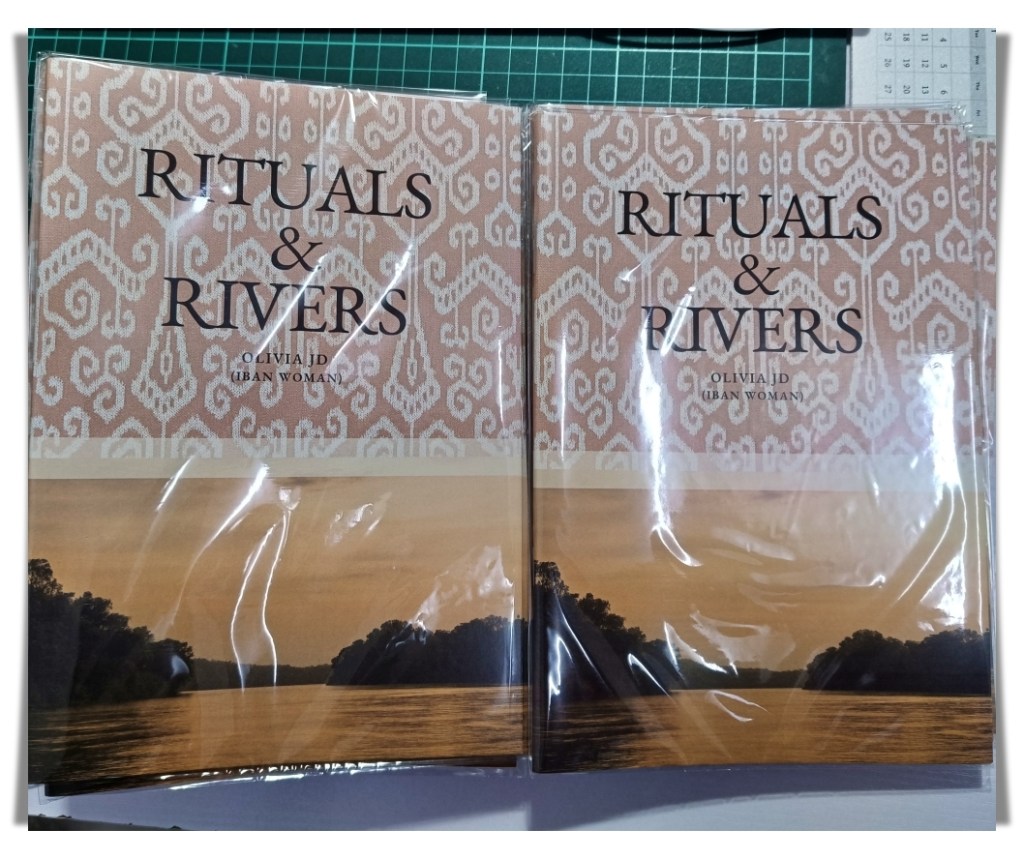
Tomorrow is the soft launch of Akar Kita Abadi, the group exhibition I’ve been preparing for the past few weeks. I will exhibit several of my Iban heritage poems called Rituals and Rivers, and holding these printed booklets, which just arrived, feels like a confirmation of all the time spent writing, editing, and polishing. This little booklet (or zine) has 10 poems from a much bigger collection of Iban heritage poetry that I want to publish in 2026. I will be selling these booklets during the exhibition and they are quite limited in number. I will share more about the exhibition after the launch tomorrow. I can’t share pictures until after the launch so I can’t really say much about the whole thing. The exhibition will last until 23 November so if you’re in Klang Valley, you may want to drop by and give us your support. 

While this exhibition marks the beginning of sharing that collection publicly, another project has started to take root in parallel. I have begun working on a new zine that will focus entirely on Iban women. This project seems like a continuation of Rituals & Rivers, but through a more personal viewpoint. It will look at various facets of Iban womanhood, from ancient times to the present.

Every page will be hand-drawn using pencil and black fine liners, but for the actual zine they will be edited and printed. Drawing by hand has a grounding effect, allowing each line to have its own rhythm and imperfection. The only printed text will be the longer passages and explanations, saving space while keeping the design balanced. I have not planned the number of pages or illustrations yet. I like to let the process evolve spontaneously. Each piece generally begins as a poem or a brief reflection before taking on a visual shape.

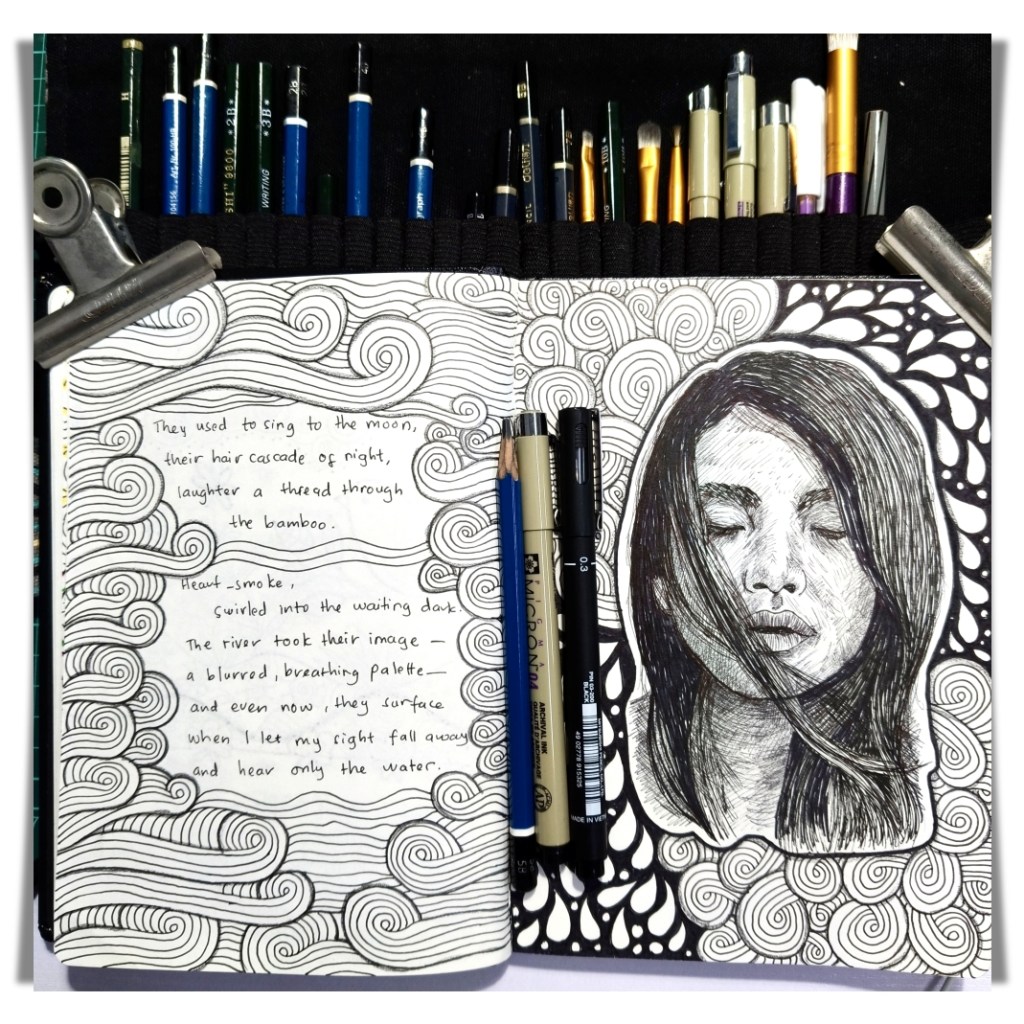
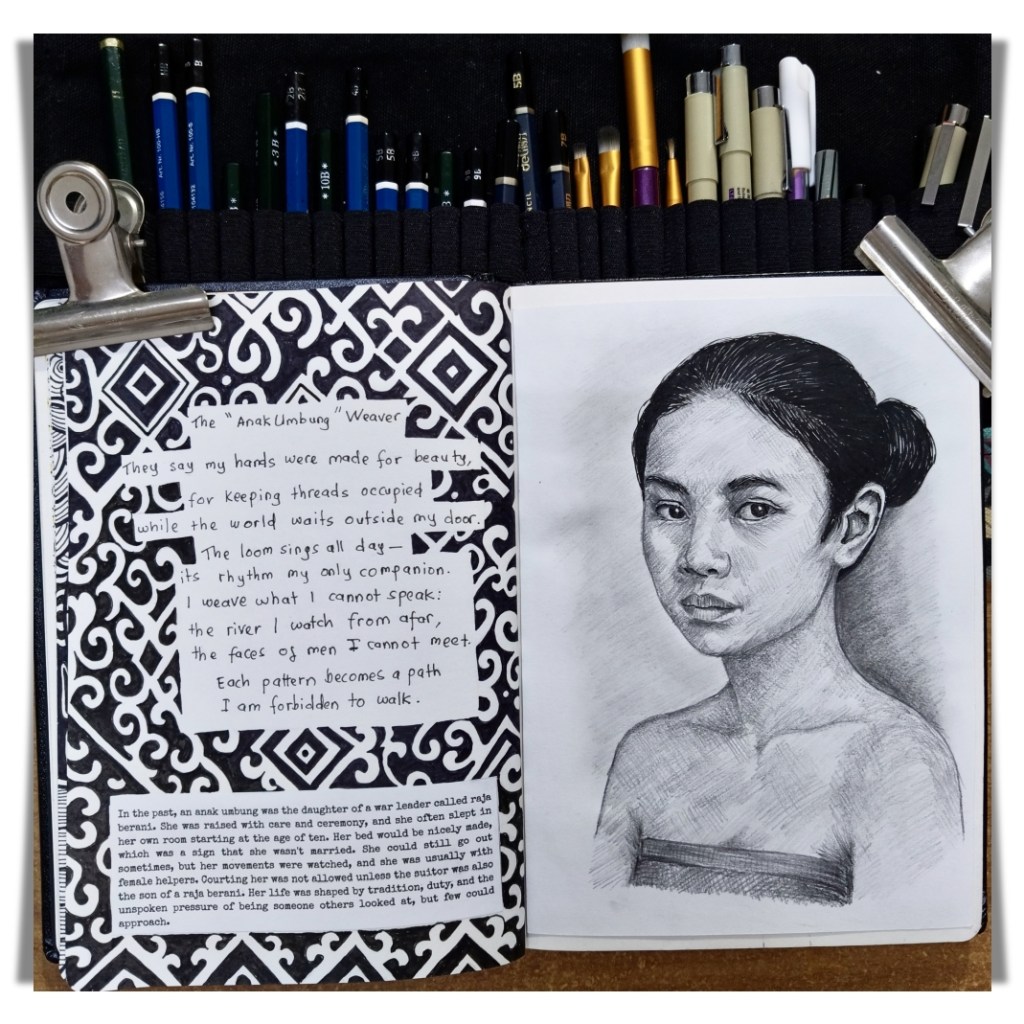
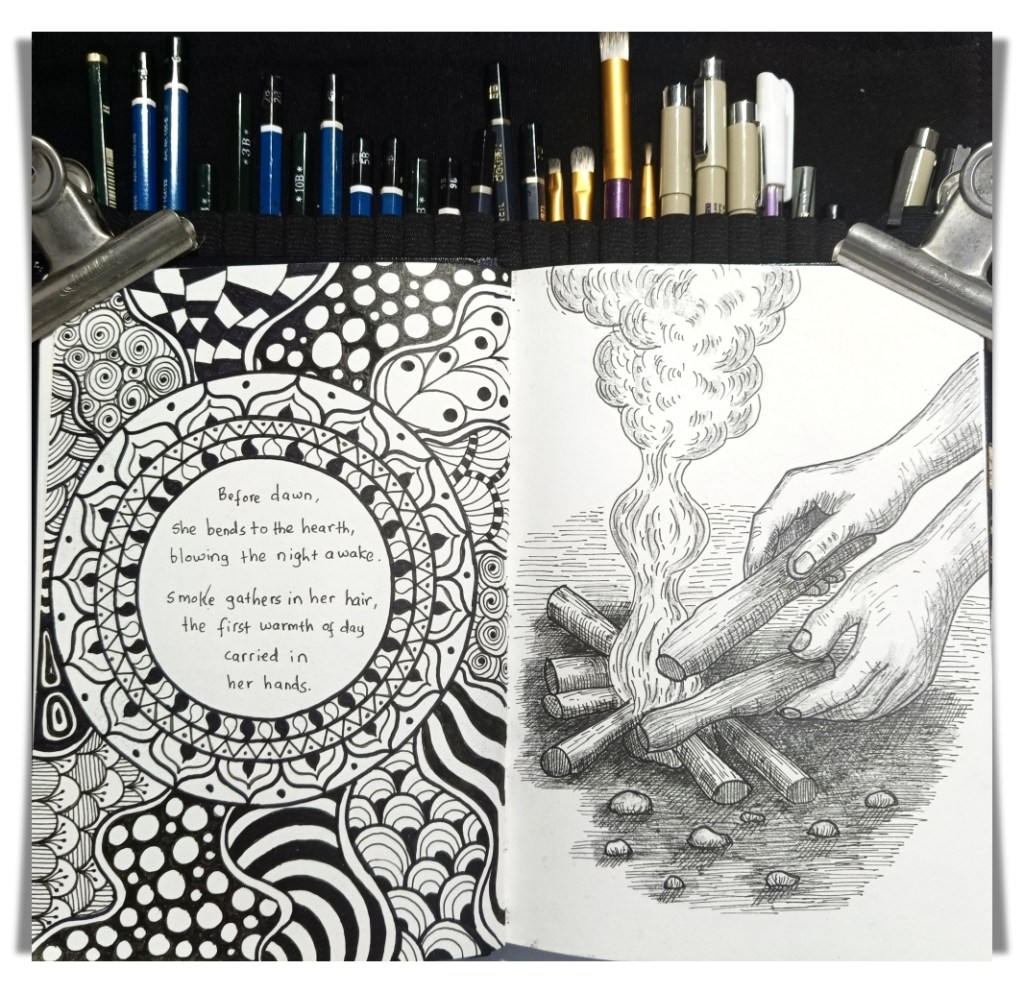
One of the first illustrations is inspired by women who sing to the moon as their laughter threads through the bamboo. Another drawing shows the anak umbung, the daughter of an Iban war leader who was raised apart from others and taught weaving skills. Her story has stayed with me, serving as a reminder of the beauty and self-control that once entwined women’s lives. There is also a drawing of a woman tending to the hearth before dawn. These aren’t big moments; they’re small actions that show tenderness, duty, and strength in Iban women. 

This new zine will be based on the same ideas as Rituals & Rivers, but it will focus more closely on the daily and the personal.  It will explore what it means to be an Iban woman across generations, including the traditions that are passed down, the unspoken resilience, and the actions that connect one life to another. It’s a way for me to listen to the voices of the women who came before me and to honor how their spirit still lives on in us now.

I don’t know what the completed zine will be like, but I know it will develop slowly, page by page, just like stories used to do, with care and patience.


I write about Iban culture, ancestral rituals, creative life, emotional truths, and the quiet transformations of love, motherhood, and identity. If this speaks to you, subscribe and journey with me.
If We Had Stayed | A Prose Poem from an Alternate Life

It was never loud between us. Our love never needed proof. Just subtle signs. A gaze that lasted too long. A jacket shrugged off without being asked. How his silence moved toward mine and made room.

We live above the bookstore near the station. The one with crooked shelves and a leaking pipe that drips near the poetry section. On quiet mornings, I wake first. The kettle whispers steam. He is still asleep, half-buried in the blankets, one arm flung across my side of the bed. I write before the city wakes up. One lamp on. My pen moves slowly and carefully across the page because some mornings are fragile. 

Some days, we walk to the cafe where we first met. The one where the windows get foggy, and I forgot a pen once. He never mentions that he kept it. Never asks why I replaced it. But he returns it anyway, weeks later, as if it was never gone. The pen, not the moment we shared.

We have a habit of not explaining. He says it once, at the door, without turning around. 

We often stroll to Yanping Riverside Park. It is our routine. We never call it that, but we keep coming back to it. On quieter days, we walk under trees that offer more than just shade. Kids dart past on scooters, while we walk slowly. His hand near mine. Sometimes he stops at the railing and looks at the river. I can feel him and the constellation he carries between us.

He rarely talks about work, and when he does, it’s only in fragments. Just enough to remind me that there are things that can’t be put into words. And that’s enough. I don’t have to know everything about him to love him.

I learn to read his silences. The way he checks the locks twice. The way his eyes drift when he’s too tired to pretend. I never think of his silence as distance. It’s a huge part of the whole.

We don’t talk about forever. We just stay.

There are rooftops and rain, the wind carrying jasmine from someone else’s balcony. Matcha soft-serve he buys without asking. The way he looks at me when I hand him a poem. How he holds it like a feather.

We don’t make any promises. But he and I stay.

He once told me that being around me hurt him like a third lung. I don’t say anything. I just trace my thumb over his knuckles and let the silence remain. There are no anniversaries. No statements. Just the ritual of being there.

He catches me when I slip on uneven pavement. His fingers wrap around my arm like the answer to the questions I’ve been too scared to ask. He says, “I guess I’m here to catch you.” I smile and file that sentence in the back of my mind, where the most important things live. 

Our life together isn’t always perfect. We fight. We turn our backs in sleep. But we stay. He doesn’t save me. I don’t save him. We just stop pretending we don’t need each other.

And in this world we’ve carved our lives into, the silence isn’t absence—it’s alive, trembling like a living thing.


Olivia Atelier offers printables, templates, and art designed to inspire reflection, healing, and creativity. Visit Olivia’s Atelier for more.

Things I Was Told Not to Say (But I’m Saying Them Anyway)

Like everyone else, I was raised to be polite, to lower my gaze, and to keep my mouth shut before it bleeds arrogance or truth. But truth doesn’t always need to wait for permission and I’m done looking for it. 

This is a list of things I was told not to say because they are deemed shocking and inappropriate. But I’m saying them anyway, because being silent isn’t always safe. It was a slow suffocation and death.

I was told not to say:

  1. “I’m tired of being the emotional one, the one who feels things.”

But I am. It’s draining carrying the burden of my own feelings and everyone else’s. You say I’m too touchy. I say you need to be more sensitive.

  1. “Sometimes I don’t want to be a mother.”

It doesn’t mean I don’t love my children. It means I want to disappear sometimes. To be free of endless burdens and responsibilities. I want to just be me without being attached to roles and expectations, even just for a while. Just long enough to find myself again.

  1. “Marriage is lonely.”

Yes, even the good ones. Especially the good ones; when you’ve been together long enough, you know each other too much there are barely any surprises anymore. 

  1. “I still think about the one who left.”

No, I don’t want him back. But he lives in the hallways of my memory, like when I stop to think about certain songs or street names or places. That’s not being unfaithful. It’s my memory and the only way to forget it is if I lost my memories to dementia or brain damage. Otherwise the memory remains. And I’m allowed to carry it.

  1. “I don’t want to go to this church anymore.”

I believe in God. But I don’t believe in being controlled and being silenced. I don’t want to pretend everything’s fine when my spirit is clearly not. I’m not giving up on faith; I’m moving toward the truth.

  1. “I feel ugly on some days.”

No amount of affirmations makes it disappear. There are days when I can’t stand my body. Some days I don’t even notice it at all. Both truths exist.

  1. “I envy women who get to choose their identity.”

Because I never did. I was born into roles before I could choose which ones I liked. Wife and mother. Good girl. Christian. I played every one of them. But now I want to rewrite the script where the real me can finally be set free. 

  1. “I don’t want to be grateful all the time.”

Gratitude is holy. But forced gratitude is performance. I don’t owe anyone a smile when I’m breaking inside. I can be grateful and grieving at the same time.

  1. “I want more.”

More silence. More passion. More space to create without guilt. More people who see me without needing me to explain myself. I want more than I was told I should ask for.

And yes, sometimes I want to be desired and not just needed. There’s a difference. And I feel it every time I’m touched with obligation instead of longing. 

I was told not to say all of this. They are taboo and a good Christian woman, a wife and a mother, shouldn’t entertain these sinful thoughts. 

I was told to play it safe. To keep my life neat, soft, godly. I was told not to stumble others in their faith.

But truth isn’t always soft. Truth can hurt and burn sometimes. And I’d rather burn than spend another decade in silence.

Call me whatever you want. A premenopausal woman in the heat of a midlife crisis. A delusional Christian woman being lured by the devil. These are some of my truths and I’ll not stop writing about them and shrink myself for others’s comfort. I’m so done with being prim and proper and always saying the right things all the time. I’m done with lying. It’s time for me to proclaim my truths and make them known to others. 

The Things That Undid Me

I cooked my love down to tar,
a black syrup in the bottom of the pot.
It taste like a lie
but I said nothing.
I was raised to chew my
tongue for supper.

I sewn myself into the good wife’s dress,
blessed and above reproach,
but I swallowed my own teeth
like communion wafers.

My children pressed their ears to my palms
and heard singing.
But some nights,
my fingers were fists
full of burnt letters.
I’m no witch,
only a woman
who learned too late
that silence is murder.

The pastor preached be pure.
But I loved the smell of rain
in my dirty hair,
my body wanting
without shame.

God, forgive me–
not for sinning
but for the way I loved it:
the unwashed sheets,
the stains on the hymns,
the animal in me
that refused to kneel.

I’m not sorry for the smoke,
or the fire I’ve become.
I’m sorry it took me
this long to strike the match.

© 2025 Olivia JD


Olivia Atelier offers printables, templates, and art designed to inspire reflection, healing, and creativity. Visit Olivia’s Atelier for more.

The Other Me | The Woman Behind the Poem

When I wrote the poem “The Other Me,” I wasn’t trying to sound bold or dramatic. I was just being honest by telling my truth. 

People often assume they know me. They see a woman who is quiet. A wife. A mom. A Christian. Someone who shows up, serves, nods politely, and doesn’t cause trouble or controversy. I’m familiar with this image because I’ve lived inside it for most of my adult life. It’s not that it’s wrong. It’s just incomplete.

There has always been a deeper current under the surface. Beneath all that facade of neatness, there is someone who asks harder questions or feels hurt when silenced. There is someone that remembers who I was before all the roles and expectations started to pile up on me.

“The Other Me” is not a fictional character. She is a real person who has always been by my side. I put her away, hidden, so that I could make room for acceptance, safety, and community. In religious communities, women are often praised for being quiet, gentle, and obedient. Where doubt must be neatly dressed in submission, and discomfort is treated like rebellion.

The poem came from the grief of hiding and of living a half-truth because the whole truth felt like too much.

I was taught to be agreeable as a child or to be well-liked. I learned that being difficult was the same as being rejected. That if you had questions, you lacked faith. That wanting more, like more closeness, more freedom, and more honesty, was wrong or selfish.

So I stayed small. I stayed quiet. I played the role so well I almost forgot I was acting. But staying quiet has a price.

When you’re around people who only know the version of you that makes them comfortable, a certain kind of loneliness grows. They love that safe version of you and they honor her because she embodies the values they approved. But you start to wonder if they would still love you if you said something out of character. What if I stopped editing myself for the sake of their comfort? What if I let the fire show?

And then one day you write a poem.

You write it because you have things you want to say but can’t. Your body remembers what your mind tries to bury. Because there is a woman inside you who is sick of bending over backwards to meet other people’s expectations.

You don’t even know if you’ll share it when you write it. But that is beside the point because the truth is you need to see this woman and say to her, “I haven’t forgotten you.”

“The Other Me” is about the version of myself that doesn’t fit into polite spaces. She is the one who laughs too loudly, writes about God and desire in the same line, and asks questions about things she was told not to touch. She loves deeply but won’t let anyone else control her.

In the past, I was scared of her.

But now I know she isn’t a threat. She isn’t being defiant just to be dramatic. She is just being honest. She is the version of me that lived and survived. And I owe her more than just silence.

When I say I feel alone sometimes, I mean it in a specific way. I don’t mean that I don’t have anyone around me. What I mean is that I don’t have a place that feels like home and where I belong. I don’t quite fit in with the local creative community, where the type of poetry that gets attention is usually light, easy to read, and trendy. I write differently. I write deeply. And sometimes, that depth becomes a wall between me and the world I want to reach. 

At the same time, the people who connect with my work often live far away. They have different cultures, different worldviews. We connect through words, but we live in different worlds. That, too, feels like a dislocation.

But still, I write.

Because this is how I heal, and this is how I remember. This is how I get back the parts of myself that I’ve tried to hide for a long time.

The Other Me is not a rebellion. It is a way for me to return to the version of me that I’ve neglected.

And maybe, just maybe, if I keep writing her into existence, someone else out there who also feels out of place, half-formed, and unseen, will recognize themselves in my words. And that recognition will feel like belonging.

We might not need to fit in to be complete. Maybe we just need to be honest.

And that is what this poem gave me. A little more honesty. A little more light. A little more room to breathe.

And to the version of me that is still hiding: I see you. We’re coming home.

Note: This poem is not published yet, but you can read a short excerpt on my Threads post.


Olivia Atelier offers printables, templates, and art designed to inspire reflection, healing, and creativity. Visit Olivia’s Atelier for more.

After Andrea | A Tribute to Andrea Gibson

Image source

When Andrea Gibson left this world, they didn’t vanish. They simply changed form.

That’s what I believe. What I’ve always believed. That death isn’t the end but a transformation. It’s a reassembly of light, soul, and memory. It becomes energy that lingers in the folds of pillows, in dog-eared pages, in the sound of your laughter.

Andrea said it best in one of their final gifts to the world: “Dying is the opposite of leaving. When I left my body, I did not go away.”

I read those words with a lump in my throat, but not because I was grieving. They reminded me of something I wrote months ago, not knowing then how it would one day connect me to someone I admired from afar.

So when we grieve for an unbearable loss and feel the crushing weight of absence, perhaps we can take comfort in knowing that nothing is ever truly gone.

The ones we miss exist in a different form now. They are scattered across the cosmos, carried in rays of sunshine, drifting in the gentle breeze. The photons that once danced across their skin continue their journey through space. Their laughter still lingers around us, waiting to be felt by those who remember.

If we explain death by physics alone, the conservation of energy means that when we die, our energy disperses into heat, into the environment, and into the people we loved. ~ Excerpt from my blog: The Physics of Goodbye

Andrea’s poems weren’t just poems; they were silent revolts against erasure and the lie that pain and beauty must live apart.

And maybe that’s what we leave behind: words and permission. Especially permission. Permission to grief and cry. To be angry. To acknowledge love out loud. To die beautifully. To stay, even after.

After Andrea 

I want to call you by the sound your bones made when they fell into the light. I want to call you return instead of loss, to pin your spirit to my wall like the last goodnight of a sunbeam. You are not gone. You are still here. You are a new verb. You breathe through my ribcage at midnight when I forget my name and remember yours. Your echoes make me who I am. You are the ghost of the lamp turning on by itself, the sudden music when no one’s home. What trick of physics lets a soul remain when the body collapses? What cruel grace? Andrea, I never touched your hands, but I have held your sorrow, your laughter, your thunder, your holy queerness. I carry it now. In me, and in everyone who heard your voice before they knew you. Thank you for the light. Thank you for the absence that still feels full. Thank you for dying like a poet; all metaphor, without end.

© 2025 Olivia JD


Olivia Atelier offers printables, templates, and art designed to inspire reflection, healing, and creativity. Visit Olivia’s Atelier for more.

What I Know Now That I’m in My 40s

As I get older, I realize that change doesn’t stop. You don’t reach a certain point where you finally feel “together.” When I was in my 20s, I thought that women in their 40s had it all figured out. They knew how to love, how to parent, and how to stay calm when their world fell apart and the bills were late and the kids were fighting. But now that I’m here, I know the truth: we’re all still learning and figuring things out.

In my 40s, I no longer chase the idea of being extraordinary. I want to be real, present, and kind to myself. I’ve stopped apologizing for being quiet, for needing time alone, or for feeling deeply. I used to shrink myself so people would find me easier to digest and tolerate. Now I let the fullness of who I am take up space, even if it makes other people feel uncomfortable.

I have learned that performance doesn’t determine one’s worth. Worth doesn’t come from being productive, getting praise, or doing everything right. Even when I’m still, I am still worthy. Or when I’m unseen or unnoticed. Or when I am not achieving a single thing. This kind of emotional growth doesn’t happen overnight. It came through years of burnout and soul-wrestling, trying to be everything to everyone and having nothing left for myself.

Motherhood taught me that but not in a pretty, “Pinterest-quote” way. It taught me in the messy, heartbreaking moments that often happen in the trenches of parenting. Motherhood revealed the gaps in my patience, where I lost my sense of self or the ghosts I hadn’t exorcised yet. It forced me to look at myself when I was at my worst and ask, “Can I still be nice to my kids? Can I still stay and get through it all?”

Marriage, too, has been a teacher but not always a gentle one. Love in your 40s is less exciting and can be boring but I’m speaking from my experience. It’s less about the big, impressive things and more about the small, boring things like showing up for each other. Or listening when you’re tired and don’t really care about the nitty-gritty of it. Or saying you’re sorry first. I used to think that being in love was like being high. But now I know better.

My art and writing have saved me more times than I can count. They gave shape to emotions I couldn’t name. They held me when I felt invisible. When I returned to writing poetry after years on hiatus, it felt like coming home to an old friend who never stopped waiting. I don’t write to impress anymore; I write to learn and understand. I want to tell the truth without worrying about how it sounds or how it looks. That’s the heart of my creative healing.

And this is my truth: I am a woman who is no longer afraid to feel everything.

I’ve learned to slow down and take my time. I’ve learned to walk away when something costs me my peace. I’ve learned to take a break without guilt. I’ve learned to feed myself what nourishes, not what numbs. I’ve learned that joy isn’t something you chase relentlessly. Joy is something you notice. You can find joy anywhere you look hard enough. In your child’s laughter. In the soft, fading light at 7.30pm. In the peaceful and dull parts of your life.

I’ve stopped needing everyone to like me. Not everyone will. And that’s okay. I am not for everyone. But I am for the people who value honesty over performance, presence over perfection, and depth over decorum.

Being a woman in your 40s means I carry both tenderness and steel in my bones. I know how to hold space and when to keep things to myself. I know how to tell the truth even when it hurts. I still make mistakes, of course. I still feel anxious most of the time, but I’m not as scared of being seen as imperfect. There is no pretending. What you see is what you get.

I don’t have it all figured out. But I know who I am now. And I like her more than I ever have.

Now That I Know

I don’t need fireworks.
I light my own sky
with the hush
of knowing I survived.
No more performance prayers.
No more bloodletting for love.
If I bend now, it’s not to please–
but to plant.
My thighs and belly are soft.
My words are sharp.
I’m no longer a girl
waiting to be chosen.
I have chosen myself,
my whole being–
transforming.

© 2025 Olivia JD


Olivia Atelier offers printables, templates, and art designed to inspire reflection, healing, and creativity. Visit Olivia’s Atelier for more.

Marriage Refines You (If You Let It)

Nobody warned me that marriage would teach me the lessons I never anticipated.

They said it would take work. They said communication was key. They said love changes. All of this is true. But no one told me that marriage is fundamentally a slow-burning crucible of personal transformation. Of course there are romance and domestic joy, but those aren’t the main things. Marriage refines you. But only if you allow it.

If I had written this post twenty years ago, things would have been different. I would have told you about the joys of growing older together, about shared jokes and parenting accomplishments, and the comfort of being wanted and desired. I might have glossed over the friction. Or made it poetic, full of excuses.

But now, I want to tell the truth: Marriage teaches you who you truly are, often through pain.

This isn’t the kind of pain that stays with you forever, at least not in a good marriage anyway. But this pain would show you how weak, selfish, and proud you are. It’d expose the parts of you that you didn’t realize needed healing until you kept bumping up against another human being who sees you completely, and sometimes unflatteringly.

In the early years, I believed that in order to be respected, I had to be right. I used to believe that a good wife was someone who was nice and made quiet sacrifices. I thought conflict meant something was wrong.

Then came the truth: Conflict is the classroom. Friction is the fire. Silence is not always peace, and compliance is not intimacy. I learned this slowly and painfully, through nights of misunderstanding, long periods of emotional detachment, and the grief of feeling invisible.

Marriage has pushed me to confront my shadow selves: the part of me that resents when he doesn’t read my mind, the part that wants to be acknowledged for invisible labor, and the part that withdraws rather than communicates when I’m upset.

He has his parts too. When both of us are weary, stressed, or simply being human, those parts collide like stones.

But here’s what I’ve learned: Stones sharpen one another.

We grow as a result of the friction, not in spite of it. This relationship has gradually dispelled some of my misconceptions. I’ve become less concerned with appearing good and more interested in becoming whole. I’ve learned how to stay present during an argument without dissociating. I’ve learned to say, “I need this,” without shame. I’ve learned to apologize and own up to my mistakes because I value the connection more than the ego battle.

Marriage has taught me about perseverance. This perseverance is not the kind where you smile and bear it, but the kind where you continue to show up to face the difficult conversations, the painful realities, and the pain of building your character.

It has taught me that love is not the absence of conflict, but the willingness to hold space for each other’s growth.

This isn’t a post about martyrdom. This isn’t about perpetuating toxic behaviors or glorifying suffering. This is about the refinement that happens in long-term relationships, when two people choose to keep coming back to the table, even when it is a mess. Especially when things are messy.

Some days, love looks like scrubbing the kitchen while the other sits quietly. Some days, it looks like asking, “Can we talk?” even when the previous talk didn’t end well. Some days, it means choosing forgiveness over keeping score. Other times, it involves setting a boundary that says, “I will not carry this alone anymore.”

Marriage as a teacher is subtle, persistent, and deeply transformative. Refinement doesn’t happen all at once. It’s gradual, and at times it feels like failure. But what I do know is that I am not the same person I was when I agreed to this life together. And I’m thankful.

Marriage, in its own imperfect, beautiful and annoying way, is a never-ending teacher. And I’m slowly turning into someone I can be proud of, not because I’ve mastered love, but because I’ve let love master me.


This Is Not a Love Poem (But It Is)

This is not a love poem.
It doesn’t lace silk into longing
or wraps itself around your wrist
like a bracelet of breathless metaphors.

It’s the crack under the door
when we don’t speak for hours.
The grease-stained dinner plate
left by your elbow
and the silence I sit with,
like a burning candle.

This is not a sonnet.
This is the sound
of your sigh in the middle of my sentence.
The way you leave the room,
still loving me.

I wanted something softer, once,
but this? This is love
that turns me over like soil.
That presses its palms into my spine
and says: grow here.

I have.

And it hurts.
And it heals.
And it is you.

© 2025 Olivia JD


Olivia’s Atelier offers printables, templates, and art designed to inspire reflection, healing, and creativity. Visit Olivia’s Atelier, Redbubble, and Teepublic for more.

When Motherhood Feels Like Too Much | A Reflection on Netflix’s Straw

Image source

I don’t watch many movies from Hollywood. But something about Straw, a Netflix movie, drew me in. I didn’t know the actors’ names. I didn’t read the reviews. I simply watched it and empathized.

Taraji Henson, who played Janiyah Wilkinson, a single mother struggling to make ends meet and to care for her sick daughter Aria, gripped my heart from the first scene. I didn’t care what critics said. Who needs them when we can form our own opinions? Watching Janiyah in that moment, she was like many mothers I’ve known. Every mother facing the struggles of motherhood, every mother who has fought, broken, and somehow kept going. I had never heard of Taraji Henson before this film, but her portrayal will stay with me.

Straw brought me to a world that was unfamiliar to me in some ways: an almost all-Black cast, a peek into lives and difficulties shaped by a reality I don’t live but deeply empathize with. It was a story of survival, love, and the crushing weight of systems created with little regard for people at the bottom. And at its core was Janiyah, a single mother who awoke that day believing she could handle everything, only to find herself in one difficult circumstance after another.

I saw myself in her. I saw many of us. Though I admit that my problems may pale in contrast to hers. The moment she snapped? I made no judgments about her. How could I? I understood. The never-ending cycle of striving to earn enough, care enough, and keep it all together in a society that keeps asking for more and more and giving so little in return. The dysfunctional healthcare system (healthcare that costs so much more than most people can afford—pure evil), the lack of emotional support for moms, and the feeling of being invisible in a world that only sees what it wants to see.

Motherhood can be so isolating, impacting motherhood mental health and contributing to motherhood exhaustion. Even when we are surrounded by people, we may feel alone in our struggles. And when there is no one to support us through the most difficult times, the weight of it all can feel intolerable. That is what Straw conveyed so powerfully for me. That is what I wanted to honor in this reflection.

I’m not writing this to offer solutions. As a mother, I understand that no one can fix what we’re going through. We don’t expect anyone to. We don’t ask for handouts or miracles. But sometimes what we want most is to be seen. To hear someone say, “I see you. I see your effort. I see the fatigue. You aren’t invisible or forgotten.”

That is why I began making emotional support materials for mothers, such as printables for mothers, poems for struggling mothers, and art for overwhelmed moms. Whether you’re seeking a printable for mothers or a poem for struggling mothers, these small creations are here for you. Small gestures that provide comfort, silent reassurance that someone out there understands. No, they don’t fix the problems. But perhaps, in some small way, they might shine a light on a dark day.

Before I close, I want to leave you with a poem. It’s a piece I wrote after watching the movie. It’s raw and honest, dedicated to mothers who feel unseen and overwhelmed.


For the Mother

This is for the mother who kneels
on the bathroom tiles, her sobs
swallowed by the flush of the toilet,
who locks the door not for privacy
but to cage the animal of her grief.

For the mother who starves herself
down to bone, who offers her child
the last crust of bread like a sacrament,
her own mouth full of nothing
but the bitter taste of absence.

For the mother whose spine bends
under the weight of a thousand silent storms,
who still paints her lips red at dawn
and sings lullabies through her teeth.

You are not invisible.
I see you—
your hands, cracked and holy,
your ribs, a cathedral of sacrifice.

You think you are drowning,
but darling, you are the ocean itself,
fierce and unforgiving,
swallowing the moon whole
and still rocking the shore to sleep.

You are not failing.
You are a war fought in silence,
a wound that blooms into a mouth
that says yes when the world says no.

You are more than enough.
You are the goddess no one prays to,
the unlit match in the dark,
the silence, the tempest, the aftermath.

©2025 Olivia JD


If you’re reading this, I want you to remember: your struggle is real, and so is your strength. You are seen. You are not alone. May we keep finding small ways to lift each other, and may you always know, you matter.

If this reflection resonates with you, I invite you to explore my creations at Olivia’s Atelier on Etsy, Teepublic, and Redbubble. Every piece is made with the intention to offer gentle support and inspiration.

My Ancestor | OKP Dana Bayang the Great Iban Headhunter & War Leader of Borneo

“The Orang Kaya Pemancha Dana Bayang of Saribas is now with me…the dreaded and the brave, as he is termed by the natives. He is small, plain-looking and old, with his left arm disabled, and his body scarred with spear wounds. I do not dislike the look of him, and of all chiefs’ of that river I believe he is the most honest and steers his course straight enough.”

— James Brooke, The White Rajah’s Diary, 1843

When I saw this prompt, I didn’t think twice. My favorite historical figure isn’t from faraway lands or great empires. He is my ancestor, Orang Kaya Pemancha Dana Bayang (or Dana Bayang), the legendary Iban war leader of the early 19th century.

Dana Bayang was from Padeh, a longhouse upriver in the Saribas. In addition to his prowess in battle, he was renowned for his ability to guide his people wisely at a period when preserving their way of life from both local and foreign dangers was essential to their survival. His warriors, loyal and fearless, served as the first line of defense. Among them was Sabok Gila Berani, his right-hand man who eventually established our longhouse (village), Stambak Ulu. Stambak Ulu was a strategic sentinel, not just a village. It sat along the river, watching for enemy warships approaching up the Layar. From there, word could be quickly transmitted upriver to alert Dana Bayang in Padeh. Stambak Ulu became a shield, protecting Dana’s people and territory.

Years later, Sabok’s son Mang adopted Dana’s granddaughter, Mindu—my great-great-grandmother—after her father, Aji, Dana’s successor, was defeated by Charles Brooke’s forces in 1858. Aji’s death was a turning point, as the old ways clashed with colonial ambition. Mindu’s mother, Dimah, died soon after, leaving her an orphan. 

When I think of Dana Bayang, I think of courage that was not for glory but for the preservation of a way of life, of the land, spirits, and community. His sons and warriors fought to keep their people free, to defend their beliefs, customs, and homeland. Nonetheless, they stood on the edge of change as the White Rajah’s army (colonialism) drove into Sarawak’s heart. The story of Dana and his warriors reminds me of what it means to belong to a people who refused to give up, who carried defiance and hope in equal measure.

You can even catch a glimpse of Dana Bayang in the 2021 Hollywood film Edge of the World, which offers a sneak peek of Brooke’s voyage of discovery to Sarawak in the 1800s.

This reflection ties closely to something I wrote earlier: Inheriting Courage From My Warrior Ancestors. The courage I speak of is not just in legends; it lives in the bloodline, in memory, in the quiet resistance of holding onto who we are.


A Chieftain’s Lament

Between the ritual’s demand and the crown’s decree
my once-steady hands falter in silence.
The nyabur rusts in my palm,
steel thirsting for blood,
now hushed by law.
The earth splits open—
Brooke’s foreign feet press into its cracks.

I hear signs, I dream dreams.
We need fertile grounds.
Blood must avenge blood.
But Brooke tells me to sheath my hunger,
swallow the sun, unlearn the hunt.
He asks me to bow, to bury my blade—
yet the wind whispers of battles still untold.

A fire stirs in the pit of my chest,
a pact with shadows, ancestors long gone.
Can we silence our spirits, break our bond?
Or will the old gods rise in the dust of our revolt?
I smell old skin burning,
the wild call of crows—
but I am chained to the unseen leash of kings
who promise peace with chains.

Note:
Nyabur – curved sword from Borneo, a headhunter’s weapon


©2024 Olivia JD


Olivia Writes offers printables, templates, and art designed to inspire reflection, healing, and creativity. Visit Olivia’s Atelier, Redbubble, and Teepublic for more.

Luther — The First Boy I Ever Loved

It was 1989. I was twelve, shy and dreamy-eyed, in Primary Six. Luther was fourteen and in Form Two. He had the most beautiful eyes I had ever seen. We met at Christening classes on Wednesday nights. I watched him from across the room, my heart racing. I was torn between wanting him to notice me and wanting to stay hidden.

It was my best friend who, with a cheeky grin, told him my secret. I was so embarrassed that I wanted to sink through the floor. But that night, everything changed. Luther noticed me and paid attention from then on. We exchanged love letters, filled with clumsy, big-hearted words, and met on small dates behind some buildings; nothing grand, not even kisses. We simply held hands and talked.

But by December of ’89, my father’s job took us to a new town, and just like that, our brief, sweet chapter ended. We didn’t keep in touch because we were too young, and maybe we both knew deep down that first loves are only supposed to last a short time.

Now that I think about it, that experience really changed how I think about love and connection. It wasn’t just about the boy or the letters or the stolen glances. It taught me that love, even in its simplest form, is about seeing and being seen. It’s about feeling, in that fleeting moment, that you matter to someone.

It makes me think of The Wonder Years, an American TV show that was on our local channel at the time. Kevin Arnold’s journey through the awkwardness, joy, and heartbreak of growing up felt so much like my own coming of age. His sweet, tentative relationship with Winnie Cooper; their shy glances, their first kiss, the way they kept circling back to each other through the ups and downs. I understood that kind of love, the sweet young love. Luther and I had our own little universe for a while, much like Kevin and Winnie. We taught each other about hope, tenderness, and letting go, just like they did.

Luther

You had eyes that swallowed me whole—
a storm behind glass,
soft enough to fool me.
Your lips never touched me,
but I felt them anyway,
like rain through a roof crack.

We wrote each other down in crooked lines,
gave ourselves to paper,
to the dark between stars.
For a while, you were a fever I didn’t want to break—
a name I kept folding smaller and smaller,
to hide.


Olivia Writes offers printables, templates, and art designed to inspire reflection, healing, and creativity. Visit Olivia’s Atelier, Redbubble, and Teepublic for more.