Marriage Refines You (If You Let It)

Nobody warned me that marriage would teach me the lessons I never anticipated.

They said it would take work. They said communication was key. They said love changes. All of this is true. But no one told me that marriage is fundamentally a slow-burning crucible of personal transformation. Of course there are romance and domestic joy, but those aren’t the main things. Marriage refines you. But only if you allow it.

If I had written this post twenty years ago, things would have been different. I would have told you about the joys of growing older together, about shared jokes and parenting accomplishments, and the comfort of being wanted and desired. I might have glossed over the friction. Or made it poetic, full of excuses.

But now, I want to tell the truth: Marriage teaches you who you truly are, often through pain.

This isn’t the kind of pain that stays with you forever, at least not in a good marriage anyway. But this pain would show you how weak, selfish, and proud you are. It’d expose the parts of you that you didn’t realize needed healing until you kept bumping up against another human being who sees you completely, and sometimes unflatteringly.

In the early years, I believed that in order to be respected, I had to be right. I used to believe that a good wife was someone who was nice and made quiet sacrifices. I thought conflict meant something was wrong.

Then came the truth: Conflict is the classroom. Friction is the fire. Silence is not always peace, and compliance is not intimacy. I learned this slowly and painfully, through nights of misunderstanding, long periods of emotional detachment, and the grief of feeling invisible.

Marriage has pushed me to confront my shadow selves: the part of me that resents when he doesn’t read my mind, the part that wants to be acknowledged for invisible labor, and the part that withdraws rather than communicates when I’m upset.

He has his parts too. When both of us are weary, stressed, or simply being human, those parts collide like stones.

But here’s what I’ve learned: Stones sharpen one another.

We grow as a result of the friction, not in spite of it. This relationship has gradually dispelled some of my misconceptions. I’ve become less concerned with appearing good and more interested in becoming whole. I’ve learned how to stay present during an argument without dissociating. I’ve learned to say, “I need this,” without shame. I’ve learned to apologize and own up to my mistakes because I value the connection more than the ego battle.

Marriage has taught me about perseverance. This perseverance is not the kind where you smile and bear it, but the kind where you continue to show up to face the difficult conversations, the painful realities, and the pain of building your character.

It has taught me that love is not the absence of conflict, but the willingness to hold space for each other’s growth.

This isn’t a post about martyrdom. This isn’t about perpetuating toxic behaviors or glorifying suffering. This is about the refinement that happens in long-term relationships, when two people choose to keep coming back to the table, even when it is a mess. Especially when things are messy.

Some days, love looks like scrubbing the kitchen while the other sits quietly. Some days, it looks like asking, “Can we talk?” even when the previous talk didn’t end well. Some days, it means choosing forgiveness over keeping score. Other times, it involves setting a boundary that says, “I will not carry this alone anymore.”

Marriage as a teacher is subtle, persistent, and deeply transformative. Refinement doesn’t happen all at once. It’s gradual, and at times it feels like failure. But what I do know is that I am not the same person I was when I agreed to this life together. And I’m thankful.

Marriage, in its own imperfect, beautiful and annoying way, is a never-ending teacher. And I’m slowly turning into someone I can be proud of, not because I’ve mastered love, but because I’ve let love master me.


This Is Not a Love Poem (But It Is)

This is not a love poem.
It doesn’t lace silk into longing
or wraps itself around your wrist
like a bracelet of breathless metaphors.

It’s the crack under the door
when we don’t speak for hours.
The grease-stained dinner plate
left by your elbow
and the silence I sit with,
like a burning candle.

This is not a sonnet.
This is the sound
of your sigh in the middle of my sentence.
The way you leave the room,
still loving me.

I wanted something softer, once,
but this? This is love
that turns me over like soil.
That presses its palms into my spine
and says: grow here.

I have.

And it hurts.
And it heals.
And it is you.

© 2025 Olivia JD


Olivia’s Atelier offers printables, templates, and art designed to inspire reflection, healing, and creativity. Visit Olivia’s Atelier, Redbubble, and Teepublic for more.

When Motherhood Feels Like Too Much | A Reflection on Netflix’s Straw

Image source

I don’t watch many movies from Hollywood. But something about Straw, a Netflix movie, drew me in. I didn’t know the actors’ names. I didn’t read the reviews. I simply watched it and empathized.

Taraji Henson, who played Janiyah Wilkinson, a single mother struggling to make ends meet and to care for her sick daughter Aria, gripped my heart from the first scene. I didn’t care what critics said. Who needs them when we can form our own opinions? Watching Janiyah in that moment, she was like many mothers I’ve known. Every mother facing the struggles of motherhood, every mother who has fought, broken, and somehow kept going. I had never heard of Taraji Henson before this film, but her portrayal will stay with me.

Straw brought me to a world that was unfamiliar to me in some ways: an almost all-Black cast, a peek into lives and difficulties shaped by a reality I don’t live but deeply empathize with. It was a story of survival, love, and the crushing weight of systems created with little regard for people at the bottom. And at its core was Janiyah, a single mother who awoke that day believing she could handle everything, only to find herself in one difficult circumstance after another.

I saw myself in her. I saw many of us. Though I admit that my problems may pale in contrast to hers. The moment she snapped? I made no judgments about her. How could I? I understood. The never-ending cycle of striving to earn enough, care enough, and keep it all together in a society that keeps asking for more and more and giving so little in return. The dysfunctional healthcare system (healthcare that costs so much more than most people can afford—pure evil), the lack of emotional support for moms, and the feeling of being invisible in a world that only sees what it wants to see.

Motherhood can be so isolating, impacting motherhood mental health and contributing to motherhood exhaustion. Even when we are surrounded by people, we may feel alone in our struggles. And when there is no one to support us through the most difficult times, the weight of it all can feel intolerable. That is what Straw conveyed so powerfully for me. That is what I wanted to honor in this reflection.

I’m not writing this to offer solutions. As a mother, I understand that no one can fix what we’re going through. We don’t expect anyone to. We don’t ask for handouts or miracles. But sometimes what we want most is to be seen. To hear someone say, “I see you. I see your effort. I see the fatigue. You aren’t invisible or forgotten.”

That is why I began making emotional support materials for mothers, such as printables for mothers, poems for struggling mothers, and art for overwhelmed moms. Whether you’re seeking a printable for mothers or a poem for struggling mothers, these small creations are here for you. Small gestures that provide comfort, silent reassurance that someone out there understands. No, they don’t fix the problems. But perhaps, in some small way, they might shine a light on a dark day.

Before I close, I want to leave you with a poem. It’s a piece I wrote after watching the movie. It’s raw and honest, dedicated to mothers who feel unseen and overwhelmed.


For the Mother

This is for the mother who kneels
on the bathroom tiles, her sobs
swallowed by the flush of the toilet,
who locks the door not for privacy
but to cage the animal of her grief.

For the mother who starves herself
down to bone, who offers her child
the last crust of bread like a sacrament,
her own mouth full of nothing
but the bitter taste of absence.

For the mother whose spine bends
under the weight of a thousand silent storms,
who still paints her lips red at dawn
and sings lullabies through her teeth.

You are not invisible.
I see you—
your hands, cracked and holy,
your ribs, a cathedral of sacrifice.

You think you are drowning,
but darling, you are the ocean itself,
fierce and unforgiving,
swallowing the moon whole
and still rocking the shore to sleep.

You are not failing.
You are a war fought in silence,
a wound that blooms into a mouth
that says yes when the world says no.

You are more than enough.
You are the goddess no one prays to,
the unlit match in the dark,
the silence, the tempest, the aftermath.

©2025 Olivia JD


If you’re reading this, I want you to remember: your struggle is real, and so is your strength. You are seen. You are not alone. May we keep finding small ways to lift each other, and may you always know, you matter.

If this reflection resonates with you, I invite you to explore my creations at Olivia’s Atelier on Etsy, Teepublic, and Redbubble. Every piece is made with the intention to offer gentle support and inspiration.

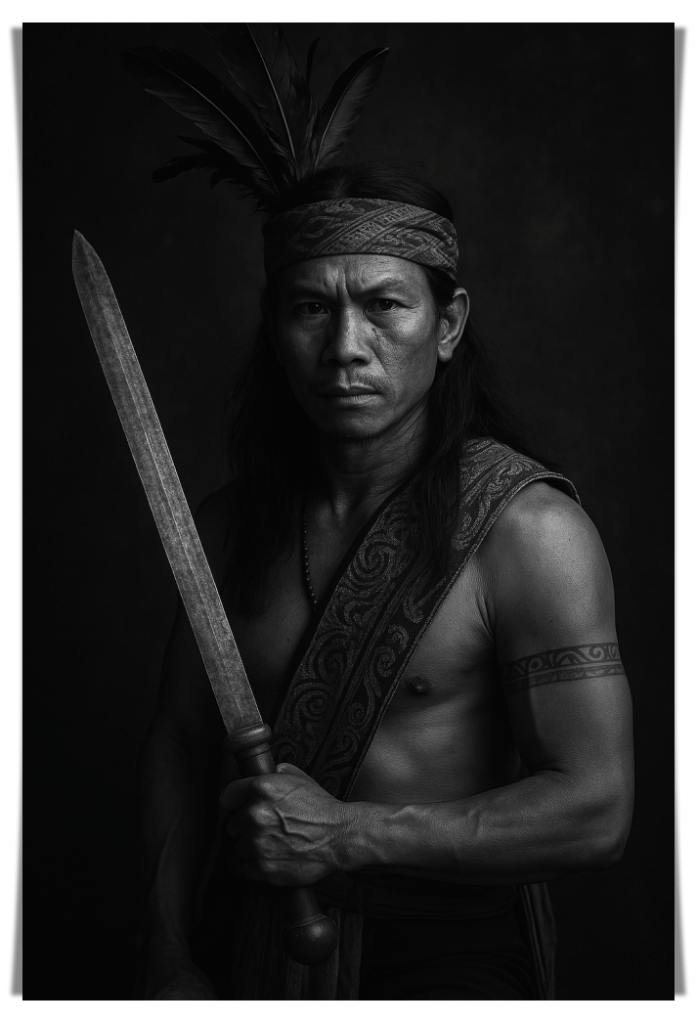
My Ancestor | OKP Dana Bayang the Great Iban Headhunter & War Leader of Borneo

“The Orang Kaya Pemancha Dana Bayang of Saribas is now with me…the dreaded and the brave, as he is termed by the natives. He is small, plain-looking and old, with his left arm disabled, and his body scarred with spear wounds. I do not dislike the look of him, and of all chiefs’ of that river I believe he is the most honest and steers his course straight enough.”

— James Brooke, The White Rajah’s Diary, 1843

When I saw this prompt, I didn’t think twice. My favorite historical figure isn’t from faraway lands or great empires. He is my ancestor, Orang Kaya Pemancha Dana Bayang (or Dana Bayang), the legendary Iban war leader of the early 19th century.

Dana Bayang was from Padeh, a longhouse upriver in the Saribas. In addition to his prowess in battle, he was renowned for his ability to guide his people wisely at a period when preserving their way of life from both local and foreign dangers was essential to their survival. His warriors, loyal and fearless, served as the first line of defense. Among them was Sabok Gila Berani, his right-hand man who eventually established our longhouse (village), Stambak Ulu. Stambak Ulu was a strategic sentinel, not just a village. It sat along the river, watching for enemy warships approaching up the Layar. From there, word could be quickly transmitted upriver to alert Dana Bayang in Padeh. Stambak Ulu became a shield, protecting Dana’s people and territory.

Years later, Sabok’s son Mang adopted Dana’s granddaughter, Mindu—my great-great-grandmother—after her father, Aji, Dana’s successor, was defeated by Charles Brooke’s forces in 1858. Aji’s death was a turning point, as the old ways clashed with colonial ambition. Mindu’s mother, Dimah, died soon after, leaving her an orphan. 

When I think of Dana Bayang, I think of courage that was not for glory but for the preservation of a way of life, of the land, spirits, and community. His sons and warriors fought to keep their people free, to defend their beliefs, customs, and homeland. Nonetheless, they stood on the edge of change as the White Rajah’s army (colonialism) drove into Sarawak’s heart. The story of Dana and his warriors reminds me of what it means to belong to a people who refused to give up, who carried defiance and hope in equal measure.

You can even catch a glimpse of Dana Bayang in the 2021 Hollywood film Edge of the World, which offers a sneak peek of Brooke’s voyage of discovery to Sarawak in the 1800s.

This reflection ties closely to something I wrote earlier: Inheriting Courage From My Warrior Ancestors. The courage I speak of is not just in legends; it lives in the bloodline, in memory, in the quiet resistance of holding onto who we are.


A Chieftain’s Lament

Between the ritual’s demand and the crown’s decree
my once-steady hands falter in silence.
The nyabur rusts in my palm,
steel thirsting for blood,
now hushed by law.
The earth splits open—
Brooke’s foreign feet press into its cracks.

I hear signs, I dream dreams.
We need fertile grounds.
Blood must avenge blood.
But Brooke tells me to sheath my hunger,
swallow the sun, unlearn the hunt.
He asks me to bow, to bury my blade—
yet the wind whispers of battles still untold.

A fire stirs in the pit of my chest,
a pact with shadows, ancestors long gone.
Can we silence our spirits, break our bond?
Or will the old gods rise in the dust of our revolt?
I smell old skin burning,
the wild call of crows—
but I am chained to the unseen leash of kings
who promise peace with chains.

Note:
Nyabur – curved sword from Borneo, a headhunter’s weapon


©2024 Olivia JD


Olivia Writes offers printables, templates, and art designed to inspire reflection, healing, and creativity. Visit Olivia’s Atelier, Redbubble, and Teepublic for more.

Luther — The First Boy I Ever Loved

It was 1989. I was twelve, shy and dreamy-eyed, in Primary Six. Luther was fourteen and in Form Two. He had the most beautiful eyes I had ever seen. We met at Christening classes on Wednesday nights. I watched him from across the room, my heart racing. I was torn between wanting him to notice me and wanting to stay hidden.

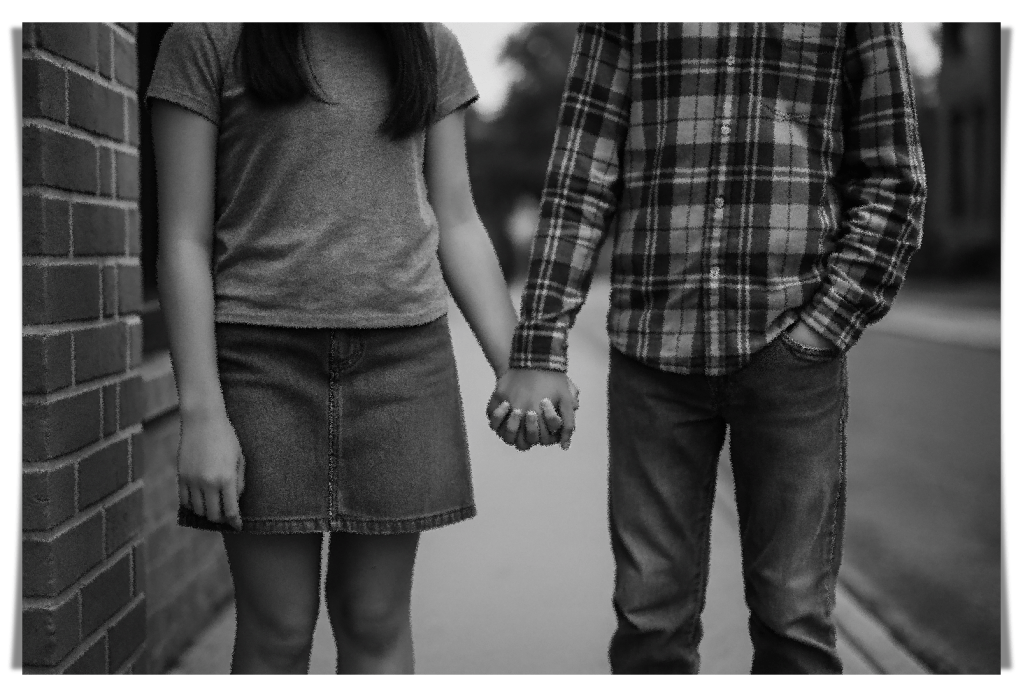
It was my best friend who, with a cheeky grin, told him my secret. I was so embarrassed that I wanted to sink through the floor. But that night, everything changed. Luther noticed me and paid attention from then on. We exchanged love letters, filled with clumsy, big-hearted words, and met on small dates behind some buildings; nothing grand, not even kisses. We simply held hands and talked.

But by December of ’89, my father’s job took us to a new town, and just like that, our brief, sweet chapter ended. We didn’t keep in touch because we were too young, and maybe we both knew deep down that first loves are only supposed to last a short time.

Now that I think about it, that experience really changed how I think about love and connection. It wasn’t just about the boy or the letters or the stolen glances. It taught me that love, even in its simplest form, is about seeing and being seen. It’s about feeling, in that fleeting moment, that you matter to someone.

It makes me think of The Wonder Years, an American TV show that was on our local channel at the time. Kevin Arnold’s journey through the awkwardness, joy, and heartbreak of growing up felt so much like my own coming of age. His sweet, tentative relationship with Winnie Cooper; their shy glances, their first kiss, the way they kept circling back to each other through the ups and downs. I understood that kind of love, the sweet young love. Luther and I had our own little universe for a while, much like Kevin and Winnie. We taught each other about hope, tenderness, and letting go, just like they did.

Luther

You had eyes that swallowed me whole—
a storm behind glass,
soft enough to fool me.
Your lips never touched me,
but I felt them anyway,
like rain through a roof crack.

We wrote each other down in crooked lines,
gave ourselves to paper,
to the dark between stars.
For a while, you were a fever I didn’t want to break—
a name I kept folding smaller and smaller,
to hide.


Olivia Writes offers printables, templates, and art designed to inspire reflection, healing, and creativity. Visit Olivia’s Atelier, Redbubble, and Teepublic for more.

This Is Not the Mother I Meant to Be

I could name only one, but that wouldn’t be honest.

A lot of times in my early years as a mother haunted me quietly like background static in an otherwise happy song. The yelling, harsh words, and unwarranted anger all fell directly on little shoulders. I wrote a poem about it once. It’s titled This Is Not the Mother I Was Meant to Be. It is now available in my Etsy shop, which can be found here.

The poem is more than just a piece of text. This is my confession. A gentle, timid apology. A mirror I held up to my own face on days when I thought I had failed in the most important duty.

I meant to be gentler. I wanted to listen more. But there were times when I snapped, yelled when I should have breathed deeply, spanked when I should have paused, gave them junk food and called it dinner and said things I wish I could take back. Things like, “Be quiet. Enough. Just stop.” When all I truly wanted to say was, “I am exhausted, honey. I am trying. I love you so much, it hurts.”

Even now, the guilt weighs heavy. But, with time, I’ve realized that remorse isn’t supposed to tie me to the past. It is meant to teach me, then let me go.

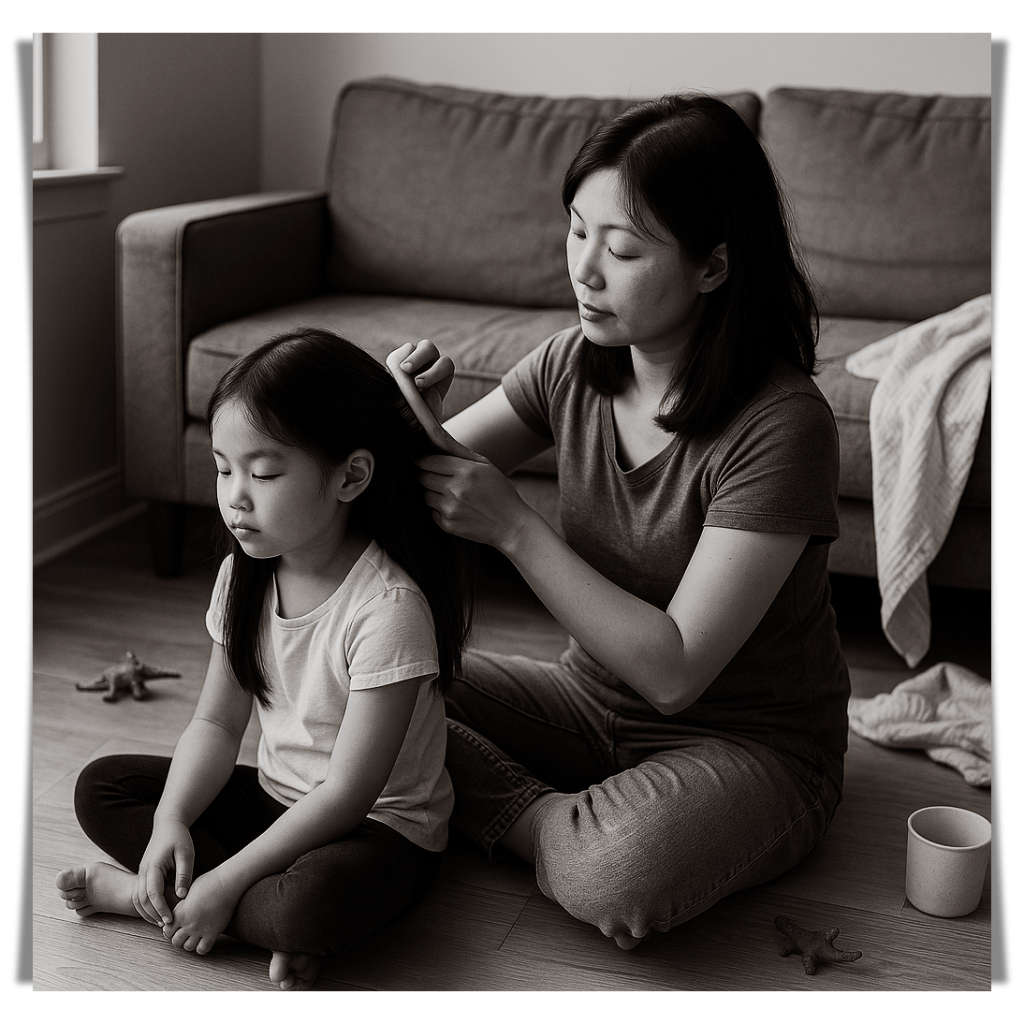
As the kids grew older, I began having open conversations with them. I apologized. Not in grand speeches, but in quiet moments together: during car rides, at bedtime, or while having a meal. To my astonishment, they forgiven me. Completely, freely. As children frequently do when love triumphs over regret.

Their forgiveness was a balm. But can I forgive myself? This is still a work in progress.

What comforts me now is the realization that motherhood is not a destination. It is a process of growing. Every mistake I made was the result of a version of myself doing my best with what I knew. And I understand better now. I pause longer. I listen more carefully. I still make mistakes, but I’m more aware of them. I grow together with them.

So, if you’re a parent who’s been lugging guilt about like a hidden stone, maybe it’s time to let it go. Perhaps you can let the softer part of yourself speak. The one who continues to show up, try, and love with each broken, beautiful step.

Because this is not the mother I meant to be. But I’m still evolving to be a better version of myself.


✨ Visit Olivia’s Atelier for printables, reel templates, and planners made to support overwhelmed moms with gentle, soulful tools.
🕊️ Enjoy 50% off everything until June 2.

A Mother’s Day Reflection

I didn’t grow up imagining myself as a mother.

Not as other girls did, pretending to cradle dolls or writing baby names in the margins of their schoolbooks. I wasn’t opposed to becoming a parent; it simply didn’t feel urgent, like something I needed to pursue or prepare for. And yet, I am here. It’s been years. A mother. With gentle hands and a heart that is always rearranging itself around little lives.

Mother’s Day used to pass with little thought. A day spent playing cards and making phone calls. Of seeing my own mother from a distance, attempting to decipher the aspects of her that I could never fully grasp. I had no idea she felt so invisible at the time. When you’ve given everything to others and lost yourselves, silence may be deafening.

Now I do.

Mother’s Day is now a quiet occasion in our family. The kids sometimes remember and sometimes they don’t. My hubby asks what I want to eat. I fold the laundry and do the dishes anyway. Life does not stop simply because it’s May. However, a part of me always wishes for a pause, if only for a moment. A pause that says, “We see you. It is not simply what you do, but who you are underneath it all.”

This year, I didn’t request flowers or breakfast in bed.

What I desire cannot be purchased or arranged.

I want someone to acknowledge my effort. How I manage to show up even when I’m very exhausted. How I manage to kiss their foreheads at night despite carrying the weight of invisible things like schedules, fears, and guilt. I want someone to say, “I see the woman you are, not just the mother you have become.”

Because I’m both.

A woman who once had aspirations that did not involve diaper bags or parent-teacher meetings. A woman who still longs for quiet mornings and uninterrupted thoughts. Also, a mother who has dedicated her body, sleep, and time to love so profound that it has utterly transformed her.

So, on Mother’s Day, I gave myself what the world frequently forgets to give: grace.

Grace for the things that remain undone.

Grace for the yelling I regret doing.

Grace for the dreams I’ve placed on hold.

Grace for the ways I am still learning to parent myself.

And maybe that’s all it needed.

Happy Belated Mother’s Day to the quiet mothers, the tired ones, the fierce ones. The ones who feel like they’re failing but keep showing up anyway.

I see you.
And I’m learning to see me, too.


Mother

They see
lunchboxes prepares,
schoolwork signed,
clothing neatly arranged into piles.

But they don’t see
the woman who forgot who she was
before responding to “Mama.”

They don’t see
how she holds her breath
until the door closes,
and she can cry
without needing to explain.

They don’t see
how she forgives herself
in small rituals—
a hot cup of tea,
a song in the car,
a scrawled poem
at midnight.

They don’t see
her saving herself
a little at a time.

And still
she shows up.
Every day.
with love nestled
into every nook of her weariness.

Because this is what she does.
That is who she is.

Copyright © Olivia JD 2025
All Rights Reserved.


✨ Looking for digital tools that support your everyday life with gentleness and intention?
At Olivia’s Atelier on Etsy, I offer more than just pretty printables—I create emotional support kits, Instagram reel templates, children’s meal planners, and other soul-nourishing resources for moms who give so much but rarely feel seen. Whether you need a moment to breathe, a tool to stay organized, or a way to connect with your audience—there’s something here for you.

🕊️ Everything is 50% off until June 2—because you deserve support that feels doable, beautiful, and kind.

If I Could Be a Criminologist for Just One Day

Some prompts ask for fantasy, but this one nudged me toward truthfulness and honesty. If I could choose any job for just one day, I wouldn’t reach for prestige or power. I wouldn’t imagine myself on a stage, in a lab, or leading a corporation. 

I’d choose to be a criminologist. 

No, I have no interest in solving crimes, examining evidence, or pursuing cold cases. Nothing like that. It is because, a long time ago, I met a criminologist and we fell in love. I want to understand him, this man who carries so much and says so little. 

What would it be like to spend a day in his shoes? I want to walk silently through his memories, particularly the ones that linger in crime scenes after everyone has left. I want to sift through his memory that stands still in front of a whiteboard full of tragedies. I want to walk through his memories because I could never reach that part of him no matter how hard I tried.

I wouldn’t be there for the thrill. I’d be there to observe the way he looks at the world when no one’s watching. I’d want to finally learn the stories he never said out loud to me, even when I cradled his head in my arms as he struggled to wake from his dark dreams. 

I’d trace the photographs he pins to the wall—the faces of the dead— and see his handwriting curve along the margins. I’d watch how he circles certain names darker than others, the lines thicker when the pen pressed harder with his instinct. 

At lunch, I’d sit across from him while he quietly picks at his food. I’d watch how his eyes drift with restraint. He sees everything. He just doesn’t always let it show.

Maybe by being a criminologist for a day, I’d learn what it means to hold other people’s pain without crumbling. And maybe I’d finally understand why he sometimes looks at me like I’m a mystery too.

By the end of the day, I’d return the badge, the case files, and boxes full of evidence. I wouldn’t need to stay. 

Because…I never want the job.

I just want the man behind it. 


Some days, love is remembering someone’s shadow. It’s like bearing witness to the way they disappear into themselves, hoping you’ve seen enough to still find them in the dark.

A poem to accompany this piece.

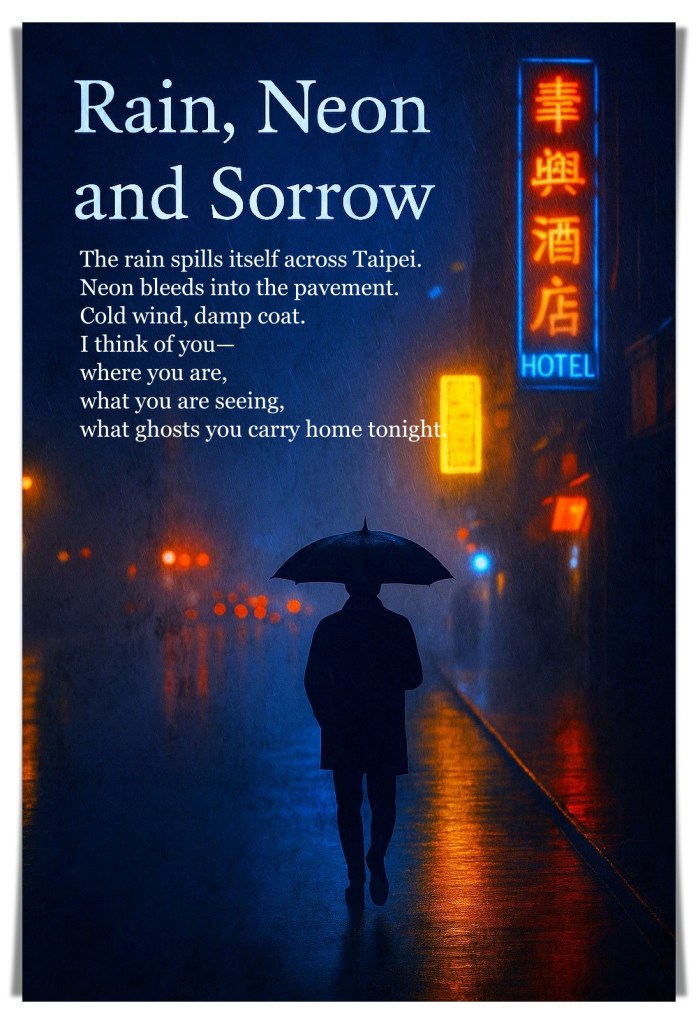
Rain, Neon and Sorrow

The rain spills itself across Taipei.
Neon bleeds into the pavement.
Cold wind, damp coat.
I think of you—
where you are,
what you are seeing,
what ghosts you carry home tonight.

Are you still bent over your desk,
searching for a disease,
fingers tracing the city’s veins—
sharp like a scalpel?

Are you peering again into the abyss?

Tell me—
how much blood have you washed off your hands?
how much stays,
burrowed beneath your nails,
tucked inside your sleepless bones?

I’ve seen you stare past me
with eyes that see things
you will never say.

You kiss me like a man
leaving a crime scene.
Touch me as if memorizing evidence.
Does love feel like guilt to you?

My love won’t pry open your fists,
won’t drag you back from the ledge
among the dead.
In this city of rain, neon and sorrow,
I wonder—
are you still whole?
still awake?
or has the night already claimed you?

Copyright © Olivia JD 2025
All Rights Reserved.

The Hour After Midnight | Why I Stayed Awake When I Should’ve Slept

For years, I stayed up too late.

It wasn’t because I was working or I had boundless energy or I was busy chasing my dreams. The main reason was that I needed to feel like a person.

It didn’t start as revenge bedtime procrastination. That phrase only found me later, when I stumbled across an article that put a name to my nightly rebellion. It felt like intense desperation. You could say it was a craving or a desperate fight for space.

When my children were small, the days blended together in a mist of needs. I remember those years vividly and if I’m honest, it makes me shudder, but not because I feel ashamed. My daily life was full of milk-stained shirts, sticky fingers, and toys scattered like confetti across every surface. I loved my kids fiercely. Still do. But in those days, I didn’t know where I ended and they began. I gave them my body, my attention, and everything. And somewhere in that giving, I began to disappear.

When the kids were finally asleep and when the house finally went quiet, and the dishes were done, I sat down. Just for a moment, just to breathe.

And that moment stretched beyond what I intended. I stayed up. Scrolling. Reading. Writing. Wandering through Facebook memories of the woman I used to be. Buying time I couldn’t afford, just to feel like I still existed.

I’d tell myself, “Just one more post. One more chapter. One more scroll.”

But truthfully? I was afraid that if I slept, I’d wake up and do it all over again. The endless giving, pouring out myself and forgetting.

So I kept stealing those hours after midnight.

And in the morning, of course, I paid the price.

I was more irritable. More short-tempered. More ashamed of the mother I was becoming.

The irony was painful: I stayed up to save myself, but it only made me more fragile the next day.

I never told anyone how much I resented the way my life had shrunk. How much I missed myself and how ashamed I felt for even feeling that way.

That was the case until I began writing about it.

That’s how The Hour After Midnight came to life. It began as fragments and eventually evolved into a complete poem. A piece of me, speaking directly to the woman I used to be. Perhaps I still am that woman, but these days I go to bed at 12 AM or earlier. As the kids grow, I enjoy my sleep more, and the resentment has disappeared.

This poem is about a mother who gives her all and suffers in silence. It’s about a woman who craves stillness to survive her crazy life of constant giving. She was just a tired soul who wanted to feel seen.

If that sounds like you, I hope this poem wraps around you like a quiet hug. It’s more than a printable; it’s a recognition and a mirror. A gentle piece of emotional support for any overstimulated mom who needs a reminder to be kind to your mind.

This digital poem makes a thoughtful and unique Mother’s Day gift, especially for the tired mom who needs to hear she’s still enough. It’s a beautiful affirmation of motherhood for those navigating revenge bedtime procrastination, mom life burnout, and those quiet moments where you whisper, “I am enough.”

Find The Hour After Midnight in my shop Olivia’s Atelier. You’ll receive a high-resolution poem print in multiple sizes, ready to frame or gift. I hope it brings you what it brought me—a pause, a breath, a beginning.

Note: Yes, I launched my Etsy shop recently to share my poems with the world. Right now, everything in the shop is 50% off until June 2, including our featured Mother’s Day Poem Printables. They are designed as heartfelt gifts or tender self-reminders to moms everywhere. Feel free to check it out.

The Way She Unwinds

Daily writing prompt
How do you unwind after a demanding day?

Note: This post contains sensual content. It’s tender and intimate, not graphic, but may not be for everyone.

Unwinding doesn’t always mean drinking herbal tea or watching Netflix. It could be about reconnecting with yourself, through your body and the presence of others.

I wrote this to examine what it means to let go of the day physically as much as emotionally. Not everyone discusses how sex may be therapeutic, grounding, or even spiritual. But it is for me.

This is an honest and vulnerable piece. I don’t believe we should hide our tenderness or yearning. Sometimes what heals us the most is the part that we’re afraid to say out loud.

She washed the day off her skin—
rose oil, lavender salts,
tepid water,
with a man behind her
who didn’t speak,
semi hard
against the curve of her spine.

She leaned back,
exhaled her weariness
mingled with steam rose like ghosts
from the bath they shared.
He shampooed her,
untangled the strands,
while she, soaping his creases
like cupping rain-warmed petals
in her palms.

She read later,
naked beneath the sheets,
the book trembling slightly
in her hands
as his finger skimmed
the back of her knee.

He asked about her day,
she told him in curses and laughter.
She wrote about it too—
in smeared writing,
pages sticking together
like sweaty thighs.

He watched her,
a repentant sinner
at a communion
he’d waited all week to taste.
She looked into his eyes,
offered her invitation
to slit open her core,
and slid inside her mess.

She was the scripture
he devoured,
worshipped with tongue and blasphemy.
Broken hymns
tumbled from their lips.
Her body a confessional booth—
each cry, a hidden truth.

After,
he was a punctuation
that curled about her,
there was never a period,
only dashes
waiting for words.

She didn’t sleep.
She exposed.
Soft.
Ravaged.
Holy.

Copyright © Olivia JD 2025
All Rights Reserved.

Evaporating No More

I never want to visit a place where I have to shrink to be accepted, loved, or tolerated. In this place, softness is seen as a warning sign, silence is misconstrued for compliance, and each mouthful feels like restraint.

I used to be there. It wasn’t a city with a name, but in living rooms where truth was unwelcome, in church pews filled with shame, in beds where I learned to sleep with absence and call it comfort.

Sometimes the cruelest places aren’t found on any map but rather built slowly by unspoken words, frozen stares, and the way someone you love says, “don’t make it a big deal” when your soul is tearing at the seams.

I never want to visit a place that demands me to chop myself into pieces to fit their platter.

I’d rather walk naked through misunderstanding than hide behind lies for others’ comfort.

Give me the wilderness—raw, shivering, and divine. In locations where no one speaks my language but still listens, where stray cats welcome me, and even the wind doesn’t ask for explanations.

I’ve spent too long evaporating, like breath against cold glass.

Never again.

Not for love.

Not for survival.

Not even for home.