


I have been struggling with migraines for the past few days. I couldn’t write or read at all. So I turned to Netflix. I don’t watch it much because I prefer to spend my time reading or writing letters to my overseas friends. Yup, real letters. I don’t use emails or messaging apps to connect with some of my friends. But that’s a topic for a future blog post.
There were plenty of good shows on Netflix. I was spoilt for choice. However, after browsing several titles, I settled on a Japanese drama, First Love. It has nine episodes and I figured if I binge-watched it, I could finish it in three days.
First Love was released in 2022. It is a non-linear, emotional romance inspired by Hikaru Utada’s iconic songs “First Love” and “Hatsukoi”. The series spans more than 20 years, jumping back and forth across three distinct timelines: the late 1990s, the 2000s, and the present day. There are two main characters:
• Yae Noguchi, an ambitious high school student with a bright future who dreams of becoming a flight attendant.
• Harumichi Namiki, a sincere and devoted high schooler who falls deeply in love with Yae and later joins the Japan Air Self-Defense Force (JASDF).
When I started watching it, my reaction to the different timelines was quite visceral. I wondered if I could follow the timelines without getting confused. We are introduced to teenage Yae who is beautiful, popular, and academically promising. She belongs to the “it” circle that I would probably not have belonged to as a teenager.
Then we see adult Yae, a woman in her late 30s or early 40s who is divorced, plainly dressed, and working as a taxi driver. My first instinct on seeing the adult version of Yae was to look at her and think she had failed. She obviously had peaked in high school, and I wondered about her life’s journey since graduating from school. Yae looked like an ordinary middle-aged woman who had gone through things in life. But as I kept watching, I started to ask myself: what happens when the person everyone expected to become extraordinary grows up to have an ordinary life?
The Stolen Dream
As the story progressed, I realised that Yae hadn’t consciously abandoned her dreams. She has a car accident that erases crucial years of her memory and, with them, her entire relationship with Namiki. The amnesia costs her relationship with Namiki because he is now a stranger to her. But apart from that, the accident completely derails her education and her future.
Eventually, she becomes a mother but gets divorced after a marriage to a brain surgeon who had treated her. Yae is financially comfortable while married, but after the divorce, she has to support herself and has a child to raise. She has to give up her dream of becoming a flight attendant. Yae ends up working two jobs: as an airline catering assistant and a cleaner at the airport. There is nothing shameful about these jobs. But it pains me to watch her physically inhabit the very place of her abandoned dream. She watches other people take flight while she remains grounded in an entirely different uniform.
“My Dull and Insignificant Life”
The scene that really broke me was when adult Yae stands on top of a hill overlooking the city and tells Namiki that her life is dull and insignificant (episode 6). She speaks about giving up her dreams after divorce, losing custody of her son, and feeling that she hasn’t accomplished anything significant in her adult life. She also mentions that sometimes she has an inkling that something crucial is missing from her life, even if she doesn’t know what it is.
The drama intercuts this scene with teenage Yae’s English speech about having dreams. The two versions of Yae are speaking to each other across time. And the devastating irony is that Namiki is standing right beside her, remembering the girl she has forgotten. He knows her dreams and who she was. And he knows what caused her amnesia. (They reconnected as adults but she doesn’t recognise him.)
This scene made me reassess my initial reaction to adult Yae. Why did I initially think of her as “just a taxi driver” and see her as having failed in life? I realised I was judging Yae by the same standard she was using to judge herself.
The Return of Memory
Yae does regain the memory she had lost, but it doesn’t happen through some dramatic medical intervention. She regains it while listening to Hikaru Utada’s song “First Love”, which had been a big hit when she was a teenager. The song has a Proustian effect on her. Her body reacts before her narrative mind catches up. The song helps her recover the memory of her lost teenage boyfriend and reconnect with a former version of herself. She finally understands that the absence she had been feeling all those years was real.
Tsunemi’s Tragedy
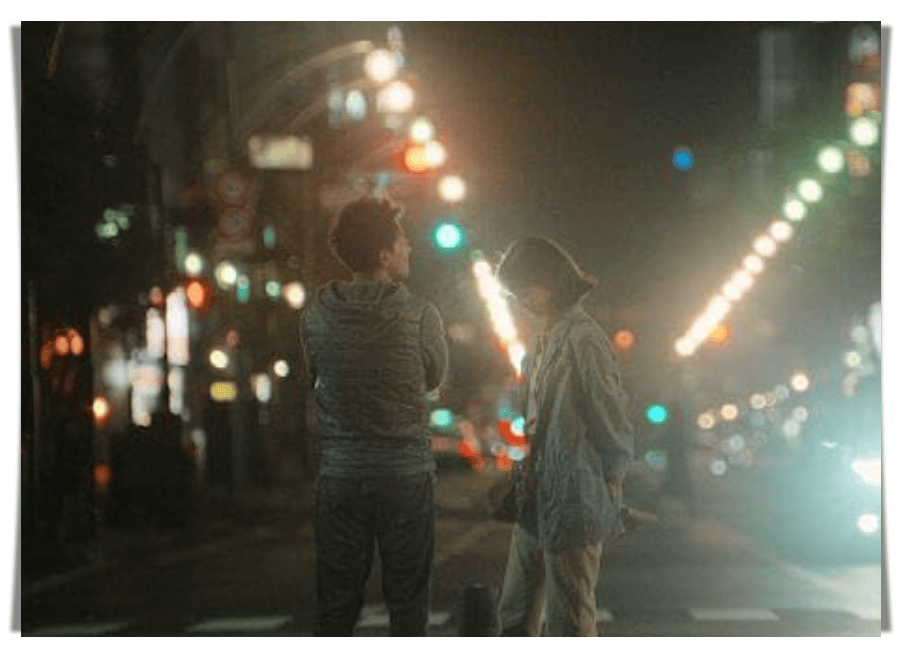
The character I found myself pitying is Tsunemi, Namiki’s fiancée. I admit I don’t really like her character, but I can certainly feel her pain.
Tsunemi was Namiki’s counsellor after his deployment to Iraq. Their relationship begins professionally, but he starts to develop romantic feelings for her. He pursues her and proposes to her. They spend years together and she supports him through his hardest times. Tsunemi believes they have a future together, but when Yae returns to Namiki’s life, his old feelings for her begin to resurface.
Leaving Tsunemi for Yae is cruel, but staying would hurt all of them even more. There is no clean choice here. I imagine what it would feel like if someone I loved and built a life with suddenly left because an old flame returned. It would be devastating. Tsunemi may be just a “side character” in this story, but she was living a love story too.
A Fairy Tale Ending
I am glad Yae and Namiki found each other in the end, but the finale in Iceland felt a bit too much like a fairy tale. I don’t dislike it, but I do feel “meh”. It felt jarring after watching episodes filled with the realistic, messy lives of these characters.
The earlier episodes show how an accident, class and ordinary circumstances can permanently change people’s lives. The ending just gives them everything back. Yae and Namiki resume their romance, she achieves her dream of becoming a flight attendant, and Namiki returns to being a pilot. If I were the showmaker, I would have preferred something quieter and more realistic, chucking that fairy tale element: maybe just two middle-aged people finding each other again and simply deciding to build a life with whatever remains.
Was Her Life Ever Insignificant?
There are plenty of reviews online that discuss their romance. While their romance is endearing and heartbreaking, that is not my main take from this drama. I am a realist and I tend to focus on the reality of the characters’ situations, especially the way Yae judges her own life.
She thinks her life is dull and insignificant because it doesn’t resemble the life her teenage self imagined. But we watch adult Yae survive a catastrophic injury. She also raises her son, even though she later loses custody. She works multiple jobs to survive. She loves and loses and keeps her tenderness and spirit alive.
The real tragedy isn’t that Yae became ordinary. It is that she learned to see the ordinariness of her life as a failure. And perhaps that leaves us with an uncomfortable question: does the difference between the life we thought we would live and the life we actually lived tell us anything about whether that life was worth it?
I write about Iban culture, ancestral rituals, creative life, emotional truths, and the quiet transformations of love, motherhood, and identity. If this speaks to you, subscribe and journey with me.

