

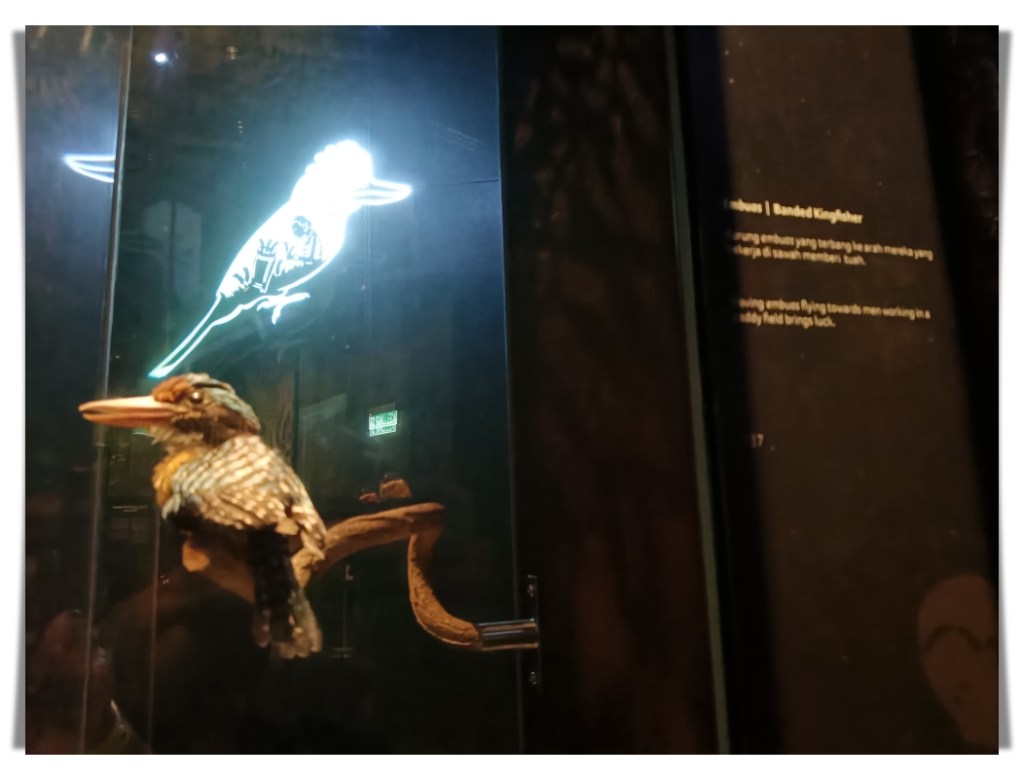
Embuas (banded kingfisher), one of the Iban’s omen bird. Photo taken at the Borneo Cultures Museum.
People sometimes ask whether I am superstitious. I never know how to answer that question. I grew up Iban in Sarawak, where the stories people carry about the world are different from those taught in textbooks. And these stories often include elements that some might consider superstitious. In many conversations today, the word “superstition” is used to describe beliefs that seem irrational or outdated. It implies a bygone era and a belief system that should be abandoned.
But the word doesn’t fit when I think about the beliefs I heard as a child growing up in Sarawak. Among the Iban, there was once a system of augury known as “beburong.” Certain birds were believed to carry messages from the spirit world. The Iban believed that these birds had a special purpose. People paid close attention to their calls, and the direction of the bird’s flight was important. People listened to them when deciding whether to begin a journey, clear land for farming, or carry out other important tasks such as headhunting.
These practices were linked to Sengalang Burong, a powerful god associated with war and omen birds. Iban people believed that he and his children watched over human affairs through the voices of these birds. The forest was never silent because every sound had a meaning. From the outside, it looks like superstition. People who depend on data, evidence, and measurable results find it hard to believe that birds could help individuals make important decisions.
The Iban once lived very closely with the land. Rivers determined travel. Forests provided food, medicine, and shelter. Paying attention to patterns in nature was part of daily life and also part of survival.
I don’t try to figure out if the birds really brought messages from the spirit world. These beliefs shaped how people saw the world and how they understood their connection to nature and the spiritual meaning of their surroundings. They taught people to pay attention and reminded communities that humans and the land that supported them were not separate.
Most Iban communities no longer depend on omens from birds. Electricity and internet connections power the longhouses that once practiced these beliefs. Younger generations leave for cities, universities, and office jobs. The old systems of interpretation are fading, and many people now refer to them as cultural history. However, the stories remain.
When elders talk about encountering certain birds, they do so with the same calm seriousness they would use to talk about a change in the weather or the flow of a river. These memories are not embarrassing for the elders to share. They are just a part of how earlier generations understood their lives.
Modern language often labels such beliefs as superstition. The word closes the conversation quickly, as if discussing it were shameful or in conflict with Abrahamic religious beliefs. It suggests that there is nothing more to examine. But as I grow older, I feel less certain about dismissing things so easily.
Beburong is part of my cultural heritage, but I never relied on omen birds to guide my decisions. Now, my days are filled with work, art, writing, family obligations, and the normal routines of modern life. But when I’m walking outdoors and hear certain birds, those beliefs return to my mind. It doesn’t ask for faith. It only reminds me that there were once other ways of listening to the world.
I write about Iban culture, ancestral rituals, creative life, emotional truths, and the quiet transformations of love, motherhood, and identity. If this speaks to you, subscribe and journey with me.


Very interesting, Olivia.
Thank you for building this site. I do enjoy to read your article and stories here. I am doing my research now for my PhD on Dayak Iban in Sungai Utik. Your stories really have a very strong connection with Sungai Utik people.
As a religious studies scholars, I little bit understand about your curiosity to answer the question you post. For me, I will put away my abrahamic religions perspective to understand Iban belief. By doing so, I can listen to Iban voice about their belief without trying to judge if they are superstitious or not. Iban belief is different from other belief especially world religion belief.
Maybe we can discuss more about this.
LikeLike
Hi Subandri, my apologies for the late reply. I have been inactive on this site because I am currently busy preparing for a zine festival to promote my work on Iban culture. Oh yes, I have watched YouTube videos about Sungai Utik before. We definitely share deep similarities and connections. After all, we are all Iban. I completely agree with your point about setting aside current religious perspectives to truly understand our Pengarap Lama. I did the exact same thing. Sadly, not everyone agrees with this approach; some look at learning about Pengarap Lama as evil-worshipping or a waste of time.
Yes, we definitely can discuss more about this. Feel free to leave your questions and comments. I would love to learn from your perspective as well.
LikeLike