Antu Ngarung | The Guardian Spirit That Shapes My Iban Identity

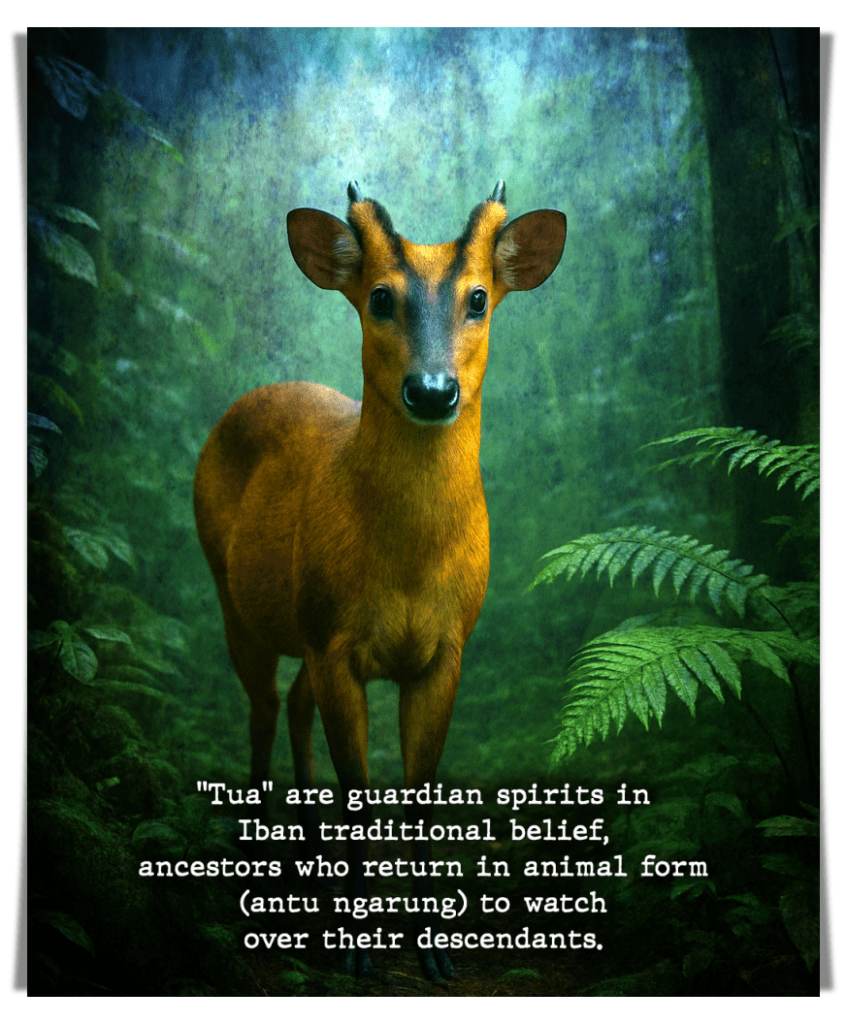
In Iban belief, the souls of those who die go to Sebayan, the afterworld. Some remain there permanently, but certain individuals are believed to return. These are people who lived with exceptional courage or accomplishment during their lifetime. When these ancestors come back, they do not appear as humans. They come ngarung, meaning concealed, taking the form of animals. These returning spirits are called tua, or guardian spirits.

In the Saribas region, guardian spirits are often seen as snakes such as cobras or pythons. They move quietly, stay in the shadows, and leave without drawing attention. When I picture antu ngarung, I always imagine a cobra coiled in the dark corner of a house or at the edge of the forest. It stays still for a long time and slips away the moment it decides to leave. To many people, it would be just an ordinary animal. To us, it can be an ancestor paying a visit.

A guardian spirit usually belongs to an entire lineage. Because of that connection, the family must never harm or eat the animal that represents their guardian. This is a form of respect. The belief is straightforward: the guardian protects the family, and the family must protect the guardian’s form on earth.

In my family, our guardian is the kijang, the Bornean yellow muntjac. When I was four or five, my late grandparents reminded us repeatedly never to harm, kill, or eat kijang. They did not offer long explanations, but the message was clear. Someone in our line was once a brave person, and that ancestor is believed to return as the kijang to watch over us.

That instruction frightened me growing up. I was afraid I might break the rule by accident. I used to remind myself to always ask what kind of meat was being served when we visited people. At that age, it felt like a tremendous responsibility. Over time, the fear changed. I started to feel that my life was connected to something older and larger than myself. I also realised that this experience was not common among many non-Iban communities, which made me value my heritage even more.

The belief in the kijang has shaped the way I understand myself. It gives me a sense of courage. I am still afraid of many things, but this belief keeps me steady. It reminds me that my ancestors lived through hardship, violence, and uncertainty. My problems today are nothing like what they endured. I often tell myself to live in a way that does not dishonor the people who came before me. I exist today because they survived so much. That thought helps me face difficult moments.

When I imagine the kijang watching me now, I think it sees a woman who lives differently from the Iban women of earlier generations. My lifestyle and interests are not the same. Yet I believe it recognises my effort to understand my roots. It may also encourage me to continue forging my own path even when no one else in my family is doing this kind of work. Many women in my family excel in traditional crafts like beadwork and weaving, but none of them are writers. I have to accept that I may be the first woman in my family to preserve our heritage through writing. Someone younger in the future may look at my work the way I once looked at my namesake, the master weaver. Remembering this keeps me going, even when the work feels lonely.

This leads to something important.

We risk losing our identity when we do not learn about our heritage. The loss does not happen suddenly. It happens slowly. We begin identifying more with other cultures. We forget the meaning behind our names, our customs, and our stories. When we fail to protect what we inherit, we leave an empty space that can be filled by influences that do not reflect who we are. This is happening in many communities around the world, and the Iban are no exception.

Iban identity will not endure by chance. It survives because someone chooses to learn, write, document, and share it. It stays alive when people believe their heritage is worth protecting. It continues when people care enough to ask questions and remember the stories their elders passed down.

Our ancestors returned as antu ngarung for a reason. We owe it to them to honor the heritage they entrusted to us.


I write about Iban culture, ancestral rituals, creative life, emotional truths, and the quiet transformations of love, motherhood, and identity. If this speaks to you, subscribe and journey with me.
The Bungai: Ancestry, Identity, and the Iban Connection to Nature

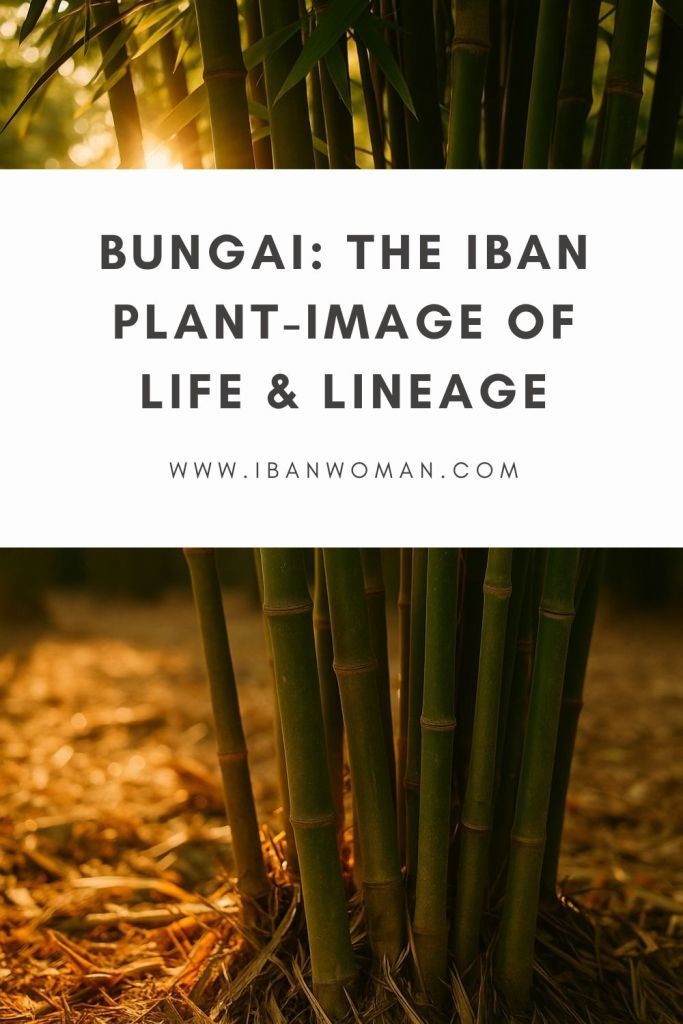
The Iban believe that the self is not limited to the body or the soul that wanders in dreams. Our ancestors believed that each person has a bungai, which is a plant-image that lives in the invisible world of Manang Menjaya, the god of healing. This plant-image takes the form of bamboo or banana and grows in clumps from a single rootstock. It is a powerful way of understanding human life. The bungai grows, strengthens, weakens, dies, and falls to the ground, just as a person does.

When I first heard about this idea, it stuck with me for days. It helped me see the forest differently and understand why the Iban imagine the community the way they do. In this worldview, no one grows alone. We rise from the same source. Relationships, ancestry, and connections we can’t see hold us together in ways that go far beyond our personal stories. This belief feels very grounding at a time when many of us feel adrift or disconnected.

The choice of bamboo and banana is meaningful. These plants do not grow by themselves. They grow in clumps, called bepumpun. A single shoot is part of a larger body that gets its nutrients from the same soil and root. Every shoot has its own height, shape, and direction, but they all come from the same source. This is how the Iban once understood family. A family is one clump. A longhouse community is made up of many clumps. The forest itself becomes a reflection of the social world.

This is not a metaphor for the sake of beauty. People who live close to the land learn its pattern by observing it daily. The Iban watched how plants behave, how they survive storms, and how they keep growing new shoots even after the old ones fall off. The Iban were shaped by the rainforest, and it was a teacher, a mirror, and a guide.

The bungai makes this idea clearer. It shows us that each person is both unique and part of a lineage. A child is a new shoot from an old rootstock. The state of one shoot affects the whole clump. The well-being of the entire garden reflects the condition of the longhouse. No one exists apart from the others who stand beside them. Even in the unseen world, the Iban imagined people living bepumpun, connected through generations, place, memory, and spiritual obligations. 

I find this comforting. There were times in my life when I felt distant from my roots. Leaving home for school, work and marriage created gaps I did not understand at the time. I lived away from Sarawak for many years. I felt as though I was a shoot attempting to thrive in soil that was not my own. Learning about the bungai made me see that the rootstock never disappears. The connection stays even after we leave. We are still held by the unseen garden. It doesn’t matter how far someone travels; the lineage remains.

Another thing I appreciate about the bungai is how it reflects emotional and spiritual states. The bungai becomes weaker when a person is sick. It withers when the soul wanders. This worldview recognizes how closely the body, mind, and emotions are connected. It respects how complicated it is to be human. A withered feeling is not seen as weakness but as a sign that the self needs care, grounding, or healing. Manang Menjaya is responsible for this realm, taking care of the gardens of human life like a healer tends to the sick. It is a gentle belief shaped by compassion.

The idea that the bungai falls when someone dies is also meaningful. The clump remains alive and ready to push a new shoot upward for the next generation. The rootstock stays strong. The lineage continues. There is sorrow, but there is also continuity. The living remain connected to those who came before them.

When I reflect on this, I see how the bungai offers us a way to think about community in today’s world.  Many of us live far from home. Some grow up with mixed heritage, navigating several identities at once. Some people don’t feel connected to their language, their land, or their family’s history. The bungai concept reminds us that belonging isn’t just about being close to someone physically. It also has to do with our shared ancestry, memories, and the unseen ties that still hold us together.

The forest shows us that we can’t survive alone. Bamboo stands because the clump stands. A community stays together because its roots are strong. Long before the words “ecology” or “sustainability” were even used, our ancestors knew this. They practiced it when they built longhouses, shared food, and worked the land. They lived in a world where the rhythms of nature and community supported each other.

Writing about the bungai feels like returning to a memory I never knew I had. It combines culture, spirituality, and nature in a way that feels very Iban. It makes me think of how our people used to observe the forest, learn its patterns, and keep it in balance. The bungai is more than just a spiritual idea. It is a way of looking at life that sees it as connected, continuous, and held by something greater than the self.

I want to honor this understanding as I continue working on my cultural projects. I want the Iban in the diaspora, those growing up with mixed heritage, and those rediscovering their language again to know that our roots are still alive, even when we feel far from them. The bungai reminds us that we come from the same source, and the clump endures.

One Clump
If we were bamboo,
we would be one rootstock.
Two shoots from the same source
fed by the same unseen tenderness
running under everything.

You would lean into me
when the wind turns,
and I would hold fast
with a strength drawn
from the ground we share.

A clump is a world.
A home where no stalk stands alone.
Each one rises
because the others do.
The root simply refuses
to forget a single one.

I want that with you—
a belonging without effort.
Our lives rising
from the same dark earth,
so that even Menjaya
counting lives in his garden,
would find us together.

If you falter, I stand closer.
If you bend, I become your spine.
We are two lives
shaped by each other’s nearness.

If we are a clump, love,
then we are one living thing—
one root,
one anchor,
one quiet refusal
to ever rise alone.


I write about Iban culture, ancestral rituals, creative life, emotional truths, and the quiet transformations of love, motherhood, and identity. If this speaks to you, subscribe and journey with me.
Iban Augury | The Language of Birds and the Art of Listening

Prior to the coming of Christianity and Islam, the Iban people had a sophisticated system of animistic beliefs. The world was believed to be filled with spirits—some friendly, others unpredictable—who lived in jungles, rivers, animals, and dreams. The desire to live in harmony with these invisible forces influenced many aspects of life, from farming and hunting to warfare and family decisions. 

Augury, or “beburong” in Iban, was one of the most intricate systems in this belief. It is a sacred form of divination that uses the movements and sounds of certain birds known as burung mali (omen birds) to seek direction. The practice was said to have been taught to humans by Sengalang Burong, the Iban God of War and divine messenger. He taught that the gods do not speak directly but send their messages through the natural world.

Every omen bird has a specific meaning. The interpretation of their cries, flight paths, and actions guides important decisions, such as whether to start planting paddy, go on a journey, or go to war.  The tuai burong, an augur who can read and understand the language of birds, is responsible for figuring out what these signs mean. This cultural duty used to be a big part of Iban life because it was a way for people to connect spiritually and keep their conduct in line with God’s will.

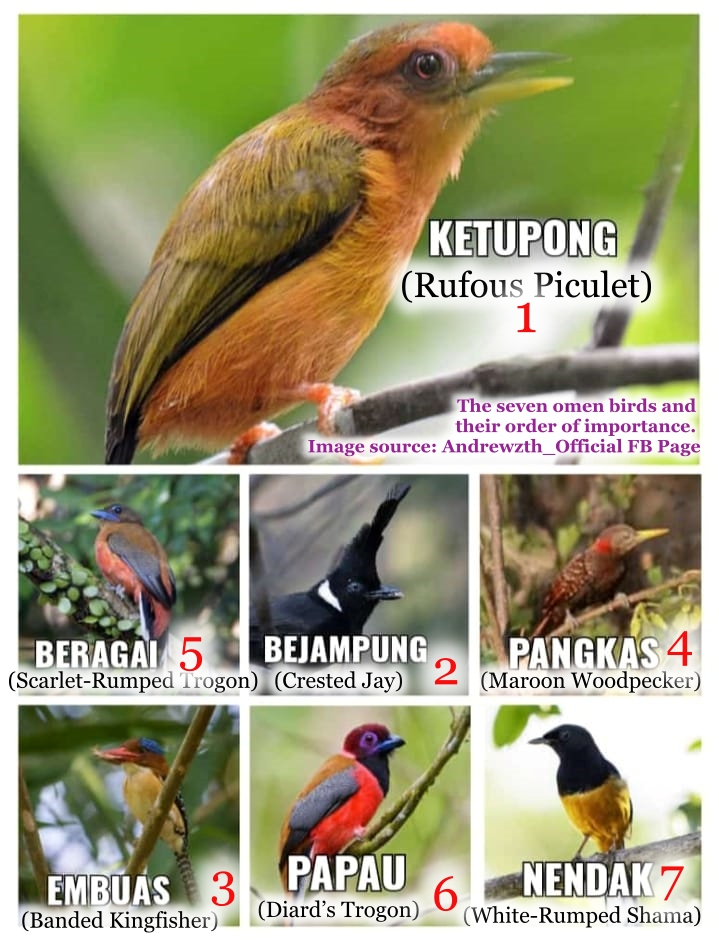
Oral history states that Sengalang Burong and his wife, Endu Sudan Berinjan Bungkong, had seven daughters and one son. Each daughter married a nobleman who became one of the seven omen birds: Ketupong (Rufous Piculet), Beragai (Scarlet-Rumped Trogon), Bejampong (Crested Jay), Pangkas (Maroon Woodpecker), Embuas (Banded Kingfisher), Kelabu Papau (Diard’s Trogon), and Burung Malam, which literally means “night bird” but is a cricket. The eighth omen bird, Nendak (White-Rumped Shama), is Sengalang Burong’s faithful messenger. All of these are real, common bird species that live in the Borneo rainforest.

Sengalang Burong passed down the knowledge of augury to his grandson, Sera Gunting. Sera Gunting is the son of Sengalang Burong’s eldest daughter, Endu Dara Tinchin Temaga, and her second husband, a man named Menggin. Sera Gunting also learned the omens of war when he joined a ngayau (headhunting) expedition with his seven uncles—the noblemen who married Sengalang Burong’s daughters. He later passed his knowledge to his descendants. Linggir Mali Lebu, Orang Kaya Pemancha Dana Bayang, and Unggang Lebor Menoa were among the subsequent generations of Iban war leaders who observed and practiced the war omens he had learned.

Sengalang Burong also taught Sera Gunting about the different stages of Gawai Burong, the festival that war leaders had to hold to invite him and his followers to attend. That is a story and post for another time.

All the omen birds mentioned above can still be found in Borneo’s rainforests. I have never seen them in the wild or heard their calls in person, but last month, when I visited the Borneo Cultures Museum, I had the opportunity to hear recorded calls from Beragai and Embuas. I could hear the sound of wind, insects, and other birds in the distance along with their calls in the recordings. It was difficult to tell which bird made which sound. It reminded me that to practice augury, you needed to believe and have an attentive ear to pay close attention to the different bird calls.

Those recordings brought back a memory from my childhood. When I was nine years old, my parents decided to adopt the baby son of a relative. They had everything ready: a small bassinet, baby clothes, and the trip to the longhouse where the child was staying. They had to walk through the jungle for three hours to reach the place. 

Along the way, they encountered an omen bird. I don’t know which one it was, but a tuai burong was consulted to explain the sign. He advised my parents not to continue. He said that if they went through with the adoption, the boy would grow up to “overrule” me and my siblings, which means he would prosper more than us and that we might fall into misfortune. My parents took the advice and chose not to go through with it. The baby stayed with his other relatives, and that was the end of it.

Looking back, I understand that moment not as superstition but as a reflection of how much faith my parents had in the way things were meant to be. They thought that signs meant something and that the natural world could warn or guide us through nature’s language. It was a way of life built on attention, not control. However, it didn’t stop me from wondering, what if the boy experienced a difficult childhood filled with poverty and hardship and was denied the chance to live a better life due to the bird’s signs?

Today I realized how rarely I listen. The world around me is full of noise—machines, traffic, and incessant messages devoid of meaning. Even in silence, my mind is busy with thoughts, endless scrolling, or work. Listening feels like a lost art. I no longer know how to hear what my forefathers intuitively understood: that signs came quietly, without noise or spectacle.

I’m not sure if anyone still practices augury today. Perhaps a few elders still possess fragments of that knowledge. Even if it is no longer practiced, I hope that Ibans, particularly the younger generation, understand its origins and significance. Beburong was once central to how our people made decisions and understood their relationship with nature. It influenced how they approached the world—with respect, patience, and a willingness to listen. Perhaps I’ll never see those birds in the wild or hear their true calls across the forest. But I’d like to believe they’re still there, their voices blending with the wind, delivering guidance that once guided entire communities.


I write about Iban culture, ancestral rituals, creative life, emotional truths, and the quiet transformations of love, motherhood, and identity. If this speaks to you, subscribe and journey with me.

Headhunting | The Rituals and Care of Antu Pala

Disclaimer: This post is only for sharing purposes. I’m not an expert, just sharing what I know. The information here is general and may not cover every detail. For Iban readers who know more, feel free to add in the comments. This post is not meant to glorify the practice of headhunting but to share knowledge for better understanding.

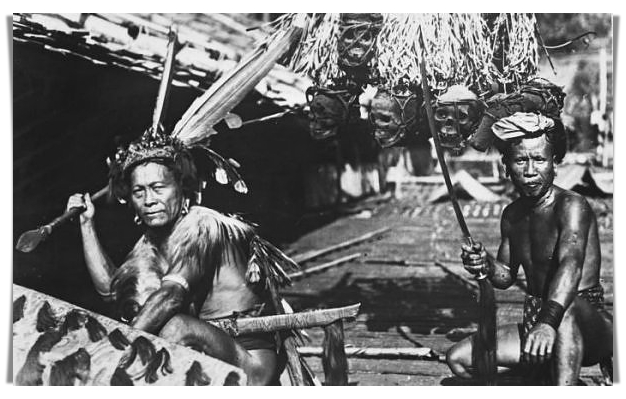
As I mentioned in my previous post, headhunting among the Iban was not random violence but part of specific mourning rituals. It was carried out to complete rites after the death of a family member. But after the warriors returned from ngayau (headhunting expedition), what happened to the severed heads? Were they hung immediately? The answer is no. Certain rituals had to be performed before the heads could be brought into the longhouse and later hung in the ruai (communal gallery).

The first thing the bujang berani (warriors) did upon returning was to manjung, which means to shout and announce their arrival. They could not enter the longhouse right away because it was taboo.  Specific rituals had to be followed. Practices varied from one Iban community to another, but what I’m sharing here is the way of the Saribas Iban from the Betong Division.

Image source

After announcing their arrival, the bujang berani stayed for a week in a small hut called langkau near the longhouse. During this time, they rested, cleansed themselves, and prepared the heads. This included cleaning and removing skin, flesh, and brain matter to prevent decay. The process took place by the river, where the heads were skewered on sticks, washed thoroughly, and boiled to loosen any remaining flesh. Once cleaned to bare skulls, they were smoked over the bedilang (hearth) until black and dry. At this stage, they were known as antu pala.

When the skulls were ready, the warriors prepared to re-enter the longhouse in full Iban regalia—baju gagong, ketapu or lanjang (headgear), sirat (loincloth), tumpa (silver armlets), and marik betaring (toothed beads). Only men who had gone on ngayau were permitted to wear the full attire. Those considered kulup (cowards) who had never participated in a headhunting expedition could only wear a sirat.

Image source

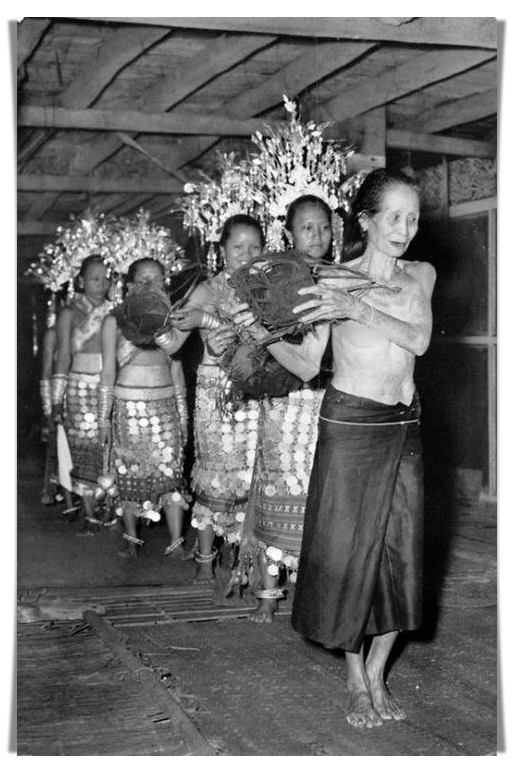
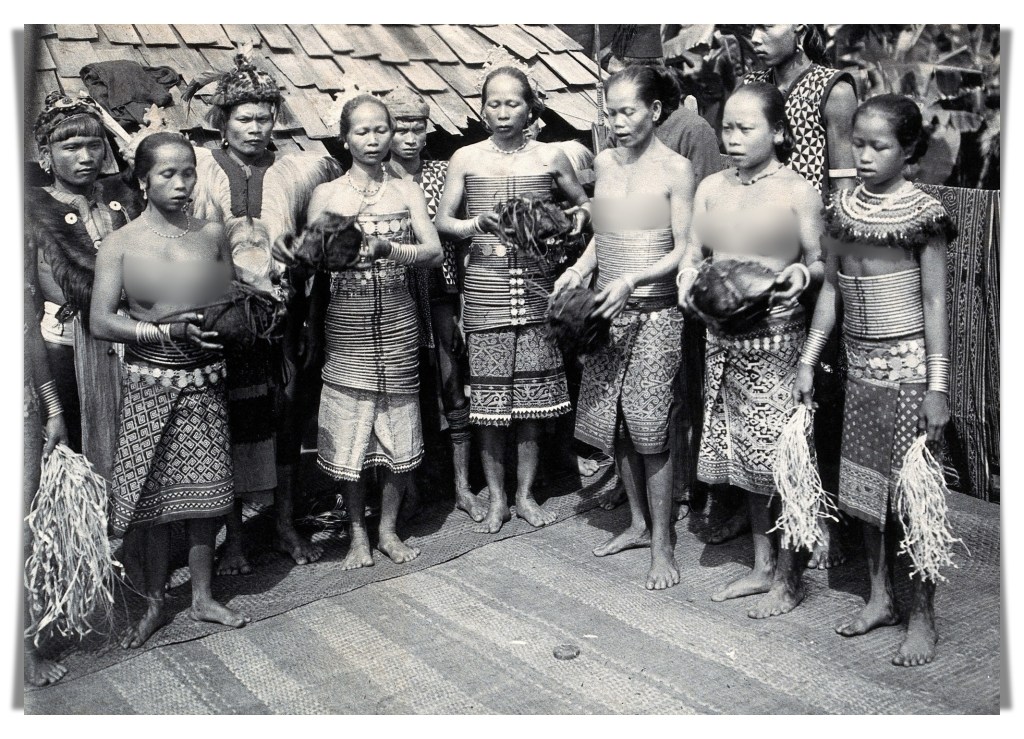
A procession called Mangka Ke Selaing was then held to welcome them home. The warriors were welcomed with panjung (victory shouts) and the beat of the Gendang Pampat. At the doorway, they were received by their mother or wife carrying a chapan (winnowing tray) covered with pua kumbu, a ceremonial textile woven only by the mother or wife of the warrior. The cleaned skulls were placed on the pua kumbu, not fresh or bloody as often imagined. The Iban always followed adat (custom) in their rituals, so there was never any confusion or disorder.

Image source

The mother or wife then played a key role in the Naku Antu Pala procession, carrying the tray of skulls along the ruai while nyangkah (chanting). The warriors marched behind the women to the rhythm of the Gendang Rayah. During this moment, they could not be touched or spoken to, as it was believed that the deities Keling and Kumang of Panggau Libau accompanied them. Disturbing them was said to cause one to faint.

The lemambang, or bards, were also present at the procession. They carried a garong, which is a bamboo container full of tuak, or rice wine. Only the bujang berani could drink this wine, and they drank it at the end of the procession. The ritual was over when the mother or wife performing Naku Antu Pala bit the skull, which meant that her spirit had won over the skull’s spirit. The antu pala then became the servant of its owner.

After the ritual, a feast called Gawai Enchaboh Arung was held in honor of Bujang Berani. There was food, ngajat (traditional dance), and happiness all night long. The mourning period came to an end with this feast. The antu pala was believed to nyilih pemati, to replace the soul of the deceased with that of the enemy, allowing the departed to rest peacefully in Sebayan (the afterlife).

Image source

Taking care of the antu pala also included different rituals, depending on the purpose. Whenever the skulls were moved or ceremonies were performed, miring or bedara’ was always required. Miring was a ceremony of prayers and offerings to Petara (God), the deities of Panggau Libau, and the ancestral spirits (Petara Aki Ini) for blessings, harmony, and protection from harm.

This was followed by bebiau, a rite using a fowl with accompanying prayers. Before it began, a piring (offering) was prepared, consisting of tobacco, betel nut, betel leaf, gambier, rice, salt, glutinous rice, rice flour, yellow rice, eggs, tuak, and chicken feathers dipped in blood from the sacrificed fowl. Larger ceremonies like Gawai Burong required even more offerings.

After miring, the antu pala had to be “fed.” This act was similar to the Chinese tradition of offering food to ancestors. Rice, water, and sometimes cigarettes were placed as offerings, and in some rituals, a pig was also sacrificed, especially when moving the antu pala to another location.

Not everyone was allowed to touch the antu pala. Only its owner or heirs could handle it. In some regions, this role was reserved for men. If a skull fell, it could not simply be picked up; a miring had to be done first, with a chicken offered before it was lifted and rehung.

These were only the basic practices. There are many more rituals surrounding the antu pala, each layered with meaning and guided by adat. These rituals may seem strange or even unsettling today, but they used to be crucial to the Iban’s understanding of life, death, and the spirit world. They show a community that was deeply guided by adat, a system that balanced courage with respect and ritual with meaning. 

If you have stories or knowledge passed down from your elders about antu pala or other old practices, I’d love to hear them in the comments. Every story adds another thread to our shared history. 

If you’d like to see a performance of the Naku Antu Pala procession, you can check out this video:


I write about Iban culture, ancestral rituals, creative life, emotional truths, and the quiet transformations of love, motherhood, and identity. If this speaks to you, subscribe and journey with me.
The Only Way I Know Not to Forget

The answer isn’t loud. It doesn’t arrive with flashy ambitions or bold declarations.

It’s silent. Steady. Rooted.

I am passionate about remembering and honoring.

I honor and remember not only to preserve personal memories but also as a way of fending off cultural erasure. It is also a sign of devotion to my ancestors, the land, and everything that made me.

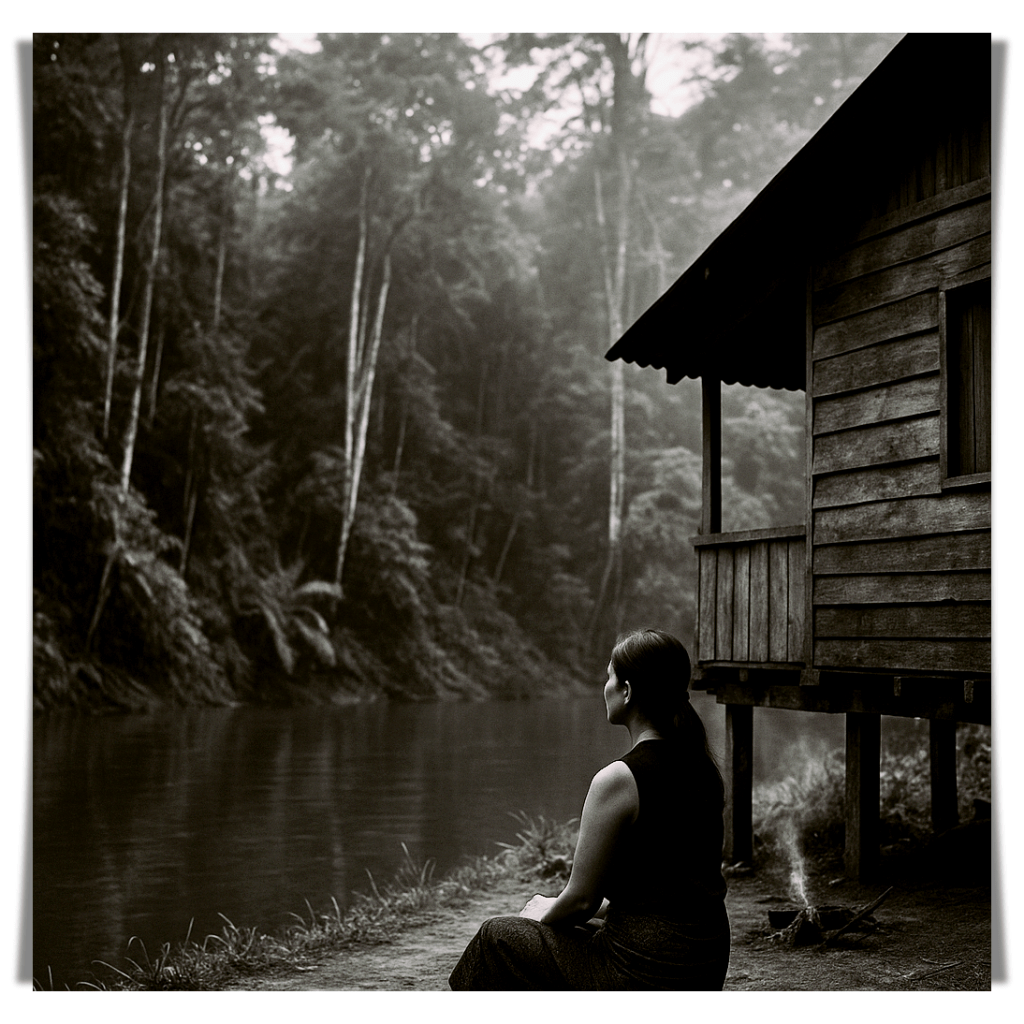
I didn’t grow up in the longhouse as my parents did. I was raised in the urban areas. But culture was never absent from my childhood. When my grandparents were still alive, we’d return to the longhouse for the holidays. It sat peacefully by the river, where the rainforest hold ancient tales and the air smelled of damp earth and woodsmoke. Our songs were sung in Iban. Our prayers were whispered into the land and borne by the wind. We spoke to the land as if it were family. Because it was.

At thirteen, I left home for boarding school, relocated to the big city, and then traveled to other countries for work. Over time, English became my dominant language, and I now speak it more fluently than Iban. I’ve raised my children in a world of shopping malls and neon lights, where the only rivers are highways and the jungle exists only in manicured, trimmed parks.

Will they recognize the sound of pantun sung at dusk?

Will they appreciate the taste of kasam ensabi or understand the beauty of our rich poetry and invocation to the deities who live in Panggau Libau, the land above the skies?

I am passionate about preserving these things. Even if it means teaching them clumsily. Even if I feel like a deteriorating bridge attempting to bear the weight of two worlds.

Why? Because culture isn’t something we simply inherit. It’s something we keep alive.

So I write and draw. I create poetry rooted in my heritage for my children and myself.

I do this not because I believe it will change the world.

But it’s the only way I know to avoid forgetting.

So that is my passion.

And that is how I love my people, my identity, my culture.

And that is how I love myself.


✨ Visit Olivia’s Atelier for printables, reel templates, and planners made to support overwhelmed moms with gentle, soulful tools.
🕊️ Enjoy 50% off everything until June 30.

Marriage Traditions of the Iban of Sarawak, Borneo

Marriage is a timeless union that binds two souls together. It also functions as a mirror, reflecting the core of a community’s culture and identity. My people, the Iban of Sarawak, Borneo, fill their traditional wedding rituals with deep meanings based on ancestral traditions. However, these traditional ceremonies are gradually disappearing as time passes.

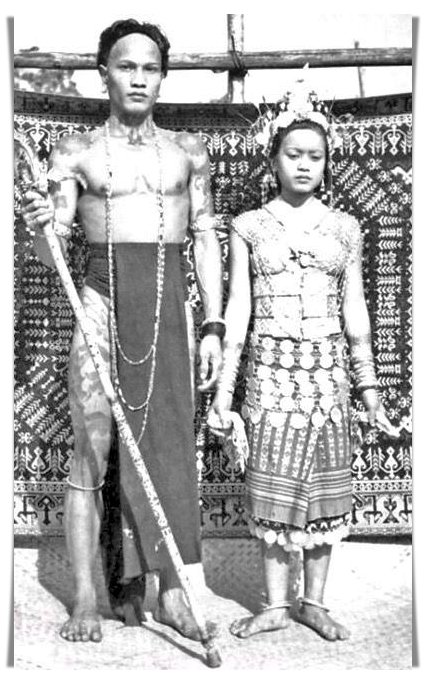
For the Iban, marriage was not just a bond between two individuals but a communion of families and communities. Traditionally, the groom’s parents carefully planned this arranged marriage. Ties of kinship often influence their choice of wife. Cousins were preferred matches because they preserved familial relationships while also reflecting the Iban’s value of unity within their extended network. When a bride was chosen, the groom’s parents would leave a rawai (silver girdle) or an ilang (sword) at her family’s home as proof of their dedication and intention.

Image source

The longhouse is the heart of Iban community life. During weddings, it becomes a lively epicenter. It was here that life and celebration collided, and the community joined together to honor the union. Careful planning is required days or weeks before the ceremony. This includes making tuak (rice wine) in enormous vats, preparing traditional buns and cookies, and selecting livestock for slaughter. Guests were invited with knotted strings to tally down the days till the celebration.

On the wedding day, the groom’s journey to the bride’s longhouse was a ceremony unto itself. The groom’s party traveled to the bride’s longhouse either by boat or on foot through the jungle. Guests were expected to dress in traditional ngepan (intricate traditional costumes), with women donning corsets or rawai (silver girdles) and men wearing armlets and feathers, among other traditional pieces. The groom’s party arrived to a joyous clash of gongs and the firing of brass cannons.

However, underneath the surface of celebration were rituals with deeper meanings. One of the most remarkable customs was the use of poetry or poetic language to provide the ceremony a sense of artistry and depth. When the official ceremony started, the host’s representative would offer the guest a drink, followed by a formal recitation inquiring about their purpose:

“I hesitate and feel nervous to talk in front of you all,
The reason I say so is because I realize that you are the mothers of porcupines,
Covered with cross-stripped white quills,
Pointed like bradawls.
I notice that you are the mothers of hornbills,
With tails striped,
crossing at right angles,
Which claim that they can fly to Brunei and return the same day.
I see that you are the mothers of bears,
Which have stout arms to make holes on the trunks of iron-wood trees.”

“We, therefore, have been sitting next to each other.
I would like to ask,
Which one of you is the mother of the hornbill?
For I am about to ask you to spit out the seeds of the belili tree,
In order that they can be picked up by a tall, unmarried lady,
So that they can be turned into the tusks of a pig,
As charms for the unripe ears left till the last in reaping,
With which we fill our padi bins.”
Poem source

These exchanges were rich in metaphor and eloquence. The poetic recitations continued throughout the ceremony, including a betusut (genealogical recitation) by an expert who detailed the bride and groom’s genealogy. This ritual not only validated the union but also ensured that the marriage respected cultural taboos and norms in order to avoid misfortune.

Image source

Elders sealed the union with feasting and storytelling, bestowing blessings and wisdom on the pair. They discussed respect, understanding, and the delicate balance required to navigate life together. Complex traditions and customs infused every action, from seating arrangements to gift exchange.

Today, such ceremonies are a rarity. The Iban embraced Christianity and Islam, abandoning many of their traditional practices in the process. The vibrant rituals of traditional Iban weddings now exist mostly in memory or retellings.

The ceremonies detailed here are not simply rituals. They depict a way of life that places a high priority on community, heritage, and balance. They remind us of the beauty of traditions that once connected people to their past while celebrating the present. The decline of this tradition is a loss not only for the Iban but also for the universal human story of connection, identity, and belonging.

The significance of the Iban wedding customs strikes me as I reflect on them. Marriage was never just about two people; it was about integrating their lives into the larger fabric of their community. It was about love, shared responsibility, and the power of a collective spirit.

Perhaps that is the true power of these traditions: their ability to touch something deep within us while also reminding us of the fragility and beauty of cultural heritage. And as we look forward, perhaps we have a tenacious hope that even as the old ways fade, their spirit will continue to shape the future in ways we may not fully comprehend.

Modern Iban weddingImage source.