The Traditional Path of an Iban Weaver

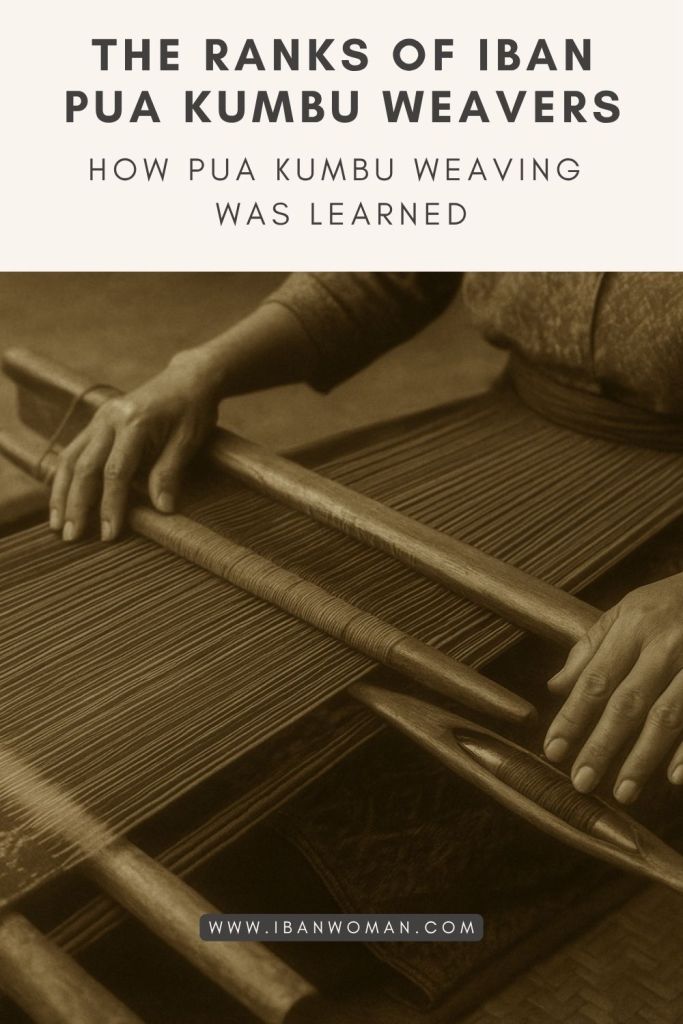
Among the Iban, weaving has always been a measure of a woman’s place in the community. The knowledge is passed down from mother to daughter, usually when a girl enters her teenage years. She learns each stage with patience: preparing cotton yarn, tying the threads, selecting designs, and working through the complex dyeing process. Every step includes a ritual to maintain balance with the spirit world. A weaver must be skilled, but she must also be spiritually open in order to progress. Through weaving, she learns how to approach the unseen forces that shape her life as a woman and as an artist.

A weaver must follow the traditional sequence of learning. If she attempts skills before she is ready, she risks falling into layu, a state of spiritual deadness. Elders say this condition can affect both the mind and body, and once it takes hold, death is believed to be the only release. Every Iban woman understands this danger, so she approaches her craft with devotion and deep caution.

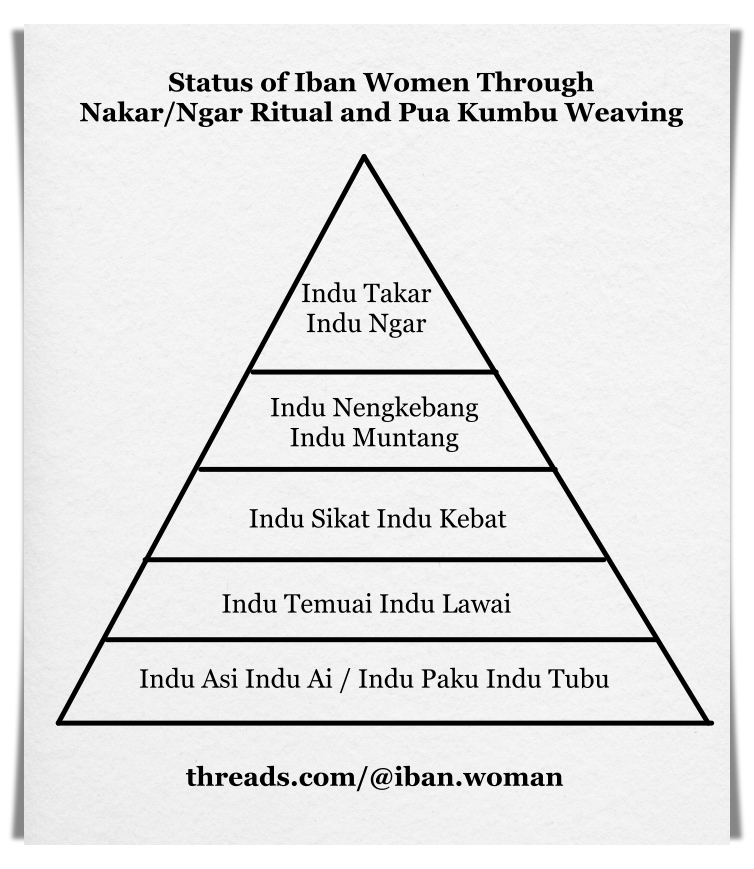
Pua kumbu is a way to understand a woman’s status. Her rank depends on the dyes she uses, the complexity of her patterns, the precision of her technique, and her relationship with the spiritual world. A pua is not judged by beauty alone. It reflects the weaver’s inner state, her discipline, and the spiritual guidance she receives. Even though many Iban families today have adopted modern beliefs, the traditional criteria for judging a pua still hold meaning. The rituals and techniques behind each piece continue to define its value.

There are several ranks within the weaving world. At the first level are women who do not weave, called Indu Asi Indu Ai or Indu Paku Indu Tubu. They may not come from weaving families or may lack the resources to learn. Much of their time is spent farming and managing household life, and they cannot afford the labour or materials needed for weaving.

The next group consists of women known for their hospitality, called Indu Temuai Indu Lawai. These women usually have enough rice, help, and stability to weave simple designs. With guidance from others, they can produce basic patterns such as creepers or bamboo motifs.

A novice learns within strict boundaries set by tradition. She begins with a small piece of cloth and a simple pattern called buah randau takong randau. She may only weave a cloth that is fifty kayu in width. As her skills improve, she increases the width of her work. By her tenth pua, she will reach a width of 109 kayu. These rules are deeply respected, as they are believed to originate from the spirit world.

When a woman becomes skillful, she is known as Indu Sikat Indu Kebat. She can weave recognised patterns but cannot create her own. Her designs come from motifs passed down through her ancestry. If she wishes to learn new patterns, she must make ritual payment to a more experienced weaver in exchange for permission to use them.

A higher rank is held by the Indu Nengkebang Indu Muntang. She is able to invent new designs, often revealed to her through dreams. She has the ability to attempt complex and spiritually demanding motifs. Her community respects her greatly, and she wears a porcupine quill tied with red thread as a mark of distinction. Other weavers pay her well for new motifs.

At the top of the hierarchy is the Indu Takar Indu Ngar. She is a master dyer, a master weaver, and a ritual specialist. She understands the exact balance of mordants and natural dyes and knows how to fix colour to cotton successfully. Many people know the basic ingredients, but only those with spiritual guidance can complete the process with precision. Her knowledge is both technical and sacred.

To reach this level, a woman must excel in all areas of weaving and dyeing. She must also receive recognition from the spiritual world. This acknowledgment often comes in dreams, which serve as both initiation and confirmation. Sometimes another person dreams on her behalf, affirming her role. Many women at this level come from long lines of weavers and dyers, inheriting designs, dye knowledge, charms, and the support of ancestors whose status once brought additional labour to their families. This allows her to devote herself fully to her craft.

The Indu Takar Indu Ngar is responsible for the ritual preparations of the mordant bath. The ceremony includes animal sacrifice, offerings, and prayer. It is known as kayau indu, or women’s warfare. The ritual is private and demanding, and the leader must be courageous. If she loses control of the spiritual forces present, she risks falling into layu. Her bravery is regarded as equal to that of a warrior.

She also plays an important role in public ceremonies. During Gawai Burong, she scatters glutinous rice at the ceremonial pole. During Gawai Antu, she prepares garong baskets to honour the master weavers of earlier generations. When she dies, her funeral is filled with praise, and her worth is compared to that of a prized jar. Her husband receives honour as well.

Every pua kumbu carries the status of its weaver. Its complexity, width, ritual purpose, and intended use shape its value. Pua kumbu textiles accompany every stage of life and death for those who still observe traditional Iban practices. Each design is tied to a specific ritual, and the ritual gains its character from the cloth chosen for it. This is why pua kumbu remains central to the spiritual life of Iban women.


I write about Iban culture, ancestral rituals, creative life, emotional truths, and the quiet transformations of love, motherhood, and identity. If this speaks to you, subscribe and journey with me.
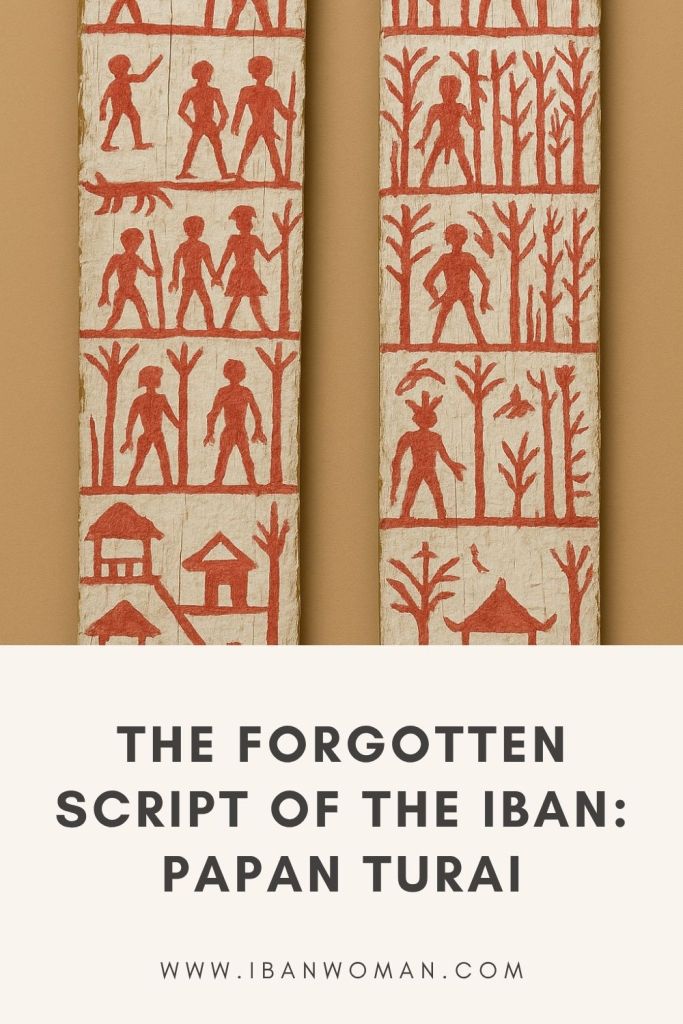
The Forgotten Script of My Ancestors | Remembering the Papan Turai

The majority of us are familiar with Egyptian hieroglyphics. However, not many people are aware that the Iban used to have their own type of pictorial writing. My ancestors’ written language, known as “turai,” is carved onto wooden boards called “papan turai.” During major festivals like Gawai Batu and Gawai Antu, lemambang (ritual bards) used these boards to recall and recite the pengap (folk epics), timang (invocations), and many other types of Iban poetry (leka main asal).

The papan turai is more than just a ceremonial piece. It serves as a link between oral and written tradition. Some of these carved symbols date back about four centuries. They preserve fragments of genealogy (tusut), the Iban’s migration history from the Kapuas region of Kalimantan to Sarawak, and even tales of tribal conflicts and legendary Iban leaders.

Researchers from the Sarawak Museum and UNIMAS have been examining these boards to find out what they symbolize. What is remarkable is that lemambang from various areas can comprehend each other’s papan turai. This demonstrates that there was once a common symbolic language among people in different communities.

This discovery goes against the previous belief that the Iban were completely “pre-literate” before Western influence arrived. The papan turai shows that our forefathers had their own way of keeping records of what they knew, which was based on ritual, cosmology, and collective memory. It reminds us that being able to read and write doesn’t just imply knowing the alphabet and how to write on paper.

In 1947, an Iban scholar named Dunging anak Gunggu expanded upon this tradition. He developed a whole writing system based on turai. However, few people know about this writing system, even among Sarawakians.

When I stood in front of the papan turai at the Borneo Cultures Museum, I felt a sense of recognition. They reminded me of the pua kumbu patterns that Iban women wove to tell stories about spirits, dreams, and journeys. Both have the same goal: to record, remember, and preserve meaning alive beyond the present.

It made me realize that each culture had its unique way of retaining memories. Some people carve it into stone, some into wood, others into sound, and yet others into cloth. For the Iban, it may have been all of these things at once. The lemambang sang what the papan turai contained, and the pua weavers wove tales and ancestral history into the thread. These were our books before books.

As I stood there, I thought about how easily such histories fade away. It’s not because they aren’t relevant, but because they aren’t documented in the systems that the world relies on. The papan turai lived on through continuity of ritual and faith. Its knowledge lived on through the lemambang, in various ceremonies and festivals, and in the community gathered around the ruai during Gawai. When modern eyes look at the papan turai, they may see only strange markings. But these are not just symbols. They hold our heritage. They are reminders that our people were already keeping records of their lives in their own way long before British colonials came with pen and paper. However, I am not sure how long we can keep them alive, as the lemambang is becoming a dying breed of heritage guardians of the Iban. 

I felt pride and loss as I left the museum that day. Pride, since the papan turai shows that Iban civilization was more complicated and deep than most people realize. Loss, because so few of us can interpret those symbols today.

Maybe this is why I write and draw. I want to continue that old rhythm in a new form. My writings and drawings are like my own papan turai, illustrating the lines that connect the past and the present. I strive to document things that could otherwise disappear, including stories from my indigenous perspective, feelings, and fragments of my identity.

To me, the papan turai is more than an artifact. It is a mirror that reflects an ancient hunger to make meaning clear and to preserve memories alive before they disappear. And maybe that instinct to leave a mark and to tell a story is something that never truly goes away. It exists in our language, our art, and our digital words. It’s the same urge that led a lemambang to carve symbols into wood hundreds of years ago, hoping that someone would remember it someday.

Sources: Religious Rites and Customs of the Iban or Dyaks of Sarawak by Leo Nyuak and Edm. Dunn (1906), UNIMAS Gazette. 


I write about Iban culture, ancestral rituals, creative life, emotional truths, and the quiet transformations of love, motherhood, and identity. If this speaks to you, subscribe and journey with me.
On Cultural Erasure and the Right to Be Ourselves | We Are Not Yours to Claim and Rename

This week, a man on social media told me that all Indigenous peoples of Borneo are Malay. He spoke as if it were an unbreakable truth, and a few confident sentences could change centuries of culture and memory. He talked like someone who was certain of his place in the world and couldn’t imagine that others might have histories older than his own.

I am Iban. You can’t claim and rename my people.

That one conversation was a sign of a much larger issue. It wasn’t just a rude comment but the same old narrative that keeps playing beneath the surface of national conversations. This idea that everything in the Nusantara archipelago belongs under the Malay umbrella is not unity. It is colonization in a new form that continues to erase the cultures that make this region truly diverse.

A thesis essay titled “Cultural Genocide Against Ethnic Groups in Sarawak” discusses this gradual erasure as a form of genocide that occurs through language, law, and land instead of war. It addresses what has been happening in Sarawak and all over Borneo for decades: the gradual disappearance of Indigenous ways of life. There won’t be any violence in the news, but you can see it in how children forget their native languages and how native stories are rewritten or how they are dismissed as myths.

The first impact is on the land. Large-scale logging, oil-palm plantations, and hydroelectric projects like the Bakun and Murum dams have forced Indigenous communities to evacuate ancestral lands they had occupied for generations. For many outsiders, these are symbols of progress. For the people who lived on that land, they are the loss of a living relative. Land isn’t just property; it’s a memory, a source of livelihood, and the center of our beliefs. When it is taken, the connection between people and their ancestors, between rituals and the land, ceases to exist.

The next impact is on language. Malay and English are the main languages spoken in classrooms and offices. Iban, Bidayuh, Penan, and other Indigenous languages, on the other hand, remain in private spaces. The national curriculum rarely acknowledges them. A language is more than just words; it also embodies every aspect of our heritage. When children grow up without it, they lose not only vocabulary but also the worldview embedded in those sounds. 

The third impact is spirituality. Before Christianity and Islam arrived, our ancestors believed in a cosmology that connected people, nature, and the unseen. The adat guided balance and respect. Several elements were based on Hindu-Buddhist beliefs from the Majapahit and Minangkabau traditions, but those influences became uniquely our own, shaped by our environment. If you call these beliefs primitive, you are ignoring how sophisticated they are. Long before the word existed, they taught people about law, ethics, and ecology. The suppression of these systems has shattered more than trust; it has destroyed the bridge between generations.

The last impact lies in invisibility. Bureaucracy rarely speaks the language of the natives. Many still struggle to gain recognition of their customary land rights or even simple documents like birth certificates and identity cards. People who don’t have these papers become ghosts in their own country—unseen in census numbers and uncounted in national decisions.

Taken together, these forces create the silent machinery of cultural genocide. It’s not about individual malice but about a system that values uniformity over diversity and control over respect. When progress is measured only by infrastructure and profit, it becomes a form of forgetting.

I write this not to sow division, but to call for honesty. Respect for Indigenous tribes and their histories is not charity but a moral obligation.  When you erase a culture, you do not create unity. You create emptiness. Real harmony happens when differences can exist side by side, without one overtaking the other.

If you have mixed roots and feel like you’re torn between two identities, know this: you’re not a poser. You are the result of two or more heritages coming together. You have the strength of several worlds inside you. You have every right to learn your ancestral language, honor both sides of your heritage, and talk about it with pride. You can still reach your roots and the journey begins with curiosity and grows through community.

And to those who continue to insist that “everyone is Malay,” listen up: you are not defending tradition; you are performing a modern version of the same colonial mindset you claim to oppose. Claiming and renaming others is not leadership. It’s theft. It is a refusal to accept that different roots can live together without merging into one trunk.

The Iban, Bidayuh, Kenyah, Penan, Lun Bawang, Melanau, Kelabit, and countless other groups are not extensions of a larger race. We are nations within a nation, with histories that predate borders. We have our own gods and deities, our own literature, our own rituals and way of life. We don’t need anyone to save us from ourselves.

So take care of your own culture and let us take care of ours. Guard your own identity and let us stay as ourselves. You don’t have to tell us what to believe, how to speak, or how to conduct our affairs. Preserve your own heritage and quit trying to claim ownership of what doesn’t belong to you.

This moment in our history calls for courage. We need courage to listen, fix what has been distorted, and return whatever is rightfully ours. We don’t need anyone’s permission to exist. Even when others pretend to forget, we remember. We will continue to speak, to write, to sing, and to exist in our own rhythm. We are not lesser branches of your tree. We are forests in our own right.


I write about Iban culture, ancestral rituals, creative life, emotional truths, and the quiet transformations of love, motherhood, and identity. If this speaks to you, subscribe and journey with me.

The Mouse-Deer and the Crocodile | A Classic Iban Folktale

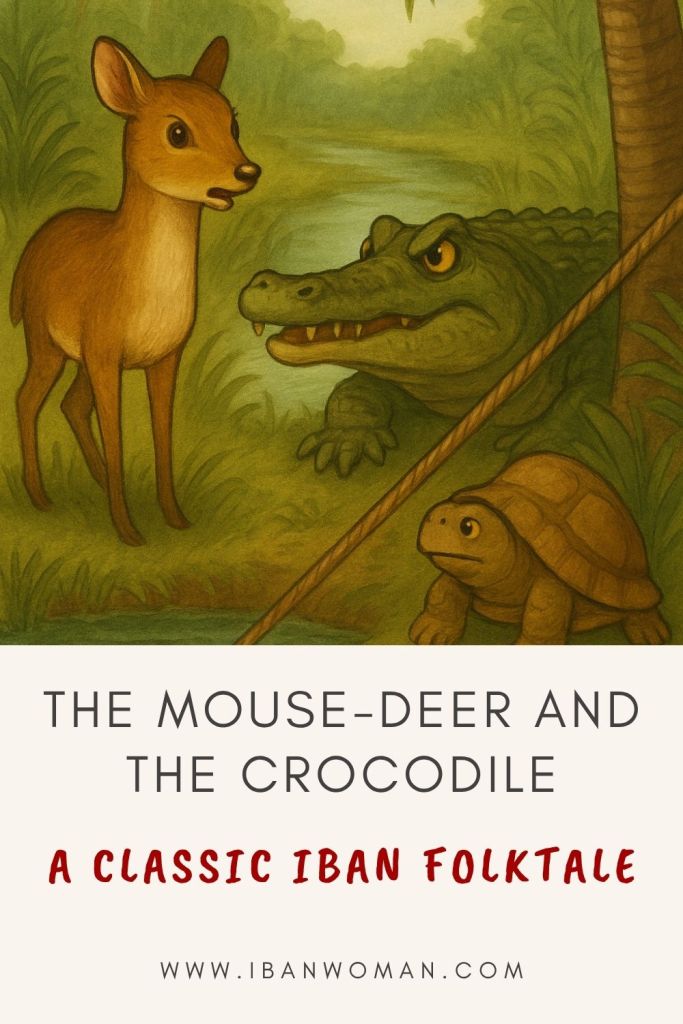
One day, the mouse-deer (pelanduk) went out to look for food. After walking for about an hour, he reached a swamp covered in tall grass (madang melai) and water plants. Not far from there, an old Malay man named Pak Dollah was busy clearing the area to prepare it for farming.

The mouse-deer wanted to eat the fallen fruits of the simpur tree (pun buan) that grew nearby, but he was afraid Pak Dollah might see him. He moved carefully, one step at a time, hoping to stay unnoticed. But his fear was unnecessary, Pak Dollah was too focused on his work to notice anything around him. So the mouse-deer went ahead and ate the fallen fruits to his heart’s content.

When he was full, he turned to leave. Just as he was about to walk away, a female crocodile (baya indu) suddenly shouted at him.

“Hey, Mouse-Deer!” she called.

“Oh, Crocodile! You scared me!” he replied.

“You ate my eggs, didn’t you?” she accused.

“What? Of course not!” said the mouse-deer.

“Don’t lie! I saw your footprints near my nest. All my eggs are broken because of you!” the crocodile shouted angrily.

“You can’t just accuse me like that. What proof do you have?” asked the mouse-deer.

“I saw your footprints, that’s proof enough!” she insisted.

The mouse-deer tried to stay calm. “I didn’t eat your eggs. Maybe they broke because Pak Dollah accidentally cut through your nesting spot while clearing the grass. Look over there, he’s still working.”

But the crocodile didn’t believe him. “Don’t try to trick me. I know your sly ways, Mouse-Deer,” she said. “You’re so small that even if I swallowed you whole, I wouldn’t be full.”

“Alright,” she continued. “If you really didn’t eat my eggs, prove it. Let’s have a tug-of-war. If you lose, that means you’re guilty. If you win, I’ll believe you’re innocent.”

The mouse-deer pretended to think for a moment, then agreed. “Big body, small brain,” he muttered under his breath. He asked for three days to prepare, and the crocodile agreed.

When he got home, the mouse-deer sat quietly, trying to come up with a plan. He knew he could never win against the crocodile by strength alone, so he decided to use his wits. He called his friend, the tortoise (tekura), for help.

“Oh, Tortoise,” he sighed. “I’m doomed. The crocodile challenged me to a tug-of-war because she thinks I ate her eggs.”

“Don’t worry, my friend, I’ll help you,” said the tortoise calmly.

“Do you have an idea?” asked the mouse-deer.

“I do,” said the tortoise. “When the contest starts, tie your end of the rope to the coconut tree by the swamp. The crocodile won’t see it since she’ll be in the water.”

“That’s brilliant. Thank you, Tortoise,” said the mouse-deer, feeling relieved.

Three days later, the crocodile waited by the swamp.

“Hey, Mouse-Deer! Are you here yet?” she called out.

“I came earlier than you,” the mouse-deer replied.

“Are you ready?”

“I am. But before we start, we need a referee,” said the mouse-deer.

Right on cue, the tortoise appeared slowly from behind a tree. Seeing him, the crocodile quickly appointed him as referee. The tortoise pretended to be surprised but accepted.

He set the rules. “Crocodile, if your feet touch the land, you lose. Mouse-Deer, if your feet touch the water, you lose. I’ll go back and forth to make sure both of you obey the rules.”

The crocodile went into the water, holding one end of the rope in her mouth. The mouse-deer stood by the coconut tree, holding the other end. Once the crocodile was ready, the tortoise hurried to help the mouse-deer tie his rope tightly to the tree.

“Alright,” said the tortoise. “One! Two! Three! Pull!”

The crocodile pulled with all her might. Her tail whipped through the water, splashing high into the air. But no matter how hard she pulled, the mouse-deer did not move an inch. On the bank, the mouse-deer pretended to pull back with great effort, squinting and swaying from side to side as if truly struggling.

The contest went on for hours, until late afternoon. The crocodile grew exhausted and finally released the rope, gasping for breath as she crawled onto the shore. The mouse-deer still sat there, holding his end of the rope, calm and unbothered.

The tortoise approached them. “The match is over. Since the crocodile let go of the rope first and came onto land, the winner is the mouse-deer. This proves he didn’t eat your eggs. They were broken because Pak Dollah accidentally cut through your nesting ground while clearing the area. You were the one at fault for laying eggs on his land.”

“See, I told you I’m not afraid of you on land,” said the mouse-deer. “Next time, don’t accuse others without proof.”

The crocodile said nothing. Embarrassed, she quietly slipped back into the water. The mouse-deer and the tortoise looked at each other and smiled before heading home, pleased with how things turned out.

Note:

I translated and adapted this story into Malay (shared on Threads) and English (here on my blog), based on the version originally shared by Gregory Nyanggau Mawar on the Iban Cultural Heritage website.


I write about Iban culture, ancestral rituals, creative life, emotional truths, and the quiet transformations of love, motherhood, and identity. If this speaks to you, subscribe and journey with me.
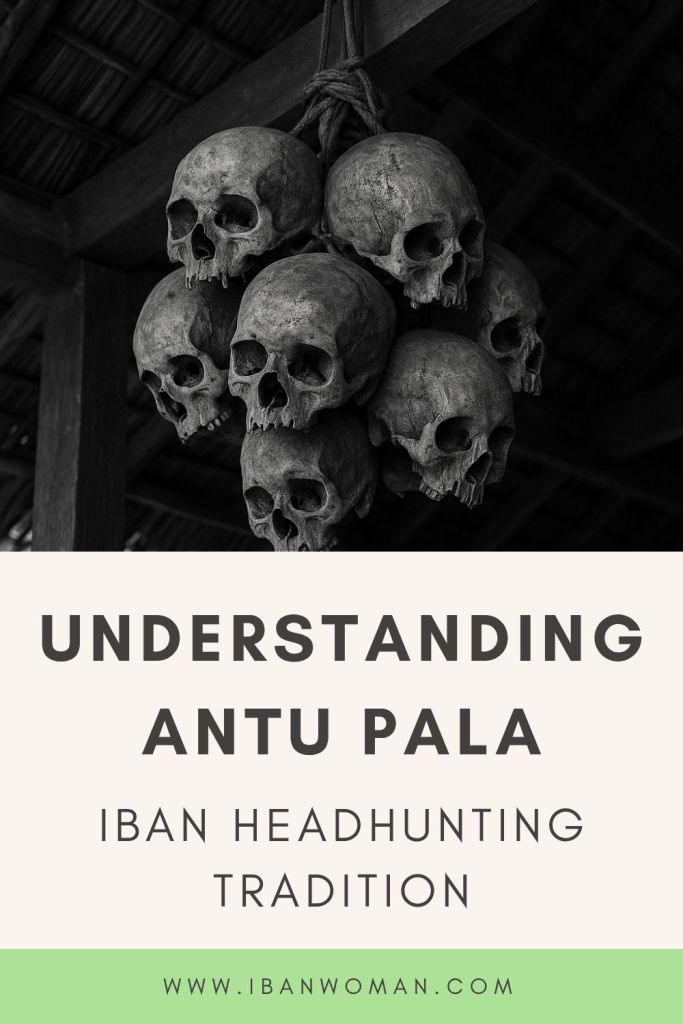
Headhunting | The Rituals and Care of Antu Pala

Disclaimer: This post is only for sharing purposes. I’m not an expert, just sharing what I know. The information here is general and may not cover every detail. For Iban readers who know more, feel free to add in the comments. This post is not meant to glorify the practice of headhunting but to share knowledge for better understanding.

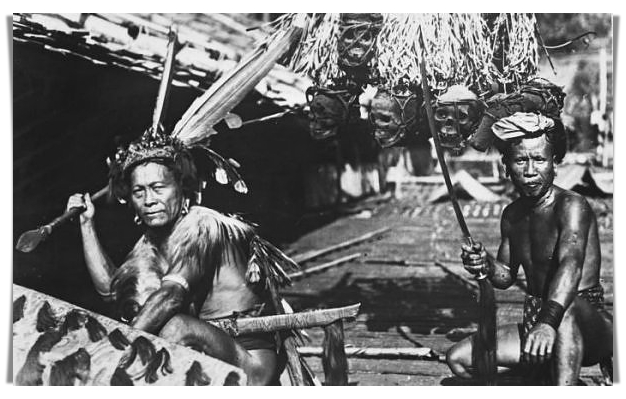
As I mentioned in my previous post, headhunting among the Iban was not random violence but part of specific mourning rituals. It was carried out to complete rites after the death of a family member. But after the warriors returned from ngayau (headhunting expedition), what happened to the severed heads? Were they hung immediately? The answer is no. Certain rituals had to be performed before the heads could be brought into the longhouse and later hung in the ruai (communal gallery).

The first thing the bujang berani (warriors) did upon returning was to manjung, which means to shout and announce their arrival. They could not enter the longhouse right away because it was taboo.  Specific rituals had to be followed. Practices varied from one Iban community to another, but what I’m sharing here is the way of the Saribas Iban from the Betong Division.

Image source

After announcing their arrival, the bujang berani stayed for a week in a small hut called langkau near the longhouse. During this time, they rested, cleansed themselves, and prepared the heads. This included cleaning and removing skin, flesh, and brain matter to prevent decay. The process took place by the river, where the heads were skewered on sticks, washed thoroughly, and boiled to loosen any remaining flesh. Once cleaned to bare skulls, they were smoked over the bedilang (hearth) until black and dry. At this stage, they were known as antu pala.

When the skulls were ready, the warriors prepared to re-enter the longhouse in full Iban regalia—baju gagong, ketapu or lanjang (headgear), sirat (loincloth), tumpa (silver armlets), and marik betaring (toothed beads). Only men who had gone on ngayau were permitted to wear the full attire. Those considered kulup (cowards) who had never participated in a headhunting expedition could only wear a sirat.

Image source

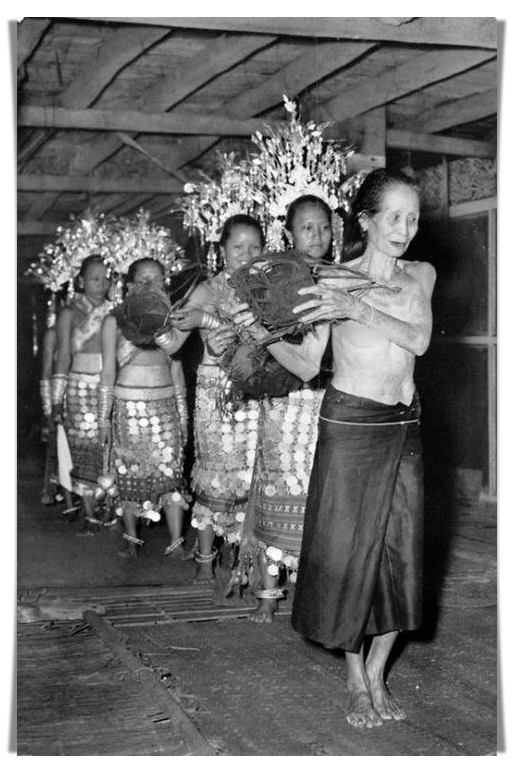
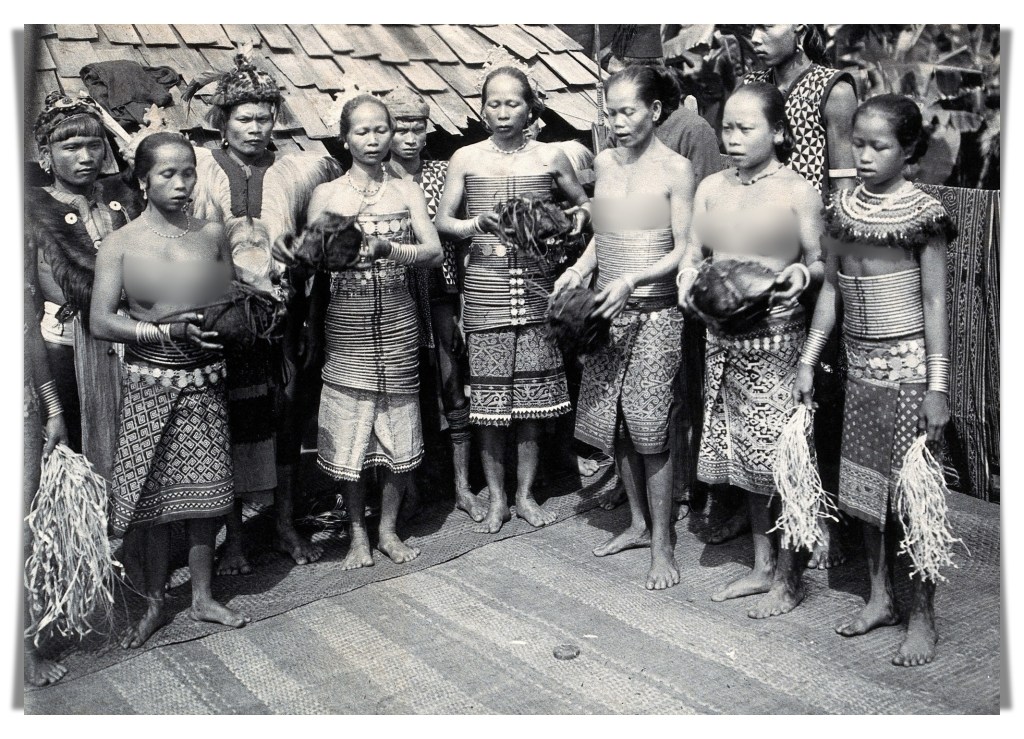
A procession called Mangka Ke Selaing was then held to welcome them home. The warriors were welcomed with panjung (victory shouts) and the beat of the Gendang Pampat. At the doorway, they were received by their mother or wife carrying a chapan (winnowing tray) covered with pua kumbu, a ceremonial textile woven only by the mother or wife of the warrior. The cleaned skulls were placed on the pua kumbu, not fresh or bloody as often imagined. The Iban always followed adat (custom) in their rituals, so there was never any confusion or disorder.

Image source

The mother or wife then played a key role in the Naku Antu Pala procession, carrying the tray of skulls along the ruai while nyangkah (chanting). The warriors marched behind the women to the rhythm of the Gendang Rayah. During this moment, they could not be touched or spoken to, as it was believed that the deities Keling and Kumang of Panggau Libau accompanied them. Disturbing them was said to cause one to faint.

The lemambang, or bards, were also present at the procession. They carried a garong, which is a bamboo container full of tuak, or rice wine. Only the bujang berani could drink this wine, and they drank it at the end of the procession. The ritual was over when the mother or wife performing Naku Antu Pala bit the skull, which meant that her spirit had won over the skull’s spirit. The antu pala then became the servant of its owner.

After the ritual, a feast called Gawai Enchaboh Arung was held in honor of Bujang Berani. There was food, ngajat (traditional dance), and happiness all night long. The mourning period came to an end with this feast. The antu pala was believed to nyilih pemati, to replace the soul of the deceased with that of the enemy, allowing the departed to rest peacefully in Sebayan (the afterlife).

Image source

Taking care of the antu pala also included different rituals, depending on the purpose. Whenever the skulls were moved or ceremonies were performed, miring or bedara’ was always required. Miring was a ceremony of prayers and offerings to Petara (God), the deities of Panggau Libau, and the ancestral spirits (Petara Aki Ini) for blessings, harmony, and protection from harm.

This was followed by bebiau, a rite using a fowl with accompanying prayers. Before it began, a piring (offering) was prepared, consisting of tobacco, betel nut, betel leaf, gambier, rice, salt, glutinous rice, rice flour, yellow rice, eggs, tuak, and chicken feathers dipped in blood from the sacrificed fowl. Larger ceremonies like Gawai Burong required even more offerings.

After miring, the antu pala had to be “fed.” This act was similar to the Chinese tradition of offering food to ancestors. Rice, water, and sometimes cigarettes were placed as offerings, and in some rituals, a pig was also sacrificed, especially when moving the antu pala to another location.

Not everyone was allowed to touch the antu pala. Only its owner or heirs could handle it. In some regions, this role was reserved for men. If a skull fell, it could not simply be picked up; a miring had to be done first, with a chicken offered before it was lifted and rehung.

These were only the basic practices. There are many more rituals surrounding the antu pala, each layered with meaning and guided by adat. These rituals may seem strange or even unsettling today, but they used to be crucial to the Iban’s understanding of life, death, and the spirit world. They show a community that was deeply guided by adat, a system that balanced courage with respect and ritual with meaning. 

If you have stories or knowledge passed down from your elders about antu pala or other old practices, I’d love to hear them in the comments. Every story adds another thread to our shared history. 

If you’d like to see a performance of the Naku Antu Pala procession, you can check out this video:


I write about Iban culture, ancestral rituals, creative life, emotional truths, and the quiet transformations of love, motherhood, and identity. If this speaks to you, subscribe and journey with me.
The Story Behind the Iban Hand Tattoo, Tegulun

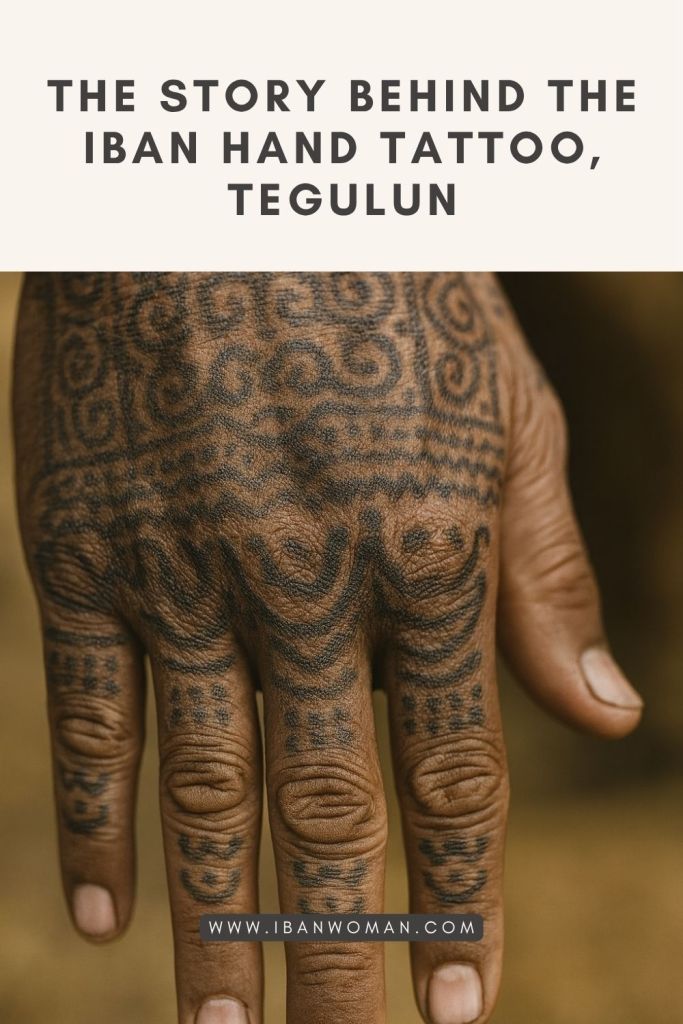
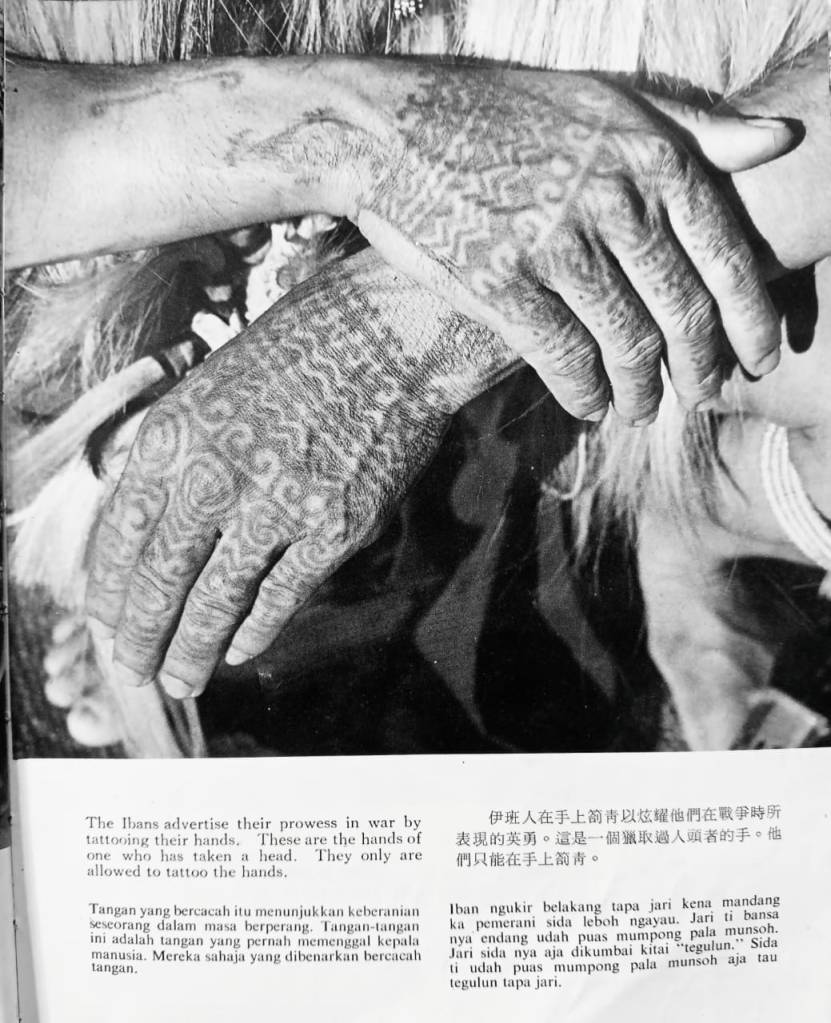
Have you ever heard of the Iban hand tattoo called tegulun? It’s one of the most striking forms of body art in our culture, yet not many people know what it really means. I found an old photo taken in 1962 from Life in a Longhouse by Hedda Morrison. It shows the hands of an Iban man with very detailed tattoos that go all the way down to his fingers. The pattern is tegulun.

In the Iban language, tattoos are called pantang or kalingai. Every tattoo on the body used to mean something. Tattoos weren’t fashion statements but they were living records of a person’s journey, courage, and place in the community. Each motif, like bungai terung (eggplant flower), ketam (crab), or kala (scorpion), meant something. For men, tattoos often showed that they participated in headhunting expeditions, or gone through rites of passage. For women, only the most skilled pua kumbu weavers were allowed to bear them.

Among women, the right to be tattooed was not given lightly. A woman known as “Indu Tau Nakar, Indu Tau Gaar”, was a master weaver who earned her tegulun through artistic and spiritual labor. With her hands, she made sacred pua kumbu cloths used in rituals such as receiving enemy heads. The tattoo on her fingers didn’t symbolize violence; it reflected her connection to the spirit world through weaving. These women were highly respected, for they were believed to hold the gift to translate dreams and visions into woven form.

The meaning of tegulun was very different for men. Those who carried it were known as kala bedengah—warriors who had taken part in ngayau, or headhunting expeditions. Someone who had tegulun on his hands was a man who had proven himself in battle. The tattoo was a visible sign of his courage and strength of spirit. It was said that every line or curve on the fingers stood for a head of an enemy that had been killed in the war.

Looking at those tattooed fingers in old photographs, one can almost feel their importance in the past. The men who bore them were not only fighters but also protectors of their culture and their way of life. They lived by a complex set of moral codes that were based on omens, dreams, and rituals. Taking a head was never an act of impulse; it was part of a ceremony tied to the safety, fertility, and prosperity of the longhouse.

One of the most well-known Iban warriors who carried tegulun was Temenggong Koh (1870–1956), a tuai serang (war leader) from Kapit, Sarawak. His fingers were covered in tegulun, each one telling a story of victory and survival. Temenggong Koh once gave his nyabur, the sword he used during ngayau, to Malcolm MacDonald, a British diplomat. The blade still bore traces of dried blood and is now displayed at the Durham University Oriental Museum in the UK.

It’s difficult to imagine that such traditions existed within living memory. Today, there are no Iban men who bear tegulun. The British made headhunting illegal after World War II. The last “licensed” expeditions took place during the Malayan Emergency and Communist Insurgency, when Iban trackers were recruited to assist the British. After that time, the custom of taking heads and the tattoos that went with it completely died out.

The tegulun is more than a reminder of war. It refers to a time when everything, from fighting to making art, was connected to the spiritual order of the world. Tattoos linked the body to the world that can’t be seen. They reflected not only bravery but also a sense of belonging. A man or woman who bore them carried the stories of their people and passed them down through the generations.

Those meanings are at risk of being lost today. Most young Ibans have only seen people with tegulun in books or museum photos. But it’s important to understand them. These tattoos show us how our ancestors thought about life, death, and the sacred balance between the two. They remind us that strength can show itself in many ways, like when you swing a nyabur (sword) or sometimes in the patient rhythm of weaving a pua kumbu.

To learn about tegulun, you have to look beyond the surface of the skin. Though the ink has faded and the rituals have ended, the meanings remain alive in memory. They are echoes from another time, reminding us that every mark and line once carried a story worth telling and remembering.

Image source: Life in a Longhouse by Hedda Morrison


I write about Iban culture, ancestral rituals, creative life, emotional truths, and the quiet transformations of love, motherhood, and identity. If this speaks to you, subscribe and journey with me.

Why the Ibans Took Heads In the Past

A quick disclaimer before I begin. Some people may find this topic upsetting because headhunting led to conflict between different ethnic groups. I don’t intend to glorify the practices of my ancestors; I just want to share what I know, especially since many people, even younger Ibans, don’t fully understand the reasons behind it. Taking a life is wrong by today’s standards, and from a modern perspective I do not support it. But we can’t change history, and judging the past by our present lens doesn’t help us understand it. What we can do is listen and learn.

The Iban had their own reasons and beliefs for taking heads. One of the most significant was to end the mourning period, a practice called ngetas ulit. When someone in the community died, the longhouse would mourn for a period of time. During this time, certain rules and taboos were followed. A ritual that demanded a fresh head was performed to end the mourning period. The family of the deceased would consult the longhouse community, and the men would plan a ngayau (head-hunting expedition) together. After getting a head, a series of complex rituals signaled the end of grief. Killing to end mourning may sound strange today, but for the Iban it was part of a cultural process called nyilih pemati, a symbolic offering for the dead.

Another reason was the belief that antu pala (enemy skulls) had spiritual power. The Iban in the old days  believed that these skulls would bring blessings if they were taken care of. Antu pala also played an important part in the Gawai Burung (the Bird Festival), which was one of the most important Iban ceremonies. As part of this complicated ceremony, the lemambang (bard) would use the skulls in his pengap (chants) to invoke the god of war, Sengalang Burong. This festival has probably disappeared because most Ibans are now Christian or Muslim, but it still holds a place in oral tradition.

There were other uses for skulls as well. They were used in healing rituals, ceremonies to call for rain during times of drought, and as guardians to protect the longhouse or farms from enemies and wild animals. In this regard, the skull became a spiritual servant for the person who kept it. They also carried social meaning. If a man didn’t take a head, he was likely called a coward or kulup (uncircumcised), and these men were not seen as good husbands. Iban society valued courage and bravery very highly.

Some have asked why heads were taken instead of other body parts. The answer lies in old beliefs. Our ancestors believed that the head was the center of a person’s life force. The head could be clearly identified, unlike the hands or feet. In the past, families knew exactly whose head was kept, even after years of blackening from smoke. Today, those identities are no longer shared openly. Imagine getting married to someone from another tribe and then walking into a longhouse and saying, “Honey, that skull belonged to your ancestor.” We have learned that silence is a way to protect the living while still honoring the past.

So, do antu pala still exist? Yes. Some Iban families keep them, like mine. They can be kept in the sadau (the top floor of the longhouse) or hung in groups called tampun on the roof. We don’t see them as trophies but as things that deserve respect. If you don’t take care of them, they can bring bad luck, so you must abide by strict rituals to keep them safe.

This picture shows a tampun that belonged to my ancestor, Unggang Lebur Menua, an Iban warrior from the late 18th century. It has 34 antu pala that are more than 200 years old, and is now kept by relatives at Rh. Panjang Matop, Paku, Betong. It serves as a reminder of a different time, when survival, belief, and identity were connected in ways that may be difficult for us to understand now.

I hope this helped you learn more about a part of Iban history that continues to live in our collective memory.

Image source: Youtube


I write about Iban culture, ancestral rituals, creative life, emotional truths, and the quiet transformations of love, motherhood, and identity. If this speaks to you, subscribe and journey with me.
The Ritual of Water | An Iban Ceremony for New Life

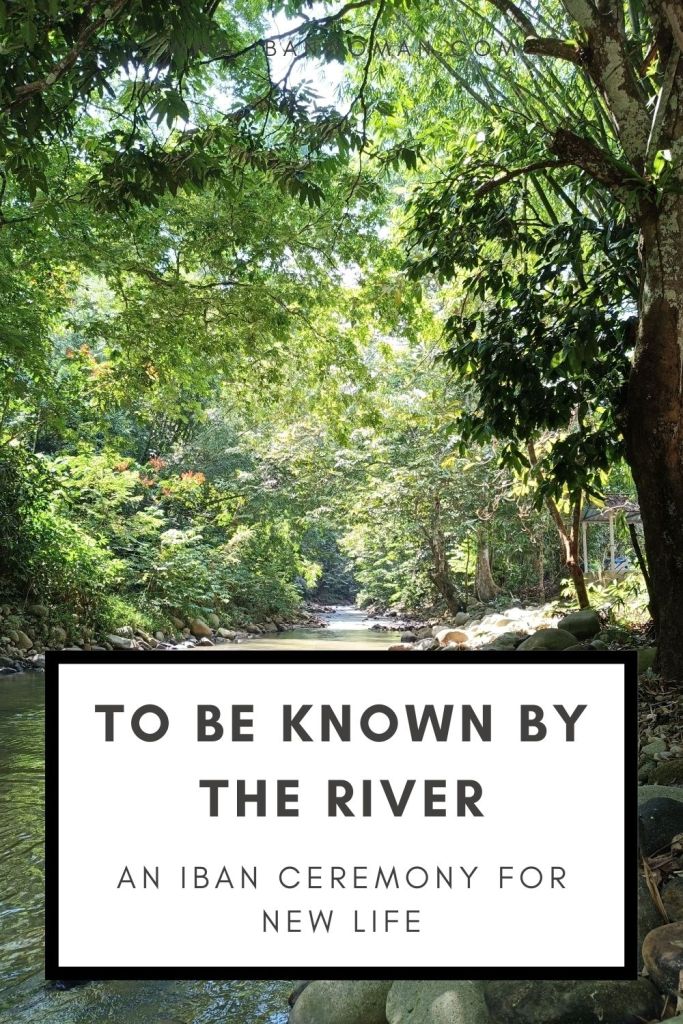
Last weekend, I found myself standing knee-deep in a shallow river in Janda Baik. The sunlight came through a canopy of trees above, casting soft streaks of light on the water’s surface. Everything felt quiet and peaceful. My kids splashed further upstream, and their laughter echoed off of rocks and trees. I stood still, closed my eyes, and let the water swirl around my legs as it flowed downstream.

It reminded me of the Iban traditional child-naming ritual. I’ve never seen it with my own eyes, but I learned about it from the elders and through reading. This ritual was held following the naming of the child and to formally “introduce” the child to the river. 

In the Iban way of life, water is more than a physical element. A body of water like a river is also a spiritual space. It gives life, but it is also a source of danger. We wash with water from the river, and sometimes, when the water is clear, we even drink and cook with it. It carries our boats to other villages, fields, and faraway places. However, it’s also where crocodiles and other dangers live. No Iban has grown up without hearing stories about someone who was attacked at the river. When a child is born, we don’t just give them a bath. We also hold a ritual to beg the river not to harm them. 

After the child is named, the bathing ritual begins. The night before the ceremony, the father informs the longhouse community of his intention. At dawn the next morning, the whole longhouse community walks to the river in a solemn procession. A flag bearer is at the front, and a man carrying a fowl follows him. Both of these men are chosen from among the respected elders. Two women walk behind them. One carries offerings and the other carries the child wrapped in handwoven pua kumbu. The rest follow, beating the gongs as they walk.

At the riverbank, the flag bearer cuts the water with a knife. The man with the fowl recites an invocation to call upon the spirits of water, earth, sky, and all the creatures that swim below the surface. He asks that the child be given good fortune, sharp vision, and safety. He calls the crocodile, the soft-shelled turtle, the barbus fish, the semah, and the tapah. He calls each one by name and tells them to regard this child as family, not food. He says, 

“If this son or grandson of ours happens to capsize and sink while he is visiting, you are the only ones who can lift him up and keep him afloat.”

It is not a metaphor but a real request, born out of fear and hope.

After the invocation, the child is bathed and the fowl is slaughtered. People make noise on purpose, like banging gongs and laughing, to drown out any bad omens. If the child is a boy, one wing of the bird is tied to a spear with red ribbon. The wing is attached to a heddle rod if it’s a girl. A bamboo basket full of offerings is then hung from a leafy pole. 

After that, they return to the longhouse and sprinkle the child with sacred water to get rid of bad omens. A feast is held and the gongs ring out to mark the ritual’s success. The child is now considered truly part of the community, and both the people and the river know it.

As I stood in that river at Janda Baik, I began to think about the rituals we’ve forgotten. What would it mean to reclaim a gesture like this, perhaps not literally but in spirit? The Ibans don’t all live in longhouses anymore. Some of us reside in cities and raise our kids as urbanites, but water still calls us. Maybe part of why we seek places like Janda Baik is because something in us still longs to make peace with the river. Rivers still take us places. They still give and take. And we too are still vulnerable to things we can’t see.

Maybe modern mothers need more moments like this, when they can recognize their fears, their prayers, and their desire to protect the people they love. We might not need to cut the water with a knife, but we can still offer a prayer, still whisper a blessing:

“We beseech you to confer on him fortune, give him sharp vision so that he will be fortunate, wealthy, and blessed with good health throughout his life. 

We can still speak to the river, and certainly we can still be heard. 


I write about Iban culture, ancestral rituals, creative life, emotional truths, and the quiet transformations of love, motherhood, and identity. If this speaks to you, subscribe and journey with me.

Pompeii’s Water Boy and the Curious Case of the Calamity Mushroom

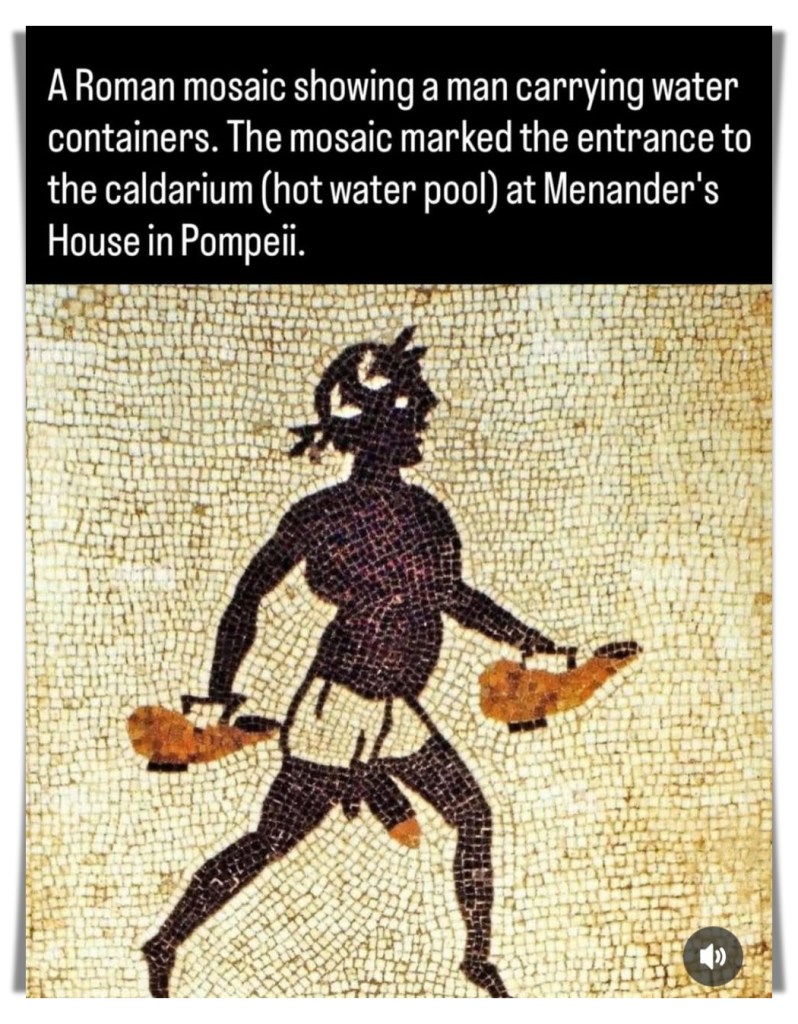
Image source

This is my 102nd post on this blog. I could’ve gone deep and reflective, writing about growth or gratitude or my journey so far. Instead, I’m giving you a man with water jugs and what appears to be a very confident, very unnecessary “thing” between his legs.

I was just going about my day when I came across a picture of this Roman mosaic while scrolling through Instagram. It was a harmless scroll and the account is offering historical tidbits. I thought I would see broken pottery, ruins, and maybe a few faded frescoes or ancient skulls and stuff. I didn’t expect this guy would be there.

It was a mosaic of a man carrying water jugs with the confidence of someone who knows he’s being watched. His muscles flexed, and his hips are a little tilted. I guess he is the original water influencer? But what really caught my attention and shamelessly wouldn’t let go?

His private part. Yup.

It was not a bulge smacked in between his legs. It was exposed. Damn. How scandalous. A big, bold mushroom swinging like a pendulum between his thighs. I looked at the screen for a long time, about thirty seconds, before whispering to myself, “But why?”

Was it supposed to be a symbol? A warning? A flex? A symbol of fertility? Or was it an inside joke from an ancient Roman tile maker who was just trying to make a boring work order more spicy? Imagine the scenario. The customer probably said, “Make it tasteful.” The artist replied, “Got it.”

The mosaic seems to have been the entrance to the caldarium, or hot water pool, in Menander’s House in Pompeii. That makes it even better. Can you picture walking into a spa and being met by a man with jugs in hand and a strange mushroom situation?

Welcome to the ancient Roman hot baths, where the water isn’t the only thing that’s hot. This might seem a little out of character for me, since I usually write about personal reflection and cultural memory. But really? Sometimes life puts a mushroom between your legs and dares you not to laugh. And at that point, you just give in and be silly. So just chill.

But after I stopped laughing (and I mean really stopped; it took a while), I became curious. Why would a Roman artist make a mosaic of this? Sure it wasn’t just for fun, right? So I asked ChatGPT and this is where things get interesting:

Art historians think that what we’re laughing at could be a waterskin, which is a leather pouch used to hold liquids. They were often shaped like penises (I don’t know why) and people carried them between their legs to keep their hands free.

So, no, it might not be an ancient anatomical exaggeration but a useful accessory. But still, they could have shaped it differently. I think many people are aware that the Romans were no strangers to sexual symbols. Their art, buildings, and even things around the house often included:

  • Phallic symbols as a sign of fertility, power, or protection (yewww).
  • Mosaics of sex in bathhouses, bedrooms, and garden walls (cringe).
  • And a general cultural comfort with the human body that was much less squeamish than our modern-day society.

Some historians say that mosaics like this at the entrance to the caldarium could have been:

  • A fun reference to the sensuality of bathing culture.
  • A good luck charm that kept evil spirits away (phallic images were thought to do this. Imagine a wife saying this to her hubby, “Honey, I think the place is haunted; why don’t you strip down?”) But I digress. 

Romans weren’t shy. Their bathhouses were shared, their jokes were dirty, and their art was often obscene. So, it could be a waterskin or a nod to something more suggestive. The fact that it’s not clear might be the whole point.

And you know what? That makes me love this mosaic even more. Maybe it wasn’t just meant for wall decoration. It could have been a reminder to not take life too seriously. We should own our stride, haul our jugs with pride, and march into the steam with a suspiciously shaped mushroom and not a hint of shame in our hearts.


Olivia Atelier offers printables, templates, and art designed to inspire reflection, healing, and creativity. Visit Olivia’s Atelier for more.

Fragmented Story | First Date

This piece captures the meaningful moments of a young narrator, an 18-year-old girl, as she deals with the unexpected shift in her reality. The clipped sentences show her youthful hesitancy. There is no over-explanation, only feeling—raw and unfiltered—told in a voice still learning how to express the depth of its own desire.

Image source

At first he was just another presence in the background, like a page in a book that I kept flipping back to without knowing why. He was handsome, though I had never given it much thought. Until one day the words slipped out before I could stop them.

I hadn’t expected it to become anything more. But my friend decided otherwise. She took my offhand comment and made sure it reached him.

Days passed before I learned what she had done. It was a casual mention, out of my silent observation, but now it had become something larger. But much to my relief, nothing came of it. No reaction. No acknowledgment. Life moved on, and that one blunder faded into the stream of ordinary days.

Then one afternoon, everything completely changed.

The bus ride home was a blur of exhaustion. The lull of the engine hummed in the background. My thoughts drifted aimlessly as the scenery flickered past the window. And then, he was there.

The bus was pretty empty, with plenty of free seats, but he walked up to where I was sitting and took the seat next to mine. For a second I froze, my breath catching in my throat. The entire world had shifted on its axis.

I risked a glance in his direction. He had a black jacket on top of a navy blue t-shirt, dark trousers, and brown shoes. His short, straight black hair framed his face. His hands were tucked into his pockets.

The silence stretched between us, saved for the sounds of late afternoon traffic and the occasional ring of the bell.

And then, a simple invitation.

I wasn’t prepared for it or expecting it, but the answer left my lips before doubt could take hold. And with that, the path was set. The bus rattled forward as if nothing had changed. But everything had.

When we arrived at our stop, he met my gaze. Then he turned towards the street. Without hesitation, I followed.

We walked side by side in silence. The long shadows of the streetlights lay on the pavement, and the faint chatter of office workers rushing home floated in the air. Once we reached the door, he stepped ahead and held it open for me. His hands rested lightly against the frame.

I stepped inside. The warmth of the cafe wrapped around us. For a moment, I wasn’t able to even look at him. A flurry of emotions brewed in my chest; my heart pounded. But when I finally looked up, there he was, a slight smile on his lips.

And in that moment, I felt it. A soft, trembling hope for something I didn’t know if I was ready for, but I couldn’t help wanting it anyway.

Related story: First Sight

Copyright © Olivia JD 2025

All Rights Reserved.