The Mouse-Deer and the Crocodile | A Classic Iban Folktale

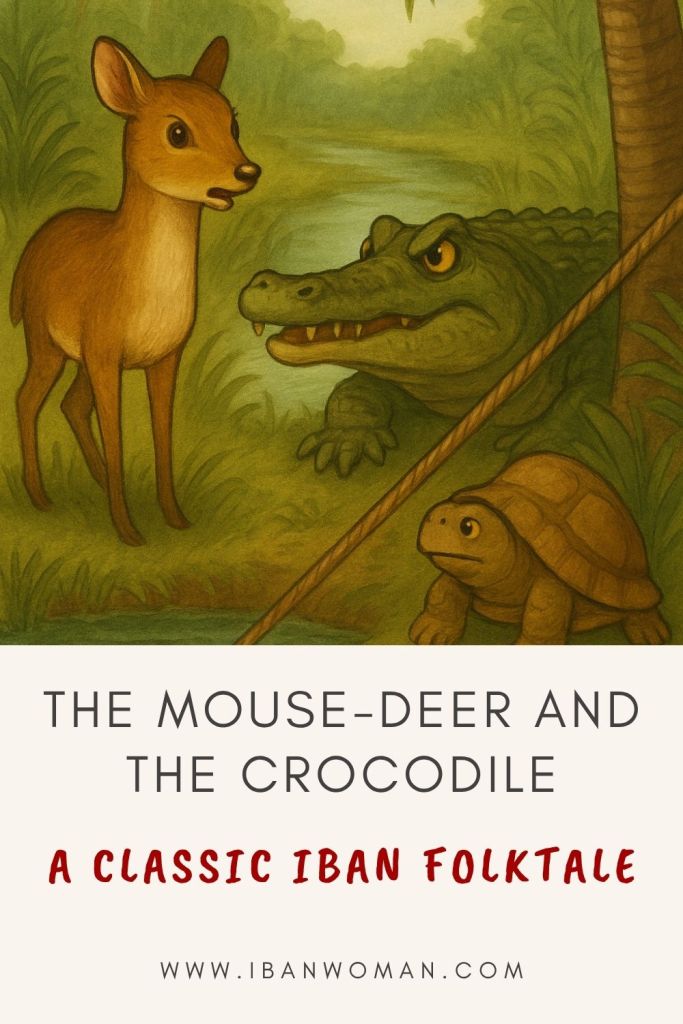
One day, the mouse-deer (pelanduk) went out to look for food. After walking for about an hour, he reached a swamp covered in tall grass (madang melai) and water plants. Not far from there, an old Malay man named Pak Dollah was busy clearing the area to prepare it for farming.

The mouse-deer wanted to eat the fallen fruits of the simpur tree (pun buan) that grew nearby, but he was afraid Pak Dollah might see him. He moved carefully, one step at a time, hoping to stay unnoticed. But his fear was unnecessary, Pak Dollah was too focused on his work to notice anything around him. So the mouse-deer went ahead and ate the fallen fruits to his heart’s content.

When he was full, he turned to leave. Just as he was about to walk away, a female crocodile (baya indu) suddenly shouted at him.

“Hey, Mouse-Deer!” she called.

“Oh, Crocodile! You scared me!” he replied.

“You ate my eggs, didn’t you?” she accused.

“What? Of course not!” said the mouse-deer.

“Don’t lie! I saw your footprints near my nest. All my eggs are broken because of you!” the crocodile shouted angrily.

“You can’t just accuse me like that. What proof do you have?” asked the mouse-deer.

“I saw your footprints, that’s proof enough!” she insisted.

The mouse-deer tried to stay calm. “I didn’t eat your eggs. Maybe they broke because Pak Dollah accidentally cut through your nesting spot while clearing the grass. Look over there, he’s still working.”

But the crocodile didn’t believe him. “Don’t try to trick me. I know your sly ways, Mouse-Deer,” she said. “You’re so small that even if I swallowed you whole, I wouldn’t be full.”

“Alright,” she continued. “If you really didn’t eat my eggs, prove it. Let’s have a tug-of-war. If you lose, that means you’re guilty. If you win, I’ll believe you’re innocent.”

The mouse-deer pretended to think for a moment, then agreed. “Big body, small brain,” he muttered under his breath. He asked for three days to prepare, and the crocodile agreed.

When he got home, the mouse-deer sat quietly, trying to come up with a plan. He knew he could never win against the crocodile by strength alone, so he decided to use his wits. He called his friend, the tortoise (tekura), for help.

“Oh, Tortoise,” he sighed. “I’m doomed. The crocodile challenged me to a tug-of-war because she thinks I ate her eggs.”

“Don’t worry, my friend, I’ll help you,” said the tortoise calmly.

“Do you have an idea?” asked the mouse-deer.

“I do,” said the tortoise. “When the contest starts, tie your end of the rope to the coconut tree by the swamp. The crocodile won’t see it since she’ll be in the water.”

“That’s brilliant. Thank you, Tortoise,” said the mouse-deer, feeling relieved.

Three days later, the crocodile waited by the swamp.

“Hey, Mouse-Deer! Are you here yet?” she called out.

“I came earlier than you,” the mouse-deer replied.

“Are you ready?”

“I am. But before we start, we need a referee,” said the mouse-deer.

Right on cue, the tortoise appeared slowly from behind a tree. Seeing him, the crocodile quickly appointed him as referee. The tortoise pretended to be surprised but accepted.

He set the rules. “Crocodile, if your feet touch the land, you lose. Mouse-Deer, if your feet touch the water, you lose. I’ll go back and forth to make sure both of you obey the rules.”

The crocodile went into the water, holding one end of the rope in her mouth. The mouse-deer stood by the coconut tree, holding the other end. Once the crocodile was ready, the tortoise hurried to help the mouse-deer tie his rope tightly to the tree.

“Alright,” said the tortoise. “One! Two! Three! Pull!”

The crocodile pulled with all her might. Her tail whipped through the water, splashing high into the air. But no matter how hard she pulled, the mouse-deer did not move an inch. On the bank, the mouse-deer pretended to pull back with great effort, squinting and swaying from side to side as if truly struggling.

The contest went on for hours, until late afternoon. The crocodile grew exhausted and finally released the rope, gasping for breath as she crawled onto the shore. The mouse-deer still sat there, holding his end of the rope, calm and unbothered.

The tortoise approached them. “The match is over. Since the crocodile let go of the rope first and came onto land, the winner is the mouse-deer. This proves he didn’t eat your eggs. They were broken because Pak Dollah accidentally cut through your nesting ground while clearing the area. You were the one at fault for laying eggs on his land.”

“See, I told you I’m not afraid of you on land,” said the mouse-deer. “Next time, don’t accuse others without proof.”

The crocodile said nothing. Embarrassed, she quietly slipped back into the water. The mouse-deer and the tortoise looked at each other and smiled before heading home, pleased with how things turned out.

Note:

I translated and adapted this story into Malay (shared on Threads) and English (here on my blog), based on the version originally shared by Gregory Nyanggau Mawar on the Iban Cultural Heritage website.


I write about Iban culture, ancestral rituals, creative life, emotional truths, and the quiet transformations of love, motherhood, and identity. If this speaks to you, subscribe and journey with me.

Sarawak Folk Noir | Red Eyes at the Ara Tree

This story was inspired by a real event, a memory from my childhood. I’ve always loved noir—the sense of dread, the fatalism, the uncertainties, and the things left unsaid. But I couldn’t find any noir stories told in an indigenous voice from Borneo. So I wrote my own. Red Eyes at the Ara Tree is what I call Sarawak folk noir. It carries the core tenets of classic noir: unseen forces, a haunting past, and the slow unraveling of certainty; but roots them in a rural, post-colonial setting where belief and memory still shape the edges of reality. There is no detective here. Just a child, and the adult they become, trying to make sense of what cannot be explained. The crime is an intrusion of something ancient and watching. It’s of the unknown stepping into an ordinary life.


When I was seven years old, we lived on top of a hill in a government housing complex. It was a modest row of boxy flats nestled along the slope, built for civil servants like my dad. Thick jungle pressed in from all sides. People said that years ago, communists camped all over this hill and the jungle beyond it. I guess that rumor was true because one afternoon while I was playing near the black drain, I saw a group of soldiers going down the hill. The town lay below. It was quiet during the day, but after nightfall, it was ghostlike, as if it had shrunk back to the edges of the footpath at night. 

My parents kept chickens and grew vegetables like kangkung, changkok, and daun ubi in our small backyard. There was always the smell of dirt, raw chicken feed, and shit in the air. My siblings and I played barefoot in the yard after school, with the red earth staining our soles. Life was simple and boring back then, until it wasn’t.

There was an ara jejawi tree about three hundred meters down the road, on the slope of the hill. People said these trees were old, too old, and not all of them were empty. Spirits dwelt in such trees. They were not necessarily bad, but never to be disturbed. The tree was huge. Its roots stretched over the earth like petrified pythons. In the afternoons, the tree cast wide shadows that spread to the road. Every family on the hill passed it on their way to town. Most of us walked faster around it or crossed to the other side of the road. Some others, like my mom, muttered short prayers. 

Our kitchen faced the ara tree. There were two doors at the back. One was a solid wooden door with a metal latch, and the other a lighter screen door made of wood and mesh. We usually left the solid door open so the air could move through, but we kept the screen door closed to keep mosquitoes and flies out. I never gave that door much thought. It was simply part of the kitchen, like the tiled counter or the creaky faucet. 

That night, everything was normal. It hadn’t rained for weeks. The heat lingered on your skin long after the sun went down. The cicadas were shrieking in the trees, and the chickens were quiet. We had dinner. My dad was at the head of the table, my mom was next to him, and the rest of us were spread out around the small table. My eldest sister sat right across from the screen door, looking out to the backyard and the ara tree beyond it. 

I remember my spoon scraping the bottom of the plate. My mom asked if anyone wanted more sambal belacan. Someone knocked over a cup and somebody wondered out loud who would win the WWE match later tonight. My sister stood up to get another helping of rice.

She paused. 

That’s what I remember. Her hand hovered above the rice cooker. Her face had gone still. Almost blank. She didn’t utter a word. She shifted her gaze and quietly scooped her rice and went back to her seat. The conversation went on. None of us noticed anything strange. Not then. 

She didn’t say a word until later, when we were in the living room and the dishes were clean. My dad had switched on the TV to watch the evening news and my brothers were bickering about whose armpits stank the most. 

She said she had seen eyes. Big, red, staring right at her from the ara tree. Right through the screen door. The eyes didn’t blink or move; they grew. Larger and larger with radial blur around the edges. Even while they stayed still, it appeared like they were getting closer. She swore they pulsed, like slow breathing. 

We didn’t speak for a long time after she told us. My mom told her not to bring it up again. That night my dad closed the solid kitchen door and pulled the bolt tighter than usual. No one complained. 

The next morning, it was a Tuesday and like any school day, we got up early to go to school. However, my sister complained of feeling chilly, though her skin was hot. My mom instructed her to stay home and prescribed Panadol. By afternoon, her temperature continued to rise. Her brow was sticky with sweat and her eyes couldn’t focus. Her appetite disappeared. She lay curled on her thin foam mattress, sweating and mumbling, eyes drifting in and out of focus. The doctor called it a viral fever and sent her home with Panadol. But after two more days, my parents started asking around and were given a number to contact. He was a manang who lived in a village near the town. 

I remember the manang arriving late in the evening, when it was a little cooler. His rusty white Corolla E70 arrived at precisely 7PM. A balding man with two beady eyes emerged from the car. He shook hands with my parents and my dad invited him in. He didn’t say much. He took off his sandals at the door and nodded politely at us. One of my brothers started to point to a strange-looking bag he was carrying on his back. It was an old wooden cylinder bag that looked more like a box—lupong manang, his healing kit. I had never seen one before, but I knew better than to ask. 

The manang sat next to my sister and opened his bag. Inside were small vials of various sizes, each one containing suspicious-looking liquid. A smooth stone that sparkled under the light—batu ilau—my mom whispered—and a small bundle of dried plants, a small bowl, and a white armlet. He softly murmured words I couldn’t understand and touched my sister’s forehead. 

My parents prepared a piring on a tray with betel nut, leaf, tobacco, glutinous rice, salt, two chicken eggs, and a small glass of tuak. I don’t remember how long he stayed because I fell asleep halfway through the strange healing ritual. But by the next morning, her fever had subsided. It wasn’t completely gone, but it seemed like something had finally released its grasp. 

The fever broke after five days. My sister woke up as if from a long dream. She never talked about the eyes anymore and refused to sit in that chair again. No one wanted to sit at that chair so we ended up squeezing on one side of the table, our elbows touching as we scooped food into our mouths. And after that, every time we drove by the ara tree in dad’s mung bean green Datsun, she would look at the miding sprouting above the bush along the road and never ahead.  

After all these decades, it’s likely that the tree is still standing. I never returned to that town, though my siblings had visited on their various work trips. None of them bother to check on our old neighborhood or the ara tree. The last time I looked on Google Maps, the area had been cleared and developed. More houses and buildings. The surrounding jungle is still there, but less menacing, somehow tamed. Even now, as an adult, I don’t try to explain it away. Maybe the fever would’ve broken on its own. Maybe the manang did nothing at all. But something changed that week—and I’ve never looked at shadows the same since.

Whether the tree still stands or not, in my memory it always does. It stands motionless with its thick trunks and aerial roots guarding its inhabitant.

Watching. Waiting. 

Note:

  • Kangkung – water spinach
  • Changkok – pucuk manis (popular leafy vegetable native to Southeast Asia
  • Daun ubi – cassava leaves
  • Ara jejawi – banyan tree
  • Sambal belacan – shrimp paste
  • Manang – shaman
  • Lupong manang – shaman healing/medicine kit
  • Batu ilau – divining stone used by Iban shamans during healing rituals.
  • Piring – offering
  • Tuak – rice wine
  • Miding – a type of fern, Stenochlaena palustris, a popular edible plant in Malaysia and other Southeast Asian countries.

I write about Iban culture, ancestral rituals, creative life, emotional truths, and the quiet transformations of love, motherhood, and identity. If this speaks to you, subscribe and journey with me.

A Stranger In the Rain

Daily writing prompt
Describe a random encounter with a stranger that stuck out positively to you.

That evening it was pouring. The rain was unremarkable. It was a consistent, calm deluge that dulled the bustling city. Everything seemed muted: the buildings, the street signs, and the people walking by with their umbrellas slanted against the wind. The pavement glistened under headlights and puddles reflected fragments of neon from signs overhead. The air smelled like coffee, wet concrete, and something faintly sweet, perhaps caramel from the cafe I frequented. It was a little corner cafe with fogged-up windows, dim lighting, and jazz playing softly in the background. It was a place that usually smelled of freshly ground beans and spices.

Image source

I was there, like I usually am. I sat by the window with my notepad open and a blue pen in my fingers. I wasn’t writing, though. I was simply watching the rain blur the world outside. It was one of those times when the silence felt thicker than normal, and you began to hear the sound of your breathing. 

Then he walked in. 

I noticed the rain on his jacket first. He brushed it off at the door and ran a hand over his damp hair. He had short, tidy hair. There was something about him that I couldn’t quite put my finger on. A fluidity in his movements, a stillness that felt almost magnetic. Like he belonged in every room without having to announce it. Was he special? Perhaps not. All I could say was he knew how to take up space without drawing attention. He looked around and saw me. I shifted my gaze to the rivulets of rain on the glass. 

He sat a few tables away, ordered a coffee, and glanced out the window just like I did. I returned to my notepad, pretending not to notice him. I could sense him. He was handsome—strong jaw, deep-set brown eyes, tall, clean-shaven, with strong hands and long fingers that lightly tapped against his cup. There was something else, but I let that thought slide. 

He didn’t talk to anyone. He slowly sipped from his cup. At one point our eyes met briefly. 

And deep down, I knew that this moment, this stranger, meant something. Not in a romantic sense, but as if some quiet part of me recognized something familiar. I couldn’t pinpoint what exactly it was, but I felt silly for believing so.

When I got up to leave, I could feel his eyes on me. The bell above the door chimed as I stepped into the rain. 

At home, I realized I had forgotten my pen. I shrugged it off at first. It was just a pen. He was just a man. 

But still that encounter stayed with me. I couldn’t explain the strange pull it had on me. It reminded me that even in a foreign city where no one knows me, the world can still offer surprises. That maybe connections, even with strangers, don’t always require explanation. Some moments just are. 

And maybe that was the positive part. I didn’t feel less lonely. It simply reminded me that I’m still capable of feeling something real. Even if it begins and ends only in my mind. 

The Way I Laugh

Daily writing prompt
What makes you laugh?

Some people can make you laugh without even trying. It’s not a loud or showy laugh, but the type of laugh that catches you off guard.

This is a mini story about that kind of laughter and a poem I wrote to accompany this story.


Image source

It started with the way he looked at the tea I made.

“You put mushrooms in this?” he asked, peering into the mug. 

I fought a smile. “It’s reishi. It’s good for your liver. Just drink it.”

He leaned in and sniffed, suspicion all over his face. “It smells like regret.”

That got a laugh out of me. “Don’t be such a baby.”

He narrowed his eyes, took a dramatic sip, and instantly recoiled. “Are you trying to kill me? Admit it. This is revenge for the pen.”

“You stole it,” I said.

“I borrowed it indefinitely.”

He drank another sip, dramatically clutching his chest. “If I die from this, please delete my browser history.”

I burst out laughing again.

He looked pleased with himself. 

I tried to change the subject, flipping through a magazine on the table. He leaned over, peering at a photo of a hairless cat. 

“Is that a testicle with whiskers?”

I almost choked on my tea.

“That’s it. Get out of my apartment.” I was still laughing.

He held up his hands. “I’ll go. But only if you admit that laugh means you’re secretly in love with me.”

I threw a cushion at him. He caught it midair and hugged it to his chest. “Even your cushion loves me.”

“You’re so full of yourself.”

He wandered over to my bookshelf, checking the titles. “Didn’t peg you for a Murakami girl.”

“Didn’t peg you for someone who uses the word ‘peg.’”

He smirked. “Careful. You’re laughing again.”

And I was.

Later, when the conversation slowed, we sat on the couch. I didn’t want him to leave. Not just yet. He retrieved a pen from my desk and held it in front of him. 

“This one yours too?”

“Maybe.”

“Should I take it? Just in case I need another reason to come back.”

He didn’t need a reason.

But I let him have it anyway.


I Gave You Tea

I gave you tea
for healing.
You drank it.
Your fingers brushed mine
when I handed you the cup,
and neither of us flinched.

You made a face,
said it tasted like regret.

I laughed.
And laughed again.

See, love—
I don’t laugh easily,
like something that escapes
from deep inside,
and betrays the body.

I gave you bad tea.
And you
say things that unmake me
in all the right places.

Copyright © Olivia JD 2025
All Rights Reserved.

Fragments of Obsession III

Obsession is not just in longing; it’s also loving him in fragments. Here’s a series of short fragmented thoughts about him—scattered images, sensations, memories, desires. They are pieces of my obsession.

Part one – Fragments of Obsession | Part two – Fragments of Obsession 2

Image source

  • His hair gently brushing his forehead, blown by the fan as he sleeps on our bed.
  • Him standing on the kitchen sink washing the dishes after dinner. The slope of his bare shoulders, the muscles on his back, the scratches I made, naked except for his dark boxers.
  • The way he hums as he unloads the laundry.
  • He sits on the couch, shirtless, scrolling through the reels, smirking, chuckling depending on what he watches.
  • His prolonged silence after I uttered some cutting remarks.
  • The way my eyes drift lower, tracing the shift of fabric, wondering what lies beneath.
  • As he passes me on the way to the bathroom, I reach out, my fingers grazing over him in a teasing touch.
  • The curve of his shoulder in the half-light when we took a nap in the afternoon.
  • The way he stares at me, intense and serious, before he smiles.
  • The way his voice cracks when he’s tired, rough and tender at the edges.
  • The smell of earth and salt on his skin after rain.
  • As he shifts in his sleep, the fabric rides up, revealing just enough to make my breath catch.
  • The smell of his skin after a shower.
  • His hands, always his hands, calloused and tender, mapping my body in the late afternoon while the curtain gently blew by the breeze.
  • His gentle snores, and sometimes he snorted while sleeping. Depending on how tired I am, it either amuses me or annoys me.
  • The way he looks at me when he thinks I am not watching.
  • I gently kiss his scars on his arms and chest.
  • The taste of his lips.
  • The heat of his body against mine. The weight of his arm across my waist while spooning.
  • The sound of his key in the door. I could hear it jangle as he exited the lift.
  • The shadow of his stubble in the morning.
  • The sound of his footsteps faded down the hall.
  • The way he holds my legs and rests them on his shoulders, his breath mingling with mine as we dissolve into one another.
  • The way his mouth finds me, his tongue teasing, drawing a gasp from my lips.
  • The way he looks at the ocean and squeezes my hand gently.
  • The way his eyes turn dark after a desperate “I love you” right before he shatters.
  • The way he says “look at me” right before I unravel.
  • The way he moves through a room.
  • His pain and grief over the people he couldn’t save.
  • The emptiness he leaves behind, a hollow I carry with me, a shape I can’t stop trying to fill.

Copyright © Olivia JD 2025

All Rights Reserved.

Fragmented Story | After All These Years

Some things are never fully lost. They stay in pieces, in corners of the mind, surfacing as the scent of rain, the pages of an old book, or a place you never intended to return to.

This fragmented story, After All These Years, reflects on such moments—small towns and bookstores, old love, and the what-ifs that never fade away. Nostalgic, like turning through an old book and discovering a dried flower between its pages. A memory of something once vibrant that has faded but is never fully gone.

There is no big resolution here. Just realizing that certain relationships change over time but never completely disappear. They settle into the crevices of life, becoming part of our identities. And maybe that is enough.


The rain poured down without mercy, chilling and drenching, seeping through every layer of clothing and skin. The town loomed in the distance. Its narrow path meanders through shadows created by bent lampposts and the subtle shape of a river in the distance. Though I never intended to stop here, I did. The rain was relentless, and I needed a refuge. This place was as good as anywhere with cafes and warmth.

Then I caught sight of it. A little worn-out sign swinging in the rain. I read the name and felt my throat seize. How long has it been? A lifetime has passed, but the heart maintains its own sense of time, unencumbered by the limitations of calendars and years.

I felt a strong instinct to turn away. I suppose it’s easier to face the storm outside than what lies within. But my curiosity drove me forward. Parking and gathering my stuff, I braved the downpour. On the cold iron doorknob, my hand trembled. The cold seeped into my flesh, and before I could think twice, the door softly cracked open.

The aroma of old paper and a subtle earthy tone greeted me first. The dim light created shadows on the walls, which were filled with books that appeared to go on forever. It was like entering a place that seemed to stand still in time.

And then I spotted him.

He sat behind the counter, buried in the pages of a book. In some ways, he looked the same. However, there were also signs of time. Strands of silver in his hair, a sweater frayed at the cuffs, and the faint heaviness of a life lived alone.

He didn’t notice me at first. For a brief moment I forgot how to breathe. The soft rustling of the page he turned brought me back to the moment. He glanced upward. Our eyes met, and then those years vanished in an instant. There was no dramatic pause or rush of words.

Time has passed as it inevitably does. It leads us into lives that are separate and distant from one another. But in the soft glow of this overlooked part of the world, that distance seemed trivial.

The conversation that ensued didn’t focus on the past, at least not in a direct way. Our discourse danced around the periphery, hinting at years and stories that belonged to others. Our separate lives had been transformed by the absence of the other. Despite our best efforts to distance ourselves, the past remained between us.

The rain subsided while we talked. Its steady beat taps against the windowpanes. Our conversation didn’t lead to any resolution or sudden insight. Instead, there was something more nuanced, perhaps a sense of acceptance or a hesitant acknowledgement of what remained.

I found myself hesitating when it was time to go. Our conversation brought a sense of peace, like a gentle reminder of the shared moments with someone who once meant so much. But I had to go. Time went by, and the people we had turned into existed in separate realities.

I stepped back into the drizzle and back in my car. My heart aches because it finally understood that some connections, no matter how changed by time, never really disappear. They stay, though no longer in their original form. They turned into echoes that tightly knotted into the essence of our being.

And maybe that was all it needed to be.

Related story: Being In the Same Room Again

Copyright © Olivia JD 2025

All Rights Reserved.