Iban Folktale | The Tale of Tekuyong and Pelandok

A long time ago, when animals could talk like we do, the river snail, Tekuyong, was slowly moving across a wide rock by the riverbank. His body glistened in the morning light as he licked moss off the stone and nibbled quietly.

Pelandok, the mousedeer, came along. He was light-footed and couldn’t sit still. He was sniffing the ground for soft buan leaves to chew. He stopped and yelled, “Oi, Sambi Tekuyong!” when he saw Tekuyong stuck to the rock with his head bowed. (Sambi means “friend or pal.”) “Why are you sitting there so still? You’re not moving at all.”

Tekuyong lifted his feelers. “I’m not idle, Sambi. I’m eating the moss by licking the stone. That is my food.”

Pelandok tossed his head back and chuckled as he heard this. He laughed until his little body shook. He laughed until his eyes welled up with tears, and his bladder gave way, soaking the ground.

Tekuyong watched silently. When Pelandok finally caught his breath, Tekuyong asked, “What is so funny, Sambi? Why are you laughing at me?”

Pelandok, however, pointed to Tekuyong’s sluggish, gliding body and continued to laugh. Shame burned at Tekuyong’s heart. “Enough, Sambi,” he finally said. “Since you find me so amusing, gather all the animals together to watch us race. We’ll find out who is actually faster in a week.”

Pelandok clapped his hoofs in delight at this. “A race? Against you? Ha! I will surely win.”

They decided that the course would run from the foot of the hill where they were standing to the great rock by the sea. 


Pelandok trotted through the jungle that evening to tell everyone about the race. “Come on, everyone! Watch me, the fastest creature in the forest, defeat Tekuyong the snail!” The monkeys shrieked with laughter, and the birds spread the news with their calls. Soon, the whole jungle was buzzing with excitement.

Tekuyong, on the other hand, crept home with a heavy heart. He called his family together and said, “I challenged Pelandok, but I wish I hadn’t. How can I ever outrun him? He runs as fast as lightning, but I crawl slower than a feather in the wind.”

Some of his family members whispered and shook their heads. One person said, “Why didn’t you think before you spoke? It is better to accept shame than to face certain defeat.”

But Tekuyong stood up straight and said, “If you won’t help me think, then I must think for myself.” He paused for a moment before revealing his plan.

Apai (Father), Aya (Uncle), and Aki (Grandfather), I need you.” You must wait at different points along the racecourse and pretend to be me. Aki, wait upon the rock by the shore. Aya, take your place at the midpoint. Apai, sit beneath the big tree near the finishing line. You all have to shout when Pelandok passes so he thinks I’m ahead of him. As for me, I’ll start the race next to him and then hide.”

The older snails nodded slowly. “It is cunning,” Aki said.  “Let us see if arrogance can be taught a lesson.”


The week went by quickly. On the appointed day, all the animals in the forest came together. Monkeys hung from branches, hornbills flew overhead, kendawang (red headed krait) snakes slithered on the ground, and wild boars dug around the edge of the clearing. The air was full of excitement.

At the starting line, Tekuyong and Pelandok stood next to each other. They picked rhinoceros to start the race. As he counted “One! Two! Three! Run!” his deep voice shook the ground. 

Pelandok shot forward like a dart from a blowpipe, his hooves hitting the ground like drums. Dust flew in his wake. While everyone was busy admiring Pelandok’s speed, Tekuyong moved slightly, then silently rolled into the grass and vanished from view.

The crowd cheered for Pelandok’s speed. “Look how fast he is!” the monkeys yelled. “The poor snail will never make it to the end.”

But when Pelandok reached the rocky shore, there sat Aki Tekuyong, waiting calmly.

Apu! (Oh no!)” Pelandok gasped in disbelief. “How can Tekuyong already be here?” He pushed himself harder.

At the midpoint, Aya Tekuyong called out cheerfully, “I’m ahead, Sambi! Why are you so slow?”

Pelandok’s heart raced. “Apu! Apu! He has beaten me again!” He ran until sweat streamed down his body and his breath tore at his chest.

Near the finish line, his legs trembling, he looked up, and there was Apai Tekuyong, waiting under the big tree! Pelandok collapsed, his sides heaving, his body drenched in sweat. “Apu! I am defeated,” he admitted.

Apai Tekuyong smiled gently. “Why are you so slow, Sambi? I’ve been waiting here for a long time.”

Pelandok bowed his head in shame. “Yes, I have lost.”

“Let this be your lesson, Sambi,” Apai Tekuyong said with a smile. “Don’t ever laugh at other people or think you’re better than them. Each of us has our strength, even the least of us.”

So Pelandok never mocked Tekuyong again. And all the animals who were there that day took the story home with them. That’s why the Iban people still say malu tekuyong today. It means shyness, which comes from respect. For example, when someone invites you to dance the ngajat (Iban traditional dance) or speak in front of the elders, you feel both honored and somewhat uncomfortable or embarrassed. We call that feeling malu tekuyong.

And that is how the snail taught the mousedeer and gave us a saying that we still use today.

Note:
I translated this folktale from Iban into English and Malay. The Malay version is available on my Threads. The original story was written by Gregory Nyanggau Mawar and published on the Iban Cultural Heritage website.


I write about Iban culture, ancestral rituals, creative life, emotional truths, and the quiet transformations of love, motherhood, and identity. If this speaks to you, subscribe and journey with me.

Sarawak Folk Noir | Red Eyes at the Ara Tree

This story was inspired by a real event, a memory from my childhood. I’ve always loved noir—the sense of dread, the fatalism, the uncertainties, and the things left unsaid. But I couldn’t find any noir stories told in an indigenous voice from Borneo. So I wrote my own. Red Eyes at the Ara Tree is what I call Sarawak folk noir. It carries the core tenets of classic noir: unseen forces, a haunting past, and the slow unraveling of certainty; but roots them in a rural, post-colonial setting where belief and memory still shape the edges of reality. There is no detective here. Just a child, and the adult they become, trying to make sense of what cannot be explained. The crime is an intrusion of something ancient and watching. It’s of the unknown stepping into an ordinary life.


When I was seven years old, we lived on top of a hill in a government housing complex. It was a modest row of boxy flats nestled along the slope, built for civil servants like my dad. Thick jungle pressed in from all sides. People said that years ago, communists camped all over this hill and the jungle beyond it. I guess that rumor was true because one afternoon while I was playing near the black drain, I saw a group of soldiers going down the hill. The town lay below. It was quiet during the day, but after nightfall, it was ghostlike, as if it had shrunk back to the edges of the footpath at night. 

My parents kept chickens and grew vegetables like kangkung, changkok, and daun ubi in our small backyard. There was always the smell of dirt, raw chicken feed, and shit in the air. My siblings and I played barefoot in the yard after school, with the red earth staining our soles. Life was simple and boring back then, until it wasn’t.

There was an ara jejawi tree about three hundred meters down the road, on the slope of the hill. People said these trees were old, too old, and not all of them were empty. Spirits dwelt in such trees. They were not necessarily bad, but never to be disturbed. The tree was huge. Its roots stretched over the earth like petrified pythons. In the afternoons, the tree cast wide shadows that spread to the road. Every family on the hill passed it on their way to town. Most of us walked faster around it or crossed to the other side of the road. Some others, like my mom, muttered short prayers. 

Our kitchen faced the ara tree. There were two doors at the back. One was a solid wooden door with a metal latch, and the other a lighter screen door made of wood and mesh. We usually left the solid door open so the air could move through, but we kept the screen door closed to keep mosquitoes and flies out. I never gave that door much thought. It was simply part of the kitchen, like the tiled counter or the creaky faucet. 

That night, everything was normal. It hadn’t rained for weeks. The heat lingered on your skin long after the sun went down. The cicadas were shrieking in the trees, and the chickens were quiet. We had dinner. My dad was at the head of the table, my mom was next to him, and the rest of us were spread out around the small table. My eldest sister sat right across from the screen door, looking out to the backyard and the ara tree beyond it. 

I remember my spoon scraping the bottom of the plate. My mom asked if anyone wanted more sambal belacan. Someone knocked over a cup and somebody wondered out loud who would win the WWE match later tonight. My sister stood up to get another helping of rice.

She paused. 

That’s what I remember. Her hand hovered above the rice cooker. Her face had gone still. Almost blank. She didn’t utter a word. She shifted her gaze and quietly scooped her rice and went back to her seat. The conversation went on. None of us noticed anything strange. Not then. 

She didn’t say a word until later, when we were in the living room and the dishes were clean. My dad had switched on the TV to watch the evening news and my brothers were bickering about whose armpits stank the most. 

She said she had seen eyes. Big, red, staring right at her from the ara tree. Right through the screen door. The eyes didn’t blink or move; they grew. Larger and larger with radial blur around the edges. Even while they stayed still, it appeared like they were getting closer. She swore they pulsed, like slow breathing. 

We didn’t speak for a long time after she told us. My mom told her not to bring it up again. That night my dad closed the solid kitchen door and pulled the bolt tighter than usual. No one complained. 

The next morning, it was a Tuesday and like any school day, we got up early to go to school. However, my sister complained of feeling chilly, though her skin was hot. My mom instructed her to stay home and prescribed Panadol. By afternoon, her temperature continued to rise. Her brow was sticky with sweat and her eyes couldn’t focus. Her appetite disappeared. She lay curled on her thin foam mattress, sweating and mumbling, eyes drifting in and out of focus. The doctor called it a viral fever and sent her home with Panadol. But after two more days, my parents started asking around and were given a number to contact. He was a manang who lived in a village near the town. 

I remember the manang arriving late in the evening, when it was a little cooler. His rusty white Corolla E70 arrived at precisely 7PM. A balding man with two beady eyes emerged from the car. He shook hands with my parents and my dad invited him in. He didn’t say much. He took off his sandals at the door and nodded politely at us. One of my brothers started to point to a strange-looking bag he was carrying on his back. It was an old wooden cylinder bag that looked more like a box—lupong manang, his healing kit. I had never seen one before, but I knew better than to ask. 

The manang sat next to my sister and opened his bag. Inside were small vials of various sizes, each one containing suspicious-looking liquid. A smooth stone that sparkled under the light—batu ilau—my mom whispered—and a small bundle of dried plants, a small bowl, and a white armlet. He softly murmured words I couldn’t understand and touched my sister’s forehead. 

My parents prepared a piring on a tray with betel nut, leaf, tobacco, glutinous rice, salt, two chicken eggs, and a small glass of tuak. I don’t remember how long he stayed because I fell asleep halfway through the strange healing ritual. But by the next morning, her fever had subsided. It wasn’t completely gone, but it seemed like something had finally released its grasp. 

The fever broke after five days. My sister woke up as if from a long dream. She never talked about the eyes anymore and refused to sit in that chair again. No one wanted to sit at that chair so we ended up squeezing on one side of the table, our elbows touching as we scooped food into our mouths. And after that, every time we drove by the ara tree in dad’s mung bean green Datsun, she would look at the miding sprouting above the bush along the road and never ahead.  

After all these decades, it’s likely that the tree is still standing. I never returned to that town, though my siblings had visited on their various work trips. None of them bother to check on our old neighborhood or the ara tree. The last time I looked on Google Maps, the area had been cleared and developed. More houses and buildings. The surrounding jungle is still there, but less menacing, somehow tamed. Even now, as an adult, I don’t try to explain it away. Maybe the fever would’ve broken on its own. Maybe the manang did nothing at all. But something changed that week—and I’ve never looked at shadows the same since.

Whether the tree still stands or not, in my memory it always does. It stands motionless with its thick trunks and aerial roots guarding its inhabitant.

Watching. Waiting. 

Note:

  • Kangkung – water spinach
  • Changkok – pucuk manis (popular leafy vegetable native to Southeast Asia
  • Daun ubi – cassava leaves
  • Ara jejawi – banyan tree
  • Sambal belacan – shrimp paste
  • Manang – shaman
  • Lupong manang – shaman healing/medicine kit
  • Batu ilau – divining stone used by Iban shamans during healing rituals.
  • Piring – offering
  • Tuak – rice wine
  • Miding – a type of fern, Stenochlaena palustris, a popular edible plant in Malaysia and other Southeast Asian countries.

I write about Iban culture, ancestral rituals, creative life, emotional truths, and the quiet transformations of love, motherhood, and identity. If this speaks to you, subscribe and journey with me.

The Tale of Endu Engkejemu and Endu Engkejuang

This is an Iban folktale I grew up with. I translated this old Iban folktale in my pursuit to preserve the Iban oral literature in my own little way. The Iban version is available online, but as far as I know, no English translation has been made. I translated this in hope I can share my obscure culture with the world. I didn’t profit from this work, and I plan to translate more stories in the future and make them available on this blog. This is the story of two women, one patient and one impulsive, and how their choices led them down very different paths.


Long ago, in a place called Lubok Meram, near Lansar Kerangan Betumpu Man and Rantau Rutan, the sacred domain of Raja Ganali (King Ganali) and Bunsu Ikan, the fish god – there lived two young women named Endu Engkejemu and Endu Engkejuang.

Both were beautiful, but Endu Engkejemu’s beauty stood out. She was graceful and brilliant. Aside from her beauty, she was wise, skilled, and thoughtful. Her calmness and ability to do things well were her strengths. Endu Engkejuang, on the other hand, was full of life and quick-tongued. She was usually the first to welcome guests and try new things. She hated being second, but her impatience showed in the fact that she didn’t always do things right. For her, how quickly something was completed was more important than the quality.

One day, as they were bathing at the river, Endu Engkejuang admired her friend’s long, beautiful hair and asked, “Wai (dear), your hair is so lovely. What’s your secret?”

Endu Engkejemu replied, “Eh, no secret, wai sulu (dear friend). I just use tilan fish bones to comb my hair.”

That evening, Endu Engkejuang found a tilan fish bone and combed her hair while chanting, “Comb my hair, oh tilan fish bones, comb it to the very end.”

But she had not spoken the request properly. The bones obeyed her words exactly, and by the time they finished, she was completely bald! Crying, she ran to Endu Engkejemu for help. Her friend gently explained, “You must ask kindly. Say, “Oh, bones of the tilan, I ask you to comb my hair well so it will grow long and thick.”

Endu Engkejuang followed her advice, and slowly, her hair began to grow again.


Not long after that, Endu Engkejuang saw a handsome man sitting at Endu Engkejemu’s ruai, the communal space of the longhouse. Curious, she rushed to her friend and asked, “Wai, who is that handsome man?”

“He appeared after I pounded some rangan lime leaves,” Endu Engkejemu replied.

Without hesitation, Endu Engkejuang gathered some leaves but picked them carelessly, including old and rotten ones. She pounded them, hoping to summon someone like the man her friend had met. Instead, an old, wrinkled, and scarred man with warts appeared!

Horrified, she ran to her friend again. “Why is yours so handsome and mine so ugly?”

Endu Engkejemu answered simply, “Because you didn’t choose the leaves properly. Only pick the young and nicest leaves. Good things come from good intentions, wai.”


Later, while working in the paddy fields, the two friends were swarmed by mosquitoes. Irritated, Endu Engkejemu said aloud, “There are so many of you! If you love me so much, why not take me as your wife?”

To her surprise, the mosquitoes lifted her gently and carried her to Raja Nyamok, the Mosquito King. There, she became his wife.

Life in the mosquito kingdom was difficult. The mosquitoes fed on blood, and Endu Engkejemu could not eat what they ate. But she never complained. She continued to treat her husband with kindness and respect, even though she was silently suffering.

Eventually, she pretended to be ill. Raja Nyamok, concerned, summoned a manang (shaman) to heal her, but she only became worse. Finally, she pretended to die.

Heartbroken, Raja Nyamok arranged a grand funeral for her. He ordered her body to be placed on a high altar, as was the custom for royal family members. He provided her with new clothes, jars, traditional musical instruments like setawak, dumbak, bendai, menyarai, engkerumong, and gong. There were many other valuable items to accompany her in the afterlife.

When the mourners returned home, Endu Engkejemu quietly unwrapped herself and took everything back with her to her longhouse. Her return amazed everyone. No one could believe what she had brought home.

Endu Engkejuang heard that she was back and she was filled with burning envy. Determined not to be left behind, she hastily went to the paddy fields and let herself be bitten by the swarming mosquitoes. “Take me as your wife if you want me so badly!” she yelled.

The mosquitoes carried her to Raja Nyamok, who accepted her as his wife. But unlike Endu Engkejemu, Endu Engkejuang couldn’t hide her disgust. At the sight of blood everywhere, she whined and complained, “My father never raised me to drink blood like this. I could never be married to someone like you!”

Insulted, Raja Nyamok declared, “You have humiliated me in front of my people and insulted our food and our way of life.”

He ordered his followers to tie her hands and feet and leave her in a part of the jungle where no one would find her. Alone in the middle of the jungle and covered in bruises and mosquito bites, Endu Engkejuang eventually freed herself and stumbled back to her longhouse.

Her family was shocked to see her when she arrived. She looked terrible: her face was swollen, her clothes were ripped, and she was crying pitifully.

Endu Engkejemu, on the other hand, lived on with quiet dignity. Her story, which has been passed down through the generations, reminded everyone that being wise, patient, humble, and caring pays off, while being envious, petty, and rushing often leads to disaster.

Note:

I translated and adapted this story into Malay (shared on Threads) and English (here on my blog), based on the version originally shared by Gregory Nyanggau Mawar on the Iban Cultural Heritage website.


I write about Iban culture, ancestral rituals, creative life, emotional truths, and the quiet transformations of love, motherhood, and identity. If this speaks to you, subscribe and journey with me.

Fragments of Obsession III

Obsession is not just in longing; it’s also loving him in fragments. Here’s a series of short fragmented thoughts about him—scattered images, sensations, memories, desires. They are pieces of my obsession.

Part one – Fragments of Obsession | Part two – Fragments of Obsession 2

Image source

  • His hair gently brushing his forehead, blown by the fan as he sleeps on our bed.
  • Him standing on the kitchen sink washing the dishes after dinner. The slope of his bare shoulders, the muscles on his back, the scratches I made, naked except for his dark boxers.
  • The way he hums as he unloads the laundry.
  • He sits on the couch, shirtless, scrolling through the reels, smirking, chuckling depending on what he watches.
  • His prolonged silence after I uttered some cutting remarks.
  • The way my eyes drift lower, tracing the shift of fabric, wondering what lies beneath.
  • As he passes me on the way to the bathroom, I reach out, my fingers grazing over him in a teasing touch.
  • The curve of his shoulder in the half-light when we took a nap in the afternoon.
  • The way he stares at me, intense and serious, before he smiles.
  • The way his voice cracks when he’s tired, rough and tender at the edges.
  • The smell of earth and salt on his skin after rain.
  • As he shifts in his sleep, the fabric rides up, revealing just enough to make my breath catch.
  • The smell of his skin after a shower.
  • His hands, always his hands, calloused and tender, mapping my body in the late afternoon while the curtain gently blew by the breeze.
  • His gentle snores, and sometimes he snorted while sleeping. Depending on how tired I am, it either amuses me or annoys me.
  • The way he looks at me when he thinks I am not watching.
  • I gently kiss his scars on his arms and chest.
  • The taste of his lips.
  • The heat of his body against mine. The weight of his arm across my waist while spooning.
  • The sound of his key in the door. I could hear it jangle as he exited the lift.
  • The shadow of his stubble in the morning.
  • The sound of his footsteps faded down the hall.
  • The way he holds my legs and rests them on his shoulders, his breath mingling with mine as we dissolve into one another.
  • The way his mouth finds me, his tongue teasing, drawing a gasp from my lips.
  • The way he looks at the ocean and squeezes my hand gently.
  • The way his eyes turn dark after a desperate “I love you” right before he shatters.
  • The way he says “look at me” right before I unravel.
  • The way he moves through a room.
  • His pain and grief over the people he couldn’t save.
  • The emptiness he leaves behind, a hollow I carry with me, a shape I can’t stop trying to fill.

Copyright © Olivia JD 2025

All Rights Reserved.

Fragments of Obsession II

Obsession doesn’t always announce itself. Sometimes, it exists in the way his fingers grasp my arm and let go too slowly, or in the way I watch him without speaking. It’s in the moments I don’t say aloud. The glances stolen across a dinner table, or the scent of his cologne in a silent car ride home. I don’t need to explain this love. I only need to describe it—as it exists in my memory, in my body, in every small, quiet way it consumes me.

Part one – Fragments of Obsession

Image source

I didn’t like the things he said to me, so I retorted. He stared at me, raised his cup to his lips, and kept eating. We continued to eat amidst the clinks of cutlery and conversations around us. We finished our food, got up from our chairs, paid for it, and left. The air was balmy as we walked to the car. Nothing moved, not even a leaf. He switched the ignition; I reached for the AC, and seconds later, the radio. The DJ chattered on about a celebrity’s antics that I had no interest in, but I listened intently. When the ad came on, I kept listening. It was a promotion for a new fragrance. I thought about my almost empty perfume bottle at home. I glanced his way, taking a quick look at his jaw, hair, nose, lips, and eyes. Especially his eyes. He navigated the traffic cautiously, signaled before switching lanes, and braked when he needed to stop. The DJ continued to talk, the AC continued to hum—diffusing the heat between us.


It was late evening. The sky was deep navy, and the moon peeked gently over the clouds. I didn’t expect to see the stars, but a few dotted the sky. We had been sitting on the park bench right after leaving the cafe. We were in no rush to go home, though it was getting late. He wanted to walk me home, and I said okay. Trees lined the street. Their branches swaying softly in the breeze. Suddenly I misstepped slightly on the uneven sidewalk and stumbled. His hand darted out to steady me. His fingers wrapped around my arm, and he asked if I was okay. His grasp was firm, and after ensuring I was alright, his grip loosened but lingered slightly longer than necessary. I didn’t say anything but continued to walk, secretly hoping I would stumble again.


I love him so intensely that it aches. My heart clenches at the mere thought of him—and I think of him constantly. Never in my life have I experienced such overwhelming love for someone. Never did I believe such a love was possible. I don’t even know how to put my feelings for him into words, but I’m trying. Maybe not by proclaiming to the world how much he means to me or delving into philosophical debates about the nature of our love. My own thoughts feel jumbled and incoherent, so why bother explaining them to anyone else? Instead, why not simply describe the love itself? Describe the actions, the moments, and the way it unfolds in my memory?

He rarely talks about his work. I know he analyzes criminal behavior and patterns, making critical decisions based on his findings. I know he works long hours and is often gone for days at a time. He spares me the details, and I never ask. Not because I don’t care, but because I don’t want to be the one to remind him of the darkness he faces. Still, I can’t help but imagine it.

On the days he is with me, I see his eyes—the shadows lurking in their depths that he tries to hide. Sometimes, he stares into the distance, to a place I will never reach. I hear his quiet sighs. And at night, when we sleep, I feel his muscles tense as he thrashes in his dreams. On nights like these, I gently grasp his wrist and call his name, coaxing him back to me. His forehead and brows are damp with sweat, soaking his pillow. He wakes, startled, before his eyes focus and relief washes over him. On nights like these, I hold him in my arms, rocking him like a frightened child. He clings to me without a word, and we stay like that until we fall asleep. On nights like these, I pray—shamelessly, desperately—for God to pull him from the abyss, from demons I can neither see nor fight.

Copyright © Olivia JD 2025

All Rights Reserved.

Fragmented Story | First Date

This piece captures the meaningful moments of a young narrator, an 18-year-old girl, as she deals with the unexpected shift in her reality. The clipped sentences show her youthful hesitancy. There is no over-explanation, only feeling—raw and unfiltered—told in a voice still learning how to express the depth of its own desire.

Image source

At first he was just another presence in the background, like a page in a book that I kept flipping back to without knowing why. He was handsome, though I had never given it much thought. Until one day the words slipped out before I could stop them.

I hadn’t expected it to become anything more. But my friend decided otherwise. She took my offhand comment and made sure it reached him.

Days passed before I learned what she had done. It was a casual mention, out of my silent observation, but now it had become something larger. But much to my relief, nothing came of it. No reaction. No acknowledgment. Life moved on, and that one blunder faded into the stream of ordinary days.

Then one afternoon, everything completely changed.

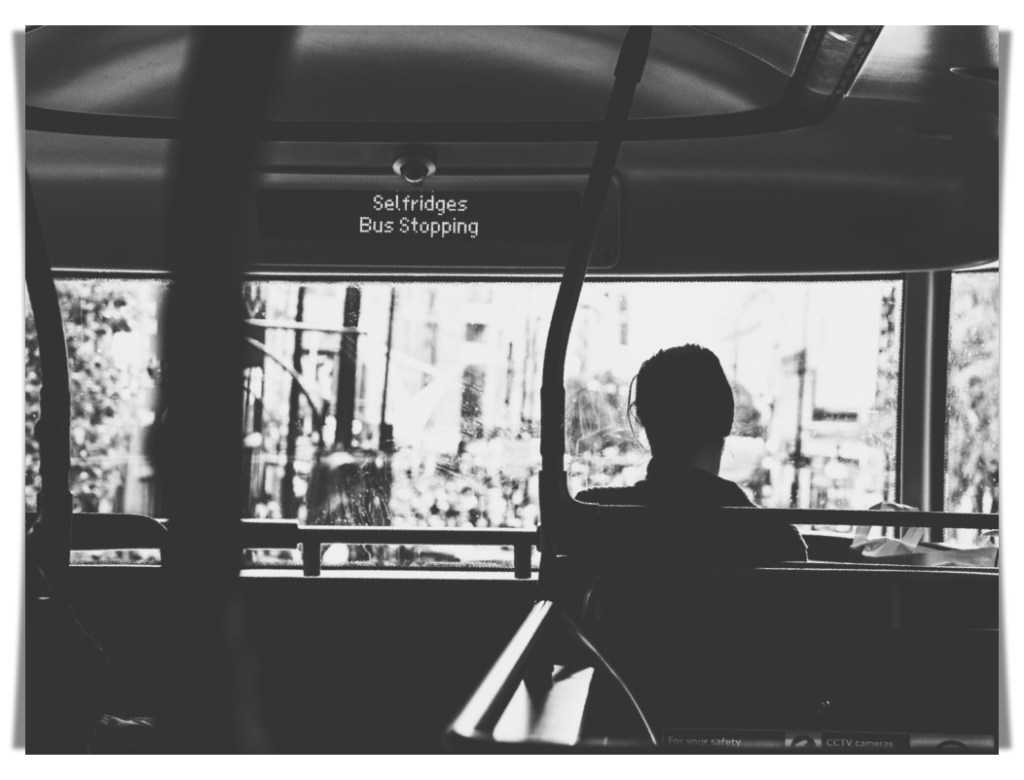
The bus ride home was a blur of exhaustion. The lull of the engine hummed in the background. My thoughts drifted aimlessly as the scenery flickered past the window. And then, he was there.

The bus was pretty empty, with plenty of free seats, but he walked up to where I was sitting and took the seat next to mine. For a second I froze, my breath catching in my throat. The entire world had shifted on its axis.

I risked a glance in his direction. He had a black jacket on top of a navy blue t-shirt, dark trousers, and brown shoes. His short, straight black hair framed his face. His hands were tucked into his pockets.

The silence stretched between us, saved for the sounds of late afternoon traffic and the occasional ring of the bell.

And then, a simple invitation.

I wasn’t prepared for it or expecting it, but the answer left my lips before doubt could take hold. And with that, the path was set. The bus rattled forward as if nothing had changed. But everything had.

When we arrived at our stop, he met my gaze. Then he turned towards the street. Without hesitation, I followed.

We walked side by side in silence. The long shadows of the streetlights lay on the pavement, and the faint chatter of office workers rushing home floated in the air. Once we reached the door, he stepped ahead and held it open for me. His hands rested lightly against the frame.

I stepped inside. The warmth of the cafe wrapped around us. For a moment, I wasn’t able to even look at him. A flurry of emotions brewed in my chest; my heart pounded. But when I finally looked up, there he was, a slight smile on his lips.

And in that moment, I felt it. A soft, trembling hope for something I didn’t know if I was ready for, but I couldn’t help wanting it anyway.

Related story: First Sight

Copyright © Olivia JD 2025

All Rights Reserved.

Fragments of Obsession

What began as a single moment never really left me. It lives in fragments of touch, of distance, of memory, and of time.

Image source

There are days he couldn’t come to me. He is always needed wherever he is. He analyzes patterns, behaviors, minds. But does anyone truly know him? On the days he is with me—the late evening light reflected on his disheveled hair. The contour of his tired shoulders. His long, calloused fingers. His moans echo in the shadows.


The light around him softened his expression into something tender. One hand held a book, the other blindly traced the tabletop. I paused mid-sentence, staring. His brows furrowed, his gentle eyes on the page. At that moment, my heart found shelter after endless wandering. He sensed my gaze and glanced up. Our eyes met—just for a moment—before he shifted away.


This is one of the nights when the apartment feels damp and cold. Thoughts ran through my mind while washing dishes, doing the laundry, and folding our clothes. Is he tailing someone right at this moment? Has he eaten? I tried listening to the audiobook, but nothing felt right. This book is too wordy. That one has a flat narrator’s tone. I closed the app and scrolled through YouTube to find a playlist to match my mood. In this playlist, the songs are too catchy. The other playlist is too sappy. I disconnected my earbuds and put my phone away. Even with all the lights on, the room feels darker. How many hours before tomorrow comes?


His hands are a map of everything I cherished. His light tan hands have carried pain and tenderness in equal measure. They have wielded weapons, sifted through crime evidence, cuffed wrists, and tenderly stroked the deepest part of me. His fingers are long and tapered; half moons peeked on his trimmed nails. Sometimes I noticed faint traces of blood and grime. When they brush against my skin, it’s like the first ray of sunlight after a long, cold night. His hands have built and mended, held and released. They’ve cupped my face, traced my curves, and held me in place. They’ve wiped away my tears and made obscene gestures in moments of anger or to stir my laughter. When I think of his hands, I’m reminded of the roots of the ancient trees or the ocean with their endless ebb and flow pulled by the moon.


The bed now is just a bed. The sheets are now crumpled into hollows that hold the shape of him. I run my fingers over the fabric and the pillows. They still smell faintly of his skin and the faint, sharp tang of his cologne. I press my face into it, trying to hold onto what’s left, but the scent is already fading. The white walls have absorbed the echo of his voice. The door clicked shut with a finality and stays closed until he returns. On the table, his cup sits lonely with the faint imprint of his lips. I leave it there to become a relic of our morning. His jacket hangs on the back of the chair, slouched in a way that feels so like him, as if it might come alive and shrug itself back into motion. The room has exhaled. It has moved on and is settling into the rhythm of my day, one that doesn’t include him.

Copyright © Olivia JD 2025

All Rights Reserved.

Fragmented Story | First Sight

Some moments will never leave you. They creep into the silent corners of your memory and wait. It’s not love, but something more delicate and mysterious. I was eighteen when I first saw him. He wasn’t looking at me or even aware I existed. But then something changed. I didn’t realize it at the time, but that moment would stick with me, embedded into the fabric of my life and reappearing when I least anticipated. This is the fragmented story of an obsession that began before I had the words for it.


Image source

I was eighteen the first time I saw him. I was too young to fully comprehend how a single moment could change the course of time, but I was old enough to sense how important it was. He was twenty-two, though I didn’t know it then.  The light that late afternoon was soft and turned everything golden. It fell through the leaves as I walked home from class. A heavy bag hung across my shoulder, the monotonous rhythm of my day fading into the background.

Then I saw him.

He stood in the distance, partially obscured by the trees. There was something arresting about him that made him seem out of place in the moment. His jacket drew my attention right away. It was a deep brown, worn suede. The rich color seemed to absorb the light, making him stand out against the colors around him. His white trousers seemed an afterthought, subtle and plain. It was the type of look you don’t think about until later, when it won’t leave your mind.

I recall that he had a camera in his hand. He was working it with his fingers as he turned it in his hands. His dark, straight hair fell just above his brow, softening the harshness of his face. Serious. Intense. His posture was nonchalant as if he didn’t care that the world might be watching.

But I was watching.

I didn’t intend or want to be there, but there I was, fixed in place. “Who is that?” I asked my friend, and the question came out before I could rethink it. She chuckled as if it were clear, then mumbled his name with a mocking grin. “You should go talk to him.”

I didn’t or couldn’t. It wasn’t just insecurity; there was something else. It seemed like he was untouchable, and whatever he was focusing on in silence was not meant to be disrupted. So I walked away, thinking I’d left the moment behind.

But the image of him stayed with me for days or weeks. It kept going through my mind: him standing alone, with the trees casting a shadow as light gathering around him. I’d find myself wondering what he was thinking about as he carefully held that camera in his hands. It drove me crazy that someone I had never talked to could occupy a corner in my head.

Even now, decades later, I find myself going back to that day. It wasn’t love then. It was something more fragile. It was like an obsession that nestles deep in your chest and stays there, waiting for reasons you don’t yet comprehend.

Copyright © Olivia JD 2025

All Rights Reserved.

Fragmented Story | His Days Were Long

Writing complete stories has never been my style. My mind wanders, seeking and focusing on moments and emotions that demand attention, even if they don’t always fit neatly into a beginning, middle, and end—like poetry. I find myself drawn to fragments of moments that exist between greater narratives. It’s in these fragments that I discover what I need to express, often eliciting more emotion with a single, still snapshot than an entire storyline.

This piece, His Days Were Long, is one such fragment. It’s a story of a man torn between his responsibilities and a yearning he can’t quite shake. It’s a little piece of a wider web of stories that live within me, ready to be told one at a time. These moments are disjointed and incomplete but filled with meaning, but these are where I feel most alive in my writing. So I’ll keep sharing them in bits and pieces, each with its own truth and emotion.

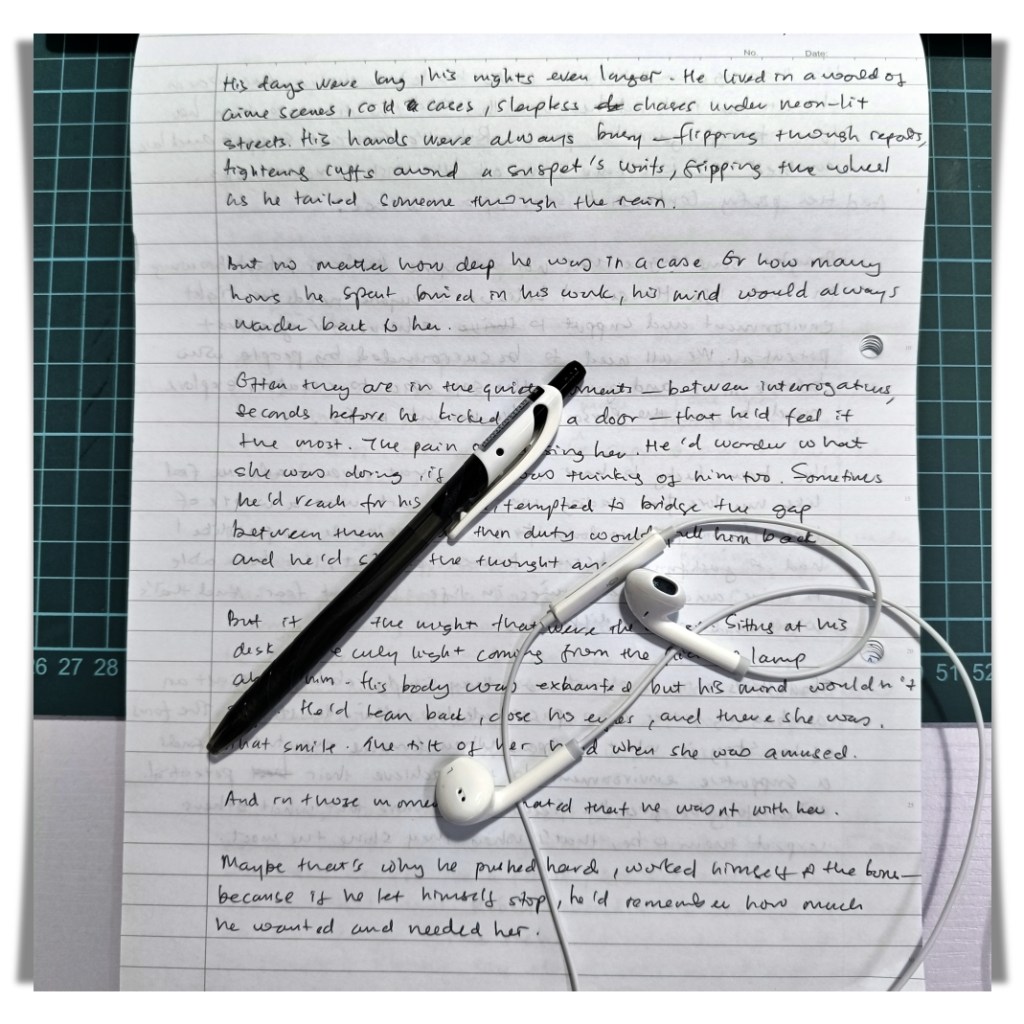
His days were long. His nights were even longer. He lived in a world of crime scenes, cold cases, and sleepless chases under neon-lit streets. Whether he was flipping through reports, putting cuffs on suspects, or driving while tailing someone through the rain, his hands were always busy.

But it didn’t matter how deep he was in a case or how many hours he worked; his mind would always go back to her.

He would often feel it in the quiet moments—between interrogations or right before he kicked open a door. The agony of missing her. He’d wonder what she was doing, if she was thinking of him too. Sometimes he’d reach for his phone, tempted to bridge the gap between them. But then duty would pull him back, and he’d shove the thought away.

But it was the nights that were the worst. Sitting at his desk, the only light coming from the flickering lamp above him. His body was exhausted, but his mind wouldn’t stop. He’d lean back, close his eyes, and there she was. That smile. Her giggle. The tilt of her head when she was amused.

And in those moments he hated that he wasn’t with her.

Maybe that’s why he pushed hard, worked himself to the bone because he was afraid that if he stopped, he’d remember how much he wanted and needed her.

Handwritten draft of this story.

Copyright © Olivia JD 2025

All Rights Reserved.