
As I walked toward the bamboo grove, the morning air in Arashiyama was cool against my skin. At forty-nine, I have learned to cherish these quiet hours before the world awakens. I had risen before dawn, leaving my hotel while Kyoto still slept, hoping to find that peace between sleep and waking where the spirit feels most alive.
I am Iban, born in Sarawak, though I have lived away from my homeland for more years than I care to count. My journey has taken me far from my roots. I came to Kyoto for a brief getaway and to seek an elusive urging, perhaps a reminder that I am still connected to something larger than myself.
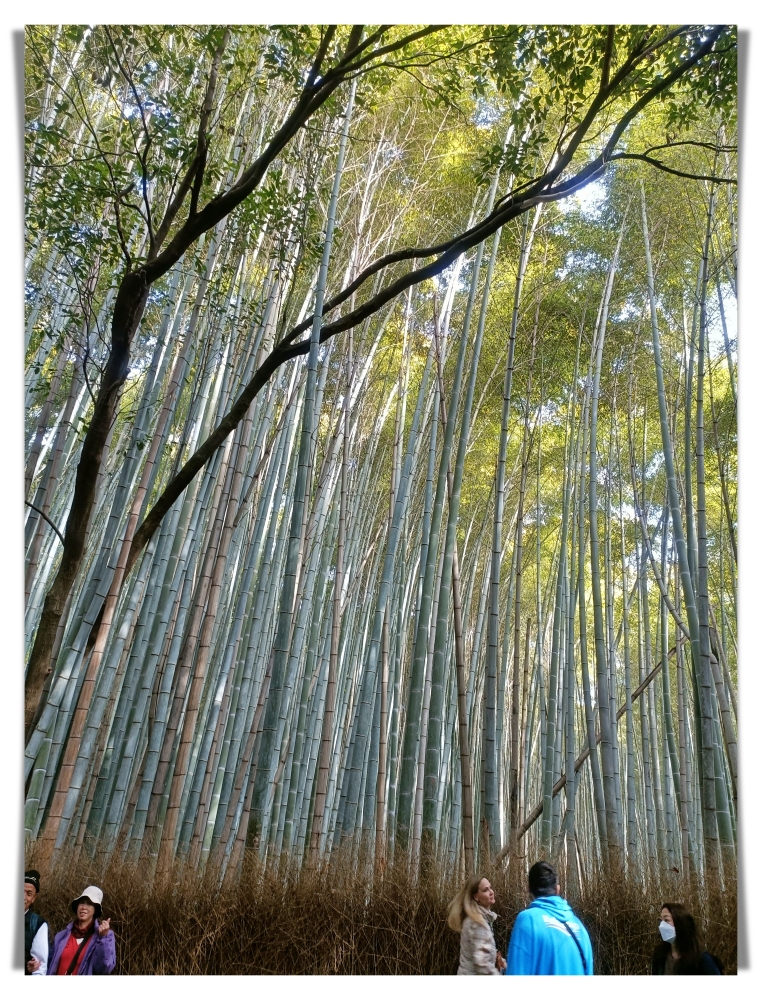
As I entered the grove, the first thing I noticed was the silence. Then the wind stirred. The rustling of the bamboo stalks, creaking and clicking against one another, filled the air with a sound so distinctive that the Japanese government has named it one of the “100 Soundscapes of Japan.” To me, it sounded like a longhouse at dusk, a murmur of voices blending into one.
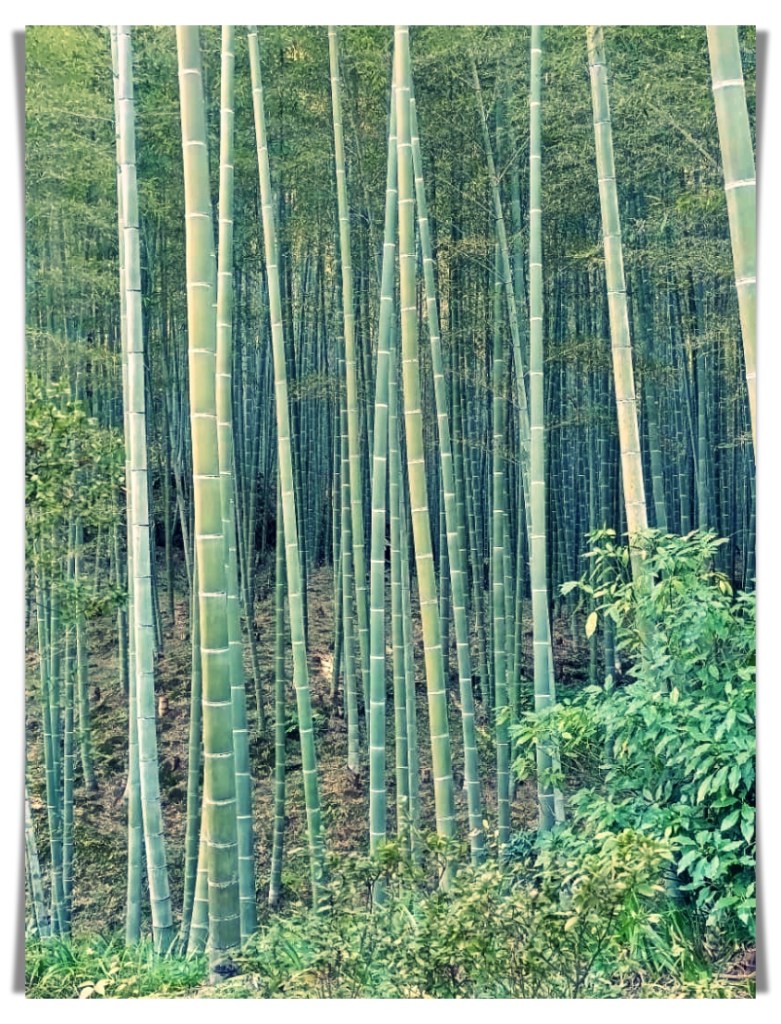
The Moso bamboo rose around me, some stalks reaching sixteen meters toward the sky. I walked slowly along the Chikurin-no-Komichi, the main path that runs for five hundred meters through the forest. The morning light filtered through the canopy, casting pale green shadows on the ground. I stopped and placed my palm against one of the stalks. It was cool and smooth, surprisingly solid for something that grows so tall and bends so easily in the wind.
This is when I remembered what my cousin in Kuching shared with me last year, the Iban traditional concept about the “bungai”. She had written to me about the bungai, a plant-image that lives in the invisible world of Manang Menjaya, the Iban god of healing. According to Iban traditional belief, each person has a bungai that takes the form of bamboo, growing in clumps from a single rootstock. The bungai grows, strengthens, weakens, dies, and falls, just as a person does.
Standing in that grove, surrounded by thousands of stalks rising from what I knew must be a shared underground network of roots, I understood this more clearly than before. The bamboo does not grow alone. Each shoot is part of a “pumpun”, a clump. Every stalk has its own height, direction, and shape. They all draw from the same roots and source. No one grows alone.
I thought of my own bungai, wherever it grows in the cosmic garden of Manang Menjaya. I imagined it as bamboo, tall, flexible, rooted in the same clump as my mother and my relatives who still live in the longhouse by the Layar River. For years I felt out of place, as if I were growing away from where I began. I left Sarawak for school, then for work and marriage. I felt disconnected, as though my stalk had been cut from the clump and planted somewhere it did not belong.
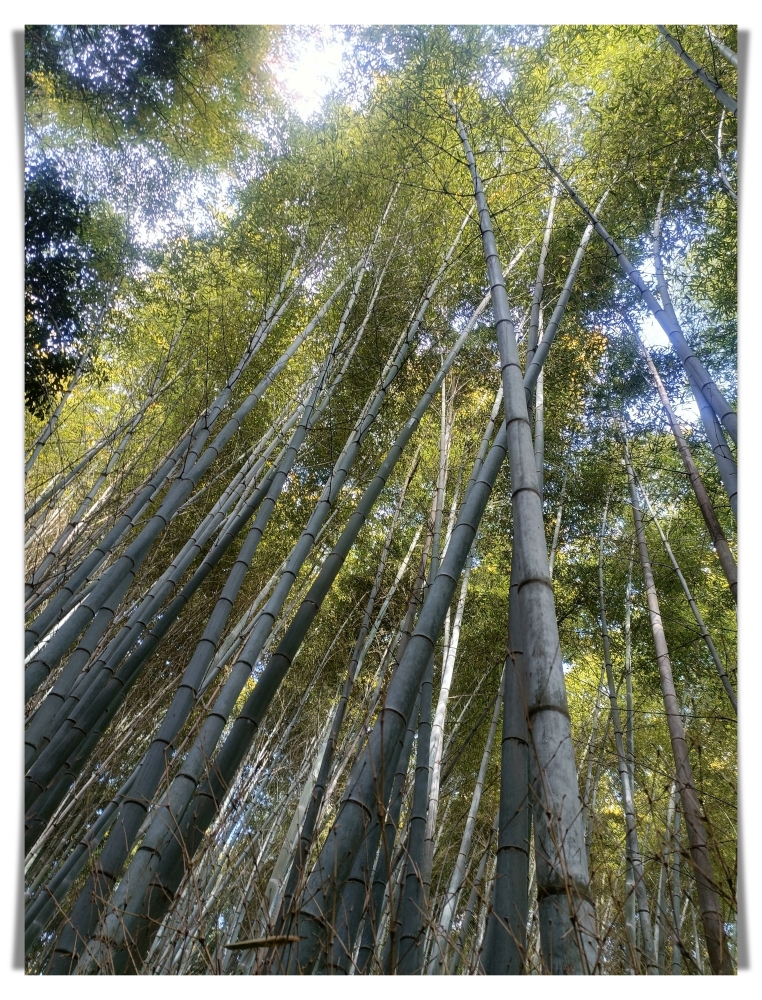
The bamboo shifted that understanding. Walking through that grove, I realized that the rootstock never disappears. The connection endures, no matter the distance. The clump remains, hidden but flourishing. My bungai is still there, nurtured by the unseen garden, sustained by the same roots that support my kin. Though I’ve been gone for years, the lineage continues.
I kept walking, finally arriving at the Nonomiya Shrine, a modest Shinto shrine tucked away in the grove. I stopped, feeling the familiar stirrings within me. Our ancestors recognized this pattern clearly when they chose bamboo for the bungai. These plants grow in clumps. They survive storms by bending rather than breaking. They send up new shoots even after the old ones fall. The Iban watched this pattern daily, living close to the land, and they recognized it as a mirror of human life.
This is how my people once understood family and community. A family is one clump. A longhouse community is many clumps standing together, sharing the same ground. The well-being of one shoot affects the whole. When someone is sick, the bungai weakens. When someone wanders, it withers. When someone dies, it falls, but the clump remains, ready to push new growth upward for the next generation.
I thought of my own children, born in a place far from Sarawak. They have never lived in a longhouse. They do not speak Iban beyond a few words. For years I worried that the connection had been broken. Standing in that grove, watching the morning light shift through the bamboo, I understood that the rootstock never disappears. My children are new shoots from an old clump. They may grow in different soil, but they draw from the same source.
The grove has two paths. I walked both that morning, the famous Chikurin-no-Komichi and the newer Bamboo Forest Trail opened in 2015. The wider path was easier for walking, but I preferred the older one, where the stalks grow closer together, where the sense of bepumpun is strongest. I stayed until the crowds began to arrive, tourists with phones raised, their voices breaking the silence. I did not resent them. They were seeking something too. Perhaps they were looking for beauty, peace, or a moment of connection in a world that increasingly isolates us.
As I walked toward the exit, I passed a sign noting that the bamboo forest is open 24 hours a day and has no entrance fee. I smiled. You cannot charge admission to a teaching that has been offered freely since before humans built temples or paved paths.
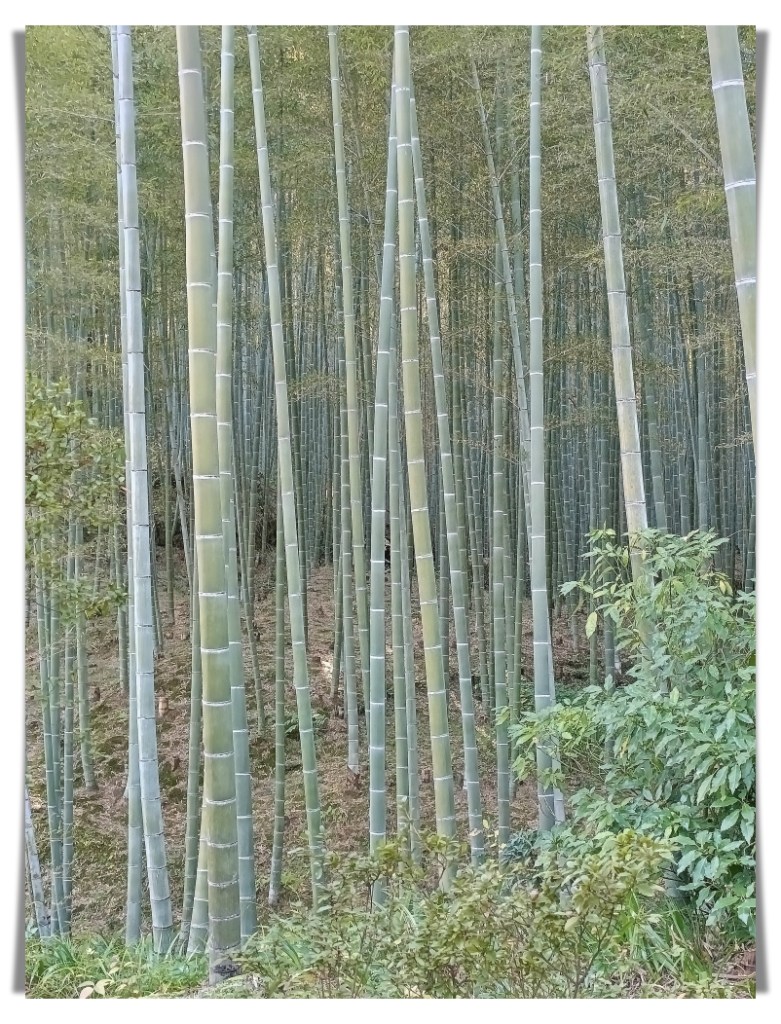
Before leaving, I visited the Okochi-Sanso Garden at the far end of the grove. The admission fee included matcha tea and a sweet, and I sat on a bench overlooking Kyoto, sipping the bitter tea and watching the city spread out below me. I thought again about the bungai and what it offers us today. Many of us live far from home. Some grow up with mixed heritage, navigating several identities at once. Some have lost their language, their land, and their connection to family history. The bungai shows that belonging extends beyond physical closeness. It rests in memory, lineage, and the ties that remain.
The forest had shown me that I cannot survive alone. Bamboo stands because the clump stands. A community endures because its roots are strong. Long before the words “ecology” or “sustainability” were used, our ancestors knew this concept. They practiced it when they built longhouses, shared food, and worked the land. Their lives were intertwined with nature and community that supported each other. The bamboo reminded me of what I had forgotten: we are not alone. We grow in clumps, we sway together when the storm comes, and we push up fresh growth from roots that have endured for ages.
I left Arashiyama that morning with a clearer understanding. I am still a shoot from the old clump. The rootstock holds. The bungai grows, even when I cannot see it. I am connected to those who came before me and those who will come after. No matter how far I travel, my roots are in the garden of Manang Menjaya, where our lives rise from the same source and intertwine across generations.
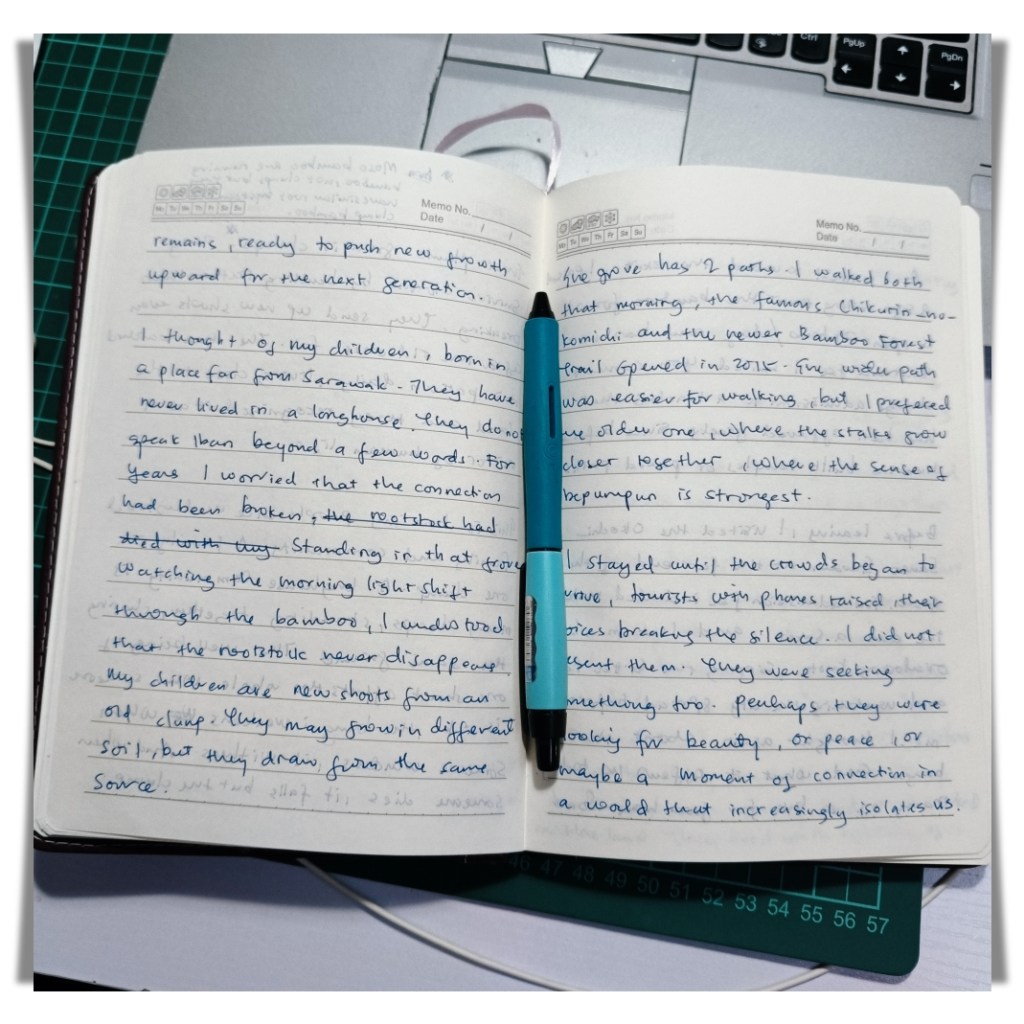
Note: Moso bamboos are running bamboos, but they have similar root systems to clump bamboos.
I write about Iban culture, ancestral rituals, creative life, emotional truths, and the quiet transformations of love, motherhood, and identity. If this speaks to you, subscribe and journey with me.



 Olivia's Atelier