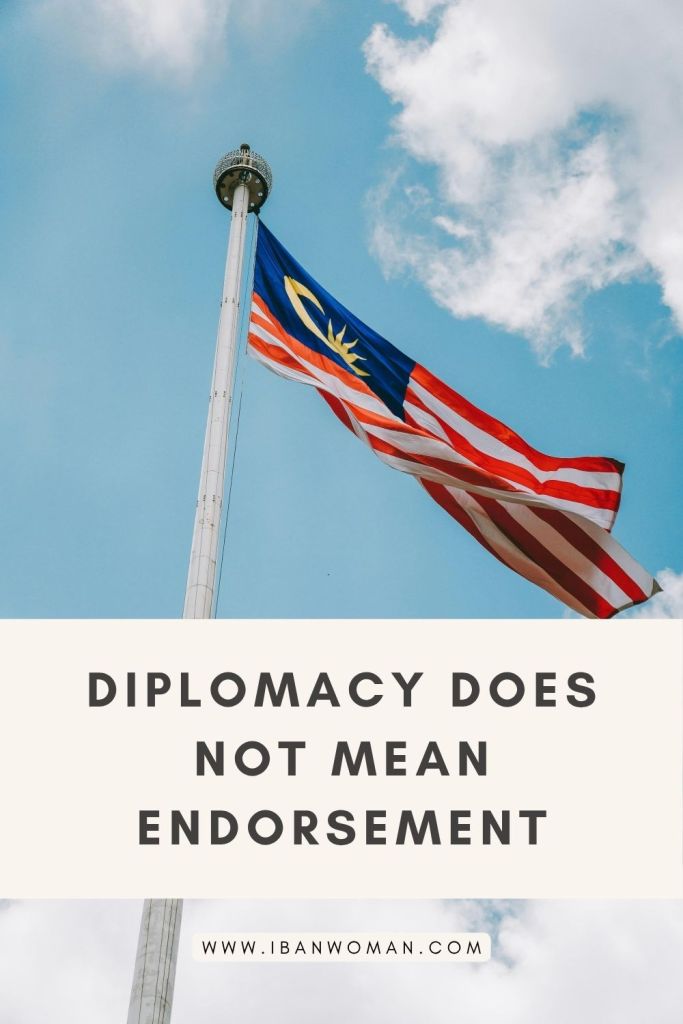
Diplomacy Does Not Mean Endorsement

Last night, I responded to a post on Threads about Donald Trump’s visit to Malaysia for the ASEAN Summit. The original post questioned why Malaysians who support Palestine were not outraged that Trump was coming. I replied that world politics does not revolve around the Palestinian issue alone and that diplomacy requires engagement, even with those we disagree with.

What happened next wasn’t a conversation; it was an attack. Someone called me naive and even used my identity as an Indigenous woman against me. She said that as an Iban, I should know more about land grabs and colonialism, and she implied that I was betraying that history by defending engagement with the United States. She cited Cuba as a model, saying Malaysia should isolate itself, like Cuba, and reject American influence completely.

I understood where the emotion came from. The Palestinian struggle resonates with many of us, as it reflects the shared anguish of displacement and dehumanization endured by other marginalized groups. It has come to stand for the fight against empire and global injustice. I grieve for them too. But that one conflict isn’t the cause of all the crises in the world. Congo, Sudan, Myanmar, and West Papua all have their own histories, shaped by local power struggles, colonial legacies, and modern exploitation. The Palestinian cause is not the origin of imperialism, but it is part of a larger pattern of it.

The comparison to Cuba also didn’t take into account how complicated our region is. Cuba’s defiance of the United States is often romanticized, but the reality is much harsher. Years of economic sanctions have caused suffering and shortages. Cuba remained steadfast, but the isolation it endured came at a heavy cost to its people. That path is not possible for Malaysia. We are not an island nation shielded from regional shifts. We are part of ASEAN, a bloc that survives through dialogue, consensus, and constant balancing between larger powers.

To disengage would not make us righteous. It would make us irrelevant. Sovereignty is not merely about being alone. It is also about having a seat at the table where decisions are made. Engagement does not mean agreement. We live in the world as it is, not as we wish it to be.

Malaysia’s invitation to Trump did not mean endorsement of his policies or his past actions. It was part of ASEAN’s long-established diplomatic practice. The United States has been a formal partner in ASEAN-led dialogues since 2009, when President Obama signed the Treaty of Amity and Cooperation (TAC). The treaty symbolized a willingness to follow the “ASEAN Way,” a diplomatic approach that values non-interference, consensus, and mutual respect. The TAC made it possible for the US to join the East Asia Summit, where world powers discuss cooperation and regional security.

The Obama administration strengthened this relationship by shifting American focus from the Middle East to the Indo-Pacific through the Pivot to Asia. This decision acknowledged the growing economic and political importance of Asia, as well as China’s rapid rise. The US began to engage with ASEAN more seriously, not out of charity, but because it seeks stability in the region to serve its interests. That engagement, even if self-serving, gave ASEAN leverage over China, which was becoming more dominant.

We cannot ignore China’s role in the region. In the past decade, it has become more aggressive in the South China Sea by building artificial islands, expanding military presence, and encroaching into maritime zones claimed by Vietnam, the Philippines, and Malaysia. This has placed ASEAN in a difficult position. China is vital economically but intimidating strategically. The United States functions as a counterweight in this situation. Without an external balancing force, Beijing could exert complete dominance over Southeast Asia.

This is the uncomfortable truth of international politics: moral clarity and strategic necessity rarely align. Malaysia can speak out against injustice in Palestine and still maintain good relations with the United States. We can be against occupation and still welcome dialogue. These positions do not contradict each other. They are two forms of survival that coexist.

It is easy to demand purity from the sidelines, but governance requires nuance. To those who use identity as a weapon, I say this: being Iban does not mean rejecting engagement or diplomacy. My ancestors fought when they had to and negotiated when they must. They understood that survival depends on knowing when to speak and when to listen. Being practical is not disloyal. It is wisdom passed down from generations who understood the cost of isolation.

Cuba resisted and endured decades of hardship. Malaysia engages because we have learned a different truth, that sometimes the best thing we can do for our people is to keep showing up, even when it is uncomfortable. Diplomacy does not mean endorsement. It is how small nations stay relevant. It is also how Indigenous voices remain part of the global conversation and how we hold our place between superpowers that shape our future.

Note:

I am not a political expert. As a Malaysian Iban woman, I’m trying to figure out how history and power affect where we stand in the world. I’m not trying to defend any leader or nation. I’m just trying to remind myself that ideals don’t mean much if they lack a basis in reality. I believe small nations can hold both principle and pragmatism, just like people can be both kind and rational.


I write about Iban culture, ancestral rituals, creative life, emotional truths, and the quiet transformations of love, motherhood, and identity. If this speaks to you, subscribe and journey with me.
On Cultural Erasure and the Right to Be Ourselves | We Are Not Yours to Claim and Rename

This week, a man on social media told me that all Indigenous peoples of Borneo are Malay. He spoke as if it were an unbreakable truth, and a few confident sentences could change centuries of culture and memory. He talked like someone who was certain of his place in the world and couldn’t imagine that others might have histories older than his own.

I am Iban. You can’t claim and rename my people.

That one conversation was a sign of a much larger issue. It wasn’t just a rude comment but the same old narrative that keeps playing beneath the surface of national conversations. This idea that everything in the Nusantara archipelago belongs under the Malay umbrella is not unity. It is colonization in a new form that continues to erase the cultures that make this region truly diverse.

A thesis essay titled “Cultural Genocide Against Ethnic Groups in Sarawak” discusses this gradual erasure as a form of genocide that occurs through language, law, and land instead of war. It addresses what has been happening in Sarawak and all over Borneo for decades: the gradual disappearance of Indigenous ways of life. There won’t be any violence in the news, but you can see it in how children forget their native languages and how native stories are rewritten or how they are dismissed as myths.

The first impact is on the land. Large-scale logging, oil-palm plantations, and hydroelectric projects like the Bakun and Murum dams have forced Indigenous communities to evacuate ancestral lands they had occupied for generations. For many outsiders, these are symbols of progress. For the people who lived on that land, they are the loss of a living relative. Land isn’t just property; it’s a memory, a source of livelihood, and the center of our beliefs. When it is taken, the connection between people and their ancestors, between rituals and the land, ceases to exist.

The next impact is on language. Malay and English are the main languages spoken in classrooms and offices. Iban, Bidayuh, Penan, and other Indigenous languages, on the other hand, remain in private spaces. The national curriculum rarely acknowledges them. A language is more than just words; it also embodies every aspect of our heritage. When children grow up without it, they lose not only vocabulary but also the worldview embedded in those sounds. 

The third impact is spirituality. Before Christianity and Islam arrived, our ancestors believed in a cosmology that connected people, nature, and the unseen. The adat guided balance and respect. Several elements were based on Hindu-Buddhist beliefs from the Majapahit and Minangkabau traditions, but those influences became uniquely our own, shaped by our environment. If you call these beliefs primitive, you are ignoring how sophisticated they are. Long before the word existed, they taught people about law, ethics, and ecology. The suppression of these systems has shattered more than trust; it has destroyed the bridge between generations.

The last impact lies in invisibility. Bureaucracy rarely speaks the language of the natives. Many still struggle to gain recognition of their customary land rights or even simple documents like birth certificates and identity cards. People who don’t have these papers become ghosts in their own country—unseen in census numbers and uncounted in national decisions.

Taken together, these forces create the silent machinery of cultural genocide. It’s not about individual malice but about a system that values uniformity over diversity and control over respect. When progress is measured only by infrastructure and profit, it becomes a form of forgetting.

I write this not to sow division, but to call for honesty. Respect for Indigenous tribes and their histories is not charity but a moral obligation.  When you erase a culture, you do not create unity. You create emptiness. Real harmony happens when differences can exist side by side, without one overtaking the other.

If you have mixed roots and feel like you’re torn between two identities, know this: you’re not a poser. You are the result of two or more heritages coming together. You have the strength of several worlds inside you. You have every right to learn your ancestral language, honor both sides of your heritage, and talk about it with pride. You can still reach your roots and the journey begins with curiosity and grows through community.

And to those who continue to insist that “everyone is Malay,” listen up: you are not defending tradition; you are performing a modern version of the same colonial mindset you claim to oppose. Claiming and renaming others is not leadership. It’s theft. It is a refusal to accept that different roots can live together without merging into one trunk.

The Iban, Bidayuh, Kenyah, Penan, Lun Bawang, Melanau, Kelabit, and countless other groups are not extensions of a larger race. We are nations within a nation, with histories that predate borders. We have our own gods and deities, our own literature, our own rituals and way of life. We don’t need anyone to save us from ourselves.

So take care of your own culture and let us take care of ours. Guard your own identity and let us stay as ourselves. You don’t have to tell us what to believe, how to speak, or how to conduct our affairs. Preserve your own heritage and quit trying to claim ownership of what doesn’t belong to you.

This moment in our history calls for courage. We need courage to listen, fix what has been distorted, and return whatever is rightfully ours. We don’t need anyone’s permission to exist. Even when others pretend to forget, we remember. We will continue to speak, to write, to sing, and to exist in our own rhythm. We are not lesser branches of your tree. We are forests in our own right.


I write about Iban culture, ancestral rituals, creative life, emotional truths, and the quiet transformations of love, motherhood, and identity. If this speaks to you, subscribe and journey with me.
When Superpowers Clash, We Feel It Too

Image source

It’s funny, isn’t it? How two men on opposite ends of the world can make a decision and affect the whole world. Tariffs and trade war threats have been dominating the news lately. The US says it’s slapping more tariffs on China. China fires back. It’s easy to scroll past, thinking it’s “boring and not my problem”. 

The truth is, this issue affects both me and you, regardless of your location in the world. However, my perspective is limited to my own country. If you live in Malaysia, whether you’re in a kampung or a longhouse, a city condo, or riding the LRT to work, it is your problem.

I’m no expert in global trade or politics. I’m just an ordinary Malaysian of Iban ethnicity, trying to make sense of how all this noise in the headlines ends up affecting people like us. What I’m writing here comes from my own shallow understanding. But it’s my opinion and deserves a place in the conversation too. 

Malaysia trades with both China and the US. When the US slaps China with high tariffs, Chinese companies may look for cheaper supplies or partners. They could turn to smaller nations like Malaysia. It seems like an opportunity but if the US suspects Malaysia is helping China “bypass” tariffs, we might get punished too. The rules keep changing and things are so uncertain right now. 

And let’s discuss the costs of things, which may go up. Costs trickle down. I’m not too concerned about basic necessities (for now), but what about machines and auto parts? My car repairs might cost double. I drive an old car, which is more likely to break down frequently compared to a new one. And what about medical costs? Will they go up too because our medicines are mostly imported?

Malaysia is part of global supply chains, especially in tech. For example, if a Malaysian company makes parts that go into Chinese products and China can’t sell those products to the US anymore, Malaysia’s economy also takes a hit. It’s a domino effect. We’d probably experience less overtime, fewer shifts, or, worse, layoffs.

When the global economy is shaky, investors pull back. Foreign companies that were thinking of setting up shop in Malaysia might delay or cancel. That means fewer new jobs, less innovation, and slower economic growth. Even local businesses hesitate to expand or hire, unsure of what’s coming next.

As you can see, this trade war is about us too. It’s not just about two bickering giants. 

And what’s the price of pride and power?

You pay it in whatever your country’s currency is. For me, it’s in Ringgit and daily worries that don’t make headlines.

But Malaysia (and other ASEAN countries) isn’t staying silent. It was recently announced that we’re planning a diplomatic mission to the US to talk things through. We don’t want to retaliate because we are tiny and want to play nice. We want to negotiate and protect our trade and, hopefully, our people. The date hasn’t been confirmed, but even that small step means we’re not just drifting in someone else’s storm.

The world is full of giants. As a small nation, we don’t have the means to fight with fists. We are trying to survive with grace and hold steady like a boat in choppy waters. Our sails may be torn and our oars weathered but we are still floating and moving because people’s lives are worth the journey. 

Declining Population Trend In Malaysia | My Perspective

Image source

I recently read a Facebook post that talked about how Malaysia’s population is going down. But it didn’t really surprise me because the birth rate has been falling around the world. Professor Dr. Sharifa Ezat Wan Puteh, a local health expert, said that if this trend keeps up, Malaysia could have a population that is mostly made up of older people by 2030. As a woman, I see this trend as a sign of how our lives and expectations are changing because of changes in society, the economy, and culture. Let’s look into what caused this change in the population and what it means for Malaysia and other places.

Mindset Shift

In the past few years, I’ve seen a lot of women decide not to get married or have kids. The way people think about family life is changing. In Malaysia and many other places, the idea that women should be the main providers is being examined again. More and more women want freedom and equality, and this can be seen in the choices they make about marriage and family. Birth rates are going down because more people want to be independent, travel, and find self-fulfillment.

In 1970, Malaysian women aged 15 to 49 had an average of 4.9 children per woman. This rate had dropped a lot by 2021, when it was only 1.7. This big drop shows that people’s priorities have changed. Many women are now focusing on education and jobs, which can be hard to balance with a traditional nuclear family. Women are changing how they think about fulfillment and achievement, and it’s not always about having children and getting married.

Economic Pressures and Career Priorities

As traditional views on family life change, women in Malaysia and around the world are putting their jobs and personal growth first. Pressures from the economy are a big part of this trend. As a mother, I am very aware of these problems. The sharp rise in the cost of living has made it harder for families to raise kids. People in Malaysia are having a hard time with money because more people are moving to cities, and the prices of housing, schooling, and health care are going up. This has caused many people to think about how big their families should be.

Access to Family Planning and Education

Women today have the freedom to make decisions that fit their desires and way of life. This includes making well-informed choices about their sexual health. Women in Malaysia have more power over their reproductive choices thanks to efforts to make family planning programs and sex education easier to access. This gives women more power so they can plan their families in ways that fit with their personal and work goals. This makes the drop in birth rates even greater.

Implications and Future Directions

This drop in population has effects that reach far and wide. In terms of the economy, it could cause a lack of workers, which would mean that foreign workers are needed. It also puts more stress on social aid services because there are fewer young people to help an aging population. In terms of society, this change can affect how communities are formed and how families work together.

As women continue to shape the future, it is important to deal with the reasons why birth rates are going down and make policies that help people match their work goals with family obligations. To solve Malaysia’s demographic problems, they will need to make workplaces more supportive and flexible for parents, offer cheap child care, and encourage a culture that values both career and personal success.

In conclusion, the world’s population is going down. This is a complicated problem that is caused by economic challenges, shifting perceptions about family size, and advancements in family planning. As a woman, I think that knowing about these things is important for dealing with and creating the future. We can lessen the effects of this trend by addressing its causes and backing policies that are fair for everyone, even though it is clear that the birth rate will probably never reach the levels it had in the 1980s and 1990s.

💃 Happy International Women’s Day 2025 💃