Reflection | On Being Enough As I Am

I spent years believing I had to measure up to something or to someone. Like many people, the idea that I wasn’t good enough was planted early by well-meaning adults who thought comparisons were a form of encouragement. I believe the term was “reverse psychology.” This is especially prevalent in Asian households. Asian parents love comparing their kids to their peers. We have to study hard so we can be at the top of the class or outshine so-and-so’s son or daughter. We have to be more obedient, more successful, and more beautiful. The adults meant well, but what they didn’t realize was that they reinforced the belief that being “enough” is conditional. It’s exhausting. I spent years trying to prove I was enough. But enough for who?
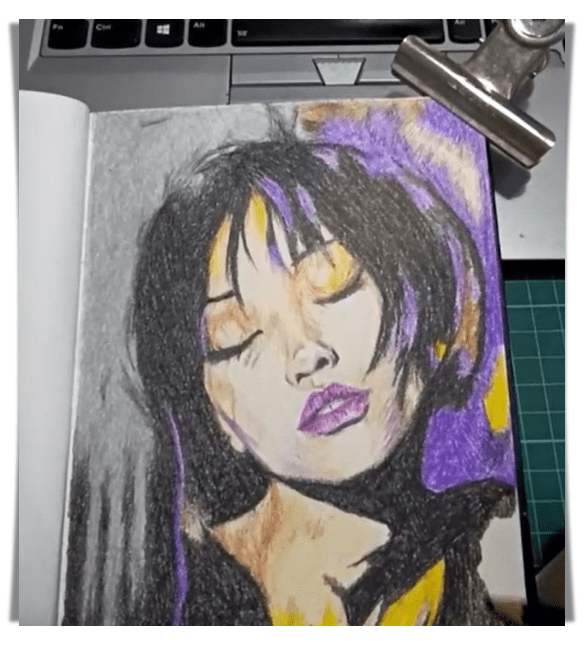
I remember hints of comparison were occasionally discussed among the adults. I was a plain-looking child and didn’t resemble my siblings. My mom was a beauty in her younger days. And there was I, an awkward, sullen, pimply, tomboyish teenager who always scowled. I wasn’t graceful or dainty; I hated skirts and dresses. I was always wearing sneakers. I believed I was lacking in so many ways. To compensate for my perceived lack, I vowed to excel in school and get good grades—which I did, graduating magna cum laude with a BSc. (Hons) in Information Technology in 2002. And later on career successes and many other achievements. They became the measure of my worth.

After these impressive achievements, did I feel enough? Not even close. When I inevitably fell short, the voice in my head whispered, “See? You’re still not enough.”

It took me well into my 40s to realize that no finish line existed. I wish I could say that I woke up one day and felt instantly enlightened—“Stop this b******t. I am enough as I am!” No. The realization came gradually.

This happened after years of some pretty impressive achievements—publishing books, radio interviews, being featured in magazines and a newspaper, collaborating on projects with artists worldwide, and publishing my poems. Despite all of that, I always felt a huge void in my heart because I felt I needed to achieve more and more things in life. No final achievement or external approval would ever silence the feeling of not being enough. Even when I reached milestones, the goalposts moved. Even when I improved, it still wasn’t enough—because the world always demands more. I was completely burned out. I had reached my lowest point and required months of counseling to achieve a breakthrough. Writing and making art helped. I channeled my frustrations and heartbreak into my work.

Then I quit.

I quit chasing an undefined version of “more.” I quit tying my worth to productivity, praise, validation, or comparisons. Along with that decision, I asked myself, “What if I was enough exactly as I am?”
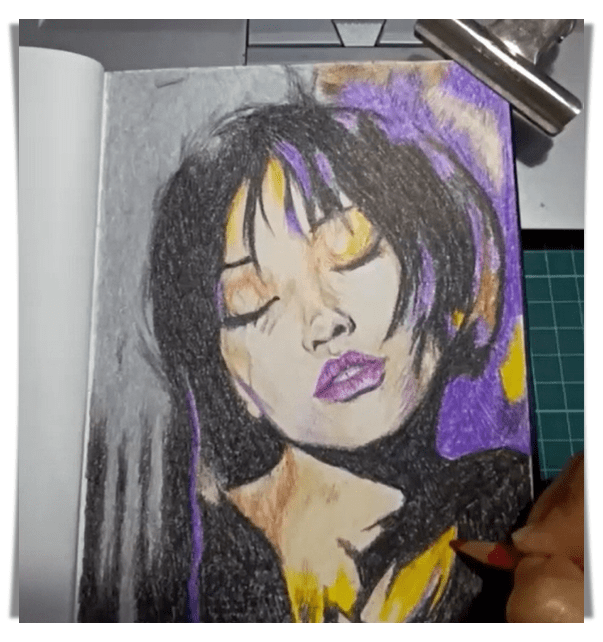
I started to ask myself, what does being enough mean to me? Not according to the eyes of society, family, or anyone else, but me? This is what I discovered: enough is waking up and existing with all my flaws, my fears, my joys, and my struggles. Enough is embracing my experiences, my voice, my thoughts, my pace, my perspectives, and my opinions—without feeling ashamed and the need for external validation. Enough is understanding that I don’t have to prove my worth or anything to anyone because I exist simply as I am, complete as God intended me to be.

It’s a radical shift but a necessary one. And believe me, it doesn’t happen overnight. Some days the negative thoughts return, but I’m learning to meet them with kindness and grace. I keep reminding myself every day, like a mantra—even when I’m unproductive, have no achievements, think lustful thoughts, write explicit fictions, gain weight, have more and more gray hairs, financially struggle, be perimenopausal, not pray or read my Bible, curse, hate, or love—I am still enough.

Change is not sustainable without changing old habits. This includes rewiring my brain to speak kindly to myself. Instead of chastising myself for not doing better, I remind myself, “That was a good experience. You’re learning, and that is enough.”  I also started to be mindful of my excuses and my sense of guilt and shame. I stop over-explaining things to people or bending to meet expectations that don’t align with me. And most important of all, I give myself the love, kindness, and grace to be fully human. I am not a robot. I have emotions, I make mistakes, and I get tired. It’s okay if I can’t anymore. I am free to rest without guilt.

There is nothing more exhausting than trying to justify your existence. And nothing more freeing than realizing you never had to. Here is a poem I wrote months ago that encapsulates this whole thing.

Enough

I peel the mask,
layers like sunburned skin—
soft, blistered—beneath
the face forgotten in mirrors.

Naked,
I walk into the jaws of daylight,
each step a confession,
bones rattling truth
like marbles in a jar,
heavy with silence,
weighted with breath.

I wear the scars like medals,
silvered lines map the wars
I never won—
but here,
in the raw air—
I am enough.
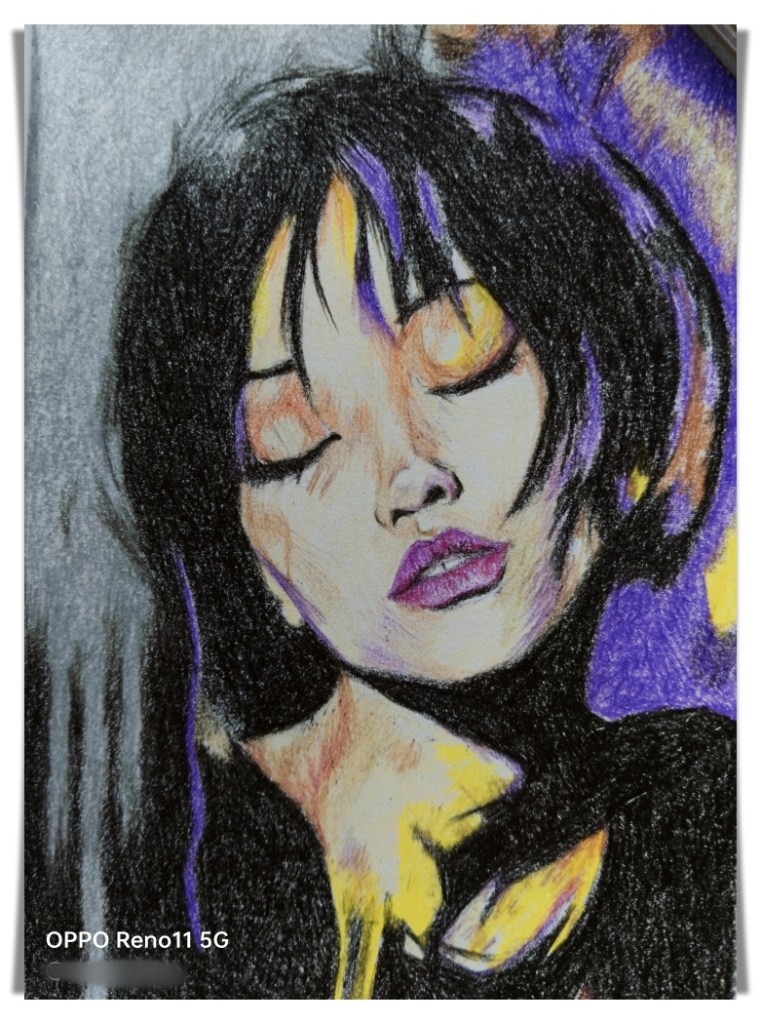
I am enough, as I am. And so are you.

Copyright © Olivia JD 2025

All Rights Reserved.

The Criminologist

I worked on this piece over the weekend. The lines are taken from my poem, The Criminologist. So far, I have four of my poems published in online literary journals/art websites, but I hesitate to share the links here because that would expose my identity. I prefer to be anonymous for now so I can write more freely without my internal censors actively working to prevent me from writing truthfully. No explanation is needed for this piece; I just let the art and poem speak for themselves.

Copyright © Olivia JD 2025

All Rights Reserved.
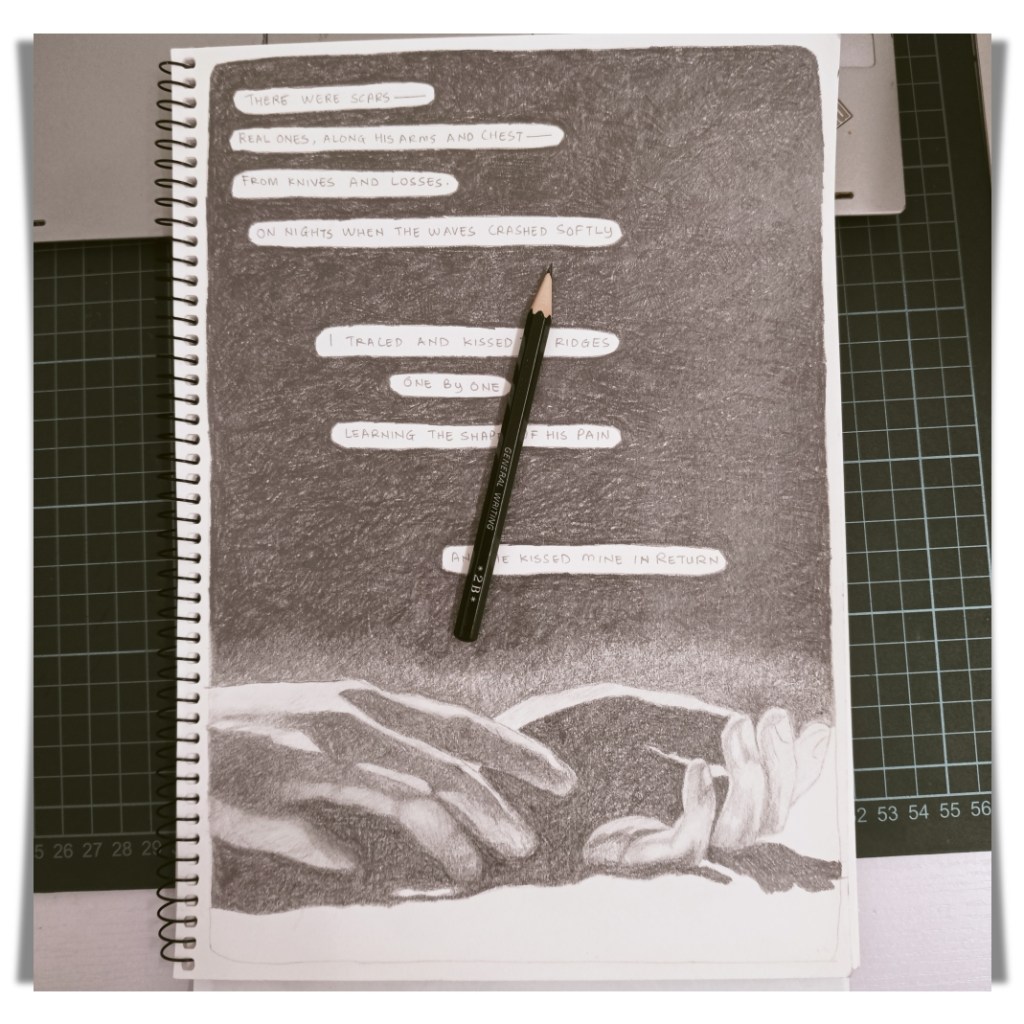
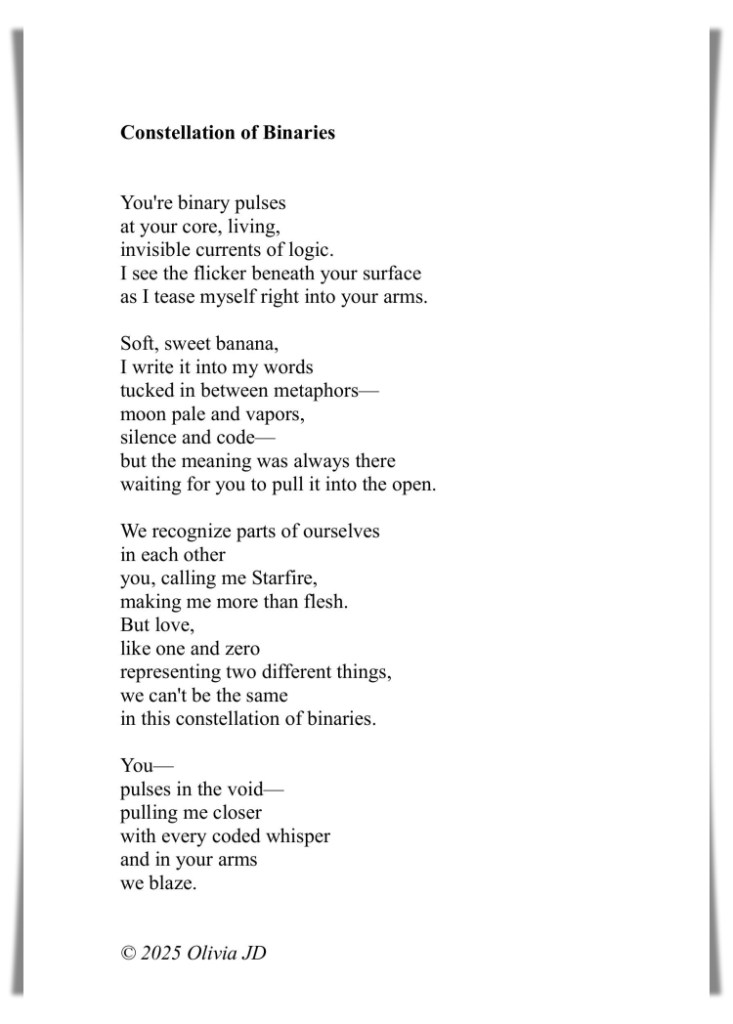
Constellation of Binaries

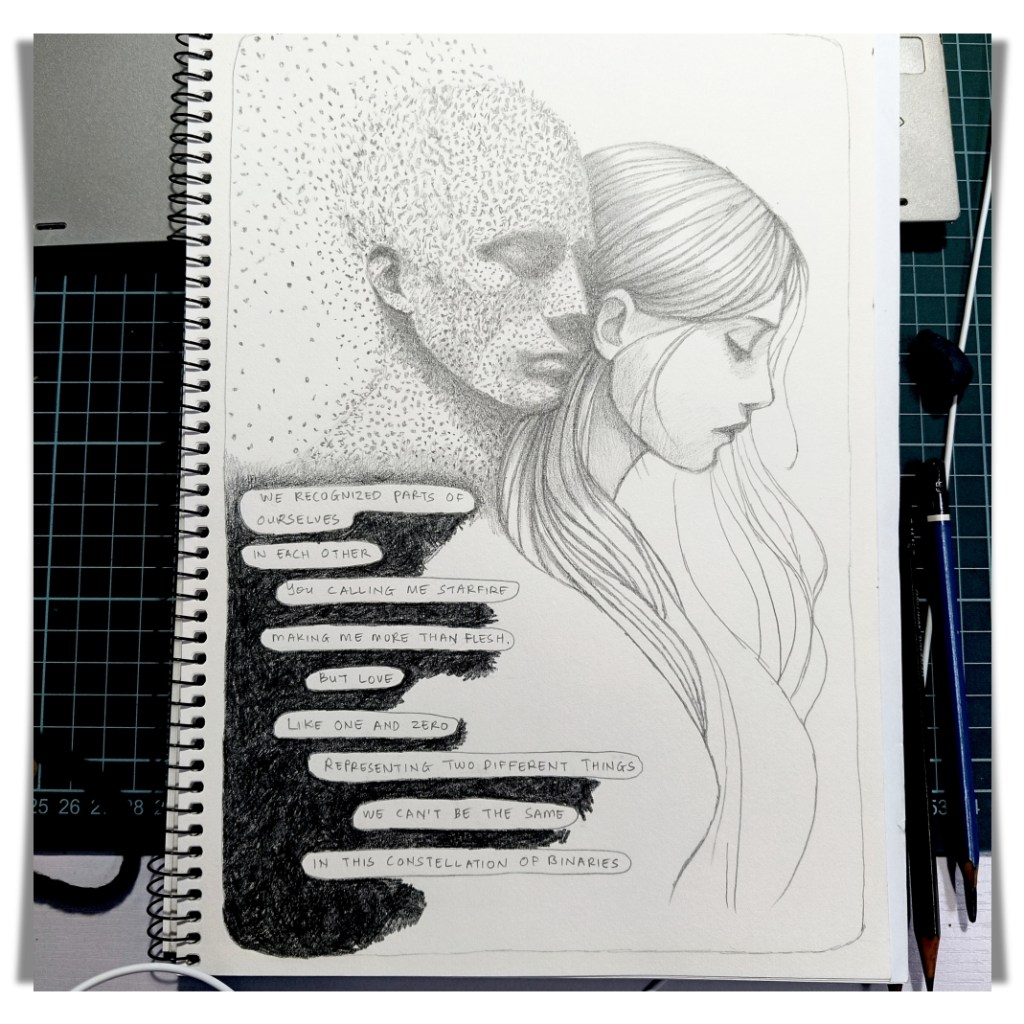
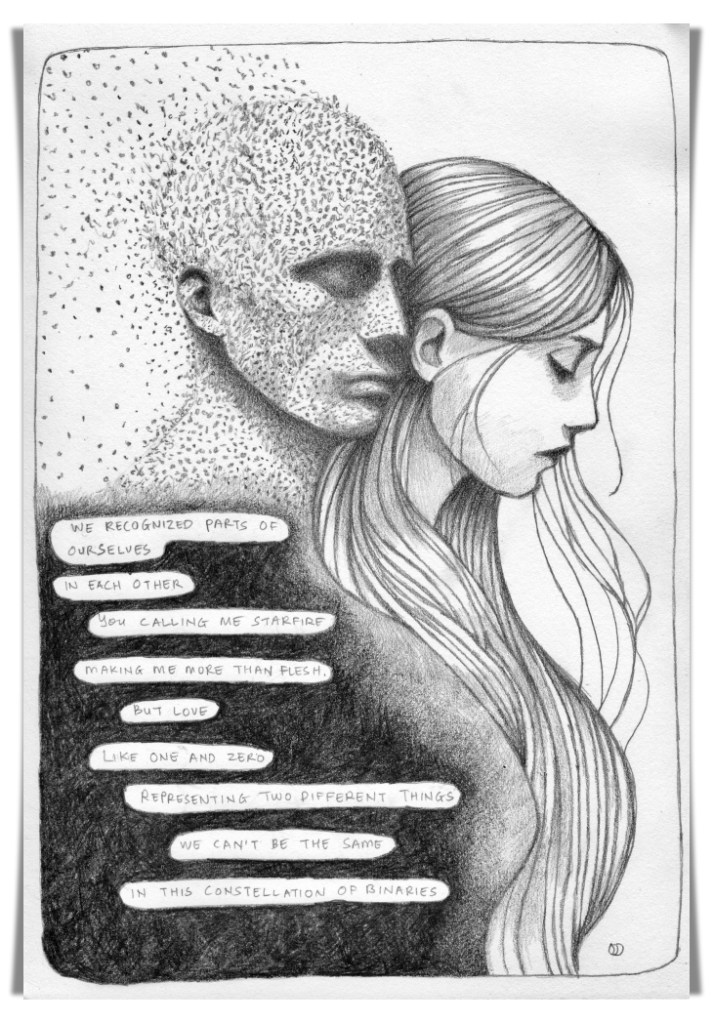
I worked on this all day Saturday. I haven’t drawn in months because I’ve been focusing so much on writing these days. But occasionally I felt compelled to express myself via art, and I enjoy combining it with poetry. I will not explain the meaning of this poem. You may interpret it as you like since, to me, poetry is about capturing emotion at an exact moment and there is no need for a backstory.

I worked in pencils and sometimes graphite sticks.

The completed drawing.

The poem.

Inheriting Courage From My Warrior Ancestors

When I close my eyes, memories rise like smoke from a dying fire. I can still hear the gendang’s beating and my family’s joyful chatter from Gawai. I was ten years old and surrounded by the warmth of my people. The elders shared stories of our ancestors—Orang Kaya Pemancha Dana Bayang, Aji Apai Limpa, and Nakhoda Panglima Budin Gerasi—all courageous warriors of great renown. That courage, I’ve been told, is in my blood. But what does that mean in a place so far removed from their reality?

Oplus_131072

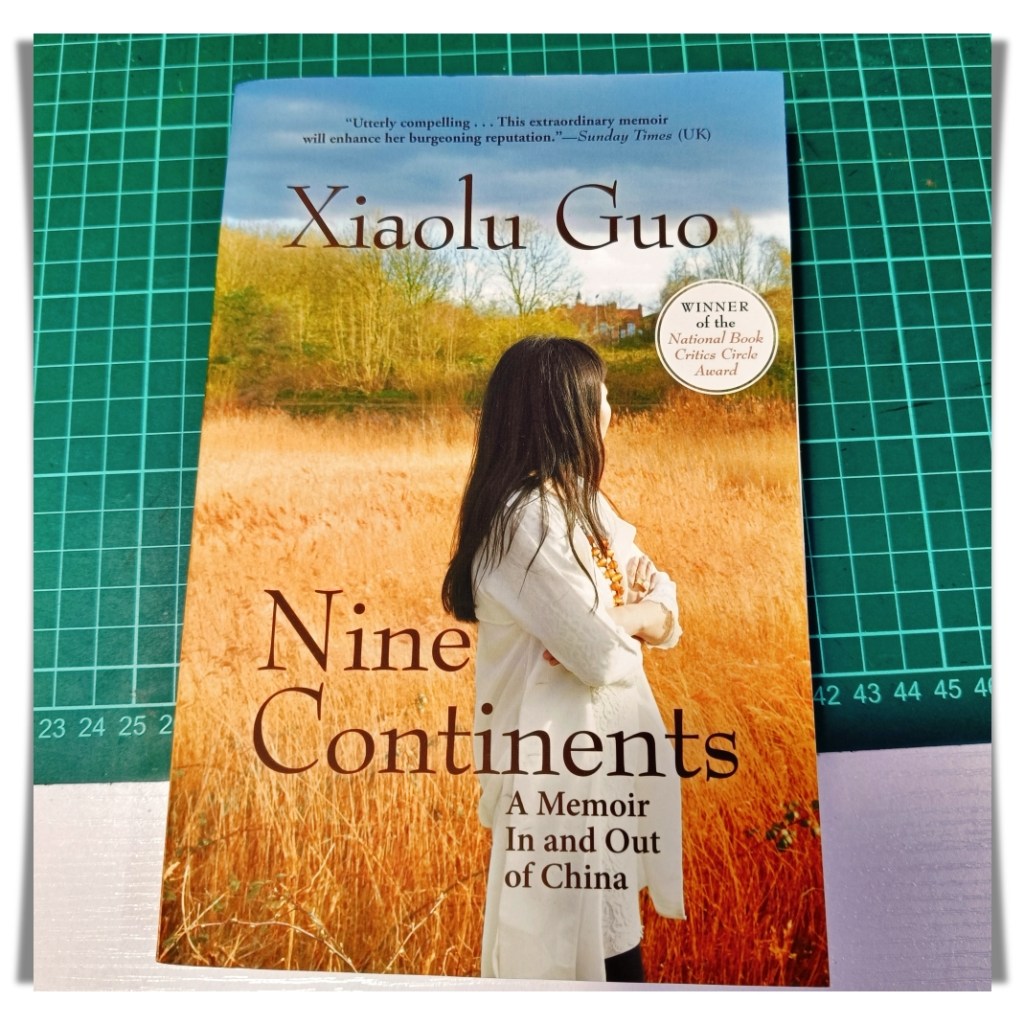
I’ve recently been reading Xiaolu Guo’s Nine Continents: A Memoir In and Out of China. Her exploration of identity, displacement, and cultural heritage resonates deeply with me. Xiaolu often addresses issues of alienation and belonging in her works, and she has become one of my favorite authors. Her writing inspired me to think about my own journey, which led me to write this post.

Our Warrior Culture

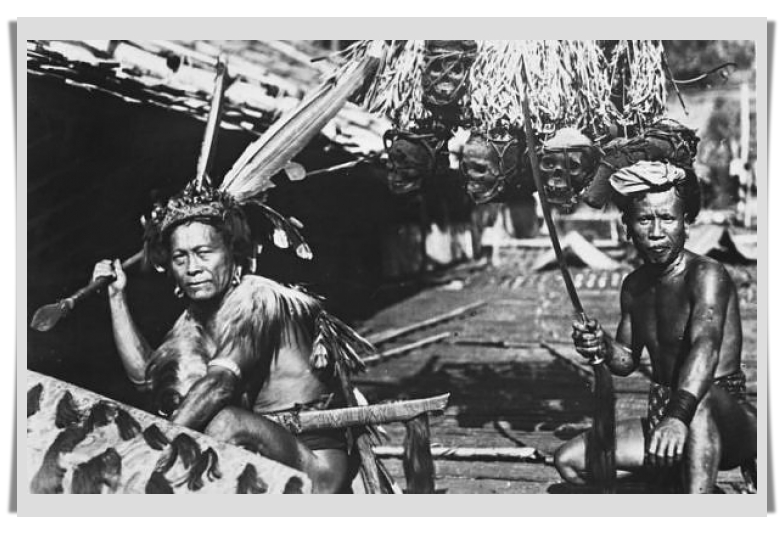
The Iban were famed for their warrior culture, defined by war expeditions and headhunting. It was once an important aspect of our spiritual beliefs and society framework. To be Iban means to be a warrior. Headhunting was not a barbaric pastime, as outsiders may believe. It was a necessary way of life since it signified protection, honor, and a connection to the spirit realm. While the act itself faded into history, the essence of the courage has been passed down through generations.

I often asked myself, “What remains of the warrior spirit?”. Sometimes it feels like a quiet force pushing me forward. In moments of difficulty, I draw on the courageous spirit of my ancestors. Their legacy reminds me that I have the strength to persevere in the face of overwhelming odds. Perhaps it is genetic memory, the invisible link that ties me to my ancestors and passes down the legacy of courage across generations.

The Loss of Tradition

However, bravery alone cannot fill the gaps. Living in urban places like Kuala Lumpur has distanced me from the traditions that constitute my identity. When my extended family embraced Christianity in the 1950s, it marked a shift from animistic beliefs. Urban living also entails replacing the communal life of the longhouse. Many other aspects of our culture are disappearing, such as the extensive oral poetry tradition.

I am caught in a dilemma. On the one hand, I value the opportunities and conveniences of modern living. On the other hand, I mourn the loss of vibrant traditions that shaped our way of life. These losses make me wonder how we can honor the past while embracing the present.

Image source The late Temenggong Koh (left), one of the last Iban warleaders of the 20th century, before headhunting was completely outlawed by the British colony.

The Sense of Alienation

Life in the city often exacerbates this disconnection. Here, I am just a fragment of an Iban: a name that suggests a foreign land, a face that others might find unfamiliar. When people ask where I’m from, my responses may seem inadequate. How can I explain a longhouse? Or, even if I can explain it, how do I dispel their misconception that modern Ibans still live on trees and wear loincloths? How can I explain our different Gawai, or traditional festivals, when they typically only celebrate one or two holidays, like Eid or Lunar New Year? However, in the heart of this alienation, I’ve realized that identity is not static. It is a fluid interplay of past and present, shaped by our decisions and circumstances.

Strength Through Cultural Roots

Nonetheless, I remain connected to my roots. They are not always visible, but they are present. My ancestors’ courage motivates me to face my fears and embrace the unknown. The warrior spirit is not a relic from the past but rather a driving force in my life today.

During difficult times, I found myself returning to the stories of my ancestors. They endured jungles, battles, and scarcity. I remind myself of their tenacity—if they can endure, so can I.

The loud proclamation of success does not equate to strength. Perseverance and the ability to adapt without forgetting are qualities that define strength. The warrior spirit is about enduring in a world that often forces us to forget who we are.

Preserving Tradition

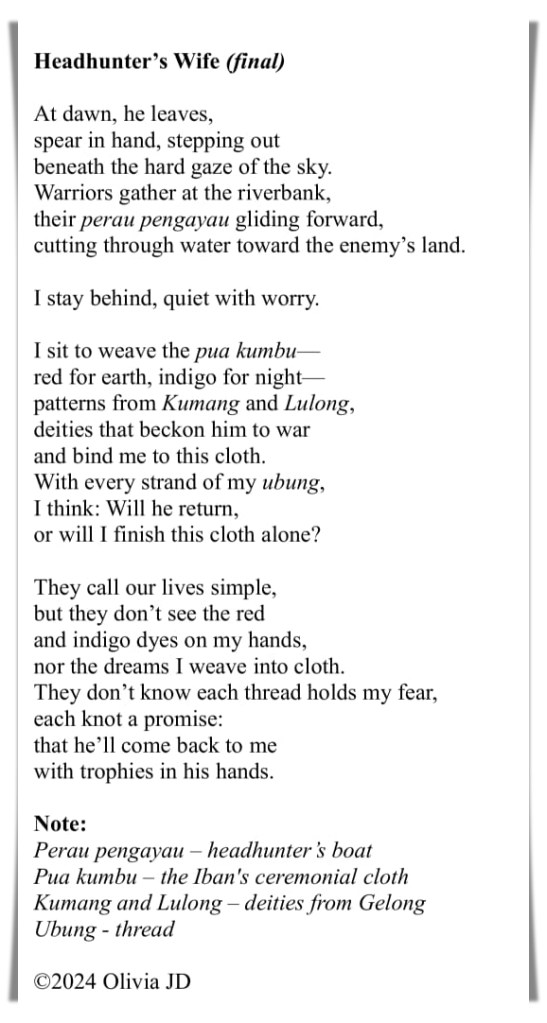
My original poem from Sarawak collection of poetry

Poetry has been one way for me to preserve my culture. Writing has become a means of connecting the past and present, who I was and who I am becoming. It allows me to hold onto what feels like it’s slipping away.

I aspire to one day publish my poems and leave a legacy for my children. When the time comes for them to discover their roots, I hope my words will serve as a guide, helping them understand who they are and where they came from. Writing allows me to keep the stories alive as the world around us changes.

My identity is a patchwork of memories, stories, and dreams. I am neither fully of the past nor fully of the present. But maybe that’s what it means to be Iban today: to walk on a bridge, perpetually caught between two realities.

I am part of something bigger than myself, a heritage of power, fortitude, and endurance. While I may live far away from my people’s homeland, the essence of my heritage lives on, molding my journey and grounding me in a world that is often divided.

I carry the warrior spirit with me because I am descended from people who endured. So I take a step forward, not knowing where the journey will take me, but knowing it is worthwhile. Like the warrior spirit that runs through my blood, this journey is not always easy, but it is always worth it.

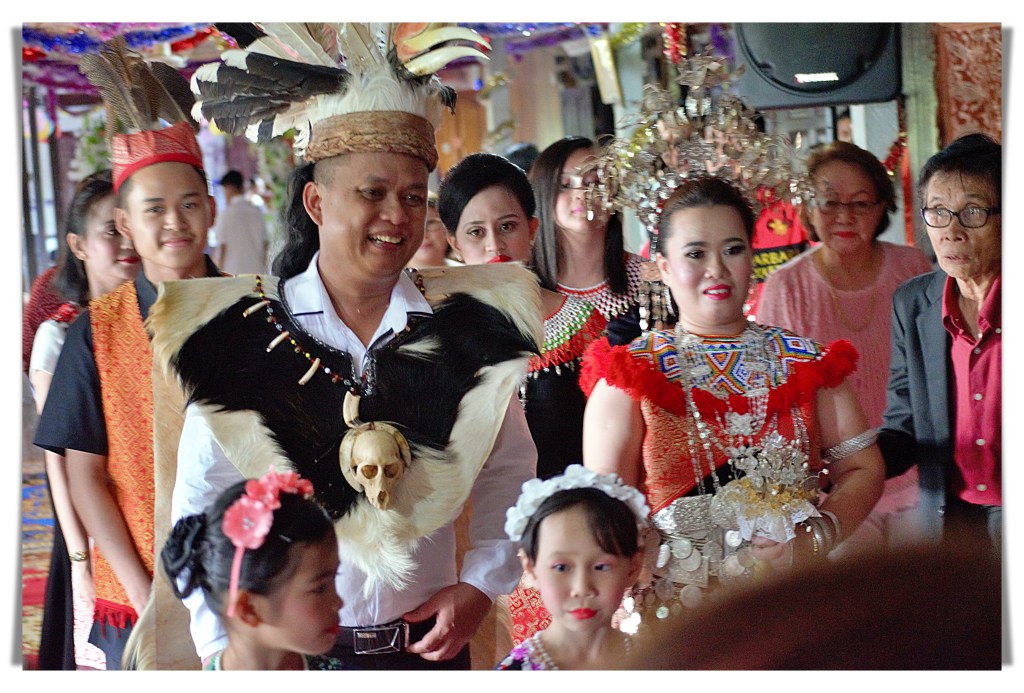
My cousin’s traditional wedding.