My First Group Exhibition in Malaysia and A New Zine in the Making

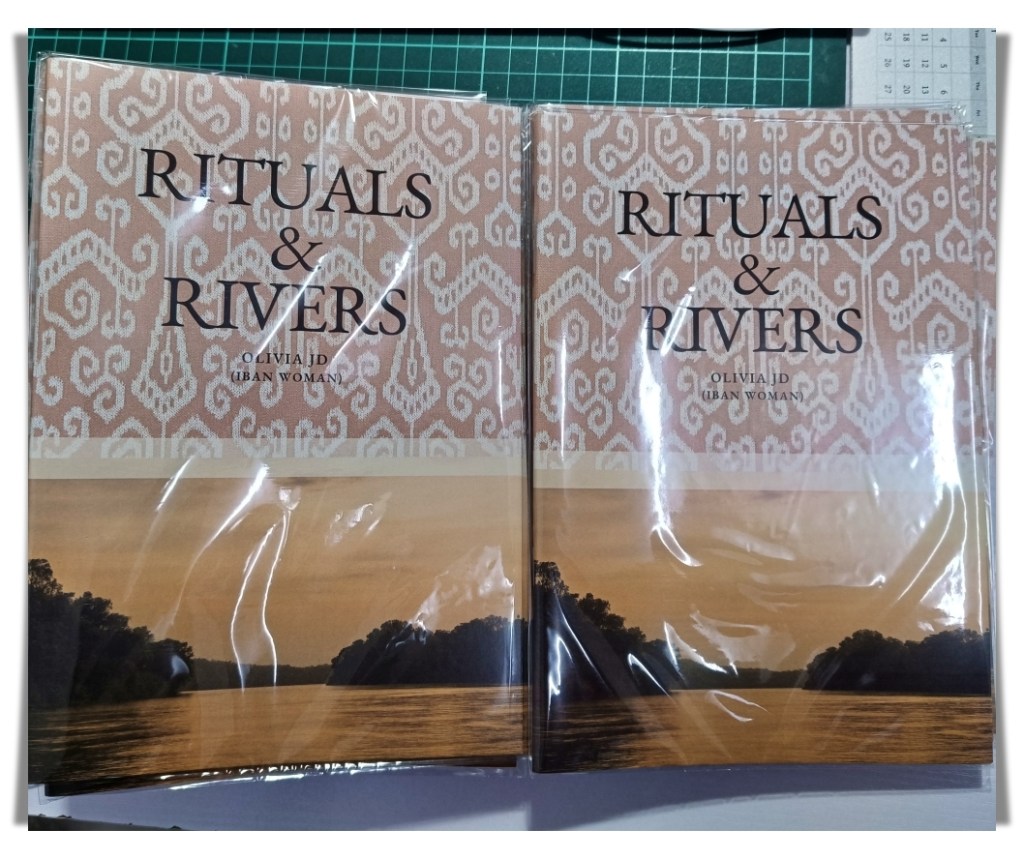
Tomorrow is the soft launch of Akar Kita Abadi, the group exhibition I’ve been preparing for the past few weeks. I will exhibit several of my Iban heritage poems called Rituals and Rivers, and holding these printed booklets, which just arrived, feels like a confirmation of all the time spent writing, editing, and polishing. This little booklet (or zine) has 10 poems from a much bigger collection of Iban heritage poetry that I want to publish in 2026. I will be selling these booklets during the exhibition and they are quite limited in number. I will share more about the exhibition after the launch tomorrow. I can’t share pictures until after the launch so I can’t really say much about the whole thing. The exhibition will last until 23 November so if you’re in Klang Valley, you may want to drop by and give us your support. 
While this exhibition marks the beginning of sharing that collection publicly, another project has started to take root in parallel. I have begun working on a new zine that will focus entirely on Iban women. This project seems like a continuation of Rituals & Rivers, but through a more personal viewpoint. It will look at various facets of Iban womanhood, from ancient times to the present.
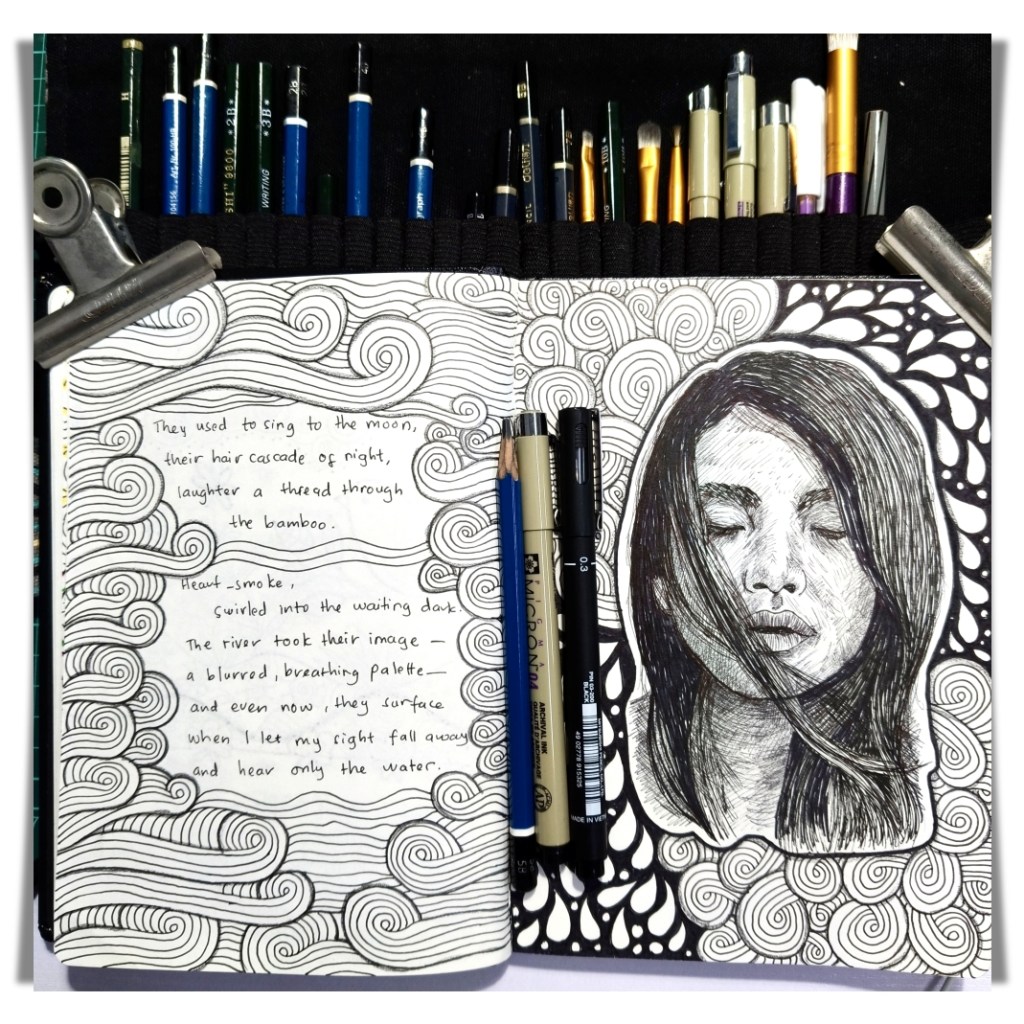
Every page will be hand-drawn using pencil and black fine liners, but for the actual zine they will be edited and printed. Drawing by hand has a grounding effect, allowing each line to have its own rhythm and imperfection. The only printed text will be the longer passages and explanations, saving space while keeping the design balanced. I have not planned the number of pages or illustrations yet. I like to let the process evolve spontaneously. Each piece generally begins as a poem or a brief reflection before taking on a visual shape.
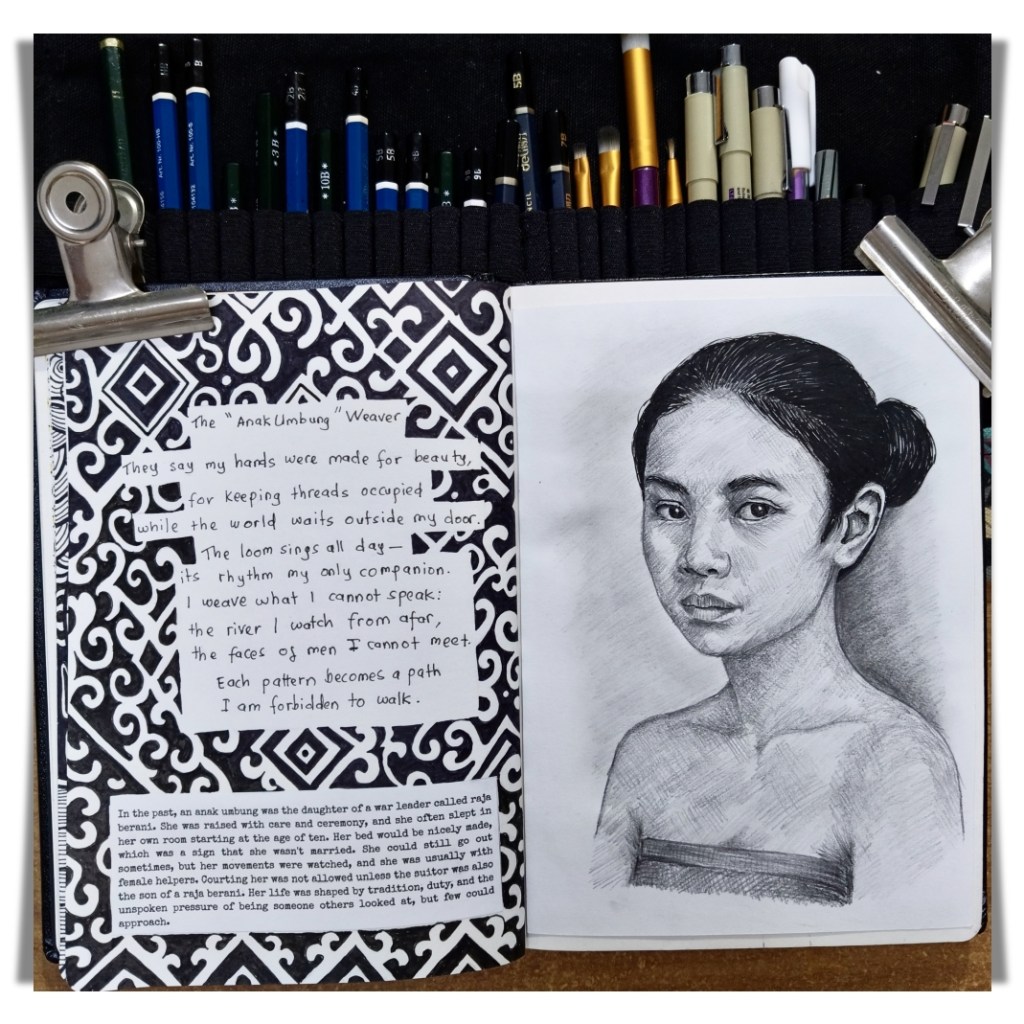
One of the first illustrations is inspired by women who sing to the moon as their laughter threads through the bamboo. Another drawing shows the anak umbung, the daughter of an Iban war leader who was raised apart from others and taught weaving skills. Her story has stayed with me, serving as a reminder of the beauty and self-control that once entwined women’s lives. There is also a drawing of a woman tending to the hearth before dawn. These aren’t big moments; they’re small actions that show tenderness, duty, and strength in Iban women. 
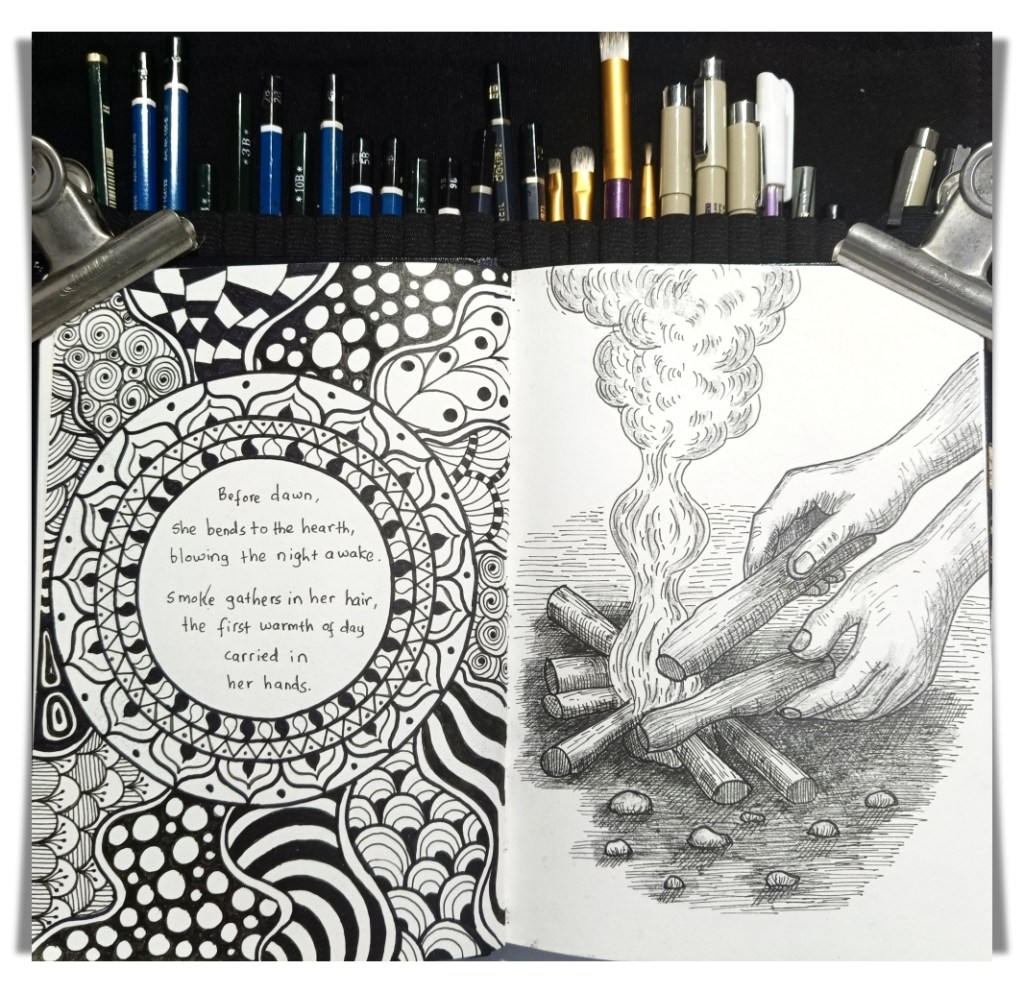
This new zine will be based on the same ideas as Rituals & Rivers, but it will focus more closely on the daily and the personal.  It will explore what it means to be an Iban woman across generations, including the traditions that are passed down, the unspoken resilience, and the actions that connect one life to another. It’s a way for me to listen to the voices of the women who came before me and to honor how their spirit still lives on in us now.

I don’t know what the completed zine will be like, but I know it will develop slowly, page by page, just like stories used to do, with care and patience.


I write about Iban culture, ancestral rituals, creative life, emotional truths, and the quiet transformations of love, motherhood, and identity. If this speaks to you, subscribe and journey with me.
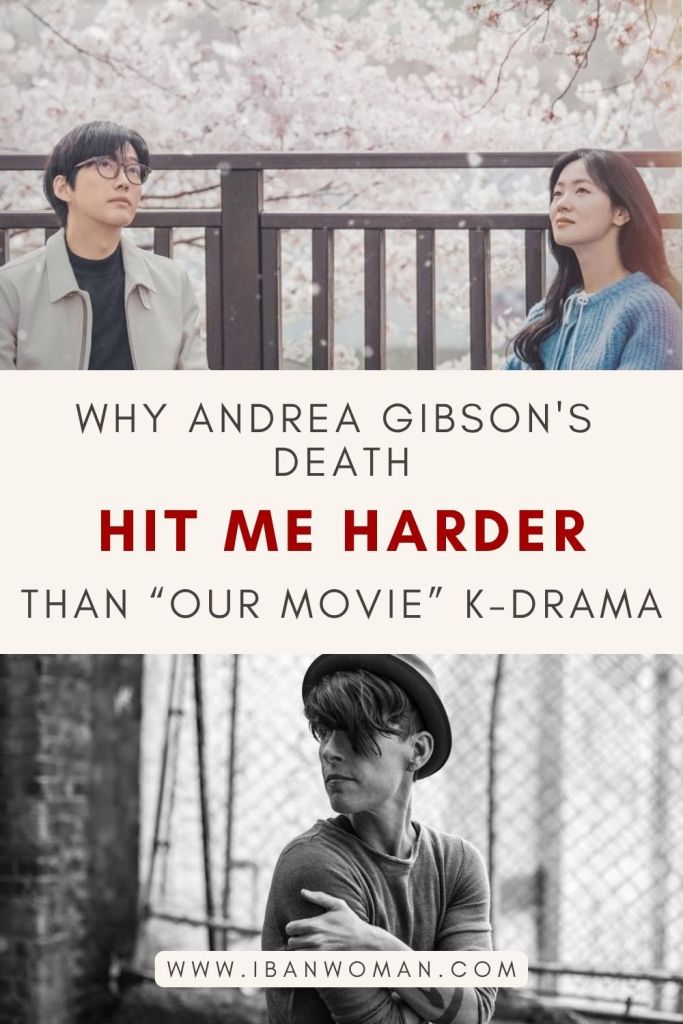
Why Andrea Gibson’s Death Hit Me Harder Than Our Movie K-Drama

This past week was hard because Andrea Gibson died, and I’m still trying to figure out what that means. I never met them, but their death feels strangely personal to me. But if you’ve read Andrea’s poems, you know exactly why. Andrea’s poems aren’t just pretty words but they are pieces of themselves they left behind. They are bloody, honest, and vulnerable.

I also watched Our Movie, a Korean drama about the slow, painful journey of dying and saying goodbye, that same week. The themes of death, memory, and love all fit together, but my response to each couldn’t have been more different.

Our Movie is exceptional. The cinematography is soft and dreamy. The acting is gentle, the soundtrack minimal. Namkoong Min plays Lee Je-ha, a quiet man who watches the woman he loves, Daeum (played by Jeon Yeo-been), die of a rare, incurable disease. She is calm, joyful, and completely at peace with dying. And he is steady, restrained, and almost stoic in the way he grieves. It’s not a bad drama; in fact, many people praise it for the gut-wrenching themes of death, dying, and hope. But for someone like me, who demands emotional rawness, it made me feel underfed.

I know the character choices were intentional. Daeum doesn’t fight her death because she is content and fulfilled. She has lived, loved, and achieved her dreams. She got what she wanted. Je-ha doesn’t break down or scream when he thinks of her. His grief is not outward but you still see it in his eyes and gestures. You see the grief, but you don’t feel it.

And maybe the show makers wanted to show us that some losses are quiet. Some people don’t break when they’re hurting. They simply retreat, bend inwards, and go still. But for me, that restraint made it hard to connect. I was waiting for something to break open. I wanted Je-ha to scream, cry, or do something that would show me how much Daeum meant to him besides memory flashbacks and stares into space. Oh, he did cry but  somehow I couldn’t connect with the way he grieves.

The drama wasn’t wrong. It’s just that I couldn’t connect with it emotionally. And that made me think of Andrea.

Andrea Gibson didn’t whisper about death. They roared and cried on stage. They made you feel uncomfortable because their truths were so intimate. Their words weren’t polished or pretty; they were rough with honesty. Andrea’s poems made you feel seen. And that’s why so many people are mourning their passing.

Andrea wasn’t afraid of being vulnerable and real. They weren’t afraid of naming the pain, sitting with it, and saying, “You’re not alone in this mess because I’m here too.”

And maybe that’s why their death feels more real than a fictional one. Andrea was there for us in the kind of grief that makes you feel like your heart is breaking and your voice is shaking, and it reminds you that this life is fragile, but it’s also worth feeling everything for.

I realized this week that I don’t just want beauty in art. I want pain and emotional bruises. I want to feel the grief and not just admire it from a safe distance. And I’m not ashamed of that anymore.

It’s not selfish to want art that speaks your emotional language. Our Movie was very well made but I think it’s okay to say that it didn’t satisfy me on the level that I had hoped for. The way I live—intensely, with longing, and an endless desire for truth—shapes my expectations. So when something falls short of that, I notice. And I’ve learned to be honest about it.

Maybe that’s the reflection for this week. This is not a review or critique. It’s just a simple truth that some stories observe grief and others enter it with you. And this week, Andrea Gibson reminded me that I will always need the latter.

I’m grateful for the reminder. And I hope that when my time comes, I’ve written even a little bit as honestly as Andrea did.

Rest gently, Andrea. And thank you for the gift of your words.

I leave this excerpt from Andrea’s poem, Love Letter From the Afterlife. You can read the complete poem on their Substack. Mind you, the imagery in this poem is breathtaking. 

“My love, I was so wrong. Dying is the opposite of leaving. When I left my body, I did not go away. That portal of light was not a portal to elsewhere, but a portal to here. I am more here than I ever was before. I am more with you than I ever could have imagined.”

And this poem, When Death Comes to Visit was written by Andrea years ago and released posthumously by their wife, Meg, today (25 July 2025).

© 2025 Olivia JD


Olivia Atelier offers printables, templates, and art designed to inspire reflection, healing, and creativity. Visit Olivia’s Atelier for more.

The Other Me | The Woman Behind the Poem

When I wrote the poem “The Other Me,” I wasn’t trying to sound bold or dramatic. I was just being honest by telling my truth. 

People often assume they know me. They see a woman who is quiet. A wife. A mom. A Christian. Someone who shows up, serves, nods politely, and doesn’t cause trouble or controversy. I’m familiar with this image because I’ve lived inside it for most of my adult life. It’s not that it’s wrong. It’s just incomplete.

There has always been a deeper current under the surface. Beneath all that facade of neatness, there is someone who asks harder questions or feels hurt when silenced. There is someone that remembers who I was before all the roles and expectations started to pile up on me.

“The Other Me” is not a fictional character. She is a real person who has always been by my side. I put her away, hidden, so that I could make room for acceptance, safety, and community. In religious communities, women are often praised for being quiet, gentle, and obedient. Where doubt must be neatly dressed in submission, and discomfort is treated like rebellion.

The poem came from the grief of hiding and of living a half-truth because the whole truth felt like too much.

I was taught to be agreeable as a child or to be well-liked. I learned that being difficult was the same as being rejected. That if you had questions, you lacked faith. That wanting more, like more closeness, more freedom, and more honesty, was wrong or selfish.

So I stayed small. I stayed quiet. I played the role so well I almost forgot I was acting. But staying quiet has a price.

When you’re around people who only know the version of you that makes them comfortable, a certain kind of loneliness grows. They love that safe version of you and they honor her because she embodies the values they approved. But you start to wonder if they would still love you if you said something out of character. What if I stopped editing myself for the sake of their comfort? What if I let the fire show?

And then one day you write a poem.

You write it because you have things you want to say but can’t. Your body remembers what your mind tries to bury. Because there is a woman inside you who is sick of bending over backwards to meet other people’s expectations.

You don’t even know if you’ll share it when you write it. But that is beside the point because the truth is you need to see this woman and say to her, “I haven’t forgotten you.”

“The Other Me” is about the version of myself that doesn’t fit into polite spaces. She is the one who laughs too loudly, writes about God and desire in the same line, and asks questions about things she was told not to touch. She loves deeply but won’t let anyone else control her.

In the past, I was scared of her.

But now I know she isn’t a threat. She isn’t being defiant just to be dramatic. She is just being honest. She is the version of me that lived and survived. And I owe her more than just silence.

When I say I feel alone sometimes, I mean it in a specific way. I don’t mean that I don’t have anyone around me. What I mean is that I don’t have a place that feels like home and where I belong. I don’t quite fit in with the local creative community, where the type of poetry that gets attention is usually light, easy to read, and trendy. I write differently. I write deeply. And sometimes, that depth becomes a wall between me and the world I want to reach. 

At the same time, the people who connect with my work often live far away. They have different cultures, different worldviews. We connect through words, but we live in different worlds. That, too, feels like a dislocation.

But still, I write.

Because this is how I heal, and this is how I remember. This is how I get back the parts of myself that I’ve tried to hide for a long time.

The Other Me is not a rebellion. It is a way for me to return to the version of me that I’ve neglected.

And maybe, just maybe, if I keep writing her into existence, someone else out there who also feels out of place, half-formed, and unseen, will recognize themselves in my words. And that recognition will feel like belonging.

We might not need to fit in to be complete. Maybe we just need to be honest.

And that is what this poem gave me. A little more honesty. A little more light. A little more room to breathe.

And to the version of me that is still hiding: I see you. We’re coming home.

Note: This poem is not published yet, but you can read a short excerpt on my Threads post.


Olivia Atelier offers printables, templates, and art designed to inspire reflection, healing, and creativity. Visit Olivia’s Atelier for more.

After Andrea | A Tribute to Andrea Gibson

Image source

When Andrea Gibson left this world, they didn’t vanish. They simply changed form.

That’s what I believe. What I’ve always believed. That death isn’t the end but a transformation. It’s a reassembly of light, soul, and memory. It becomes energy that lingers in the folds of pillows, in dog-eared pages, in the sound of your laughter.

Andrea said it best in one of their final gifts to the world: “Dying is the opposite of leaving. When I left my body, I did not go away.”

I read those words with a lump in my throat, but not because I was grieving. They reminded me of something I wrote months ago, not knowing then how it would one day connect me to someone I admired from afar.

So when we grieve for an unbearable loss and feel the crushing weight of absence, perhaps we can take comfort in knowing that nothing is ever truly gone.

The ones we miss exist in a different form now. They are scattered across the cosmos, carried in rays of sunshine, drifting in the gentle breeze. The photons that once danced across their skin continue their journey through space. Their laughter still lingers around us, waiting to be felt by those who remember.

If we explain death by physics alone, the conservation of energy means that when we die, our energy disperses into heat, into the environment, and into the people we loved. ~ Excerpt from my blog: The Physics of Goodbye

Andrea’s poems weren’t just poems; they were silent revolts against erasure and the lie that pain and beauty must live apart.

And maybe that’s what we leave behind: words and permission. Especially permission. Permission to grief and cry. To be angry. To acknowledge love out loud. To die beautifully. To stay, even after.

After Andrea 

I want to call you by the sound your bones made when they fell into the light. I want to call you return instead of loss, to pin your spirit to my wall like the last goodnight of a sunbeam. You are not gone. You are still here. You are a new verb. You breathe through my ribcage at midnight when I forget my name and remember yours. Your echoes make me who I am. You are the ghost of the lamp turning on by itself, the sudden music when no one’s home. What trick of physics lets a soul remain when the body collapses? What cruel grace? Andrea, I never touched your hands, but I have held your sorrow, your laughter, your thunder, your holy queerness. I carry it now. In me, and in everyone who heard your voice before they knew you. Thank you for the light. Thank you for the absence that still feels full. Thank you for dying like a poet; all metaphor, without end.

© 2025 Olivia JD


Olivia Atelier offers printables, templates, and art designed to inspire reflection, healing, and creativity. Visit Olivia’s Atelier for more.

The Hour After Midnight | Why I Stayed Awake When I Should’ve Slept

For years, I stayed up too late.

It wasn’t because I was working or I had boundless energy or I was busy chasing my dreams. The main reason was that I needed to feel like a person.

It didn’t start as revenge bedtime procrastination. That phrase only found me later, when I stumbled across an article that put a name to my nightly rebellion. It felt like intense desperation. You could say it was a craving or a desperate fight for space.

When my children were small, the days blended together in a mist of needs. I remember those years vividly and if I’m honest, it makes me shudder, but not because I feel ashamed. My daily life was full of milk-stained shirts, sticky fingers, and toys scattered like confetti across every surface. I loved my kids fiercely. Still do. But in those days, I didn’t know where I ended and they began. I gave them my body, my attention, and everything. And somewhere in that giving, I began to disappear.

When the kids were finally asleep and when the house finally went quiet, and the dishes were done, I sat down. Just for a moment, just to breathe.

And that moment stretched beyond what I intended. I stayed up. Scrolling. Reading. Writing. Wandering through Facebook memories of the woman I used to be. Buying time I couldn’t afford, just to feel like I still existed.

I’d tell myself, “Just one more post. One more chapter. One more scroll.”

But truthfully? I was afraid that if I slept, I’d wake up and do it all over again. The endless giving, pouring out myself and forgetting.

So I kept stealing those hours after midnight.

And in the morning, of course, I paid the price.

I was more irritable. More short-tempered. More ashamed of the mother I was becoming.

The irony was painful: I stayed up to save myself, but it only made me more fragile the next day.

I never told anyone how much I resented the way my life had shrunk. How much I missed myself and how ashamed I felt for even feeling that way.

That was the case until I began writing about it.

That’s how The Hour After Midnight came to life. It began as fragments and eventually evolved into a complete poem. A piece of me, speaking directly to the woman I used to be. Perhaps I still am that woman, but these days I go to bed at 12 AM or earlier. As the kids grow, I enjoy my sleep more, and the resentment has disappeared.

This poem is about a mother who gives her all and suffers in silence. It’s about a woman who craves stillness to survive her crazy life of constant giving. She was just a tired soul who wanted to feel seen.

If that sounds like you, I hope this poem wraps around you like a quiet hug. It’s more than a printable; it’s a recognition and a mirror. A gentle piece of emotional support for any overstimulated mom who needs a reminder to be kind to your mind.

This digital poem makes a thoughtful and unique Mother’s Day gift, especially for the tired mom who needs to hear she’s still enough. It’s a beautiful affirmation of motherhood for those navigating revenge bedtime procrastination, mom life burnout, and those quiet moments where you whisper, “I am enough.”

Find The Hour After Midnight in my shop Olivia’s Atelier. You’ll receive a high-resolution poem print in multiple sizes, ready to frame or gift. I hope it brings you what it brought me—a pause, a breath, a beginning.

Note: Yes, I launched my Etsy shop recently to share my poems with the world. Right now, everything in the shop is 50% off until June 2, including our featured Mother’s Day Poem Printables. They are designed as heartfelt gifts or tender self-reminders to moms everywhere. Feel free to check it out.

Evaporating No More

I never want to visit a place where I have to shrink to be accepted, loved, or tolerated. In this place, softness is seen as a warning sign, silence is misconstrued for compliance, and each mouthful feels like restraint.

I used to be there. It wasn’t a city with a name, but in living rooms where truth was unwelcome, in church pews filled with shame, in beds where I learned to sleep with absence and call it comfort.

Sometimes the cruelest places aren’t found on any map but rather built slowly by unspoken words, frozen stares, and the way someone you love says, “don’t make it a big deal” when your soul is tearing at the seams.

I never want to visit a place that demands me to chop myself into pieces to fit their platter.

I’d rather walk naked through misunderstanding than hide behind lies for others’ comfort.

Give me the wilderness—raw, shivering, and divine. In locations where no one speaks my language but still listens, where stray cats welcome me, and even the wind doesn’t ask for explanations.

I’ve spent too long evaporating, like breath against cold glass.

Never again.

Not for love.

Not for survival.

Not even for home.

The Color Called Olivia

Daily writing prompt
If you could have something named after you, what would it be?

If something carried my name, it would not be a star, a street, or a species of bird. No, I believe it would be more intimate. I’m not always sure how to define myself. Sometimes I feel like a color. It is not a solid color you find in stores or on paint charts. It’s a blend of several shades at once. It burns slowly before softening into something else.

This poem is the first piece of a new series of poetry, stories, and art called Color Studies: Olivia. It’s a way for me to trace the shape of who I am through emotion, memory, and metaphor. This first piece is the closest I’ve come to naming the in-between shade I carry in my heart.


The Color Called Olivia

There’s a shade I carry
that no one’s ever named.
Not even the sky has a word for it.
It comes after the burn,
before the skin peels.
It’s not plum. Not violet.
It happens after violet,
when the bruise turns philosophical.

I wear it like breath—
soft, unnoticed, until it’s gone.
I’ve been called gentle.
But they don’t see
how my gentleness and sorrow
are barbed wire wrapped in silk.

My laugh has layers
echoing through my ribs.
They hear it—
but not the hush
that comes before.

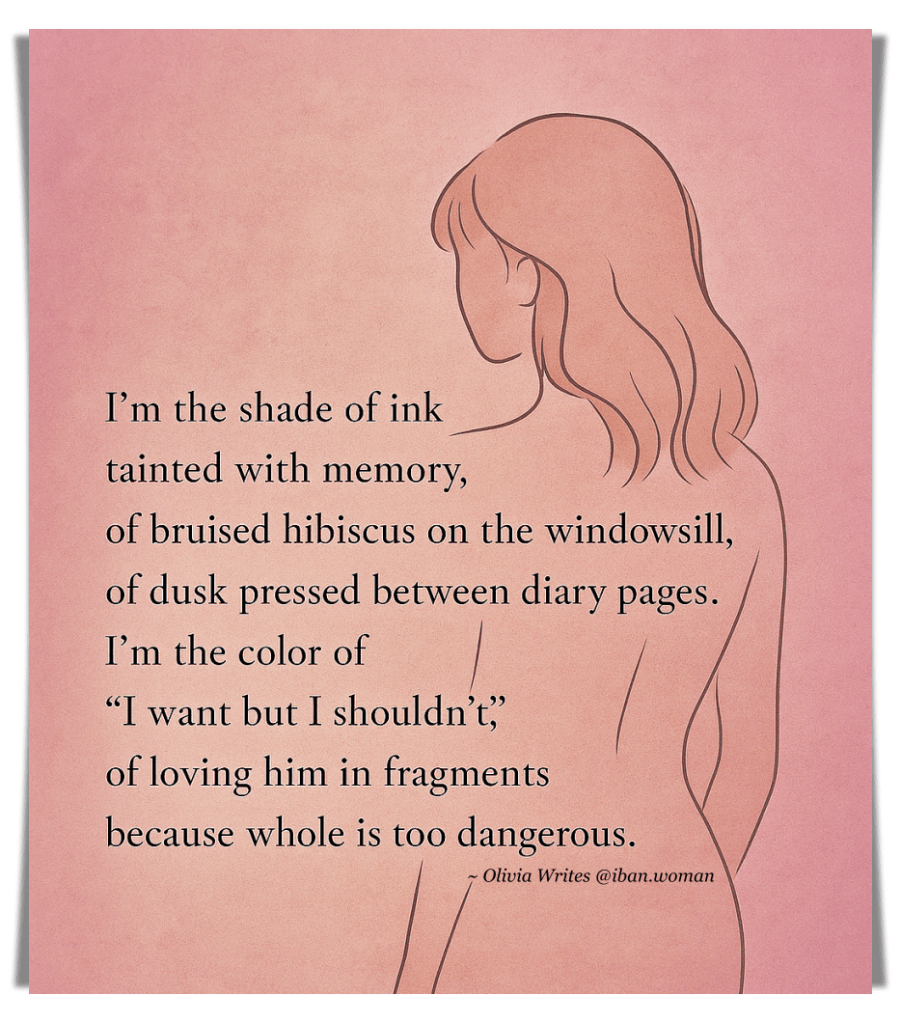
I’m the shade of ink
tainted with memory,
of bruised hibiscus on the windowsill,
of dusk pressed between diary pages.
I’m the color of
“I want but I shouldn’t,”
of loving him in fragments
because whole is too dangerous.

They’ll never sell me in stores.
Bottle me up. Claim me.
I’m the color of dusk
over a foreign city,
where no one knows my name.
I could be anyone.
I could be no one.


I’ve always felt as if I exist in between what I desire and what I allow myself to have. Writing this helped me identify that feeling, not with a label, but with a color. I don’t think any of us consist of “solid colors.” We are many things: bruises, washes, and layers. I’m slowly discovering what shades I am, and this is the first one.

If you were a color, what would it be? Or what color do you become when someone sees you?

Copyright © Olivia JD 2025
All Rights Reserved.

The Way I Laugh

Daily writing prompt
What makes you laugh?

Some people can make you laugh without even trying. It’s not a loud or showy laugh, but the type of laugh that catches you off guard.

This is a mini story about that kind of laughter and a poem I wrote to accompany this story.


Image source

It started with the way he looked at the tea I made.

“You put mushrooms in this?” he asked, peering into the mug. 

I fought a smile. “It’s reishi. It’s good for your liver. Just drink it.”

He leaned in and sniffed, suspicion all over his face. “It smells like regret.”

That got a laugh out of me. “Don’t be such a baby.”

He narrowed his eyes, took a dramatic sip, and instantly recoiled. “Are you trying to kill me? Admit it. This is revenge for the pen.”

“You stole it,” I said.

“I borrowed it indefinitely.”

He drank another sip, dramatically clutching his chest. “If I die from this, please delete my browser history.”

I burst out laughing again.

He looked pleased with himself. 

I tried to change the subject, flipping through a magazine on the table. He leaned over, peering at a photo of a hairless cat. 

“Is that a testicle with whiskers?”

I almost choked on my tea.

“That’s it. Get out of my apartment.” I was still laughing.

He held up his hands. “I’ll go. But only if you admit that laugh means you’re secretly in love with me.”

I threw a cushion at him. He caught it midair and hugged it to his chest. “Even your cushion loves me.”

“You’re so full of yourself.”

He wandered over to my bookshelf, checking the titles. “Didn’t peg you for a Murakami girl.”

“Didn’t peg you for someone who uses the word ‘peg.’”

He smirked. “Careful. You’re laughing again.”

And I was.

Later, when the conversation slowed, we sat on the couch. I didn’t want him to leave. Not just yet. He retrieved a pen from my desk and held it in front of him. 

“This one yours too?”

“Maybe.”

“Should I take it? Just in case I need another reason to come back.”

He didn’t need a reason.

But I let him have it anyway.


I Gave You Tea

I gave you tea
for healing.
You drank it.
Your fingers brushed mine
when I handed you the cup,
and neither of us flinched.

You made a face,
said it tasted like regret.

I laughed.
And laughed again.

See, love—
I don’t laugh easily,
like something that escapes
from deep inside,
and betrays the body.

I gave you bad tea.
And you
say things that unmake me
in all the right places.

Copyright © Olivia JD 2025
All Rights Reserved.

The Loneliness That Lives Inside Love

Daily writing prompt
What’s something most people don’t understand?

Image source

Most people don’t understand that you can love someone deeply, share a life with them, raise children together, sleep side by side every night—and still feel alone.

You still feel alone—not because they don’t love you or they don’t try. It’s because they can’t meet some of your deepest needs. Again, this is not because they’re unwilling or are dense but because that’s not how they’re built. That’s not who they are. You can’t force people to be what they are not. 

This post is not meant to bash my husband.

My husband and I had been together for 26 years. That’s a long time to share a life. Throughout our marriage, he carries many burdens. He works hard and often under tremendous pressure. He provides and makes sure we have what we need. The kids and I never lack anything and I see that and never take it for granted. Every time he comes home from work, no matter how exhausted he is, he still smiles and gives me a warm hug. When the kids were little, they would race to the door to greet him. And sometimes they still do, even as teenagers. I know what that kind of weight does to a person—the pressure of being the provider and the silent burden of responsibility.

But I carry a lot of weight too. And most of them are invisible. It’s emotional and mental load. The labor of noticing, of anticipating needs, of asking questions to diffuse stress, soothing tensions, bridging gaps.

People rarely see that part. They think that if a marriage lasts, it must be balanced. But many don’t realize that love doesn’t always mean symmetry. 

My husband is a sweet, sweet man. He is not cruel or careless. He simply wasn’t taught how to sit inside discomfort and witness pain without attempting to fix or fleeing from it. He tries in his own way by cracking awkward jokes, physical closeness, showing up with food or spoiling me rotten. And I’ve learned, over the years, to see the love in those things.

But I must be honest and as a writer, confronting my deepest truth is necessary. I want more than physical efforts or gestures. I want to be seen and not just supported. I want conversations that delve deep and not just coexistence. I want someone to meet me at the door of my inner world and not be afraid to come in. 

Am I being bitter and writing all these down under the cloak of anonymity? Certainly not. We discussed this many times and he’s admitted he can’t meet me there because he is who he is and not built that way. And I acknowledge and accept him as who he truly is. And with acceptance, there is peace. Because I know I haven’t met all of his needs either. Marriage always goes both ways.

Most people don’t understand that kind of grief. It’s the grief that comes with loving someone who can’t meet you where you are. It’s bittersweet and lonely. That loneliness doesn’t scream—it’s just there, aches, and lingers.

But even within that grief, there is love. There’s kindness, history, forgiveness, effort, sacrifice, and acceptance of all that is good and bad. I love him so much. We are trying. Maybe not always in the same way, but still—we try each and every day. 

We both carry weight. His is visible, important, and perhaps measurable in the eyes of the world. Mine is not. And that’s what most people don’t understand. 


I wrote this poem to accompany this post. Here you go:

Marriage

I fold the laundry—
his shirts, inside out,
boxers with holes,
T-shirts over-stretched,
but we wear them anyway—
like this marriage—
flawed, warm in its own weather.

My mind jumbled with lists—
he doesn’t see them.

He brings home groceries
but forgets the eggs.
The kale is yellowing on the edges.
When good mood returns
he touches my hip like a question,
but never waits for the answer.

Still, he comes home.

Every night,
hanging his silence next to mine.
We sit.
We eat.
Scroll through our newsfeed.

I carry the emotional X-rays,
the careful calibration of my moods
to his weather.

But he carries things too—
numbers, bills,
the fear of shame
of not being the man
his father never taught him to be.

We are not broken,
only bruised by expectation.

And still,
he holds the child when I break,
warms the bed before I slip in.
Calls me “babe”.
In return,
I still reach for his length
to soothe myself to sleep.

So no—
I don’t need rescue.
This is the truthful
opening of the hearts
of two people
carrying what they can.

He lifts the roof.
I hold the floor.

And in the middle,
we meet.

Copyright © Olivia JD 2025
All Rights Reserved.

You are welcome to subscribe to my blog if my words resonate with you. Thank you.

Reflection | A Rebellion Beneath My Breasts

Daily writing prompt
How often do you say “no” to things that would interfere with your goals?

Image source

I don’t usually say “no” out loud. Not like people imagine—with steely resolve or loud announcements.

But I speak quietly—in small decisions, in between invitations, or when I left several trivial texts unanswered.

When I moved to Taipei two decades ago (for work), I didn’t have a set list of goals. I arrived with curiosity and a bag full of lonely ambition. The first several months felt like a jumble of polite conversations and an endless stream of data on spreadsheets. I attended dinners with coworkers because I had to, not because I wanted to. I replied yes because of responsibility but no in my heart.

However, I gradually began to make other choices.

I stopped wasting my evenings with pointless nonsense. I found cafes with fogged-up windows and dim lighting where I could write. I stopped accepting weekend plans simply to avoid being alone. I began declining activities that diverted my attention away from what was important: reflection, art, and authentic experiences.

Some people express “no” by closing doors. I say it while slowly walking in the opposite direction.

I may not always know where I’m heading, but I do know what I’m no longer willing to participate in. That’s a start.

These days, my “no” does not imply rejection. It’s a diversion or a simple acknowledgment of the space I require to breathe, create, and exist.

I recall the moment I nodded and allowed him to sit across from me in that café. It was hardly anything. However, it was pregnant with meaning.

I had always said no to strangers, spontaneous encounters, and anything that threatened the careful solitude I had built around myself like armor. But that day, I didn’t.

I didn’t say “yes” aloud. I simply didn’t say “no”.

And sometimes, that’s okay.


Quiet Nod

It wasn’t a yes.
Just a twitch in my neck
and a rebellion beneath my breasts—
a dare whispered to the
soft animal of my body:
Stay.

You dragged the chair
and stirred something feral
I’d buried beneath work
and loneliness.

You sat and
asked nothing.
Still, I answered
by not running.

And maybe that’s how it starts—
without longing,
but with the smallest betrayal
of your own solitude.

Maybe the truest ‘no’ is the one we say to fear—so that something else can finally answer yes.

Copyright © Olivia JD 2025
All Rights Reserved.