The Other Me | The Woman Behind the Poem

When I wrote the poem “The Other Me,” I wasn’t trying to sound bold or dramatic. I was just being honest by telling my truth. 

People often assume they know me. They see a woman who is quiet. A wife. A mom. A Christian. Someone who shows up, serves, nods politely, and doesn’t cause trouble or controversy. I’m familiar with this image because I’ve lived inside it for most of my adult life. It’s not that it’s wrong. It’s just incomplete.

There has always been a deeper current under the surface. Beneath all that facade of neatness, there is someone who asks harder questions or feels hurt when silenced. There is someone that remembers who I was before all the roles and expectations started to pile up on me.

“The Other Me” is not a fictional character. She is a real person who has always been by my side. I put her away, hidden, so that I could make room for acceptance, safety, and community. In religious communities, women are often praised for being quiet, gentle, and obedient. Where doubt must be neatly dressed in submission, and discomfort is treated like rebellion.

The poem came from the grief of hiding and of living a half-truth because the whole truth felt like too much.

I was taught to be agreeable as a child or to be well-liked. I learned that being difficult was the same as being rejected. That if you had questions, you lacked faith. That wanting more, like more closeness, more freedom, and more honesty, was wrong or selfish.

So I stayed small. I stayed quiet. I played the role so well I almost forgot I was acting. But staying quiet has a price.

When you’re around people who only know the version of you that makes them comfortable, a certain kind of loneliness grows. They love that safe version of you and they honor her because she embodies the values they approved. But you start to wonder if they would still love you if you said something out of character. What if I stopped editing myself for the sake of their comfort? What if I let the fire show?

And then one day you write a poem.

You write it because you have things you want to say but can’t. Your body remembers what your mind tries to bury. Because there is a woman inside you who is sick of bending over backwards to meet other people’s expectations.

You don’t even know if you’ll share it when you write it. But that is beside the point because the truth is you need to see this woman and say to her, “I haven’t forgotten you.”

“The Other Me” is about the version of myself that doesn’t fit into polite spaces. She is the one who laughs too loudly, writes about God and desire in the same line, and asks questions about things she was told not to touch. She loves deeply but won’t let anyone else control her.

In the past, I was scared of her.

But now I know she isn’t a threat. She isn’t being defiant just to be dramatic. She is just being honest. She is the version of me that lived and survived. And I owe her more than just silence.

When I say I feel alone sometimes, I mean it in a specific way. I don’t mean that I don’t have anyone around me. What I mean is that I don’t have a place that feels like home and where I belong. I don’t quite fit in with the local creative community, where the type of poetry that gets attention is usually light, easy to read, and trendy. I write differently. I write deeply. And sometimes, that depth becomes a wall between me and the world I want to reach. 

At the same time, the people who connect with my work often live far away. They have different cultures, different worldviews. We connect through words, but we live in different worlds. That, too, feels like a dislocation.

But still, I write.

Because this is how I heal, and this is how I remember. This is how I get back the parts of myself that I’ve tried to hide for a long time.

The Other Me is not a rebellion. It is a way for me to return to the version of me that I’ve neglected.

And maybe, just maybe, if I keep writing her into existence, someone else out there who also feels out of place, half-formed, and unseen, will recognize themselves in my words. And that recognition will feel like belonging.

We might not need to fit in to be complete. Maybe we just need to be honest.

And that is what this poem gave me. A little more honesty. A little more light. A little more room to breathe.

And to the version of me that is still hiding: I see you. We’re coming home.

Note: This poem is not published yet, but you can read a short excerpt on my Threads post.


Olivia Atelier offers printables, templates, and art designed to inspire reflection, healing, and creativity. Visit Olivia’s Atelier for more.
The Hour After Midnight | Why I Stayed Awake When I Should’ve Slept

For years, I stayed up too late.

It wasn’t because I was working or I had boundless energy or I was busy chasing my dreams. The main reason was that I needed to feel like a person.

It didn’t start as revenge bedtime procrastination. That phrase only found me later, when I stumbled across an article that put a name to my nightly rebellion. It felt like intense desperation. You could say it was a craving or a desperate fight for space.

When my children were small, the days blended together in a mist of needs. I remember those years vividly and if I’m honest, it makes me shudder, but not because I feel ashamed. My daily life was full of milk-stained shirts, sticky fingers, and toys scattered like confetti across every surface. I loved my kids fiercely. Still do. But in those days, I didn’t know where I ended and they began. I gave them my body, my attention, and everything. And somewhere in that giving, I began to disappear.

When the kids were finally asleep and when the house finally went quiet, and the dishes were done, I sat down. Just for a moment, just to breathe.

And that moment stretched beyond what I intended. I stayed up. Scrolling. Reading. Writing. Wandering through Facebook memories of the woman I used to be. Buying time I couldn’t afford, just to feel like I still existed.

I’d tell myself, “Just one more post. One more chapter. One more scroll.”

But truthfully? I was afraid that if I slept, I’d wake up and do it all over again. The endless giving, pouring out myself and forgetting.

So I kept stealing those hours after midnight.

And in the morning, of course, I paid the price.

I was more irritable. More short-tempered. More ashamed of the mother I was becoming.

The irony was painful: I stayed up to save myself, but it only made me more fragile the next day.

I never told anyone how much I resented the way my life had shrunk. How much I missed myself and how ashamed I felt for even feeling that way.

That was the case until I began writing about it.

That’s how The Hour After Midnight came to life. It began as fragments and eventually evolved into a complete poem. A piece of me, speaking directly to the woman I used to be. Perhaps I still am that woman, but these days I go to bed at 12 AM or earlier. As the kids grow, I enjoy my sleep more, and the resentment has disappeared.

This poem is about a mother who gives her all and suffers in silence. It’s about a woman who craves stillness to survive her crazy life of constant giving. She was just a tired soul who wanted to feel seen.

If that sounds like you, I hope this poem wraps around you like a quiet hug. It’s more than a printable; it’s a recognition and a mirror. A gentle piece of emotional support for any overstimulated mom who needs a reminder to be kind to your mind.

This digital poem makes a thoughtful and unique Mother’s Day gift, especially for the tired mom who needs to hear she’s still enough. It’s a beautiful affirmation of motherhood for those navigating revenge bedtime procrastination, mom life burnout, and those quiet moments where you whisper, “I am enough.”

Find The Hour After Midnight in my shop Olivia’s Atelier. You’ll receive a high-resolution poem print in multiple sizes, ready to frame or gift. I hope it brings you what it brought me—a pause, a breath, a beginning.

Note: Yes, I launched my Etsy shop recently to share my poems with the world. Right now, everything in the shop is 50% off until June 2, including our featured Mother’s Day Poem Printables. They are designed as heartfelt gifts or tender self-reminders to moms everywhere. Feel free to check it out.

Reflection | A Rebellion Beneath My Breasts

Daily writing prompt
How often do you say “no” to things that would interfere with your goals?

Image source

I don’t usually say “no” out loud. Not like people imagine—with steely resolve or loud announcements.

But I speak quietly—in small decisions, in between invitations, or when I left several trivial texts unanswered.

When I moved to Taipei two decades ago (for work), I didn’t have a set list of goals. I arrived with curiosity and a bag full of lonely ambition. The first several months felt like a jumble of polite conversations and an endless stream of data on spreadsheets. I attended dinners with coworkers because I had to, not because I wanted to. I replied yes because of responsibility but no in my heart.

However, I gradually began to make other choices.

I stopped wasting my evenings with pointless nonsense. I found cafes with fogged-up windows and dim lighting where I could write. I stopped accepting weekend plans simply to avoid being alone. I began declining activities that diverted my attention away from what was important: reflection, art, and authentic experiences.

Some people express “no” by closing doors. I say it while slowly walking in the opposite direction.

I may not always know where I’m heading, but I do know what I’m no longer willing to participate in. That’s a start.

These days, my “no” does not imply rejection. It’s a diversion or a simple acknowledgment of the space I require to breathe, create, and exist.

I recall the moment I nodded and allowed him to sit across from me in that café. It was hardly anything. However, it was pregnant with meaning.

I had always said no to strangers, spontaneous encounters, and anything that threatened the careful solitude I had built around myself like armor. But that day, I didn’t.

I didn’t say “yes” aloud. I simply didn’t say “no”.

And sometimes, that’s okay.


Quiet Nod

It wasn’t a yes.
Just a twitch in my neck
and a rebellion beneath my breasts—
a dare whispered to the
soft animal of my body:
Stay.

You dragged the chair
and stirred something feral
I’d buried beneath work
and loneliness.

You sat and
asked nothing.
Still, I answered
by not running.

And maybe that’s how it starts—
without longing,
but with the smallest betrayal
of your own solitude.

Maybe the truest ‘no’ is the one we say to fear—so that something else can finally answer yes.

Copyright © Olivia JD 2025
All Rights Reserved.

The Criminologist

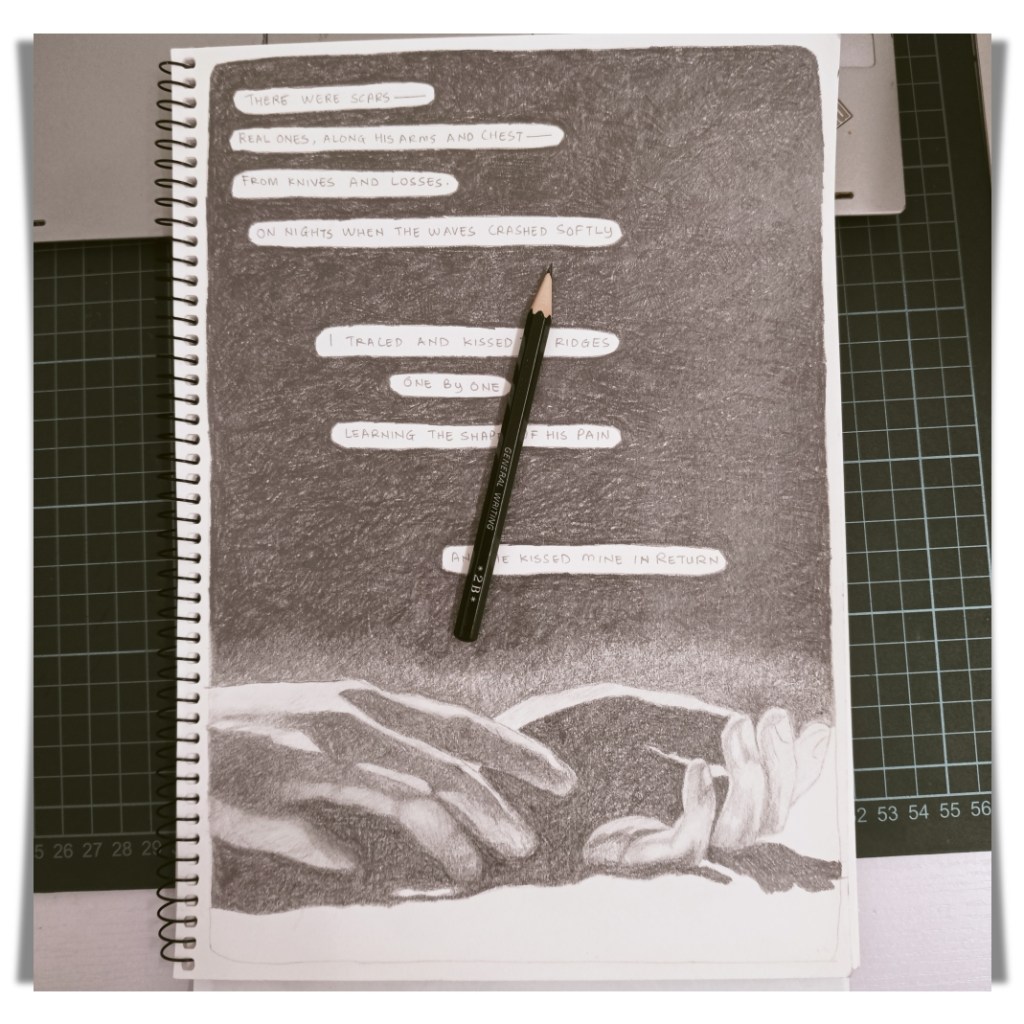
I worked on this piece over the weekend. The lines are taken from my poem, The Criminologist. So far, I have four of my poems published in online literary journals/art websites, but I hesitate to share the links here because that would expose my identity. I prefer to be anonymous for now so I can write more freely without my internal censors actively working to prevent me from writing truthfully. No explanation is needed for this piece; I just let the art and poem speak for themselves.

Copyright © Olivia JD 2025

All Rights Reserved.