On Cultural Erasure and the Right to Be Ourselves | We Are Not Yours to Claim and Rename

This week, a man on social media told me that all Indigenous peoples of Borneo are Malay. He spoke as if it were an unbreakable truth, and a few confident sentences could change centuries of culture and memory. He talked like someone who was certain of his place in the world and couldn’t imagine that others might have histories older than his own.

I am Iban. You can’t claim and rename my people.

That one conversation was a sign of a much larger issue. It wasn’t just a rude comment but the same old narrative that keeps playing beneath the surface of national conversations. This idea that everything in the Nusantara archipelago belongs under the Malay umbrella is not unity. It is colonization in a new form that continues to erase the cultures that make this region truly diverse.

A thesis essay titled “Cultural Genocide Against Ethnic Groups in Sarawak” discusses this gradual erasure as a form of genocide that occurs through language, law, and land instead of war. It addresses what has been happening in Sarawak and all over Borneo for decades: the gradual disappearance of Indigenous ways of life. There won’t be any violence in the news, but you can see it in how children forget their native languages and how native stories are rewritten or how they are dismissed as myths.

The first impact is on the land. Large-scale logging, oil-palm plantations, and hydroelectric projects like the Bakun and Murum dams have forced Indigenous communities to evacuate ancestral lands they had occupied for generations. For many outsiders, these are symbols of progress. For the people who lived on that land, they are the loss of a living relative. Land isn’t just property; it’s a memory, a source of livelihood, and the center of our beliefs. When it is taken, the connection between people and their ancestors, between rituals and the land, ceases to exist.

The next impact is on language. Malay and English are the main languages spoken in classrooms and offices. Iban, Bidayuh, Penan, and other Indigenous languages, on the other hand, remain in private spaces. The national curriculum rarely acknowledges them. A language is more than just words; it also embodies every aspect of our heritage. When children grow up without it, they lose not only vocabulary but also the worldview embedded in those sounds. 

The third impact is spirituality. Before Christianity and Islam arrived, our ancestors believed in a cosmology that connected people, nature, and the unseen. The adat guided balance and respect. Several elements were based on Hindu-Buddhist beliefs from the Majapahit and Minangkabau traditions, but those influences became uniquely our own, shaped by our environment. If you call these beliefs primitive, you are ignoring how sophisticated they are. Long before the word existed, they taught people about law, ethics, and ecology. The suppression of these systems has shattered more than trust; it has destroyed the bridge between generations.

The last impact lies in invisibility. Bureaucracy rarely speaks the language of the natives. Many still struggle to gain recognition of their customary land rights or even simple documents like birth certificates and identity cards. People who don’t have these papers become ghosts in their own country—unseen in census numbers and uncounted in national decisions.

Taken together, these forces create the silent machinery of cultural genocide. It’s not about individual malice but about a system that values uniformity over diversity and control over respect. When progress is measured only by infrastructure and profit, it becomes a form of forgetting.

I write this not to sow division, but to call for honesty. Respect for Indigenous tribes and their histories is not charity but a moral obligation.  When you erase a culture, you do not create unity. You create emptiness. Real harmony happens when differences can exist side by side, without one overtaking the other.

If you have mixed roots and feel like you’re torn between two identities, know this: you’re not a poser. You are the result of two or more heritages coming together. You have the strength of several worlds inside you. You have every right to learn your ancestral language, honor both sides of your heritage, and talk about it with pride. You can still reach your roots and the journey begins with curiosity and grows through community.

And to those who continue to insist that “everyone is Malay,” listen up: you are not defending tradition; you are performing a modern version of the same colonial mindset you claim to oppose. Claiming and renaming others is not leadership. It’s theft. It is a refusal to accept that different roots can live together without merging into one trunk.

The Iban, Bidayuh, Kenyah, Penan, Lun Bawang, Melanau, Kelabit, and countless other groups are not extensions of a larger race. We are nations within a nation, with histories that predate borders. We have our own gods and deities, our own literature, our own rituals and way of life. We don’t need anyone to save us from ourselves.

So take care of your own culture and let us take care of ours. Guard your own identity and let us stay as ourselves. You don’t have to tell us what to believe, how to speak, or how to conduct our affairs. Preserve your own heritage and quit trying to claim ownership of what doesn’t belong to you.

This moment in our history calls for courage. We need courage to listen, fix what has been distorted, and return whatever is rightfully ours. We don’t need anyone’s permission to exist. Even when others pretend to forget, we remember. We will continue to speak, to write, to sing, and to exist in our own rhythm. We are not lesser branches of your tree. We are forests in our own right.


I write about Iban culture, ancestral rituals, creative life, emotional truths, and the quiet transformations of love, motherhood, and identity. If this speaks to you, subscribe and journey with me.


The Story Behind the Iban Hand Tattoo, Tegulun

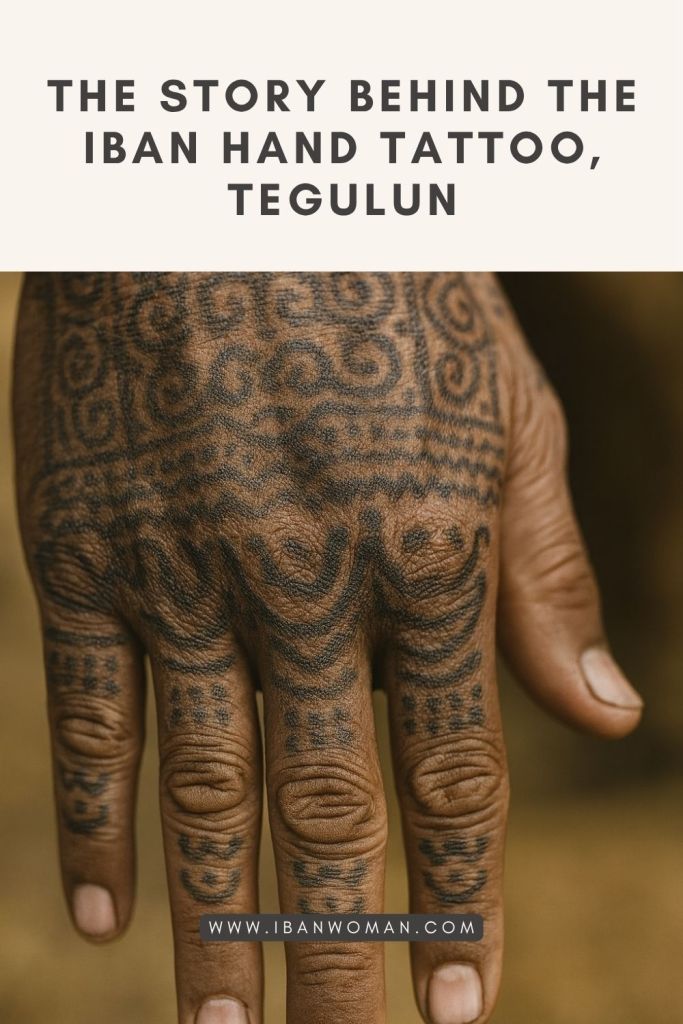
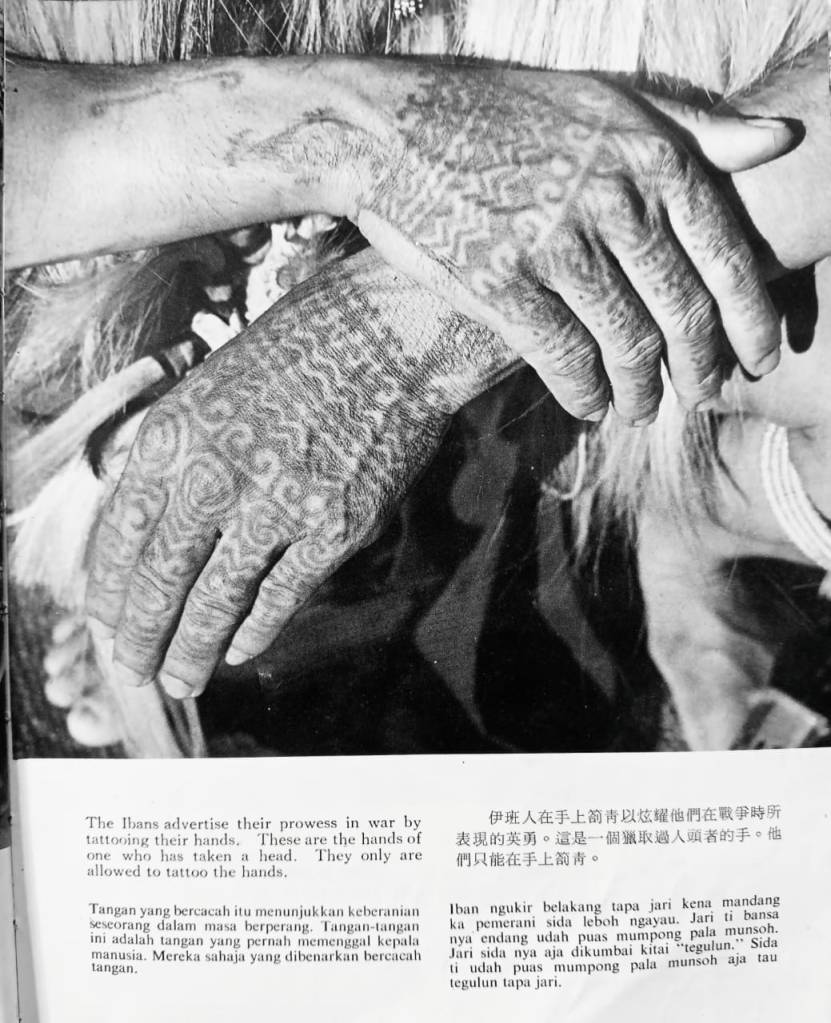
Have you ever heard of the Iban hand tattoo called tegulun? It’s one of the most striking forms of body art in our culture, yet not many people know what it really means. I found an old photo taken in 1962 from Life in a Longhouse by Hedda Morrison. It shows the hands of an Iban man with very detailed tattoos that go all the way down to his fingers. The pattern is tegulun.

In the Iban language, tattoos are called pantang or kalingai. Every tattoo on the body used to mean something. Tattoos weren’t fashion statements but they were living records of a person’s journey, courage, and place in the community. Each motif, like bungai terung (eggplant flower), ketam (crab), or kala (scorpion), meant something. For men, tattoos often showed that they participated in headhunting expeditions, or gone through rites of passage. For women, only the most skilled pua kumbu weavers were allowed to bear them.

Among women, the right to be tattooed was not given lightly. A woman known as “Indu Tau Nakar, Indu Tau Gaar”, was a master weaver who earned her tegulun through artistic and spiritual labor. With her hands, she made sacred pua kumbu cloths used in rituals such as receiving enemy heads. The tattoo on her fingers didn’t symbolize violence; it reflected her connection to the spirit world through weaving. These women were highly respected, for they were believed to hold the gift to translate dreams and visions into woven form.

The meaning of tegulun was very different for men. Those who carried it were known as kala bedengah—warriors who had taken part in ngayau, or headhunting expeditions. Someone who had tegulun on his hands was a man who had proven himself in battle. The tattoo was a visible sign of his courage and strength of spirit. It was said that every line or curve on the fingers stood for a head of an enemy that had been killed in the war.

Looking at those tattooed fingers in old photographs, one can almost feel their importance in the past. The men who bore them were not only fighters but also protectors of their culture and their way of life. They lived by a complex set of moral codes that were based on omens, dreams, and rituals. Taking a head was never an act of impulse; it was part of a ceremony tied to the safety, fertility, and prosperity of the longhouse.

One of the most well-known Iban warriors who carried tegulun was Temenggong Koh (1870–1956), a tuai serang (war leader) from Kapit, Sarawak. His fingers were covered in tegulun, each one telling a story of victory and survival. Temenggong Koh once gave his nyabur, the sword he used during ngayau, to Malcolm MacDonald, a British diplomat. The blade still bore traces of dried blood and is now displayed at the Durham University Oriental Museum in the UK.

It’s difficult to imagine that such traditions existed within living memory. Today, there are no Iban men who bear tegulun. The British made headhunting illegal after World War II. The last “licensed” expeditions took place during the Malayan Emergency and Communist Insurgency, when Iban trackers were recruited to assist the British. After that time, the custom of taking heads and the tattoos that went with it completely died out.

The tegulun is more than a reminder of war. It refers to a time when everything, from fighting to making art, was connected to the spiritual order of the world. Tattoos linked the body to the world that can’t be seen. They reflected not only bravery but also a sense of belonging. A man or woman who bore them carried the stories of their people and passed them down through the generations.

Those meanings are at risk of being lost today. Most young Ibans have only seen people with tegulun in books or museum photos. But it’s important to understand them. These tattoos show us how our ancestors thought about life, death, and the sacred balance between the two. They remind us that strength can show itself in many ways, like when you swing a nyabur (sword) or sometimes in the patient rhythm of weaving a pua kumbu.

To learn about tegulun, you have to look beyond the surface of the skin. Though the ink has faded and the rituals have ended, the meanings remain alive in memory. They are echoes from another time, reminding us that every mark and line once carried a story worth telling and remembering.

Image source: Life in a Longhouse by Hedda Morrison


I write about Iban culture, ancestral rituals, creative life, emotional truths, and the quiet transformations of love, motherhood, and identity. If this speaks to you, subscribe and journey with me.
Why the Ibans Took Heads In the Past

A quick disclaimer before I begin. Some people may find this topic upsetting because headhunting led to conflict between different ethnic groups. I don’t intend to glorify the practices of my ancestors; I just want to share what I know, especially since many people, even younger Ibans, don’t fully understand the reasons behind it. Taking a life is wrong by today’s standards, and from a modern perspective I do not support it. But we can’t change history, and judging the past by our present lens doesn’t help us understand it. What we can do is listen and learn.

The Iban had their own reasons and beliefs for taking heads. One of the most significant was to end the mourning period, a practice called ngetas ulit. When someone in the community died, the longhouse would mourn for a period of time. During this time, certain rules and taboos were followed. A ritual that demanded a fresh head was performed to end the mourning period. The family of the deceased would consult the longhouse community, and the men would plan a ngayau (head-hunting expedition) together. After getting a head, a series of complex rituals signaled the end of grief. Killing to end mourning may sound strange today, but for the Iban it was part of a cultural process called nyilih pemati, a symbolic offering for the dead.

Another reason was the belief that antu pala (enemy skulls) had spiritual power. The Iban in the old days  believed that these skulls would bring blessings if they were taken care of. Antu pala also played an important part in the Gawai Burung (the Bird Festival), which was one of the most important Iban ceremonies. As part of this complicated ceremony, the lemambang (bard) would use the skulls in his pengap (chants) to invoke the god of war, Sengalang Burong. This festival has probably disappeared because most Ibans are now Christian or Muslim, but it still holds a place in oral tradition.

There were other uses for skulls as well. They were used in healing rituals, ceremonies to call for rain during times of drought, and as guardians to protect the longhouse or farms from enemies and wild animals. In this regard, the skull became a spiritual servant for the person who kept it. They also carried social meaning. If a man didn’t take a head, he was likely called a coward or kulup (uncircumcised), and these men were not seen as good husbands. Iban society valued courage and bravery very highly.

Some have asked why heads were taken instead of other body parts. The answer lies in old beliefs. Our ancestors believed that the head was the center of a person’s life force. The head could be clearly identified, unlike the hands or feet. In the past, families knew exactly whose head was kept, even after years of blackening from smoke. Today, those identities are no longer shared openly. Imagine getting married to someone from another tribe and then walking into a longhouse and saying, “Honey, that skull belonged to your ancestor.” We have learned that silence is a way to protect the living while still honoring the past.

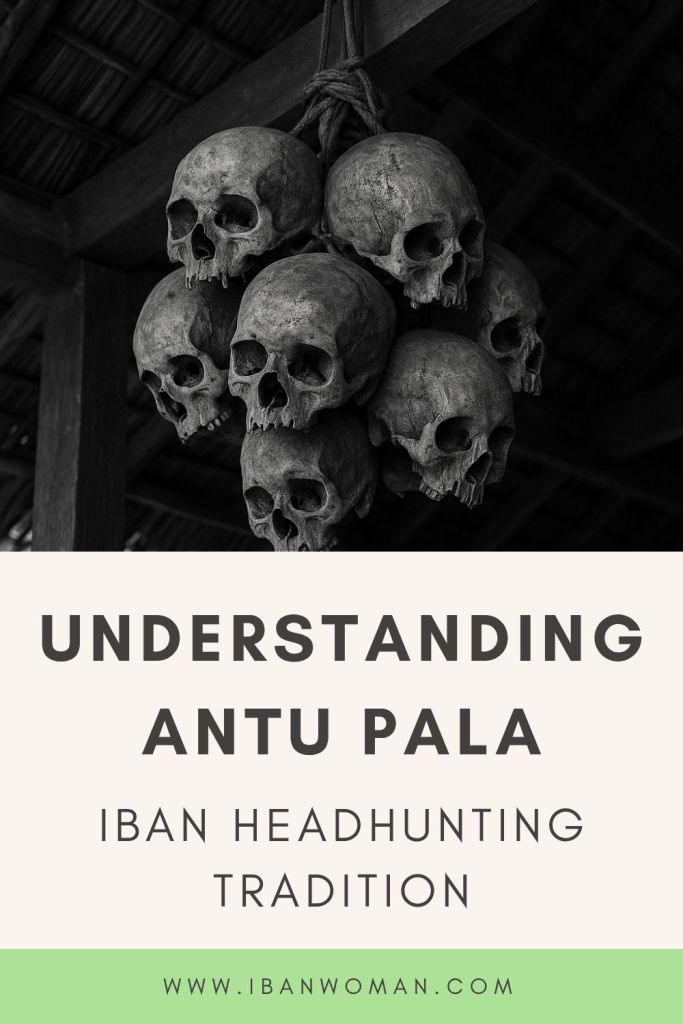
So, do antu pala still exist? Yes. Some Iban families keep them, like mine. They can be kept in the sadau (the top floor of the longhouse) or hung in groups called tampun on the roof. We don’t see them as trophies but as things that deserve respect. If you don’t take care of them, they can bring bad luck, so you must abide by strict rituals to keep them safe.

This picture shows a tampun that belonged to my ancestor, Unggang Lebur Menua, an Iban warrior from the late 18th century. It has 34 antu pala that are more than 200 years old, and is now kept by relatives at Rh. Panjang Matop, Paku, Betong. It serves as a reminder of a different time, when survival, belief, and identity were connected in ways that may be difficult for us to understand now.

I hope this helped you learn more about a part of Iban history that continues to live in our collective memory.

Image source: Youtube


I write about Iban culture, ancestral rituals, creative life, emotional truths, and the quiet transformations of love, motherhood, and identity. If this speaks to you, subscribe and journey with me.
Pengarap Lama Iban | Iban Animistic Beliefs

TL;DR:

A simplified overview of traditional Iban animistic beliefs, including the Supreme God (Petara), nature spirits, ancestral souls, and mystical beings like Kumang and Keling. These oral stories, once passed down generation to generation, are now slowly being archived here from my Threads posts for easier access and deeper reflection.

Prior to the arrival of Christianity and Islam, the Iban people practiced a form of animism. It’s a complex belief system where spirits existed in rivers, jungles, animals, dreams, and even illnesses. Though most Ibans today identify as Christians, many still observe traditional customs during weddings, festivals, and ancestral rites. It’s worth noting that the Iban never had a written system to record these beliefs. Every story and ritual was passed down orally from one generation to the next. Because of this, different river regions or divisions often have slightly different versions of the same story, each molded by the voices and landscapes that keep them alive. 

Here is a short, simple summary of this complex cosmology that you can use as a reference. I’ve been actively posting about Iban culture, legends, and folklore on Threads, but now I’m slowly fleshing them out and archiving them here for my readers. 

Note: I’ll touch more about the Sengalang Burong’s family when I write about Iban omens and augury. 

Core Beliefs

Iban animism is based on the idea that there are many spiritual beings that are part of everyday life and the afterlife. These include:

  • Supreme God, called Petara / Tuhan or Raja Entala
  • Deities and spirits, called Bunsu Petara – each with their own roles i.e Sengalang Burong
  • Spirits of ancestors, called Petara Aki Ini – often called upon during rites like Gawai Antu i.e roh nenek moyang
  • Spirits of nature, found in animals, plants, rivers, and forests and also include Bunsu Antu i.e jin, iblis
  • Mystical beings from the sky realm called Panggau Libau and Gelong i.e Kumang, Keling

Dreams were (and still are) taken seriously, often seen as spiritual messages. If a deity (i.e Sengalang Burong) or mystical being (i.e Kumang) appears in a dream, it’s treated as guidance that must be followed.

Categories of Gods and Spirits

1) Petara / Tuhan (Supreme God)

  • Also known as Raja Entala
  • Creator of all living things

2) Seven Main Deities / Bunsu Petara (Who live in the realm of Tangsang Kenyalang)

These seven deities are the children of Raja Jembu and Endu Endat Baku Kansat. Raja Jembu is the son of Raja Durong and Endu Kumang Cheremin Bintang. There is more to this lineage, but for simplicity, let’s just focus on Raja Jembu’s family. These seven deities or Bunsu Petara, are often invoked in Iban poetry, like pengap and timang

  • Sengalang Burong – God of war (Sengalang Burong’s wife is Endu Sudan Beringan Bungkong. They have eight children including a daughter, Endu Dara Tinchin Temaga)
  • Biku Bunsu Petara – God of resources
  • Sempulang Gana – God of agriculture
  • Selempandai – God of creation and procreation
  • Menjaya Manang – God of healing
  • Anda Mara – God of wealth
  • Ini Andan – Female spirit doctor and goddess of justice

3) Mystical Beings (Who live in the land above the sky, Panggau Libau and Gelong)

  • Kumang, Keling Gerasi Nading, Kelinah Indai Abang (Keling’s sister), Lulong, Laja, Pungga, Selinggar Matahari, Sempurai Bungai Nuing, Tutong (Kumang’s brother) – Divine beings who help humans succeed in life, especially warriors and brave people. Kumang and Keling appeared more in dreams compare to the rest.

4) Spirits of Nature

  • Bunsu Jelu – Animal spirits
  • Antu Utai Tumboh – Plant spirits
  • Bunsu Antu – Ghosts or restless spirits, some helpful, some harmful

5) Souls of Ancestors / Petara Aki Ini

  • Honored during rituals like Gawai Antu
  • Believed to offer blessings and protection when remembered properly

Copyright © Olivia JD 2025

All Rights Reserved.

I write about Iban culture, ancestral rituals, creative life, emotional truths, and the quiet transformations of love, motherhood, and identity. If this speaks to you, subscribe and journey with me.
Fragments of Obsession V | What Remains of Him

This fragment of obsession is a continuation of Part 4. You can find the first four parts here: part 1, part 2, part 3, and part 4.


The Victims

They stay with him. That much I know. 

They weren’t merely evidence in sealed bags. They had names. They had voices. They were echoes in a room where someone had begged, bled, or died without being heard. They live somewhere behind his eyes, hidden deep down but never completely out of reach. 

He doesn’t discuss them. But I can sense it in the way he moves, sometimes too still like he’s bracing for the inevitable. I wonder which one visits him in sleep. Whose case file he opens up in his dream without meaning to. 

He must have a list in his head. A list of faces, some vaguely remembered, some impossible to forget. The girl with the red hoodie. The elderly man found with his hands tied. The body that no one claimed. 

I used to think that grief only belonged to families and those who loved them. However, there is a certain kind of pain that comes from being the last person to look at their picture, read their texts, or trace their final hour backwards. He carries that deep in his soul, mourning for people he never knew. 

Maybe it hardens something in him. Or maybe it makes him gentler in ways he doesn’t realize. The truth is I don’t know. I just know that he touches the evidence gently. And he blinks slower than usual when he stares at a photo too long. 

In my culture, the spirits—antu—linger when death is unresolved. Some say they roam, whispering into the ears of the living. He doesn’t fear ghosts or darkness. The ones that haunt him are printed on paper, kept in boxes, and saved on hard drives. There they remain. Always waiting. Always watching. 


The Walk

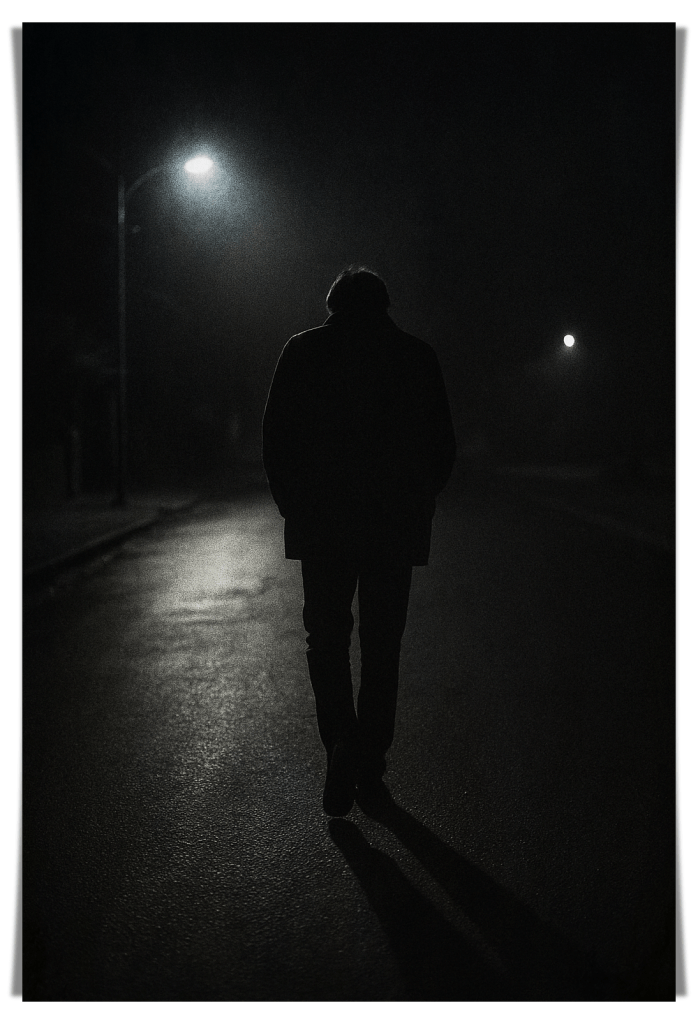
He walks at night, but not every night. Only on those when sleep is a stranger and the weight on his chest refuses to lift. He seeks the hour between two and four. That’s when the world goes quiet, signaling him to step out. 

He brings no phone, has no destination. Just his feet on the pavement, carrying his momentum through sleeping streets. He passed shuttered shops, empty lots, and the lonely glow of neon signs. In this slumber, the city is transformed—muted, and temporarily pacified. 

Is he trying to shake them off? The blood, the tragedies, and the ghosts that cling to the inside of his eyelids? Or is he chasing the silence he can’t find inside? Or maybe he just believes that if he walks long enough, the chaos in his head will have to settle.

Hands in pockets, shoulders a permanent slope. From afar, he’s just a man. But a closer look at his eyes would tell you everything. 

This is the unseen part. The aftermath, stripped of crime scenes and case files. There is no suspect to corner, no puzzle to solve. He’s a man alone with the night, waiting to feel human again.

In that moment, I don’t see the criminologist. I see a tired man who would rather move through the honest darkness of the streets than lie still in a loud, empty room.


Epilogue

All of this, I’ve only imagined. The desk. The scene. The interrogation. The victims. The walk. They’re a part of his life that I will never touch. He doesn’t talk about it much, at least not directly. A line may slip out from time to time, and that’s it. Most of it comes through in other ways, like when he gets too quiet and his hands stop moving. The tension in his jaw after a long day. The shadows beneath his eyes that no amount of sleep seems to erase. 

There are nights he startles awake. He never says why, just lies there, breathing heavily. I never ask either. I simply wait for his return. 

What he endures is his own. And I’ve stopped trying to reach for it. His work is an extension of who he is, bound to his bones. It affects how he sees the world and how he protects others without even thinking about it. 

However, there are times when it becomes apparent. Like when he touches me and listens to me even when I say something silly. Or how he holds silence like it’s sacred. 

I used to think he was distant. But now I understand: he was too full of things he could never say. I write these fragments not to know him better or to hope that he’ll find them. He won’t. The door closed two decades ago. These are the only pieces I kept. 


Copyright © Olivia JD 2025

All Rights Reserved.

I write about Iban culture, ancestral rituals, creative life, emotional truths, and the quiet transformations of love, motherhood, and identity. If this speaks to you, subscribe and journey with me.
Fragments of Obsession IV | The Criminologist

Some time ago I began writing Fragments of Obsession, brief glimpses into a private world of desire and distance. These new pieces pick up where the last ones left off, but they explore a darker area: the world of a criminologist.

I can’t sit at his desk or walk with him into the places he inhabits. All I have are fragments, imagined through the silence between us. They’re not about the crimes themselves but rather the places around them: his desk, the crime scene, and the interrogation room.

What interests me is not the evidence he gathers, but the burden that persists afterward. These pieces are how I watch from the outside and write about things I’ll never see. They belong to the same map of longing I began tracing in the first three Fragments of Obsession — part 1, part 2, part 3


The Desk

I never stood in front of it, but I know it like I’ve touched its surface a thousand times in my mind. A desk that holds the stories that no one wants to tell, and even fewer want to hear. Its top is scratched, probably from years of people dropping folders, forgotten coffee cups, and constant shuffles of pens and clips. Sturdy but with scars like him.

On one side, there is an uneven stack of papers threatening to tumble. Case notes, autopsy reports, and transcripts of late-night interviews with men who lie easily and women who have given up on getting justice. I imagine the edges fading from being read too often, held in worn hands. Underneath them, photographs turned face down, and the victim’s eyes still burning even when hidden. 

The other side is neater. A computer. A notebook with a page full of his neat, small handwriting. His pen would sometimes rest diagonally across it, with ink smudges on the margins where he applied pressure too hard. I imagine him hesitating mid-thought, his brows furrowing. 

There must be a hidden gun nearby. Cold, clinical, and within his reach. The barrel pointing nowhere, a constant reminder of how violence is always a part of his life. My people never lived with guns except for the ones that were passed down to us. My grandfather’s shotgun passed to my father and now to my eldest brother. A hunting tool, not for murder. Unloaded but heavy with potential, lingering like a sinister presence at the periphery of every thought. 

I can see his hand, with raised veins and long fingers, tracing the tabletop absentmindedly when fatigue creeps in. A gesture that seems almost loving, as if he were anchoring himself. He’s a man who has read too many lies in too many statements. He doesn’t stop. He keeps returning to this desk, like a man returning to his menua, the land he was born in, where his roots are waiting for him, no matter how far he has gone.

I’ll never sit across from him there. I only know it through imagination. This distance allows me to observe things that others may overlook: the silence around him, the way the desk has become an extension of his body, his determination, and his solitude. 


The Crime Scene

I picture it as the opposite of his desk. No order, no familiar scratches, no steady ground. There was chaos sealed off by yellow tape. It’s a place where a life has ended and everything normal—shoes by the door, a half-empty cup on the table, a curtain in the wind—suddenly feels obscene. 

The air is thick with things that can’t be cleaned. The iron tang of blood and the sour staleness of fear. A house where someone used to laugh is now silent. He goes through it methodically, but I know he notices everything. The scattered belongings. How things look wrong when they aren’t where they belong. The imprint of violence that remains like smoke after a fire. 

He kneels by the details others step over. A broken clasp. Mud tracked across the tiles. Fibers snagged on a nail. His hand hovers above them, never in a hurry or careless. He bends down low to collect evidence. I imagine how his eyes narrow as he gathers pieces that the rest of us can’t see. 

Somewhere close, a camera flashes, officers talk, and someone fills in a logbook. He moves like none of them are there. The scene is speaking to him. It tells him what to look for, what to doubt, and what doesn’t belong. 

And maybe he thinks of the victim too. Not just as a body drawn in chalk, but as a person who went barefoot over this floor and brushed their teeth at that sink. He’s seen too many of them. Each scene digs into him like a thumbnail. 

According to my people, when someone dies tragically, the place becomes restless. You don’t linger there long unless you want to carry that darkness home. He has to stay. He lets the silence seep into him and the darkness push against his skin. This is the only way to read what the dead left behind. The chaos doesn’t stay behind when he finally steps back over the tape. It follows him and becomes the real evidence he can never log. 


The Interrogation Room

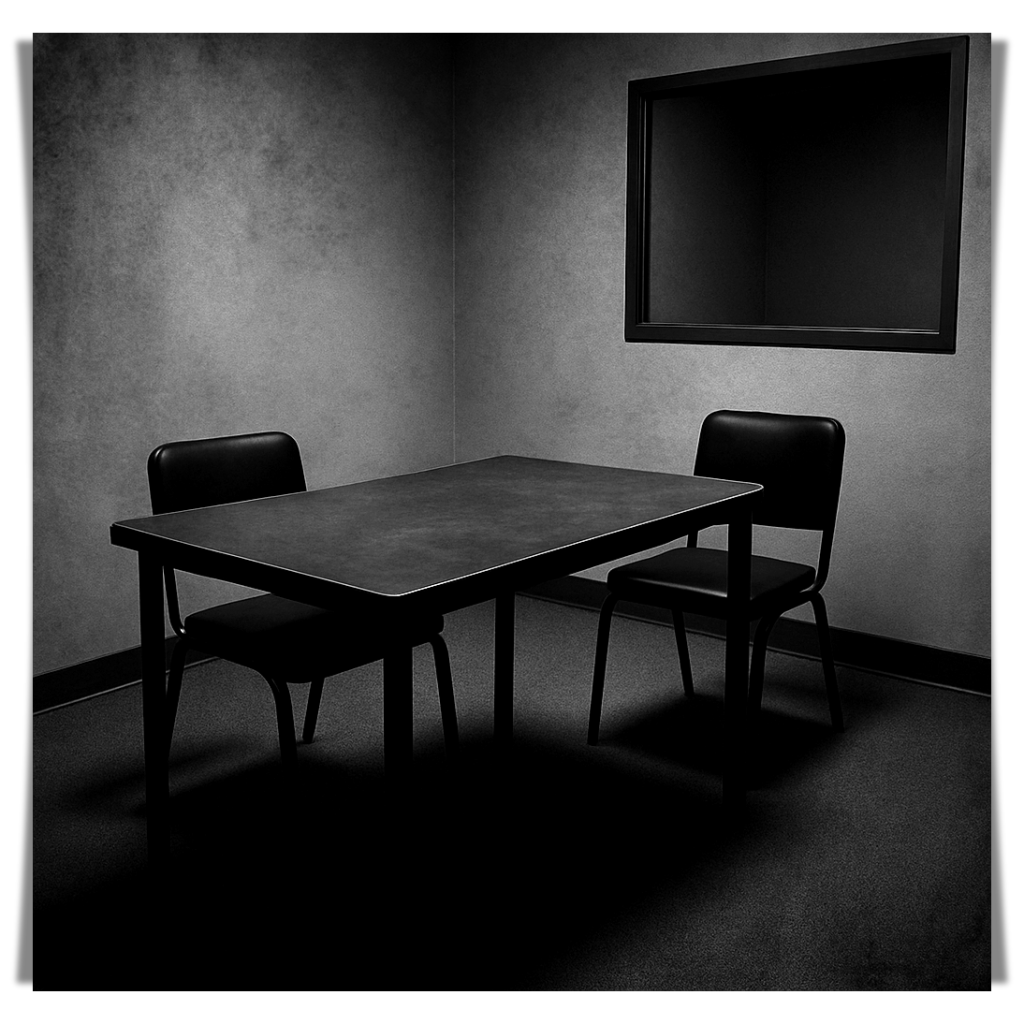
I can see it clearly, even though I’ve never been inside. The walls are bare and dull gray with faint finger prints on the paint from palms dragged in terror, boredom, or defiance. A single table in the center with uneven legs. One chair on each side but only one feels in charge. 

I imagine the air stale with breath and the absence of sunlight. There are no windows to the outside world. Only a dark pane of glass on one wall. He knows they’re watching. He doesn’t care. His focus is always here. This is a space where people stall, spin, crack, or burn. 

He sits across from them. Calm. Still like the river at dusk before swallowing the last light. He doesn’t raise his voice. He waits and lets them fill the silence with their own guilt. Lets them fidget, lie, and repeat themselves. Lets them feel uncomfortable about what they said. 

There’s always a file in front of him. Sometimes it’s closed. Sometimes it’s open to a photo or a sentence scribbled in red. He doesn’t look at it much. He stares at them, watches how their jaw moves, how they scratch their nose, and how their eyes dart to the door when they think no one’s watching. 

I wonder if he thinks of the victim while he listens. If he remembers the angle of the neck, the bruise on the cheek, and the time of death. If he keeps those pieces in his pockets like charms, reminding him of who he’s really speaking for. 

In my people’s old way of life, truth wasn’t pried out in rooms like these. We invoked Ini Andan, the goddess of justice, and waited for signs. Now there are only fluorescent lights and CCTV. The ritual remains the same. Watching. Listening. Putting the soul on a scale. 

He doesn’t need to catch them lying. They’ll hand it over eventually. Little by little, like decaying meat falling apart in their hands. 


Note:

I’m still working through two more fragments—The Victims and The Walk. They’ll come when they’re ready, and together they’ll complete this small sequence of obsession.


Copyright © Olivia JD 2025

All Rights Reserved.
I write about Iban culture, ancestral rituals, creative life, emotional truths, and the quiet transformations of love, motherhood, and identity. If this speaks to you, subscribe and journey with me.
Iban Folktale | The Tale of Tekuyong and Pelandok

A long time ago, when animals could talk like we do, the river snail, Tekuyong, was slowly moving across a wide rock by the riverbank. His body glistened in the morning light as he licked moss off the stone and nibbled quietly.

Pelandok, the mousedeer, came along. He was light-footed and couldn’t sit still. He was sniffing the ground for soft buan leaves to chew. He stopped and yelled, “Oi, Sambi Tekuyong!” when he saw Tekuyong stuck to the rock with his head bowed. (Sambi means “friend or pal.”) “Why are you sitting there so still? You’re not moving at all.”

Tekuyong lifted his feelers. “I’m not idle, Sambi. I’m eating the moss by licking the stone. That is my food.”

Pelandok tossed his head back and chuckled as he heard this. He laughed until his little body shook. He laughed until his eyes welled up with tears, and his bladder gave way, soaking the ground.

Tekuyong watched silently. When Pelandok finally caught his breath, Tekuyong asked, “What is so funny, Sambi? Why are you laughing at me?”

Pelandok, however, pointed to Tekuyong’s sluggish, gliding body and continued to laugh. Shame burned at Tekuyong’s heart. “Enough, Sambi,” he finally said. “Since you find me so amusing, gather all the animals together to watch us race. We’ll find out who is actually faster in a week.”

Pelandok clapped his hoofs in delight at this. “A race? Against you? Ha! I will surely win.”

They decided that the course would run from the foot of the hill where they were standing to the great rock by the sea. 


Pelandok trotted through the jungle that evening to tell everyone about the race. “Come on, everyone! Watch me, the fastest creature in the forest, defeat Tekuyong the snail!” The monkeys shrieked with laughter, and the birds spread the news with their calls. Soon, the whole jungle was buzzing with excitement.

Tekuyong, on the other hand, crept home with a heavy heart. He called his family together and said, “I challenged Pelandok, but I wish I hadn’t. How can I ever outrun him? He runs as fast as lightning, but I crawl slower than a feather in the wind.”

Some of his family members whispered and shook their heads. One person said, “Why didn’t you think before you spoke? It is better to accept shame than to face certain defeat.”

But Tekuyong stood up straight and said, “If you won’t help me think, then I must think for myself.” He paused for a moment before revealing his plan.

Apai (Father), Aya (Uncle), and Aki (Grandfather), I need you.” You must wait at different points along the racecourse and pretend to be me. Aki, wait upon the rock by the shore. Aya, take your place at the midpoint. Apai, sit beneath the big tree near the finishing line. You all have to shout when Pelandok passes so he thinks I’m ahead of him. As for me, I’ll start the race next to him and then hide.”

The older snails nodded slowly. “It is cunning,” Aki said.  “Let us see if arrogance can be taught a lesson.”


The week went by quickly. On the appointed day, all the animals in the forest came together. Monkeys hung from branches, hornbills flew overhead, kendawang (red headed krait) snakes slithered on the ground, and wild boars dug around the edge of the clearing. The air was full of excitement.

At the starting line, Tekuyong and Pelandok stood next to each other. They picked rhinoceros to start the race. As he counted “One! Two! Three! Run!” his deep voice shook the ground. 

Pelandok shot forward like a dart from a blowpipe, his hooves hitting the ground like drums. Dust flew in his wake. While everyone was busy admiring Pelandok’s speed, Tekuyong moved slightly, then silently rolled into the grass and vanished from view.

The crowd cheered for Pelandok’s speed. “Look how fast he is!” the monkeys yelled. “The poor snail will never make it to the end.”

But when Pelandok reached the rocky shore, there sat Aki Tekuyong, waiting calmly.

Apu! (Oh no!)” Pelandok gasped in disbelief. “How can Tekuyong already be here?” He pushed himself harder.

At the midpoint, Aya Tekuyong called out cheerfully, “I’m ahead, Sambi! Why are you so slow?”

Pelandok’s heart raced. “Apu! Apu! He has beaten me again!” He ran until sweat streamed down his body and his breath tore at his chest.

Near the finish line, his legs trembling, he looked up, and there was Apai Tekuyong, waiting under the big tree! Pelandok collapsed, his sides heaving, his body drenched in sweat. “Apu! I am defeated,” he admitted.

Apai Tekuyong smiled gently. “Why are you so slow, Sambi? I’ve been waiting here for a long time.”

Pelandok bowed his head in shame. “Yes, I have lost.”

“Let this be your lesson, Sambi,” Apai Tekuyong said with a smile. “Don’t ever laugh at other people or think you’re better than them. Each of us has our strength, even the least of us.”

So Pelandok never mocked Tekuyong again. And all the animals who were there that day took the story home with them. That’s why the Iban people still say malu tekuyong today. It means shyness, which comes from respect. For example, when someone invites you to dance the ngajat (Iban traditional dance) or speak in front of the elders, you feel both honored and somewhat uncomfortable or embarrassed. We call that feeling malu tekuyong.

And that is how the snail taught the mousedeer and gave us a saying that we still use today.

Note:
I translated this folktale from Iban into English and Malay. The Malay version is available on my Threads. The original story was written by Gregory Nyanggau Mawar and published on the Iban Cultural Heritage website.


I write about Iban culture, ancestral rituals, creative life, emotional truths, and the quiet transformations of love, motherhood, and identity. If this speaks to you, subscribe and journey with me.
The Cry of the Koklir | An Iban Ghost Story

Before I share my experiences, I’d want to clarify who the koklir is and what she represents in Iban belief.

People often think of the Iban people of Sarawak as headhunters, which is a part of our history, but it tends to eclipse the deeper aspects of who we are. However, our culture is not only based on headhunting. We have a strong spiritual connection to the natural world, which is rich in stories about spirits that live in rivers, lands, mountains, and dreams. Our folklores are alive with omens, taboos, and the spirits of people who have departed. Some spirits protect, some guide, and others, like the koklir, are said to return because something in their death was left unresolved.

In Iban culture, the koklir is one of the most feared spirits. She is believed to be the spirit of a woman who died during childbirth or shortly thereafter, specifically during the vulnerable bekindu period, which lasts for forty days of healing and recuperation. Her death is known as busong mati, or a spiritually unfortunate death, and her soul is considered to become jai (malevolent). Her soul is malevolent not because she did something wrong in life, but because her death was unnatural and tragic. Her spirit doesn’t cross over to the other side in peace; instead, it lingers behind, transformed by pain and grief.

As a ritual precaution, lime thorns (duri limau) are poked into her hands and soles before she is buried. It’s a symbolic act aimed at weakening her spirit and preventing her from becoming a koklir. Some people allege that her tongue is also pierced.

Then a prayer is being offered, asking her to rest and not come back to bother the living. But if the ritual isn’t done or if the death is really violent or sudden, people say she might still come back to haunt, seek, and punish.

The koklir is believed to target men. Most of the time, you can hear her presence through a chilling cry that starts out like a hen calling her chicks: “kok, kok, kok…” and ends with a piercing, terrifying “haiiiiii waiiiiii!” Before she attacked her victim, she would scream “kokliiiiiiiiiiiiiiirrrrrrrrrr”. She sometimes takes the form of a beautiful woman, hiding her face with a tanggui serawong (woven sunhat) or a kubong leaf. Sometimes she manifests as an enturun, a shaggy, nocturnal bearcat with long claws. Some men say they’ve heard her voice in the jungle or by the river at night. Some people say they’ve seen her scratch at windows or doors with fingers that look like claws. The stories are shared quietly among men, usually late at night, and sometimes with fear or bravado.

I’ve never seen her. But would you believe me if I told you I heard her twice? And I remember it very well both times.

First Encounter

I was fourteen. It was the first day of the school break. Because my flight home was later that night, I was the only student left at the girls’ hostel at my boarding school. Everyone else had left throughout the day. The hostel was quiet and empty.

That morning, the warden told me to turn off the lights and close all the doors before I left. I said I would. After dinner, at about 6 PM, I took my bags outside and waited for my cousin to pick me up. It was getting dark already.

Before leaving, I went back in to do what I promised: turn off the lights and close the doors. I went up to the first floor, strolled through the empty corridor, and did what I had to do. The only sound was the rustling leaves blowing in the breeze. Everything else was still and quiet.

I heard something as I came back down, near the bathroom on the ground floor.

Kok… kok… kok…

It was soft and faint, exactly like a hen calling its chicks.

But this was a school compound. No nearby houses, no chickens. Just trees and a greenhouse. I stopped and listened again. I thought maybe I imagined it. I finished what I was doing and went back to the entrance. I stood there in the light of the corridor, looking out at the road. Everything else around me was dark.

Then, around 7PM, I heard it again.

Kok… kok… kok… kok…

It was slower and closer.

I felt chills and goosebumps all over my body. I was too scared to look around. I just kept my eyes on the road, expecting to see my cousin’s headlights. He came soon after that. I hastily loaded my bags into the car and drove away. I never looked back.

I didn’t see her, but I know what I heard. We believe that the koklir doesn’t harm girls or women because she only targets men. That gave me some comfort, but the sound stuck with me for years.

Second Encounter

I was still living in the same hostel a year later. I didn’t hear her voice this time, but I did hear something else. My bed was next to the door. Sometimes, I would wake up to a loud scratching sound at the door. I believed it was stray dogs trying to get in, so I went back to sleep.

However, I looked at the door one morning because I was curious. There were scratch marks, but they weren’t at the bottom where a dog could reach them. They were higher up, around chest height. That detail stuck with me. What kind of dog can scratch that high?

I didn’t say anything to anyone. I didn’t want to scare the others, especially the younger girls. But I remembered what the elders used to say: the koklir scratches at doors and windows with her long nails to find a way in.

After that, the scratching happened every now and then. I didn’t say anything about it until much later. I told the story years later in our WhatsApp group for former dormmates. I was surprised to learn that I wasn’t the only one. Others remembered the same sounds from the same door and that same feeling of unease. However, we all stayed quiet, but we were all scared.

Some people might not believe these stories. They can argue it’s merely animals, wind, imagination, or ridiculous stories from the natives. But I don’t think I made anything up since I know what I heard.

These encounters aren’t just stories about ghosts. She is a reminder of how deeply the Iban people see death and life as intertwined, how even grief has a place in our stories. As Iban people, we understand spiritual realms that involve death, grief, and the things that linger. The koklir is a reminder of women who died too young or too soon, often forgotten or feared, yet still searching for peace. She didn’t show herself to me. But I heard her cry and have never forgotten it, even after decades have passed.


I write about Iban culture, ancestral rituals, creative life, emotional truths, and the quiet transformations of love, motherhood, and identity. If this speaks to you, subscribe and journey with me.

The Ritual of Water | An Iban Ceremony for New Life

Last weekend, I found myself standing knee-deep in a shallow river in Janda Baik. The sunlight came through a canopy of trees above, casting soft streaks of light on the water’s surface. Everything felt quiet and peaceful. My kids splashed further upstream, and their laughter echoed off of rocks and trees. I stood still, closed my eyes, and let the water swirl around my legs as it flowed downstream.

It reminded me of the Iban traditional child-naming ritual. I’ve never seen it with my own eyes, but I learned about it from the elders and through reading. This ritual was held following the naming of the child and to formally “introduce” the child to the river. 

In the Iban way of life, water is more than a physical element. A body of water like a river is also a spiritual space. It gives life, but it is also a source of danger. We wash with water from the river, and sometimes, when the water is clear, we even drink and cook with it. It carries our boats to other villages, fields, and faraway places. However, it’s also where crocodiles and other dangers live. No Iban has grown up without hearing stories about someone who was attacked at the river. When a child is born, we don’t just give them a bath. We also hold a ritual to beg the river not to harm them. 

After the child is named, the bathing ritual begins. The night before the ceremony, the father informs the longhouse community of his intention. At dawn the next morning, the whole longhouse community walks to the river in a solemn procession. A flag bearer is at the front, and a man carrying a fowl follows him. Both of these men are chosen from among the respected elders. Two women walk behind them. One carries offerings and the other carries the child wrapped in handwoven pua kumbu. The rest follow, beating the gongs as they walk.

At the riverbank, the flag bearer cuts the water with a knife. The man with the fowl recites an invocation to call upon the spirits of water, earth, sky, and all the creatures that swim below the surface. He asks that the child be given good fortune, sharp vision, and safety. He calls the crocodile, the soft-shelled turtle, the barbus fish, the semah, and the tapah. He calls each one by name and tells them to regard this child as family, not food. He says, 

“If this son or grandson of ours happens to capsize and sink while he is visiting, you are the only ones who can lift him up and keep him afloat.”

It is not a metaphor but a real request, born out of fear and hope.

After the invocation, the child is bathed and the fowl is slaughtered. People make noise on purpose, like banging gongs and laughing, to drown out any bad omens. If the child is a boy, one wing of the bird is tied to a spear with red ribbon. The wing is attached to a heddle rod if it’s a girl. A bamboo basket full of offerings is then hung from a leafy pole. 

After that, they return to the longhouse and sprinkle the child with sacred water to get rid of bad omens. A feast is held and the gongs ring out to mark the ritual’s success. The child is now considered truly part of the community, and both the people and the river know it.

As I stood in that river at Janda Baik, I began to think about the rituals we’ve forgotten. What would it mean to reclaim a gesture like this, perhaps not literally but in spirit? The Ibans don’t all live in longhouses anymore. Some of us reside in cities and raise our kids as urbanites, but water still calls us. Maybe part of why we seek places like Janda Baik is because something in us still longs to make peace with the river. Rivers still take us places. They still give and take. And we too are still vulnerable to things we can’t see.

Maybe modern mothers need more moments like this, when they can recognize their fears, their prayers, and their desire to protect the people they love. We might not need to cut the water with a knife, but we can still offer a prayer, still whisper a blessing:

“We beseech you to confer on him fortune, give him sharp vision so that he will be fortunate, wealthy, and blessed with good health throughout his life. 

We can still speak to the river, and certainly we can still be heard. 


I write about Iban culture, ancestral rituals, creative life, emotional truths, and the quiet transformations of love, motherhood, and identity. If this speaks to you, subscribe and journey with me.

First Image of a Black Hole | Looking Across Space and Time

I didn’t think I would cry. I just wanted to watch something that wouldn’t make my grief worse. Netflix’s documentary, Black Holes: The Edge of All We Know, wasn’t supposed to make me weep, but I wept anyway.

I lost it as soon as they showed the first image of the M87 supermassive black hole. It was an image of a dark center with a faint, perfect ring of light around it. Such an event had never happened before in human history. We used to think we could never capture it. And there it was. It was no longer just theory or math but something we could finally see and name. We could finally see the unseeable.

It wasn’t the mind-blowing science that got to me. It was the time it took for that image to travel to our planet. That image of light we saw in 2019 had been traveling for 55 million years from the galaxy M87. We somehow caught that image of the black hole in this present day during our lifetime. What we were really looking at wasn’t just a region in space. We were looking back in time.

Image source

Fifty-five million years ago, the Earth was in the early Eocene epoch, which was only ten million years after the dinosaurs vanished. The world was warm and tropical and teeming with early mammals. Forests covered much of the land. Our distant ancestors were small, curious primates who climbed trees and lived on a planet that was still recovering from extinction.

The light began its journey somewhere in that ancient, lush world. It left behind a galaxy that no living thing on Earth had ever thought of. It traveled through the universe quietly and steadily as life on Earth evolved. It kept going as continents shifted, species came and went, and the first humans learned to make fire, sing songs, build temples, write poetry, and wage wars. It travelled throughout millions of millennia and arrived in our lifetimes.

That’s why I cried. So poetic. It felt like divine timing, a cosmic coincidence that was too beautiful to ignore. Our existence coincided with this fleeting moment in history, marking the completion of that ancient light’s journey. That all of human history had aligned so that we could see the shadow of something that used to only exist in the realms of physics and imagination. A black hole is a void so complete that it bends reality, and the light that falls into it makes it visible to our eyes.

I felt small and humbled. I reflected on the countless generations that had lived and died without ever being aware of this. In the grand scheme of things, our stories are extremely small. But somehow, we were able to look back 55 million years and make sense of what we saw. We were able to see it because we had the courage to ask questions and persistently search for answers. 

I think that’s what stayed with me. It’s a reminder that certain things we perceive as unknowable may not remain so. Sometimes, truth comes like light from far away – slowly, patiently, and without fail. And sometimes, the edge of everything we know is just the beginning of the realm of future discoveries.

I wonder how many more truths are coming our way right now. If we keep looking, I wonder what other things that seem impossible we might discover.


Olivia Atelier offers printables, templates, and art designed to inspire reflection, healing, and creativity. Visit Olivia’s Atelier for more.