
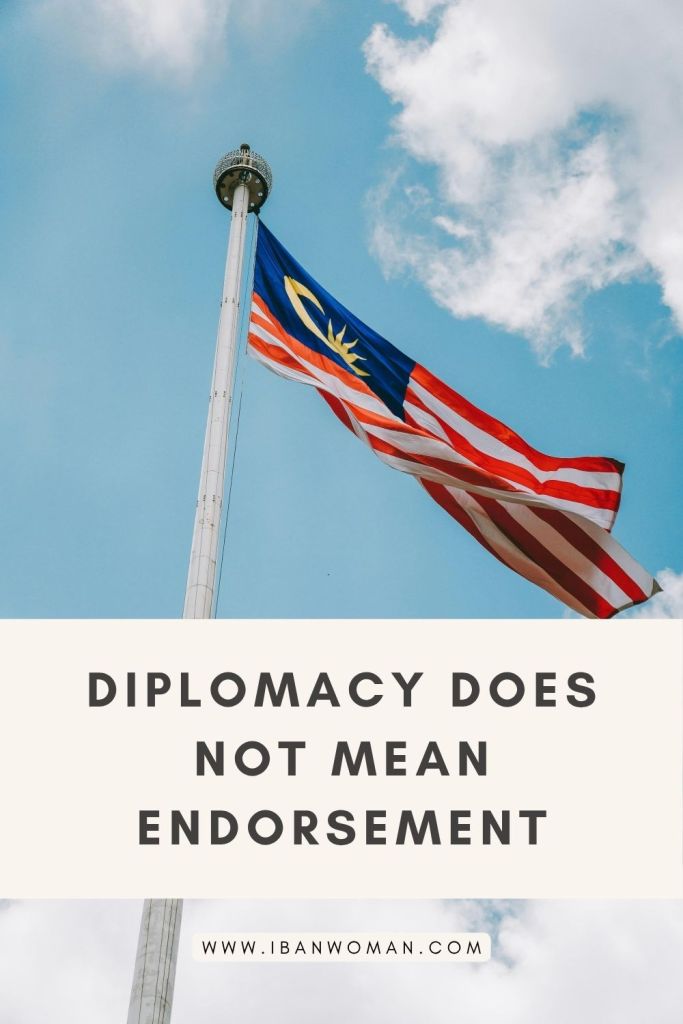
Last night, I responded to a post on Threads about Donald Trump’s visit to Malaysia for the ASEAN Summit. The original post questioned why Malaysians who support Palestine were not outraged that Trump was coming. I replied that world politics does not revolve around the Palestinian issue alone and that diplomacy requires engagement, even with those we disagree with.
What happened next wasn’t a conversation; it was an attack. Someone called me naive and even used my identity as an Indigenous woman against me. She said that as an Iban, I should know more about land grabs and colonialism, and she implied that I was betraying that history by defending engagement with the United States. She cited Cuba as a model, saying Malaysia should isolate itself, like Cuba, and reject American influence completely.
I understood where the emotion came from. The Palestinian struggle resonates with many of us, as it reflects the shared anguish of displacement and dehumanization endured by other marginalized groups. It has come to stand for the fight against empire and global injustice. I grieve for them too. But that one conflict isn’t the cause of all the crises in the world. Congo, Sudan, Myanmar, and West Papua all have their own histories, shaped by local power struggles, colonial legacies, and modern exploitation. The Palestinian cause is not the origin of imperialism, but it is part of a larger pattern of it.
The comparison to Cuba also didn’t take into account how complicated our region is. Cuba’s defiance of the United States is often romanticized, but the reality is much harsher. Years of economic sanctions have caused suffering and shortages. Cuba remained steadfast, but the isolation it endured came at a heavy cost to its people. That path is not possible for Malaysia. We are not an island nation shielded from regional shifts. We are part of ASEAN, a bloc that survives through dialogue, consensus, and constant balancing between larger powers.
To disengage would not make us righteous. It would make us irrelevant. Sovereignty is not merely about being alone. It is also about having a seat at the table where decisions are made. Engagement does not mean agreement. We live in the world as it is, not as we wish it to be.
Malaysia’s invitation to Trump did not mean endorsement of his policies or his past actions. It was part of ASEAN’s long-established diplomatic practice. The United States has been a formal partner in ASEAN-led dialogues since 2009, when President Obama signed the Treaty of Amity and Cooperation (TAC). The treaty symbolized a willingness to follow the “ASEAN Way,” a diplomatic approach that values non-interference, consensus, and mutual respect. The TAC made it possible for the US to join the East Asia Summit, where world powers discuss cooperation and regional security.
The Obama administration strengthened this relationship by shifting American focus from the Middle East to the Indo-Pacific through the Pivot to Asia. This decision acknowledged the growing economic and political importance of Asia, as well as China’s rapid rise. The US began to engage with ASEAN more seriously, not out of charity, but because it seeks stability in the region to serve its interests. That engagement, even if self-serving, gave ASEAN leverage over China, which was becoming more dominant.
We cannot ignore China’s role in the region. In the past decade, it has become more aggressive in the South China Sea by building artificial islands, expanding military presence, and encroaching into maritime zones claimed by Vietnam, the Philippines, and Malaysia. This has placed ASEAN in a difficult position. China is vital economically but intimidating strategically. The United States functions as a counterweight in this situation. Without an external balancing force, Beijing could exert complete dominance over Southeast Asia.
This is the uncomfortable truth of international politics: moral clarity and strategic necessity rarely align. Malaysia can speak out against injustice in Palestine and still maintain good relations with the United States. We can be against occupation and still welcome dialogue. These positions do not contradict each other. They are two forms of survival that coexist.
It is easy to demand purity from the sidelines, but governance requires nuance. To those who use identity as a weapon, I say this: being Iban does not mean rejecting engagement or diplomacy. My ancestors fought when they had to and negotiated when they must. They understood that survival depends on knowing when to speak and when to listen. Being practical is not disloyal. It is wisdom passed down from generations who understood the cost of isolation.
Cuba resisted and endured decades of hardship. Malaysia engages because we have learned a different truth, that sometimes the best thing we can do for our people is to keep showing up, even when it is uncomfortable. Diplomacy does not mean endorsement. It is how small nations stay relevant. It is also how Indigenous voices remain part of the global conversation and how we hold our place between superpowers that shape our future.
Note:
I am not a political expert. As a Malaysian Iban woman, I’m trying to figure out how history and power affect where we stand in the world. I’m not trying to defend any leader or nation. I’m just trying to remind myself that ideals don’t mean much if they lack a basis in reality. I believe small nations can hold both principle and pragmatism, just like people can be both kind and rational.
I write about Iban culture, ancestral rituals, creative life, emotional truths, and the quiet transformations of love, motherhood, and identity. If this speaks to you, subscribe and journey with me.

 Olivia's Atelier