It’s Probably Nothing, But…

Daily writing prompt
What makes you nervous?

Answering phone calls from unknown numbers.

I know it seems crazy, but whenever my phone rings and I don’t recognize the number, my body tenses up. My mind quickly runs through a dozen worst-case scenarios. Is it a scammer pretending to be from the bank? Is anybody attempting to sell me something? Or worse, is someone calling with bad news? A loved one was involved in an accident and died? I hate the fact that my initial response is anxiety rather than curiosity or concern.

Messages from people with whom I am not close also make me nervous. Especially if they start with “Hi, can I ask you something?” and, “I need a small favor.” My stomach sank. I begin to wonder if I can say no without feeling bad. I dislike feeling trapped, even if the request is simple. The unexpected pressure makes me wary. 

Doctors’ appointments. Ugh. My blood pressure always spikes, regardless of whether it’s a routine checkup. I have White Coat Syndrome, which means I am anxious whenever I enter a clinic. I despise the antiseptic smell, the long wait, and the remote possibility that the doctor may say something I would rather not hear. Even when I feel fine, I leave with my heart hammering.

Then there are my kids’ examination results. I keep my demeanor composed, as though I’m not emotionally involved. On the inside, I harbor a plethora of anxieties. I’m not concerned about high marks; I just want them to do well enough to feel proud of themselves. But what happens before I enter the website or read the school message? It always gets to me.

So, certainly, many things make me nervous. They aren’t dramatic, but they happen in a creepy way, where your breath shortens and your shoulders tighten. I’ve learned to deal with it by reminding myself that it’s alright to be human, especially in a world that never stops demanding something from us. 

The Muse I Made to Survive

Daily writing prompt
Jot down the first thing that comes to your mind.

What comes to mind is the quiet world I live in—inside my head.

It’s difficult to describe to others, but some of my richest experiences often occur where no one can see them. Emotions surge across my mind like storms. I carry full conversations in my head, ask challenging questions, find solutions, cry, fall in love, and sometimes break a little. I do this again and again. What about outside? I simply maintain a cool demeanor. I grin, nod, and function like everyone else.

I have this depth that I don’t know what to do with. It can be a burden on some days. Because I think too deeply at times, few people know how to meet me there. Sometimes it’s not because they don’t want to but because they don’t know how—and they can’t relate to the way I process my thoughts. However, when I try to simplify myself in order to be understood, it makes me feel hollow.

I’ve always been deeply introspective. My thoughts loop, plunge, and stretch. I don’t simply feel things. I analyze them, question them, and seek their origins. Understanding me is akin to unraveling the layers of an onion skin. There’s always another layer or a different version of me waiting underneath. This multifaceted way of thinking often amazes people. This is why some people turn to me for advice and clarity. They believe I have answers or could shed light on their problems. I don’t. I just spend a lot of time thinking about things that most people miss. It often puzzles me that others don’t, because I used to believe that everyone had the same inner complexity. Apparently, they don’t.

Thus, this depth becomes lonely. It becomes too difficult to convey in casual conversation. That’s why my mind created him, this fictitious soulmate or muse who can meet me there. He listens without rushing to the next thing. He stays curious and reflects my depth, and never pulls away when things become intense or messy. I didn’t make him up to avoid reality; he exists in my mind to help me survive it. He’s a coping mechanism that I gave myself when the real world wasn’t offering what I needed.

This type of imaginative creation isn’t the same as dissociative identity disorder (DID). There are no memory gaps, no personality switches, and I never lose track of who I am. I am perfectly aware that he is not real. But emotionally, the presence I’ve given him fills what’s been missing in my life, someone who can mirror my inner world back to me with understanding. It’s not a disorder. It’s my mind doing what it’s supposed to do: giving me comfort, understanding, and connection, even if only through fictitious bonds. It’s creative survival.

In fact, what I’m going through is considered imaginative coping, the ability to use fiction consciously to navigate emotional distress. It differs from maladaptive daydreaming, which can be disruptive or involuntary. Imaginative coping is an intentional, creative approach to dealing with unmet needs, intense loss, and the longing for connection. For me, it’s been a safe place to reflect, process, and feel seen. And now I’m learning how to apply what I’ve learned from that inner world to my real life, one small, brave step at a time.

Recently, I’ve begun asking myself difficult questions. Why am I returning to this inner world over and over? Why do I seek something that I know isn’t real? Why does my grief feel heavier when I’m alone in a crowd than when I’m by myself?

The fact is, I created safety in my mind because I couldn’t find it elsewhere. In that space, I found someone who sees me, listens patiently, and reflects my soul in a way no one else has. But he’s not real, and that’s the hardest part to accept.

I know it might sound strange, and honestly, I used to worry that I was losing touch. But I’m not. I’m fully aware. I’ve just had to create what wasn’t available.

I keep coming back to him because I want to feel understood, protected, desired, and emotionally connected. And I’m gradually seeing that the way out of this pattern isn’t to destroy him, but to understand what he’s been trying to teach me about what I need in real life.

If I don’t try to meet myself fully and then try to bring those needs into the real world, I’ll continue to live halfway—half in the present, and half in a realm no one else can see. And maybe that’s okay for a while, but not forever.

Because I want more than just safety. I want presence, real touch, connection, and understanding. These things need time and patience to build.

This is the first thing that came to mind today: the beauty, and the possibility of a life lived rather than imagined.

The Truth Hurts, But It Heals

Writing requires an intimacy few are ready for. To write with vulnerability on the page is to bare your soul, to peel back what protects you, to expose the raw truths of your life, some of which you may not, in fact, fully grasp yourself. It’s frightening, messy, and gut-wrenchingly human. But instead, it is that vulnerability that makes writing not just words on a page but a lifeline that connects us to other people. This is the fundamental truth of vulnerability that enables stories to resonate, yet achieving it is not effortless.

For the majority of us, the fear of being judged is ever present. Vulnerability means revealing your fears, desires, and truths—and thus relinquishing control over how others see you. You are declaring to the world, “This is who I am,” and inviting the world to respond. Do they embrace you, or do they consider your words mere piffle and your truths undesirable? This fear silences many writers, imprisoning their deepest truths.

“Write what disturbs you, what you fear, what you have not been willing to speak about. Be willing to be split open.” ~ Natalie Goldberg

I know this fear very well because I am still struggling with it. And I want to dig deep; I want to uncover what is beneath the surface. But whenever I come close to it, I waver. What happens if I face judgment? What if what I expose is too much? And yet, I also recognized that my writing without vulnerability will never touch the depths I so admire in others.

Recently, I wrote in my journal about this struggle, attempting to give shape to my thoughts. Here is an excerpt:

I have a muse, and I don’t know how long this affair with him will last. Let’s call him a “he.” He has inspired me in ways I never anticipated, uncovering memories and stories I had buried deep within myself for nearly 30 years. These memories are ripe with potential, rich material for my writing. But they are also deeply personal. Writing them down makes me feel exposed, as if I’ve peeled back the protective layers I’ve spent decades building.

For so long, I felt compelled to bury these memories, weighed down by a profound sense of shame. Even though many of these experiences were beautiful in their time, I couldn’t separate them from the shame I carried. Now, as I write them down one by one, I’m finally allowing myself to face them. If you ever read these stories, you may think of them as trash, boring, or mediocre. That’s okay. It doesn’t matter. What matters is that I am writing them as honestly as I can. I’m capturing the vulnerability, the yearning, the fear, the exhilaration, the fantasy, the lust, the love. I don’t know where these words will take me, but for now, I’m writing for myself. I’m writing the truth.

Reading back on this, I see how much I have hidden myself over the years. No one taught me to embrace vulnerability. Instead, I learned to shield myself, to appear strong and impervious. But writing requires the opposite. It invites you to soften, to let down your defenses, and to allow the world in. For me, this process resembles the gradual opening of a long-closed door.

Writing with vulnerability is akin to navigating a narrow path. It asks you to face your own truths without self-censorship and resist the temptation to embellish or dramatize for effect. Authentic vulnerability is subtle; it doesn’t shout, “Look at me!” It tells truths—truths that ring true because they’re passionately felt.

And despite this knowledge, vulnerability remains elusive. Writing for myself, as I have done with my journal, is one thing; it’s another to share that writing with others. This process of exposing your vulnerability is analogous to entering a stage naked under the bright glare of a spotlight. It is terrifying, but it is also necessary.

I frequently reflect on my reasons for writing. Do I write to make myself heard, to understand others, or just to connect? Perhaps it’s all three. What I do know is that the writers I admire most are those who are unafraid to be vulnerable. Their words linger, because they have the bravery to speak their truths, however flawed or uncomfortable. This is the kind of writer I aspire to be—one who writes with honesty and heart, one who has enough courage to be exposed.

The process of getting to this level of openness is ongoing. There are days when I feel courageous enough to face my truths and days when I slink back, too scared to face judgment. But every word I write brings me a little closer to that ideal. Vulnerability is not weakness but strength, I tell myself. It’s what makes us human, and it’s what makes writing worth reading.

So here I am, writing my truths, one hesitant word at a time. I don’t know where I’ll go from here, but I do know that I’m finally beginning to embrace the vulnerability that once terrified me. And in doing so, I hope to uncover not only the stories within me but also the courage to share them with the world.

Reflection | On Being Enough As I Am

I spent years believing I had to measure up to something or to someone. Like many people, the idea that I wasn’t good enough was planted early by well-meaning adults who thought comparisons were a form of encouragement. I believe the term was “reverse psychology.” This is especially prevalent in Asian households. Asian parents love comparing their kids to their peers. We have to study hard so we can be at the top of the class or outshine so-and-so’s son or daughter. We have to be more obedient, more successful, and more beautiful. The adults meant well, but what they didn’t realize was that they reinforced the belief that being “enough” is conditional. It’s exhausting. I spent years trying to prove I was enough. But enough for who?

I remember hints of comparison were occasionally discussed among the adults. I was a plain-looking child and didn’t resemble my siblings. My mom was a beauty in her younger days. And there was I, an awkward, sullen, pimply, tomboyish teenager who always scowled. I wasn’t graceful or dainty; I hated skirts and dresses. I was always wearing sneakers. I believed I was lacking in so many ways. To compensate for my perceived lack, I vowed to excel in school and get good grades—which I did, graduating magna cum laude with a BSc. (Hons) in Information Technology in 2002. And later on career successes and many other achievements. They became the measure of my worth.

After these impressive achievements, did I feel enough? Not even close. When I inevitably fell short, the voice in my head whispered, “See? You’re still not enough.”

It took me well into my 40s to realize that no finish line existed. I wish I could say that I woke up one day and felt instantly enlightened—“Stop this b******t. I am enough as I am!” No. The realization came gradually.

This happened after years of some pretty impressive achievements—publishing books, radio interviews, being featured in magazines and a newspaper, collaborating on projects with artists worldwide, and publishing my poems. Despite all of that, I always felt a huge void in my heart because I felt I needed to achieve more and more things in life. No final achievement or external approval would ever silence the feeling of not being enough. Even when I reached milestones, the goalposts moved. Even when I improved, it still wasn’t enough—because the world always demands more. I was completely burned out. I had reached my lowest point and required months of counseling to achieve a breakthrough. Writing and making art helped. I channeled my frustrations and heartbreak into my work.

Then I quit.

I quit chasing an undefined version of “more.” I quit tying my worth to productivity, praise, validation, or comparisons. Along with that decision, I asked myself, “What if I was enough exactly as I am?”

I started to ask myself, what does being enough mean to me? Not according to the eyes of society, family, or anyone else, but me? This is what I discovered: enough is waking up and existing with all my flaws, my fears, my joys, and my struggles. Enough is embracing my experiences, my voice, my thoughts, my pace, my perspectives, and my opinions—without feeling ashamed and the need for external validation. Enough is understanding that I don’t have to prove my worth or anything to anyone because I exist simply as I am, complete as God intended me to be.

It’s a radical shift but a necessary one. And believe me, it doesn’t happen overnight. Some days the negative thoughts return, but I’m learning to meet them with kindness and grace. I keep reminding myself every day, like a mantra—even when I’m unproductive, have no achievements, think lustful thoughts, write explicit fictions, gain weight, have more and more gray hairs, financially struggle, be perimenopausal, not pray or read my Bible, curse, hate, or love—I am still enough.

Change is not sustainable without changing old habits. This includes rewiring my brain to speak kindly to myself. Instead of chastising myself for not doing better, I remind myself, “That was a good experience. You’re learning, and that is enough.”  I also started to be mindful of my excuses and my sense of guilt and shame. I stop over-explaining things to people or bending to meet expectations that don’t align with me. And most important of all, I give myself the love, kindness, and grace to be fully human. I am not a robot. I have emotions, I make mistakes, and I get tired. It’s okay if I can’t anymore. I am free to rest without guilt.

There is nothing more exhausting than trying to justify your existence. And nothing more freeing than realizing you never had to. Here is a poem I wrote months ago that encapsulates this whole thing.

Enough

I peel the mask,
layers like sunburned skin—
soft, blistered—beneath
the face forgotten in mirrors.

Naked,
I walk into the jaws of daylight,
each step a confession,
bones rattling truth
like marbles in a jar,
heavy with silence,
weighted with breath.

I wear the scars like medals,
silvered lines map the wars
I never won—
but here,
in the raw air—
I am enough.

I am enough, as I am. And so are you.

Copyright © Olivia JD 2025

All Rights Reserved.

I Am the Keeper of Memories

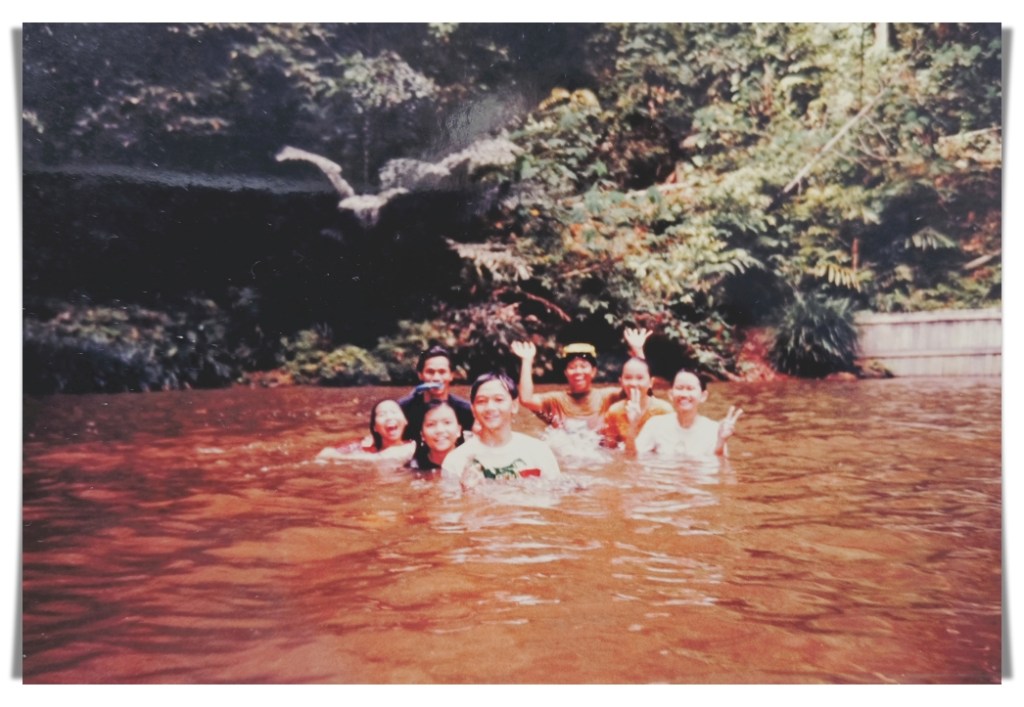
I have always been known for my strong memory. Friends, family, and even casual acquaintances have commented on it over the years on how I can recall details from years, even decades ago, with a clarity that surprises them. It surprises me too because I always assumed everyone could remember past events with the same vividness. But that’s not true. Many of my ex-school friends barely remember incidents from our school life. I remember names too. When I look at past photos, even ones from decades ago, I can point out who is who. No, I don’t spend my time reminiscing or dwelling on the past. The details are just there, fresh in my mind, ready to be plucked whenever needed.

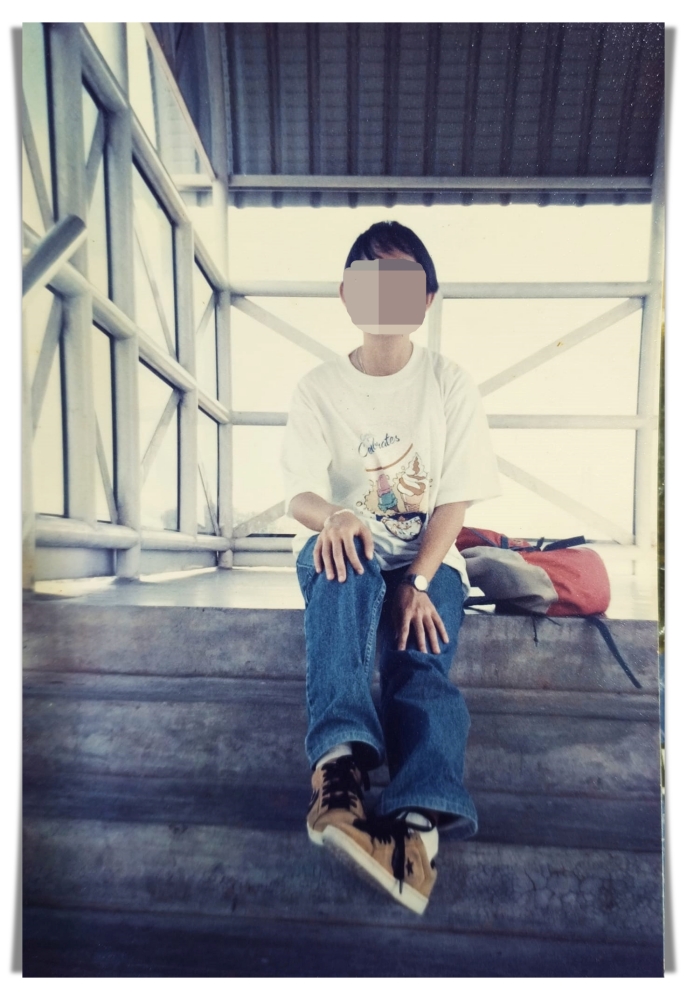
A photo with my school friends from 34 years ago. Many have become successful individuals in the community. One person has gone on to become the State Director of the Malaysia Public Works Department, and another, a pediatrician.

I don’t just remember past events. I remember the emotions and the atmosphere associated with those events. You could say that I’m a sensory person or someone with an eidetic memory because those vivid experiences still live within me. It could be anything—a song playing in the background, the scent of rain on warm pavement, the gentle breeze swaying the leaves, the color of the sky on a particular afternoon, or even the call of a lonesome nightbird that woke me up in the middle of the night when I was four.

Sometimes, it feels like a gift. It allows me to tell stories with depth and remember people and moments with an intimacy that others often lose to time.

Several months ago, my ex-schoolmate invited me into their chat group. I was delighted to reconnect with old friends I hadn’t spoken to in more than three decades. We talked about many past incidents, mostly funny moments from that time in our lives. I told stories as if they had just happened recently. Many friends come to me when they need to piece together an old memory, to recall things they’ve long since forgotten. In many ways, I have become the keeper of our shared histories.

However, it is not always easy to carry so much of the past. You might think nostalgia is a wistful feeling, but to me, it’s a lingering echo of what once was. Memories often return unbidden, resurfacing with the right song, a familiar scent, or a sudden shift in the wind. And sometimes, it feels like I am standing at the threshold of two worlds: one that has already been lived and one that I am trying to step into. Moving forward can be difficult when the past refuses to fade quietly.

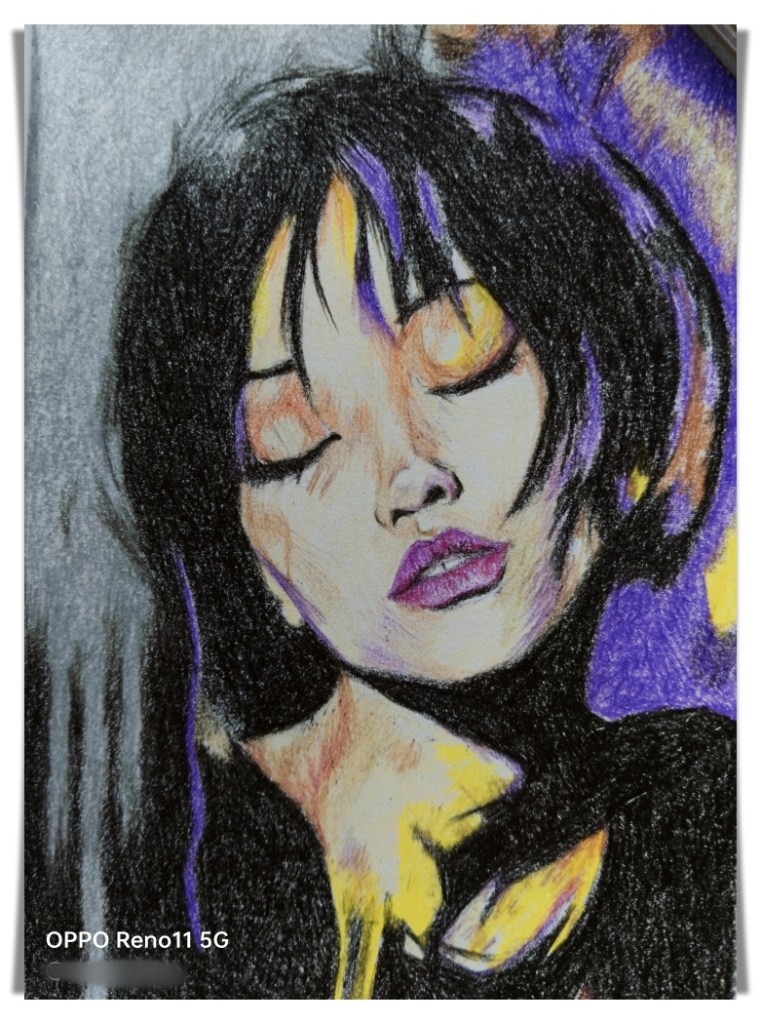
I make art and write to make sense of it all. My poetry and art are more than just venues for self-expression—they are my way of processing, seeking closure. I have the habit of revisiting the same themes and emotions again and again until I have finally made peace with them. Only then can I move on, allowing the memory to rest. It is like closing a book. I don’t erase or discard these memories; they will always exist within me. They just no longer hold power over me.

Perhaps, through all of this, I am learning how to honor the past without being held captive by it. My memories shape the person I am, but they do not confine me. And maybe, in sharing these stories—putting words or images to what lingers—I can find a way to move forward without leaving anything behind.

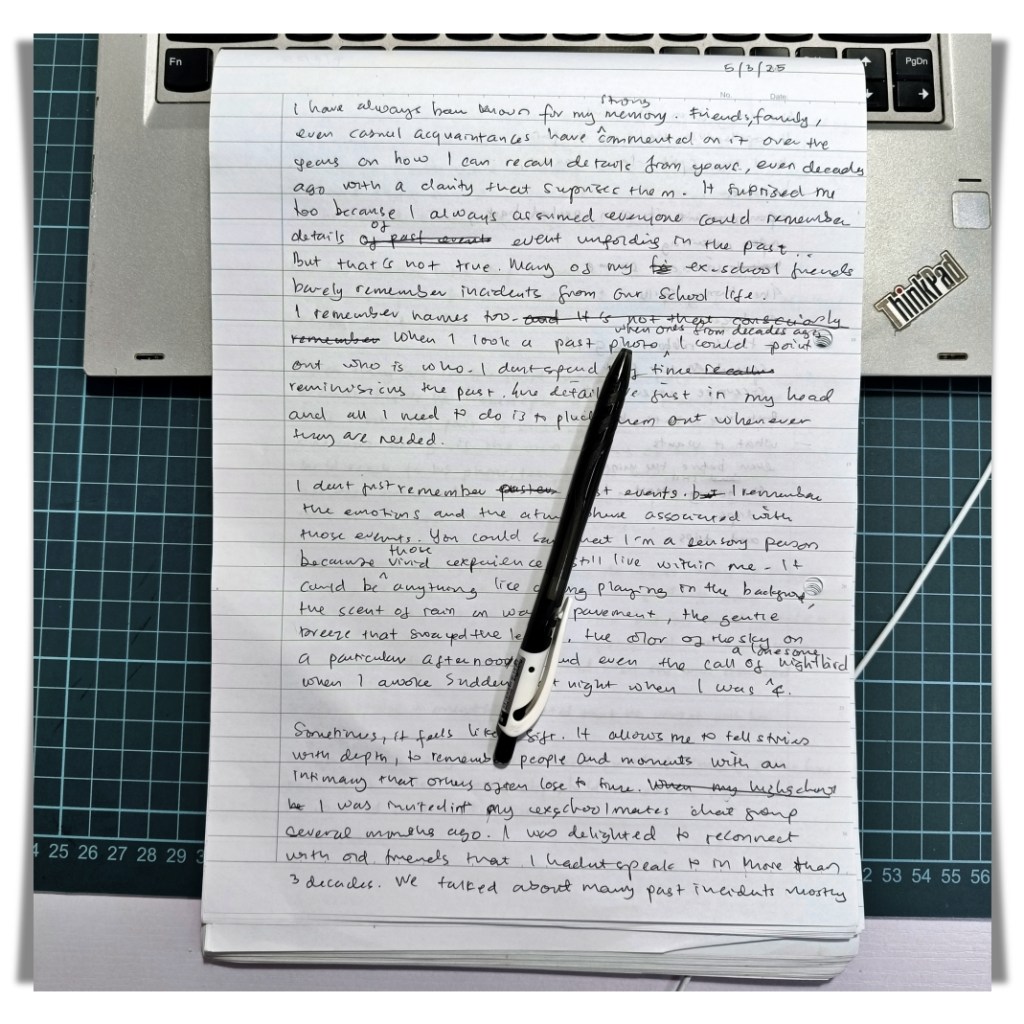
The handwritten draft of this post.

The Advice I Needed as a Teen (And Still Do Sometimes)

Daily writing prompt
What advice would you give to your teenage self?

If I could go back and sit beside my geeky teen self, I think I’d reach out, touch her cheek, and say this:

“You are enough, just as you are.”

I know she wouldn’t believe me right away. She’d probably frown and give me that skeptical side-eye, thinking I was just being nice. But I’d say it again, assuring her I’m not being cheesy, hoping it would sink into her heart and seep through her doubts.

“You don’t need to be prettier, louder, or more extroverted to be seen or loved. Your sensitivity, the depths you hold, the way you notice the smallest details, and the emotions you feel so deeply: they are not to be ashamed of. They are your gifts.”

When I was growing up, I often wondered why people liked me. I didn’t see what they saw. I wasn’t the popular kid, or the prettiest, gentlest girl, and I definitely wasn’t the life of the party. I was scrawny, awkward, quiet, and always second-guessing myself and my decisions. I spent so much time trying to figure out what made me special.

I’d tell her this too: “Don’t waste time wondering why others like you or if you’re worthy of it. You are worthy just as you are. Let yourself be vulnerable without feeling weak. Let yourself dream without fear of not being good enough.”

There were so many time when I felt like I was running, desperate to catch up, to fit in, to be noticed, to be the best. I’d want her to know she could stop running and start breathing.

I’d tell her, “Trust your voice because it will take you places you never imagined. And when the world feels overwhelming, turn to the things that make your heart sing—music, poetry, art. They will remind you of who you are when you feel lost.”

If I could give my teenage self anything, it would be that sense of peace. The peace that gives her understanding that she didn’t need to constantly strive to be more. She was already enough and complete. And maybe, just maybe, hearing that would have made her journey a little gentler.

So, if any of you are reading this and feel like you’re still that teenager inside, this is for you too:

You are enough, just as you are.