What I Know Now That I’m in My 40s

As I get older, I realize that change doesn’t stop. You don’t reach a certain point where you finally feel “together.” When I was in my 20s, I thought that women in their 40s had it all figured out. They knew how to love, how to parent, and how to stay calm when their world fell apart and the bills were late and the kids were fighting. But now that I’m here, I know the truth: we’re all still learning and figuring things out.

In my 40s, I no longer chase the idea of being extraordinary. I want to be real, present, and kind to myself. I’ve stopped apologizing for being quiet, for needing time alone, or for feeling deeply. I used to shrink myself so people would find me easier to digest and tolerate. Now I let the fullness of who I am take up space, even if it makes other people feel uncomfortable.

I have learned that performance doesn’t determine one’s worth. Worth doesn’t come from being productive, getting praise, or doing everything right. Even when I’m still, I am still worthy. Or when I’m unseen or unnoticed. Or when I am not achieving a single thing. This kind of emotional growth doesn’t happen overnight. It came through years of burnout and soul-wrestling, trying to be everything to everyone and having nothing left for myself.

Motherhood taught me that but not in a pretty, “Pinterest-quote” way. It taught me in the messy, heartbreaking moments that often happen in the trenches of parenting. Motherhood revealed the gaps in my patience, where I lost my sense of self or the ghosts I hadn’t exorcised yet. It forced me to look at myself when I was at my worst and ask, “Can I still be nice to my kids? Can I still stay and get through it all?”

Marriage, too, has been a teacher but not always a gentle one. Love in your 40s is less exciting and can be boring but I’m speaking from my experience. It’s less about the big, impressive things and more about the small, boring things like showing up for each other. Or listening when you’re tired and don’t really care about the nitty-gritty of it. Or saying you’re sorry first. I used to think that being in love was like being high. But now I know better.

My art and writing have saved me more times than I can count. They gave shape to emotions I couldn’t name. They held me when I felt invisible. When I returned to writing poetry after years on hiatus, it felt like coming home to an old friend who never stopped waiting. I don’t write to impress anymore; I write to learn and understand. I want to tell the truth without worrying about how it sounds or how it looks. That’s the heart of my creative healing.

And this is my truth: I am a woman who is no longer afraid to feel everything.

I’ve learned to slow down and take my time. I’ve learned to walk away when something costs me my peace. I’ve learned to take a break without guilt. I’ve learned to feed myself what nourishes, not what numbs. I’ve learned that joy isn’t something you chase relentlessly. Joy is something you notice. You can find joy anywhere you look hard enough. In your child’s laughter. In the soft, fading light at 7.30pm. In the peaceful and dull parts of your life.

I’ve stopped needing everyone to like me. Not everyone will. And that’s okay. I am not for everyone. But I am for the people who value honesty over performance, presence over perfection, and depth over decorum.

Being a woman in your 40s means I carry both tenderness and steel in my bones. I know how to hold space and when to keep things to myself. I know how to tell the truth even when it hurts. I still make mistakes, of course. I still feel anxious most of the time, but I’m not as scared of being seen as imperfect. There is no pretending. What you see is what you get.

I don’t have it all figured out. But I know who I am now. And I like her more than I ever have.

Now That I Know

I don’t need fireworks.
I light my own sky
with the hush
of knowing I survived.
No more performance prayers.
No more bloodletting for love.
If I bend now, it’s not to please–
but to plant.
My thighs and belly are soft.
My words are sharp.
I’m no longer a girl
waiting to be chosen.
I have chosen myself,
my whole being–
transforming.

© 2025 Olivia JD


Olivia Atelier offers printables, templates, and art designed to inspire reflection, healing, and creativity. Visit Olivia’s Atelier for more.
Marriage Refines You (If You Let It)

Nobody warned me that marriage would teach me the lessons I never anticipated.

They said it would take work. They said communication was key. They said love changes. All of this is true. But no one told me that marriage is fundamentally a slow-burning crucible of personal transformation. Of course there are romance and domestic joy, but those aren’t the main things. Marriage refines you. But only if you allow it.

If I had written this post twenty years ago, things would have been different. I would have told you about the joys of growing older together, about shared jokes and parenting accomplishments, and the comfort of being wanted and desired. I might have glossed over the friction. Or made it poetic, full of excuses.

But now, I want to tell the truth: Marriage teaches you who you truly are, often through pain.

This isn’t the kind of pain that stays with you forever, at least not in a good marriage anyway. But this pain would show you how weak, selfish, and proud you are. It’d expose the parts of you that you didn’t realize needed healing until you kept bumping up against another human being who sees you completely, and sometimes unflatteringly.

In the early years, I believed that in order to be respected, I had to be right. I used to believe that a good wife was someone who was nice and made quiet sacrifices. I thought conflict meant something was wrong.

Then came the truth: Conflict is the classroom. Friction is the fire. Silence is not always peace, and compliance is not intimacy. I learned this slowly and painfully, through nights of misunderstanding, long periods of emotional detachment, and the grief of feeling invisible.

Marriage has pushed me to confront my shadow selves: the part of me that resents when he doesn’t read my mind, the part that wants to be acknowledged for invisible labor, and the part that withdraws rather than communicates when I’m upset.

He has his parts too. When both of us are weary, stressed, or simply being human, those parts collide like stones.

But here’s what I’ve learned: Stones sharpen one another.

We grow as a result of the friction, not in spite of it. This relationship has gradually dispelled some of my misconceptions. I’ve become less concerned with appearing good and more interested in becoming whole. I’ve learned how to stay present during an argument without dissociating. I’ve learned to say, “I need this,” without shame. I’ve learned to apologize and own up to my mistakes because I value the connection more than the ego battle.

Marriage has taught me about perseverance. This perseverance is not the kind where you smile and bear it, but the kind where you continue to show up to face the difficult conversations, the painful realities, and the pain of building your character.

It has taught me that love is not the absence of conflict, but the willingness to hold space for each other’s growth.

This isn’t a post about martyrdom. This isn’t about perpetuating toxic behaviors or glorifying suffering. This is about the refinement that happens in long-term relationships, when two people choose to keep coming back to the table, even when it is a mess. Especially when things are messy.

Some days, love looks like scrubbing the kitchen while the other sits quietly. Some days, it looks like asking, “Can we talk?” even when the previous talk didn’t end well. Some days, it means choosing forgiveness over keeping score. Other times, it involves setting a boundary that says, “I will not carry this alone anymore.”

Marriage as a teacher is subtle, persistent, and deeply transformative. Refinement doesn’t happen all at once. It’s gradual, and at times it feels like failure. But what I do know is that I am not the same person I was when I agreed to this life together. And I’m thankful.

Marriage, in its own imperfect, beautiful and annoying way, is a never-ending teacher. And I’m slowly turning into someone I can be proud of, not because I’ve mastered love, but because I’ve let love master me.


This Is Not a Love Poem (But It Is)

This is not a love poem.
It doesn’t lace silk into longing
or wraps itself around your wrist
like a bracelet of breathless metaphors.

It’s the crack under the door
when we don’t speak for hours.
The grease-stained dinner plate
left by your elbow
and the silence I sit with,
like a burning candle.

This is not a sonnet.
This is the sound
of your sigh in the middle of my sentence.
The way you leave the room,
still loving me.

I wanted something softer, once,
but this? This is love
that turns me over like soil.
That presses its palms into my spine
and says: grow here.

I have.

And it hurts.
And it heals.
And it is you.

© 2025 Olivia JD


Olivia’s Atelier offers printables, templates, and art designed to inspire reflection, healing, and creativity. Visit Olivia’s Atelier, Redbubble, and Teepublic for more.

Marriage Traditions of the Iban of Sarawak, Borneo

Marriage is a timeless union that binds two souls together. It also functions as a mirror, reflecting the core of a community’s culture and identity. My people, the Iban of Sarawak, Borneo, fill their traditional wedding rituals with deep meanings based on ancestral traditions. However, these traditional ceremonies are gradually disappearing as time passes.

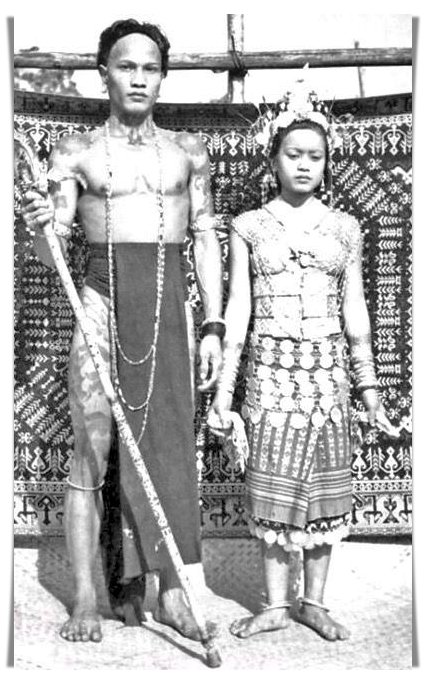
For the Iban, marriage was not just a bond between two individuals but a communion of families and communities. Traditionally, the groom’s parents carefully planned this arranged marriage. Ties of kinship often influence their choice of wife. Cousins were preferred matches because they preserved familial relationships while also reflecting the Iban’s value of unity within their extended network. When a bride was chosen, the groom’s parents would leave a rawai (silver girdle) or an ilang (sword) at her family’s home as proof of their dedication and intention.

Image source

The longhouse is the heart of Iban community life. During weddings, it becomes a lively epicenter. It was here that life and celebration collided, and the community joined together to honor the union. Careful planning is required days or weeks before the ceremony. This includes making tuak (rice wine) in enormous vats, preparing traditional buns and cookies, and selecting livestock for slaughter. Guests were invited with knotted strings to tally down the days till the celebration.

On the wedding day, the groom’s journey to the bride’s longhouse was a ceremony unto itself. The groom’s party traveled to the bride’s longhouse either by boat or on foot through the jungle. Guests were expected to dress in traditional ngepan (intricate traditional costumes), with women donning corsets or rawai (silver girdles) and men wearing armlets and feathers, among other traditional pieces. The groom’s party arrived to a joyous clash of gongs and the firing of brass cannons.

However, underneath the surface of celebration were rituals with deeper meanings. One of the most remarkable customs was the use of poetry or poetic language to provide the ceremony a sense of artistry and depth. When the official ceremony started, the host’s representative would offer the guest a drink, followed by a formal recitation inquiring about their purpose:

“I hesitate and feel nervous to talk in front of you all,
The reason I say so is because I realize that you are the mothers of porcupines,
Covered with cross-stripped white quills,
Pointed like bradawls.
I notice that you are the mothers of hornbills,
With tails striped,
crossing at right angles,
Which claim that they can fly to Brunei and return the same day.
I see that you are the mothers of bears,
Which have stout arms to make holes on the trunks of iron-wood trees.”

“We, therefore, have been sitting next to each other.
I would like to ask,
Which one of you is the mother of the hornbill?
For I am about to ask you to spit out the seeds of the belili tree,
In order that they can be picked up by a tall, unmarried lady,
So that they can be turned into the tusks of a pig,
As charms for the unripe ears left till the last in reaping,
With which we fill our padi bins.”
Poem source

These exchanges were rich in metaphor and eloquence. The poetic recitations continued throughout the ceremony, including a betusut (genealogical recitation) by an expert who detailed the bride and groom’s genealogy. This ritual not only validated the union but also ensured that the marriage respected cultural taboos and norms in order to avoid misfortune.

Image source

Elders sealed the union with feasting and storytelling, bestowing blessings and wisdom on the pair. They discussed respect, understanding, and the delicate balance required to navigate life together. Complex traditions and customs infused every action, from seating arrangements to gift exchange.

Today, such ceremonies are a rarity. The Iban embraced Christianity and Islam, abandoning many of their traditional practices in the process. The vibrant rituals of traditional Iban weddings now exist mostly in memory or retellings.

The ceremonies detailed here are not simply rituals. They depict a way of life that places a high priority on community, heritage, and balance. They remind us of the beauty of traditions that once connected people to their past while celebrating the present. The decline of this tradition is a loss not only for the Iban but also for the universal human story of connection, identity, and belonging.

The significance of the Iban wedding customs strikes me as I reflect on them. Marriage was never just about two people; it was about integrating their lives into the larger fabric of their community. It was about love, shared responsibility, and the power of a collective spirit.

Perhaps that is the true power of these traditions: their ability to touch something deep within us while also reminding us of the fragility and beauty of cultural heritage. And as we look forward, perhaps we have a tenacious hope that even as the old ways fade, their spirit will continue to shape the future in ways we may not fully comprehend.

Modern Iban weddingImage source.

The Loneliness That Lives Inside Love

Daily writing prompt
What’s something most people don’t understand?

Image source

Most people don’t understand that you can love someone deeply, share a life with them, raise children together, sleep side by side every night—and still feel alone.

You still feel alone—not because they don’t love you or they don’t try. It’s because they can’t meet some of your deepest needs. Again, this is not because they’re unwilling or are dense but because that’s not how they’re built. That’s not who they are. You can’t force people to be what they are not. 

This post is not meant to bash my husband.

My husband and I had been together for 26 years. That’s a long time to share a life. Throughout our marriage, he carries many burdens. He works hard and often under tremendous pressure. He provides and makes sure we have what we need. The kids and I never lack anything and I see that and never take it for granted. Every time he comes home from work, no matter how exhausted he is, he still smiles and gives me a warm hug. When the kids were little, they would race to the door to greet him. And sometimes they still do, even as teenagers. I know what that kind of weight does to a person—the pressure of being the provider and the silent burden of responsibility.

But I carry a lot of weight too. And most of them are invisible. It’s emotional and mental load. The labor of noticing, of anticipating needs, of asking questions to diffuse stress, soothing tensions, bridging gaps.

People rarely see that part. They think that if a marriage lasts, it must be balanced. But many don’t realize that love doesn’t always mean symmetry. 

My husband is a sweet, sweet man. He is not cruel or careless. He simply wasn’t taught how to sit inside discomfort and witness pain without attempting to fix or fleeing from it. He tries in his own way by cracking awkward jokes, physical closeness, showing up with food or spoiling me rotten. And I’ve learned, over the years, to see the love in those things.

But I must be honest and as a writer, confronting my deepest truth is necessary. I want more than physical efforts or gestures. I want to be seen and not just supported. I want conversations that delve deep and not just coexistence. I want someone to meet me at the door of my inner world and not be afraid to come in. 

Am I being bitter and writing all these down under the cloak of anonymity? Certainly not. We discussed this many times and he’s admitted he can’t meet me there because he is who he is and not built that way. And I acknowledge and accept him as who he truly is. And with acceptance, there is peace. Because I know I haven’t met all of his needs either. Marriage always goes both ways.

Most people don’t understand that kind of grief. It’s the grief that comes with loving someone who can’t meet you where you are. It’s bittersweet and lonely. That loneliness doesn’t scream—it’s just there, aches, and lingers.

But even within that grief, there is love. There’s kindness, history, forgiveness, effort, sacrifice, and acceptance of all that is good and bad. I love him so much. We are trying. Maybe not always in the same way, but still—we try each and every day. 

We both carry weight. His is visible, important, and perhaps measurable in the eyes of the world. Mine is not. And that’s what most people don’t understand. 


I wrote this poem to accompany this post. Here you go:

Marriage

I fold the laundry—
his shirts, inside out,
boxers with holes,
T-shirts over-stretched,
but we wear them anyway—
like this marriage—
flawed, warm in its own weather.

My mind jumbled with lists—
he doesn’t see them.

He brings home groceries
but forgets the eggs.
The kale is yellowing on the edges.
When good mood returns
he touches my hip like a question,
but never waits for the answer.

Still, he comes home.

Every night,
hanging his silence next to mine.
We sit.
We eat.
Scroll through our newsfeed.

I carry the emotional X-rays,
the careful calibration of my moods
to his weather.

But he carries things too—
numbers, bills,
the fear of shame
of not being the man
his father never taught him to be.

We are not broken,
only bruised by expectation.

And still,
he holds the child when I break,
warms the bed before I slip in.
Calls me “babe”.
In return,
I still reach for his length
to soothe myself to sleep.

So no—
I don’t need rescue.
This is the truthful
opening of the hearts
of two people
carrying what they can.

He lifts the roof.
I hold the floor.

And in the middle,
we meet.

Copyright © Olivia JD 2025
All Rights Reserved.

You are welcome to subscribe to my blog if my words resonate with you. Thank you.