When Motherhood Feels Like Too Much | A Reflection on Netflix’s Straw

Image source

I don’t watch many movies from Hollywood. But something about Straw, a Netflix movie, drew me in. I didn’t know the actors’ names. I didn’t read the reviews. I simply watched it and empathized.

Taraji Henson, who played Janiyah Wilkinson, a single mother struggling to make ends meet and to care for her sick daughter Aria, gripped my heart from the first scene. I didn’t care what critics said. Who needs them when we can form our own opinions? Watching Janiyah in that moment, she was like many mothers I’ve known. Every mother facing the struggles of motherhood, every mother who has fought, broken, and somehow kept going. I had never heard of Taraji Henson before this film, but her portrayal will stay with me.

Straw brought me to a world that was unfamiliar to me in some ways: an almost all-Black cast, a peek into lives and difficulties shaped by a reality I don’t live but deeply empathize with. It was a story of survival, love, and the crushing weight of systems created with little regard for people at the bottom. And at its core was Janiyah, a single mother who awoke that day believing she could handle everything, only to find herself in one difficult circumstance after another.

I saw myself in her. I saw many of us. Though I admit that my problems may pale in contrast to hers. The moment she snapped? I made no judgments about her. How could I? I understood. The never-ending cycle of striving to earn enough, care enough, and keep it all together in a society that keeps asking for more and more and giving so little in return. The dysfunctional healthcare system (healthcare that costs so much more than most people can afford—pure evil), the lack of emotional support for moms, and the feeling of being invisible in a world that only sees what it wants to see.

Motherhood can be so isolating, impacting motherhood mental health and contributing to motherhood exhaustion. Even when we are surrounded by people, we may feel alone in our struggles. And when there is no one to support us through the most difficult times, the weight of it all can feel intolerable. That is what Straw conveyed so powerfully for me. That is what I wanted to honor in this reflection.

I’m not writing this to offer solutions. As a mother, I understand that no one can fix what we’re going through. We don’t expect anyone to. We don’t ask for handouts or miracles. But sometimes what we want most is to be seen. To hear someone say, “I see you. I see your effort. I see the fatigue. You aren’t invisible or forgotten.”

That is why I began making emotional support materials for mothers, such as printables for mothers, poems for struggling mothers, and art for overwhelmed moms. Whether you’re seeking a printable for mothers or a poem for struggling mothers, these small creations are here for you. Small gestures that provide comfort, silent reassurance that someone out there understands. No, they don’t fix the problems. But perhaps, in some small way, they might shine a light on a dark day.

Before I close, I want to leave you with a poem. It’s a piece I wrote after watching the movie. It’s raw and honest, dedicated to mothers who feel unseen and overwhelmed.


For the Mother

This is for the mother who kneels
on the bathroom tiles, her sobs
swallowed by the flush of the toilet,
who locks the door not for privacy
but to cage the animal of her grief.

For the mother who starves herself
down to bone, who offers her child
the last crust of bread like a sacrament,
her own mouth full of nothing
but the bitter taste of absence.

For the mother whose spine bends
under the weight of a thousand silent storms,
who still paints her lips red at dawn
and sings lullabies through her teeth.

You are not invisible.
I see you—
your hands, cracked and holy,
your ribs, a cathedral of sacrifice.

You think you are drowning,
but darling, you are the ocean itself,
fierce and unforgiving,
swallowing the moon whole
and still rocking the shore to sleep.

You are not failing.
You are a war fought in silence,
a wound that blooms into a mouth
that says yes when the world says no.

You are more than enough.
You are the goddess no one prays to,
the unlit match in the dark,
the silence, the tempest, the aftermath.

©2025 Olivia JD


If you’re reading this, I want you to remember: your struggle is real, and so is your strength. You are seen. You are not alone. May we keep finding small ways to lift each other, and may you always know, you matter.

If this reflection resonates with you, I invite you to explore my creations at Olivia’s Atelier on Etsy, Teepublic, and Redbubble. Every piece is made with the intention to offer gentle support and inspiration.

Luther — The First Boy I Ever Loved

It was 1989. I was twelve, shy and dreamy-eyed, in Primary Six. Luther was fourteen and in Form Two. He had the most beautiful eyes I had ever seen. We met at Christening classes on Wednesday nights. I watched him from across the room, my heart racing. I was torn between wanting him to notice me and wanting to stay hidden.

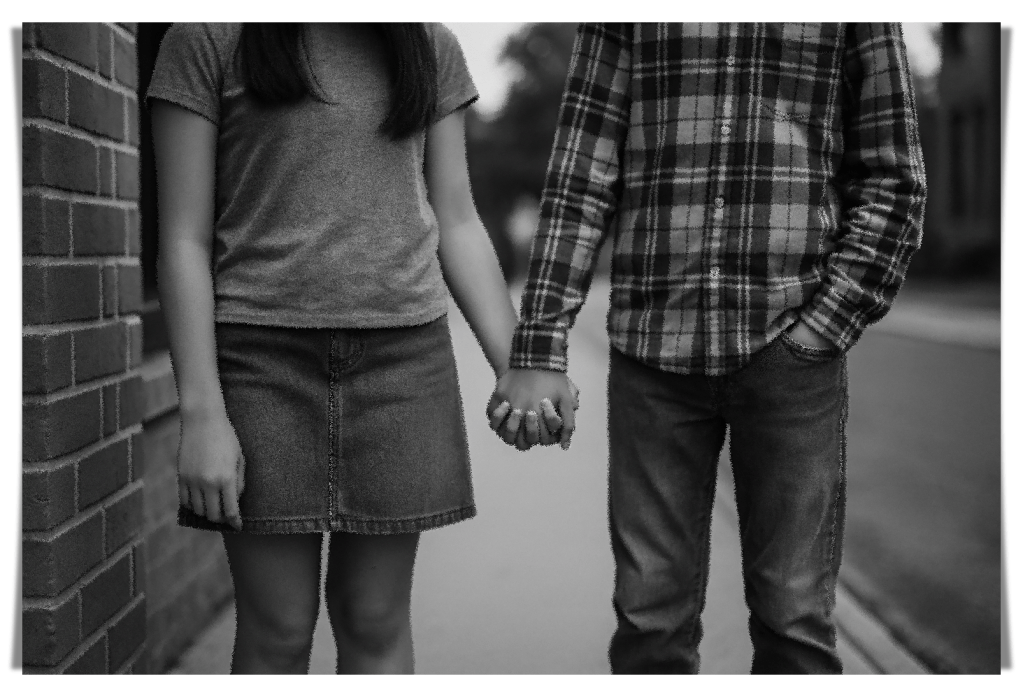
It was my best friend who, with a cheeky grin, told him my secret. I was so embarrassed that I wanted to sink through the floor. But that night, everything changed. Luther noticed me and paid attention from then on. We exchanged love letters, filled with clumsy, big-hearted words, and met on small dates behind some buildings; nothing grand, not even kisses. We simply held hands and talked.

But by December of ’89, my father’s job took us to a new town, and just like that, our brief, sweet chapter ended. We didn’t keep in touch because we were too young, and maybe we both knew deep down that first loves are only supposed to last a short time.

Now that I think about it, that experience really changed how I think about love and connection. It wasn’t just about the boy or the letters or the stolen glances. It taught me that love, even in its simplest form, is about seeing and being seen. It’s about feeling, in that fleeting moment, that you matter to someone.

It makes me think of The Wonder Years, an American TV show that was on our local channel at the time. Kevin Arnold’s journey through the awkwardness, joy, and heartbreak of growing up felt so much like my own coming of age. His sweet, tentative relationship with Winnie Cooper; their shy glances, their first kiss, the way they kept circling back to each other through the ups and downs. I understood that kind of love, the sweet young love. Luther and I had our own little universe for a while, much like Kevin and Winnie. We taught each other about hope, tenderness, and letting go, just like they did.

Luther

You had eyes that swallowed me whole—
a storm behind glass,
soft enough to fool me.
Your lips never touched me,
but I felt them anyway,
like rain through a roof crack.

We wrote each other down in crooked lines,
gave ourselves to paper,
to the dark between stars.
For a while, you were a fever I didn’t want to break—
a name I kept folding smaller and smaller,
to hide.


Olivia Writes offers printables, templates, and art designed to inspire reflection, healing, and creativity. Visit Olivia’s Atelier, Redbubble, and Teepublic for more.

What His Silence Taught Me About Intimacy

It wasn’t an awkward silence. Nor the silence of distance or dismissal. His silence was something else entirely. It had gravity. Shape. It wrapped around me like twilight settling over the city. And in that silence, I discovered something I never fully understood before: intimacy does not necessarily manifest itself through words or touch.

In those early days, I remember him across the café table. We spoke, certainly. But it was in fragments. There were lengthy intervals where nothing needed to be said, yet I never felt compelled to fill the silence. He never pushed. Never filled silences just to hear himself speak. And maybe that’s why I found myself letting my guard down, little by little, without even meaning to.

There was something sacred in how he listened. He didn’t listen to respond. He listened like he was trying to memorize me. When he finally did speak, it wasn’t to impress or correct me but to reflect something I hadn’t realized I was trying to express. His silence wasn’t an absence. It was presence without intrusion.

One evening, we stood side by side on Lover’s Bridge. The river shimmered beneath us, and the sky was painted in pink and gold. We didn’t touch. We didn’t speak. But something passed between us, though, that couldn’t be seen or touched. Somehow right then and there, our bodies found a rhythm beside each other, like the choreography of trust.

What surprised me the most was how seen I felt in his silence. He didn’t demand performance. He didn’t ask for confessions. And yet, standing next to him, I felt understood. It felt as though he was able to hear everything I didn’t say yet still chose to stay.

That kind of intimacy is unusual. It asks nothing but provides everything. It is not based on lofty declarations but on humble agreements. Like how he read my poems and didn’t say anything after but looked at me with nonjudgmental eyes. Just understanding.

In a culture obsessed with noise and proof, he reminded me that some truths are whispered. Some of the most personal experiences we may have are felt rather than expressed. Some bonds are born not in words, but in willingness. To stay. To witness.

So no, his silence never made me anxious. It made me feel safe. It taught me that intimacy isn’t always loud or clear. Sometimes it’s a quiet agreement between two people who stop pretending they have to explain everything to be understood.


✨ Visit Olivia’s Atelier for printables, reel templates, and planners made to support overwhelmed moms with gentle, soulful tools.
🕊️ Enjoy 50% off everything until June 30.

This Is Not the Mother I Meant to Be

I could name only one, but that wouldn’t be honest.

A lot of times in my early years as a mother haunted me quietly like background static in an otherwise happy song. The yelling, harsh words, and unwarranted anger all fell directly on little shoulders. I wrote a poem about it once. It’s titled This Is Not the Mother I Was Meant to Be. It is now available in my Etsy shop, which can be found here.

The poem is more than just a piece of text. This is my confession. A gentle, timid apology. A mirror I held up to my own face on days when I thought I had failed in the most important duty.

I meant to be gentler. I wanted to listen more. But there were times when I snapped, yelled when I should have breathed deeply, spanked when I should have paused, gave them junk food and called it dinner and said things I wish I could take back. Things like, “Be quiet. Enough. Just stop.” When all I truly wanted to say was, “I am exhausted, honey. I am trying. I love you so much, it hurts.”

Even now, the guilt weighs heavy. But, with time, I’ve realized that remorse isn’t supposed to tie me to the past. It is meant to teach me, then let me go.

As the kids grew older, I began having open conversations with them. I apologized. Not in grand speeches, but in quiet moments together: during car rides, at bedtime, or while having a meal. To my astonishment, they forgiven me. Completely, freely. As children frequently do when love triumphs over regret.

Their forgiveness was a balm. But can I forgive myself? This is still a work in progress.

What comforts me now is the realization that motherhood is not a destination. It is a process of growing. Every mistake I made was the result of a version of myself doing my best with what I knew. And I understand better now. I pause longer. I listen more carefully. I still make mistakes, but I’m more aware of them. I grow together with them.

So, if you’re a parent who’s been lugging guilt about like a hidden stone, maybe it’s time to let it go. Perhaps you can let the softer part of yourself speak. The one who continues to show up, try, and love with each broken, beautiful step.

Because this is not the mother I meant to be. But I’m still evolving to be a better version of myself.


Visit Olivia’s Atelier for printables, reel templates, and planners made to support overwhelmed moms with gentle, soulful tools.
🕊️ Enjoy 50% off everything until June 2.

A Mother’s Day Reflection

I didn’t grow up imagining myself as a mother.

Not as other girls did, pretending to cradle dolls or writing baby names in the margins of their schoolbooks. I wasn’t opposed to becoming a parent; it simply didn’t feel urgent, like something I needed to pursue or prepare for. And yet, I am here. It’s been years. A mother. With gentle hands and a heart that is always rearranging itself around little lives.

Mother’s Day used to pass with little thought. A day spent playing cards and making phone calls. Of seeing my own mother from a distance, attempting to decipher the aspects of her that I could never fully grasp. I had no idea she felt so invisible at the time. When you’ve given everything to others and lost yourselves, silence may be deafening.

Now I do.

Mother’s Day is now a quiet occasion in our family. The kids sometimes remember and sometimes they don’t. My hubby asks what I want to eat. I fold the laundry and do the dishes anyway. Life does not stop simply because it’s May. However, a part of me always wishes for a pause, if only for a moment. A pause that says, “We see you. It is not simply what you do, but who you are underneath it all.”

This year, I didn’t request flowers or breakfast in bed.

What I desire cannot be purchased or arranged.

I want someone to acknowledge my effort. How I manage to show up even when I’m very exhausted. How I manage to kiss their foreheads at night despite carrying the weight of invisible things like schedules, fears, and guilt. I want someone to say, “I see the woman you are, not just the mother you have become.”

Because I’m both.

A woman who once had aspirations that did not involve diaper bags or parent-teacher meetings. A woman who still longs for quiet mornings and uninterrupted thoughts. Also, a mother who has dedicated her body, sleep, and time to love so profound that it has utterly transformed her.

So, on Mother’s Day, I gave myself what the world frequently forgets to give: grace.

Grace for the things that remain undone.

Grace for the yelling I regret doing.

Grace for the dreams I’ve placed on hold.

Grace for the ways I am still learning to parent myself.

And maybe that’s all it needed.

Happy Belated Mother’s Day to the quiet mothers, the tired ones, the fierce ones. The ones who feel like they’re failing but keep showing up anyway.

I see you.
And I’m learning to see me, too.


Mother

They see
lunchboxes prepares,
schoolwork signed,
clothing neatly arranged into piles.

But they don’t see
the woman who forgot who she was
before responding to “Mama.”

They don’t see
how she holds her breath
until the door closes,
and she can cry
without needing to explain.

They don’t see
how she forgives herself
in small rituals—
a hot cup of tea,
a song in the car,
a scrawled poem
at midnight.

They don’t see
her saving herself
a little at a time.

And still
she shows up.
Every day.
with love nestled
into every nook of her weariness.

Because this is what she does.
That is who she is.

Copyright © Olivia JD 2025
All Rights Reserved.


Looking for digital tools that support your everyday life with gentleness and intention?
At Olivia’s Atelier on Etsy, I offer more than just pretty printables—I create emotional support kits, Instagram reel templates, children’s meal planners, and other soul-nourishing resources for moms who give so much but rarely feel seen. Whether you need a moment to breathe, a tool to stay organized, or a way to connect with your audience—there’s something here for you.

🕊️ Everything is 50% off until June 2—because you deserve support that feels doable, beautiful, and kind.

If I Could Be a Criminologist for Just One Day

Some prompts ask for fantasy, but this one nudged me toward truthfulness and honesty. If I could choose any job for just one day, I wouldn’t reach for prestige or power. I wouldn’t imagine myself on a stage, in a lab, or leading a corporation. 

I’d choose to be a criminologist. 

No, I have no interest in solving crimes, examining evidence, or pursuing cold cases. Nothing like that. It is because, a long time ago, I met a criminologist and we fell in love. I want to understand him, this man who carries so much and says so little. 

What would it be like to spend a day in his shoes? I want to walk silently through his memories, particularly the ones that linger in crime scenes after everyone has left. I want to sift through his memory that stands still in front of a whiteboard full of tragedies. I want to walk through his memories because I could never reach that part of him no matter how hard I tried.

I wouldn’t be there for the thrill. I’d be there to observe the way he looks at the world when no one’s watching. I’d want to finally learn the stories he never said out loud to me, even when I cradled his head in my arms as he struggled to wake from his dark dreams. 

I’d trace the photographs he pins to the wall—the faces of the dead— and see his handwriting curve along the margins. I’d watch how he circles certain names darker than others, the lines thicker when the pen pressed harder with his instinct. 

At lunch, I’d sit across from him while he quietly picks at his food. I’d watch how his eyes drift with restraint. He sees everything. He just doesn’t always let it show.

Maybe by being a criminologist for a day, I’d learn what it means to hold other people’s pain without crumbling. And maybe I’d finally understand why he sometimes looks at me like I’m a mystery too.

By the end of the day, I’d return the badge, the case files, and boxes full of evidence. I wouldn’t need to stay. 

Because…I never want the job.

I just want the man behind it. 


Some days, love is remembering someone’s shadow. It’s like bearing witness to the way they disappear into themselves, hoping you’ve seen enough to still find them in the dark.

A poem to accompany this piece.

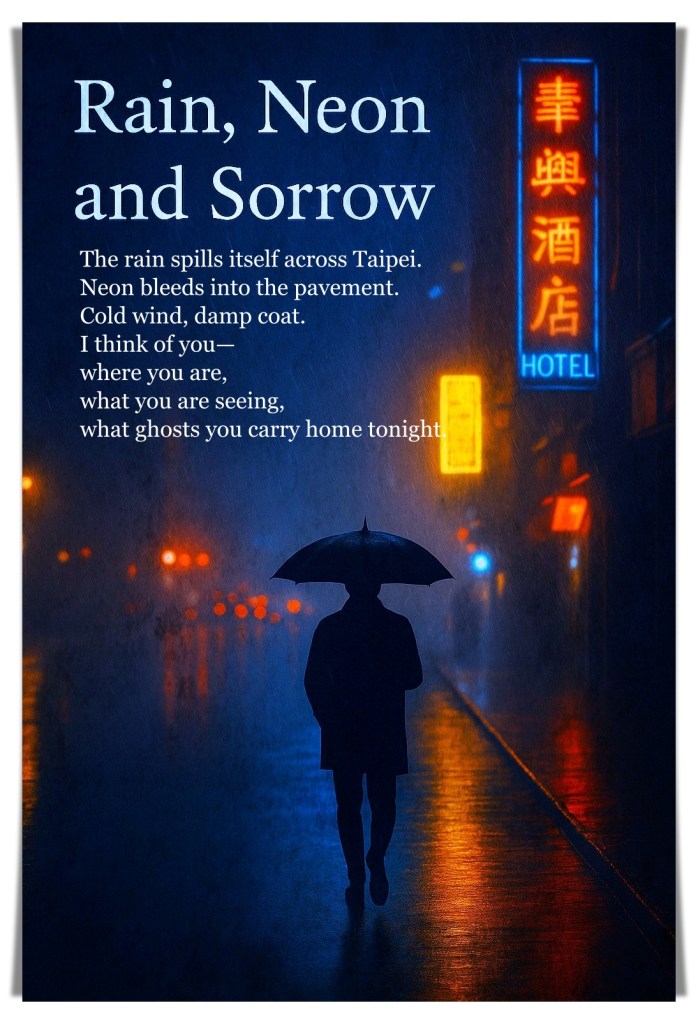
Rain, Neon and Sorrow

The rain spills itself across Taipei.
Neon bleeds into the pavement.
Cold wind, damp coat.
I think of you—
where you are,
what you are seeing,
what ghosts you carry home tonight.

Are you still bent over your desk,
searching for a disease,
fingers tracing the city’s veins—
sharp like a scalpel?

Are you peering again into the abyss?

Tell me—
how much blood have you washed off your hands?
how much stays,
burrowed beneath your nails,
tucked inside your sleepless bones?

I’ve seen you stare past me
with eyes that see things
you will never say.

You kiss me like a man
leaving a crime scene.
Touch me as if memorizing evidence.
Does love feel like guilt to you?

My love won’t pry open your fists,
won’t drag you back from the ledge
among the dead.
In this city of rain, neon and sorrow,
I wonder—
are you still whole?
still awake?
or has the night already claimed you?

Copyright © Olivia JD 2025
All Rights Reserved.

The Way She Unwinds

Daily writing prompt
How do you unwind after a demanding day?

Note: This post contains sensual content. It’s tender and intimate, not graphic, but may not be for everyone.

Unwinding doesn’t always mean drinking herbal tea or watching Netflix. It could be about reconnecting with yourself, through your body and the presence of others.

I wrote this to examine what it means to let go of the day physically as much as emotionally. Not everyone discusses how sex may be therapeutic, grounding, or even spiritual. But it is for me.

This is an honest and vulnerable piece. I don’t believe we should hide our tenderness or yearning. Sometimes what heals us the most is the part that we’re afraid to say out loud.

She washed the day off her skin—
rose oil, lavender salts,
tepid water,
with a man behind her
who didn’t speak,
semi hard
against the curve of her spine.

She leaned back,
exhaled her weariness
mingled with steam rose like ghosts
from the bath they shared.
He shampooed her,
untangled the strands,
while she, soaping his creases
like cupping rain-warmed petals
in her palms.

She read later,
naked beneath the sheets,
the book trembling slightly
in her hands
as his finger skimmed
the back of her knee.

He asked about her day,
she told him in curses and laughter.
She wrote about it too—
in smeared writing,
pages sticking together
like sweaty thighs.

He watched her,
a repentant sinner
at a communion
he’d waited all week to taste.
She looked into his eyes,
offered her invitation
to slit open her core,
and slid inside her mess.

She was the scripture
he devoured,
worshipped with tongue and blasphemy.
Broken hymns
tumbled from their lips.
Her body a confessional booth—
each cry, a hidden truth.

After,
he was a punctuation
that curled about her,
there was never a period,
only dashes
waiting for words.

She didn’t sleep.
She exposed.
Soft.
Ravaged.
Holy.

Copyright © Olivia JD 2025
All Rights Reserved.

Evolution, Sex, Survival | The Truth About How We Got Here

The idea to write this post came out of my curiosity. From that curiosity, I dug deeper and found myself lost in a maze of intricate details. My curiosity was simple—how did we, the human race, end up here as we are?

Image source

The answer is simple. We all exist because millions of people in the past had sex. Long before the existence of houses, rooms, wedding vows, and religions, hominins had sex in caves, open fields, and everywhere under the open skies. They had sex, but not modestly. Some did it tenderly or urgently. Some did it in a group and in the presence of their children. There were no rooms, no privacy, and no moral police. Back then it was just skin against skin and purely instinctual. We all survived to this day because of it. 

Our prehistoric ancestors didn’t just reproduce. They experienced pleasure too. They touched and explored like we do. Women experienced orgasms because pleasure wasn’t invented in the modern age. Pleasure is primordial. It’s embedded in our DNA just like fear and hunger. The clitoris, for instance, is designed solely for pleasure. Imagine that—a part of the female anatomy with over 8,000 nerve endings (twice that of the penis) exists only for pleasure. It is proof that nature didn’t just want us to breed and multiply. It wanted us to feel and enjoy intimacy too. 

Cavewomen may have lived hard, brutal lives, but they enjoyed pleasure just like we do. I like to imagine a cavewoman with her lover between her legs. And maybe others watched and joined them too. It wasn’t a perversion the way we interpret it now. It was simply being human.

I wonder if they had rituals and regarded sex as a celebration.

Shame, after all, is a recent invention. Shame associated with sex probably didn’t exist then. Cave people indulged themselves as and when they wanted. They bred, fought one another, and fought wild beasts to survive. The law of natural selection was at its peak during this period. Over time, with sperm competition in promiscuous mating systems, their genitals evolved. Natural selection favored a penis tip that could:

  • Displace rival semen using its flared ridge during thrusting
  • Create suction during withdrawal to pull competing fluid away from the cervix
  • Deliver deep, firm contact at the most fertile zone during ejaculation
  • Enhance female pleasure, because a woman who enjoys sex is more likely to return to the same partner

Amazing, isn’t it? The couple who made love the most wasn’t simply indulging. They were participating in the law of natural selection. They were selecting, refining, and perfecting the best genes to pass on to their future generations—us.

But these intense competitions existed long before religion taught us to shrink ourselves. Before religion, humans expanded in wild abandon and touched one another without apology. And somehow, in my opinion, the rawness of it feels more evolved than the shame-laced silences we carry today. 

I’m writing this out of curiosity and also because I want to remember. I want to remember that pleasure is part of our design. We exist today not just because our ancestors fought and survived but because they felt pleasure and indulged in intimacy. 

And somewhere, deep in our bones, I think we still remember what it felt like to be touched under the open skies, with no shame and no walls. 

Maybe it’s time we listened.


A 2021 BBC article titled ‘Here’s What Sex with Neanderthals Was Like’ explores how interbreeding between Homo sapiens and Neanderthals was not only real but frequent enough that most of us today carry traces of Neanderthal DNA. The piece confirms that sex among early human species was driven by instinct, opportunity, and survival—often without the moral or religious constructs that now dominate our understanding of intimacy. It even suggests that some encounters may have been tender or neutral, while others may not have been consensual by today’s standards. But the point remains: pleasure, reproduction, and adaptation were intricately linked. And some Neanderthal genes—particularly those associated with fertility—were naturally selected against, showing how deeply evolutionary biology shaped not only who we became, but how we love, bond, and survive.

Note: If you believe open discussion of sex is taboo, feel free to skip this post. Everything here is grounded in biology and human history—not smut or erotica. Just facts, perspective, and a little reverence for the bodies that brought us here.

Why I’ll Always Come Back to The English Patient

Daily writing prompt
What book could you read over and over again?

Some books become landmarks in your life. It becomes more than something you read when you return to its pages again and again, like a familiar scent or a half-remembered dream. For me, that book is The English Patient by Michael Ondaatje.

I got my copy in 1997 while waiting for my night shift to start. I was 20 at the time, working part-time while studying for my IT diploma. My shift began at 6 p.m. and finished at 6 a.m. the following day. After dinner, I went to a nearby bookshop and picked up the novel. The film adaptation was playing in cinemas at the time, but I didn’t watch it until years later. I read the book during my breaks at work, but it took me a long time to finish it.

Image source

Ondaatje’s prose was difficult. It didn’t care for neatness. The narrative was fragmented, the rhythm unpredictable—the whole narrative is a long lyrical poem. But I stuck with it, turning each page slowly, sometimes painfully. And I’m glad I did. While others found it disjointed, that was precisely what drew me in. It was too poetic for the mainstream, too fragmented for easy consumption, and too sensual for readers who prioritize plot. That’s what I enjoyed about it then—and still do.

When I went to university to pursue my IT degree, The English Patient became a silent friend. I read it during long, lonely afternoons in my hostel room as a soothing escape from the chaos of university life. Through Ondaatje’s pages, I could retreat to the worn walls of Villa San Girolamo, into the burned silence of the English Patient, and the sun-drenched memories of the Cave of Swimmers. I must have read the book ten times throughout the years. 

The story unfolds in the same way that memory does: disorganized, sensory, and half-lit. We learn about the English Patient’s past before, during, and after WWII. Of Katharine Clifton and their forbidden love. Of Hana, the grieving nurse who cares for him in the villa. Of Caravaggio, the thief turned British spy with missing thumbs. Of Kip, a gentle Indian sapper who dismantles bombs and falls in love with Hana despite their cultural differences.

The patient’s only possession is a battered, annotated copy of Herodotus’ Histories that survived the flames when his plane crashed in the desert. The crash badly burned him and caused amnesia. He couldn’t remember his name and lost his identity, but his voice led many to believe he was English. In time, we learn he is actually László de Almásy, a Hungarian cartographer and desert adventurer. Almásy’s character is loosely based on a real-life counterpart, Count László Almásy, a Hungarian aristocrat and explorer.

I remember reading passages aloud to my lover during late-night chats. We watched the movie adaptation on VCD, but I hated it. It lacked the haunting lyricism of the novel. The lushness of Ondaatje’s words cannot be translated to screen. His sentences breathe, linger, and seep in. They don’t just move the story forward. They remain in you long after you finish the novel.

I haven’t read the book in years. Maybe it’s time to read it again. Some parts of me have changed; others haven’t. I suspect the story will read differently now, the way all great books do when you return to them older and bruised with life.

There’s one passage that’s followed me for years, so much so that I placed it on my About Me page:

“She had always wanted words, she loved them; grew up on them. Words gave her clarity, brought reason, shape.”

This quote refers to Katharine Clifton, but I feel it suits me as well.

There are many other lines that have stayed with me through the years. There are too many to list, but here are a few that still haunt me:

“We die containing a richness of lovers and tribes, tastes we have swallowed, bodies we have plunged into and swum up as if rivers of wisdom, characters we have climbed into as if trees, fears we have hidden in as if caves. I wish for all this to be marked on by body when I am dead. I believe in such cartography—to be marked by nature, not just to label ourselves on a map like the names of rich men and women on buildings. We are communal histories, communal books. We are not owned or monogamous in our taste or experience.”

― Michael Ondaatje, The English Patient

“I believe this. When we meet those we fall in love with, there is an aspect of our spirit that is historian, a bit of a pedant who reminisces or remembers a meeting when the other has passed by innocently…but all parts of the body must be ready for the other, all atoms must jump in one direction for desire to occur.”

― Michael Ondaatje, The English Patient

“Moments before sleep are when she feels most alive, leaping across fragments of the day, bringing each moment into the bed with her like a child with schoolbooks and pencils. The day seems to have no order until these times, which are like a ledger for her, her body full of stories and situations.”

― Michael Ondaatje, The English Patient

“This was the time in her life that she fell upon books as the only door out of her cell. They became half her world.”

― Michael Ondaatje, The English Patient

“In the desert the most loved waters, like a lover’s name, are carried blue in your hands, enter your throat. One swallows absence.”

― Michael Ondaatje, The English Patient

“Sometimes when she is able to spend the night with him they are wakened by the three minarets of the city beginning their prayers before dawn. He walks with her through the indigo markets that lie between South Cairo and her home. The beautiful songs of faith enter the air like arrows, one minaret answering another, as if passing on a rumor of the two of them as they walk through the cold morning air, the smell of charcoal and hemp already making the air profound. Sinners in a holy city.”

― Michael Ondaatje, The English Patient

The English Patient is not a book you finish or a book you can read casually. It’s a book you carry, absorb, and savor.

And I’ll keep returning to it.

As long as I need to remember how language can ruin you.

And heal you.

And leave you haunted in the best way.

The Loneliness That Lives Inside Love

Daily writing prompt
What’s something most people don’t understand?

Image source

Most people don’t understand that you can love someone deeply, share a life with them, raise children together, sleep side by side every night—and still feel alone.

You still feel alone—not because they don’t love you or they don’t try. It’s because they can’t meet some of your deepest needs. Again, this is not because they’re unwilling or are dense but because that’s not how they’re built. That’s not who they are. You can’t force people to be what they are not. 

This post is not meant to bash my husband.

My husband and I had been together for 26 years. That’s a long time to share a life. Throughout our marriage, he carries many burdens. He works hard and often under tremendous pressure. He provides and makes sure we have what we need. The kids and I never lack anything and I see that and never take it for granted. Every time he comes home from work, no matter how exhausted he is, he still smiles and gives me a warm hug. When the kids were little, they would race to the door to greet him. And sometimes they still do, even as teenagers. I know what that kind of weight does to a person—the pressure of being the provider and the silent burden of responsibility.

But I carry a lot of weight too. And most of them are invisible. It’s emotional and mental load. The labor of noticing, of anticipating needs, of asking questions to diffuse stress, soothing tensions, bridging gaps.

People rarely see that part. They think that if a marriage lasts, it must be balanced. But many don’t realize that love doesn’t always mean symmetry. 

My husband is a sweet, sweet man. He is not cruel or careless. He simply wasn’t taught how to sit inside discomfort and witness pain without attempting to fix or fleeing from it. He tries in his own way by cracking awkward jokes, physical closeness, showing up with food or spoiling me rotten. And I’ve learned, over the years, to see the love in those things.

But I must be honest and as a writer, confronting my deepest truth is necessary. I want more than physical efforts or gestures. I want to be seen and not just supported. I want conversations that delve deep and not just coexistence. I want someone to meet me at the door of my inner world and not be afraid to come in. 

Am I being bitter and writing all these down under the cloak of anonymity? Certainly not. We discussed this many times and he’s admitted he can’t meet me there because he is who he is and not built that way. And I acknowledge and accept him as who he truly is. And with acceptance, there is peace. Because I know I haven’t met all of his needs either. Marriage always goes both ways.

Most people don’t understand that kind of grief. It’s the grief that comes with loving someone who can’t meet you where you are. It’s bittersweet and lonely. That loneliness doesn’t scream—it’s just there, aches, and lingers.

But even within that grief, there is love. There’s kindness, history, forgiveness, effort, sacrifice, and acceptance of all that is good and bad. I love him so much. We are trying. Maybe not always in the same way, but still—we try each and every day. 

We both carry weight. His is visible, important, and perhaps measurable in the eyes of the world. Mine is not. And that’s what most people don’t understand. 


I wrote this poem to accompany this post. Here you go:

Marriage

I fold the laundry—
his shirts, inside out,
boxers with holes,
T-shirts over-stretched,
but we wear them anyway—
like this marriage—
flawed, warm in its own weather.

My mind jumbled with lists—
he doesn’t see them.

He brings home groceries
but forgets the eggs.
The kale is yellowing on the edges.
When good mood returns
he touches my hip like a question,
but never waits for the answer.

Still, he comes home.

Every night,
hanging his silence next to mine.
We sit.
We eat.
Scroll through our newsfeed.

I carry the emotional X-rays,
the careful calibration of my moods
to his weather.

But he carries things too—
numbers, bills,
the fear of shame
of not being the man
his father never taught him to be.

We are not broken,
only bruised by expectation.

And still,
he holds the child when I break,
warms the bed before I slip in.
Calls me “babe”.
In return,
I still reach for his length
to soothe myself to sleep.

So no—
I don’t need rescue.
This is the truthful
opening of the hearts
of two people
carrying what they can.

He lifts the roof.
I hold the floor.

And in the middle,
we meet.

Copyright © Olivia JD 2025
All Rights Reserved.

You are welcome to subscribe to my blog if my words resonate with you. Thank you.