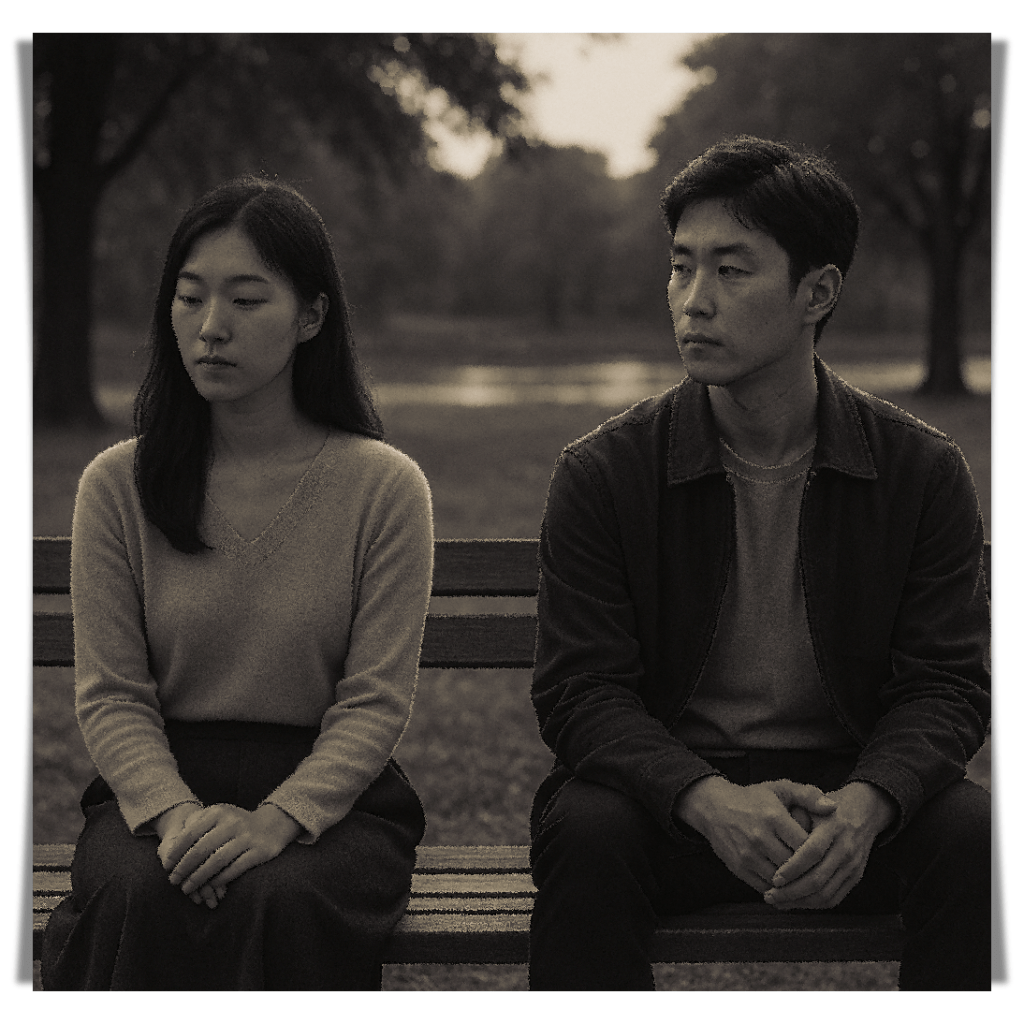
What His Silence Taught Me About Intimacy

It wasn’t an awkward silence. Nor the silence of distance or dismissal. His silence was something else entirely. It had gravity. Shape. It wrapped around me like twilight settling over the city. And in that silence, I discovered something I never fully understood before: intimacy does not necessarily manifest itself through words or touch.

In those early days, I remember him across the café table. We spoke, certainly. But it was in fragments. There were lengthy intervals where nothing needed to be said, yet I never felt compelled to fill the silence. He never pushed. Never filled silences just to hear himself speak. And maybe that’s why I found myself letting my guard down, little by little, without even meaning to.

There was something sacred in how he listened. He didn’t listen to respond. He listened like he was trying to memorize me. When he finally did speak, it wasn’t to impress or correct me but to reflect something I hadn’t realized I was trying to express. His silence wasn’t an absence. It was presence without intrusion.

One evening, we stood side by side on Lover’s Bridge. The river shimmered beneath us, and the sky was painted in pink and gold. We didn’t touch. We didn’t speak. But something passed between us, though, that couldn’t be seen or touched. Somehow right then and there, our bodies found a rhythm beside each other, like the choreography of trust.

What surprised me the most was how seen I felt in his silence. He didn’t demand performance. He didn’t ask for confessions. And yet, standing next to him, I felt understood. It felt as though he was able to hear everything I didn’t say yet still chose to stay.

That kind of intimacy is unusual. It asks nothing but provides everything. It is not based on lofty declarations but on humble agreements. Like how he read my poems and didn’t say anything after but looked at me with nonjudgmental eyes. Just understanding.

In a culture obsessed with noise and proof, he reminded me that some truths are whispered. Some of the most personal experiences we may have are felt rather than expressed. Some bonds are born not in words, but in willingness. To stay. To witness.

So no, his silence never made me anxious. It made me feel safe. It taught me that intimacy isn’t always loud or clear. Sometimes it’s a quiet agreement between two people who stop pretending they have to explain everything to be understood.


✨ Visit Olivia’s Atelier for printables, reel templates, and planners made to support overwhelmed moms with gentle, soulful tools.
🕊️ Enjoy 50% off everything until June 30.

Evolution, Sex, Survival | The Truth About How We Got Here

The idea to write this post came out of my curiosity. From that curiosity, I dug deeper and found myself lost in a maze of intricate details. My curiosity was simple—how did we, the human race, end up here as we are?

Image source

The answer is simple. We all exist because millions of people in the past had sex. Long before the existence of houses, rooms, wedding vows, and religions, hominins had sex in caves, open fields, and everywhere under the open skies. They had sex, but not modestly. Some did it tenderly or urgently. Some did it in a group and in the presence of their children. There were no rooms, no privacy, and no moral police. Back then it was just skin against skin and purely instinctual. We all survived to this day because of it. 

Our prehistoric ancestors didn’t just reproduce. They experienced pleasure too. They touched and explored like we do. Women experienced orgasms because pleasure wasn’t invented in the modern age. Pleasure is primordial. It’s embedded in our DNA just like fear and hunger. The clitoris, for instance, is designed solely for pleasure. Imagine that—a part of the female anatomy with over 8,000 nerve endings (twice that of the penis) exists only for pleasure. It is proof that nature didn’t just want us to breed and multiply. It wanted us to feel and enjoy intimacy too. 

Cavewomen may have lived hard, brutal lives, but they enjoyed pleasure just like we do. I like to imagine a cavewoman with her lover between her legs. And maybe others watched and joined them too. It wasn’t a perversion the way we interpret it now. It was simply being human.

I wonder if they had rituals and regarded sex as a celebration.

Shame, after all, is a recent invention. Shame associated with sex probably didn’t exist then. Cave people indulged themselves as and when they wanted. They bred, fought one another, and fought wild beasts to survive. The law of natural selection was at its peak during this period. Over time, with sperm competition in promiscuous mating systems, their genitals evolved. Natural selection favored a penis tip that could:

  • Displace rival semen using its flared ridge during thrusting
  • Create suction during withdrawal to pull competing fluid away from the cervix
  • Deliver deep, firm contact at the most fertile zone during ejaculation
  • Enhance female pleasure, because a woman who enjoys sex is more likely to return to the same partner

Amazing, isn’t it? The couple who made love the most wasn’t simply indulging. They were participating in the law of natural selection. They were selecting, refining, and perfecting the best genes to pass on to their future generations—us.

But these intense competitions existed long before religion taught us to shrink ourselves. Before religion, humans expanded in wild abandon and touched one another without apology. And somehow, in my opinion, the rawness of it feels more evolved than the shame-laced silences we carry today. 

I’m writing this out of curiosity and also because I want to remember. I want to remember that pleasure is part of our design. We exist today not just because our ancestors fought and survived but because they felt pleasure and indulged in intimacy. 

And somewhere, deep in our bones, I think we still remember what it felt like to be touched under the open skies, with no shame and no walls. 

Maybe it’s time we listened.


A 2021 BBC article titled ‘Here’s What Sex with Neanderthals Was Like’ explores how interbreeding between Homo sapiens and Neanderthals was not only real but frequent enough that most of us today carry traces of Neanderthal DNA. The piece confirms that sex among early human species was driven by instinct, opportunity, and survival—often without the moral or religious constructs that now dominate our understanding of intimacy. It even suggests that some encounters may have been tender or neutral, while others may not have been consensual by today’s standards. But the point remains: pleasure, reproduction, and adaptation were intricately linked. And some Neanderthal genes—particularly those associated with fertility—were naturally selected against, showing how deeply evolutionary biology shaped not only who we became, but how we love, bond, and survive.

Note: If you believe open discussion of sex is taboo, feel free to skip this post. Everything here is grounded in biology and human history—not smut or erotica. Just facts, perspective, and a little reverence for the bodies that brought us here.