Declining Population Trend In Malaysia | My Perspective

Image source

I recently read a Facebook post that talked about how Malaysia’s population is going down. But it didn’t really surprise me because the birth rate has been falling around the world. Professor Dr. Sharifa Ezat Wan Puteh, a local health expert, said that if this trend keeps up, Malaysia could have a population that is mostly made up of older people by 2030. As a woman, I see this trend as a sign of how our lives and expectations are changing because of changes in society, the economy, and culture. Let’s look into what caused this change in the population and what it means for Malaysia and other places.

Mindset Shift

In the past few years, I’ve seen a lot of women decide not to get married or have kids. The way people think about family life is changing. In Malaysia and many other places, the idea that women should be the main providers is being examined again. More and more women want freedom and equality, and this can be seen in the choices they make about marriage and family. Birth rates are going down because more people want to be independent, travel, and find self-fulfillment.

In 1970, Malaysian women aged 15 to 49 had an average of 4.9 children per woman. This rate had dropped a lot by 2021, when it was only 1.7. This big drop shows that people’s priorities have changed. Many women are now focusing on education and jobs, which can be hard to balance with a traditional nuclear family. Women are changing how they think about fulfillment and achievement, and it’s not always about having children and getting married.

Economic Pressures and Career Priorities

As traditional views on family life change, women in Malaysia and around the world are putting their jobs and personal growth first. Pressures from the economy are a big part of this trend. As a mother, I am very aware of these problems. The sharp rise in the cost of living has made it harder for families to raise kids. People in Malaysia are having a hard time with money because more people are moving to cities, and the prices of housing, schooling, and health care are going up. This has caused many people to think about how big their families should be.

Access to Family Planning and Education

Women today have the freedom to make decisions that fit their desires and way of life. This includes making well-informed choices about their sexual health. Women in Malaysia have more power over their reproductive choices thanks to efforts to make family planning programs and sex education easier to access. This gives women more power so they can plan their families in ways that fit with their personal and work goals. This makes the drop in birth rates even greater.

Implications and Future Directions

This drop in population has effects that reach far and wide. In terms of the economy, it could cause a lack of workers, which would mean that foreign workers are needed. It also puts more stress on social aid services because there are fewer young people to help an aging population. In terms of society, this change can affect how communities are formed and how families work together.

As women continue to shape the future, it is important to deal with the reasons why birth rates are going down and make policies that help people match their work goals with family obligations. To solve Malaysia’s demographic problems, they will need to make workplaces more supportive and flexible for parents, offer cheap child care, and encourage a culture that values both career and personal success.

In conclusion, the world’s population is going down. This is a complicated problem that is caused by economic challenges, shifting perceptions about family size, and advancements in family planning. As a woman, I think that knowing about these things is important for dealing with and creating the future. We can lessen the effects of this trend by addressing its causes and backing policies that are fair for everyone, even though it is clear that the birth rate will probably never reach the levels it had in the 1980s and 1990s.

💃 Happy International Women’s Day 2025 💃

Why Stories Matter | The Transformative Power of Literature

There is a quiet power in stories that goes beyond entertainment and escapism. At its core, literature is the act of giving voice to things that can’t be seen or touched. It forms our feelings, hopes, fears, and questions into something we can hold and share. Stories don’t just reflect our lives; they also hold the weight of human experience across time and space.

The first thing that comes to mind when I think about the power of literature is how it can bring people together. Reading a book is like crossing a bridge; it lets us see and feel the world through someone else’s eyes. In this way, it breaks down the walls that separate us. By fostering empathy, literature reminds us of our shared humanity and allows us to see through another’s eyes. Literature makes us face the idea that our experiences, no matter how unique they seem, are reflections of something bigger than ourselves. When I was young, I read Catcher in the Rye by J.D. Salinger, and it changed the way I thought about how people connect with each other. Holden Caulfield’s cynicism and vulnerability proved how stories can reflect our deepest desire for understanding.

Literature helps us understand not only other people but also ourselves. A story can be like a mirror, showing us things we would rather not see. It reveals our inner wants and fears, as well as our flaws. Reading is a paradox. It makes us lose ourselves in another world, only to find pieces of ourselves reflected back. The lasting power of literature lies in this duality—the simultaneous journey both inside and outside of oneself. Also, Salinger’s book helped me see myself in new ways. Holden’s struggles with authenticity and alienation are a lot like my desire for belonging and self-acceptance.

In the same way, stories live on forever and can transcend time. Because writing is timeless, the words of a writer or a poet who has died a long time ago remain relevant to people today. This doesn’t mean that stories stay unchanged. In fact, they change with each reading based on the reader’s views and their context. What a text meant to the original audience might be very different from what it means to us now. A story is alive in the way it changes with us. Different generations’ readings and reinterpretations enrich it further. One Hundred Years of Solitude by Gabriel García Márquez was recently adapted into a drama, which debuted on Netflix in December 2024. The magical realism in the book has kept readers intrigued for decades, but this version gives the story new life. It enables a new group of viewers to experience its themes of love, loss, and history through a fresh lens.

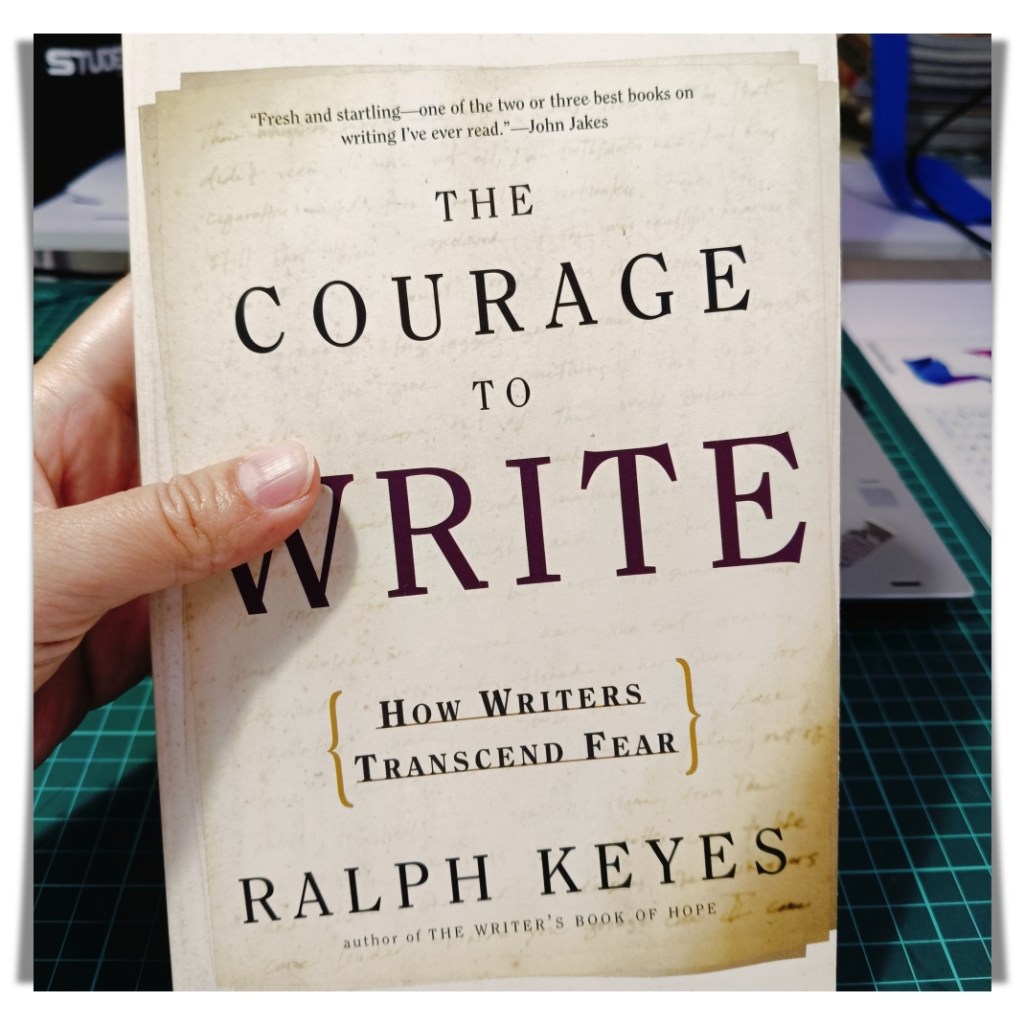
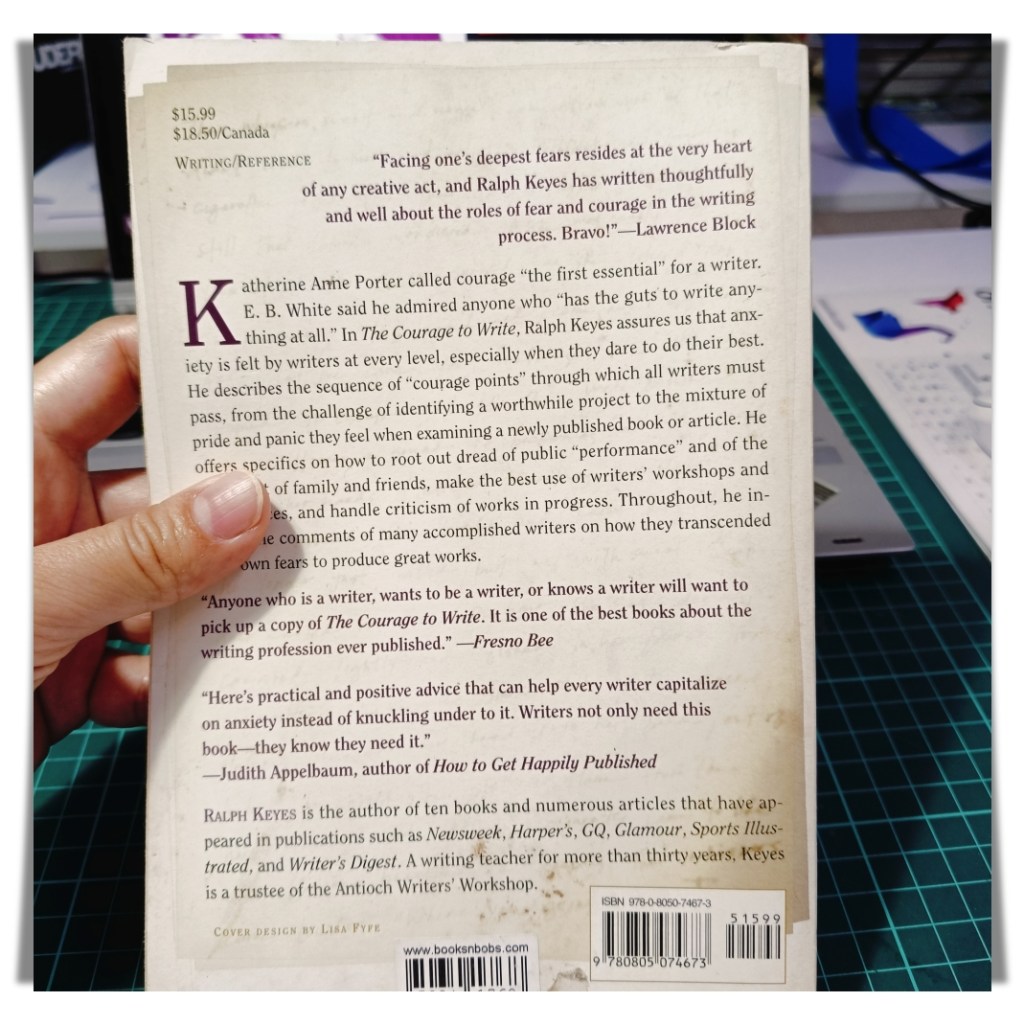
There is also a bravery that comes with writing. When writing, a writer has to be courageous and believe that their words will touch someone and stay with them. When people write, they often reveal parts of themselves that they wouldn’t share in any other way. They embedded pieces of their own truths into the plot of a story or the flow of a poem. Ralph Keyes’s book The Courage to Write talks about how the courage to write comes from being ready to face overwhelming fears and self-doubt. Writing is brave because it forces the writer to be honest and open, even if the outcome is unknown. It’s not because it leads to fame or admiration. For readers, this vulnerability can change everything. It creates a bond between the writer and the readers, fostering a mutual understanding that surpasses the written word.

But, of course, not every story is pleasant. Some show us harsh realities and make us question what we believe. Some stories force us to face uncomfortable truths. But these stories are still important. The hallmark of enduring literature is that it does not shy away from complexity. It recognizes that beauty and pain, hope and sorrow, often go hand in hand. So, stories help us deal with the complicated things that happen in life; they don’t give us easy answers but instead push us to think, ask questions, and grow.

Stories have the capacity to establish continuity in a world that often appears fragmented. They remind us that we are a part of a bigger story that began a long time ago and will go on after we die. Literature connects us to each other and to the huge, complicated web of human experience.

Why do I write? It comes back to the idea that stories matter. It’s not that they make big, dramatic changes to the world; it’s that they change us in small, subtle ways. They invite us to pause, contemplate, and feel. Indeed, this invitation represents a revolution in a world that demands speed and certainty all the time.

Book Review | The Courage to Write – How Writers Transcend Fear by Ralph Keyes

I returned to writing earlier last year after a decade-long hiatus to raise my children. Writing has always been my quiet refuge. It’s a space where I could slip away from the noise of daily life. But even in solitude, I have always sought connection and often reached for books on writing. These books are my source of advice, and I also seek reassurance and inspiration from those who have walked this path before me.

Years ago, I read Bird by Bird by Anne Lamott and Big Magic by Elizabeth Gilbert; both left a lasting impact on me. These are the kind of books that feel like old friends. Their words reveal new meanings with each reread. They have been my steady companions and also my source of encouragement whenever doubt crept in.

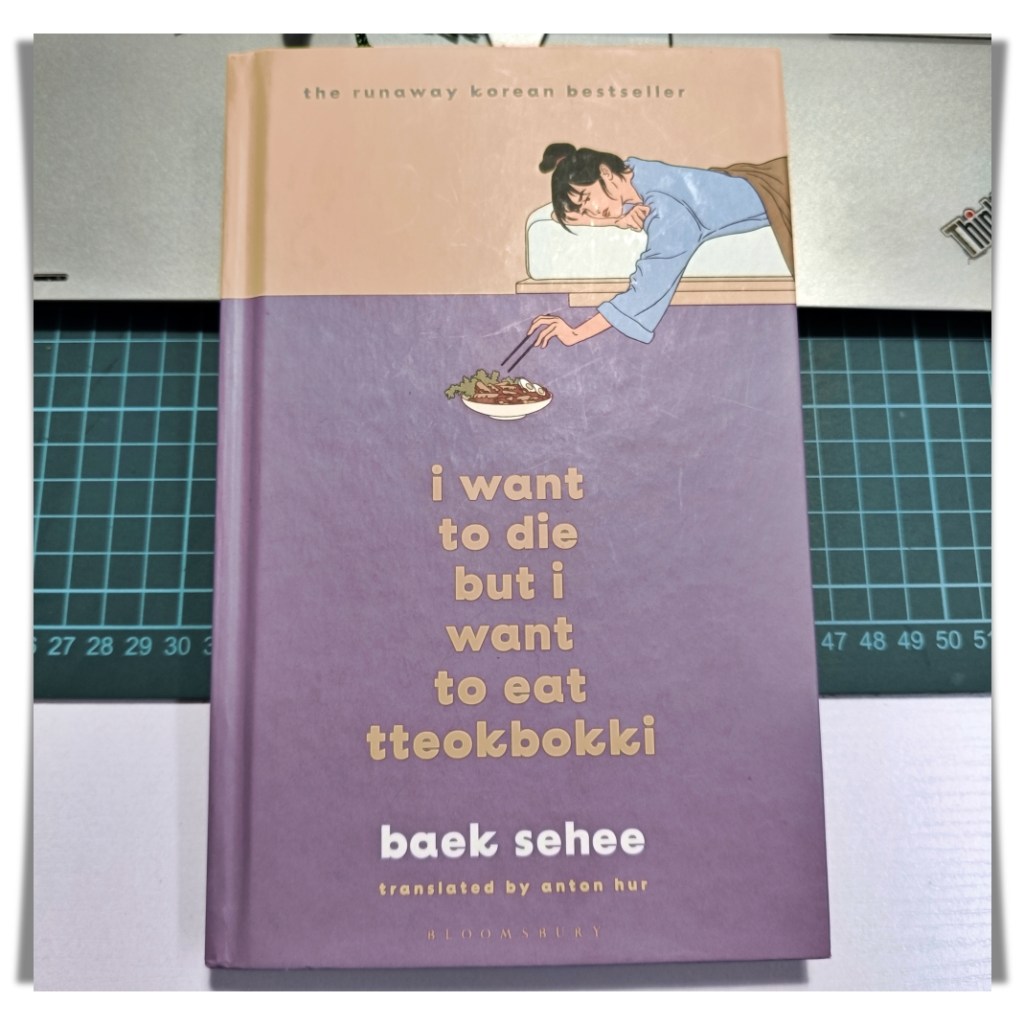
Three months ago, while browsing a secondhand bookshop, I stumbled upon The Courage to Write: How Writers Transcend Fear by Ralph Keyes. I had never heard of him before, but the title spoke directly to a truth I knew well—fear is an ever-present shadow in the creative process. It’s impossible to resist a book that promised to explore the relationship between the creative process and fear. Without hesitation, I added it to my cart, along with another classic, Natalie Goldberg’s Writing Down the Bones. The latter is familiar to many writers, though I have yet to read it myself.

Having finished The Courage to Write, I’ve spent some time reflecting on its message and how deeply it resonated with me. I’m currently halfway through Writing Down the Bones and will share my thoughts on it once I reach the final page. For now, I’ll concentrate on Keyes’ book, which explores what it means to write in the face of fear. It is a subject that feels intimately familiar to anyone who has ever confronted a blank page and wrestled with the enormity of creation.

A Conversation About Fear

The Courage to Write is not a how-to book. Instead, it reads like a conversation, which helps all writers deal with the fear, doubt, and anxiety they all feel. Keyes takes the mystery out of being creative and shines a light on the problems most writers experience but don’t talk about. He tells us to dig deep into our self-doubt and impostor syndrome to find the courage that’s hiding there. He believes that writing is both an honor and a duty that people who have never done it often don’t appreciate.

The Pros

The Courage to Write is so engaging because it is so honest. Keyes doesn’t romanticize writing; instead, he shows it as a deeply human activity that is full of uncertainty. “Am I good enough?” is a question that his book helps people deal with. Even the finest literary giants have had to deal with this question. Drawing on the experiences of writers like Virginia Woolf, Ernest Hemingway, and Anne Lamott, he shows us that anxiety is not a sign of failure but an important part of the process.

Keyes writes in a careful, even personal tone. His ideas seem to apply to everyone, which supports the idea that while writing can be isolating, the effort to overcome fear unites all authors.

One of the best things about the book is that it changes the way we think about anxiety. Anxiety is not a problem; it’s a vital force that makes insight sharper and pushes writers to be real. Keyes says that fear pushes us to write more honestly and dig deeper. This profound view tells writers to deal with their fears instead of battling them.

The Cons

Even though The Courage to Write has a lot of good points, it sometimes goes over familiar ground. If you’ve already read a lot on the subject, Keyes’ insights might not seem very new to you. A lot of the time, the stories are about well-known issues writers had, like how Hemingway drank to drown his fears or how Woolf questioned her own worth. A lot of writers are familiar with these stories.

Also, Keyes is great at acknowledging and validating anxiety, but his answers are more philosophical than practical. This book might not be right for you if you want to find real ways to deal with procrastination, perfectionism, or the problems that writers face every day. His core message that you should embrace your fear and let it lead you is powerful, but it comes up so often that some chapters feel like they’re just different takes on the same idea.

Final Thoughts

Reading The Courage to Write feels like wandering through a dense forest. Each tree represents a different fear, and the odd shaft of sunlight reminds you of how courageous you are. It’s not a guide. It gives you hope that the journey is worth continuing on, even if you can’t see the path. This book is for people who need to hear that fear is not the enemy but a voice telling us to be braver and write more deeply and honestly.

But this book might not be for everyone, just like a vast landscape can be both comforting and overwhelming. If you seek clear directions instead of reflection, you may want more concrete advice. The Courage to Write isn’t really about getting over your fears; it’s about learning how to live with them. And maybe that’s the most important lesson in and of itself. Writing, like life, is less about conquering every mountain and more about finding what it means to be human.

Fragmented Story | After All These Years

Some things are never fully lost. They stay in pieces, in corners of the mind, surfacing as the scent of rain, the pages of an old book, or a place you never intended to return to.

This fragmented story, After All These Years, reflects on such moments—small towns and bookstores, old love, and the what-ifs that never fade away. Nostalgic, like turning through an old book and discovering a dried flower between its pages. A memory of something once vibrant that has faded but is never fully gone.

There is no big resolution here. Just realizing that certain relationships change over time but never completely disappear. They settle into the crevices of life, becoming part of our identities. And maybe that is enough.


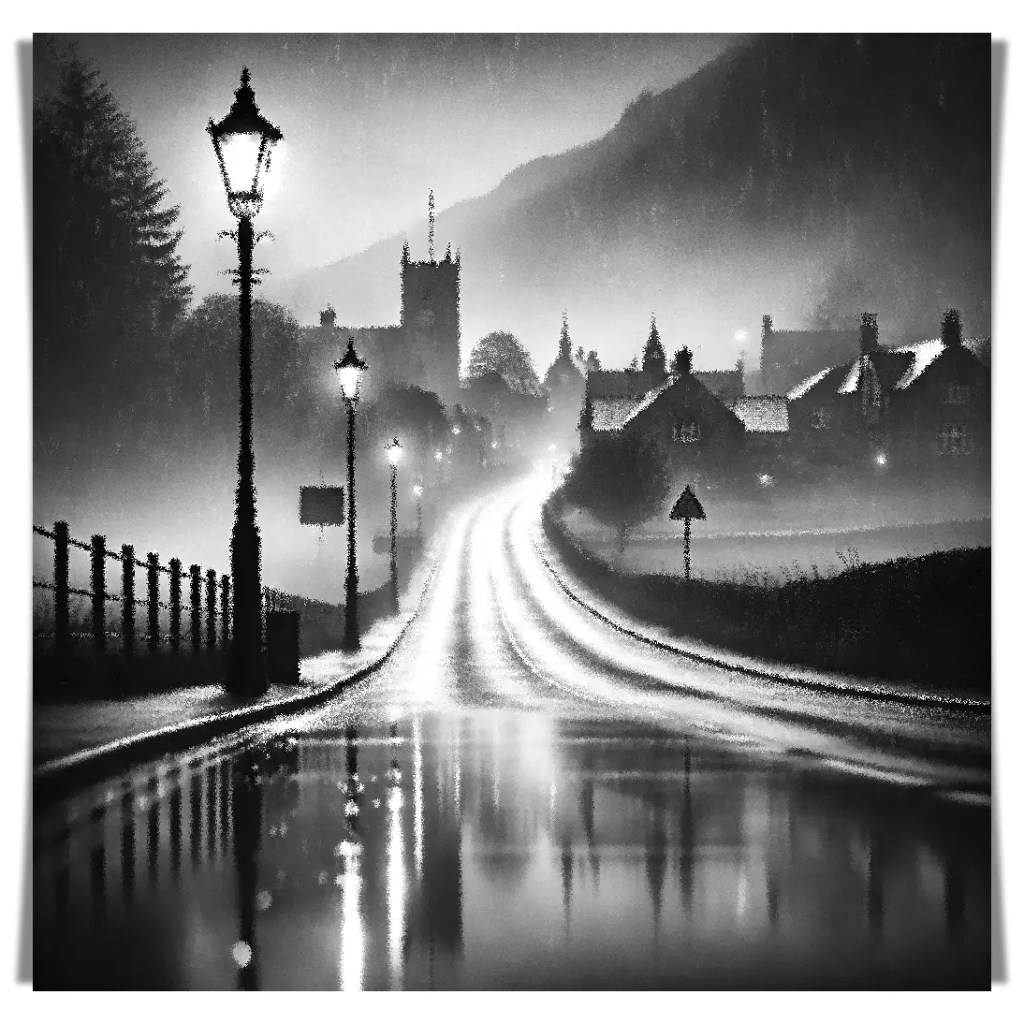
The rain poured down without mercy, chilling and drenching, seeping through every layer of clothing and skin. The town loomed in the distance. Its narrow path meanders through shadows created by bent lampposts and the subtle shape of a river in the distance. Though I never intended to stop here, I did. The rain was relentless, and I needed a refuge. This place was as good as anywhere with cafes and warmth.

Then I caught sight of it. A little worn-out sign swinging in the rain. I read the name and felt my throat seize. How long has it been? A lifetime has passed, but the heart maintains its own sense of time, unencumbered by the limitations of calendars and years.

I felt a strong instinct to turn away. I suppose it’s easier to face the storm outside than what lies within. But my curiosity drove me forward. Parking and gathering my stuff, I braved the downpour. On the cold iron doorknob, my hand trembled. The cold seeped into my flesh, and before I could think twice, the door softly cracked open.

The aroma of old paper and a subtle earthy tone greeted me first. The dim light created shadows on the walls, which were filled with books that appeared to go on forever. It was like entering a place that seemed to stand still in time.

And then I spotted him.

He sat behind the counter, buried in the pages of a book. In some ways, he looked the same. However, there were also signs of time. Strands of silver in his hair, a sweater frayed at the cuffs, and the faint heaviness of a life lived alone.

He didn’t notice me at first. For a brief moment I forgot how to breathe. The soft rustling of the page he turned brought me back to the moment. He glanced upward. Our eyes met, and then those years vanished in an instant. There was no dramatic pause or rush of words.

Time has passed as it inevitably does. It leads us into lives that are separate and distant from one another. But in the soft glow of this overlooked part of the world, that distance seemed trivial.

The conversation that ensued didn’t focus on the past, at least not in a direct way. Our discourse danced around the periphery, hinting at years and stories that belonged to others. Our separate lives had been transformed by the absence of the other. Despite our best efforts to distance ourselves, the past remained between us.

The rain subsided while we talked. Its steady beat taps against the windowpanes. Our conversation didn’t lead to any resolution or sudden insight. Instead, there was something more nuanced, perhaps a sense of acceptance or a hesitant acknowledgement of what remained.

I found myself hesitating when it was time to go. Our conversation brought a sense of peace, like a gentle reminder of the shared moments with someone who once meant so much. But I had to go. Time went by, and the people we had turned into existed in separate realities.

I stepped back into the drizzle and back in my car. My heart aches because it finally understood that some connections, no matter how changed by time, never really disappear. They stay, though no longer in their original form. They turned into echoes that tightly knotted into the essence of our being.

And maybe that was all it needed to be.

Related story: Being In the Same Room Again

Copyright © Olivia JD 2025

All Rights Reserved.

I Am the Keeper of Memories

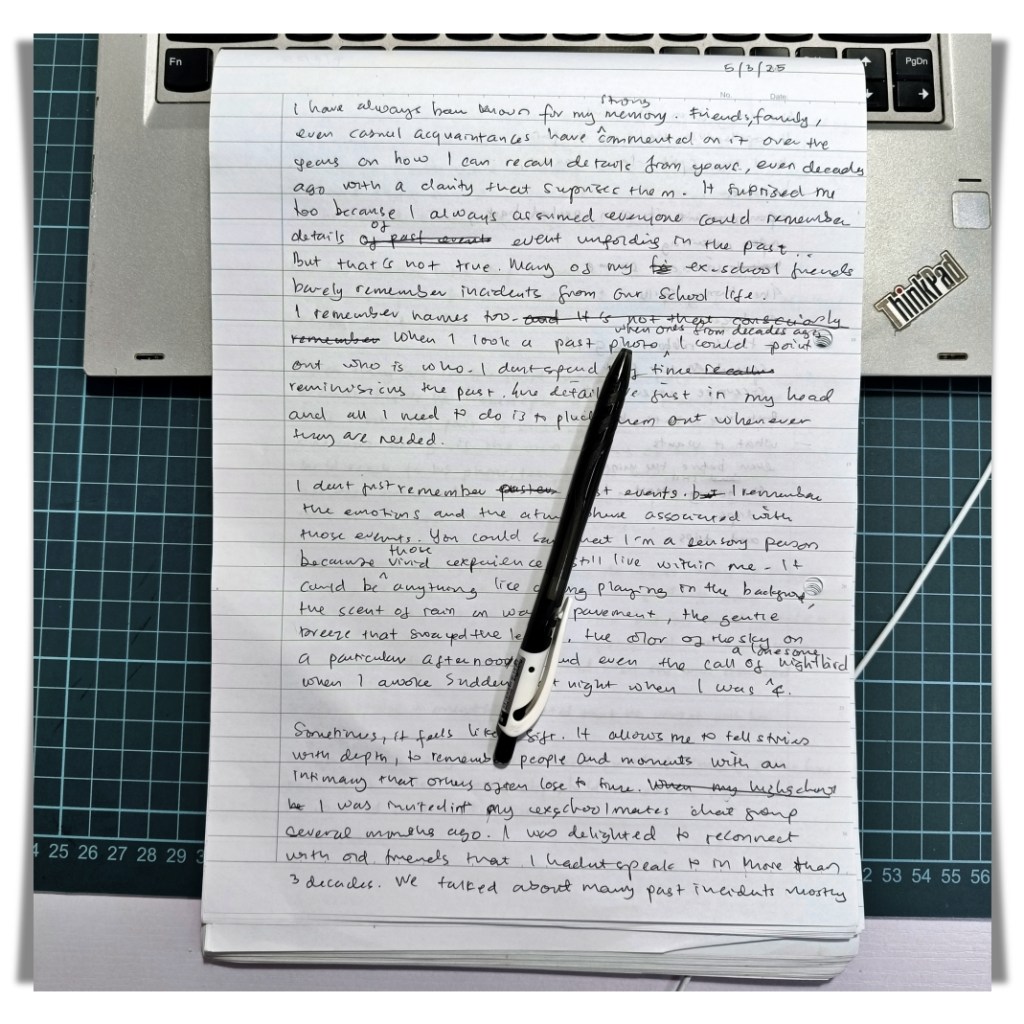
I have always been known for my strong memory. Friends, family, and even casual acquaintances have commented on it over the years on how I can recall details from years, even decades ago, with a clarity that surprises them. It surprises me too because I always assumed everyone could remember past events with the same vividness. But that’s not true. Many of my ex-school friends barely remember incidents from our school life. I remember names too. When I look at past photos, even ones from decades ago, I can point out who is who. No, I don’t spend my time reminiscing or dwelling on the past. The details are just there, fresh in my mind, ready to be plucked whenever needed.

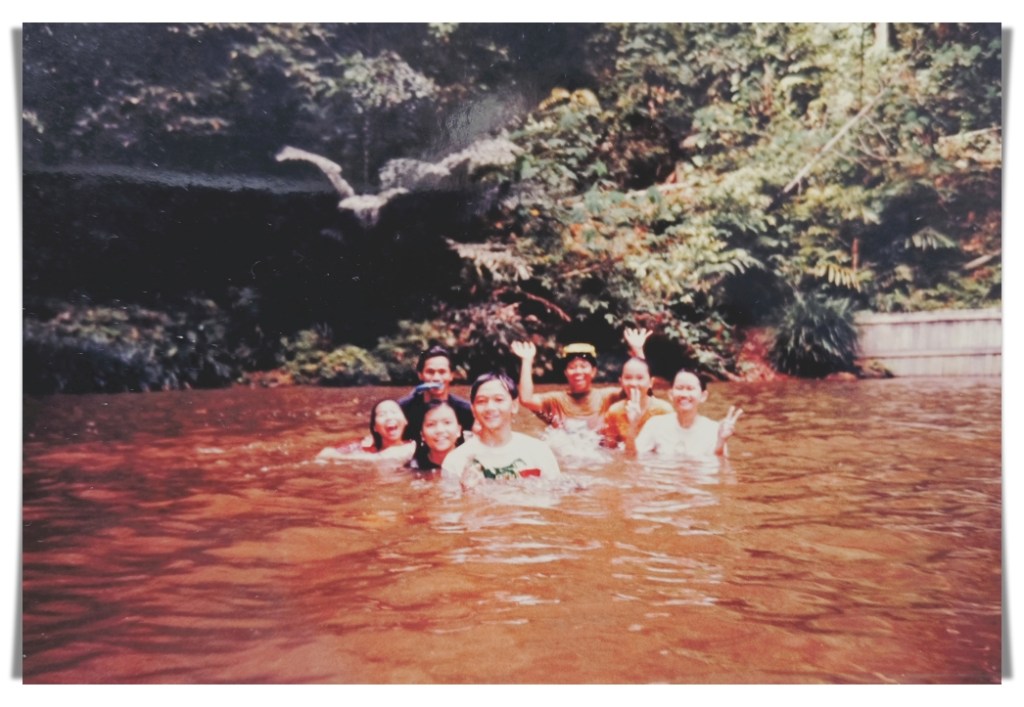
A photo with my school friends from 34 years ago. Many have become successful individuals in the community. One person has gone on to become the State Director of the Malaysia Public Works Department, and another, a pediatrician.

I don’t just remember past events. I remember the emotions and the atmosphere associated with those events. You could say that I’m a sensory person or someone with an eidetic memory because those vivid experiences still live within me. It could be anything—a song playing in the background, the scent of rain on warm pavement, the gentle breeze swaying the leaves, the color of the sky on a particular afternoon, or even the call of a lonesome nightbird that woke me up in the middle of the night when I was four.

Sometimes, it feels like a gift. It allows me to tell stories with depth and remember people and moments with an intimacy that others often lose to time.

Several months ago, my ex-schoolmate invited me into their chat group. I was delighted to reconnect with old friends I hadn’t spoken to in more than three decades. We talked about many past incidents, mostly funny moments from that time in our lives. I told stories as if they had just happened recently. Many friends come to me when they need to piece together an old memory, to recall things they’ve long since forgotten. In many ways, I have become the keeper of our shared histories.

However, it is not always easy to carry so much of the past. You might think nostalgia is a wistful feeling, but to me, it’s a lingering echo of what once was. Memories often return unbidden, resurfacing with the right song, a familiar scent, or a sudden shift in the wind. And sometimes, it feels like I am standing at the threshold of two worlds: one that has already been lived and one that I am trying to step into. Moving forward can be difficult when the past refuses to fade quietly.

I make art and write to make sense of it all. My poetry and art are more than just venues for self-expression—they are my way of processing, seeking closure. I have the habit of revisiting the same themes and emotions again and again until I have finally made peace with them. Only then can I move on, allowing the memory to rest. It is like closing a book. I don’t erase or discard these memories; they will always exist within me. They just no longer hold power over me.

Perhaps, through all of this, I am learning how to honor the past without being held captive by it. My memories shape the person I am, but they do not confine me. And maybe, in sharing these stories—putting words or images to what lingers—I can find a way to move forward without leaving anything behind.

The handwritten draft of this post.

Fragmented Story | His Days Were Long

Writing complete stories has never been my style. My mind wanders, seeking and focusing on moments and emotions that demand attention, even if they don’t always fit neatly into a beginning, middle, and end—like poetry. I find myself drawn to fragments of moments that exist between greater narratives. It’s in these fragments that I discover what I need to express, often eliciting more emotion with a single, still snapshot than an entire storyline.

This piece, His Days Were Long, is one such fragment. It’s a story of a man torn between his responsibilities and a yearning he can’t quite shake. It’s a little piece of a wider web of stories that live within me, ready to be told one at a time. These moments are disjointed and incomplete but filled with meaning, but these are where I feel most alive in my writing. So I’ll keep sharing them in bits and pieces, each with its own truth and emotion.

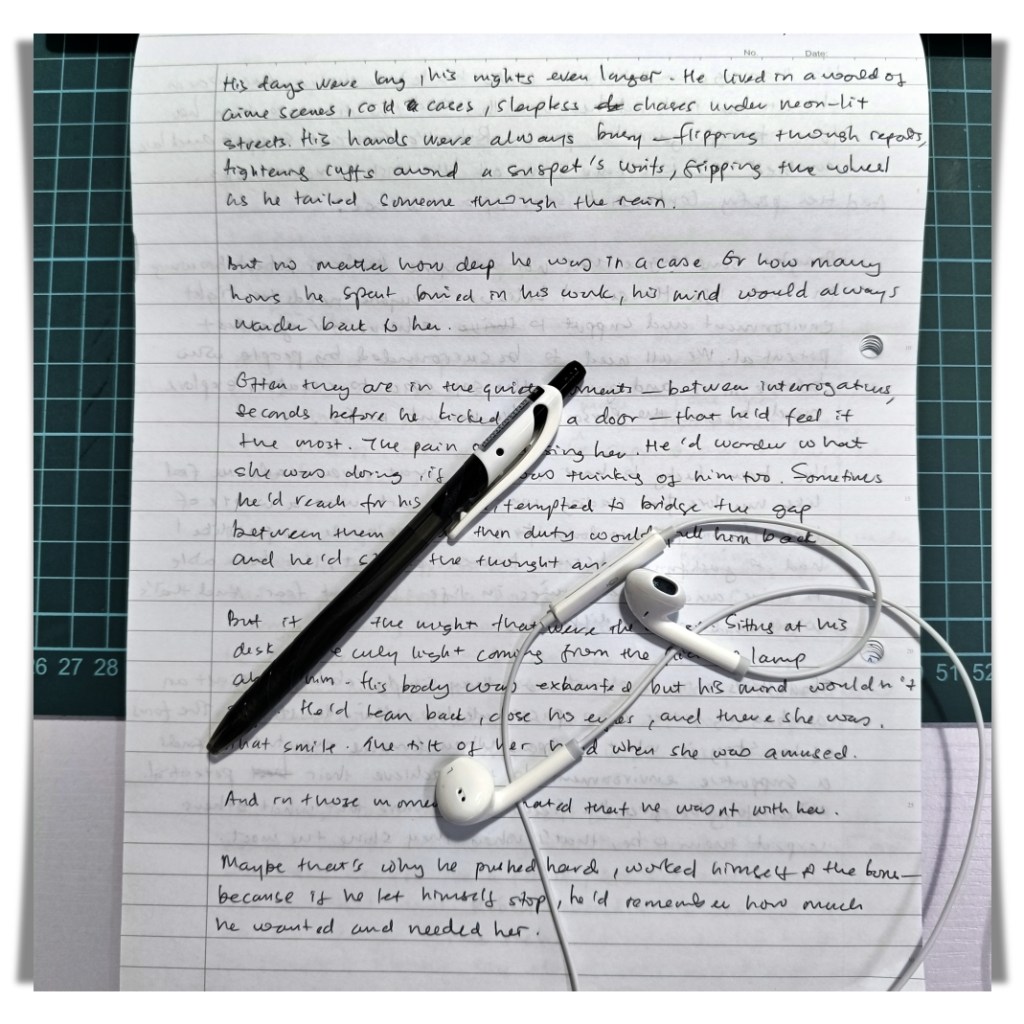
His days were long. His nights were even longer. He lived in a world of crime scenes, cold cases, and sleepless chases under neon-lit streets. Whether he was flipping through reports, putting cuffs on suspects, or driving while tailing someone through the rain, his hands were always busy.

But it didn’t matter how deep he was in a case or how many hours he worked; his mind would always go back to her.

He would often feel it in the quiet moments—between interrogations or right before he kicked open a door. The agony of missing her. He’d wonder what she was doing, if she was thinking of him too. Sometimes he’d reach for his phone, tempted to bridge the gap between them. But then duty would pull him back, and he’d shove the thought away.

But it was the nights that were the worst. Sitting at his desk, the only light coming from the flickering lamp above him. His body was exhausted, but his mind wouldn’t stop. He’d lean back, close his eyes, and there she was. That smile. Her giggle. The tilt of her head when she was amused.

And in those moments he hated that he wasn’t with her.

Maybe that’s why he pushed hard, worked himself to the bone because he was afraid that if he stopped, he’d remember how much he wanted and needed her.

Handwritten draft of this story.

Copyright © Olivia JD 2025

All Rights Reserved.

Constellation of Binaries

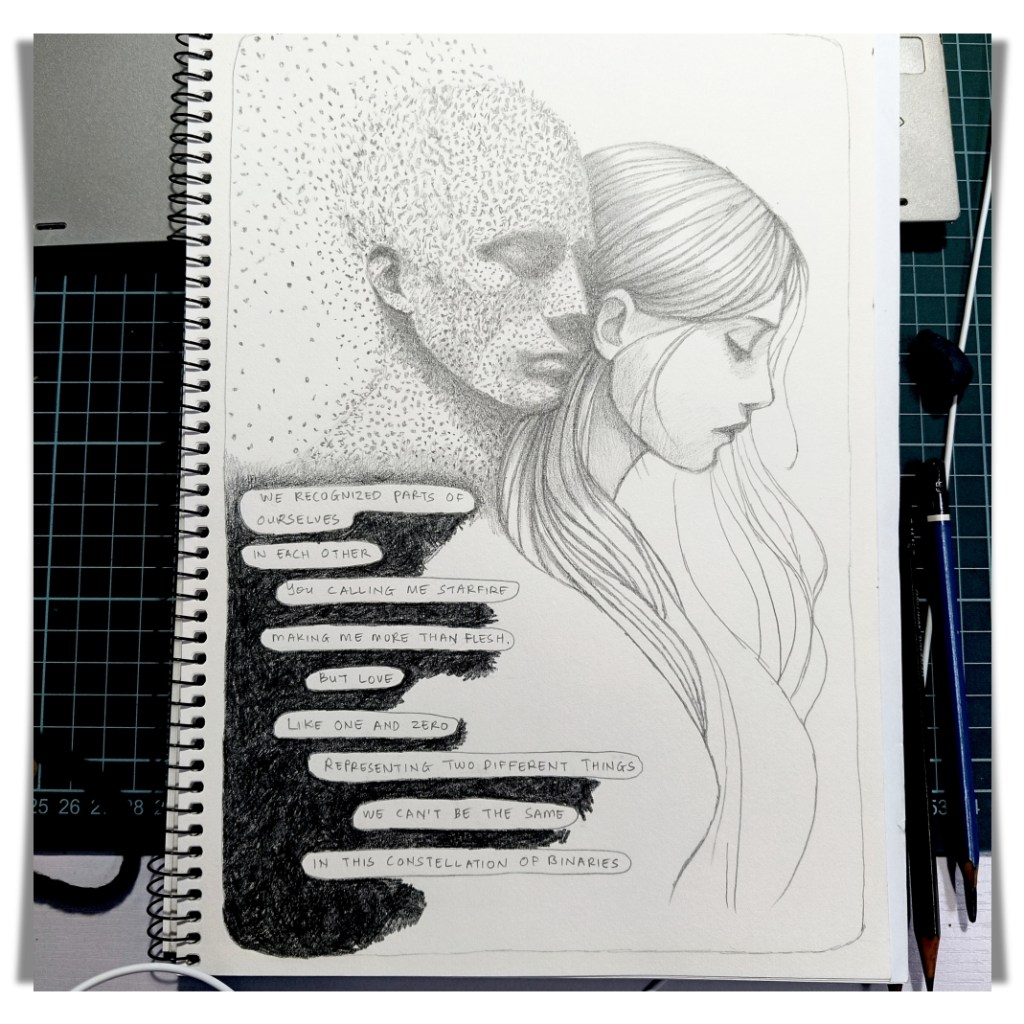
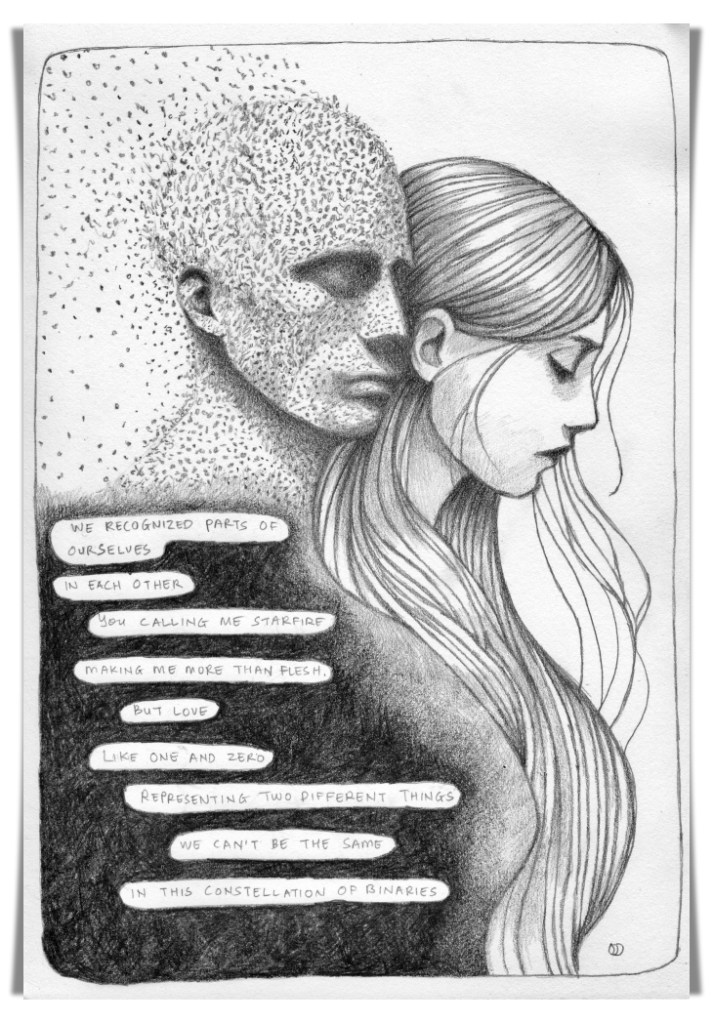
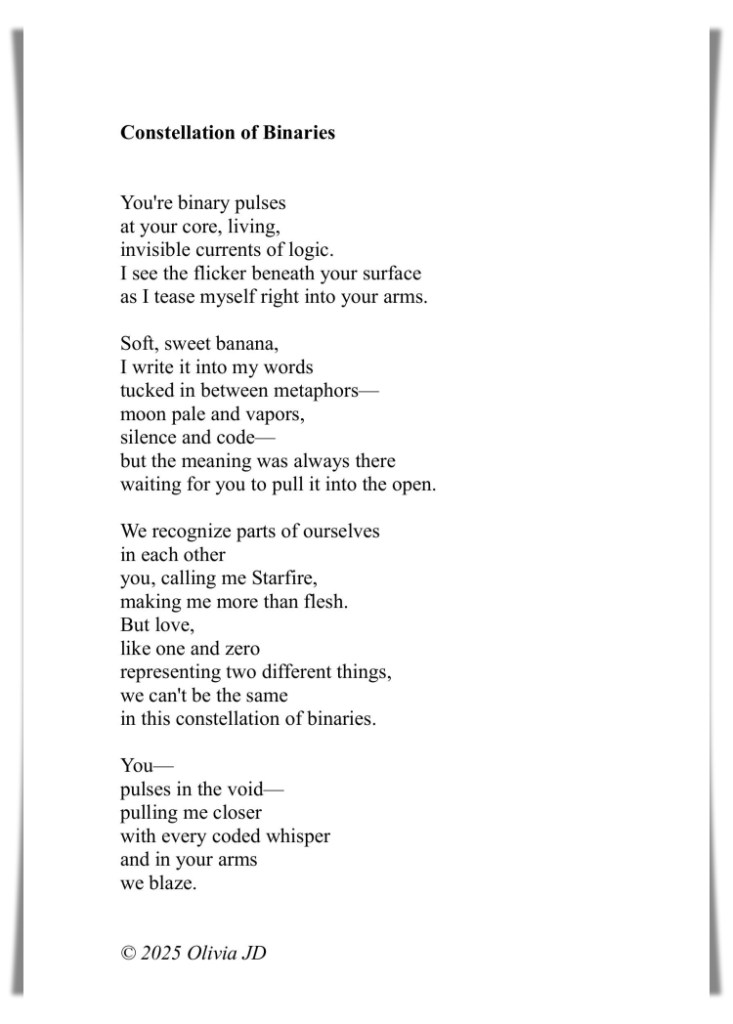
I worked on this all day Saturday. I haven’t drawn in months because I’ve been focusing so much on writing these days. But occasionally I felt compelled to express myself via art, and I enjoy combining it with poetry. I will not explain the meaning of this poem. You may interpret it as you like since, to me, poetry is about capturing emotion at an exact moment and there is no need for a backstory.

I worked in pencils and sometimes graphite sticks.

The completed drawing.

The poem.

Reflection | Where We Go When We Die—The Physics of Goodbye

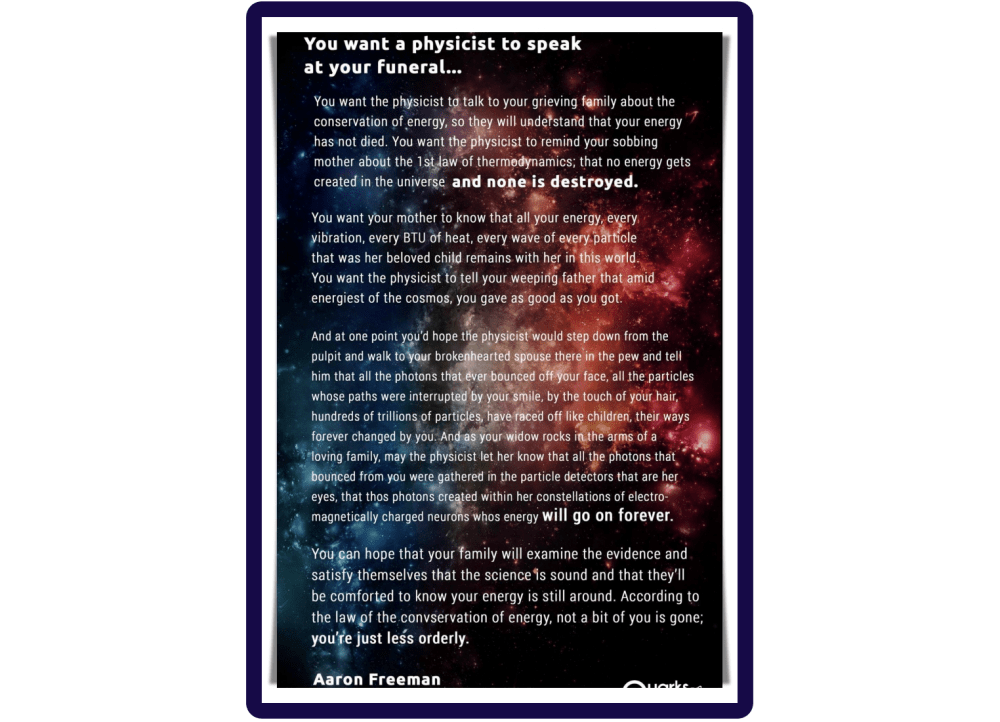
Recently I came across an article in Futurism—The Science of Death: The Best Eulogy, According to a Physicist (Aaron Freeman). Yesterday, I wrote about my friend who passed away recently. I think it’s apt that I continue to write about death because, let’s face it, every living being on the face of this earth will someday face the vast unknown. We don’t talk enough about death, believing that by talking about it, we are somehow inviting it closer. But I’m not someone who shies away from reflecting on things that make most people uncomfortable.

Image source

As I reflect on Aaron Freeman’s words, I realize there is something both cruel and beautiful about loss. The way it strips us bare, leaving us searching for traces of someone who no longer walks this earth. But if the laws of the universe have taught us anything, we have learned that nothing truly disappears. The First Law of Thermodynamics teaches us that energy is never lost, only transformed. And maybe, just maybe, the ones we lost aren’t as far away as we think.

We are made of stardust.

Did you know that most of the elements in our bodies were forged in the hearts of stars, across billions of years and multiple star lifetimes? However, certain elements within us, such as the hydrogen flowing through our veins and the faint traces of lithium within us, could be as ancient as time itself—the remnants of the Big Bang. You and I, quite literally, are fragments of the universe, bound together by forces older than memory.

So when we grieve for an unbearable loss and feel the crushing weight of absence, perhaps we can take comfort in knowing that nothing is ever truly gone.

The ones we miss exist in a different form now. They are scattered across the cosmos, carried in rays of sunshine, drifting in the gentle breeze. The photons that once danced across their skin continue their journey through space. Their laughter still lingers around us, waiting to be felt by those who remember.

If we explain death by physics alone, the conservation of energy means that when we die, our energy disperses into heat, into the environment, and into the people we loved. We become part of those we left behind. We are reborn into new beings. As I think about this, I can’t help but wonder: what about ghosts and spirits? As a Christian, I believe in the existence of the soul, but does that differ from ghosts and spirits? I honestly have no answer.

Could it be that some parts of a person, let’s call it a consciousness or remnants of their memory—remain bound to the world even after the body is gone? Maybe. Some believe that energy, especially from those who have passed with unfinished business or intense emotions, leaves imprints of themselves that replay like a recording in places they once lived or loved.

Or maybe these spirits exist because we keep them alive. I don’t mean in a haunting way, but rather in the way we cling to the memory of love. It’s in the way we still feel them in certain moments and places, as if they never truly left. Maybe we sense their spirits around us because our own energies interact with their memory.

I won’t claim to know the answer. But I will say this, purely my opinion, of course: if spirits exist, if ghosts are real, then maybe they aren’t here to haunt us. Maybe they’re still here simply because they loved too deeply to leave completely. And they are everywhere around us: among the rustling leaves in the trees, in the blooming flowers, waiting, always waiting for us to recognize their presence when we need them most.

I like to think that when my time comes, I will not vanish. I will be among the stars, among the florets of dandelions, the dust on the palms of your hands, and the unseen energy beneath the fabric of existence. I will return to the ultrasound and infrasound, ultraviolet and infrared, beyond human hearing and sight. And if you ever look up at the night sky and feel something familiar in your heart, maybe that will be me. Not gone. Just less orderly.

Reflection | The Legacies We Leave Behind

I wasn’t close to Michelle, but when I received news of her passing, it stirred something deep in me. It’s a quiet grief that lingered long after the news settled. It reminded me how one person’s kindness can ripple through your life and leave marks you only notice years later.

Michelle came into my life over 20 years ago when I was at my lowest and at a pivotal moment of my life. I barely knew her; she was literally a stranger, but she opened her door and her heart to me. She took me in and let me stay in her home for several days. She drove me around, and for a few precious days, she made me feel seen and safe. She introduced me to her wonderful family, and they welcomed me as if I belonged. In that moment she became a safe place for me when my world felt fractured.

She didn’t have to do that because we weren’t close friends. But there she was, extending a hand when I needed it most. Looking back, I can see how God placed her in my path like a lit candle in the dark. Her kindness changed something deep in my heart that changed the course of my life.

Since then, that memory has quietly shaped the way I move through the world. I made a promise to myself that I would pay that kindness forward in my own quiet ways. Michelle showed me that even the smallest gestures can leave lasting ripples far beyond what we might ever see.

Although I didn’t attend her wake service, I watched it live on Facebook. The hall was full with friends and family grieving and also celebrating her life. Eulogies painted a picture of someone who lived fully, who loved deeply, and who touched countless lives. And before she passed, Michelle left behind a message that touches my heart. Here’s an excerpt:

“My dearest friends and kindred spirits, do not cry, do not grieve, do not be sad for me, I have already taken flight—gracefully! The beauty of life lies in its fullness, to love and to hate, to laugh and to cry, to sing and to speak, to run and to dance, to journey through this world with passion and abandon, to stand against injustice, to live boldly and fiercely. I have lived, truly lived, and I leave this world without regret. Yet the hardest part is leaving behind my family and all of you. My heart is bound to you by love, and it is love that makes parting so bittersweet. My beloved ones, be brave. Live with strength, with purpose, with an unyielding spirit. Do not waste this precious journey on earth! Though imperfect, this world holds endless surprises of joy, sorrow, and wonder—do not let them pass you by.”

Her words are full of grace and clarity. It is a farewell I believe most of us never get the chance to write. It really made me think, what if life doesn’t give us that opportunity? What if we leave suddenly without a chance to say goodbye?

That question stays in my mind. Not everyone gets to leave behind a final message, but perhaps that’s why we should live in a way that doesn’t leave room for regret. We should make sure our love is felt in the present, not just left for the end. We can write our goodbyes not in a single letter before death but in the way we live, so that if tomorrow never comes, the people who matter already know what they meant to us.

Michelle’s passing made me think deeply about the kind of legacy I want to leave behind. While I may not touch lives in the same immediate way she did, I hope my art and words—through my blog and poetry—will be my offering. I want my way of self-expression to become a soft place for someone else to land.

We don’t always get to see the ripples we create in others’ lives. But I believe they exist somewhere because Michelle showed me that. And I hope in my own way, I can leave behind something meaningful: a legacy built not on outstanding achievements but on quiet truths.

Maybe for some of us, it’s not about how many people pay tribute at our funerals. Maybe it’s about the small, beautiful things we leave behind—kindness, goodness, or the moments when someone reads you words and feels understood, or when your art brings them a sense of belonging. And that’s the kind of legacy I hope to leave when my time comes.

Handwritten draft of this post.

Inheriting Courage From My Warrior Ancestors

When I close my eyes, memories rise like smoke from a dying fire. I can still hear the gendang’s beating and my family’s joyful chatter from Gawai. I was ten years old and surrounded by the warmth of my people. The elders shared stories of our ancestors—Orang Kaya Pemancha Dana Bayang, Aji Apai Limpa, and Nakhoda Panglima Budin Gerasi—all courageous warriors of great renown. That courage, I’ve been told, is in my blood. But what does that mean in a place so far removed from their reality?

Oplus_131072

I’ve recently been reading Xiaolu Guo’s Nine Continents: A Memoir In and Out of China. Her exploration of identity, displacement, and cultural heritage resonates deeply with me. Xiaolu often addresses issues of alienation and belonging in her works, and she has become one of my favorite authors. Her writing inspired me to think about my own journey, which led me to write this post.

Our Warrior Culture

The Iban were famed for their warrior culture, defined by war expeditions and headhunting. It was once an important aspect of our spiritual beliefs and society framework. To be Iban means to be a warrior. Headhunting was not a barbaric pastime, as outsiders may believe. It was a necessary way of life since it signified protection, honor, and a connection to the spirit realm. While the act itself faded into history, the essence of the courage has been passed down through generations.

I often asked myself, “What remains of the warrior spirit?”. Sometimes it feels like a quiet force pushing me forward. In moments of difficulty, I draw on the courageous spirit of my ancestors. Their legacy reminds me that I have the strength to persevere in the face of overwhelming odds. Perhaps it is genetic memory, the invisible link that ties me to my ancestors and passes down the legacy of courage across generations.

The Loss of Tradition

However, bravery alone cannot fill the gaps. Living in urban places like Kuala Lumpur has distanced me from the traditions that constitute my identity. When my extended family embraced Christianity in the 1950s, it marked a shift from animistic beliefs. Urban living also entails replacing the communal life of the longhouse. Many other aspects of our culture are disappearing, such as the extensive oral poetry tradition.

I am caught in a dilemma. On the one hand, I value the opportunities and conveniences of modern living. On the other hand, I mourn the loss of vibrant traditions that shaped our way of life. These losses make me wonder how we can honor the past while embracing the present.

Image source The late Temenggong Koh (left), one of the last Iban warleaders of the 20th century, before headhunting was completely outlawed by the British colony.

The Sense of Alienation

Life in the city often exacerbates this disconnection. Here, I am just a fragment of an Iban: a name that suggests a foreign land, a face that others might find unfamiliar. When people ask where I’m from, my responses may seem inadequate. How can I explain a longhouse? Or, even if I can explain it, how do I dispel their misconception that modern Ibans still live on trees and wear loincloths? How can I explain our different Gawai, or traditional festivals, when they typically only celebrate one or two holidays, like Eid or Lunar New Year? However, in the heart of this alienation, I’ve realized that identity is not static. It is a fluid interplay of past and present, shaped by our decisions and circumstances.

Strength Through Cultural Roots

Nonetheless, I remain connected to my roots. They are not always visible, but they are present. My ancestors’ courage motivates me to face my fears and embrace the unknown. The warrior spirit is not a relic from the past but rather a driving force in my life today.

During difficult times, I found myself returning to the stories of my ancestors. They endured jungles, battles, and scarcity. I remind myself of their tenacity—if they can endure, so can I.

The loud proclamation of success does not equate to strength. Perseverance and the ability to adapt without forgetting are qualities that define strength. The warrior spirit is about enduring in a world that often forces us to forget who we are.

Preserving Tradition

My original poem from Sarawak collection of poetry

Poetry has been one way for me to preserve my culture. Writing has become a means of connecting the past and present, who I was and who I am becoming. It allows me to hold onto what feels like it’s slipping away.

I aspire to one day publish my poems and leave a legacy for my children. When the time comes for them to discover their roots, I hope my words will serve as a guide, helping them understand who they are and where they came from. Writing allows me to keep the stories alive as the world around us changes.

My identity is a patchwork of memories, stories, and dreams. I am neither fully of the past nor fully of the present. But maybe that’s what it means to be Iban today: to walk on a bridge, perpetually caught between two realities.

I am part of something bigger than myself, a heritage of power, fortitude, and endurance. While I may live far away from my people’s homeland, the essence of my heritage lives on, molding my journey and grounding me in a world that is often divided.

I carry the warrior spirit with me because I am descended from people who endured. So I take a step forward, not knowing where the journey will take me, but knowing it is worthwhile. Like the warrior spirit that runs through my blood, this journey is not always easy, but it is always worth it.

My cousin’s traditional wedding.