
Marriage is a timeless union that binds two souls together. It also functions as a mirror, reflecting the core of a community’s culture and identity. My people, the Iban of Sarawak, Borneo, fill their traditional wedding rituals with deep meanings based on ancestral traditions. However, these traditional ceremonies are gradually disappearing as time passes.
For the Iban, marriage was not just a bond between two individuals but a communion of families and communities. Traditionally, the groom’s parents carefully planned this arranged marriage. Ties of kinship often influence their choice of wife. Cousins were preferred matches because they preserved familial relationships while also reflecting the Iban’s value of unity within their extended network. When a bride was chosen, the groom’s parents would leave a rawai (silver girdle) or an ilang (sword) at her family’s home as proof of their dedication and intention.
The longhouse is the heart of Iban community life. During weddings, it becomes a lively epicenter. It was here that life and celebration collided, and the community joined together to honor the union. Careful planning is required days or weeks before the ceremony. This includes making tuak (rice wine) in enormous vats, preparing traditional buns and cookies, and selecting livestock for slaughter. Guests were invited with knotted strings to tally down the days till the celebration.
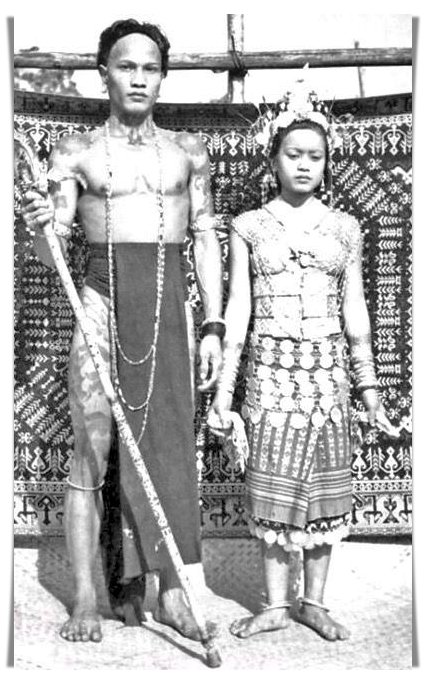
On the wedding day, the groom’s journey to the bride’s longhouse was a ceremony unto itself. The groom’s party traveled to the bride’s longhouse either by boat or on foot through the jungle. Guests were expected to dress in traditional ngepan (intricate traditional costumes), with women donning corsets or rawai (silver girdles) and men wearing armlets and feathers, among other traditional pieces. The groom’s party arrived to a joyous clash of gongs and the firing of brass cannons.
However, underneath the surface of celebration were rituals with deeper meanings. One of the most remarkable customs was the use of poetry or poetic language to provide the ceremony a sense of artistry and depth. When the official ceremony started, the host’s representative would offer the guest a drink, followed by a formal recitation inquiring about their purpose:
“I hesitate and feel nervous to talk in front of you all,
The reason I say so is because I realize that you are the mothers of porcupines,
Covered with cross-stripped white quills,
Pointed like bradawls.
I notice that you are the mothers of hornbills,
With tails striped,
crossing at right angles,
Which claim that they can fly to Brunei and return the same day.
I see that you are the mothers of bears,
Which have stout arms to make holes on the trunks of iron-wood trees.”
“We, therefore, have been sitting next to each other.
I would like to ask,
Which one of you is the mother of the hornbill?
For I am about to ask you to spit out the seeds of the belili tree,
In order that they can be picked up by a tall, unmarried lady,
So that they can be turned into the tusks of a pig,
As charms for the unripe ears left till the last in reaping,
With which we fill our padi bins.”
Poem source
These exchanges were rich in metaphor and eloquence. The poetic recitations continued throughout the ceremony, including a betusut (genealogical recitation) by an expert who detailed the bride and groom’s genealogy. This ritual not only validated the union but also ensured that the marriage respected cultural taboos and norms in order to avoid misfortune.

Elders sealed the union with feasting and storytelling, bestowing blessings and wisdom on the pair. They discussed respect, understanding, and the delicate balance required to navigate life together. Complex traditions and customs infused every action, from seating arrangements to gift exchange.
Today, such ceremonies are a rarity. The Iban embraced Christianity and Islam, abandoning many of their traditional practices in the process. The vibrant rituals of traditional Iban weddings now exist mostly in memory or retellings.
The ceremonies detailed here are not simply rituals. They depict a way of life that places a high priority on community, heritage, and balance. They remind us of the beauty of traditions that once connected people to their past while celebrating the present. The decline of this tradition is a loss not only for the Iban but also for the universal human story of connection, identity, and belonging.
The significance of the Iban wedding customs strikes me as I reflect on them. Marriage was never just about two people; it was about integrating their lives into the larger fabric of their community. It was about love, shared responsibility, and the power of a collective spirit.
Perhaps that is the true power of these traditions: their ability to touch something deep within us while also reminding us of the fragility and beauty of cultural heritage. And as we look forward, perhaps we have a tenacious hope that even as the old ways fade, their spirit will continue to shape the future in ways we may not fully comprehend.

Modern Iban wedding. Image source.
 Olivia's Atelier