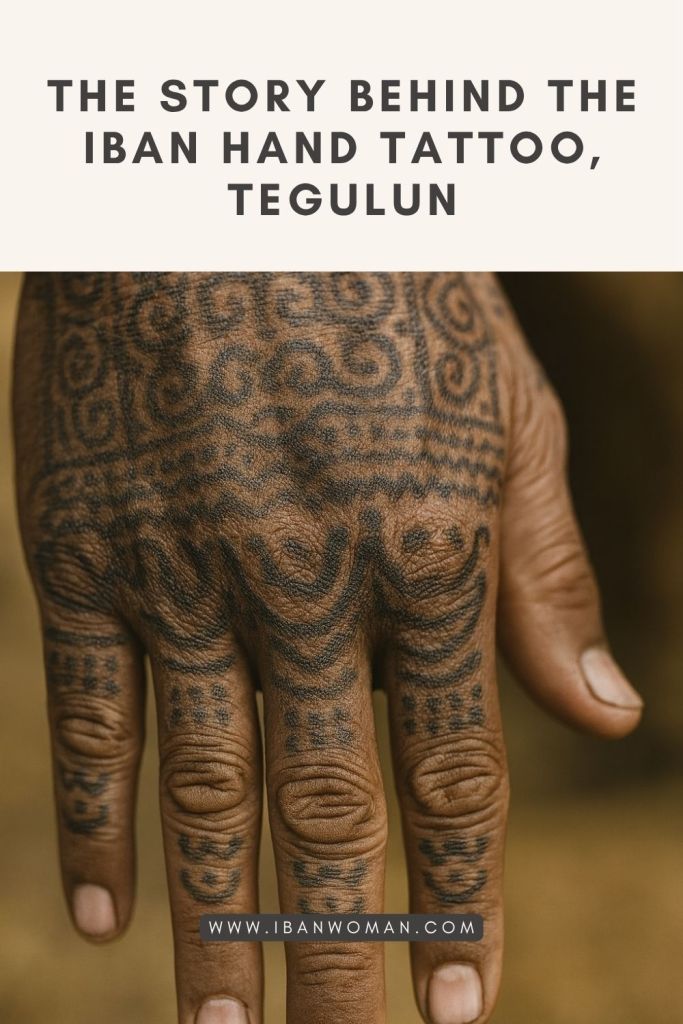
The Story Behind the Iban Hand Tattoo, Tegulun

Have you ever heard of the Iban hand tattoo called tegulun? It’s one of the most striking forms of body art in our culture, yet not many people know what it really means. I found an old photo taken in 1962 from Life in a Longhouse by Hedda Morrison. It shows the hands of an Iban man with very detailed tattoos that go all the way down to his fingers. The pattern is tegulun.

In the Iban language, tattoos are called pantang or kalingai. Every tattoo on the body used to mean something. Tattoos weren’t fashion statements but they were living records of a person’s journey, courage, and place in the community. Each motif, like bungai terung (eggplant flower), ketam (crab), or kala (scorpion), meant something. For men, tattoos often showed that they participated in headhunting expeditions, or gone through rites of passage. For women, only the most skilled pua kumbu weavers were allowed to bear them.

Among women, the right to be tattooed was not given lightly. A woman known as “Indu Tau Nakar, Indu Tau Gaar”, was a master weaver who earned her tegulun through artistic and spiritual labor. With her hands, she made sacred pua kumbu cloths used in rituals such as receiving enemy heads. The tattoo on her fingers didn’t symbolize violence; it reflected her connection to the spirit world through weaving. These women were highly respected, for they were believed to hold the gift to translate dreams and visions into woven form.

The meaning of tegulun was very different for men. Those who carried it were known as kala bedengah—warriors who had taken part in ngayau, or headhunting expeditions. Someone who had tegulun on his hands was a man who had proven himself in battle. The tattoo was a visible sign of his courage and strength of spirit. It was said that every line or curve on the fingers stood for a head of an enemy that had been killed in the war.

Looking at those tattooed fingers in old photographs, one can almost feel their importance in the past. The men who bore them were not only fighters but also protectors of their culture and their way of life. They lived by a complex set of moral codes that were based on omens, dreams, and rituals. Taking a head was never an act of impulse; it was part of a ceremony tied to the safety, fertility, and prosperity of the longhouse.

One of the most well-known Iban warriors who carried tegulun was Temenggong Koh (1870–1956), a tuai serang (war leader) from Kapit, Sarawak. His fingers were covered in tegulun, each one telling a story of victory and survival. Temenggong Koh once gave his nyabur, the sword he used during ngayau, to Malcolm MacDonald, a British diplomat. The blade still bore traces of dried blood and is now displayed at the Durham University Oriental Museum in the UK.

It’s difficult to imagine that such traditions existed within living memory. Today, there are no Iban men who bear tegulun. The British made headhunting illegal after World War II. The last “licensed” expeditions took place during the Malayan Emergency and Communist Insurgency, when Iban trackers were recruited to assist the British. After that time, the custom of taking heads and the tattoos that went with it completely died out.

The tegulun is more than a reminder of war. It refers to a time when everything, from fighting to making art, was connected to the spiritual order of the world. Tattoos linked the body to the world that can’t be seen. They reflected not only bravery but also a sense of belonging. A man or woman who bore them carried the stories of their people and passed them down through the generations.

Those meanings are at risk of being lost today. Most young Ibans have only seen people with tegulun in books or museum photos. But it’s important to understand them. These tattoos show us how our ancestors thought about life, death, and the sacred balance between the two. They remind us that strength can show itself in many ways, like when you swing a nyabur (sword) or sometimes in the patient rhythm of weaving a pua kumbu.

To learn about tegulun, you have to look beyond the surface of the skin. Though the ink has faded and the rituals have ended, the meanings remain alive in memory. They are echoes from another time, reminding us that every mark and line once carried a story worth telling and remembering.
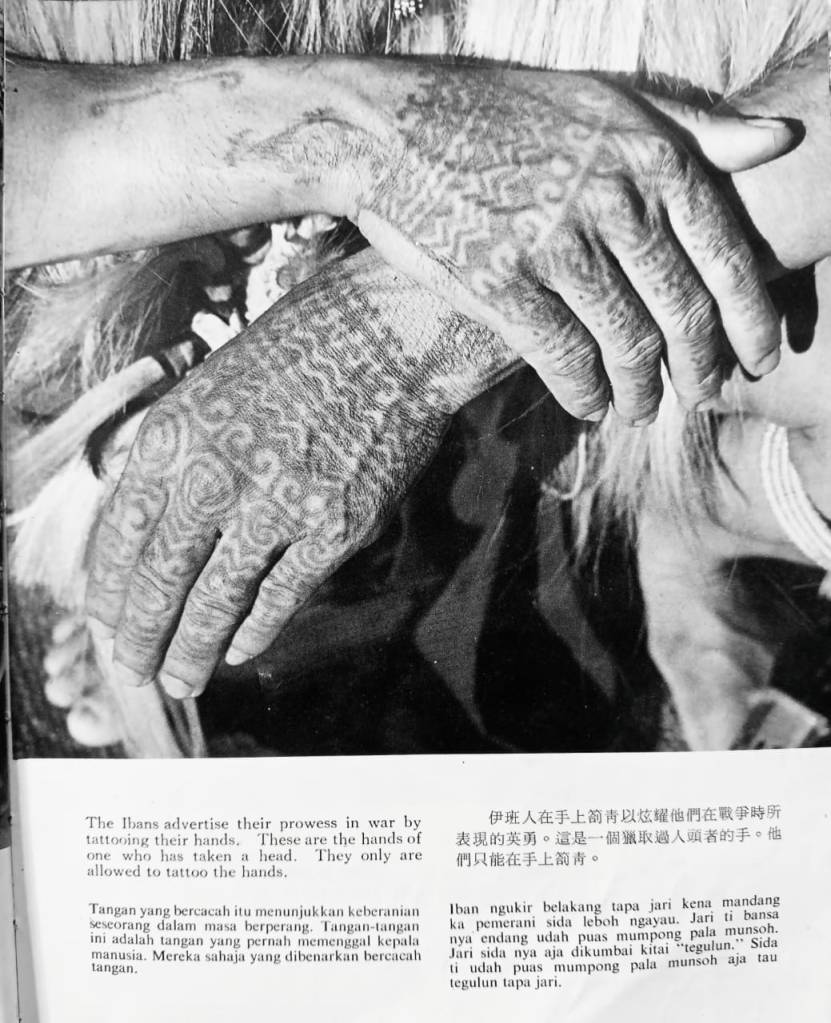
Image source: Life in a Longhouse by Hedda Morrison


I write about Iban culture, ancestral rituals, creative life, emotional truths, and the quiet transformations of love, motherhood, and identity. If this speaks to you, subscribe and journey with me.
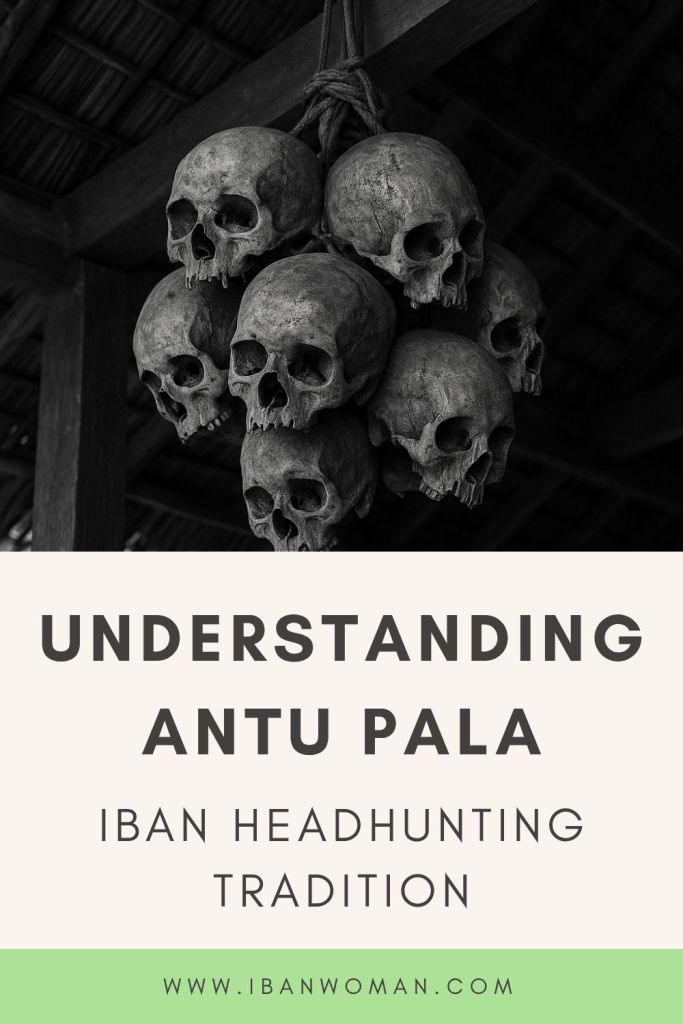
Why the Ibans Took Heads In the Past

A quick disclaimer before I begin. Some people may find this topic upsetting because headhunting led to conflict between different ethnic groups. I don’t intend to glorify the practices of my ancestors; I just want to share what I know, especially since many people, even younger Ibans, don’t fully understand the reasons behind it. Taking a life is wrong by today’s standards, and from a modern perspective I do not support it. But we can’t change history, and judging the past by our present lens doesn’t help us understand it. What we can do is listen and learn.

The Iban had their own reasons and beliefs for taking heads. One of the most significant was to end the mourning period, a practice called ngetas ulit. When someone in the community died, the longhouse would mourn for a period of time. During this time, certain rules and taboos were followed. A ritual that demanded a fresh head was performed to end the mourning period. The family of the deceased would consult the longhouse community, and the men would plan a ngayau (head-hunting expedition) together. After getting a head, a series of complex rituals signaled the end of grief. Killing to end mourning may sound strange today, but for the Iban it was part of a cultural process called nyilih pemati, a symbolic offering for the dead.

Another reason was the belief that antu pala (enemy skulls) had spiritual power. The Iban in the old days  believed that these skulls would bring blessings if they were taken care of. Antu pala also played an important part in the Gawai Burung (the Bird Festival), which was one of the most important Iban ceremonies. As part of this complicated ceremony, the lemambang (bard) would use the skulls in his pengap (chants) to invoke the god of war, Sengalang Burong. This festival has probably disappeared because most Ibans are now Christian or Muslim, but it still holds a place in oral tradition.

There were other uses for skulls as well. They were used in healing rituals, ceremonies to call for rain during times of drought, and as guardians to protect the longhouse or farms from enemies and wild animals. In this regard, the skull became a spiritual servant for the person who kept it. They also carried social meaning. If a man didn’t take a head, he was likely called a coward or kulup (uncircumcised), and these men were not seen as good husbands. Iban society valued courage and bravery very highly.

Some have asked why heads were taken instead of other body parts. The answer lies in old beliefs. Our ancestors believed that the head was the center of a person’s life force. The head could be clearly identified, unlike the hands or feet. In the past, families knew exactly whose head was kept, even after years of blackening from smoke. Today, those identities are no longer shared openly. Imagine getting married to someone from another tribe and then walking into a longhouse and saying, “Honey, that skull belonged to your ancestor.” We have learned that silence is a way to protect the living while still honoring the past.

So, do antu pala still exist? Yes. Some Iban families keep them, like mine. They can be kept in the sadau (the top floor of the longhouse) or hung in groups called tampun on the roof. We don’t see them as trophies but as things that deserve respect. If you don’t take care of them, they can bring bad luck, so you must abide by strict rituals to keep them safe.

This picture shows a tampun that belonged to my ancestor, Unggang Lebur Menua, an Iban warrior from the late 18th century. It has 34 antu pala that are more than 200 years old, and is now kept by relatives at Rh. Panjang Matop, Paku, Betong. It serves as a reminder of a different time, when survival, belief, and identity were connected in ways that may be difficult for us to understand now.

I hope this helped you learn more about a part of Iban history that continues to live in our collective memory.

Image source: Youtube


I write about Iban culture, ancestral rituals, creative life, emotional truths, and the quiet transformations of love, motherhood, and identity. If this speaks to you, subscribe and journey with me.

The Tale of Endu Engkejemu and Endu Engkejuang

This is an Iban folktale I grew up with. I translated this old Iban folktale in my pursuit to preserve the Iban oral literature in my own little way. The Iban version is available online, but as far as I know, no English translation has been made. I translated this in hope I can share my obscure culture with the world. I didn’t profit from this work, and I plan to translate more stories in the future and make them available on this blog. This is the story of two women, one patient and one impulsive, and how their choices led them down very different paths.


Long ago, in a place called Lubok Meram, near Lansar Kerangan Betumpu Man and Rantau Rutan, the sacred domain of Raja Ganali (King Ganali) and Bunsu Ikan, the fish god – there lived two young women named Endu Engkejemu and Endu Engkejuang.

Both were beautiful, but Endu Engkejemu’s beauty stood out. She was graceful and brilliant. Aside from her beauty, she was wise, skilled, and thoughtful. Her calmness and ability to do things well were her strengths. Endu Engkejuang, on the other hand, was full of life and quick-tongued. She was usually the first to welcome guests and try new things. She hated being second, but her impatience showed in the fact that she didn’t always do things right. For her, how quickly something was completed was more important than the quality.

One day, as they were bathing at the river, Endu Engkejuang admired her friend’s long, beautiful hair and asked, “Wai (dear), your hair is so lovely. What’s your secret?”

Endu Engkejemu replied, “Eh, no secret, wai sulu (dear friend). I just use tilan fish bones to comb my hair.”

That evening, Endu Engkejuang found a tilan fish bone and combed her hair while chanting, “Comb my hair, oh tilan fish bones, comb it to the very end.”

But she had not spoken the request properly. The bones obeyed her words exactly, and by the time they finished, she was completely bald! Crying, she ran to Endu Engkejemu for help. Her friend gently explained, “You must ask kindly. Say, “Oh, bones of the tilan, I ask you to comb my hair well so it will grow long and thick.”

Endu Engkejuang followed her advice, and slowly, her hair began to grow again.


Not long after that, Endu Engkejuang saw a handsome man sitting at Endu Engkejemu’s ruai, the communal space of the longhouse. Curious, she rushed to her friend and asked, “Wai, who is that handsome man?”

“He appeared after I pounded some rangan lime leaves,” Endu Engkejemu replied.

Without hesitation, Endu Engkejuang gathered some leaves but picked them carelessly, including old and rotten ones. She pounded them, hoping to summon someone like the man her friend had met. Instead, an old, wrinkled, and scarred man with warts appeared!

Horrified, she ran to her friend again. “Why is yours so handsome and mine so ugly?”

Endu Engkejemu answered simply, “Because you didn’t choose the leaves properly. Only pick the young and nicest leaves. Good things come from good intentions, wai.”


Later, while working in the paddy fields, the two friends were swarmed by mosquitoes. Irritated, Endu Engkejemu said aloud, “There are so many of you! If you love me so much, why not take me as your wife?”

To her surprise, the mosquitoes lifted her gently and carried her to Raja Nyamok, the Mosquito King. There, she became his wife.

Life in the mosquito kingdom was difficult. The mosquitoes fed on blood, and Endu Engkejemu could not eat what they ate. But she never complained. She continued to treat her husband with kindness and respect, even though she was silently suffering.

Eventually, she pretended to be ill. Raja Nyamok, concerned, summoned a manang (shaman) to heal her, but she only became worse. Finally, she pretended to die.

Heartbroken, Raja Nyamok arranged a grand funeral for her. He ordered her body to be placed on a high altar, as was the custom for royal family members. He provided her with new clothes, jars, traditional musical instruments like setawak, dumbak, bendai, menyarai, engkerumong, and gong. There were many other valuable items to accompany her in the afterlife.

When the mourners returned home, Endu Engkejemu quietly unwrapped herself and took everything back with her to her longhouse. Her return amazed everyone. No one could believe what she had brought home.

Endu Engkejuang heard that she was back and she was filled with burning envy. Determined not to be left behind, she hastily went to the paddy fields and let herself be bitten by the swarming mosquitoes. “Take me as your wife if you want me so badly!” she yelled.

The mosquitoes carried her to Raja Nyamok, who accepted her as his wife. But unlike Endu Engkejemu, Endu Engkejuang couldn’t hide her disgust. At the sight of blood everywhere, she whined and complained, “My father never raised me to drink blood like this. I could never be married to someone like you!”

Insulted, Raja Nyamok declared, “You have humiliated me in front of my people and insulted our food and our way of life.”

He ordered his followers to tie her hands and feet and leave her in a part of the jungle where no one would find her. Alone in the middle of the jungle and covered in bruises and mosquito bites, Endu Engkejuang eventually freed herself and stumbled back to her longhouse.

Her family was shocked to see her when she arrived. She looked terrible: her face was swollen, her clothes were ripped, and she was crying pitifully.

Endu Engkejemu, on the other hand, lived on with quiet dignity. Her story, which has been passed down through the generations, reminded everyone that being wise, patient, humble, and caring pays off, while being envious, petty, and rushing often leads to disaster.

Note:

I translated and adapted this story into Malay (shared on Threads) and English (here on my blog), based on the version originally shared by Gregory Nyanggau Mawar on the Iban Cultural Heritage website.


I write about Iban culture, ancestral rituals, creative life, emotional truths, and the quiet transformations of love, motherhood, and identity. If this speaks to you, subscribe and journey with me.