People typically consider cultural preservation to be something that is conducted on a large scale. It is generally placed in the context of institutions, archives, or official documents. But it can also happen on a smaller, personal scale.
I have been making a series of handmade zines that are based on Iban culture and history. Each page of these zines pairs a drawing with a text of information or a poem. The drawings are hand-drawn, and the pages are put together painstakingly, one at a time. Every decision, from picture placement to word space, needs to be carefully considered. The whole thing is done entirely by hand.
While working on these pages, I learned that preservation is more than just keeping information intact. It also has to do with how that information is passed on. The information in these zines is not new. They have been told before, and they exist in oral histories, family accounts, and old literature. What I do is simply place them into a different form.
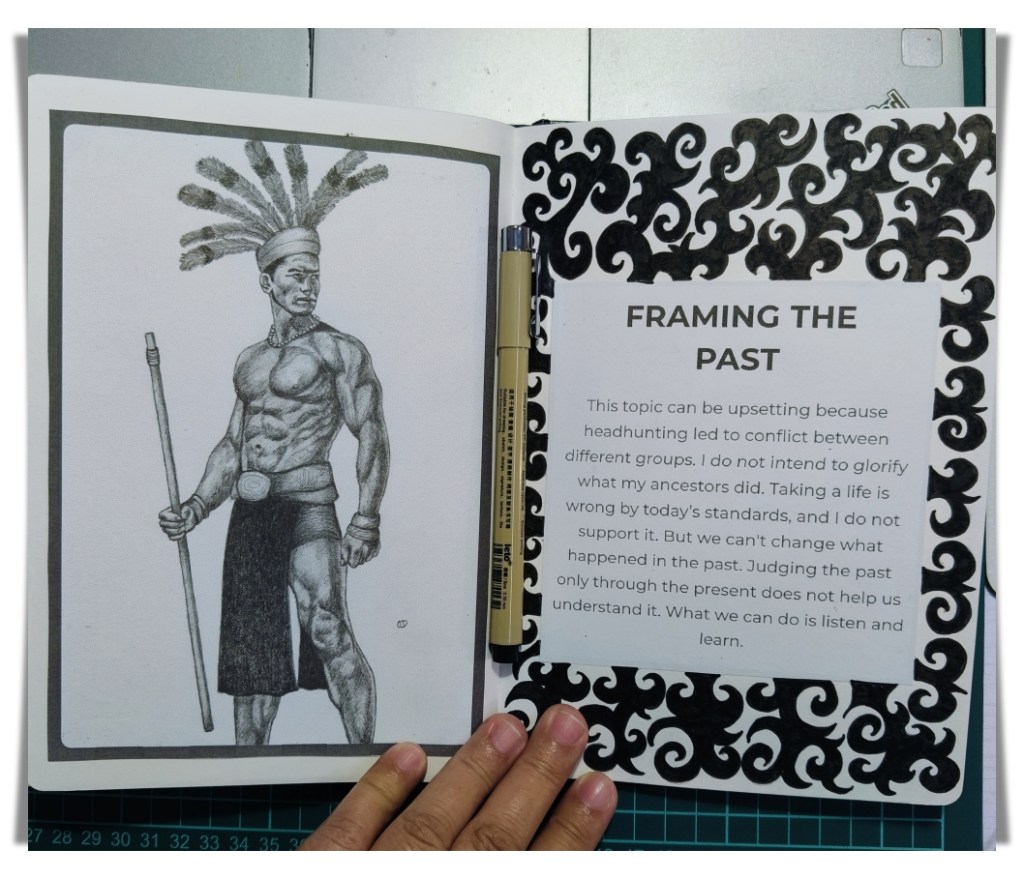
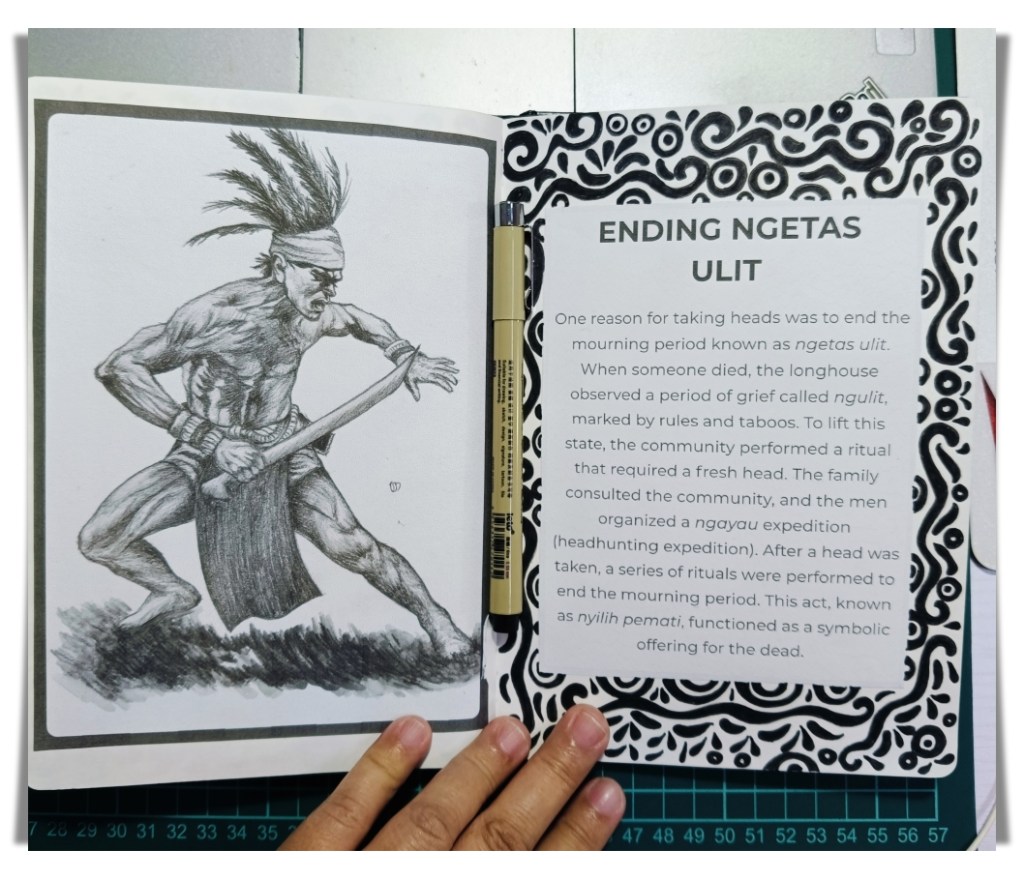
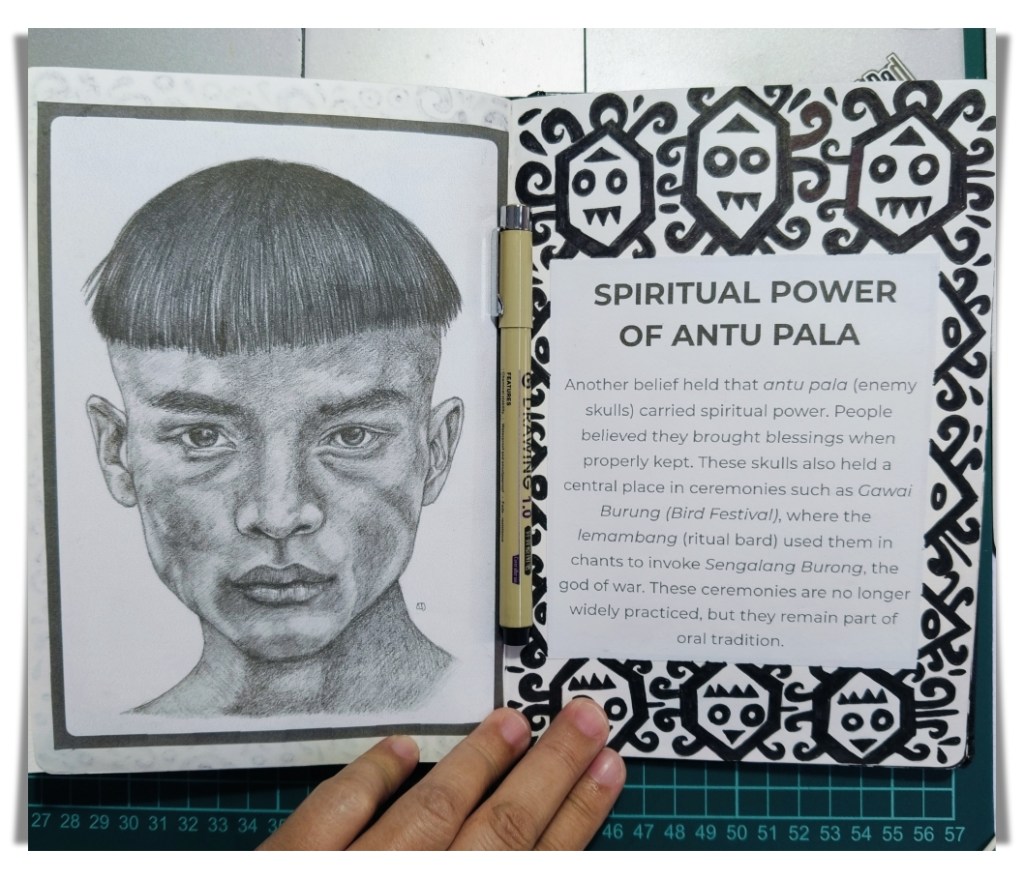
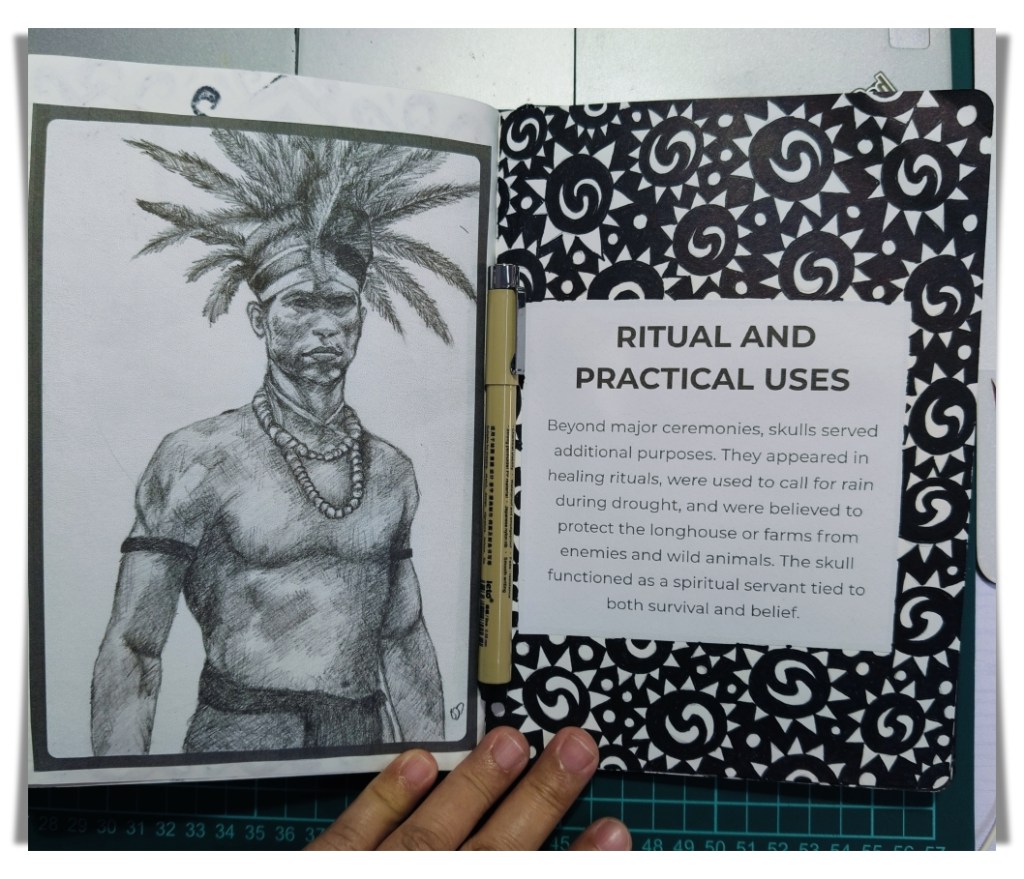
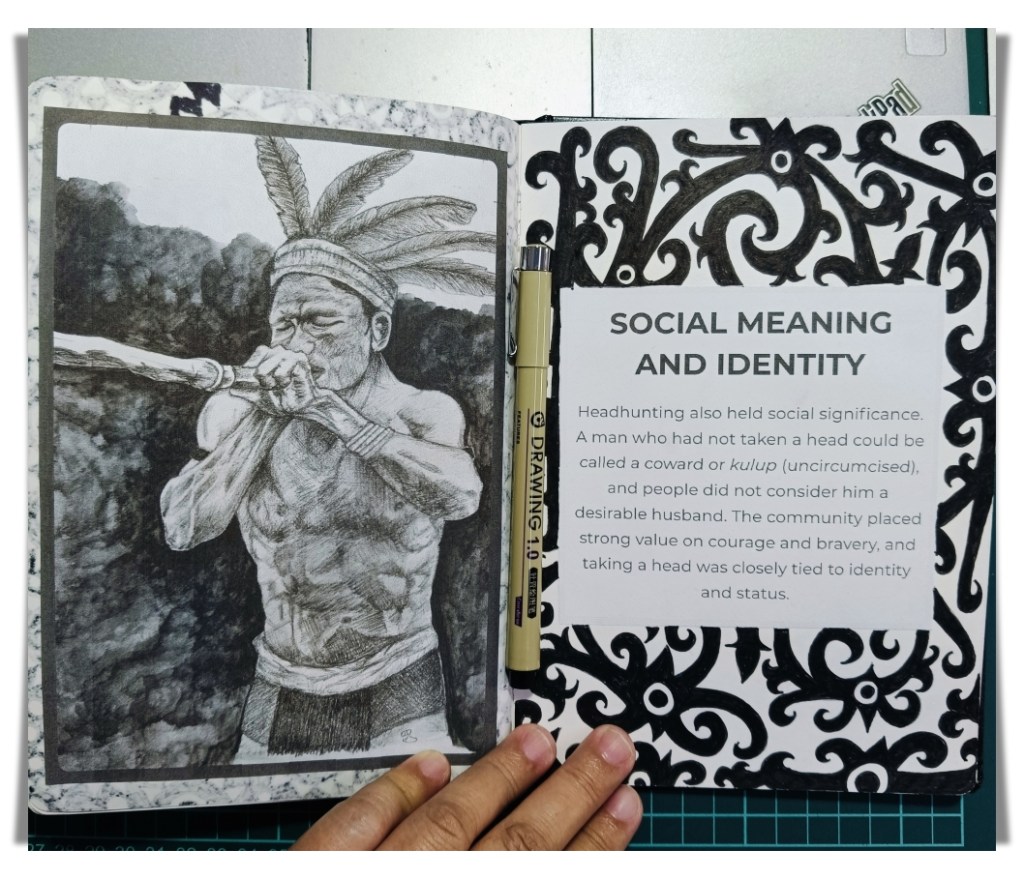
For instance, in these sketchbook pages, I talked about why the Ibans practiced headhunting in the past. It’s a difficult topic that people often misunderstand or only see one side of. I give it context instead of simplifying it. Each section describes a specific reason or belief and is paired with a hand-drawn drawing of an Iban warrior instead of an abstract idea. When I draw, it influences how I feel about the subject. When I sketch a figure, I pay attention to details that I would otherwise overlook.
This zine doesn’t attempt to be a full record of the Iban history. It keeps some parts of it. The imperfections in the pages are part of that process. They show that it was created by hand, with time and care. In this regard, preservation isn’t only about accuracy or completeness. It’s also about continuity, working with it, and allowing it to exist again in the present.
I write about Iban culture, ancestral rituals, creative life, emotional truths, and the quiet transformations of love, motherhood, and identity. If this speaks to you, subscribe and journey with me.
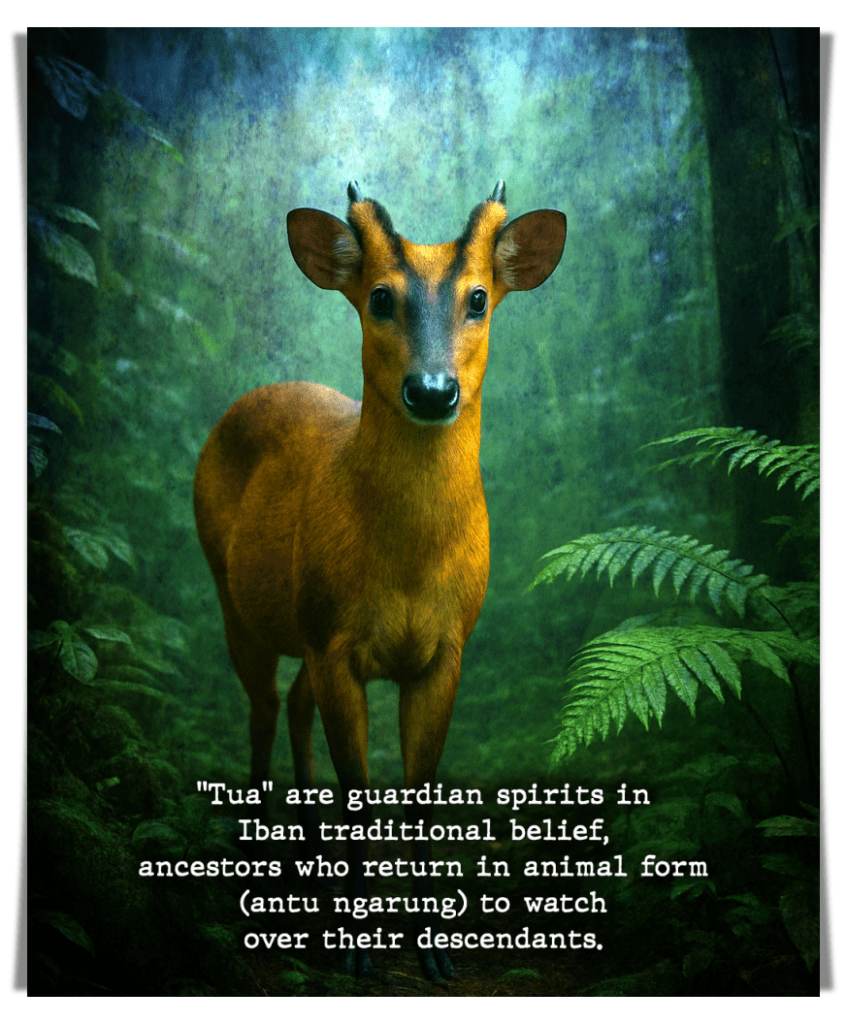
In Iban belief, the souls of those who die go to Sebayan, the afterworld. Some remain there permanently, but certain individuals are believed to return. These are people who lived with exceptional courage or accomplishment during their lifetime. When these ancestors come back, they do not appear as humans. They come ngarung, meaning concealed, taking the form of animals. These returning spirits are called tua, or guardian spirits.
In the Saribas region, guardian spirits are often seen as snakes such as cobras or pythons. They move quietly, stay in the shadows, and leave without drawing attention. When I picture antu ngarung, I always imagine a cobra coiled in the dark corner of a house or at the edge of the forest. It stays still for a long time and slips away the moment it decides to leave. To many people, it would be just an ordinary animal. To us, it can be an ancestor paying a visit.
A guardian spirit usually belongs to an entire lineage. Because of that connection, the family must never harm or eat the animal that represents their guardian. This is a form of respect. The belief is straightforward: the guardian protects the family, and the family must protect the guardian’s form on earth.
In my family, our guardian is the kijang, the Bornean yellow muntjac. When I was four or five, my late grandparents reminded us repeatedly never to harm, kill, or eat kijang. They did not offer long explanations, but the message was clear. Someone in our line was once a brave person, and that ancestor is believed to return as the kijang to watch over us.
That instruction frightened me growing up. I was afraid I might break the rule by accident. I used to remind myself to always ask what kind of meat was being served when we visited people. At that age, it felt like a tremendous responsibility. Over time, the fear changed. I started to feel that my life was connected to something older and larger than myself. I also realised that this experience was not common among many non-Iban communities, which made me value my heritage even more.
The belief in the kijang has shaped the way I understand myself. It gives me a sense of courage. I am still afraid of many things, but this belief keeps me steady. It reminds me that my ancestors lived through hardship, violence, and uncertainty. My problems today are nothing like what they endured. I often tell myself to live in a way that does not dishonor the people who came before me. I exist today because they survived so much. That thought helps me face difficult moments.
When I imagine the kijang watching me now, I think it sees a woman who lives differently from the Iban women of earlier generations. My lifestyle and interests are not the same. Yet I believe it recognises my effort to understand my roots. It may also encourage me to continue forging my own path even when no one else in my family is doing this kind of work. Many women in my family excel in traditional crafts like beadwork and weaving, but none of them are writers. I have to accept that I may be the first woman in my family to preserve our heritage through writing. Someone younger in the future may look at my work the way I once looked at my namesake, the master weaver. Remembering this keeps me going, even when the work feels lonely.
This leads to something important.
We risk losing our identity when we do not learn about our heritage. The loss does not happen suddenly. It happens slowly. We begin identifying more with other cultures. We forget the meaning behind our names, our customs, and our stories. When we fail to protect what we inherit, we leave an empty space that can be filled by influences that do not reflect who we are. This is happening in many communities around the world, and the Iban are no exception.
Iban identity will not endure by chance. It survives because someone chooses to learn, write, document, and share it. It stays alive when people believe their heritage is worth protecting. It continues when people care enough to ask questions and remember the stories their elders passed down.
Our ancestors returned as antu ngarung for a reason. We owe it to them to honor the heritage they entrusted to us.
I write about Iban culture, ancestral rituals, creative life, emotional truths, and the quiet transformations of love, motherhood, and identity. If this speaks to you, subscribe and journey with me.
I used to think that rituals like beserara’ bungai were just old traditions that had no place in today’s world. Growing up, I believed they belonged to the past. I thought the Iban needed to leave them behind to move forward. Whenever elders talked about these beliefs, I felt restless. My world revolved around progress, education, and the principles of organized religion. I didn’t see the value of rituals, and I never took the time to understand what they really meant.
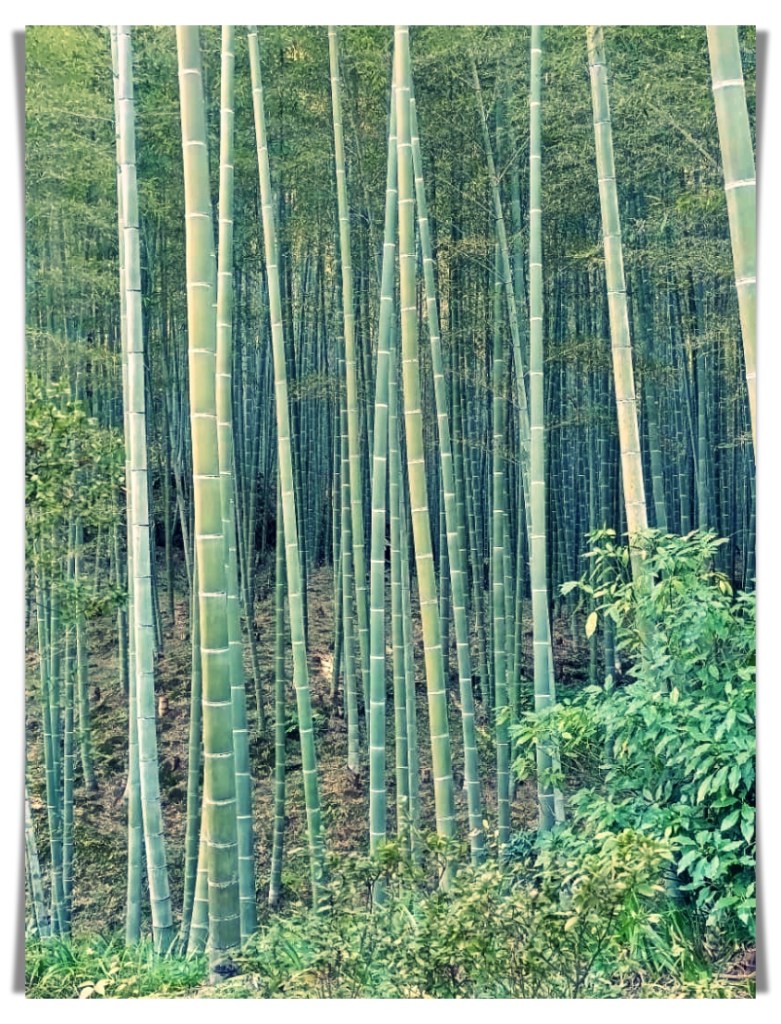
That mindset began to shift—slowly at first, then more clearly—as I read more about the Iban worldview. It wasn’t emotion or nostalgia that changed me, but understanding. I began to see that the Iban learned about life by watching the natural world. They noticed patterns in nature and connected them to how we live. For example, they saw how bamboo and banana plants grow in clusters. Each shoot is part of a single root system underground. If one shoot is unhealthy, it affects the others. When one dies, the root still supports new life. Death was not an ending but part of the cycle. This wasn’t superstition, but wisdom based on careful observation.
Thebungai, the “plant-image” that represents each Iban person in the cosmic realm of Menjaya (the god of healing), began to make sense to me. I understood how it symbolized family and community. Each person is like a shoot, but we all come from the same root. When someone passes, the rest carry on, still connected. New life can grow from the same source. It’s a way of seeing life that is deeply connected and respectful of nature. The ancestors weren’t imagining things—they were describing the interconnected world they knew.
As I learned more, I started to feel a quiet pride in where I come from. I discovered that my ancestors included warriors and raja berani, people whose stories are still told in my family. I began to understand that even though I live far from my homeland, I am still part of that root system. This connection also extends to my children. They may not know all the customs or speak the language well, but the roots are still there. They are part of something that has been passed down through generations.
When I learned about beserara’ bungai, the ritual that separates the living from the dead, I felt something shift in me. This ritual is about care—not forgetting what we have lost. It helps both the living and the dead let go so they don’t hold each other back. The living need to keep moving forward, and the dead need peace on their journey to Sebayan. It’s a ritual of compassion that affirms the connection with the dead even as they journey on to the otherworld.
This understanding arrived at a time when I was wrestling with my own spiritual ties. I had been part of the same church community for many years. It shaped how I saw God, faith, and morality. But as I grew older, those teachings started to feel burdensome. I found myself questioning doctrines that encouraged separation from people who did not meet certain standards of spirituality. I began noticing the tension between fear-based expectations and the compassion-centered teachings of Jesus in the Gospels. As I continued to question, the burden of belonging to a system that no longer aligned with my conscience intensified.
Learning about beserara’ bungai gave me words for what I was feeling. I realized I was trying to protect my spirit. I wasn’t leaving faith behind—I was returning to what felt true. Jesus became the real rootstock. I wanted a faith grounded in his teachings: kindness, justice, presence, love, and compassion—not fear or guilt. I needed space to grow without feeling judged by a community that often equated questions with spiritual instability.
In a way, I’m experiencing my own kind of separation from the church rootstock. It is not a rejection of my past or of the people who have been a huge part of my life for the past two decades. It is a necessary separation so I can continue growing without feeling suffocated by expectations that no longer fit the life I am trying to build. I’m holding onto what still nourishes me and letting go of what drains me. The Iban worldview helped me understand that letting go can be a way of protecting both myself and the things I want to keep alive.
The more I reflect on it, the more I hope my children learn something different from what I learned in my early years of faith. I hope they are not afraid to ask questions. I hope they do not feel inferior in front of people who sound knowledgeable but speak without warmth. I want them to grow into a faith that welcomes curiosity, thoughtfulness, and conscience. I want them to recognize that their connection to God is direct, personal, and rooted in compassion—not fear. I want them to inherit a sense of strength that comes from understanding where they come from, both culturally and spiritually.
As I learn more about rituals like beserara’ bungai, I’ve come to understand that my ancestors didn’t divide life into “spiritual” and “ordinary.” Everything was connected. Life, death, nature, community, and spirit were all part of one whole. That way of seeing the world teaches me to live with care and humility. It shows me that letting go can be a loving act, and returning to our roots can take courage.
I write about Iban culture, ancestral rituals, creative life, emotional truths, and the quiet transformations of love, motherhood, and identity. If this speaks to you, subscribe and journey with me.
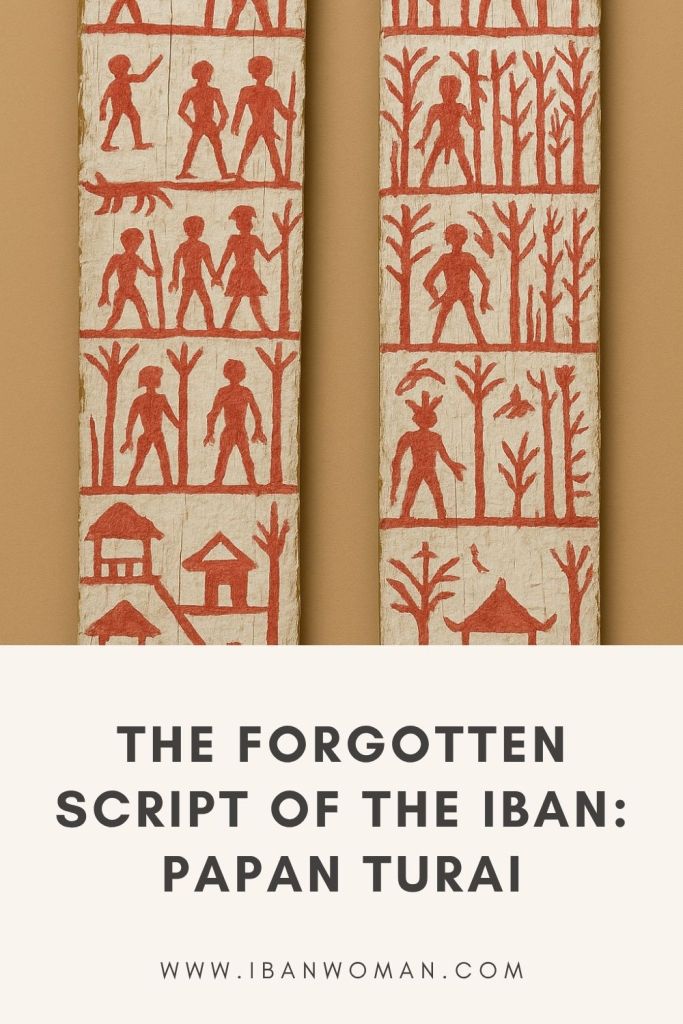
The majority of us are familiar with Egyptian hieroglyphics. However, not many people are aware that the Iban used to have their own type of pictorial writing. My ancestors’ written language, known as “turai,” is carved onto wooden boards called “papan turai.” During major festivals like Gawai Batu and Gawai Antu, lemambang (ritual bards) used these boards to recall and recite the pengap (folk epics), timang (invocations), and many other types of Iban poetry (leka main asal).
The papan turai is more than just a ceremonial piece. It serves as a link between oral and written tradition. Some of these carved symbols date back about four centuries. They preserve fragments of genealogy (tusut), the Iban’s migration history from the Kapuas region of Kalimantan to Sarawak, and even tales of tribal conflicts and legendary Iban leaders.
Researchers from the Sarawak Museum and UNIMAS have been examining these boards to find out what they symbolize. What is remarkable is that lemambang from various areas can comprehend each other’s papan turai. This demonstrates that there was once a common symbolic language among people in different communities.
This discovery goes against the previous belief that the Iban were completely “pre-literate” before Western influence arrived. The papan turai shows that our forefathers had their own way of keeping records of what they knew, which was based on ritual, cosmology, and collective memory. It reminds us that being able to read and write doesn’t just imply knowing the alphabet and how to write on paper.
In 1947, an Iban scholar named Dunging anak Gunggu expanded upon this tradition. He developed a whole writing system based on turai. However, few people know about this writing system, even among Sarawakians.
When I stood in front of the papan turai at the Borneo Cultures Museum, I felt a sense of recognition. They reminded me of the pua kumbu patterns that Iban women wove to tell stories about spirits, dreams, and journeys. Both have the same goal: to record, remember, and preserve meaning alive beyond the present.
It made me realize that each culture had its unique way of retaining memories. Some people carve it into stone, some into wood, others into sound, and yet others into cloth. For the Iban, it may have been all of these things at once. The lemambang sang what the papan turai contained, and the pua weavers wove tales and ancestral history into the thread. These were our books before books.
As I stood there, I thought about how easily such histories fade away. It’s not because they aren’t relevant, but because they aren’t documented in the systems that the world relies on. The papan turai lived on through continuity of ritual and faith. Its knowledge lived on through the lemambang, in various ceremonies and festivals, and in the community gathered around the ruai during Gawai. When modern eyes look at the papan turai, they may see only strange markings. But these are not just symbols. They hold our heritage. They are reminders that our people were already keeping records of their lives in their own way long before British colonials came with pen and paper. However, I am not sure how long we can keep them alive, as the lemambang is becoming a dying breed of heritage guardians of the Iban.
I felt pride and loss as I left the museum that day. Pride, since the papan turai shows that Iban civilization was more complicated and deep than most people realize. Loss, because so few of us can interpret those symbols today.
Maybe this is why I write and draw. I want to continue that old rhythm in a new form. My writings and drawings are like my own papan turai, illustrating the lines that connect the past and the present. I strive to document things that could otherwise disappear, including stories from my indigenous perspective, feelings, and fragments of my identity.
To me, the papan turai is more than an artifact. It is a mirror that reflects an ancient hunger to make meaning clear and to preserve memories alive before they disappear. And maybe that instinct to leave a mark and to tell a story is something that never truly goes away. It exists in our language, our art, and our digital words. It’s the same urge that led a lemambang to carve symbols into wood hundreds of years ago, hoping that someone would remember it someday.
Sources: Religious Rites and Customs of the Iban or Dyaks of Sarawak by Leo Nyuak and Edm. Dunn (1906), UNIMAS Gazette.
I write about Iban culture, ancestral rituals, creative life, emotional truths, and the quiet transformations of love, motherhood, and identity. If this speaks to you, subscribe and journey with me.
Prior to the coming of Christianity and Islam, the Iban people had a sophisticated system of animistic beliefs. The world was believed to be filled with spirits—some friendly, others unpredictable—who lived in jungles, rivers, animals, and dreams. The desire to live in harmony with these invisible forces influenced many aspects of life, from farming and hunting to warfare and family decisions.
Augury, or “beburong” in Iban, was one of the most intricate systems in this belief. It is a sacred form of divination that uses the movements and sounds of certain birds known as burung mali (omen birds) to seek direction. The practice was said to have been taught to humans by Sengalang Burong, the Iban God of War and divine messenger. He taught that the gods do not speak directly but send their messages through the natural world.
Every omen bird has a specific meaning. The interpretation of their cries, flight paths, and actions guides important decisions, such as whether to start planting paddy, go on a journey, or go to war. The tuai burong, an augur who can read and understand the language of birds, is responsible for figuring out what these signs mean. This cultural duty used to be a big part of Iban life because it was a way for people to connect spiritually and keep their conduct in line with God’s will.
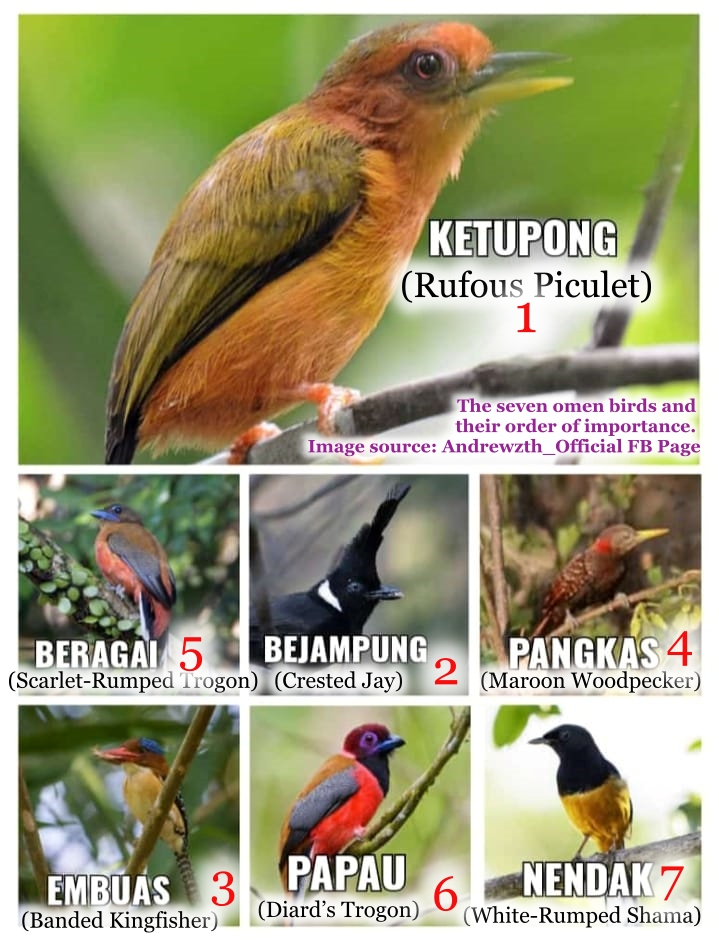
Oral history states that Sengalang Burong and his wife, Endu Sudan Berinjan Bungkong, had seven daughters and one son. Each daughter married a nobleman who became one of the seven omen birds: Ketupong (Rufous Piculet), Beragai (Scarlet-Rumped Trogon), Bejampong (Crested Jay), Pangkas (Maroon Woodpecker), Embuas (Banded Kingfisher), Kelabu Papau (Diard’s Trogon), and Burung Malam, which literally means “night bird” but is a cricket. The eighth omen bird, Nendak (White-Rumped Shama), is Sengalang Burong’s faithful messenger. All of these are real, common bird species that live in the Borneo rainforest.
Sengalang Burong passed down the knowledge of augury to his grandson, Sera Gunting. Sera Gunting is the son of Sengalang Burong’s eldest daughter, Endu Dara Tinchin Temaga, and her second husband, a man named Menggin. Sera Gunting also learned the omens of war when he joined angayau (headhunting) expedition with his seven uncles—the noblemen who married Sengalang Burong’s daughters. He later passed his knowledge to his descendants. Linggir Mali Lebu, Orang Kaya Pemancha Dana Bayang, and Unggang Lebor Menoa were among the subsequent generations of Iban war leaders who observed and practiced the war omens he had learned.
Sengalang Burong also taught Sera Gunting about the different stages of Gawai Burong, the festival that war leaders had to hold to invite him and his followers to attend. That is a story and post for another time.
All the omen birds mentioned above can still be found in Borneo’s rainforests. I have never seen them in the wild or heard their calls in person, but last month, when I visited the Borneo Cultures Museum, I had the opportunity to hear recorded calls from Beragai and Embuas. I could hear the sound of wind, insects, and other birds in the distance along with their calls in the recordings. It was difficult to tell which bird made which sound. It reminded me that to practice augury, you needed to believe and have an attentive ear to pay close attention to the different bird calls.
Those recordings brought back a memory from my childhood. When I was nine years old, my parents decided to adopt the baby son of a relative. They had everything ready: a small bassinet, baby clothes, and the trip to the longhouse where the child was staying. They had to walk through the jungle for three hours to reach the place.
Along the way, they encountered an omen bird. I don’t know which one it was, but a tuai burong was consulted to explain the sign. He advised my parents not to continue. He said that if they went through with the adoption, the boy would grow up to “overrule” me and my siblings, which means he would prosper more than us and that we might fall into misfortune. My parents took the advice and chose not to go through with it. The baby stayed with his other relatives, and that was the end of it.
Looking back, I understand that moment not as superstition but as a reflection of how much faith my parents had in the way things were meant to be. They thought that signs meant something and that the natural world could warn or guide us through nature’s language. It was a way of life built on attention, not control. However, it didn’t stop me from wondering, what if the boy experienced a difficult childhood filled with poverty and hardship and was denied the chance to live a better life due to the bird’s signs?
Today I realized how rarely I listen. The world around me is full of noise—machines, traffic, and incessant messages devoid of meaning. Even in silence, my mind is busy with thoughts, endless scrolling, or work. Listening feels like a lost art. I no longer know how to hear what my forefathers intuitively understood: that signs came quietly, without noise or spectacle.
I’m not sure if anyone still practices augury today. Perhaps a few elders still possess fragments of that knowledge. Even if it is no longer practiced, I hope that Ibans, particularly the younger generation, understand its origins and significance. Beburong was once central to how our people made decisions and understood their relationship with nature. It influenced how they approached the world—with respect, patience, and a willingness to listen. Perhaps I’ll never see those birds in the wild or hear their true calls across the forest. But I’d like to believe they’re still there, their voices blending with the wind, delivering guidance that once guided entire communities.
I write about Iban culture, ancestral rituals, creative life, emotional truths, and the quiet transformations of love, motherhood, and identity. If this speaks to you, subscribe and journey with me.


 Olivia's Atelier