The Tale of Endu Engkejemu and Endu Engkejuang

This is an Iban folktale I grew up with. I translated this old Iban folktale in my pursuit to preserve the Iban oral literature in my own little way. The Iban version is available online, but as far as I know, no English translation has been made. I translated this in hope I can share my obscure culture with the world. I didn’t profit from this work, and I plan to translate more stories in the future and make them available on this blog. This is the story of two women, one patient and one impulsive, and how their choices led them down very different paths.


Long ago, in a place called Lubok Meram, near Lansar Kerangan Betumpu Man and Rantau Rutan, the sacred domain of Raja Ganali (King Ganali) and Bunsu Ikan, the fish god – there lived two young women named Endu Engkejemu and Endu Engkejuang.

Both were beautiful, but Endu Engkejemu’s beauty stood out. She was graceful and brilliant. Aside from her beauty, she was wise, skilled, and thoughtful. Her calmness and ability to do things well were her strengths. Endu Engkejuang, on the other hand, was full of life and quick-tongued. She was usually the first to welcome guests and try new things. She hated being second, but her impatience showed in the fact that she didn’t always do things right. For her, how quickly something was completed was more important than the quality.

One day, as they were bathing at the river, Endu Engkejuang admired her friend’s long, beautiful hair and asked, “Wai (dear), your hair is so lovely. What’s your secret?”

Endu Engkejemu replied, “Eh, no secret, wai sulu (dear friend). I just use tilan fish bones to comb my hair.”

That evening, Endu Engkejuang found a tilan fish bone and combed her hair while chanting, “Comb my hair, oh tilan fish bones, comb it to the very end.”

But she had not spoken the request properly. The bones obeyed her words exactly, and by the time they finished, she was completely bald! Crying, she ran to Endu Engkejemu for help. Her friend gently explained, “You must ask kindly. Say, “Oh, bones of the tilan, I ask you to comb my hair well so it will grow long and thick.”

Endu Engkejuang followed her advice, and slowly, her hair began to grow again.


Not long after that, Endu Engkejuang saw a handsome man sitting at Endu Engkejemu’s ruai, the communal space of the longhouse. Curious, she rushed to her friend and asked, “Wai, who is that handsome man?”

“He appeared after I pounded some rangan lime leaves,” Endu Engkejemu replied.

Without hesitation, Endu Engkejuang gathered some leaves but picked them carelessly, including old and rotten ones. She pounded them, hoping to summon someone like the man her friend had met. Instead, an old, wrinkled, and scarred man with warts appeared!

Horrified, she ran to her friend again. “Why is yours so handsome and mine so ugly?”

Endu Engkejemu answered simply, “Because you didn’t choose the leaves properly. Only pick the young and nicest leaves. Good things come from good intentions, wai.”


Later, while working in the paddy fields, the two friends were swarmed by mosquitoes. Irritated, Endu Engkejemu said aloud, “There are so many of you! If you love me so much, why not take me as your wife?”

To her surprise, the mosquitoes lifted her gently and carried her to Raja Nyamok, the Mosquito King. There, she became his wife.

Life in the mosquito kingdom was difficult. The mosquitoes fed on blood, and Endu Engkejemu could not eat what they ate. But she never complained. She continued to treat her husband with kindness and respect, even though she was silently suffering.

Eventually, she pretended to be ill. Raja Nyamok, concerned, summoned a manang (shaman) to heal her, but she only became worse. Finally, she pretended to die.

Heartbroken, Raja Nyamok arranged a grand funeral for her. He ordered her body to be placed on a high altar, as was the custom for royal family members. He provided her with new clothes, jars, traditional musical instruments like setawak, dumbak, bendai, menyarai, engkerumong, and gong. There were many other valuable items to accompany her in the afterlife.

When the mourners returned home, Endu Engkejemu quietly unwrapped herself and took everything back with her to her longhouse. Her return amazed everyone. No one could believe what she had brought home.

Endu Engkejuang heard that she was back and she was filled with burning envy. Determined not to be left behind, she hastily went to the paddy fields and let herself be bitten by the swarming mosquitoes. “Take me as your wife if you want me so badly!” she yelled.

The mosquitoes carried her to Raja Nyamok, who accepted her as his wife. But unlike Endu Engkejemu, Endu Engkejuang couldn’t hide her disgust. At the sight of blood everywhere, she whined and complained, “My father never raised me to drink blood like this. I could never be married to someone like you!”

Insulted, Raja Nyamok declared, “You have humiliated me in front of my people and insulted our food and our way of life.”

He ordered his followers to tie her hands and feet and leave her in a part of the jungle where no one would find her. Alone in the middle of the jungle and covered in bruises and mosquito bites, Endu Engkejuang eventually freed herself and stumbled back to her longhouse.

Her family was shocked to see her when she arrived. She looked terrible: her face was swollen, her clothes were ripped, and she was crying pitifully.

Endu Engkejemu, on the other hand, lived on with quiet dignity. Her story, which has been passed down through the generations, reminded everyone that being wise, patient, humble, and caring pays off, while being envious, petty, and rushing often leads to disaster.

Note:

I translated and adapted this story into Malay (shared on Threads) and English (here on my blog), based on the version originally shared by Gregory Nyanggau Mawar on the Iban Cultural Heritage website.


I write about Iban culture, ancestral rituals, creative life, emotional truths, and the quiet transformations of love, motherhood, and identity. If this speaks to you, subscribe and journey with me.

Marriage Traditions of the Iban of Sarawak, Borneo

Marriage is a timeless union that binds two souls together. It also functions as a mirror, reflecting the core of a community’s culture and identity. My people, the Iban of Sarawak, Borneo, fill their traditional wedding rituals with deep meanings based on ancestral traditions. However, these traditional ceremonies are gradually disappearing as time passes.

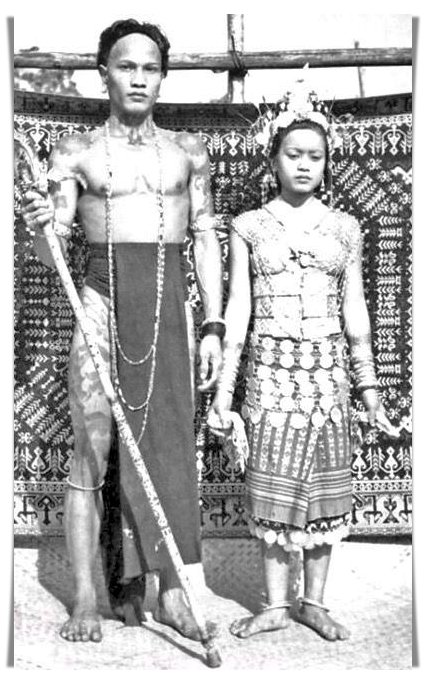
For the Iban, marriage was not just a bond between two individuals but a communion of families and communities. Traditionally, the groom’s parents carefully planned this arranged marriage. Ties of kinship often influence their choice of wife. Cousins were preferred matches because they preserved familial relationships while also reflecting the Iban’s value of unity within their extended network. When a bride was chosen, the groom’s parents would leave a rawai (silver girdle) or an ilang (sword) at her family’s home as proof of their dedication and intention.

Image source

The longhouse is the heart of Iban community life. During weddings, it becomes a lively epicenter. It was here that life and celebration collided, and the community joined together to honor the union. Careful planning is required days or weeks before the ceremony. This includes making tuak (rice wine) in enormous vats, preparing traditional buns and cookies, and selecting livestock for slaughter. Guests were invited with knotted strings to tally down the days till the celebration.

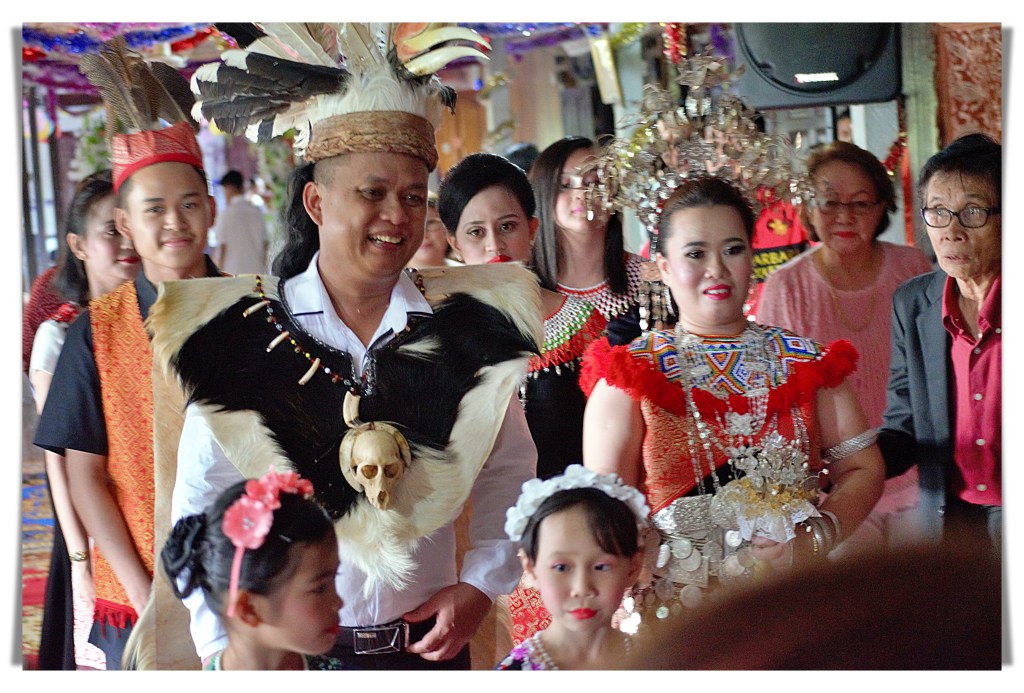
On the wedding day, the groom’s journey to the bride’s longhouse was a ceremony unto itself. The groom’s party traveled to the bride’s longhouse either by boat or on foot through the jungle. Guests were expected to dress in traditional ngepan (intricate traditional costumes), with women donning corsets or rawai (silver girdles) and men wearing armlets and feathers, among other traditional pieces. The groom’s party arrived to a joyous clash of gongs and the firing of brass cannons.

However, underneath the surface of celebration were rituals with deeper meanings. One of the most remarkable customs was the use of poetry or poetic language to provide the ceremony a sense of artistry and depth. When the official ceremony started, the host’s representative would offer the guest a drink, followed by a formal recitation inquiring about their purpose:

“I hesitate and feel nervous to talk in front of you all,
The reason I say so is because I realize that you are the mothers of porcupines,
Covered with cross-stripped white quills,
Pointed like bradawls.
I notice that you are the mothers of hornbills,
With tails striped,
crossing at right angles,
Which claim that they can fly to Brunei and return the same day.
I see that you are the mothers of bears,
Which have stout arms to make holes on the trunks of iron-wood trees.”

“We, therefore, have been sitting next to each other.
I would like to ask,
Which one of you is the mother of the hornbill?
For I am about to ask you to spit out the seeds of the belili tree,
In order that they can be picked up by a tall, unmarried lady,
So that they can be turned into the tusks of a pig,
As charms for the unripe ears left till the last in reaping,
With which we fill our padi bins.”
Poem source

These exchanges were rich in metaphor and eloquence. The poetic recitations continued throughout the ceremony, including a betusut (genealogical recitation) by an expert who detailed the bride and groom’s genealogy. This ritual not only validated the union but also ensured that the marriage respected cultural taboos and norms in order to avoid misfortune.

Image source

Elders sealed the union with feasting and storytelling, bestowing blessings and wisdom on the pair. They discussed respect, understanding, and the delicate balance required to navigate life together. Complex traditions and customs infused every action, from seating arrangements to gift exchange.

Today, such ceremonies are a rarity. The Iban embraced Christianity and Islam, abandoning many of their traditional practices in the process. The vibrant rituals of traditional Iban weddings now exist mostly in memory or retellings.

The ceremonies detailed here are not simply rituals. They depict a way of life that places a high priority on community, heritage, and balance. They remind us of the beauty of traditions that once connected people to their past while celebrating the present. The decline of this tradition is a loss not only for the Iban but also for the universal human story of connection, identity, and belonging.

The significance of the Iban wedding customs strikes me as I reflect on them. Marriage was never just about two people; it was about integrating their lives into the larger fabric of their community. It was about love, shared responsibility, and the power of a collective spirit.

Perhaps that is the true power of these traditions: their ability to touch something deep within us while also reminding us of the fragility and beauty of cultural heritage. And as we look forward, perhaps we have a tenacious hope that even as the old ways fade, their spirit will continue to shape the future in ways we may not fully comprehend.

Modern Iban weddingImage source.

Inheriting Courage From My Warrior Ancestors

When I close my eyes, memories rise like smoke from a dying fire. I can still hear the gendang’s beating and my family’s joyful chatter from Gawai. I was ten years old and surrounded by the warmth of my people. The elders shared stories of our ancestors—Orang Kaya Pemancha Dana Bayang, Aji Apai Limpa, and Nakhoda Panglima Budin Gerasi—all courageous warriors of great renown. That courage, I’ve been told, is in my blood. But what does that mean in a place so far removed from their reality?

Oplus_131072

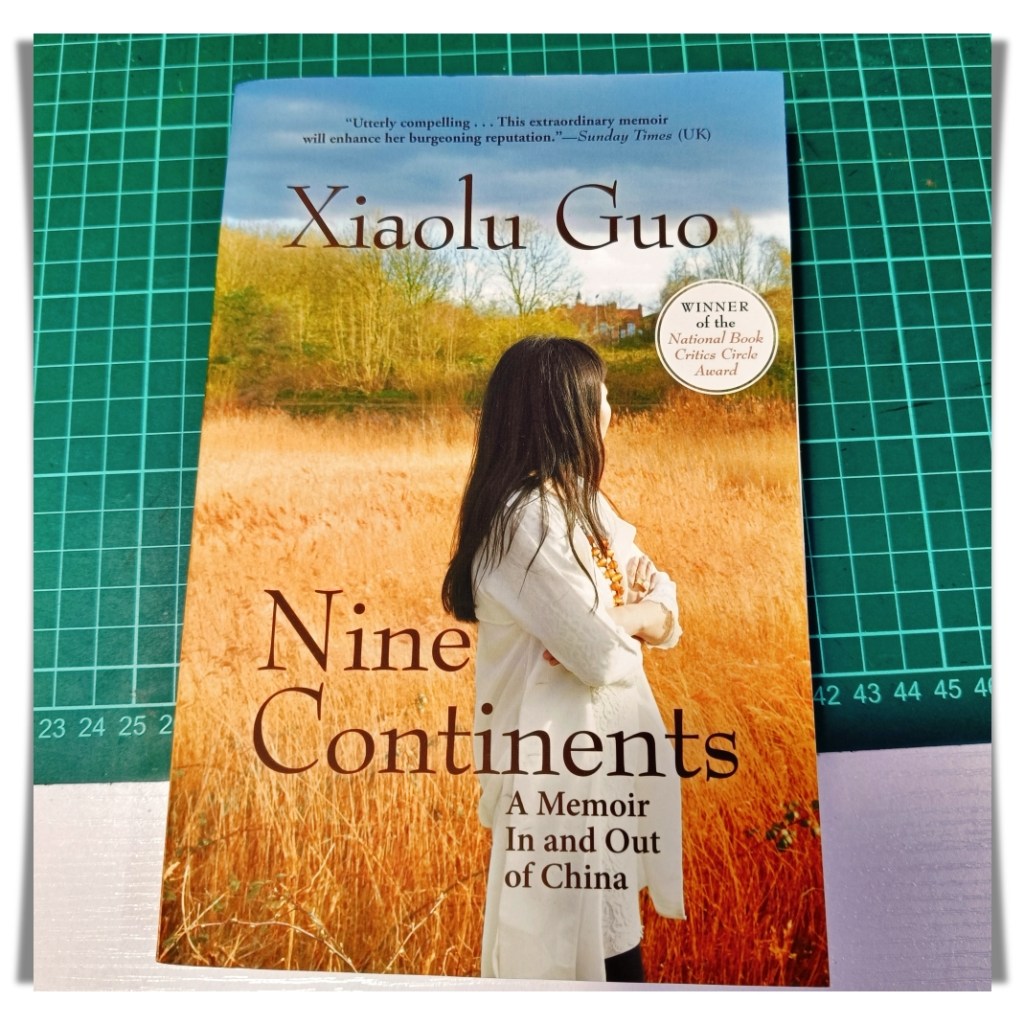
I’ve recently been reading Xiaolu Guo’s Nine Continents: A Memoir In and Out of China. Her exploration of identity, displacement, and cultural heritage resonates deeply with me. Xiaolu often addresses issues of alienation and belonging in her works, and she has become one of my favorite authors. Her writing inspired me to think about my own journey, which led me to write this post.

Our Warrior Culture

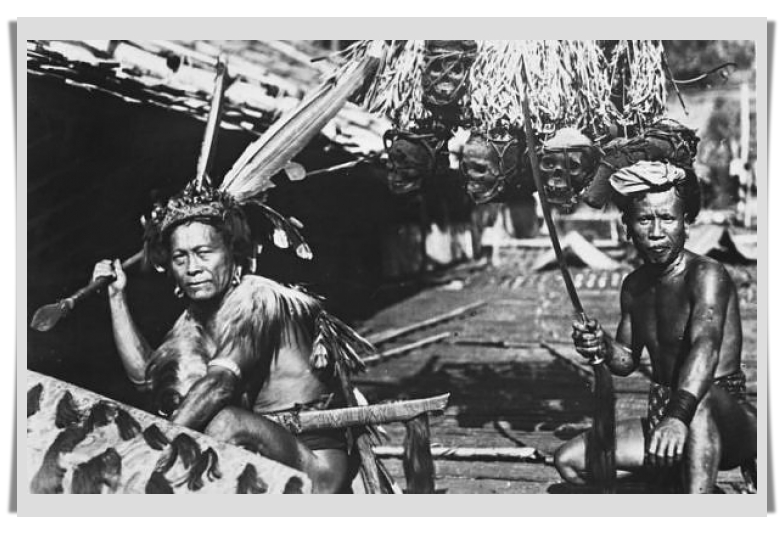
The Iban were famed for their warrior culture, defined by war expeditions and headhunting. It was once an important aspect of our spiritual beliefs and society framework. To be Iban means to be a warrior. Headhunting was not a barbaric pastime, as outsiders may believe. It was a necessary way of life since it signified protection, honor, and a connection to the spirit realm. While the act itself faded into history, the essence of the courage has been passed down through generations.

I often asked myself, “What remains of the warrior spirit?”. Sometimes it feels like a quiet force pushing me forward. In moments of difficulty, I draw on the courageous spirit of my ancestors. Their legacy reminds me that I have the strength to persevere in the face of overwhelming odds. Perhaps it is genetic memory, the invisible link that ties me to my ancestors and passes down the legacy of courage across generations.

The Loss of Tradition

However, bravery alone cannot fill the gaps. Living in urban places like Kuala Lumpur has distanced me from the traditions that constitute my identity. When my extended family embraced Christianity in the 1950s, it marked a shift from animistic beliefs. Urban living also entails replacing the communal life of the longhouse. Many other aspects of our culture are disappearing, such as the extensive oral poetry tradition.

I am caught in a dilemma. On the one hand, I value the opportunities and conveniences of modern living. On the other hand, I mourn the loss of vibrant traditions that shaped our way of life. These losses make me wonder how we can honor the past while embracing the present.

Image source The late Temenggong Koh (left), one of the last Iban warleaders of the 20th century, before headhunting was completely outlawed by the British colony.

The Sense of Alienation

Life in the city often exacerbates this disconnection. Here, I am just a fragment of an Iban: a name that suggests a foreign land, a face that others might find unfamiliar. When people ask where I’m from, my responses may seem inadequate. How can I explain a longhouse? Or, even if I can explain it, how do I dispel their misconception that modern Ibans still live on trees and wear loincloths? How can I explain our different Gawai, or traditional festivals, when they typically only celebrate one or two holidays, like Eid or Lunar New Year? However, in the heart of this alienation, I’ve realized that identity is not static. It is a fluid interplay of past and present, shaped by our decisions and circumstances.

Strength Through Cultural Roots

Nonetheless, I remain connected to my roots. They are not always visible, but they are present. My ancestors’ courage motivates me to face my fears and embrace the unknown. The warrior spirit is not a relic from the past but rather a driving force in my life today.

During difficult times, I found myself returning to the stories of my ancestors. They endured jungles, battles, and scarcity. I remind myself of their tenacity—if they can endure, so can I.

The loud proclamation of success does not equate to strength. Perseverance and the ability to adapt without forgetting are qualities that define strength. The warrior spirit is about enduring in a world that often forces us to forget who we are.

Preserving Tradition

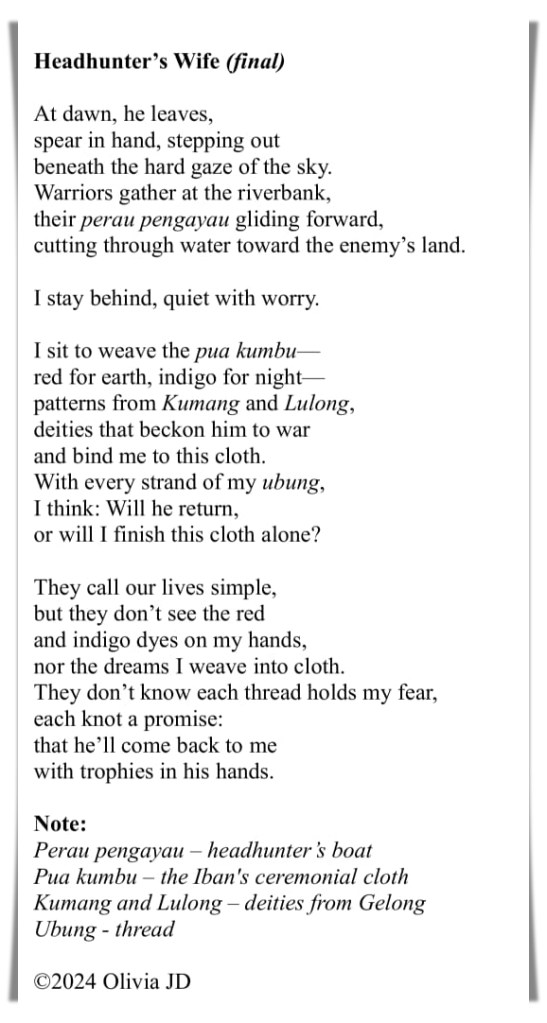
My original poem from Sarawak collection of poetry

Poetry has been one way for me to preserve my culture. Writing has become a means of connecting the past and present, who I was and who I am becoming. It allows me to hold onto what feels like it’s slipping away.

I aspire to one day publish my poems and leave a legacy for my children. When the time comes for them to discover their roots, I hope my words will serve as a guide, helping them understand who they are and where they came from. Writing allows me to keep the stories alive as the world around us changes.

My identity is a patchwork of memories, stories, and dreams. I am neither fully of the past nor fully of the present. But maybe that’s what it means to be Iban today: to walk on a bridge, perpetually caught between two realities.

I am part of something bigger than myself, a heritage of power, fortitude, and endurance. While I may live far away from my people’s homeland, the essence of my heritage lives on, molding my journey and grounding me in a world that is often divided.

I carry the warrior spirit with me because I am descended from people who endured. So I take a step forward, not knowing where the journey will take me, but knowing it is worthwhile. Like the warrior spirit that runs through my blood, this journey is not always easy, but it is always worth it.

My cousin’s traditional wedding.