Antu Ngarung | The Guardian Spirit That Shapes My Iban Identity

In Iban belief, the souls of those who die go to Sebayan, the afterworld. Some remain there permanently, but certain individuals are believed to return. These are people who lived with exceptional courage or accomplishment during their lifetime. When these ancestors come back, they do not appear as humans. They come ngarung, meaning concealed, taking the form of animals. These returning spirits are called tua, or guardian spirits.

In the Saribas region, guardian spirits are often seen as snakes such as cobras or pythons. They move quietly, stay in the shadows, and leave without drawing attention. When I picture antu ngarung, I always imagine a cobra coiled in the dark corner of a house or at the edge of the forest. It stays still for a long time and slips away the moment it decides to leave. To many people, it would be just an ordinary animal. To us, it can be an ancestor paying a visit.

A guardian spirit usually belongs to an entire lineage. Because of that connection, the family must never harm or eat the animal that represents their guardian. This is a form of respect. The belief is straightforward: the guardian protects the family, and the family must protect the guardian’s form on earth.

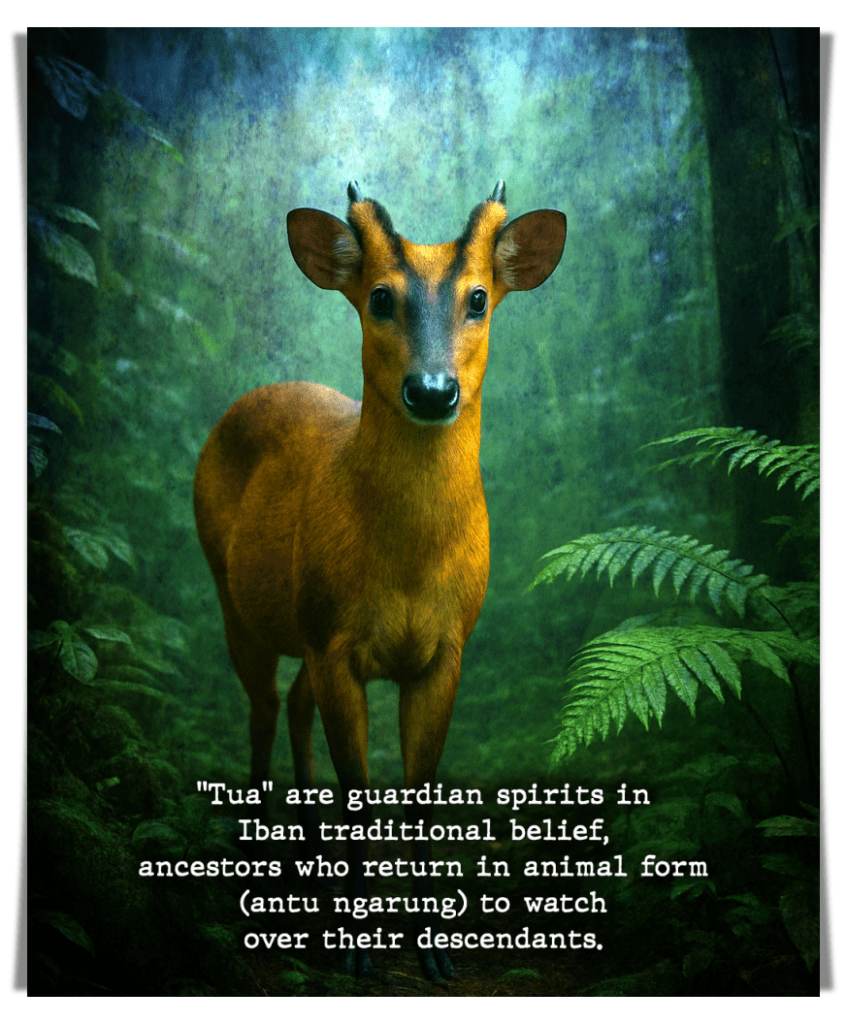
In my family, our guardian is the kijang, the Bornean yellow muntjac. When I was four or five, my late grandparents reminded us repeatedly never to harm, kill, or eat kijang. They did not offer long explanations, but the message was clear. Someone in our line was once a brave person, and that ancestor is believed to return as the kijang to watch over us.

That instruction frightened me growing up. I was afraid I might break the rule by accident. I used to remind myself to always ask what kind of meat was being served when we visited people. At that age, it felt like a tremendous responsibility. Over time, the fear changed. I started to feel that my life was connected to something older and larger than myself. I also realised that this experience was not common among many non-Iban communities, which made me value my heritage even more.

The belief in the kijang has shaped the way I understand myself. It gives me a sense of courage. I am still afraid of many things, but this belief keeps me steady. It reminds me that my ancestors lived through hardship, violence, and uncertainty. My problems today are nothing like what they endured. I often tell myself to live in a way that does not dishonor the people who came before me. I exist today because they survived so much. That thought helps me face difficult moments.

When I imagine the kijang watching me now, I think it sees a woman who lives differently from the Iban women of earlier generations. My lifestyle and interests are not the same. Yet I believe it recognises my effort to understand my roots. It may also encourage me to continue forging my own path even when no one else in my family is doing this kind of work. Many women in my family excel in traditional crafts like beadwork and weaving, but none of them are writers. I have to accept that I may be the first woman in my family to preserve our heritage through writing. Someone younger in the future may look at my work the way I once looked at my namesake, the master weaver. Remembering this keeps me going, even when the work feels lonely.

This leads to something important.

We risk losing our identity when we do not learn about our heritage. The loss does not happen suddenly. It happens slowly. We begin identifying more with other cultures. We forget the meaning behind our names, our customs, and our stories. When we fail to protect what we inherit, we leave an empty space that can be filled by influences that do not reflect who we are. This is happening in many communities around the world, and the Iban are no exception.

Iban identity will not endure by chance. It survives because someone chooses to learn, write, document, and share it. It stays alive when people believe their heritage is worth protecting. It continues when people care enough to ask questions and remember the stories their elders passed down.

Our ancestors returned as antu ngarung for a reason. We owe it to them to honor the heritage they entrusted to us.


I write about Iban culture, ancestral rituals, creative life, emotional truths, and the quiet transformations of love, motherhood, and identity. If this speaks to you, subscribe and journey with me.
The Traditional Path of an Iban Weaver

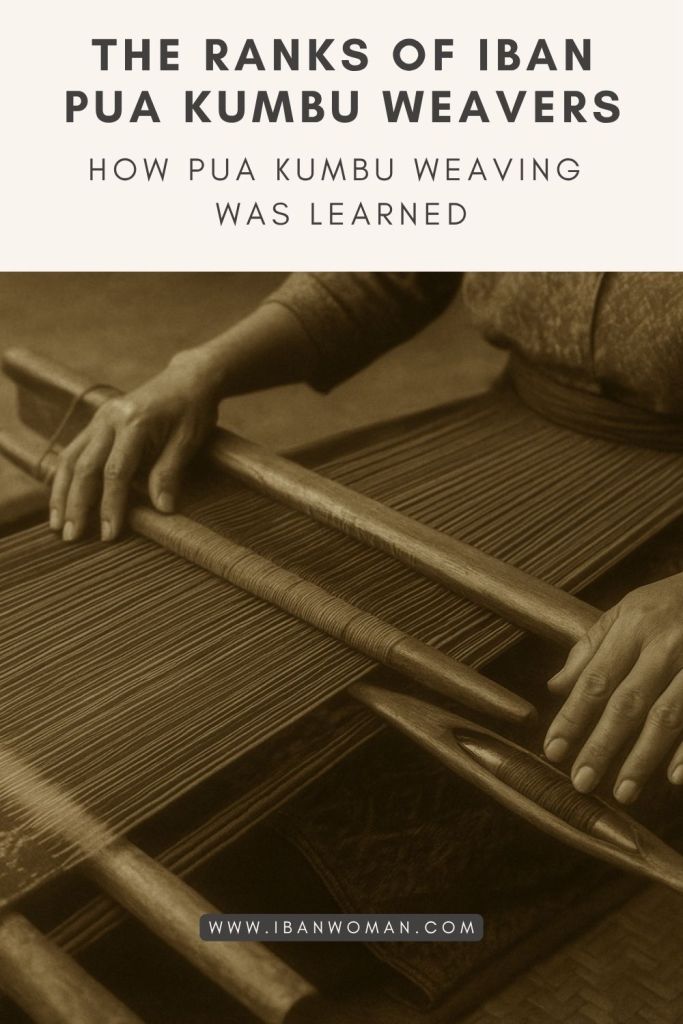
Among the Iban, weaving has always been a measure of a woman’s place in the community. The knowledge is passed down from mother to daughter, usually when a girl enters her teenage years. She learns each stage with patience: preparing cotton yarn, tying the threads, selecting designs, and working through the complex dyeing process. Every step includes a ritual to maintain balance with the spirit world. A weaver must be skilled, but she must also be spiritually open in order to progress. Through weaving, she learns how to approach the unseen forces that shape her life as a woman and as an artist.

A weaver must follow the traditional sequence of learning. If she attempts skills before she is ready, she risks falling into layu, a state of spiritual deadness. Elders say this condition can affect both the mind and body, and once it takes hold, death is believed to be the only release. Every Iban woman understands this danger, so she approaches her craft with devotion and deep caution.

Pua kumbu is a way to understand a woman’s status. Her rank depends on the dyes she uses, the complexity of her patterns, the precision of her technique, and her relationship with the spiritual world. A pua is not judged by beauty alone. It reflects the weaver’s inner state, her discipline, and the spiritual guidance she receives. Even though many Iban families today have adopted modern beliefs, the traditional criteria for judging a pua still hold meaning. The rituals and techniques behind each piece continue to define its value.

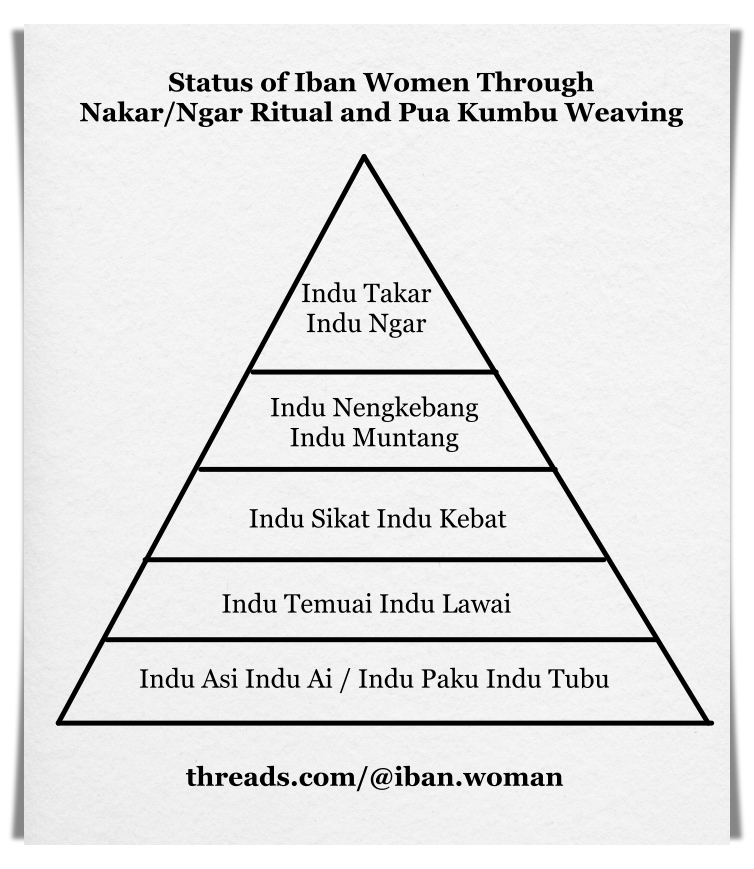
There are several ranks within the weaving world. At the first level are women who do not weave, called Indu Asi Indu Ai or Indu Paku Indu Tubu. They may not come from weaving families or may lack the resources to learn. Much of their time is spent farming and managing household life, and they cannot afford the labour or materials needed for weaving.

The next group consists of women known for their hospitality, called Indu Temuai Indu Lawai. These women usually have enough rice, help, and stability to weave simple designs. With guidance from others, they can produce basic patterns such as creepers or bamboo motifs.

A novice learns within strict boundaries set by tradition. She begins with a small piece of cloth and a simple pattern called buah randau takong randau. She may only weave a cloth that is fifty kayu in width. As her skills improve, she increases the width of her work. By her tenth pua, she will reach a width of 109 kayu. These rules are deeply respected, as they are believed to originate from the spirit world.

When a woman becomes skillful, she is known as Indu Sikat Indu Kebat. She can weave recognised patterns but cannot create her own. Her designs come from motifs passed down through her ancestry. If she wishes to learn new patterns, she must make ritual payment to a more experienced weaver in exchange for permission to use them.

A higher rank is held by the Indu Nengkebang Indu Muntang. She is able to invent new designs, often revealed to her through dreams. She has the ability to attempt complex and spiritually demanding motifs. Her community respects her greatly, and she wears a porcupine quill tied with red thread as a mark of distinction. Other weavers pay her well for new motifs.

At the top of the hierarchy is the Indu Takar Indu Ngar. She is a master dyer, a master weaver, and a ritual specialist. She understands the exact balance of mordants and natural dyes and knows how to fix colour to cotton successfully. Many people know the basic ingredients, but only those with spiritual guidance can complete the process with precision. Her knowledge is both technical and sacred.

To reach this level, a woman must excel in all areas of weaving and dyeing. She must also receive recognition from the spiritual world. This acknowledgment often comes in dreams, which serve as both initiation and confirmation. Sometimes another person dreams on her behalf, affirming her role. Many women at this level come from long lines of weavers and dyers, inheriting designs, dye knowledge, charms, and the support of ancestors whose status once brought additional labour to their families. This allows her to devote herself fully to her craft.

The Indu Takar Indu Ngar is responsible for the ritual preparations of the mordant bath. The ceremony includes animal sacrifice, offerings, and prayer. It is known as kayau indu, or women’s warfare. The ritual is private and demanding, and the leader must be courageous. If she loses control of the spiritual forces present, she risks falling into layu. Her bravery is regarded as equal to that of a warrior.

She also plays an important role in public ceremonies. During Gawai Burong, she scatters glutinous rice at the ceremonial pole. During Gawai Antu, she prepares garong baskets to honour the master weavers of earlier generations. When she dies, her funeral is filled with praise, and her worth is compared to that of a prized jar. Her husband receives honour as well.

Every pua kumbu carries the status of its weaver. Its complexity, width, ritual purpose, and intended use shape its value. Pua kumbu textiles accompany every stage of life and death for those who still observe traditional Iban practices. Each design is tied to a specific ritual, and the ritual gains its character from the cloth chosen for it. This is why pua kumbu remains central to the spiritual life of Iban women.


I write about Iban culture, ancestral rituals, creative life, emotional truths, and the quiet transformations of love, motherhood, and identity. If this speaks to you, subscribe and journey with me.
The Forgotten Script of My Ancestors | Remembering the Papan Turai

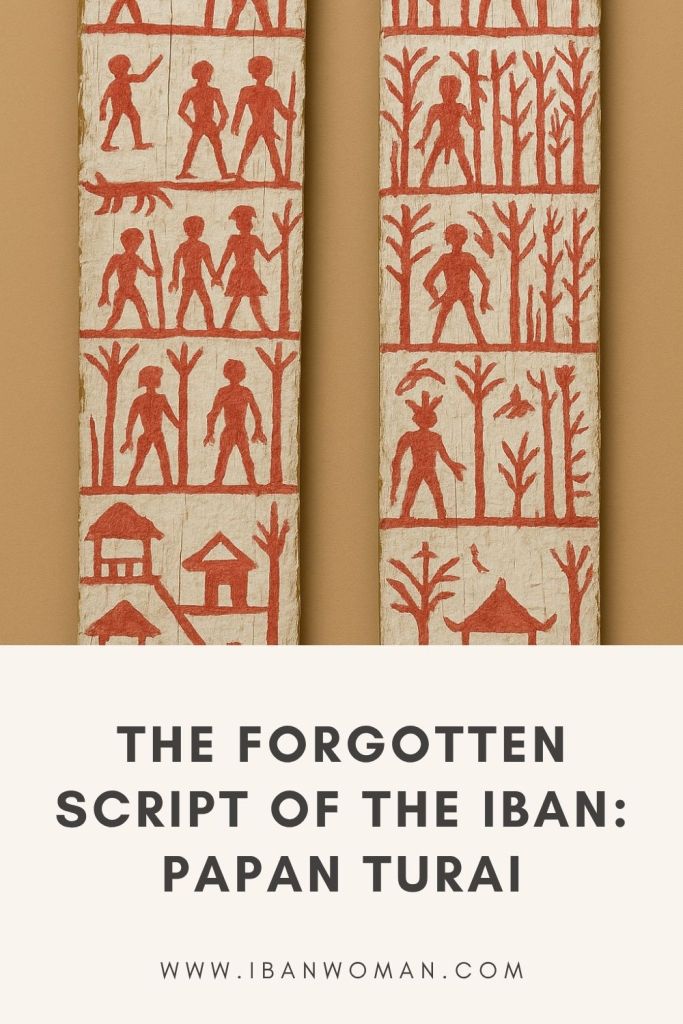
The majority of us are familiar with Egyptian hieroglyphics. However, not many people are aware that the Iban used to have their own type of pictorial writing. My ancestors’ written language, known as “turai,” is carved onto wooden boards called “papan turai.” During major festivals like Gawai Batu and Gawai Antu, lemambang (ritual bards) used these boards to recall and recite the pengap (folk epics), timang (invocations), and many other types of Iban poetry (leka main asal).

The papan turai is more than just a ceremonial piece. It serves as a link between oral and written tradition. Some of these carved symbols date back about four centuries. They preserve fragments of genealogy (tusut), the Iban’s migration history from the Kapuas region of Kalimantan to Sarawak, and even tales of tribal conflicts and legendary Iban leaders.

Researchers from the Sarawak Museum and UNIMAS have been examining these boards to find out what they symbolize. What is remarkable is that lemambang from various areas can comprehend each other’s papan turai. This demonstrates that there was once a common symbolic language among people in different communities.

This discovery goes against the previous belief that the Iban were completely “pre-literate” before Western influence arrived. The papan turai shows that our forefathers had their own way of keeping records of what they knew, which was based on ritual, cosmology, and collective memory. It reminds us that being able to read and write doesn’t just imply knowing the alphabet and how to write on paper.

In 1947, an Iban scholar named Dunging anak Gunggu expanded upon this tradition. He developed a whole writing system based on turai. However, few people know about this writing system, even among Sarawakians.

When I stood in front of the papan turai at the Borneo Cultures Museum, I felt a sense of recognition. They reminded me of the pua kumbu patterns that Iban women wove to tell stories about spirits, dreams, and journeys. Both have the same goal: to record, remember, and preserve meaning alive beyond the present.

It made me realize that each culture had its unique way of retaining memories. Some people carve it into stone, some into wood, others into sound, and yet others into cloth. For the Iban, it may have been all of these things at once. The lemambang sang what the papan turai contained, and the pua weavers wove tales and ancestral history into the thread. These were our books before books.

As I stood there, I thought about how easily such histories fade away. It’s not because they aren’t relevant, but because they aren’t documented in the systems that the world relies on. The papan turai lived on through continuity of ritual and faith. Its knowledge lived on through the lemambang, in various ceremonies and festivals, and in the community gathered around the ruai during Gawai. When modern eyes look at the papan turai, they may see only strange markings. But these are not just symbols. They hold our heritage. They are reminders that our people were already keeping records of their lives in their own way long before British colonials came with pen and paper. However, I am not sure how long we can keep them alive, as the lemambang is becoming a dying breed of heritage guardians of the Iban. 

I felt pride and loss as I left the museum that day. Pride, since the papan turai shows that Iban civilization was more complicated and deep than most people realize. Loss, because so few of us can interpret those symbols today.

Maybe this is why I write and draw. I want to continue that old rhythm in a new form. My writings and drawings are like my own papan turai, illustrating the lines that connect the past and the present. I strive to document things that could otherwise disappear, including stories from my indigenous perspective, feelings, and fragments of my identity.

To me, the papan turai is more than an artifact. It is a mirror that reflects an ancient hunger to make meaning clear and to preserve memories alive before they disappear. And maybe that instinct to leave a mark and to tell a story is something that never truly goes away. It exists in our language, our art, and our digital words. It’s the same urge that led a lemambang to carve symbols into wood hundreds of years ago, hoping that someone would remember it someday.

Sources: Religious Rites and Customs of the Iban or Dyaks of Sarawak by Leo Nyuak and Edm. Dunn (1906), UNIMAS Gazette. 


I write about Iban culture, ancestral rituals, creative life, emotional truths, and the quiet transformations of love, motherhood, and identity. If this speaks to you, subscribe and journey with me.

Sengalang Burong and the Origins of Iban Augury

Before the arrival of Christianity and Islam, the Iban people practiced a complex system of animistic belief. The world was seen as alive with spirits; some benevolent, some unpredictable, residing in rivers, jungles, animals, and dreams. The desire to stay in harmony with these unseen forces guided every aspect of farming, hunting, and war.

Scholars such as Benedict Sandin and Clifford Sather suggest that early contact with Hindu-Minangkabau traditions from Sumatra may have influenced some aspects of Iban spirituality. These influences probably came when noblemen and their followers from the Majapahit kingdom fled westward at the end of the empire to escape persecution as Muslim rule expanded. They brought with them knowledge of rituals, governance, war, and agriculture. These ideas were slowly taken in and reinterpreted through the Iban worldview.

From this convergence emerged a cosmology rich with ritual poetry, omens, and divine intermediaries. One of its most complicated systems is augury, a sacred form of divination that reads the calls and looks of certain birds as messages from the spirit world. These omen birds are still an important part of Iban ritual life, especially during farming and community events.

Sengalang Burong, the Iban God of War and messenger of the gods, is at the heart of this belief. He established the system of augury that connects the physical world with the spiritual world. Through him, communication between the two is made possible. The living interpret every sighting and call of an omen bird as a sign from God.

Sengalang Burong: The Iban God of War

In Iban belief, Sengalang Burong is the most revered of all deities. He is remembered as both the God of War and the divine messenger who connects the world of humans with the world of gods. Many ritual invocations and prayers include his name, and people often ask him for courage, protection, and clarity.

According to oral tradition, Sengalang Burong descends from Raja Jembu, a powerful deity whose family tree goes back to Raja Durong of Sumatra. It is said that Raja Durong and his followers fled their home near the end of the Majapahit era. They brought with them religious and cultural traditions that were influenced by Hindu-Minangkabau beliefs. These encompassed ritualistic practices, frameworks of social governance, agricultural knowledge, and strategies of warfare. Over time, these ideas merged with the Iban’s indigenous worldview, creating the spiritual framework that shaped their understanding of the cosmos.

In Iban ritual liturgy, Raja Jembu is the guardian of the batu umai, which is a sacred whetstone used in Iban farming rituals. He married Endu Endat Baku Kansat, and they had six sons and one daughter together. Their children became the main pantheon of the Iban gods, Bunsu Petara. 

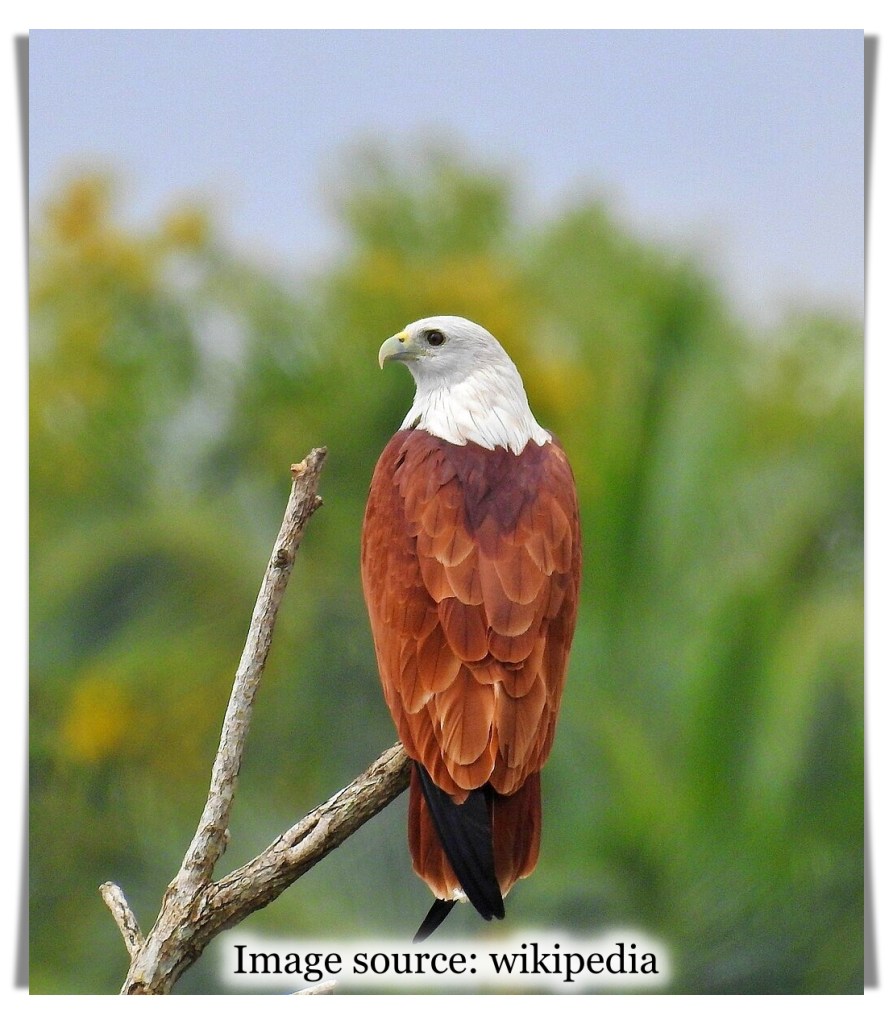
Sengalang Burong, the oldest son, rules from Tansang Kenyalang (Hornbill’s Nest), in a realm high in the sky. On earth, he transforms into a Brahminy Kite, known affectionately among the Iban as Aki Lang (Grandfather Lang). He guides humankind through omen birds that act as his messengers. Through these birds, he sends divine messages that govern decisions related to farming, war, and community affairs.

Sengalang Burong married Endu Sudan Berinjan Bungkong, and together they had seven daughters and one son. Each daughter married a nobleman who became one of the seven omen birds: Ketupong, Beragai, Bejampong, Pangkas, Embuas, Kelabu Papau, and Burung Malam. Nendak, the eighth omen bird, is Sengalang Burong’s faithful messenger.

These eight omen birds form the foundation of the Iban system of augury. Their calls, directions of flight, and behavior are interpreted during rituals to determine whether an action, such as starting a journey, planting paddy, or launching a war expedition—is blessed or forbidden. For the Iban, these signs are not superstition but sacred communication. They represent the continuing dialogue between the natural and the spiritual worlds, a system established by Sengalang Burong himself.

In future posts, I will explain more about each omen bird and its role within Iban augury.


I write about Iban culture, ancestral rituals, creative life, emotional truths, and the quiet transformations of love, motherhood, and identity. If this speaks to you, subscribe and journey with me.

On Cultural Erasure and the Right to Be Ourselves | We Are Not Yours to Claim and Rename

This week, a man on social media told me that all Indigenous peoples of Borneo are Malay. He spoke as if it were an unbreakable truth, and a few confident sentences could change centuries of culture and memory. He talked like someone who was certain of his place in the world and couldn’t imagine that others might have histories older than his own.

I am Iban. You can’t claim and rename my people.

That one conversation was a sign of a much larger issue. It wasn’t just a rude comment but the same old narrative that keeps playing beneath the surface of national conversations. This idea that everything in the Nusantara archipelago belongs under the Malay umbrella is not unity. It is colonization in a new form that continues to erase the cultures that make this region truly diverse.

A thesis essay titled “Cultural Genocide Against Ethnic Groups in Sarawak” discusses this gradual erasure as a form of genocide that occurs through language, law, and land instead of war. It addresses what has been happening in Sarawak and all over Borneo for decades: the gradual disappearance of Indigenous ways of life. There won’t be any violence in the news, but you can see it in how children forget their native languages and how native stories are rewritten or how they are dismissed as myths.

The first impact is on the land. Large-scale logging, oil-palm plantations, and hydroelectric projects like the Bakun and Murum dams have forced Indigenous communities to evacuate ancestral lands they had occupied for generations. For many outsiders, these are symbols of progress. For the people who lived on that land, they are the loss of a living relative. Land isn’t just property; it’s a memory, a source of livelihood, and the center of our beliefs. When it is taken, the connection between people and their ancestors, between rituals and the land, ceases to exist.

The next impact is on language. Malay and English are the main languages spoken in classrooms and offices. Iban, Bidayuh, Penan, and other Indigenous languages, on the other hand, remain in private spaces. The national curriculum rarely acknowledges them. A language is more than just words; it also embodies every aspect of our heritage. When children grow up without it, they lose not only vocabulary but also the worldview embedded in those sounds. 

The third impact is spirituality. Before Christianity and Islam arrived, our ancestors believed in a cosmology that connected people, nature, and the unseen. The adat guided balance and respect. Several elements were based on Hindu-Buddhist beliefs from the Majapahit and Minangkabau traditions, but those influences became uniquely our own, shaped by our environment. If you call these beliefs primitive, you are ignoring how sophisticated they are. Long before the word existed, they taught people about law, ethics, and ecology. The suppression of these systems has shattered more than trust; it has destroyed the bridge between generations.

The last impact lies in invisibility. Bureaucracy rarely speaks the language of the natives. Many still struggle to gain recognition of their customary land rights or even simple documents like birth certificates and identity cards. People who don’t have these papers become ghosts in their own country—unseen in census numbers and uncounted in national decisions.

Taken together, these forces create the silent machinery of cultural genocide. It’s not about individual malice but about a system that values uniformity over diversity and control over respect. When progress is measured only by infrastructure and profit, it becomes a form of forgetting.

I write this not to sow division, but to call for honesty. Respect for Indigenous tribes and their histories is not charity but a moral obligation.  When you erase a culture, you do not create unity. You create emptiness. Real harmony happens when differences can exist side by side, without one overtaking the other.

If you have mixed roots and feel like you’re torn between two identities, know this: you’re not a poser. You are the result of two or more heritages coming together. You have the strength of several worlds inside you. You have every right to learn your ancestral language, honor both sides of your heritage, and talk about it with pride. You can still reach your roots and the journey begins with curiosity and grows through community.

And to those who continue to insist that “everyone is Malay,” listen up: you are not defending tradition; you are performing a modern version of the same colonial mindset you claim to oppose. Claiming and renaming others is not leadership. It’s theft. It is a refusal to accept that different roots can live together without merging into one trunk.

The Iban, Bidayuh, Kenyah, Penan, Lun Bawang, Melanau, Kelabit, and countless other groups are not extensions of a larger race. We are nations within a nation, with histories that predate borders. We have our own gods and deities, our own literature, our own rituals and way of life. We don’t need anyone to save us from ourselves.

So take care of your own culture and let us take care of ours. Guard your own identity and let us stay as ourselves. You don’t have to tell us what to believe, how to speak, or how to conduct our affairs. Preserve your own heritage and quit trying to claim ownership of what doesn’t belong to you.

This moment in our history calls for courage. We need courage to listen, fix what has been distorted, and return whatever is rightfully ours. We don’t need anyone’s permission to exist. Even when others pretend to forget, we remember. We will continue to speak, to write, to sing, and to exist in our own rhythm. We are not lesser branches of your tree. We are forests in our own right.


I write about Iban culture, ancestral rituals, creative life, emotional truths, and the quiet transformations of love, motherhood, and identity. If this speaks to you, subscribe and journey with me.
Why the Ibans Took Heads In the Past

A quick disclaimer before I begin. Some people may find this topic upsetting because headhunting led to conflict between different ethnic groups. I don’t intend to glorify the practices of my ancestors; I just want to share what I know, especially since many people, even younger Ibans, don’t fully understand the reasons behind it. Taking a life is wrong by today’s standards, and from a modern perspective I do not support it. But we can’t change history, and judging the past by our present lens doesn’t help us understand it. What we can do is listen and learn.

The Iban had their own reasons and beliefs for taking heads. One of the most significant was to end the mourning period, a practice called ngetas ulit. When someone in the community died, the longhouse would mourn for a period of time. During this time, certain rules and taboos were followed. A ritual that demanded a fresh head was performed to end the mourning period. The family of the deceased would consult the longhouse community, and the men would plan a ngayau (head-hunting expedition) together. After getting a head, a series of complex rituals signaled the end of grief. Killing to end mourning may sound strange today, but for the Iban it was part of a cultural process called nyilih pemati, a symbolic offering for the dead.

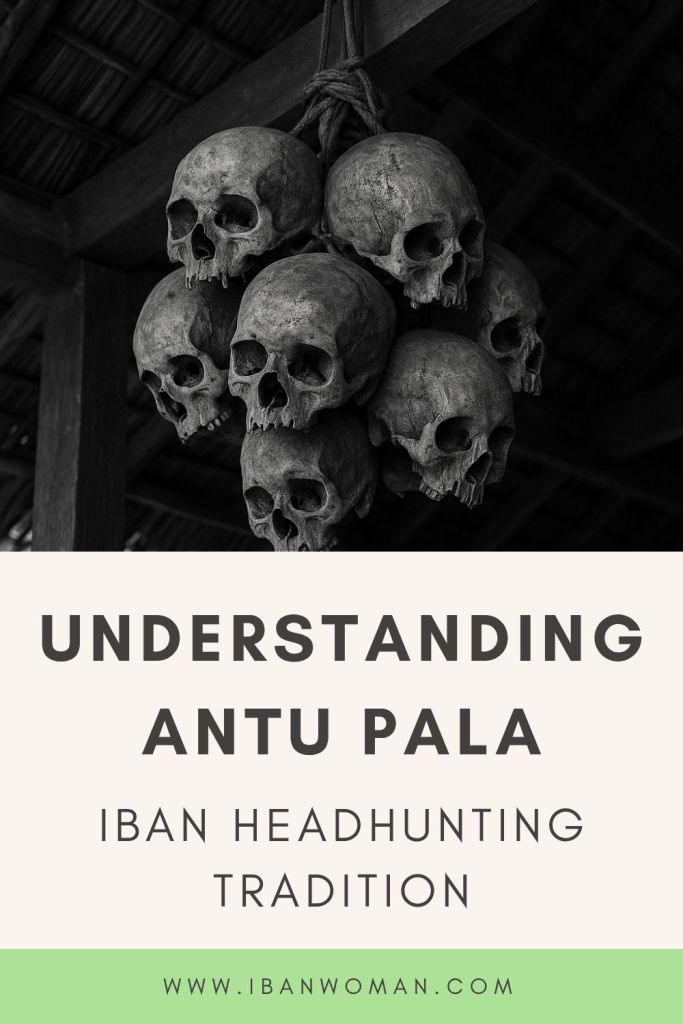
Another reason was the belief that antu pala (enemy skulls) had spiritual power. The Iban in the old days  believed that these skulls would bring blessings if they were taken care of. Antu pala also played an important part in the Gawai Burung (the Bird Festival), which was one of the most important Iban ceremonies. As part of this complicated ceremony, the lemambang (bard) would use the skulls in his pengap (chants) to invoke the god of war, Sengalang Burong. This festival has probably disappeared because most Ibans are now Christian or Muslim, but it still holds a place in oral tradition.

There were other uses for skulls as well. They were used in healing rituals, ceremonies to call for rain during times of drought, and as guardians to protect the longhouse or farms from enemies and wild animals. In this regard, the skull became a spiritual servant for the person who kept it. They also carried social meaning. If a man didn’t take a head, he was likely called a coward or kulup (uncircumcised), and these men were not seen as good husbands. Iban society valued courage and bravery very highly.

Some have asked why heads were taken instead of other body parts. The answer lies in old beliefs. Our ancestors believed that the head was the center of a person’s life force. The head could be clearly identified, unlike the hands or feet. In the past, families knew exactly whose head was kept, even after years of blackening from smoke. Today, those identities are no longer shared openly. Imagine getting married to someone from another tribe and then walking into a longhouse and saying, “Honey, that skull belonged to your ancestor.” We have learned that silence is a way to protect the living while still honoring the past.

So, do antu pala still exist? Yes. Some Iban families keep them, like mine. They can be kept in the sadau (the top floor of the longhouse) or hung in groups called tampun on the roof. We don’t see them as trophies but as things that deserve respect. If you don’t take care of them, they can bring bad luck, so you must abide by strict rituals to keep them safe.

This picture shows a tampun that belonged to my ancestor, Unggang Lebur Menua, an Iban warrior from the late 18th century. It has 34 antu pala that are more than 200 years old, and is now kept by relatives at Rh. Panjang Matop, Paku, Betong. It serves as a reminder of a different time, when survival, belief, and identity were connected in ways that may be difficult for us to understand now.

I hope this helped you learn more about a part of Iban history that continues to live in our collective memory.

Image source: Youtube


I write about Iban culture, ancestral rituals, creative life, emotional truths, and the quiet transformations of love, motherhood, and identity. If this speaks to you, subscribe and journey with me.
Pengarap Lama Iban | Iban Animistic Beliefs

TL;DR:

A simplified overview of traditional Iban animistic beliefs, including the Supreme God (Petara), nature spirits, ancestral souls, and mystical beings like Kumang and Keling. These oral stories, once passed down generation to generation, are now slowly being archived here from my Threads posts for easier access and deeper reflection.

Prior to the arrival of Christianity and Islam, the Iban people practiced a form of animism. It’s a complex belief system where spirits existed in rivers, jungles, animals, dreams, and even illnesses. Though most Ibans today identify as Christians, many still observe traditional customs during weddings, festivals, and ancestral rites. It’s worth noting that the Iban never had a written system to record these beliefs. Every story and ritual was passed down orally from one generation to the next. Because of this, different river regions or divisions often have slightly different versions of the same story, each molded by the voices and landscapes that keep them alive. 

Here is a short, simple summary of this complex cosmology that you can use as a reference. I’ve been actively posting about Iban culture, legends, and folklore on Threads, but now I’m slowly fleshing them out and archiving them here for my readers. 

Note: I’ll touch more about the Sengalang Burong’s family when I write about Iban omens and augury. 

Core Beliefs

Iban animism is based on the idea that there are many spiritual beings that are part of everyday life and the afterlife. These include:

  • Supreme God, called Petara / Tuhan or Raja Entala
  • Deities and spirits, called Bunsu Petara – each with their own roles i.e Sengalang Burong
  • Spirits of ancestors, called Petara Aki Ini – often called upon during rites like Gawai Antu i.e roh nenek moyang
  • Spirits of nature, found in animals, plants, rivers, and forests and also include Bunsu Antu i.e jin, iblis
  • Mystical beings from the sky realm called Panggau Libau and Gelong i.e Kumang, Keling

Dreams were (and still are) taken seriously, often seen as spiritual messages. If a deity (i.e Sengalang Burong) or mystical being (i.e Kumang) appears in a dream, it’s treated as guidance that must be followed.

Categories of Gods and Spirits

1) Petara / Tuhan (Supreme God)

  • Also known as Raja Entala
  • Creator of all living things

2) Seven Main Deities / Bunsu Petara (Who live in the realm of Tangsang Kenyalang)

These seven deities are the children of Raja Jembu and Endu Endat Baku Kansat. Raja Jembu is the son of Raja Durong and Endu Kumang Cheremin Bintang. There is more to this lineage, but for simplicity, let’s just focus on Raja Jembu’s family. These seven deities or Bunsu Petara, are often invoked in Iban poetry, like pengap and timang

  • Sengalang Burong – God of war (Sengalang Burong’s wife is Endu Sudan Beringan Bungkong. They have eight children including a daughter, Endu Dara Tinchin Temaga)
  • Biku Bunsu Petara – God of resources
  • Sempulang Gana – God of agriculture
  • Selempandai – God of creation and procreation
  • Menjaya Manang – God of healing
  • Anda Mara – God of wealth
  • Ini Andan – Female spirit doctor and goddess of justice

3) Mystical Beings (Who live in the land above the sky, Panggau Libau and Gelong)

  • Kumang, Keling Gerasi Nading, Kelinah Indai Abang (Keling’s sister), Lulong, Laja, Pungga, Selinggar Matahari, Sempurai Bungai Nuing, Tutong (Kumang’s brother) – Divine beings who help humans succeed in life, especially warriors and brave people. Kumang and Keling appeared more in dreams compare to the rest.

4) Spirits of Nature

  • Bunsu Jelu – Animal spirits
  • Antu Utai Tumboh – Plant spirits
  • Bunsu Antu – Ghosts or restless spirits, some helpful, some harmful

5) Souls of Ancestors / Petara Aki Ini

  • Honored during rituals like Gawai Antu
  • Believed to offer blessings and protection when remembered properly

Copyright © Olivia JD 2025

All Rights Reserved.

I write about Iban culture, ancestral rituals, creative life, emotional truths, and the quiet transformations of love, motherhood, and identity. If this speaks to you, subscribe and journey with me.
Pompeii’s Water Boy and the Curious Case of the Calamity Mushroom

Image source

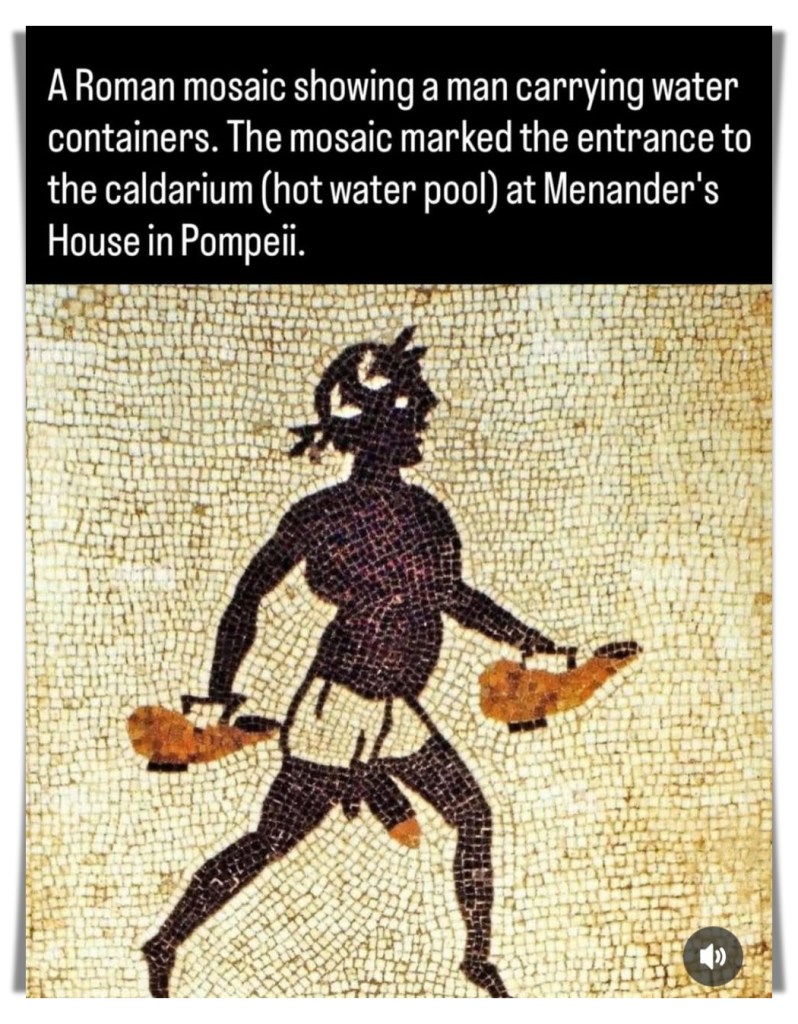
This is my 102nd post on this blog. I could’ve gone deep and reflective, writing about growth or gratitude or my journey so far. Instead, I’m giving you a man with water jugs and what appears to be a very confident, very unnecessary “thing” between his legs.

I was just going about my day when I came across a picture of this Roman mosaic while scrolling through Instagram. It was a harmless scroll and the account is offering historical tidbits. I thought I would see broken pottery, ruins, and maybe a few faded frescoes or ancient skulls and stuff. I didn’t expect this guy would be there.

It was a mosaic of a man carrying water jugs with the confidence of someone who knows he’s being watched. His muscles flexed, and his hips are a little tilted. I guess he is the original water influencer? But what really caught my attention and shamelessly wouldn’t let go?

His private part. Yup.

It was not a bulge smacked in between his legs. It was exposed. Damn. How scandalous. A big, bold mushroom swinging like a pendulum between his thighs. I looked at the screen for a long time, about thirty seconds, before whispering to myself, “But why?”

Was it supposed to be a symbol? A warning? A flex? A symbol of fertility? Or was it an inside joke from an ancient Roman tile maker who was just trying to make a boring work order more spicy? Imagine the scenario. The customer probably said, “Make it tasteful.” The artist replied, “Got it.”

The mosaic seems to have been the entrance to the caldarium, or hot water pool, in Menander’s House in Pompeii. That makes it even better. Can you picture walking into a spa and being met by a man with jugs in hand and a strange mushroom situation?

Welcome to the ancient Roman hot baths, where the water isn’t the only thing that’s hot. This might seem a little out of character for me, since I usually write about personal reflection and cultural memory. But really? Sometimes life puts a mushroom between your legs and dares you not to laugh. And at that point, you just give in and be silly. So just chill.

But after I stopped laughing (and I mean really stopped; it took a while), I became curious. Why would a Roman artist make a mosaic of this? Sure it wasn’t just for fun, right? So I asked ChatGPT and this is where things get interesting:

Art historians think that what we’re laughing at could be a waterskin, which is a leather pouch used to hold liquids. They were often shaped like penises (I don’t know why) and people carried them between their legs to keep their hands free.

So, no, it might not be an ancient anatomical exaggeration but a useful accessory. But still, they could have shaped it differently. I think many people are aware that the Romans were no strangers to sexual symbols. Their art, buildings, and even things around the house often included:

  • Phallic symbols as a sign of fertility, power, or protection (yewww).
  • Mosaics of sex in bathhouses, bedrooms, and garden walls (cringe).
  • And a general cultural comfort with the human body that was much less squeamish than our modern-day society.

Some historians say that mosaics like this at the entrance to the caldarium could have been:

  • A fun reference to the sensuality of bathing culture.
  • A good luck charm that kept evil spirits away (phallic images were thought to do this. Imagine a wife saying this to her hubby, “Honey, I think the place is haunted; why don’t you strip down?”) But I digress. 

Romans weren’t shy. Their bathhouses were shared, their jokes were dirty, and their art was often obscene. So, it could be a waterskin or a nod to something more suggestive. The fact that it’s not clear might be the whole point.

And you know what? That makes me love this mosaic even more. Maybe it wasn’t just meant for wall decoration. It could have been a reminder to not take life too seriously. We should own our stride, haul our jugs with pride, and march into the steam with a suspiciously shaped mushroom and not a hint of shame in our hearts.


Olivia Atelier offers printables, templates, and art designed to inspire reflection, healing, and creativity. Visit Olivia’s Atelier for more.

Marriage Traditions of the Iban of Sarawak, Borneo

Marriage is a timeless union that binds two souls together. It also functions as a mirror, reflecting the core of a community’s culture and identity. My people, the Iban of Sarawak, Borneo, fill their traditional wedding rituals with deep meanings based on ancestral traditions. However, these traditional ceremonies are gradually disappearing as time passes.

For the Iban, marriage was not just a bond between two individuals but a communion of families and communities. Traditionally, the groom’s parents carefully planned this arranged marriage. Ties of kinship often influence their choice of wife. Cousins were preferred matches because they preserved familial relationships while also reflecting the Iban’s value of unity within their extended network. When a bride was chosen, the groom’s parents would leave a rawai (silver girdle) or an ilang (sword) at her family’s home as proof of their dedication and intention.

Image source

The longhouse is the heart of Iban community life. During weddings, it becomes a lively epicenter. It was here that life and celebration collided, and the community joined together to honor the union. Careful planning is required days or weeks before the ceremony. This includes making tuak (rice wine) in enormous vats, preparing traditional buns and cookies, and selecting livestock for slaughter. Guests were invited with knotted strings to tally down the days till the celebration.

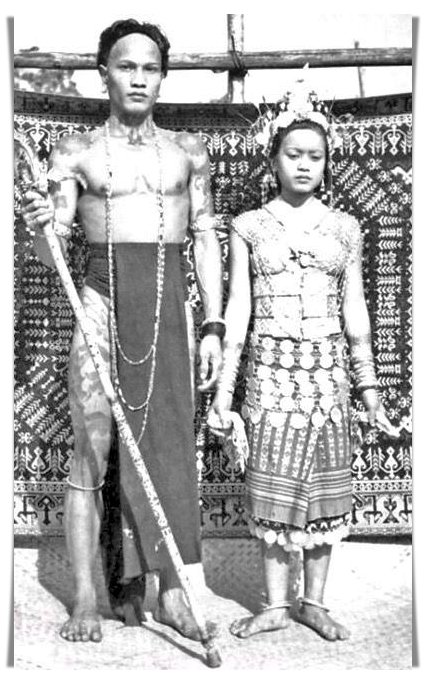
On the wedding day, the groom’s journey to the bride’s longhouse was a ceremony unto itself. The groom’s party traveled to the bride’s longhouse either by boat or on foot through the jungle. Guests were expected to dress in traditional ngepan (intricate traditional costumes), with women donning corsets or rawai (silver girdles) and men wearing armlets and feathers, among other traditional pieces. The groom’s party arrived to a joyous clash of gongs and the firing of brass cannons.

However, underneath the surface of celebration were rituals with deeper meanings. One of the most remarkable customs was the use of poetry or poetic language to provide the ceremony a sense of artistry and depth. When the official ceremony started, the host’s representative would offer the guest a drink, followed by a formal recitation inquiring about their purpose:

“I hesitate and feel nervous to talk in front of you all,
The reason I say so is because I realize that you are the mothers of porcupines,
Covered with cross-stripped white quills,
Pointed like bradawls.
I notice that you are the mothers of hornbills,
With tails striped,
crossing at right angles,
Which claim that they can fly to Brunei and return the same day.
I see that you are the mothers of bears,
Which have stout arms to make holes on the trunks of iron-wood trees.”

“We, therefore, have been sitting next to each other.
I would like to ask,
Which one of you is the mother of the hornbill?
For I am about to ask you to spit out the seeds of the belili tree,
In order that they can be picked up by a tall, unmarried lady,
So that they can be turned into the tusks of a pig,
As charms for the unripe ears left till the last in reaping,
With which we fill our padi bins.”
Poem source

These exchanges were rich in metaphor and eloquence. The poetic recitations continued throughout the ceremony, including a betusut (genealogical recitation) by an expert who detailed the bride and groom’s genealogy. This ritual not only validated the union but also ensured that the marriage respected cultural taboos and norms in order to avoid misfortune.

Image source

Elders sealed the union with feasting and storytelling, bestowing blessings and wisdom on the pair. They discussed respect, understanding, and the delicate balance required to navigate life together. Complex traditions and customs infused every action, from seating arrangements to gift exchange.

Today, such ceremonies are a rarity. The Iban embraced Christianity and Islam, abandoning many of their traditional practices in the process. The vibrant rituals of traditional Iban weddings now exist mostly in memory or retellings.

The ceremonies detailed here are not simply rituals. They depict a way of life that places a high priority on community, heritage, and balance. They remind us of the beauty of traditions that once connected people to their past while celebrating the present. The decline of this tradition is a loss not only for the Iban but also for the universal human story of connection, identity, and belonging.

The significance of the Iban wedding customs strikes me as I reflect on them. Marriage was never just about two people; it was about integrating their lives into the larger fabric of their community. It was about love, shared responsibility, and the power of a collective spirit.

Perhaps that is the true power of these traditions: their ability to touch something deep within us while also reminding us of the fragility and beauty of cultural heritage. And as we look forward, perhaps we have a tenacious hope that even as the old ways fade, their spirit will continue to shape the future in ways we may not fully comprehend.

Modern Iban weddingImage source.

Evolution, Sex, Survival | The Truth About How We Got Here

The idea to write this post came out of my curiosity. From that curiosity, I dug deeper and found myself lost in a maze of intricate details. My curiosity was simple—how did we, the human race, end up here as we are?

Image source

The answer is simple. We all exist because millions of people in the past had sex. Long before the existence of houses, rooms, wedding vows, and religions, hominins had sex in caves, open fields, and everywhere under the open skies. They had sex, but not modestly. Some did it tenderly or urgently. Some did it in a group and in the presence of their children. There were no rooms, no privacy, and no moral police. Back then it was just skin against skin and purely instinctual. We all survived to this day because of it. 

Our prehistoric ancestors didn’t just reproduce. They experienced pleasure too. They touched and explored like we do. Women experienced orgasms because pleasure wasn’t invented in the modern age. Pleasure is primordial. It’s embedded in our DNA just like fear and hunger. The clitoris, for instance, is designed solely for pleasure. Imagine that—a part of the female anatomy with over 8,000 nerve endings (twice that of the penis) exists only for pleasure. It is proof that nature didn’t just want us to breed and multiply. It wanted us to feel and enjoy intimacy too. 

Cavewomen may have lived hard, brutal lives, but they enjoyed pleasure just like we do. I like to imagine a cavewoman with her lover between her legs. And maybe others watched and joined them too. It wasn’t a perversion the way we interpret it now. It was simply being human.

I wonder if they had rituals and regarded sex as a celebration.

Shame, after all, is a recent invention. Shame associated with sex probably didn’t exist then. Cave people indulged themselves as and when they wanted. They bred, fought one another, and fought wild beasts to survive. The law of natural selection was at its peak during this period. Over time, with sperm competition in promiscuous mating systems, their genitals evolved. Natural selection favored a penis tip that could:

  • Displace rival semen using its flared ridge during thrusting
  • Create suction during withdrawal to pull competing fluid away from the cervix
  • Deliver deep, firm contact at the most fertile zone during ejaculation
  • Enhance female pleasure, because a woman who enjoys sex is more likely to return to the same partner

Amazing, isn’t it? The couple who made love the most wasn’t simply indulging. They were participating in the law of natural selection. They were selecting, refining, and perfecting the best genes to pass on to their future generations—us.

But these intense competitions existed long before religion taught us to shrink ourselves. Before religion, humans expanded in wild abandon and touched one another without apology. And somehow, in my opinion, the rawness of it feels more evolved than the shame-laced silences we carry today. 

I’m writing this out of curiosity and also because I want to remember. I want to remember that pleasure is part of our design. We exist today not just because our ancestors fought and survived but because they felt pleasure and indulged in intimacy. 

And somewhere, deep in our bones, I think we still remember what it felt like to be touched under the open skies, with no shame and no walls. 

Maybe it’s time we listened.


A 2021 BBC article titled ‘Here’s What Sex with Neanderthals Was Like’ explores how interbreeding between Homo sapiens and Neanderthals was not only real but frequent enough that most of us today carry traces of Neanderthal DNA. The piece confirms that sex among early human species was driven by instinct, opportunity, and survival—often without the moral or religious constructs that now dominate our understanding of intimacy. It even suggests that some encounters may have been tender or neutral, while others may not have been consensual by today’s standards. But the point remains: pleasure, reproduction, and adaptation were intricately linked. And some Neanderthal genes—particularly those associated with fertility—were naturally selected against, showing how deeply evolutionary biology shaped not only who we became, but how we love, bond, and survive.

Note: If you believe open discussion of sex is taboo, feel free to skip this post. Everything here is grounded in biology and human history—not smut or erotica. Just facts, perspective, and a little reverence for the bodies that brought us here.