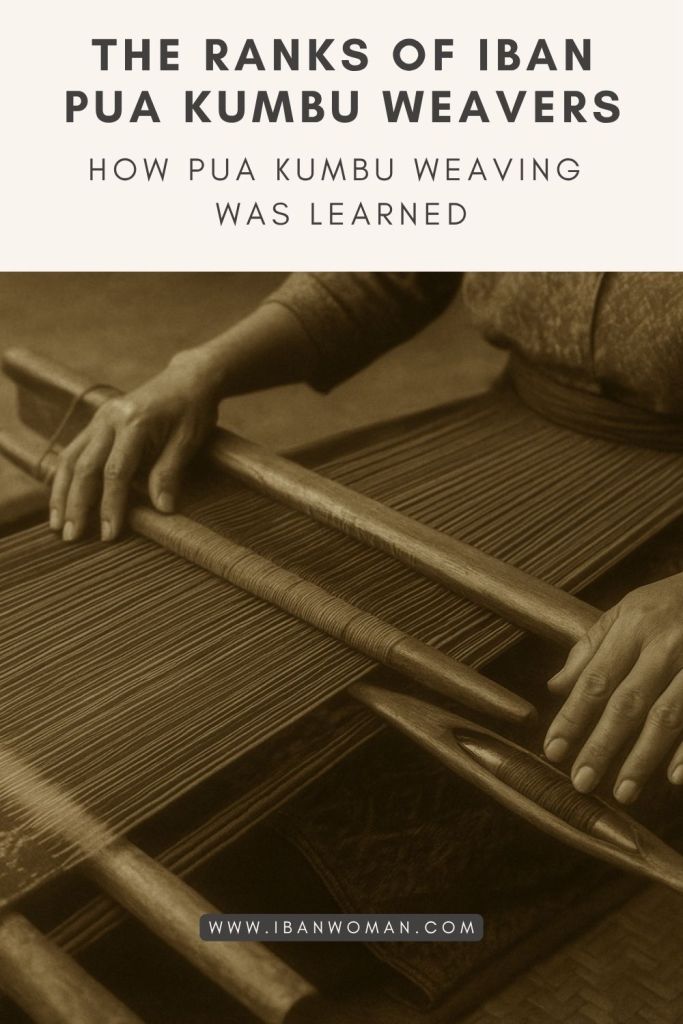
The Traditional Path of an Iban Weaver

Among the Iban, weaving has always been a measure of a woman’s place in the community. The knowledge is passed down from mother to daughter, usually when a girl enters her teenage years. She learns each stage with patience: preparing cotton yarn, tying the threads, selecting designs, and working through the complex dyeing process. Every step includes a ritual to maintain balance with the spirit world. A weaver must be skilled, but she must also be spiritually open in order to progress. Through weaving, she learns how to approach the unseen forces that shape her life as a woman and as an artist.

A weaver must follow the traditional sequence of learning. If she attempts skills before she is ready, she risks falling into layu, a state of spiritual deadness. Elders say this condition can affect both the mind and body, and once it takes hold, death is believed to be the only release. Every Iban woman understands this danger, so she approaches her craft with devotion and deep caution.

Pua kumbu is a way to understand a woman’s status. Her rank depends on the dyes she uses, the complexity of her patterns, the precision of her technique, and her relationship with the spiritual world. A pua is not judged by beauty alone. It reflects the weaver’s inner state, her discipline, and the spiritual guidance she receives. Even though many Iban families today have adopted modern beliefs, the traditional criteria for judging a pua still hold meaning. The rituals and techniques behind each piece continue to define its value.
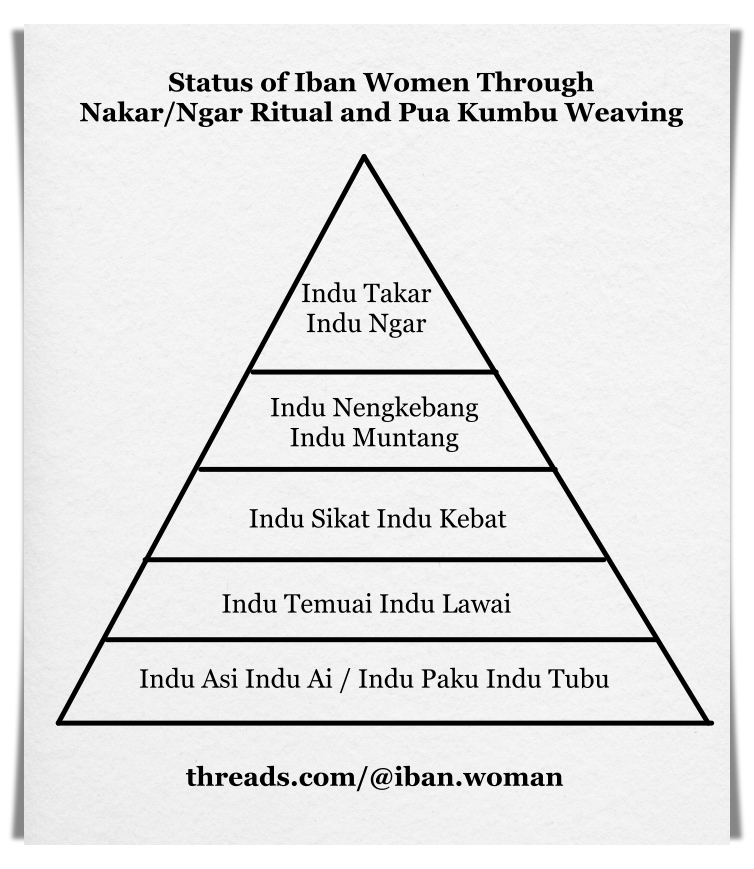
There are several ranks within the weaving world. At the first level are women who do not weave, called Indu Asi Indu Ai or Indu Paku Indu Tubu. They may not come from weaving families or may lack the resources to learn. Much of their time is spent farming and managing household life, and they cannot afford the labour or materials needed for weaving.

The next group consists of women known for their hospitality, called Indu Temuai Indu Lawai. These women usually have enough rice, help, and stability to weave simple designs. With guidance from others, they can produce basic patterns such as creepers or bamboo motifs.

A novice learns within strict boundaries set by tradition. She begins with a small piece of cloth and a simple pattern called buah randau takong randau. She may only weave a cloth that is fifty kayu in width. As her skills improve, she increases the width of her work. By her tenth pua, she will reach a width of 109 kayu. These rules are deeply respected, as they are believed to originate from the spirit world.

When a woman becomes skillful, she is known as Indu Sikat Indu Kebat. She can weave recognised patterns but cannot create her own. Her designs come from motifs passed down through her ancestry. If she wishes to learn new patterns, she must make ritual payment to a more experienced weaver in exchange for permission to use them.

A higher rank is held by the Indu Nengkebang Indu Muntang. She is able to invent new designs, often revealed to her through dreams. She has the ability to attempt complex and spiritually demanding motifs. Her community respects her greatly, and she wears a porcupine quill tied with red thread as a mark of distinction. Other weavers pay her well for new motifs.

At the top of the hierarchy is the Indu Takar Indu Ngar. She is a master dyer, a master weaver, and a ritual specialist. She understands the exact balance of mordants and natural dyes and knows how to fix colour to cotton successfully. Many people know the basic ingredients, but only those with spiritual guidance can complete the process with precision. Her knowledge is both technical and sacred.

To reach this level, a woman must excel in all areas of weaving and dyeing. She must also receive recognition from the spiritual world. This acknowledgment often comes in dreams, which serve as both initiation and confirmation. Sometimes another person dreams on her behalf, affirming her role. Many women at this level come from long lines of weavers and dyers, inheriting designs, dye knowledge, charms, and the support of ancestors whose status once brought additional labour to their families. This allows her to devote herself fully to her craft.

The Indu Takar Indu Ngar is responsible for the ritual preparations of the mordant bath. The ceremony includes animal sacrifice, offerings, and prayer. It is known as kayau indu, or women’s warfare. The ritual is private and demanding, and the leader must be courageous. If she loses control of the spiritual forces present, she risks falling into layu. Her bravery is regarded as equal to that of a warrior.

She also plays an important role in public ceremonies. During Gawai Burong, she scatters glutinous rice at the ceremonial pole. During Gawai Antu, she prepares garong baskets to honour the master weavers of earlier generations. When she dies, her funeral is filled with praise, and her worth is compared to that of a prized jar. Her husband receives honour as well.

Every pua kumbu carries the status of its weaver. Its complexity, width, ritual purpose, and intended use shape its value. Pua kumbu textiles accompany every stage of life and death for those who still observe traditional Iban practices. Each design is tied to a specific ritual, and the ritual gains its character from the cloth chosen for it. This is why pua kumbu remains central to the spiritual life of Iban women.


I write about Iban culture, ancestral rituals, creative life, emotional truths, and the quiet transformations of love, motherhood, and identity. If this speaks to you, subscribe and journey with me.

Headhunting | The Rituals and Care of Antu Pala

Disclaimer: This post is only for sharing purposes. I’m not an expert, just sharing what I know. The information here is general and may not cover every detail. For Iban readers who know more, feel free to add in the comments. This post is not meant to glorify the practice of headhunting but to share knowledge for better understanding.

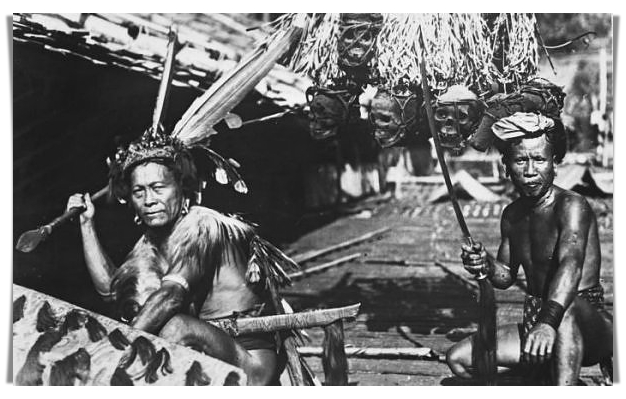
As I mentioned in my previous post, headhunting among the Iban was not random violence but part of specific mourning rituals. It was carried out to complete rites after the death of a family member. But after the warriors returned from ngayau (headhunting expedition), what happened to the severed heads? Were they hung immediately? The answer is no. Certain rituals had to be performed before the heads could be brought into the longhouse and later hung in the ruai (communal gallery).

The first thing the bujang berani (warriors) did upon returning was to manjung, which means to shout and announce their arrival. They could not enter the longhouse right away because it was taboo.  Specific rituals had to be followed. Practices varied from one Iban community to another, but what I’m sharing here is the way of the Saribas Iban from the Betong Division.

Image source

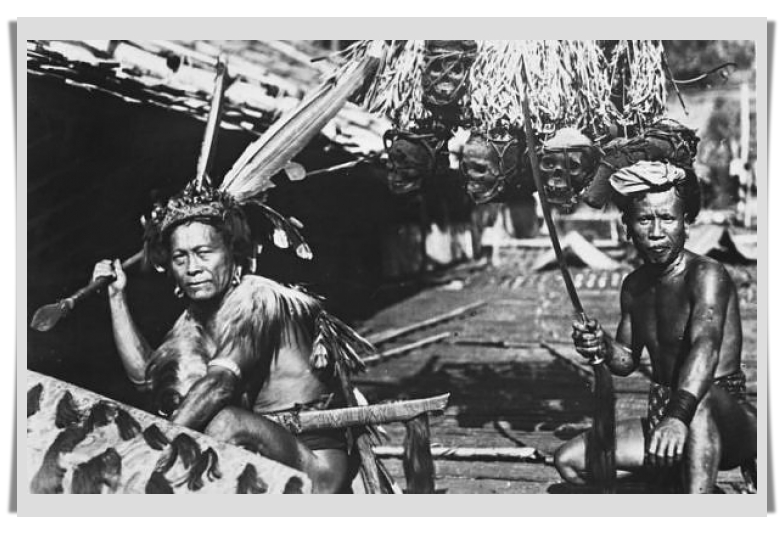
After announcing their arrival, the bujang berani stayed for a week in a small hut called langkau near the longhouse. During this time, they rested, cleansed themselves, and prepared the heads. This included cleaning and removing skin, flesh, and brain matter to prevent decay. The process took place by the river, where the heads were skewered on sticks, washed thoroughly, and boiled to loosen any remaining flesh. Once cleaned to bare skulls, they were smoked over the bedilang (hearth) until black and dry. At this stage, they were known as antu pala.

When the skulls were ready, the warriors prepared to re-enter the longhouse in full Iban regalia—baju gagong, ketapu or lanjang (headgear), sirat (loincloth), tumpa (silver armlets), and marik betaring (toothed beads). Only men who had gone on ngayau were permitted to wear the full attire. Those considered kulup (cowards) who had never participated in a headhunting expedition could only wear a sirat.

Image source

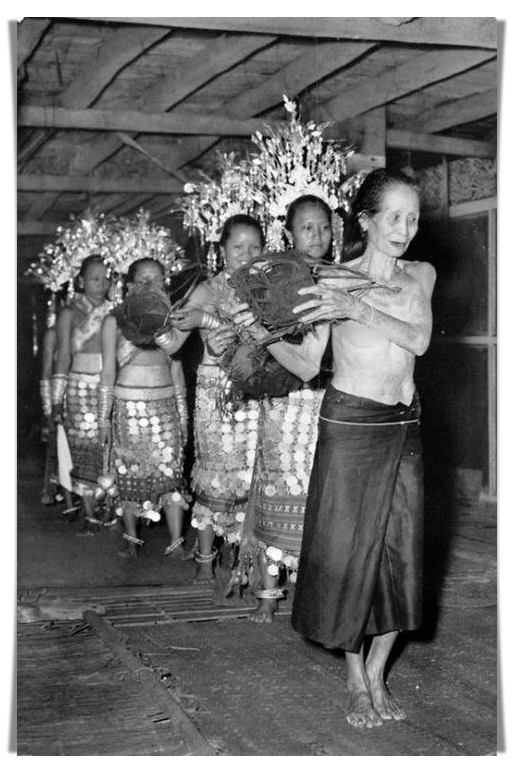
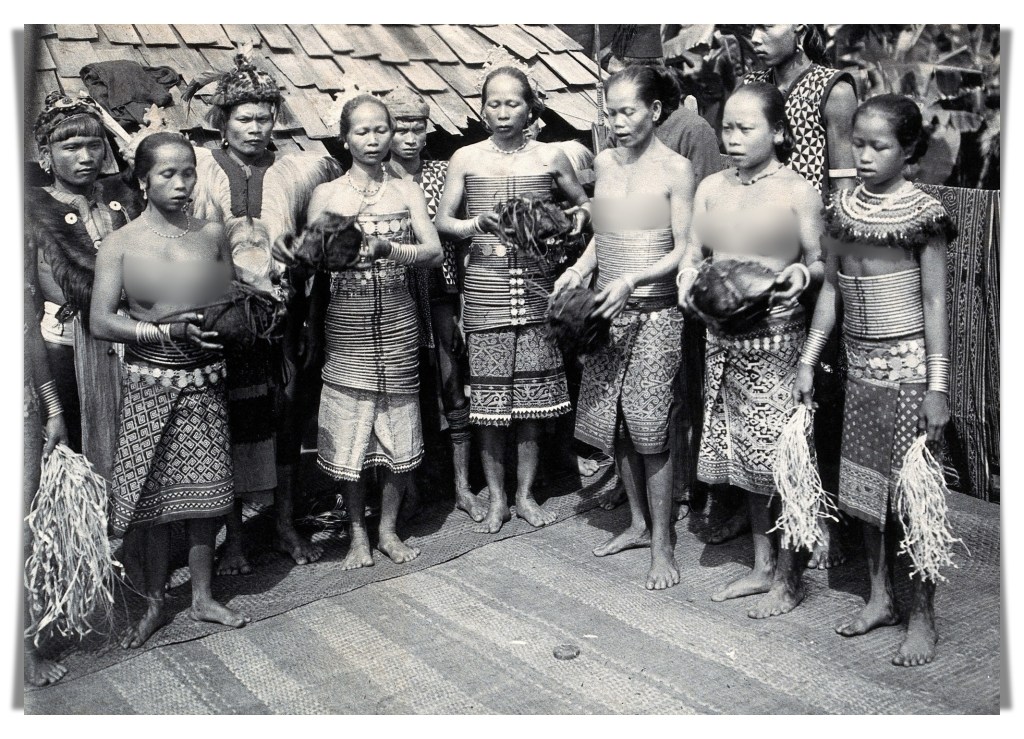
A procession called Mangka Ke Selaing was then held to welcome them home. The warriors were welcomed with panjung (victory shouts) and the beat of the Gendang Pampat. At the doorway, they were received by their mother or wife carrying a chapan (winnowing tray) covered with pua kumbu, a ceremonial textile woven only by the mother or wife of the warrior. The cleaned skulls were placed on the pua kumbu, not fresh or bloody as often imagined. The Iban always followed adat (custom) in their rituals, so there was never any confusion or disorder.

Image source

The mother or wife then played a key role in the Naku Antu Pala procession, carrying the tray of skulls along the ruai while nyangkah (chanting). The warriors marched behind the women to the rhythm of the Gendang Rayah. During this moment, they could not be touched or spoken to, as it was believed that the deities Keling and Kumang of Panggau Libau accompanied them. Disturbing them was said to cause one to faint.

The lemambang, or bards, were also present at the procession. They carried a garong, which is a bamboo container full of tuak, or rice wine. Only the bujang berani could drink this wine, and they drank it at the end of the procession. The ritual was over when the mother or wife performing Naku Antu Pala bit the skull, which meant that her spirit had won over the skull’s spirit. The antu pala then became the servant of its owner.

After the ritual, a feast called Gawai Enchaboh Arung was held in honor of Bujang Berani. There was food, ngajat (traditional dance), and happiness all night long. The mourning period came to an end with this feast. The antu pala was believed to nyilih pemati, to replace the soul of the deceased with that of the enemy, allowing the departed to rest peacefully in Sebayan (the afterlife).

Image source

Taking care of the antu pala also included different rituals, depending on the purpose. Whenever the skulls were moved or ceremonies were performed, miring or bedara’ was always required. Miring was a ceremony of prayers and offerings to Petara (God), the deities of Panggau Libau, and the ancestral spirits (Petara Aki Ini) for blessings, harmony, and protection from harm.

This was followed by bebiau, a rite using a fowl with accompanying prayers. Before it began, a piring (offering) was prepared, consisting of tobacco, betel nut, betel leaf, gambier, rice, salt, glutinous rice, rice flour, yellow rice, eggs, tuak, and chicken feathers dipped in blood from the sacrificed fowl. Larger ceremonies like Gawai Burong required even more offerings.

After miring, the antu pala had to be “fed.” This act was similar to the Chinese tradition of offering food to ancestors. Rice, water, and sometimes cigarettes were placed as offerings, and in some rituals, a pig was also sacrificed, especially when moving the antu pala to another location.

Not everyone was allowed to touch the antu pala. Only its owner or heirs could handle it. In some regions, this role was reserved for men. If a skull fell, it could not simply be picked up; a miring had to be done first, with a chicken offered before it was lifted and rehung.

These were only the basic practices. There are many more rituals surrounding the antu pala, each layered with meaning and guided by adat. These rituals may seem strange or even unsettling today, but they used to be crucial to the Iban’s understanding of life, death, and the spirit world. They show a community that was deeply guided by adat, a system that balanced courage with respect and ritual with meaning. 

If you have stories or knowledge passed down from your elders about antu pala or other old practices, I’d love to hear them in the comments. Every story adds another thread to our shared history. 

If you’d like to see a performance of the Naku Antu Pala procession, you can check out this video:


I write about Iban culture, ancestral rituals, creative life, emotional truths, and the quiet transformations of love, motherhood, and identity. If this speaks to you, subscribe and journey with me.

Inheriting Courage From My Warrior Ancestors

When I close my eyes, memories rise like smoke from a dying fire. I can still hear the gendang’s beating and my family’s joyful chatter from Gawai. I was ten years old and surrounded by the warmth of my people. The elders shared stories of our ancestors—Orang Kaya Pemancha Dana Bayang, Aji Apai Limpa, and Nakhoda Panglima Budin Gerasi—all courageous warriors of great renown. That courage, I’ve been told, is in my blood. But what does that mean in a place so far removed from their reality?

Oplus_131072

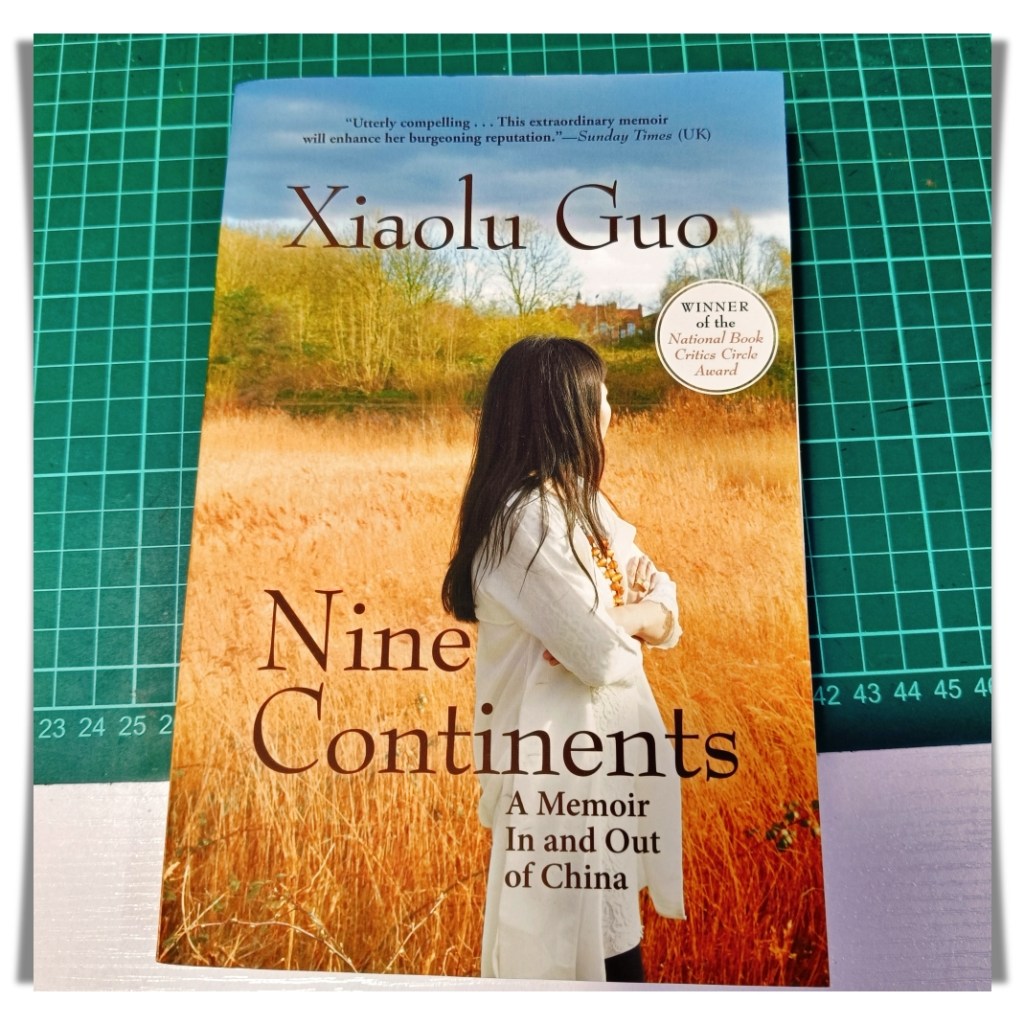
I’ve recently been reading Xiaolu Guo’s Nine Continents: A Memoir In and Out of China. Her exploration of identity, displacement, and cultural heritage resonates deeply with me. Xiaolu often addresses issues of alienation and belonging in her works, and she has become one of my favorite authors. Her writing inspired me to think about my own journey, which led me to write this post.

Our Warrior Culture

The Iban were famed for their warrior culture, defined by war expeditions and headhunting. It was once an important aspect of our spiritual beliefs and society framework. To be Iban means to be a warrior. Headhunting was not a barbaric pastime, as outsiders may believe. It was a necessary way of life since it signified protection, honor, and a connection to the spirit realm. While the act itself faded into history, the essence of the courage has been passed down through generations.

I often asked myself, “What remains of the warrior spirit?”. Sometimes it feels like a quiet force pushing me forward. In moments of difficulty, I draw on the courageous spirit of my ancestors. Their legacy reminds me that I have the strength to persevere in the face of overwhelming odds. Perhaps it is genetic memory, the invisible link that ties me to my ancestors and passes down the legacy of courage across generations.

The Loss of Tradition

However, bravery alone cannot fill the gaps. Living in urban places like Kuala Lumpur has distanced me from the traditions that constitute my identity. When my extended family embraced Christianity in the 1950s, it marked a shift from animistic beliefs. Urban living also entails replacing the communal life of the longhouse. Many other aspects of our culture are disappearing, such as the extensive oral poetry tradition.

I am caught in a dilemma. On the one hand, I value the opportunities and conveniences of modern living. On the other hand, I mourn the loss of vibrant traditions that shaped our way of life. These losses make me wonder how we can honor the past while embracing the present.

Image source The late Temenggong Koh (left), one of the last Iban warleaders of the 20th century, before headhunting was completely outlawed by the British colony.

The Sense of Alienation

Life in the city often exacerbates this disconnection. Here, I am just a fragment of an Iban: a name that suggests a foreign land, a face that others might find unfamiliar. When people ask where I’m from, my responses may seem inadequate. How can I explain a longhouse? Or, even if I can explain it, how do I dispel their misconception that modern Ibans still live on trees and wear loincloths? How can I explain our different Gawai, or traditional festivals, when they typically only celebrate one or two holidays, like Eid or Lunar New Year? However, in the heart of this alienation, I’ve realized that identity is not static. It is a fluid interplay of past and present, shaped by our decisions and circumstances.

Strength Through Cultural Roots

Nonetheless, I remain connected to my roots. They are not always visible, but they are present. My ancestors’ courage motivates me to face my fears and embrace the unknown. The warrior spirit is not a relic from the past but rather a driving force in my life today.

During difficult times, I found myself returning to the stories of my ancestors. They endured jungles, battles, and scarcity. I remind myself of their tenacity—if they can endure, so can I.

The loud proclamation of success does not equate to strength. Perseverance and the ability to adapt without forgetting are qualities that define strength. The warrior spirit is about enduring in a world that often forces us to forget who we are.

Preserving Tradition

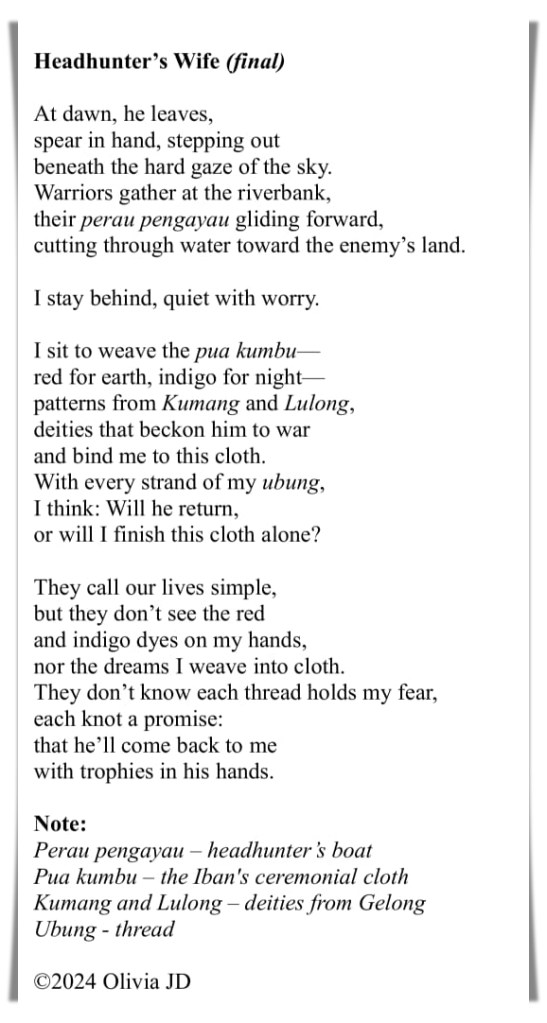
My original poem from Sarawak collection of poetry

Poetry has been one way for me to preserve my culture. Writing has become a means of connecting the past and present, who I was and who I am becoming. It allows me to hold onto what feels like it’s slipping away.

I aspire to one day publish my poems and leave a legacy for my children. When the time comes for them to discover their roots, I hope my words will serve as a guide, helping them understand who they are and where they came from. Writing allows me to keep the stories alive as the world around us changes.

My identity is a patchwork of memories, stories, and dreams. I am neither fully of the past nor fully of the present. But maybe that’s what it means to be Iban today: to walk on a bridge, perpetually caught between two realities.

I am part of something bigger than myself, a heritage of power, fortitude, and endurance. While I may live far away from my people’s homeland, the essence of my heritage lives on, molding my journey and grounding me in a world that is often divided.

I carry the warrior spirit with me because I am descended from people who endured. So I take a step forward, not knowing where the journey will take me, but knowing it is worthwhile. Like the warrior spirit that runs through my blood, this journey is not always easy, but it is always worth it.

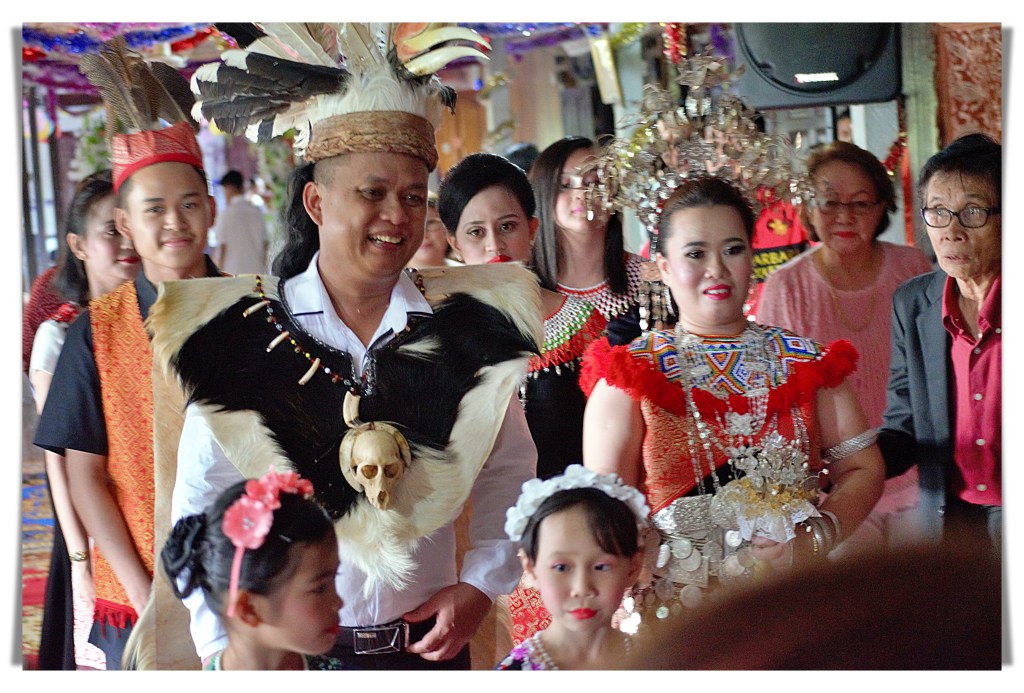
My cousin’s traditional wedding.