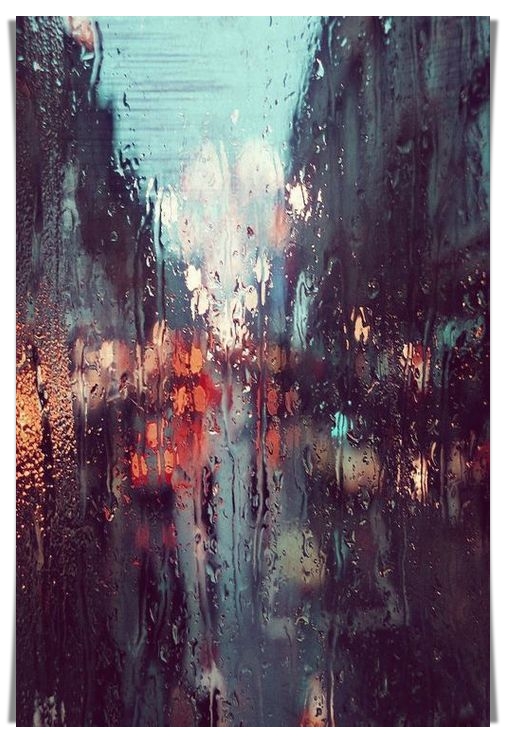
That evening it was pouring. The rain was unremarkable. It was a consistent, calm deluge that dulled the bustling city. Everything seemed muted: the buildings, the street signs, and the people walking by with their umbrellas slanted against the wind. The pavement glistened under headlights and puddles reflected fragments of neon from signs overhead. The air smelled like coffee, wet concrete, and something faintly sweet, perhaps caramel from the cafe I frequented. It was a little corner cafe with fogged-up windows, dim lighting, and jazz playing softly in the background. It was a place that usually smelled of freshly ground beans and spices.
I was there, like I usually am. I sat by the window with my notepad open and a blue pen in my fingers. I wasn’t writing, though. I was simply watching the rain blur the world outside. It was one of those times when the silence felt thicker than normal, and you began to hear the sound of your breathing.
Then he walked in.
I noticed the rain on his jacket first. He brushed it off at the door and ran a hand over his damp hair. He had short, tidy hair. There was something about him that I couldn’t quite put my finger on. A fluidity in his movements, a stillness that felt almost magnetic. Like he belonged in every room without having to announce it. Was he special? Perhaps not. All I could say was he knew how to take up space without drawing attention. He looked around and saw me. I shifted my gaze to the rivulets of rain on the glass.
He sat a few tables away, ordered a coffee, and glanced out the window just like I did. I returned to my notepad, pretending not to notice him. I could sense him. He was handsome—strong jaw, deep-set brown eyes, tall, clean-shaven, with strong hands and long fingers that lightly tapped against his cup. There was something else, but I let that thought slide.
He didn’t talk to anyone. He slowly sipped from his cup. At one point our eyes met briefly.
And deep down, I knew that this moment, this stranger, meant something. Not in a romantic sense, but as if some quiet part of me recognized something familiar. I couldn’t pinpoint what exactly it was, but I felt silly for believing so.
When I got up to leave, I could feel his eyes on me. The bell above the door chimed as I stepped into the rain.
At home, I realized I had forgotten my pen. I shrugged it off at first. It was just a pen. He was just a man.
But still that encounter stayed with me. I couldn’t explain the strange pull it had on me. It reminded me that even in a foreign city where no one knows me, the world can still offer surprises. That maybe connections, even with strangers, don’t always require explanation. Some moments just are.
And maybe that was the positive part. I didn’t feel less lonely. It simply reminded me that I’m still capable of feeling something real. Even if it begins and ends only in my mind.
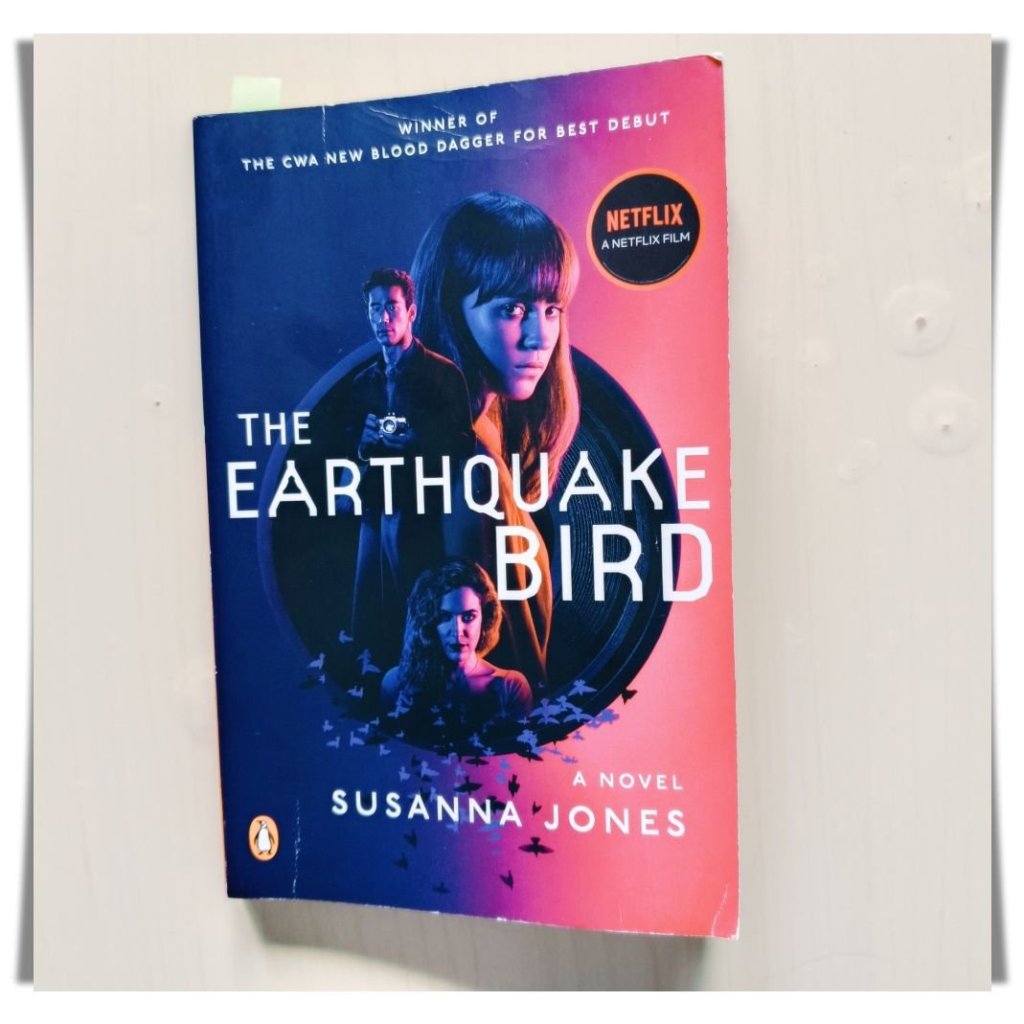
Last weekend, I finally had the chance to read Susanna Jones’s novel, The Earthquake Bird. It was a long-awaited opportunity. I watched the movie adaptation on Netflix back in 2019, and it left a lasting impression on me. I was enchanted by the haunting atmosphere, the layered characters, and the psychological tension. And that left me wanting to dig up the original source material. But since the novel was published in 2001, it was difficult to find a copy. That is, until recently. The second I discovered it, I knew I needed to revisit Lucy Fly’s story, this time in the author’s own words.
Reading The Earthquake Bird was an intense experience. The novel immerses you in Lucy’s fragmented memories and unreliable narration, plunging you deep inside her mind. As I turned the pages, I could feel her guilt, her isolation, and her complicated relationships with the people around her. The raw emotional force of Jones’s spare, precise prose lingers long after you close the book.
Plot Summary of The Earthquake Bird
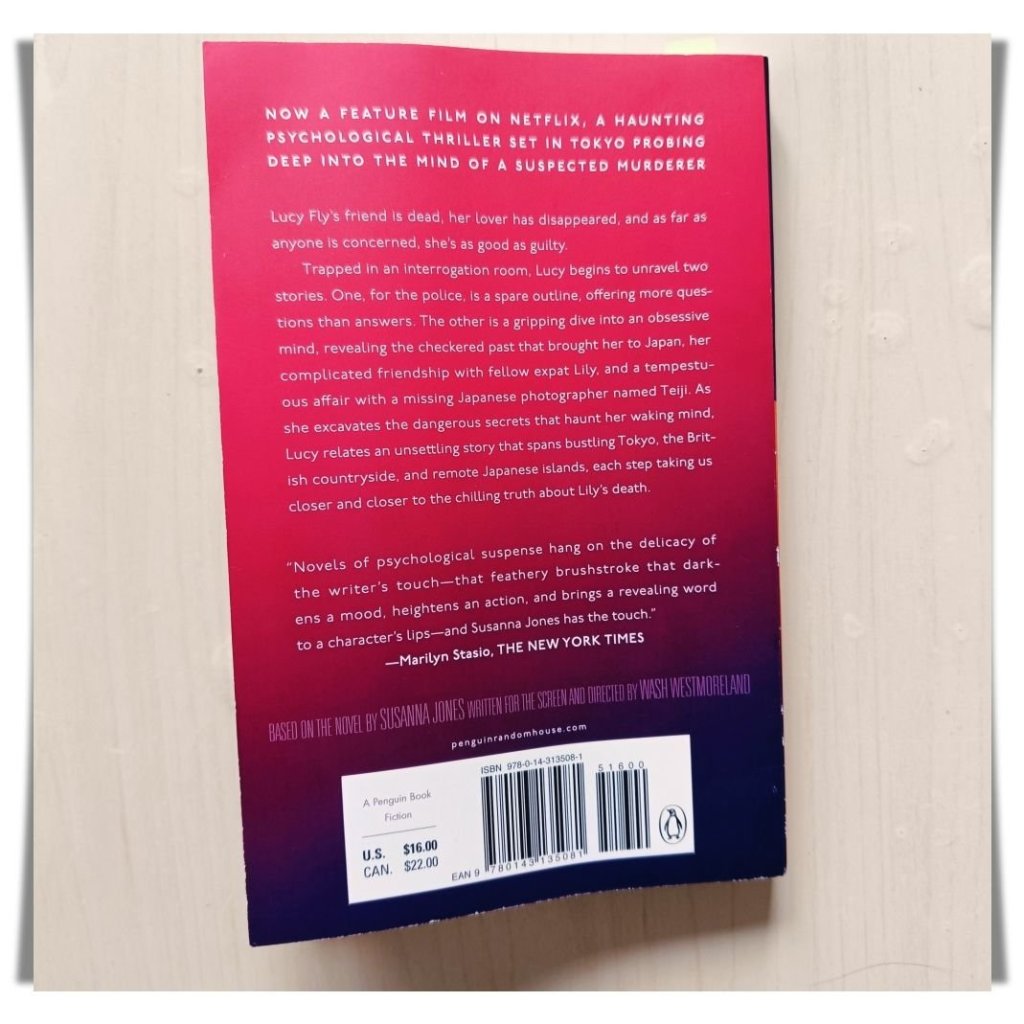
The Earthquake Bird is set in Tokyo, following Lucy Fly, a British expatriate who works as a translator and whose solitary existence is upturned when she becomes the prime suspect in the murder of fellow expat and her newfound friend, Lily Bridges. Lucy is the narrator, recounting her life, her entanglement with a mysterious Japanese photographer, Teiji Matsuda, and her intricate, troubled friendship with Lily.
The novel intertwines themes of guilt, cultural dislocation, and the indistinct boundary between love and obsession. The novel unfolds through Lucy’s recounts of the events leading up to Lily’s death, but her memories are disjointed and unreliable, leading readers to wonder how much of her version of reality can be believed. With its haunting atmosphere and complex character dynamics, The Earthquake Bird is as much a psychological portrait as a murder mystery.
Lucy’s Third-Person Narration
One of the most striking aspects of the novel is Lucy’s tendency to refer to herself in the third person when recounting her past. This shall seem, at first, an odd and disorienting narrative choice. But as I delved further, it was obvious that this was a conscious mirroring of Lucy’s psychological state. Her disconnection from her own memories reflects her emotional detachment, a coping mechanism she’s developed through her traumatic experiences and unbearable sense of guilt.
Lucy’s belief that she brings disaster and death to those around her is a recurring theme. She bears the burden of past tragedies, believing she is somehow to blame. This third-person narration creates a distance between her present self and her past actions, as though she’s attempting to disassociate from the person she used to be. This narrative technique enhances the haunting quality of the novel, immersing readers in Lucy’s splintered self.
The Mystery of Teiji
Lucy’s relationship with Teiji is at the core of the story, and it is as mysterious as the man himself. Despite being his girlfriend, Lucy realizes how little she truly knows about him. She doesn’t even know his last name. Surprising moments like Teiji’s casual mention of his love for mopping floors and washing up, or Lucy’s hearing him sing, remind us that people are always more complicated than we imagine. There are facets of Teiji that remain hidden from Lucy, even after they’ve spent a great deal of time together.
This realization resonated with me deeply. It’s a humbling reminder that we never fully know someone, no matter how close we are or how long we’ve been in each other’s lives. People have depths, and their inner worlds often remain a mystery. For Lucy, this lack of understanding becomes both a source of fascination and frustration, adding tension to their already strained relationship.
Chapter 12: Grief and Betrayal
If I had to pick a favorite part of the novel, it would be Chapter 12. In this chapter, Lucy is grieving the loss of her lover while grappling with the emotional aftermath of Teiji and Lily’s betrayal. What most impressed me was the way Jones portrayed Lucy’s pain so subtly. The chapter doesn’t linger on Lucy’s heartbreak explicitly, but her suffering is all but tangible in every sentence. The emptiness that she feels, the way in which her world appears to collapse in on itself—it’s all there, woven into the fabric of the narrative.
Jones’s ability to evoke such deep emotions without resorting to melodrama is truly masterful. It made me feel Lucy’s pain as if it were my own. It’s a testament to the power of understated writing—show, don’t tell.
My Thoughts on Lily Bridges
Lily Bridges is a character that elicits mixed feelings. From the start, Lucy is wary of her. Lily’s wimpy, needy attitude irritates Lucy, and it’s not hard to see why. However, Lucy secretly relishes Lily’s need for her. For someone like Lucy, who frequently feels invisible and isolated, Lily’s dependence on her makes her feel smart and capable. This dichotomy makes for an intriguing dynamic between the two women.
But I couldn’t help but disapprove of Lucy’s decision to include Lily in her private time with Teiji. If I were Lucy, I’d be even more territorial. I would not feel good about the idea of my man getting too friendly with a female friend, especially someone I am not personally fond of. And still, Lucy’s decision to allow Lily into her world says so much about who she is. It reflects her desire for validation and her struggle to navigate the dynamic of friendship and intimacy.
A Story That Haunts You
The reason The Earthquake Bird is so compelling is because it tackles guilt and identity. Lucy’s perception of herself is that she is a natural-born destroyer, that her very existence brings harm to the people she loves. It’s a guilt that permeates all facets of her life, from her relationships to how she sees her own worth.
The novel also takes up the theme of cultural displacement. As an expatriate in Japan, Lucy sometimes feels like an outsider, caught between two worlds. This alienation only exacerbates her identity crisis, heightening the poignancy of her struggles.
Final Thoughts
Reading The Earthquake Bird was an unforgettable experience. Susanna Jones has created a haunting and provocative novel, with a protagonist of such complexity whose presence reverberates long after the last page has been turned. Lucy Fly is not a loveable character; she’s full of imperfections and fear, making her narrative even more relatable.
If you’ve only seen the Netflix adaptation, then I recommend checking out the book. Although the film impressively conveys the tone of the story, the novel is a deeper exploration of Lucy’s mind and the labyrinthine relationships that make up her landscape. It’s a story about guilt, love, betrayal, and the fragmented nature of identity—a story that lingers with you, quietly unsettling, long after you turn the last page.
I’ll be reviewing the Netflix adaptation in a separate post, where I’ll explore how the movie differs from the book and whether it captures the same depth and nuance. Now, though, I’m glad to have finally read the novel. It was worth the wait, and, I suspect, a story I’ll return to, discovering different layers and meanings each time I do so.
It started with the way he looked at the tea I made.
“You put mushrooms in this?” he asked, peering into the mug.
I fought a smile. “It’s reishi. It’s good for your liver. Just drink it.”
He leaned in and sniffed, suspicion all over his face. “It smells like regret.”
That got a laugh out of me. “Don’t be such a baby.”
He narrowed his eyes, took a dramatic sip, and instantly recoiled. “Are you trying to kill me? Admit it. This is revenge for the pen.”
“You stole it,” I said.
“I borrowed it indefinitely.”
He drank another sip, dramatically clutching his chest. “If I die from this, please delete my browser history.”
I burst out laughing again.
He looked pleased with himself.
I tried to change the subject, flipping through a magazine on the table. He leaned over, peering at a photo of a hairless cat.
“Is that a testicle with whiskers?”
I almost choked on my tea.
“That’s it. Get out of my apartment.” I was still laughing.
He held up his hands. “I’ll go. But only if you admit that laugh means you’re secretly in love with me.”
I threw a cushion at him. He caught it midair and hugged it to his chest. “Even your cushion loves me.”
“You’re so full of yourself.”
He wandered over to my bookshelf, checking the titles. “Didn’t peg you for a Murakami girl.”
“Didn’t peg you for someone who uses the word ‘peg.’”
He smirked. “Careful. You’re laughing again.”
And I was.
Later, when the conversation slowed, we sat on the couch. I didn’t want him to leave. Not just yet. He retrieved a pen from my desk and held it in front of him.
“This one yours too?”
“Maybe.”
“Should I take it? Just in case I need another reason to come back.”
He didn’t need a reason.
But I let him have it anyway.
I Gave You Tea
I gave you tea for healing. You drank it. Your fingers brushed mine when I handed you the cup, and neither of us flinched.
You made a face, said it tasted like regret.
I laughed. And laughed again.
See, love— I don’t laugh easily, like something that escapes from deep inside, and betrays the body.
I gave you bad tea. And you say things that unmake me in all the right places.
This is a short excerpt from my novella-in-progress. The story unfolds through fragments and moments that shape the narrative from beginning to end. It follows two people (a foreign woman and a local man) who meet by chance in Taipei, Taiwan, and how their bond deepens through small, ordinary exchanges.
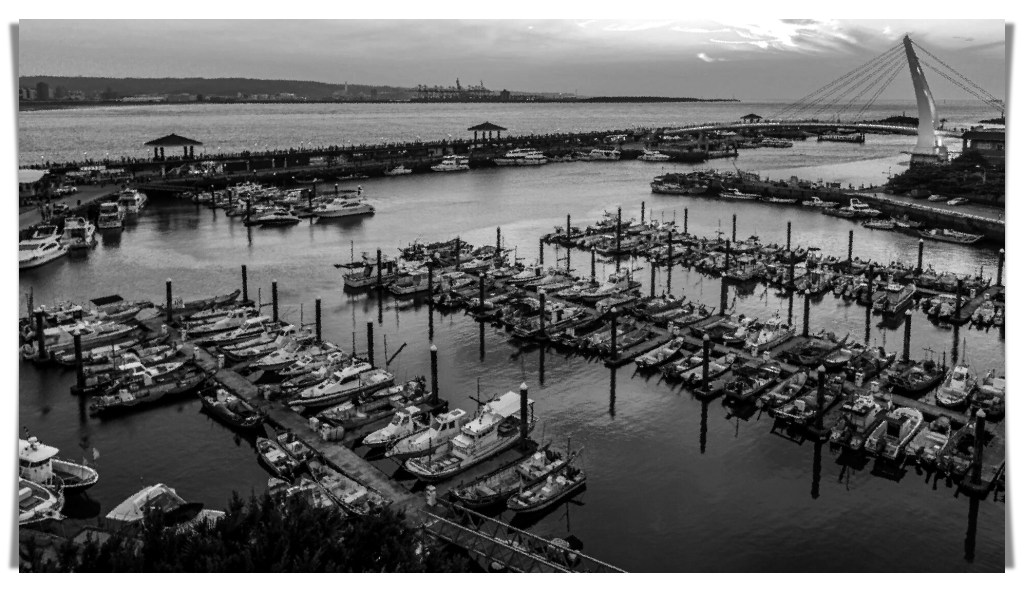
This scene takes place at Tamsui Fisherman’s Wharf, on a cold spring Sunday.
I chose to strip this piece (and the whole novella) of unnecessary description, leaving only the essentials—just enough for the reader to fill in the rest.
English is my third language. I used to think I needed big words or beautiful sentences to be taken seriously. But I don’t believe that anymore. This quote by Haruki Murakami reminds me why I write the way I do:
“Writing in a foreign language, with all the limitations that it entailed, removed this obstacle. It also led me to the realisation that I could express my thoughts and feelings with a limited set of words and grammatical structures, as long as I combined them effectively and linked them together in a skilful manner. Ultimately, I learned that there was no need for a lot of difficult words – I didn’t have to try to impress people with beautiful turns of phrase.”
I hope this piece lingers with you in its simplicity. If anything I write resonates with you, feel free to subscribe for updates on the novella and future posts.
I stared at the message for a while. It was after three in the afternoon. The sky was cloudy, and it was quiet and dreary outside. I had just finished folding laundry, still in my shorts and tank top.
“Okay. But where?”
He picked me up at four. The car was warm, and the radio was set to low. We didn’t say anything on the journey to Tamsui. The windows blurred a little from the cold, and he touched the heater with the back of his knuckle. I remember watching the skyline thin out as the river widened.
It was a chilly spring day; it was slightly sunny, but the light appeared warmer than it actually was. I pulled the jacket around me as we strolled along the wharf. Couples were everywhere, holding hands and snapping photos, while children laughed with sticky hands.
When the cool breeze began to blow, he stayed close.
We went past the food kiosks, which offered grilled squid, fried sweet potatoes, and sugar-coated strawberries on skewers. He stopped at a freezer cart and bought us two soft-serve cones: one matcha and one black sesame.
I gave him a look. “Ice cream?”
He smirked. “Trust me.”
We sat on a bench facing the docks, eating silently. The ice cream quickly melted and dripped onto his wrist. He licked it clean without a word. I giggled. He looked at me and smiled.
As twilight drew near, we strolled toward the bridge.
The Lover’s Bridge arched across the river, its pale structure gleaming in the late afternoon sun. Tourists passed us, cameras in hand, but we strolled slowly, side by side, as if we had all the time in the world.
We stopped midway.
From there, the view widened. The water below shimmered with long strokes of orange and pink. The sun fell lower beneath the horizon. Boats bobbed softly in the harbor.
I stood silently beside him. The breeze brushed a loose strand of hair across my cheek.
We did not talk because there was no need for words.
I could feel him beside me, and that was enough.
We neither touch nor lean in.
But somehow, in that hush of twilight, we felt closer than we had before.
When we eventually turned to go, he said nothing. Neither did I.
But I believe we both realized something had changed.
I found the tattoo parlor while wandering aimlessly through one of the narrow, lantern-lit streets of Datong District. The parlor looked old, tucked between a toy store and a Chinese medicine hall.
The needle vibrated and pierced. I closed my eyes and welcomed the sting. I imagined the ink seeping in, letter by letter.
Yours.
It was on my left breast, right above my heart.
Days later, his lips are on my skin. When he reaches the ink, he stops. His fingers tighten ever so slightly against my ribs. He exhales slowly. No questions asked. No words uttered. He kisses it tenderly at first, then again, firmer this time. His tongue traces the letters.
That night, it is different. Neither rough nor fast.
Just intense.
The Present
It’s been years. I have gray hairs now, mostly at my temples. I don’t think of him often—at least, not like I used to. But today, I catch a glimpse of myself in the mirror. Bare skin. My body is softer now, but there it is.
Yours.
My fingers brush over the letters, the ghost of his lips flickering behind my eyes. I should get it removed. I tell myself that sometimes.
But I won’t.
Back then, his fingertips grazed the ink absentmindedly. While the night bird called in the distance, he’d press his lips against it and whisper—mine.
Now, my fingers trace the letters, following the path his touch once took. The ink remains, but his touch is long gone. I keep waiting for the pain to dull, but it never does.
Back then, it was a vow.
Now, it’s just a relic.
Someone new notices it once. His fingertips pause over the letters.
Obsession is not just in longing; it’s also loving him in fragments. Here’s a series of short fragmented thoughts about him—scattered images, sensations, memories, desires. They are pieces of my obsession.
His hair gently brushing his forehead, blown by the fan as he sleeps on our bed.
Him standing on the kitchen sink washing the dishes after dinner. The slope of his bare shoulders, the muscles on his back, the scratches I made, naked except for his dark boxers.
The way he hums as he unloads the laundry.
He sits on the couch, shirtless, scrolling through the reels, smirking, chuckling depending on what he watches.
His prolonged silence after I uttered some cutting remarks.
The way my eyes drift lower, tracing the shift of fabric, wondering what lies beneath.
As he passes me on the way to the bathroom, I reach out, my fingers grazing over him in a teasing touch.
The curve of his shoulder in the half-light when we took a nap in the afternoon.
The way he stares at me, intense and serious, before he smiles.
The way his voice cracks when he’s tired, rough and tender at the edges.
The smell of earth and salt on his skin after rain.
As he shifts in his sleep, the fabric rides up, revealing just enough to make my breath catch.
The smell of his skin after a shower.
His hands, always his hands, calloused and tender, mapping my body in the late afternoon while the curtain gently blew by the breeze.
His gentle snores, and sometimes he snorted while sleeping. Depending on how tired I am, it either amuses me or annoys me.
The way he looks at me when he thinks I am not watching.
I gently kiss his scars on his arms and chest.
The taste of his lips.
The heat of his body against mine. The weight of his arm across my waist while spooning.
The sound of his key in the door. I could hear it jangle as he exited the lift.
The shadow of his stubble in the morning.
The sound of his footsteps faded down the hall.
The way he holds my legs and rests them on his shoulders, his breath mingling with mine as we dissolve into one another.
The way his mouth finds me, his tongue teasing, drawing a gasp from my lips.
The way he looks at the ocean and squeezes my hand gently.
The way his eyes turn dark after a desperate “I love you” right before he shatters.
The way he says “look at me” right before I unravel.
The way he moves through a room.
His pain and grief over the people he couldn’t save.
The emptiness he leaves behind, a hollow I carry with me, a shape I can’t stop trying to fill.
Obsession doesn’t always announce itself. Sometimes, it exists in the way his fingers grasp my arm and let go too slowly, or in the way I watch him without speaking. It’s in the moments I don’t say aloud. The glances stolen across a dinner table, or the scent of his cologne in a silent car ride home. I don’t need to explain this love. I only need to describe it—as it exists in my memory, in my body, in every small, quiet way it consumes me.
I didn’t like the things he said to me, so I retorted. He stared at me, raised his cup to his lips, and kept eating. We continued to eat amidst the clinks of cutlery and conversations around us. We finished our food, got up from our chairs, paid for it, and left. The air was balmy as we walked to the car. Nothing moved, not even a leaf. He switched the ignition; I reached for the AC, and seconds later, the radio. The DJ chattered on about a celebrity’s antics that I had no interest in, but I listened intently. When the ad came on, I kept listening. It was a promotion for a new fragrance. I thought about my almost empty perfume bottle at home. I glanced his way, taking a quick look at his jaw, hair, nose, lips, and eyes. Especially his eyes. He navigated the traffic cautiously, signaled before switching lanes, and braked when he needed to stop. The DJ continued to talk, the AC continued to hum—diffusing the heat between us.
It was late evening. The sky was deep navy, and the moon peeked gently over the clouds. I didn’t expect to see the stars, but a few dotted the sky. We had been sitting on the park bench right after leaving the cafe. We were in no rush to go home, though it was getting late. He wanted to walk me home, and I said okay. Trees lined the street. Their branches swaying softly in the breeze. Suddenly I misstepped slightly on the uneven sidewalk and stumbled. His hand darted out to steady me. His fingers wrapped around my arm, and he asked if I was okay. His grasp was firm, and after ensuring I was alright, his grip loosened but lingered slightly longer than necessary. I didn’t say anything but continued to walk, secretly hoping I would stumble again.
I love him so intensely that it aches. My heart clenches at the mere thought of him—and I think of him constantly. Never in my life have I experienced such overwhelming love for someone. Never did I believe such a love was possible. I don’t even know how to put my feelings for him into words, but I’m trying. Maybe not by proclaiming to the world how much he means to me or delving into philosophical debates about the nature of our love. My own thoughts feel jumbled and incoherent, so why bother explaining them to anyone else? Instead, why not simply describe the love itself? Describe the actions, the moments, and the way it unfolds in my memory?
He rarely talks about his work. I know he analyzes criminal behavior and patterns, making critical decisions based on his findings. I know he works long hours and is often gone for days at a time. He spares me the details, and I never ask. Not because I don’t care, but because I don’t want to be the one to remind him of the darkness he faces. Still, I can’t help but imagine it.
On the days he is with me, I see his eyes—the shadows lurking in their depths that he tries to hide. Sometimes, he stares into the distance, to a place I will never reach. I hear his quiet sighs. And at night, when we sleep, I feel his muscles tense as he thrashes in his dreams. On nights like these, I gently grasp his wrist and call his name, coaxing him back to me. His forehead and brows are damp with sweat, soaking his pillow. He wakes, startled, before his eyes focus and relief washes over him. On nights like these, I hold him in my arms, rocking him like a frightened child. He clings to me without a word, and we stay like that until we fall asleep. On nights like these, I pray—shamelessly, desperately—for God to pull him from the abyss, from demons I can neither see nor fight.
This piece captures the meaningful moments of a young narrator, an 18-year-old girl, as she deals with the unexpected shift in her reality. The clipped sentences show her youthful hesitancy. There is no over-explanation, only feeling—raw and unfiltered—told in a voice still learning how to express the depth of its own desire.
At first he was just another presence in the background, like a page in a book that I kept flipping back to without knowing why. He was handsome, though I had never given it much thought. Until one day the words slipped out before I could stop them.
I hadn’t expected it to become anything more. But my friend decided otherwise. She took my offhand comment and made sure it reached him.
Days passed before I learned what she had done. It was a casual mention, out of my silent observation, but now it had become something larger. But much to my relief, nothing came of it. No reaction. No acknowledgment. Life moved on, and that one blunder faded into the stream of ordinary days.
Then one afternoon, everything completely changed.
The bus ride home was a blur of exhaustion. The lull of the engine hummed in the background. My thoughts drifted aimlessly as the scenery flickered past the window. And then, he was there.
The bus was pretty empty, with plenty of free seats, but he walked up to where I was sitting and took the seat next to mine. For a second I froze, my breath catching in my throat. The entire world had shifted on its axis.
I risked a glance in his direction. He had a black jacket on top of a navy blue t-shirt, dark trousers, and brown shoes. His short, straight black hair framed his face. His hands were tucked into his pockets.
The silence stretched between us, saved for the sounds of late afternoon traffic and the occasional ring of the bell.
And then, a simple invitation.
I wasn’t prepared for it or expecting it, but the answer left my lips before doubt could take hold. And with that, the path was set. The bus rattled forward as if nothing had changed. But everything had.
When we arrived at our stop, he met my gaze. Then he turned towards the street. Without hesitation, I followed.
We walked side by side in silence. The long shadows of the streetlights lay on the pavement, and the faint chatter of office workers rushing home floated in the air. Once we reached the door, he stepped ahead and held it open for me. His hands rested lightly against the frame.
I stepped inside. The warmth of the cafe wrapped around us. For a moment, I wasn’t able to even look at him. A flurry of emotions brewed in my chest; my heart pounded. But when I finally looked up, there he was, a slight smile on his lips.
And in that moment, I felt it. A soft, trembling hope for something I didn’t know if I was ready for, but I couldn’t help wanting it anyway.
There are days he couldn’t come to me. He is always needed wherever he is. He analyzes patterns, behaviors, minds. But does anyone truly know him? On the days he is with me—the late evening light reflected on his disheveled hair. The contour of his tired shoulders. His long, calloused fingers. His moans echo in the shadows.
The light around him softened his expression into something tender. One hand held a book, the other blindly traced the tabletop. I paused mid-sentence, staring. His brows furrowed, his gentle eyes on the page. At that moment, my heart found shelter after endless wandering. He sensed my gaze and glanced up. Our eyes met—just for a moment—before he shifted away.
This is one of the nights when the apartment feels damp and cold. Thoughts ran through my mind while washing dishes, doing the laundry, and folding our clothes. Is he tailing someone right at this moment? Has he eaten? I tried listening to the audiobook, but nothing felt right. This book is too wordy. That one has a flat narrator’s tone. I closed the app and scrolled through YouTube to find a playlist to match my mood. In this playlist, the songs are too catchy. The other playlist is too sappy. I disconnected my earbuds and put my phone away. Even with all the lights on, the room feels darker. How many hours before tomorrow comes?
His hands are a map of everything I cherished. His light tan hands have carried pain and tenderness in equal measure. They have wielded weapons, sifted through crime evidence, cuffed wrists, and tenderly stroked the deepest part of me. His fingers are long and tapered; half moons peeked on his trimmed nails. Sometimes I noticed faint traces of blood and grime. When they brush against my skin, it’s like the first ray of sunlight after a long, cold night. His hands have built and mended, held and released. They’ve cupped my face, traced my curves, and held me in place. They’ve wiped away my tears and made obscene gestures in moments of anger or to stir my laughter. When I think of his hands, I’m reminded of the roots of the ancient trees or the ocean with their endless ebb and flow pulled by the moon.
The bed now is just a bed. The sheets are now crumpled into hollows that hold the shape of him. I run my fingers over the fabric and the pillows. They still smell faintly of his skin and the faint, sharp tang of his cologne. I press my face into it, trying to hold onto what’s left, but the scent is already fading. The white walls have absorbed the echo of his voice. The door clicked shut with a finality and stays closed until he returns. On the table, his cup sits lonely with the faint imprint of his lips. I leave it there to become a relic of our morning. His jacket hangs on the back of the chair, slouched in a way that feels so like him, as if it might come alive and shrug itself back into motion. The room has exhaled. It has moved on and is settling into the rhythm of my day, one that doesn’t include him.
Some moments will never leave you. They creep into the silent corners of your memory and wait. It’s not love, but something more delicate and mysterious. I was eighteen when I first saw him. He wasn’t looking at me or even aware I existed. But then something changed. I didn’t realize it at the time, but that moment would stick with me, embedded into the fabric of my life and reappearing when I least anticipated. This is the fragmented story of an obsession that began before I had the words for it.
I was eighteen the first time I saw him. I was too young to fully comprehend how a single moment could change the course of time, but I was old enough to sense how important it was. He was twenty-two, though I didn’t know it then. The light that late afternoon was soft and turned everything golden. It fell through the leaves as I walked home from class. A heavy bag hung across my shoulder, the monotonous rhythm of my day fading into the background.
Then I saw him.
He stood in the distance, partially obscured by the trees. There was something arresting about him that made him seem out of place in the moment. His jacket drew my attention right away. It was a deep brown, worn suede. The rich color seemed to absorb the light, making him stand out against the colors around him. His white trousers seemed an afterthought, subtle and plain. It was the type of look you don’t think about until later, when it won’t leave your mind.
I recall that he had a camera in his hand. He was working it with his fingers as he turned it in his hands. His dark, straight hair fell just above his brow, softening the harshness of his face. Serious. Intense. His posture was nonchalant as if he didn’t care that the world might be watching.
But I was watching.
I didn’t intend or want to be there, but there I was, fixed in place. “Who is that?” I asked my friend, and the question came out before I could rethink it. She chuckled as if it were clear, then mumbled his name with a mocking grin. “You should go talk to him.”
I didn’t or couldn’t. It wasn’t just insecurity; there was something else. It seemed like he was untouchable, and whatever he was focusing on in silence was not meant to be disrupted. So I walked away, thinking I’d left the moment behind.
But the image of him stayed with me for days or weeks. It kept going through my mind: him standing alone, with the trees casting a shadow as light gathering around him. I’d find myself wondering what he was thinking about as he carefully held that camera in his hands. It drove me crazy that someone I had never talked to could occupy a corner in my head.
Even now, decades later, I find myself going back to that day. It wasn’t love then. It was something more fragile. It was like an obsession that nestles deep in your chest and stays there, waiting for reasons you don’t yet comprehend.










 Olivia's Atelier