

I found Su Tong’s Raise the Red Lantern while rummaging through books at Bookaholics’s Jom Baca! RM5 Book Fair. I have been reading Asian literature lately and this book naturally went home with me.
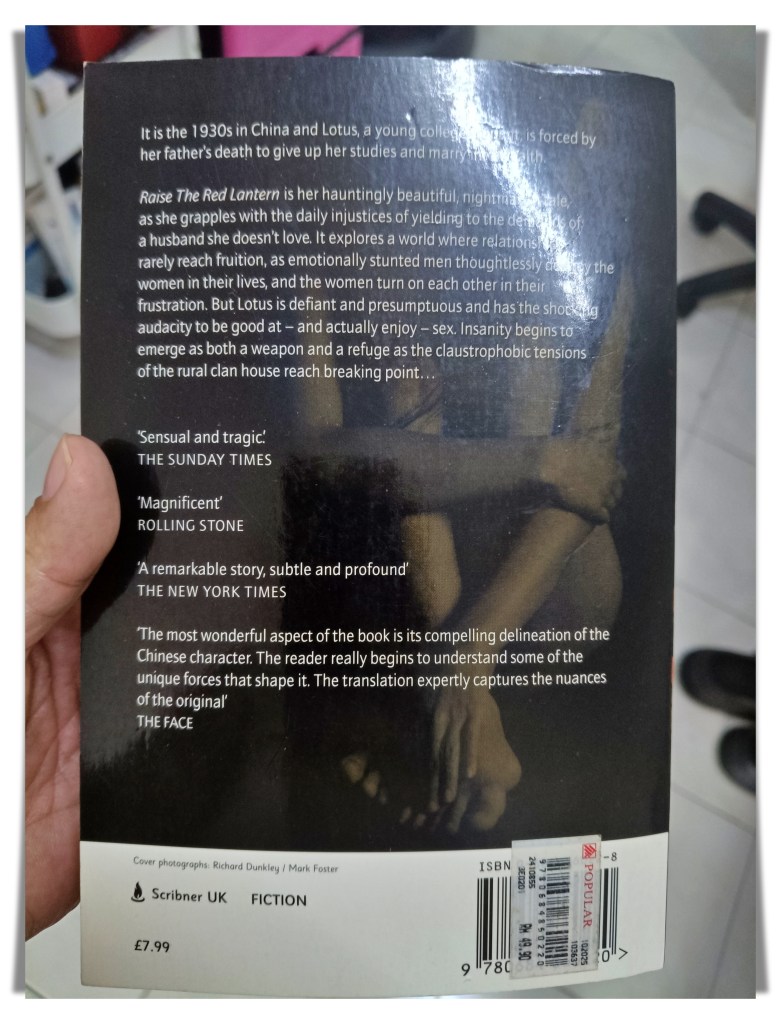
When I finished reading it, my first reaction was something like: what the hell did I just read? The story is almost unassuming, very ordinary and plain on the surface. A young woman named Lotus marries a wealthy fifty-year-old man, Chen Zuoqian, as his fourth wife. She enters his household and finds three women already there: Joy, Cloud, and Coral. What follows is a story of jealousy, rivalry, deceit, and eventually death and madness.
There is nothing particularly elaborate about Su Tong’s prose but I kept stopping while reading, going back to certain scenes and asking myself: why did he do that? Why is Lotus so emotional? Why are these wives organising their entire emotional lives around whether this ageing old man visits them tonight?
That is when I realised the story was doing something clever. It was showing me a system and letting me figure out the rules.
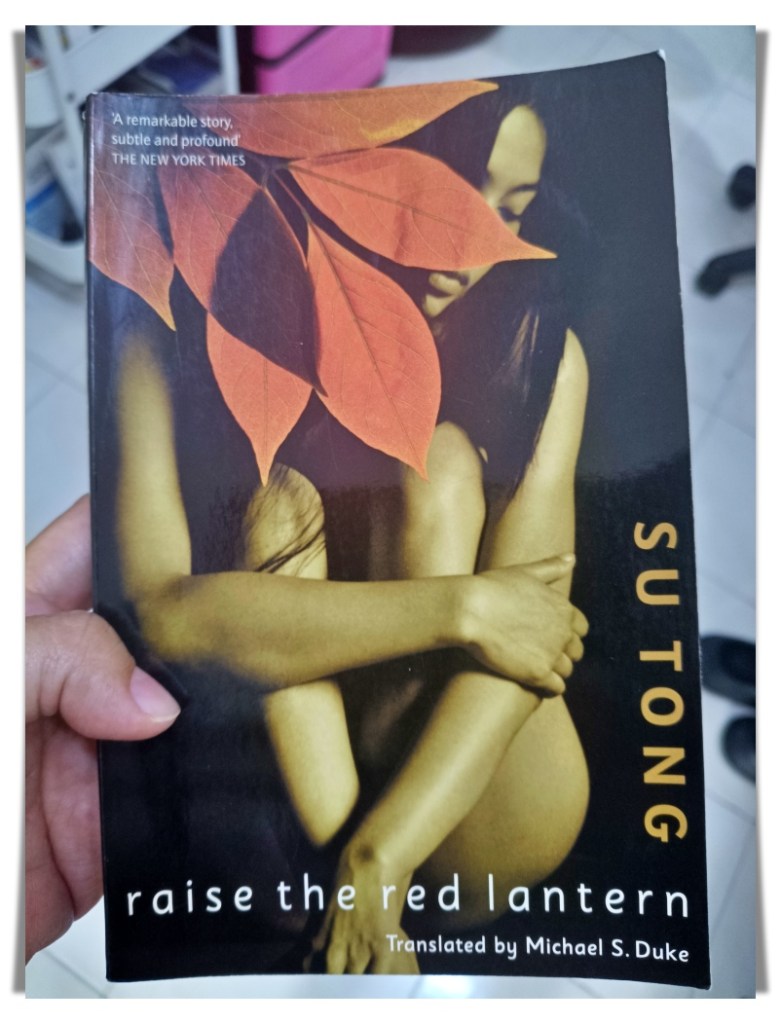
The Novella vs Zhang Yimou’s Film Adaptation
I was fairly new to Su Tong’s work even though I came across his books several times in the past. I wasn’t aware that the novella was originally titled Wives and Concubines. It was published as Raise the Red Lantern in some editions following Zhang Yimou’s film adaptation.
In the film adaptation, the red lanterns were raised outside a wife’s quarters when she was being chosen for the night. The whole household can see who has favour and who does not. Those lanterns don’t exist in the novella. In the original story, Chen Zuoqian simply goes to whichever wife’s room he fancies for the night.
The Wives Are Not Waiting for Sex
I admit my first reaction to the wives’ conniving and petty behaviours was disgust. These women spend their waking hours scheming, competing and humiliating each other. They wait around for an old man who, by the end of the story, is struggling with impotence.
That reaction was too simple and easy. They are not just waiting for sex. In that household, Chen Zuoqian’s favour determines everything. If he visits you, you get better food, better treatment from servants and more respect from others. If he doesn’t, you become invisible and lose ground. Sexual favour becomes status.
In other words, sex has become currency and they did not design the world in which they are living. Take away women’s choices, their money, their freedom to leave, their control over their own futures. And put them under one powerful man and make his attention the only path to comfort and dignity, then watch them compete.
The system can point at the result and say: look how petty and vicious women are. It is easy to blame the person rather than the conditions they are living in. The system created those conditions. Chen Zuoqian doesn’t need to actively oppress anyone every minute of the day. Because once the hierarchy exists, the women police themselves and each other.
Lotus and Her Impossible Position
Lotus is the most tragic character because she enters the household believing she made a choice. After her father dies and her circumstances change dramatically, she decides to become a rich man’s concubine rather than marry an ordinary man. She thinks she’s choosing Chen Zuoqian and a life of comfort. She doesn’t realise that she is actually choosing the Chen household.
Once she’s inside, almost every relationship becomes contaminated by hierarchy. She can’t be friends with the other wives because they are competitors. She can’t trust the servants because they gossip and have ulterior motives of their own. Even her own body becomes a site of conflict. She is young and her husband is old enough to be her father. She has desires and eventually Chen Zuoqian cannot satisfy them. When he asks something of her sexually that she finds degrading and she refuses him, his resentment becomes punishment and he withdraws his affection.
Her descent into madness happens through accumulation. She fears that her servant, Swallow, is being used against her. She becomes obsessed with the mysterious well where women of the household who violated the sexual order were disposed of.
Lotus is also drawn towards Feipu, Chen Zuoqian’s eldest son, who is older than her. Feipu fascinates me because Su Tong never gives a proper explanation of his character. Lotus tries to seduce him but he refuses her advances. Is he a homosexual? Is he frightened of his father? Has he been so overshadowed by his father that even his desires have become inhibited? Or is Feipu himself still confused about what he wants?
Coral’s Crime
Coral’s fate makes the double standard absolutely clear. Chen Zuoqian can marry Joy, Cloud, Coral, Lotus, and fondle servants. He eventually marries a fifth wife even when he is impotent. His sexual plurality is institutionalised and society sees no issue with that.
But when Coral seeks a lover outside the household, she is thrown into the mysterious well. Coral and the women accused of adultery in Chen’s family history are punished because their sexuality belongs to the patriarch, while his sexuality belongs solely to himself. Coral’s crime is to exercise sexual autonomy.
Lotus witnesses that and she understands the danger. The possibility that she might someday desire someone else is not out of the ordinary. What is extraordinary is living in a world where acting upon that desire could kill her. Lotus knows on some level that she might end up in that well herself.
Swallow’s Tragedy
Lotus’s descent into madness also appears more complex than simple jealousy. She lives in a household where paranoia is often warranted. The wives plot against and undermine one another while the servants gossip. Alliances change, and so does their position in the hierarchy.
Lotus’s fears are not unfounded when she discovers that Swallow has made a doll bearing her name and pierced it with needles. However, Swallow is just a lowly servant, beneath Lotus in the hierarchy.
There are many things beyond Lotus’s control. Chen Zuoqian’s favour. His other wives. The structure that imprisoned her. But she can control Swallow; therefore her fear travels downward.
She humiliates and punishes Swallow. When Swallow dies, Lotus must live with the consequences and her guilt. This is one of the distressing things in the story. The person on top doesn’t have to be the one performing every violent act for an oppressive system to work. Once a hierarchy is established, those lower down may start hurting each other.
Cloud’s Cunning
The character I found myself admiring, almost against my will, is Cloud. Amid the vicious competition between the wives, Cloud survives through social intelligence. She knows when to use her charm, when to appear harmless, when to gather information, and when to act accordingly. She works through whatever channels are available to her instead of brute confrontation. She doesn’t act dramatically, but she becomes very good at living in Chen Zuoqian’s little kingdom.
This Is Still Happening
Here is what makes Raise the Red Lantern feel contemporary rather than like a story about a distant past. We still see these things today. Women undermine other women everywhere. Working mothers versus stay-at-home mothers. Married women versus single women. Women with children versus women without. Women who abort versus women who keep the pregnancy. The list goes on and on. There is no winner when we argue over which version of womanhood deserves approval.
It makes me think of the term “pick-me.” Originally, it describes a woman who presents herself as ‘not like other women’ and therefore more deserving of male approval. However, when women start using “pick-me” to police other women, we create another category of performing femininity incorrectly.
But I have to tread carefully here because not every disagreement between women is caused by patriarchy. Women have free will and we can be selfish, judgemental, competitive, prejudiced, and cruel for all the ordinary reasons human beings can.
However, it is undeniable that patriarchy has historically created systems in which women gain security and social legitimacy through their relationships to men. Under those conditions, it’s not surprising that female competition thrives.
Feminism Is Not a Dirty Word
And that is why I think feminism is not a dirty word, though somehow it has become one for some women. I find that odd because many choices women now take for granted exist partly because women before us fought for them. The right to education, to work, to own property, to enter politics, to divorce, to have children. Those rights are incomplete and not the same everywhere in the world.
Feminism does not have to mean that every woman makes the same liberated choice. A woman who chooses marriage and children is not necessarily less free than a woman who chooses neither. A woman who stays home is not necessarily oppressed, just as a woman with a career is not necessarily liberated.
It all comes down to one thing: choice. And Raise the Red Lantern made me think about what that word means. Lotus made a choice. She chose concubinage over marrying an ordinary man. But how meaningful was that choice when the alternatives were already so constrained? How free is a woman who can choose between one form of dependence and another?
Those questions are not confined to Lotus’s world. I am an Iban woman reading this story in Malaysia, many decades after the world Su Tong depicts. My life is infinitely freer than Lotus’s. My circumstances, culture, and time are different from hers. I don’t want to iron out those differences by assuming that all women’s experiences are the same.
There is a bigger question: How much of what women call choice is genuinely ours and how much of it is dictated by what our families, cultures, religions, and societies have taught us to believe a woman should be?
After finishing Raise the Red Lantern, I no longer found those women pathetic for waiting for Chen Zuoqian. I found their situation tragic. They had been placed in a world where their status, their security and eventually their survival might be determined by one man’s attention.
And while our world is radically different from theirs, women are still arguing about who among us is doing femininity right. Maybe the more pertinent issue is why we are still being expected to prove it at all.
I write about Iban culture, ancestral rituals, creative life, emotional truths, and the quiet transformations of love, motherhood, and identity. If this speaks to you, subscribe and journey with me.

