Why Andrea Gibson’s Death Hit Me Harder Than Our Movie K-Drama

This past week was hard because Andrea Gibson died, and I’m still trying to figure out what that means. I never met them, but their death feels strangely personal to me. But if you’ve read Andrea’s poems, you know exactly why. Andrea’s poems aren’t just pretty words but they are pieces of themselves they left behind. They are bloody, honest, and vulnerable.

I also watched Our Movie, a Korean drama about the slow, painful journey of dying and saying goodbye, that same week. The themes of death, memory, and love all fit together, but my response to each couldn’t have been more different.

Our Movie is exceptional. The cinematography is soft and dreamy. The acting is gentle, the soundtrack minimal. Namkoong Min plays Lee Je-ha, a quiet man who watches the woman he loves, Daeum (played by Jeon Yeo-been), die of a rare, incurable disease. She is calm, joyful, and completely at peace with dying. And he is steady, restrained, and almost stoic in the way he grieves. It’s not a bad drama; in fact, many people praise it for the gut-wrenching themes of death, dying, and hope. But for someone like me, who demands emotional rawness, it made me feel underfed.

I know the character choices were intentional. Daeum doesn’t fight her death because she is content and fulfilled. She has lived, loved, and achieved her dreams. She got what she wanted. Je-ha doesn’t break down or scream when he thinks of her. His grief is not outward but you still see it in his eyes and gestures. You see the grief, but you don’t feel it.

And maybe the show makers wanted to show us that some losses are quiet. Some people don’t break when they’re hurting. They simply retreat, bend inwards, and go still. But for me, that restraint made it hard to connect. I was waiting for something to break open. I wanted Je-ha to scream, cry, or do something that would show me how much Daeum meant to him besides memory flashbacks and stares into space. Oh, he did cry but  somehow I couldn’t connect with the way he grieves.

The drama wasn’t wrong. It’s just that I couldn’t connect with it emotionally. And that made me think of Andrea.

Andrea Gibson didn’t whisper about death. They roared and cried on stage. They made you feel uncomfortable because their truths were so intimate. Their words weren’t polished or pretty; they were rough with honesty. Andrea’s poems made you feel seen. And that’s why so many people are mourning their passing.

Andrea wasn’t afraid of being vulnerable and real. They weren’t afraid of naming the pain, sitting with it, and saying, “You’re not alone in this mess because I’m here too.”

And maybe that’s why their death feels more real than a fictional one. Andrea was there for us in the kind of grief that makes you feel like your heart is breaking and your voice is shaking, and it reminds you that this life is fragile, but it’s also worth feeling everything for.

I realized this week that I don’t just want beauty in art. I want pain and emotional bruises. I want to feel the grief and not just admire it from a safe distance. And I’m not ashamed of that anymore.

It’s not selfish to want art that speaks your emotional language. Our Movie was very well made but I think it’s okay to say that it didn’t satisfy me on the level that I had hoped for. The way I live—intensely, with longing, and an endless desire for truth—shapes my expectations. So when something falls short of that, I notice. And I’ve learned to be honest about it.

Maybe that’s the reflection for this week. This is not a review or critique. It’s just a simple truth that some stories observe grief and others enter it with you. And this week, Andrea Gibson reminded me that I will always need the latter.

I’m grateful for the reminder. And I hope that when my time comes, I’ve written even a little bit as honestly as Andrea did.

Rest gently, Andrea. And thank you for the gift of your words.

I leave this excerpt from Andrea’s poem, Love Letter From the Afterlife. You can read the complete poem on their Substack. Mind you, the imagery in this poem is breathtaking. 

“My love, I was so wrong. Dying is the opposite of leaving. When I left my body, I did not go away. That portal of light was not a portal to elsewhere, but a portal to here. I am more here than I ever was before. I am more with you than I ever could have imagined.”

And this poem, When Death Comes to Visit was written by Andrea years ago and released posthumously by their wife, Meg, today (25 July 2025).

© 2025 Olivia JD


Olivia Atelier offers printables, templates, and art designed to inspire reflection, healing, and creativity. Visit Olivia’s Atelier for more.
Reflection | Where We Go When We Die—The Physics of Goodbye

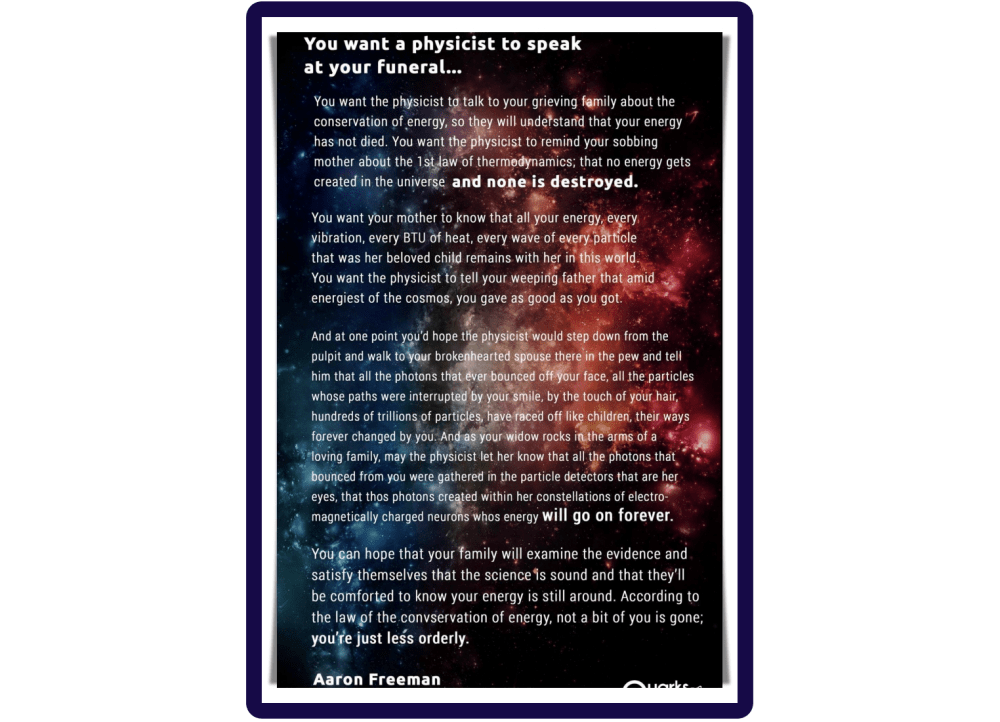
Recently I came across an article in Futurism—The Science of Death: The Best Eulogy, According to a Physicist (Aaron Freeman). Yesterday, I wrote about my friend who passed away recently. I think it’s apt that I continue to write about death because, let’s face it, every living being on the face of this earth will someday face the vast unknown. We don’t talk enough about death, believing that by talking about it, we are somehow inviting it closer. But I’m not someone who shies away from reflecting on things that make most people uncomfortable.

Image source

As I reflect on Aaron Freeman’s words, I realize there is something both cruel and beautiful about loss. The way it strips us bare, leaving us searching for traces of someone who no longer walks this earth. But if the laws of the universe have taught us anything, we have learned that nothing truly disappears. The First Law of Thermodynamics teaches us that energy is never lost, only transformed. And maybe, just maybe, the ones we lost aren’t as far away as we think.

We are made of stardust.

Did you know that most of the elements in our bodies were forged in the hearts of stars, across billions of years and multiple star lifetimes? However, certain elements within us, such as the hydrogen flowing through our veins and the faint traces of lithium within us, could be as ancient as time itself—the remnants of the Big Bang. You and I, quite literally, are fragments of the universe, bound together by forces older than memory.

So when we grieve for an unbearable loss and feel the crushing weight of absence, perhaps we can take comfort in knowing that nothing is ever truly gone.

The ones we miss exist in a different form now. They are scattered across the cosmos, carried in rays of sunshine, drifting in the gentle breeze. The photons that once danced across their skin continue their journey through space. Their laughter still lingers around us, waiting to be felt by those who remember.

If we explain death by physics alone, the conservation of energy means that when we die, our energy disperses into heat, into the environment, and into the people we loved. We become part of those we left behind. We are reborn into new beings. As I think about this, I can’t help but wonder: what about ghosts and spirits? As a Christian, I believe in the existence of the soul, but does that differ from ghosts and spirits? I honestly have no answer.

Could it be that some parts of a person, let’s call it a consciousness or remnants of their memory—remain bound to the world even after the body is gone? Maybe. Some believe that energy, especially from those who have passed with unfinished business or intense emotions, leaves imprints of themselves that replay like a recording in places they once lived or loved.

Or maybe these spirits exist because we keep them alive. I don’t mean in a haunting way, but rather in the way we cling to the memory of love. It’s in the way we still feel them in certain moments and places, as if they never truly left. Maybe we sense their spirits around us because our own energies interact with their memory.

I won’t claim to know the answer. But I will say this, purely my opinion, of course: if spirits exist, if ghosts are real, then maybe they aren’t here to haunt us. Maybe they’re still here simply because they loved too deeply to leave completely. And they are everywhere around us: among the rustling leaves in the trees, in the blooming flowers, waiting, always waiting for us to recognize their presence when we need them most.

I like to think that when my time comes, I will not vanish. I will be among the stars, among the florets of dandelions, the dust on the palms of your hands, and the unseen energy beneath the fabric of existence. I will return to the ultrasound and infrasound, ultraviolet and infrared, beyond human hearing and sight. And if you ever look up at the night sky and feel something familiar in your heart, maybe that will be me. Not gone. Just less orderly.

Reflection | The Legacies We Leave Behind

I wasn’t close to Michelle, but when I received news of her passing, it stirred something deep in me. It’s a quiet grief that lingered long after the news settled. It reminded me how one person’s kindness can ripple through your life and leave marks you only notice years later.

Michelle came into my life over 20 years ago when I was at my lowest and at a pivotal moment of my life. I barely knew her; she was literally a stranger, but she opened her door and her heart to me. She took me in and let me stay in her home for several days. She drove me around, and for a few precious days, she made me feel seen and safe. She introduced me to her wonderful family, and they welcomed me as if I belonged. In that moment she became a safe place for me when my world felt fractured.

She didn’t have to do that because we weren’t close friends. But there she was, extending a hand when I needed it most. Looking back, I can see how God placed her in my path like a lit candle in the dark. Her kindness changed something deep in my heart that changed the course of my life.

Since then, that memory has quietly shaped the way I move through the world. I made a promise to myself that I would pay that kindness forward in my own quiet ways. Michelle showed me that even the smallest gestures can leave lasting ripples far beyond what we might ever see.

Although I didn’t attend her wake service, I watched it live on Facebook. The hall was full with friends and family grieving and also celebrating her life. Eulogies painted a picture of someone who lived fully, who loved deeply, and who touched countless lives. And before she passed, Michelle left behind a message that touches my heart. Here’s an excerpt:

“My dearest friends and kindred spirits, do not cry, do not grieve, do not be sad for me, I have already taken flight—gracefully! The beauty of life lies in its fullness, to love and to hate, to laugh and to cry, to sing and to speak, to run and to dance, to journey through this world with passion and abandon, to stand against injustice, to live boldly and fiercely. I have lived, truly lived, and I leave this world without regret. Yet the hardest part is leaving behind my family and all of you. My heart is bound to you by love, and it is love that makes parting so bittersweet. My beloved ones, be brave. Live with strength, with purpose, with an unyielding spirit. Do not waste this precious journey on earth! Though imperfect, this world holds endless surprises of joy, sorrow, and wonder—do not let them pass you by.”

Her words are full of grace and clarity. It is a farewell I believe most of us never get the chance to write. It really made me think, what if life doesn’t give us that opportunity? What if we leave suddenly without a chance to say goodbye?

That question stays in my mind. Not everyone gets to leave behind a final message, but perhaps that’s why we should live in a way that doesn’t leave room for regret. We should make sure our love is felt in the present, not just left for the end. We can write our goodbyes not in a single letter before death but in the way we live, so that if tomorrow never comes, the people who matter already know what they meant to us.

Michelle’s passing made me think deeply about the kind of legacy I want to leave behind. While I may not touch lives in the same immediate way she did, I hope my art and words—through my blog and poetry—will be my offering. I want my way of self-expression to become a soft place for someone else to land.

We don’t always get to see the ripples we create in others’ lives. But I believe they exist somewhere because Michelle showed me that. And I hope in my own way, I can leave behind something meaningful: a legacy built not on outstanding achievements but on quiet truths.

Maybe for some of us, it’s not about how many people pay tribute at our funerals. Maybe it’s about the small, beautiful things we leave behind—kindness, goodness, or the moments when someone reads you words and feels understood, or when your art brings them a sense of belonging. And that’s the kind of legacy I hope to leave when my time comes.

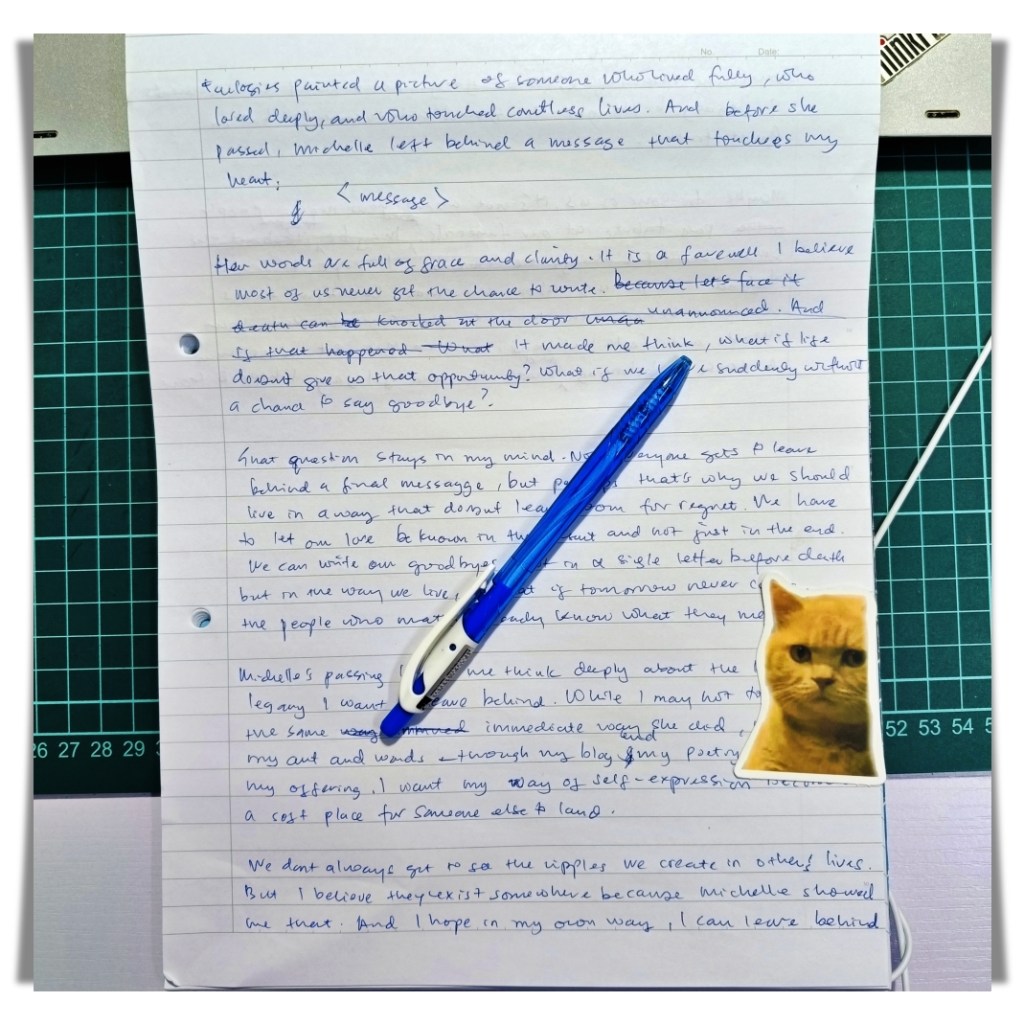
Handwritten draft of this post.