In the old days, it is said that the tortoise was not small like it is today. It was very large back then. If it stood up, it would be almost as tall as a person. It had a smooth, polished shell, unlike the patterned or segmented one we see now. The tortoise was also quite smart and could talk well, but it had one bad trait: it liked to make fun of and trick other animals. Because of this, its wicked nature often got it into problems.
At one time, a long drought struck the land. Plants in the forest dried out and could hardly grow. The animals struggled to find food because many trees had withered or died. The tortoise had the worst time since it moved so slowly. It got thinner, its stomach shrank, and its eyes got dull because it was so thirsty. It gave in to fate and thought its end was near since it was so weak. It crept slowly in search of water, using up the last of its strength while it waited for death.
The tortoise crawled for a long time before reaching a small river. It drank as much as it could because it was so thirsty, and then it fell asleep from being so tired. It looked like it was already dead since its body was motionless and its eyes were closed. A short time later, a flock of birds came to bathe in the river. The tortoise could still hear the commotion around it, even though it was feeble. It pretended to be dead. Unfortunately, at that moment, it had to fart. It attempted to hold it in to keep up the charade. But the longer it kept it, the more it wanted to let it out, and finally it did so with a loud bang.
The explosion stirred the river water and caused the tortoise to flip onto its back. The birds were startled. They turned and saw the tortoise on its back and assumed it had died.
“Oh, how pitiful. The tortoise is dead and didn’t get to fly with us high up into the sky to visit the King of the Sky,” the birds lamented, and the tortoise could hear them clearly.
The birds then prepared to leave. The tortoise quickly got up and decided to go with them to visit the King of the Sky. It opened its eyes wide, gathered all of its might, and crawled as swiftly as it could toward the group. When it reached them, it expressed its wish to follow them into the sky.
“We don’t know how to bring you along because you don’t have wings,” the birds said.
“Oh, it’s not that difficult,” said the tortoise. “Each of you can donate a feather so I can build wings and fly.”
“We refuse to give you our feathers because you are known as a liar. We do not want to be deceived by you,” one of the birds replied.
“Hah! All of you are stupid and narrow-minded,” the tortoise said. “There are many kinds of tortoises. There are deceitful tortoises, hard-shelled tortoises, spiny tortoises, hermit tortoises. In your eyes, what kind of tortoise am I? I am not a deceitful tortoise,” it continued.
The birds fell silent upon hearing its words. They looked at one another and discussed among themselves. In the end, each agreed to contribute one feather to build wings for the tortoise. Even the larger birds such as the peacock, hornbill, eagle, and rhinoceros hornbill agreed. When the wings were completed, they all flew to visit the King of the Sky.
After a long journey, they finally arrived in the realm of the King of the Sky. At that time, the King was hosting a grand gawai festival. The tortoise and the group of birds cleaned themselves in preparation to attend the feast. While they were getting ready, they could smell the rich aroma of delicious food.
Seeing this, the tortoise whispered to itself, “It’s been a long time since I’ve had anything good to eat. I thought I would starve to death during this drought. But I know I’ll live if I get to eat the food at the feast.”
Once they were ready, they lined up to enter the house of the King of the Sky. But before they went up, the tortoise announced, “According to local custom, before entering the house here, guests must change their names to new ones.”
The birds believed that the tortoise was knowledgeable because it had been to many places. They all agreed to change their names, including the tortoise. Various names were chosen. The tortoise announced right away, “My new name is… ‘All of You.’ From now until we return, all of you must call me by my new name: All of You.”
Then they all went into the house, with the tortoise in the lead. When they arrived, they were invited to sit in the ruai. The King of the Sky invited the tortoise to sit in the center, assuming it was the leader of the group. Once everyone was comfortable in their seats, all kinds of food were served. The King of the Sky delivered a speech before the guests started eating to say how happy he was to have visitors from far away. When he was done, he asked them to eat. But the tortoise spoke up before anyone could begin.
“Your Majesty, before anyone eats, since our group is quite large, who do you intend to give this food to?”
“Oh! This food is served for all of you,” replied the King of the Sky.
Hearing the words “all of you,” the tortoise turned to the birds.
“Did you all hear what the King said? Don’t say I have bad intentions,” said the tortoise. “I do want all of you to eat, but the King said this food is only for me because my new name is ‘All of You,'” it added.
The tortoise started to eat right away. It devoured the food greedily because it hadn’t had anything delicious to eat throughout the drought. The birds could only look on in shock as the tortoise enjoyed the feast. Only after it was completely full did it invite the birds to eat the leftovers. However, they refused because they were outraged that they had been lied to. The Eagle was the only one who was willing to eat the scraps, while the others would rather be hungry than humiliated. They were so angry that they ripped off all the feathers that made the tortoise’s wings and flew away, leaving the tortoise and the Eagle behind.
Seeing the birds abandon it, the tortoise panicked. It had lost all of its feathers, save for the Eagle’s. When the Eagle finished eating, it too flew away. Before it left, the tortoise begged the Eagle to alert its dear friend, the Mousedeer, to make a big soft bed for it to land on when it jumped from the sky.
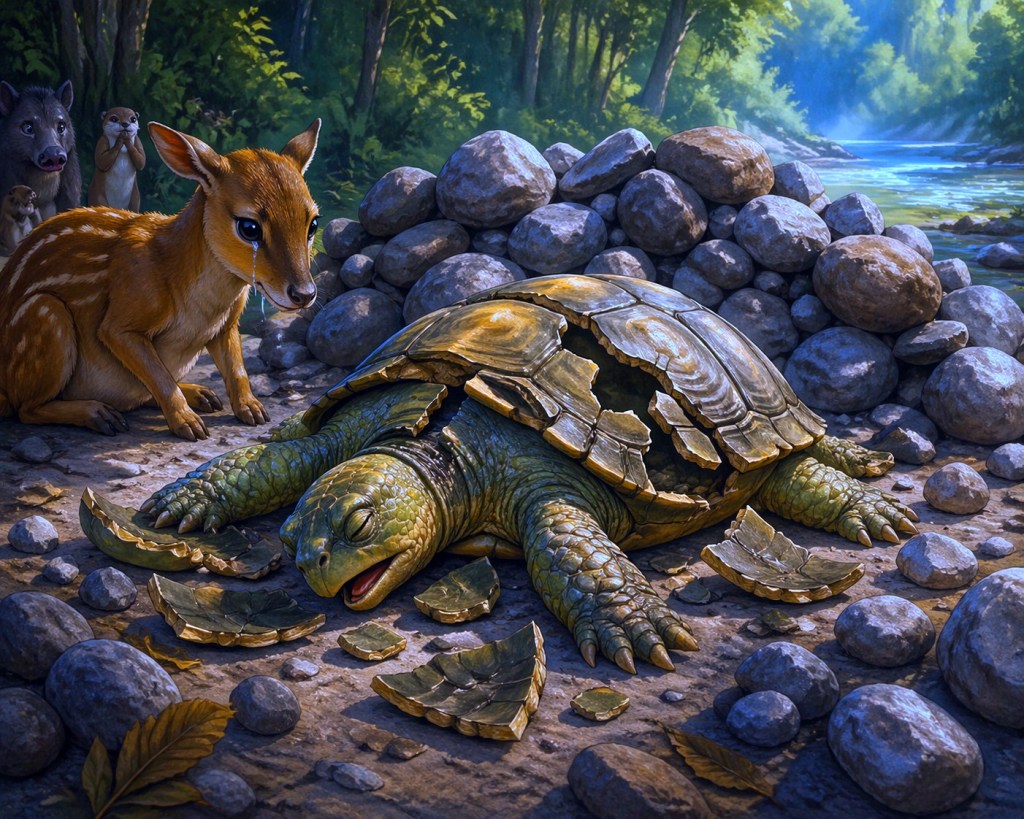
When the Eagle landed, it delivered the message. The Mousedeer immediately called all the creatures in the forest when it heard it. They worked together to make a place to land. But sadly, instead of a mattress, they made a mound of stones because the Eagle delivered the wrong message.
Once everything was ready, the tortoise leapt from the sky. Without wings, it fell rapidly and crashed onto the pile of stones. The sound of the impact was deafening. Hearing it, the Mousedeer rushed over and found the tortoise’s shell shattered into pieces. The tortoise lay unconscious. The Mousedeer cried when it saw this, thinking that the tortoise was beyond help. After crying, it gathered the scattered pieces of shell and carried the tortoise home for treatment.
At home, the Mousedeer sought help from the Lizard Shaman to heal the tortoise. That evening, the shaman conducted a ritual in which he used his wisdom to put the fractured shell back together. But not all of the pieces could be found since they had broken too finely. It took a long time, but the shell was finally reassembled.
The rebuilt shell was a lot smaller than the original. The tortoise itself became smaller because of this. This is why tortoises are smaller now and not as big as they used to be. Their shells are no longer smooth as they once were. Instead, they are patterned and segmented, as if they were put together.
Note:
I translated and adapted this story into Malay (shared on Threads) and English (here on my blog), based on the Iban version originally shared by Gregory Nyanggau Mawar on the Iban Cultural Heritage website.
I write about Iban culture, ancestral rituals, creative life, emotional truths, and the quiet transformations of love, motherhood, and identity. If this speaks to you, subscribe and journey with me.