If We Had Stayed | A Prose Poem from an Alternate Life

It was never loud between us. Our love never needed proof. Just subtle signs. A gaze that lasted too long. A jacket shrugged off without being asked. How his silence moved toward mine and made room.

We live above the bookstore near the station. The one with crooked shelves and a leaking pipe that drips near the poetry section. On quiet mornings, I wake first. The kettle whispers steam. He is still asleep, half-buried in the blankets, one arm flung across my side of the bed. I write before the city wakes up. One lamp on. My pen moves slowly and carefully across the page because some mornings are fragile. 

Some days, we walk to the cafe where we first met. The one where the windows get foggy, and I forgot a pen once. He never mentions that he kept it. Never asks why I replaced it. But he returns it anyway, weeks later, as if it was never gone. The pen, not the moment we shared.

We have a habit of not explaining. He says it once, at the door, without turning around. 

We often stroll to Yanping Riverside Park. It is our routine. We never call it that, but we keep coming back to it. On quieter days, we walk under trees that offer more than just shade. Kids dart past on scooters, while we walk slowly. His hand near mine. Sometimes he stops at the railing and looks at the river. I can feel him and the constellation he carries between us.

He rarely talks about work, and when he does, it’s only in fragments. Just enough to remind me that there are things that can’t be put into words. And that’s enough. I don’t have to know everything about him to love him.

I learn to read his silences. The way he checks the locks twice. The way his eyes drift when he’s too tired to pretend. I never think of his silence as distance. It’s a huge part of the whole.

We don’t talk about forever. We just stay.

There are rooftops and rain, the wind carrying jasmine from someone else’s balcony. Matcha soft-serve he buys without asking. The way he looks at me when I hand him a poem. How he holds it like a feather.

We don’t make any promises. But he and I stay.

He once told me that being around me hurt him like a third lung. I don’t say anything. I just trace my thumb over his knuckles and let the silence remain. There are no anniversaries. No statements. Just the ritual of being there.

He catches me when I slip on uneven pavement. His fingers wrap around my arm like the answer to the questions I’ve been too scared to ask. He says, “I guess I’m here to catch you.” I smile and file that sentence in the back of my mind, where the most important things live. 

Our life together isn’t always perfect. We fight. We turn our backs in sleep. But we stay. He doesn’t save me. I don’t save him. We just stop pretending we don’t need each other.

And in this world we’ve carved our lives into, the silence isn’t absence—it’s alive, trembling like a living thing.


Olivia Atelier offers printables, templates, and art designed to inspire reflection, healing, and creativity. Visit Olivia’s Atelier for more.

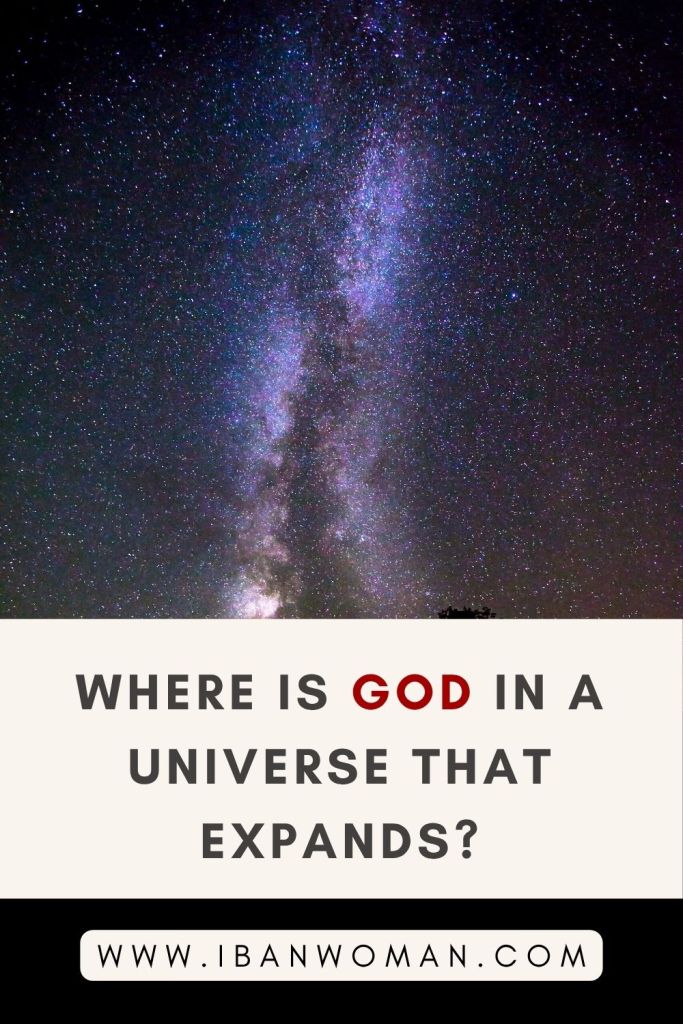
Where Is God in a Universe That Expands?

A couple of nights ago, I found myself thinking about black holes and the curvature of spacetime. It wasn’t a planned deep dive into physics. It all started with a simple question: how can a black hole not be seen/invisible? That question led to one of the most intense conversations I’ve ever had. It started with astrophysics and then slowly turned into theology. And like most of the things I reflect on late at night, it made me more curious than it did give me answers.

I learned that space is not empty. It is a real piece of “fabric” that can bend, stretch, and ripple. This fabric curves because of mass, which is what we feel as gravity. The more mass there is, the stronger the curvature and the stronger the gravity. This is why a black hole’s pull is so strong: its mass is compressed into such a tiny point that even light can’t get away from it. The event horizon is the line that marks the end of visibility (what we can see). Beyond it, not even light can come back. It’s not that the black hole is an empty hole; it’s that our limited perception doesn’t allow us to see past a certain point.

But what excited me was finding out that time is also a part of this fabric. Time doesn’t flow evenly throughout the universe. Time slows down around massive objects because their gravity pulls on the fabric of space more strongly. Time goes by more slowly when there is more gravity. This means that time moves a little slower on Earth than it does in space. And time almost stops close to a black hole. Do you know that one hour near the black hole is equal to thousands of years on earth? That alone changes how I perceive reality. Time doesn’t go in a straight line; it bends or curves relative to the surrounding mass.

And then there’s the expansion of the universe. I used to believe that the galaxies are moving away from each other in some cosmic ocean. Little did I know that the space itself is stretching like an elastic fabric. Space isn’t moving galaxies through it; it’s actively growing and pulling them apart. And here’s the interesting part: this expansion is speeding up. But what or who did it? The scientists call it dark energy, and it’s a force in the universe that we don’t really understand. Dark energy makes up about 68% of the universe we know about. It pushes everything away from one another, making the space between galaxies grow bigger and bigger.

All of this left me thinking: where is God in all this?

What kind of God made the universe that keeps stretching, spacetime that is constantly changing, and stars that collapse and disappear into black holes that bend reality to the point of no return? What kind of God exists in that?

For a while now, I’ve been deconstructing my faith. I have questions that I’m sometimes scared to ask out loud. I grew up believing in a God who was all-knowing, all-loving, and in control. But the more I learn about suffering, physics, and history, the harder it is to hold on to that version of God.

But still… I still have faith in God but not necessarily the all-powerful entity on a throne somewhere above the universe. I still believe in a God that started all of this.

It’s possible that God isn’t outside the universe, looking in. It’s possible that God is the universe—the intelligence within the fabric of spacetime and the consciousness behind every expansion and collapse. He is not a puppeteer or a micromanager but a divine presence that orchestrated the cosmic mystery.

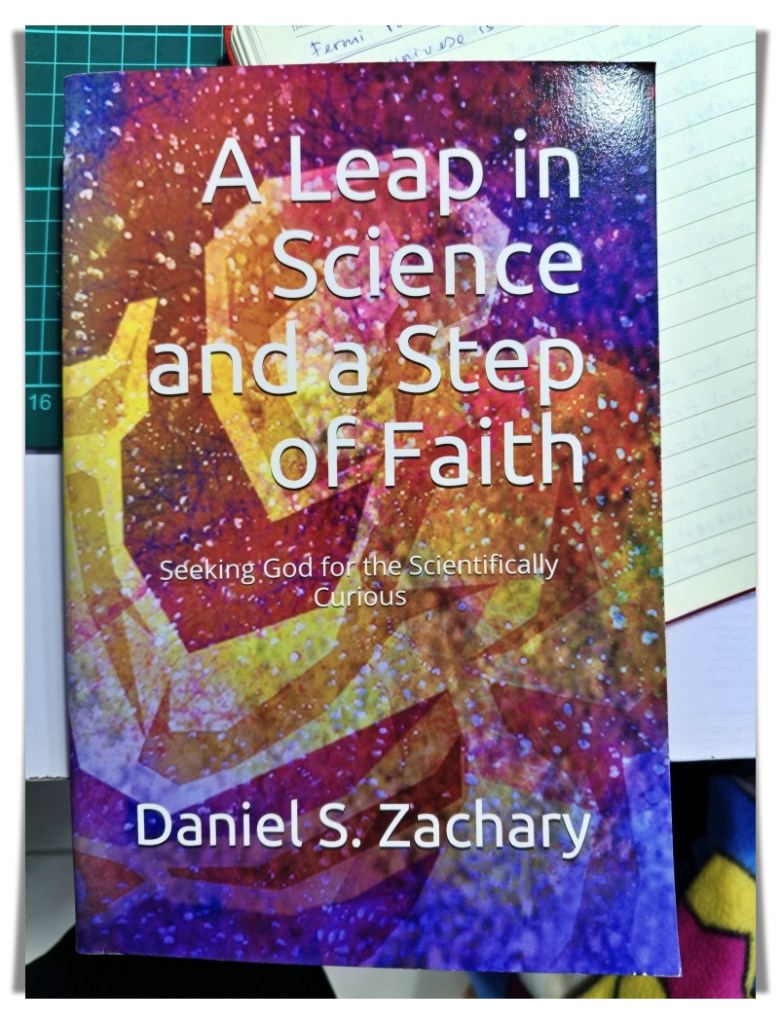
Two years ago, I bought a book by Daniel S. Zachary called “A Leap in Science and a Step of Faith.” He’s an astronomer. I went to one of his talks once, a couple of years ago. The subtitle of the book is “Seeking God for the Scientifically Curious”. I didn’t read it back then. Maybe I wasn’t ready or was still too scared to confess that I didn’t believe the version of God I had been raised up with. But what about now? I believe I’m ready to read it and slowly explore and find answers to my doubts.

The truth is that I’m not looking for a perfect theology anymore. I’m looking for a God who makes sense in a world where stars are born and die, time bends, and the universe is expanding to somewhere or nowhere. I’m looking for a God who can deal with my doubts and doesn’t get scared when I ask, are we the only intelligent beings in all of this?

The design is too accurate and intelligent so I tend to believe that we might not be the only ones. Some entity might be lying awake somewhere else, asking the same questions under a different sky. Or maybe we are alone, but I don’t think we have the capacity to figure it out. It’s just not possible.

I don’t believe in a God who needs me to do everything right anymore. I believe in a God who sees my reconstructing as a gift to myself. And if that means I have to float through this cosmic mystery for a while longer, so be it.

This drifting is holy.

And maybe God isn’t the answer I was searching for but the gravity that keeps pulling me back to the questions.


Olivia Atelier offers printables, templates, and art designed to inspire reflection, healing, and creativity. Visit Olivia’s Atelier for more.

Let Me Write in Peace | What I’d Change About How We Treat Non-Native Writers

I hand-wrote every piece of my writing.

If I could change one thing about modern society, it would be this: how we shame non-native English speakers and writers for how they write and express themselves, especially when they use AI tools (Grammarly, QuillBot, etc.) to make their voices clearer.

We claim we value authenticity and diversity, but when someone’s English doesn’t “sound native” or they use em-dashes or contrastive phrasing, people often ignore them. People think a sentence is AI if it seems “too polished.” There’s a term they used to label such writing – AI slop. How elitist and gatekeeping.

But what if we (bloggers or writers), like me, are trying our best to make sense and be understood? This issue has been weighing heavily on my chest for several months now. And maybe writing this and putting it out here on the blog is my way of letting some light through that heaviness. 

I’m a non-native English writer/speaker. I use tools like QuillBot to improve my writing and generative AI tools to help me explore new ideas. I also use em-dashes and Oxford commas because they make my writing clearer. I use contrast in my writing too because why not? Life is full of contradictions, and sometimes the best way to explain how I feel is to show it through a shift of perspective.

Apparently, to many people out there on the Internet, all of that seems to make my writing look like “AI slop.”

I didn’t know that using punctuation could be made fun of. I didn’t know that using too many em-dashes, or writing that sounds too polished, or having your ideas shaped by a tool could make people think you’re lazy or fake. I’ve seen again and again on the Internet how native speakers make fun of us for not knowing how to write “properly.”

I had no idea that after writing poems since I was ten, or writing hundreds of essays and poems over the years, and then returning to writing after more than a decade of motherhood, I would be made to feel like a fraud.

The sentiment is everywhere. It’s subtle but sharp and cutting. It’s loud and condescending when you already feel so small: “This writing sounds like AI. So it must not be worth anything. Plagiarism. Lazy. Fake.”

But these language purists don’t see the effort I put into rewording or rewriting my posts. They don’t see the weariness of constantly questioning each sentence to see if it sounds right or if it conveys the intended meaning. They don’t see the emotional strain of attempting to mold my voice in a language that is not my first. They don’t see the courage required to publish anything at all. Now this is beside the point but English is my third language (I’m fluent in 5 languages). Let me ask these gatekeepers, how many languages do they speak and write in?

I didn’t plagiarize anything. However, I used a tool, similar to Lightroom or Photoshop, which is used by photographers to enhance their photos. Like how designers use templates. And somehow, that’s enough for some people to reduce what I made to nothing.

It hurts. It feels like persecution rather than merely criticism.

Sometimes I feel too scared to publish anything. I’m worried that I’ll be accused of being lazy or being dismissed with “This sounds like it was written by a bot.” But what about the soul of my writing—pain, memories, lived experience? Can they be undone by sentence structure?

What about the truths inside the writing, may I ask? The ones about identity, faith, loneliness, grief, and motherhood? Do those not count just because I refined them using a tool?

What about the fact that I edit or that I write or that I give it a shot? What about the emotional labor that goes into the words? There is nothing fake or artificial about any of those things. So yes. I use tools. I use em-dashes. I use contrast. I use help.

But I’m the one who feels the words before they exist. I’m the one who decides to speak up when it might be safer to be silent. I am the one who sorts through memories, longings, and fragments of myself to shape what eventually gets read. There is a human behind all these, not some made-up AI text.

And I’m sick of being ashamed of that. Let us write the way we need to. Let’s use what we need to. Let us tell our stories, even if we do so with tools and a language that isn’t our first.

It doesn’t matter if it looks like AI or not. It’s whether it came from something real and true, like every word of this. They all came from me.

Read more here:
AI-Detectors Biased Against Non-Native English Writers

© 2025 Olivia JD


Olivia Atelier offers printables, templates, and art designed to inspire reflection, healing, and creativity. Visit Olivia’s Atelier for more.

What Romance Means to Me Now

A couple holding hands in a quiet park, showing what romantic love looks like after years together

I used to think that romantic love was supposed to be grand. Surprises, flowers, and long letters written by hand that show how much you miss them. Maybe it was because I grew up with 90s love songs and paperbacks that always had that one scene, you know, the one where everything fell into place and you replayed it in your head for years. I’ve desired that kind of love for a long time. I used to think that if love didn’t look like it did in the movies, it probably wasn’t love.

But now? This is what romance means to me.

It’s in the small, mundane things. How he puts my mug in the same place every morning because he knows it’s the only one I use. How he listens even when I talk about things he doesn’t understand, like my blog traffic, my latest art idea, or why I spent an hour editing a blog post. It’s how he laughs at my jokes that aren’t funny to anyone else. It’s how he doesn’t flinch when I break down for the fifth time in a week or when my anxiety keeps me up at night.

For me, the definition of romantic is all about being present for the one you love. It’s not loud or demanding attention. It’s in the effort to keep choosing someone even after the butterflies have settled into the routine of everyday life.

And to be honest, I had to unlearn a lot of what I thought I knew about love to understand this. I had to stop waiting for scenes in movies and start paying attention to what was happening in my life. I pay attention to things like the way our hands touch when we’re having a tense conversation. The way he carries the groceries when I’m too tired to talk. The way he makes time for the kids even when he’s tired from work.

I think about how our love has changed over the years. How it grew to hold grief, misunderstandings, financial challenges, and stress from being a parent. We came close to giving up at times. There were times when I wasn’t sure I still liked him. He probably didn’t like me at times too. But we stayed. We learned how to communicate to each other. We fought, made up, fell apart, and started over.

I think that’s romantic too. Romance in real life is not the absence of conflict, but the commitment to return. To make peace. To say you’re sorry even when it’s hard. To give each other room to grow, even when it’s hard.

Learning how to be your own safe place is another part of romance. It took me years to understand that I couldn’t keep hoping that someone else would save me from my loneliness, sadness, and exhaustion. I also had to learn how to take care of myself. I learned to listen to and parent my inner child by whispering kind things to myself when I felt ugly or unworthy.

Now, everyday romance is my husband standing by the kitchen’s door while I cook, just to be near me. It’s him asking if I’ve eaten. It’s the silence we share at night, when the house is finally quiet and we are just two people who have made it through another day together.

And sometimes, romance looks like him leaving me alone when I need time alone.

I used to feel guilty about the lack of passion in our love. That it didn’t make me swoon anymore. Now, though, I see the beauty in this gradual, steady burn and the way it grounds me.

I want to say this to anyone who thinks their relationship is too ordinary to be romantic: don’t underestimate your quiet love. The love that keeps trying. The love that stays despite knowing your worst. The love that continues to thrive in the mundane.

Romance is not always in the gestures. Sometimes, it’s in the staying.

Sometimes, it’s in the letting go.

And sometimes, it’s in the way we turn the ordinary into something sacred.

Romance

He doesn’t bring me roses—
because I said they’re useless.
So he brings silence
when the room inside me aches.

He doesn’t write letters—
he reads my face
and answers with
a gentle hand
on my lower back.

He doesn’t call me beautiful—
but he finds my mug,
pours the water,
watches the rice,
mops the floor.

No fireworks,
no symphonies—
just staying
that doesn’t beg to be seen.

And I,
still learning not to ask for more
than this
steady, worn-in miracle.

© 2025 Olivia JD


Olivia Atelier offers printables, templates, and art designed to inspire reflection, healing, and creativity. Visit Olivia’s Atelier for more.
Marriage Refines You (If You Let It)

Nobody warned me that marriage would teach me the lessons I never anticipated.

They said it would take work. They said communication was key. They said love changes. All of this is true. But no one told me that marriage is fundamentally a slow-burning crucible of personal transformation. Of course there are romance and domestic joy, but those aren’t the main things. Marriage refines you. But only if you allow it.

If I had written this post twenty years ago, things would have been different. I would have told you about the joys of growing older together, about shared jokes and parenting accomplishments, and the comfort of being wanted and desired. I might have glossed over the friction. Or made it poetic, full of excuses.

But now, I want to tell the truth: Marriage teaches you who you truly are, often through pain.

This isn’t the kind of pain that stays with you forever, at least not in a good marriage anyway. But this pain would show you how weak, selfish, and proud you are. It’d expose the parts of you that you didn’t realize needed healing until you kept bumping up against another human being who sees you completely, and sometimes unflatteringly.

In the early years, I believed that in order to be respected, I had to be right. I used to believe that a good wife was someone who was nice and made quiet sacrifices. I thought conflict meant something was wrong.

Then came the truth: Conflict is the classroom. Friction is the fire. Silence is not always peace, and compliance is not intimacy. I learned this slowly and painfully, through nights of misunderstanding, long periods of emotional detachment, and the grief of feeling invisible.

Marriage has pushed me to confront my shadow selves: the part of me that resents when he doesn’t read my mind, the part that wants to be acknowledged for invisible labor, and the part that withdraws rather than communicates when I’m upset.

He has his parts too. When both of us are weary, stressed, or simply being human, those parts collide like stones.

But here’s what I’ve learned: Stones sharpen one another.

We grow as a result of the friction, not in spite of it. This relationship has gradually dispelled some of my misconceptions. I’ve become less concerned with appearing good and more interested in becoming whole. I’ve learned how to stay present during an argument without dissociating. I’ve learned to say, “I need this,” without shame. I’ve learned to apologize and own up to my mistakes because I value the connection more than the ego battle.

Marriage has taught me about perseverance. This perseverance is not the kind where you smile and bear it, but the kind where you continue to show up to face the difficult conversations, the painful realities, and the pain of building your character.

It has taught me that love is not the absence of conflict, but the willingness to hold space for each other’s growth.

This isn’t a post about martyrdom. This isn’t about perpetuating toxic behaviors or glorifying suffering. This is about the refinement that happens in long-term relationships, when two people choose to keep coming back to the table, even when it is a mess. Especially when things are messy.

Some days, love looks like scrubbing the kitchen while the other sits quietly. Some days, it looks like asking, “Can we talk?” even when the previous talk didn’t end well. Some days, it means choosing forgiveness over keeping score. Other times, it involves setting a boundary that says, “I will not carry this alone anymore.”

Marriage as a teacher is subtle, persistent, and deeply transformative. Refinement doesn’t happen all at once. It’s gradual, and at times it feels like failure. But what I do know is that I am not the same person I was when I agreed to this life together. And I’m thankful.

Marriage, in its own imperfect, beautiful and annoying way, is a never-ending teacher. And I’m slowly turning into someone I can be proud of, not because I’ve mastered love, but because I’ve let love master me.


This Is Not a Love Poem (But It Is)

This is not a love poem.
It doesn’t lace silk into longing
or wraps itself around your wrist
like a bracelet of breathless metaphors.

It’s the crack under the door
when we don’t speak for hours.
The grease-stained dinner plate
left by your elbow
and the silence I sit with,
like a burning candle.

This is not a sonnet.
This is the sound
of your sigh in the middle of my sentence.
The way you leave the room,
still loving me.

I wanted something softer, once,
but this? This is love
that turns me over like soil.
That presses its palms into my spine
and says: grow here.

I have.

And it hurts.
And it heals.
And it is you.

© 2025 Olivia JD


Olivia’s Atelier offers printables, templates, and art designed to inspire reflection, healing, and creativity. Visit Olivia’s Atelier, Redbubble, and Teepublic for more.

A Story of Motherhood, Resilience, and Healing After Surgery

It was a late, quiet evening in an operating theater when I first learned that even joy can arrive with a scar. My son was born through an emergency cesarean section, and I almost didn’t make it. Massive blood loss turned a moment meant for joy into a flurry of dread, beeping equipment, and desperate prayers. I recall trying to stay awake not for myself, but for him. For the child I hadn’t yet held.

That birth was my first major surgery. But it was also the first time I witnessed a new version of myself emerge, forged in pain but softened by fierce love. That moment shaped the beginning of my journey in motherhood and resilience.

Years later, I would have another surgery. This time, gallbladder surgery for cholecystitis, not delivery, brought me to my knees. My gallbladder had turned into a ticking bomb. What followed was not just the removal of an organ but the gradual deterioration of my physical health. Even after the surgery, I wasn’t recovering well. During the peak of the Covid-19 pandemic, I was hospitalized multiple times because of retained stones in my bile duct. Each admission was accompanied by fear: being alone, catching the virus, and not returning to my children.

One of the procedures used to remove the stones resulted in pancreatitis. The pain was excruciating, but the mental health after surgery nearly broke me. The never-ending anxiety, the exhaustion, and the uncertainty of whether my body would ever heal were overwhelming.

And yet. I survived. They were very difficult, but I persevered and survived.

Motherhood, in many ways, prepared me for these storms. You see, when you have children, you know deep down that you need to fight and pull through difficulties in life for their sake.

I didn’t discover the strength I needed to heal, to walk again after surgery, to smile through pain so my children wouldn’t be concerned, in a textbook or a self-help podcast. I discovered it in the middle of the night, as I cuddled my sick kid to my chest and whispered lullabies into the darkness. I discovered it when I folded laundry while nursing a headache, prepared meals on days I couldn’t eat, and said, “I’m fine,” even when I wasn’t.

These healing after surgery experiences left scars on my body, but they also carved new realities in my soul. Motherhood, illness, and these near-death experiences as a mom have transformed me into a different person. I became more intentional and thoughtful. I listen to my body more and take measures to safeguard my health. I became someone who sees life as a sacred space to be protected rather than a timeline to be fulfilled.

Motherhood didn’t just make me a mother. It shaped me into a woman who understands the value of life, of being present, and of holding both joy and suffering in her hand. And when I create today, whether it’s a poem or a work of art, it comes from a deep place. And this deep place understands what it means to unravel and still reassemble into someone wiser, more whole.

If you’re going through your own healing process, if you’ve been sewn back together more times than you can count, I see you. I have been there. And maybe the scarred places in us are where the light pours in.

This blog is where I share those reflections. Stories like these are part of a greater journey that I’m stitching together: of motherhood, transformation, and perseverance. If you’re searching for stories of emotional healing for mothers, I hope mine offers you a moment of recognition.

If this resonated with you, I hope you’ll stay a while. I’m slowly building something meaningful here, a refuge for women or anyone who carries both gentleness and strength in equal measure.


Olivia Writes offers printables, templates, and art designed to inspire reflection, healing, and creativity. Visit Olivia’s Atelier for more.
A Reflection on My Self-Care | Returning to Myself

The other night, when the house had settled into its usual silence, I sat alone with a cup of tea that had gone cold without me knowing it. Not only was I weary from the day’s routines and tasks, but I was also drained from the burden of my thoughts. I stared at the cup for a time, allowing myself to sit. There was no to-do list going through my thoughts. There’s no strategy for what happens next. Just me, solitude, and a reminder that sometimes, this is enough and I am content. In that little moment, I felt a glimmer of peace, a reminder that I am free to rest without having to earn it.

For me, self-care has never been remarkable. It is quiet. It is unremarkable in appearance, but profound in its impact. I find that breaking this idea into smaller thoughts mirrors the gentler rhythm I want to share. Spa days and costly treats are seldom considered, yet they do have their place. Instead, it exists in the fleeting, nearly invisible moments when I return to myself. It’s the five minutes I sneak to draw without care for how it looks. Or the words I scribble in my journal that will never be read by another soul. It’s stepping outside for a few breaths of night air, letting the darkness embrace me like an old friend. These small gestures are how I create a soft shelter for myself, a place where I can slow down, heal, and begin again.

I believe we are often taught that self-care needs to look a specific way. It has to be glossy, curated, and impressive. But in reality it might be as simple as letting ourselves be, without expectations. When I create, whether it’s a drawing, a poem, or a printable, I aim to include the same intention: an invitation to slow down, breathe, and reconnect. Each artwork I create becomes a reminder to myself and others that small moments are important. They often serve as the starting points for healing.

In the past, I assumed that self-care meant doing more. I tried to make every minute count by fixing, improving, or doing something. But I’ve learned that gentle self-care can sometimes mean doing less, or perhaps nothing at all. It means learning to say, “This is enough for now.” I am enough for now. And in that space, I can hear my heart again.

If you’re looking for ways to practice self-care, here are a few ideas that have helped me over the years.

Simple Self-Care Ideas That Have Helped Me

Sketch without purpose. Let your pencil wander and see where it takes you. There is freedom in creating without expectation.

Write one honest sentence. No pressure, no rules. Just your truth. Some of my most honest moments come out this way, in fragments that don’t need to become anything more.

Sit quietly with tea (or coffee, or water) and do nothing else. Allow the present to be enough. When the world becomes too distracting, even a few minutes of silence may be soothing.

Print out an affirmation or phrase that soothes you. Place it somewhere you’ll see when you need it most. Sometimes I tape mine to the mirror, or tuck it inside my journal.

Go outside, even for a minute. Allow the breeze to remind you that the world continues to spin and that you are a part of something greater.

Take deep, focused breaths. Close your eyes, if possible, and feel your breath travel through you. When everything becomes too much, just a small act of anchoring can help.

Let go of perfection for a while. You don’t need to be perfect in whatever you’re doing, whether cooking, sketching, writing, or simply being. All you have to do is be kind to yourself.

Make something just for you. You can create something as simple as a doodle, a few words of poetry, or a note to yourself. It doesn’t have to be shared or finished. You’re caring for yourself. 

Unplug for a moment. Even five minutes away from screens might seem like a mental refresher.

When I think of my own self-care, I see it as a silent commitment I make to myself. A promise to appreciate the parts of myself that are sometimes overlooked. These are the parts that long for peace, for simplicity, for gentle reminders that I don’t have to do or be more to be worthy of rest. This is something I strive to integrate into my work as well. When I produce something, whether it’s a printable, a template, a poem, or a work of art, I hope it serves as a companion to someone else’s self-care journey. May we all find small ways to return to ourselves.

If this gentle self-care reflection speaks to you, I hope you can find small ways to be kind and patient with yourself today. And if it feels right, you’re welcome to explore my shop. It’s a small beginning, and I look forward to adding more gentle offerings over time.


Olivia’s Atelier offers printables, templates, and art designed to inspire reflection, healing, and creativity. Visit Olivia’s Atelier for more.
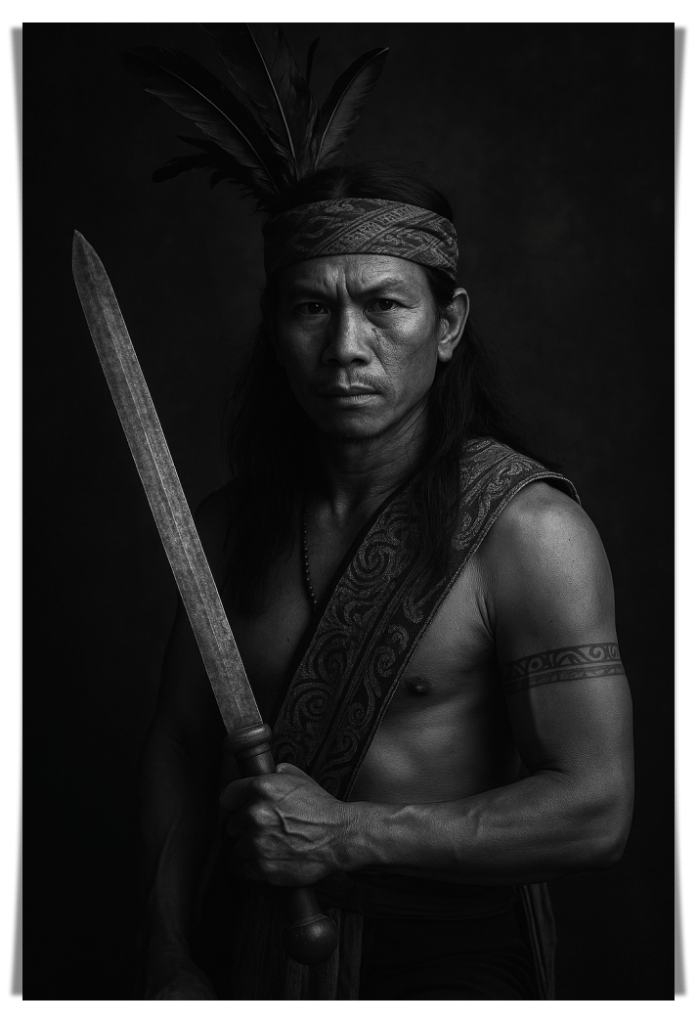
My Ancestor | OKP Dana Bayang the Great Iban Headhunter & War Leader of Borneo

“The Orang Kaya Pemancha Dana Bayang of Saribas is now with me…the dreaded and the brave, as he is termed by the natives. He is small, plain-looking and old, with his left arm disabled, and his body scarred with spear wounds. I do not dislike the look of him, and of all chiefs’ of that river I believe he is the most honest and steers his course straight enough.”

— James Brooke, The White Rajah’s Diary, 1843

When I saw this prompt, I didn’t think twice. My favorite historical figure isn’t from faraway lands or great empires. He is my ancestor, Orang Kaya Pemancha Dana Bayang (or Dana Bayang), the legendary Iban war leader of the early 19th century.

Dana Bayang was from Padeh, a longhouse upriver in the Saribas. In addition to his prowess in battle, he was renowned for his ability to guide his people wisely at a period when preserving their way of life from both local and foreign dangers was essential to their survival. His warriors, loyal and fearless, served as the first line of defense. Among them was Sabok Gila Berani, his right-hand man who eventually established our longhouse (village), Stambak Ulu. Stambak Ulu was a strategic sentinel, not just a village. It sat along the river, watching for enemy warships approaching up the Layar. From there, word could be quickly transmitted upriver to alert Dana Bayang in Padeh. Stambak Ulu became a shield, protecting Dana’s people and territory.

Years later, Sabok’s son Mang adopted Dana’s granddaughter, Mindu—my great-great-grandmother—after her father, Aji, Dana’s successor, was defeated by Charles Brooke’s forces in 1858. Aji’s death was a turning point, as the old ways clashed with colonial ambition. Mindu’s mother, Dimah, died soon after, leaving her an orphan. 

When I think of Dana Bayang, I think of courage that was not for glory but for the preservation of a way of life, of the land, spirits, and community. His sons and warriors fought to keep their people free, to defend their beliefs, customs, and homeland. Nonetheless, they stood on the edge of change as the White Rajah’s army (colonialism) drove into Sarawak’s heart. The story of Dana and his warriors reminds me of what it means to belong to a people who refused to give up, who carried defiance and hope in equal measure.

You can even catch a glimpse of Dana Bayang in the 2021 Hollywood film Edge of the World, which offers a sneak peek of Brooke’s voyage of discovery to Sarawak in the 1800s.

This reflection ties closely to something I wrote earlier: Inheriting Courage From My Warrior Ancestors. The courage I speak of is not just in legends; it lives in the bloodline, in memory, in the quiet resistance of holding onto who we are.


A Chieftain’s Lament

Between the ritual’s demand and the crown’s decree
my once-steady hands falter in silence.
The nyabur rusts in my palm,
steel thirsting for blood,
now hushed by law.
The earth splits open—
Brooke’s foreign feet press into its cracks.

I hear signs, I dream dreams.
We need fertile grounds.
Blood must avenge blood.
But Brooke tells me to sheath my hunger,
swallow the sun, unlearn the hunt.
He asks me to bow, to bury my blade—
yet the wind whispers of battles still untold.

A fire stirs in the pit of my chest,
a pact with shadows, ancestors long gone.
Can we silence our spirits, break our bond?
Or will the old gods rise in the dust of our revolt?
I smell old skin burning,
the wild call of crows—
but I am chained to the unseen leash of kings
who promise peace with chains.

Note:
Nyabur – curved sword from Borneo, a headhunter’s weapon


©2024 Olivia JD


Olivia Writes offers printables, templates, and art designed to inspire reflection, healing, and creativity. Visit Olivia’s Atelier, Redbubble, and Teepublic for more.

Luther — The First Boy I Ever Loved

It was 1989. I was twelve, shy and dreamy-eyed, in Primary Six. Luther was fourteen and in Form Two. He had the most beautiful eyes I had ever seen. We met at Christening classes on Wednesday nights. I watched him from across the room, my heart racing. I was torn between wanting him to notice me and wanting to stay hidden.

It was my best friend who, with a cheeky grin, told him my secret. I was so embarrassed that I wanted to sink through the floor. But that night, everything changed. Luther noticed me and paid attention from then on. We exchanged love letters, filled with clumsy, big-hearted words, and met on small dates behind some buildings; nothing grand, not even kisses. We simply held hands and talked.

But by December of ’89, my father’s job took us to a new town, and just like that, our brief, sweet chapter ended. We didn’t keep in touch because we were too young, and maybe we both knew deep down that first loves are only supposed to last a short time.

Now that I think about it, that experience really changed how I think about love and connection. It wasn’t just about the boy or the letters or the stolen glances. It taught me that love, even in its simplest form, is about seeing and being seen. It’s about feeling, in that fleeting moment, that you matter to someone.

It makes me think of The Wonder Years, an American TV show that was on our local channel at the time. Kevin Arnold’s journey through the awkwardness, joy, and heartbreak of growing up felt so much like my own coming of age. His sweet, tentative relationship with Winnie Cooper; their shy glances, their first kiss, the way they kept circling back to each other through the ups and downs. I understood that kind of love, the sweet young love. Luther and I had our own little universe for a while, much like Kevin and Winnie. We taught each other about hope, tenderness, and letting go, just like they did.

Luther

You had eyes that swallowed me whole—
a storm behind glass,
soft enough to fool me.
Your lips never touched me,
but I felt them anyway,
like rain through a roof crack.

We wrote each other down in crooked lines,
gave ourselves to paper,
to the dark between stars.
For a while, you were a fever I didn’t want to break—
a name I kept folding smaller and smaller,
to hide.


Olivia Writes offers printables, templates, and art designed to inspire reflection, healing, and creativity. Visit Olivia’s Atelier, Redbubble, and Teepublic for more.

Favorite Thing About Myself

What’s my favorite thing about myself?

I pause at that question. I seldom contemplate what I like about myself. If I sit quietly with it and really try to answer, I think I’d say this: my quiet perseverance.

I keep going. Even when I’m tired. Even at moments of fear. Even when doubt creeps in and whispers, “I’m not good enough.” I don’t live my life loudly or boldly in the way that the world typically applauds. However, I move steadily. I keep turning up. I never give up. I never stop learning. I’m always evolving. I complete the task even if no one notices. That’s something I’m proud of, though I rarely say it out loud.

I don’t hesitate to admit my struggles, no matter how terrified I am. I’m not scared to admit and address my weaknesses. I don’t behave like they don’t exist or blame others for my flaws. I say, “This part of me is fragile.” I need to care for this aspect of myself. After that, I look for ways to improve and make those parts better. I admit I’m not always right. But I don’t give up on myself either.

I’ve learned that quiet perseverance doesn’t mean never faltering. It involves repeatedly pulling yourself together despite trembling hands. It’s about accepting the difficult situation and stating, “I’m still here, still trying.”

Perhaps that’s my favorite thing about myself. I try even when I’m scared, not that I’m fearless. Regardless of how overwhelming the day feels, I decide to keep moving forward, one step at a time.


✨ Visit Olivia’s Atelier for printables, reel templates, and planners made to support overwhelmed moms with gentle, soulful tools.
🕊️ Enjoy 50% off everything until June 30.