Fragments of Obsession VI: The Art of Lingering

This is one of the things I did for fun and did it with only my memory and imagination as company. It’s an old habit: writing fragments of obsession that I started years ago and keep coming back to when I’m feeling heavy or restless. When I finished Fragments of Obsession V: What Remains of Him, I knew there was still more to figure out—more shadows, more tenderness, and more moments haunted by tragedy. So I let myself return to his rooms, his silences, and his gaze, and I wrote a few more. This is what play looks like for me now. This is not an escape but a way for me to process past experiences and to turn them into gentle longing, finally tame and set free. 

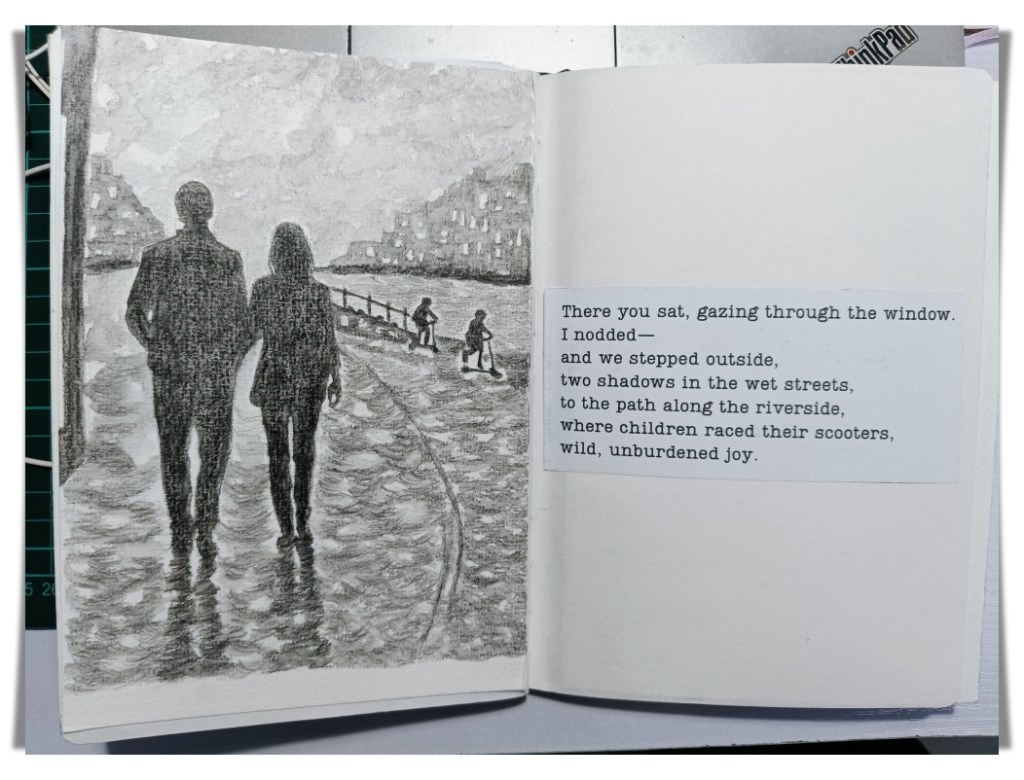
Riverside

I fall behind pretending I care about the river, when all I really want to do is watch him move ahead. He never misses anything. His hands in his pockets and his shoulders tight. But then he slows down, turns around, and gives me that look, like he’s been waiting for me all his life. I see that half-smile he only gives me. It almost feels private, something he keeps to himself and lets slip just for me.

I could live in that space between us just for the thrill of him staying still and making me want to get closer. He doesn’t say my name. He never does. He stands there with his boots on, the city and river catching in the leather of his jacket, making him look both real and unattainable.

He watches every step I take. He doesn’t fill the gap. He makes me feel the anguish of wanting to be closer. He let me reach him and let me be the one to move first. He tilts his head, keeps his eyes focused and drawls softly, “Took you long enough.”

I can’t help it. I smile. Because I know I’ll always keep chasing him, and he’ll always let me find him.

His Apartment

His apartment is nothing like I imagined, though in some ways it’s exactly what I expected. There are books all over the place. Some were stacked, some were abandoned in the middle of a thought, and some had bent pages where he stopped reading. When he isn’t looking, I run my fingers along the spines and read the titles like clues. I wonder about the books he returns to, those he doesn’t finish, and the ones he holds close. I try to picture which lines he remembered and which sentences he underlined in his mind.

His boots are next to the door, with the laces loose and the toes pointing out like he kicked them off without thinking. There’s a mug on the table with a faint coffee ring drying at the bottom. I pick it up, turn it slowly, and picture his mouth there. I always do that—touch the things he touched, like maybe I can learn something from him that he doesn’t say.

A jacket hangs off the chair, slumped over and heavy in the shoulders. It looks worn out. I wonder how long it’s been carrying him like that. A scarf draped carelessly over the back, still holding the shape of his neck. I don’t touch it. I don’t want to change how he left it.

There are pictures by the window. I look at them when he’s in the other room. Family. People I don’t know. I study them for too long, trying to remember their faces and figure out where he came from and what made him who he is now. He doesn’t explain them. I don’t ask. But my mind keeps going around and around them, restless and unfulfilled. I want to know who he was before he learned how to hold back.

In the morning, sunlight spills over the rug, revealing dust, creases, and the signs of the days he’s lived without me. I see everything. The fact that he always puts his keys in the same place. The small pile of my belongings that have started to gather—a pen, a hair tie, and a notebook that I left on purpose and pretended was an accident. He never moves them.

When I sit on his couch, I pull the blanket over my legs and breathe in his scent. His smell is faint but stubbornly sticking to the fabric. There are dents in the pillows. I press my hand into the hollow and imagine how he fell asleep there on the nights he was too exhausted to care.

In his bedroom, the bed is never made. The sheets were twisted, and the blankets were half fallen to the floor. A shirt is hanging over the chair, and the sleeves are knotted like it was taken off in a hurry. I lie there and stare at the ceiling, counting the cracks and listening to the city breathe outside. Here, my body relaxes in a way it doesn’t anywhere else. Here, his hands don’t have to hold evidence, or grief, or anything but me.

At night, I watch him sleep. I memorize how he breathes, the slight pause before it settles. I tell myself that I will remember it later. That’s what I always think. Like memory is something I can stockpile.

In the morning, the light climbs the wall slowly, indifferent. I know I’ll be leaving again. I do it all the time. But I also know that I leave parts of myself behind that are too small to see but impossible to take back. A strand of hair in his bed. A warmth that stays even after my body is gone. A familiarity he’ll feel later and not know why.

His apartment is not mine. But my desire is everywhere in it. And every time I leave, I can’t help but think that I know him better through his absence than his words.

Haunted

He comes in late, and the door closes quietly behind him. He doesn’t turn on the main lights; instead, he lets the dusk hang softly between us. His shoulders are hunched under the old leather jacket, and I know right away that something heavy followed him home. I can tell by the way he takes off his boots and the silence he carries with him.

He sits on the couch, elbows on his knees, head bowed, and hands dangling. There is blood on the edge of his shirt cuff, but it might not be his. I see how his fingers flex and how he runs a hand through his hair. He’s not with me yet. Still stuck in whatever he saw and can’t say out loud.

This is how I remember him: the hollows under his eyes, the day-old stubble on his jaw, the cut on his knuckle from a door he probably shouldn’t have punched. I look at him and see the small tremor in his hands and the shallow breaths he inhaled. He stares at the wall instead of me.

He doesn’t talk about work, at least not the real stuff. But the story always creeps into the room, clinging to his skin, hair, and the distance between us. I want to reach out to him, pull the darkness off his back, and hold all the sorrow he tries to hide. But I don’t. I just watch and let myself memorize him when he’s like this: unreachable, falling apart, but still here.

He finally looks up, and there’s something wild in his eyes. A flash of pain that isn’t meant for me but finds me anyway. I take it all at once. I tell myself that if I can remember him like this, haunted and broken, then nothing the world throws at us will ever make me forget him.

So I keep watching. I let my eyes linger, wanting to see every scar and every unnamed pain. I keep watching until he starts to come back, when his breathing slows and his hands stop shaking. And when he finally looks me in the eye, it feels like apologies and resignation to survive.


I write about Iban culture, ancestral rituals, creative life, emotional truths, and the quiet transformations of love, motherhood, and identity. If this speaks to you, subscribe and journey with me.
Noticing What Has Changed

I feel like the question “What have you learned recently?” is simple, but when I try to answer it, I have to pause. I don’t notice most changes in my life until I look back. I go about my day, dealing with whatever comes up, without really thinking about whether I’m getting better or not. But sometimes it’s clear that something has changed. That’s what this is, an attempt to notice what’s changed or improved.

Lately, I’ve been more aware of how much space I let myself take up. I made myself small for most of my life. I only spoke up when I was sure I wouldn’t hurt anyone’s feelings. I tried to guess what people wanted, what they would put up with, and what would make me look out of place. Staying hidden can make you feel safe, but it wears you down over time. I didn’t realize that waiting for permission to share an idea, make something, or want something for myself was a choice because it had become such a habit. I don’t remember when it changed, but I do know that I don’t ask for so much approval anymore. I write or draw what I want, when I want. I publish things with my name on them sometimes, and other times I use a different name. Other times, I just leave the words on my hard drive. I don’t have to do anything for anyone. I quietly came to this realization, and it has remained with me.

I have also slowed down, both by necessity and by choice. It’s difficult to put into words how heavy this year has been. There were times when my body just gave up on me, like when I was always tired and had migraines that came out of nowhere and persisted. I quit working out. I stopped pretending that pushing myself harder would help. I waited for a while, trying to deal with the pain and uncertainty by not moving much. I did figure out the cause of my fatigue and migraines, and since then, they have improved a lot. That experience taught me to slow down and listen to my body and get the help it needed. 

The worst of the symptoms have disappeared, allowing me to move again. I don’t mean that in a figurative way; I really do walk and jog more. Three kilometers, three or four times a week, and there’s no need to hurry. There isn’t any more pressure to “get fit.” I just walk. I see the trees, hear the birds, and feel my legs moving again after months of inertia. It’s normal, but it means a lot to me. It feels like returning to my skin after months of being wrecked by fatigue and pain.

Setting boundaries is still new. For years, I thought it was my job to be there for others, take on their moods, and ensure things went well. Now, I say no more often. I let people deal with their problems. I don’t explain myself as much. It doesn’t feel empowering or freeing; it’s awkward and tense at times, but it’s real. Guilt comes and goes but I let it go. I’m starting to realize that saying yes won’t fix everything.

Another lesson learned and change made: I don’t doubt my right to want things as much as I used to. For a long time, I told myself that I was easy to please and that wanting too much would only make me disappointed. It was better to keep my needs vague and not say them out loud. However, I want more lately—more peace, more meaning, a stronger connection, and more room for my writing and art. I’m not sorry for it, even though I know I won’t get everything I want. I write and create because I need to, not to please anyone or gain more followers and likes. Those things are undoubtedly flattering, but they are just a bonus.

Trust is also a big deal, especially knowing that my voice matters. I still doubt myself, especially when I write in English. The urge to hold back is still there, but I keep going. I write what I think is honest, even if it’s not perfect. I establish boundaries when necessary. I don’t pretend like I know more than I do. Sharing is a form of practice in and of itself. I don’t know if anyone is interested in what I have to say. It doesn’t matter as much now; I just write and create.

Routine is what keeps me grounded. My days are typically plain. I get up, do what needs to be done, take a morning walk or jog, cook, read, draw, and write. Repetition is comforting. Things that used to be trivial are now important, like how the light changes during the day, the sound of rain in the morning, or a quick note from a friend. I don’t ignore these things anymore. I remember days by their texture and temperature and not by what I accomplished.

There’s nothing dramatic about the last few months. The most significant changes are internal, and I can’t see them unless I write them down. I’m not as interested in what looks appealing as I am in what feels right and true. I still mess up and sometimes I fall back into old habits. I’m not sure if there’s a lesson here at all. It’s just a slow process of living and noticing what’s different.

If you asked me a year ago what I’d learn, I wouldn’t have guessed any of this. Most things happen without a plan. They reveal themselves in silence after the fact, when I look up and realize I’m not in the same place anymore.


I write about Iban culture, ancestral rituals, creative life, emotional truths, and the quiet transformations of love, motherhood, and identity. If this speaks to you, subscribe and journey with me.
What Sparks My Admiration in Others

Image source

There are many qualities people celebrate in this world: confidence, achievement, ambition, and charm. I understand why those traits draw attention, but the things that spark my admiration are usually less noticeable, simpler, and harder to measure. I’m drawn to people who move through life in a steady, consistent way that is easy to miss. Their strength is not loud or dramatic. It does not demand attention. You feel it more than you see it, and it appears in small, everyday moments.

One quality I admire deeply is quiet strength. Some people carry difficult histories, but they never turn their pain into a performance. They don’t talk about what they have survived or how exhausting their days can be. They wake up and continue living with purpose. They make thoughtful choices. They speak gently even when life has not been kind to them. This kind of strength does not need recognition to exist. It reminds me that courage isn’t always fierce or loud. Sometimes it sits in the background, unnoticed but ever present. 

I also admire consistency. There are people who show up the same way regardless of what season they are in. They do not disappear when things become complicated, and they do not change their personality based on convenience. Their presence feels reliable, like a rhythm you can return to when everything else feels uncertain. Consistency requires emotional maturity and the willingness to take responsibility for your actions, which is why it is uncommon. When someone carries the same sincerity on ordinary days as they do on meaningful ones, it leaves an impression on me. It feels like witnessing integrity as a lived practice rather than an idea.

Another quality I value is the ability to handle emotional weight with grace. These are people who can sit through difficult conversations without becoming defensive or dismissive. They try to be honest with themselves and acknowledge their shortcomings instead of hiding behind excuses. They grow without needing applause. They apologize when they hurt anyone. They listen carefully and speak clearly. Seeing someone go through life with this level of emotional awareness feels like observing wisdom in action. It encourages me to reflect on my habits and to grow at a pace that feels true to me.

Another thing that draws me in is depth. I admire people who see the world in layers rather than quick snapshots. They pay attention to little things, like how the light moves through a window at a certain time of day, how someone’s tone changes when they’re trying to hide their sadness, or the meaning behind a seemingly ordinary gesture. They remember things that other people forget.  They ask sincere questions because they want to understand, not because they want to impress. You can tell that they are really paying attention. Being around them feels like exploring something together rather than exchanging information. I appreciate how they make room for complexity without turning it into confusion.

Authenticity is another trait I hold in high regard. I respect people who remain true to themselves even when the world pressures them to fit into narrow definitions of success, beauty, or worth. They do not pretend or shrink themselves to gain approval. They do not hide the parts of themselves that feel different. Living this way honestly takes courage, especially in environments that reward conformity. When I meet someone who seems comfortable in their skin, it reminds me to honor my path. Their presence gives others permission to be real as well.

These traits all share one thing: they don’t relate to performance. They show who they are slowly, through small actions instead of big ones. They come from character rather than image. They are lived, not displayed. I admire them because they feel human in a world that moves too rapidly for humanity. These qualities remind me of the kind of person I want to be: steady, focused, brave enough to change, and honest enough to stay true to myself.

Admiration is a gentle emotion. It comes softly, and I don’t always notice it right away. It happens when I see how someone deals with the stress of everyday life and how they cope with uncertainty. It also happens when I see how someone treats people who can’t provide them anything in return. It grows when kindness doesn’t seek attention and when strength doesn’t seek reward. It deepens whenever someone chooses integrity even when no one is watching.

When I contemplate what makes me admire something, I always come back to how simple it is. I like how people carry themselves. I admire the choices they make when it would be easier to pick something else. I notice moments where truth matters more than convenience. These are the qualities that remain with me. They might seem small at first glance, but they become meaningful when you truly see them.


I write about Iban culture, ancestral rituals, creative life, emotional truths, and the quiet transformations of love, motherhood, and identity. If this speaks to you, subscribe and journey with me.
Aji Apai Limpa: The Ancestor I Wish I Could Meet

Image source

Some mornings begin with a calm sense of familiarity. The air is still cool from the night when I step outside. Dew gathers on the grass, clinging to each blade as if it has been waiting there. In Iban, we call it ambun, and I grew up believing that it is more than moisture. We believe that ambun holds memories and also the substance of our ancestors that find their way back into the living world. The elders in my family often spoke about the cycle of the soul. This belief is deeply held among the Saribas Iban, where my ancestors lived. When someone dies, their soul travels to Sebayan, the land of the dead, traditionally believed to be located at Batang Mandai in Kapuas, West Kalimantan, Borneo. Life in Sebayan mirrors life here. Souls continue living in longhouses, planting rice, raising families, and keeping the same rhythms they once had on earth.

This cycle is not eternal. The soul is believed to live and die seven times. After the seventh death, whatever remains dissolves into a fine mist that falls back to earth as ambun. The dew is especially meaningful at the end of the dry season, when families complete their planting and the land waits for water. The ambun nourishes the young paddy shoots, feeding the next generation. It is a beautiful belief, one I never questioned when I was young. I simply accepted that those who had gone before us returned quietly each morning. When I saw thick dew on the grass, I thought of people I loved who were no longer here, finding their way back to us through the rice we depended on.

I have been thinking about this belief again today because of a simple question from a blog prompt: If you could meet a historical figure, who would it be, and why? It is a straightforward question for most people, but for me, it brings up a feeling I can only describe as longing. In the history of the Iban, the figure I would choose is not distant. He is not a king, a philosopher, or someone from a faraway land. He is my ancestor. My great-great-great-grandfather, Aji Apai Limpa.

Aji was a well-known war leader of the Saribas Iban in the mid-nineteenth century. Between 1854 and 1858, he led his warriors against the advancing rule of the second White Rajah, Charles Brooke. His resistance was fierce and relentless. He died in 1858 in a battle at Sg. Langit. His bravery was not only remembered; it was immortalized in the oral traditions of the Iban. The lemambang (bards) recited his name in their ritual poetry. His courage became part of the narrative of our people, carried through chants and invocations, passed from one generation to the next.

If I could meet him, I would not meet him as a historical figure. I would meet him as an ancestor whose choices shaped the path that eventually led to me. I wonder what he was like as a person outside of battle. I wonder what he feared, what he hoped for, and what drove him to carry responsibility that heavy. The written records focus on warfare and resistance, but I imagine a man who also worried about his people, who made decisions that weighed on him, a man who had moments of doubt and understood that his actions would have consequences beyond his lifetime.

I would ask him what courage meant to him. I would ask him what it felt like to stand in front of his warriors and lead them into danger. I would ask him how he held his ground when the world around him was changing. And I would want to know what he thought about the legacy he would leave behind. There are times when people describe me as sharp or strong-willed, and I think about where those traits may have come from. Perhaps those traits were passed down from him to me, just as ambun returns to nourish the young paddy shoots without anyone noticing.

I think about the belief in Sebayan and how it shapes the way I imagine meeting him. I do not picture a physical meeting. I see it more as a recognition, something that happens inwardly through the echoes that live within us. When I feel the urge to protect my roots or speak about my heritage, I think that he might be part of that voice. The belief that the soul returns as dew makes the idea of connection feel less abstract. If ambun holds the last traces of our ancestors, we may encounter them repeatedly through the land, the rice, and the aspects of ourselves that seem older than our years.

The blog prompt seems simple, but it opens a deeper reflection for me. Meeting a historical figure means meeting someone who has shaped the world you inherited. For me, that figure is not distant or symbolic. He is the ancestor whose bloodline runs through mine, whose story lives on in my people’s poetry, and whose bravery still affects how I live my life.

When the ambun is heavy on the grass in the morning, I think about the souls who have traveled their full journey through Sebayan and returned to nourish the living. I imagine Aji among them. I think that in some small way, he is still here, still part of the cycle that continues without end. And in that sense, the meeting I long for might already be happening in the early morning, when the world is still and the dew falls softly on the ground.


I write about Iban culture, ancestral rituals, creative life, emotional truths, and the quiet transformations of love, motherhood, and identity. If this speaks to you, subscribe and journey with me.
The Risks I Haven’t Taken Yet

When we talk about risks, people often think of something brave or daring like skydiving, quitting a job to travel, or moving to a new country. Those are great choices, but the kind of risk I think about isn’t loud or exciting. It’s quiet, personal, and deep inside me.

The first risk I want to take is to be honest and tell the truth. Not the polite kind that makes things easier, and not the one that hides behind metaphors to avoid being judged. I want to be honest about how I feel and what I believe, even if it makes people who think they know me uncomfortable.

For a long time, I’ve written about love, faith, culture, motherhood, and identity. Writing has always helped me remember and make sense of things. But I’ve also noticed how often I hold back. I choose my words carefully. I filter and rewrite. I tell my stories in ways that feel safe because I’m afraid of being misunderstood or seen as disrespectful. I was taught to value peace, and I learned early that honesty was not always as safe as obedience. But as I grow older, I realize that silence can also be a form of dishonesty.

I want to talk about how faith changes, how love doesn’t fit into neat boxes, and how I’ve changed as a person after years of trying to please everyone. I no longer want to hide behind my writing. I want my voice to sound like it belongs to someone who has lived, made mistakes, and learned from them. Of course, the risk is that people won’t like what they read. But that’s a risk I’m finally willing to take, because what I write now is not for approval—it’s for truth.

The second risk is more physical. I want to get a tattoo.

It might sound simple, but it means a lot to me. I’ve wanted one for years, but I hesitated because of my religious beliefs. For a long time, I thought it was wrong. I thought my body should remain unmarked. Over time, though, my faith changed. It became simpler, gentler, and more personal. It no longer revolves around rules or fear; it revolves around love and truth. And part of that truth is that I want to mark my body in a way that tells my story.

When I finally get a tattoo, it won’t be something trendy or meaningless. It will be something that ties me to my heritage. I won’t use traditional Iban motifs that were meant for men, because I deeply respect the cultural and spiritual meaning behind those designs. But I’ve thought about creating something inspired by them—perhaps the tali nyawa spiral from the bungai terung, which represents the rope of life, or a design based on the buah engkabang, a forest fruit from Borneo with wing-like shapes that symbolize growth and resilience. Both carry meanings that reflect my life, my culture, and the changes that have shaped me.

I also like the idea of tattooing the coordinates of my parents’ longhouses—one for my father and one for my mother. Two longhouses in two different villages, both by the rivers that have run through my family’s history. It feels like mapping where I come from, a way to connect with the places that made me who I am. It would remind me of my roots and, in a strange way, serve as a promise that I will never lose them.

And to be completely honest, the practical side of it gives me comfort too. If I ever died far from home without identification, the coordinates would at least tell someone where I belong. It sounds morbid, but the thought brings me peace. It feels like a way of saying, “If you find me, bring me home.”

I plan to get the tattoo when I turn fifty. That gives me time to think, refine the design, and make sure it feels right. It will also mark a milestone: fifty years of living, growing, and learning to live on my own terms. The tattoo will not just be art on my skin; it will be a story written in ink, one that connects my body, spirit, and heritage.

These two risks—telling the truth and marking my skin—feel deeply connected. Both are about claiming ownership of who I am. Both are about letting go of the fear of how others might see me. I no longer want to live quietly in the background, trying to make everyone happy. I want to speak with honesty and carry symbols that reflect the life I’ve lived and the ancestors who came before me.

Risk might not always mean danger or being careless. It could be as simple as having the courage to live in a way that is true to who you are. That’s the risk I want to take.


I write about Iban culture, ancestral rituals, creative life, emotional truths, and the quiet transformations of love, motherhood, and identity. If this speaks to you, subscribe and journey with me.
What Most People Don’t See

Most people think I’m soft by nature. They think that gentleness is something I was born with. When people read my poems or see my drawings, they often describe them as whimsical, calm, tender, or peaceful. I don’t correct them. It is true in a way, but not the whole truth.

Softness was not something that came naturally to me. It took me years to realize that it can exist with pain. It took even longer to choose it on purpose. I learned it through exhaustion, heartbreak, and slowly putting myself back together after each disappointment. My softness is not passive. It’s a choice I made like a defiance against the hardness that threatened my heart once.

When I was younger, I thought survival meant staying guarded. I thought that being kind would let the world take advantage of me, so I learned to keep my feelings to myself and not talk as much. I became observant and cautious, studying people before deciding if it’s safe to let others in. I had that habit for years without understanding how difficult it was to break.

Art eventually taught me that erecting walls doesn’t always keep you secure. Sometimes it comes from creating something that is honest enough to show who you really are. I find peace when I write, draw, or pair my poems with drawings (“poetry art”). The page doesn’t judge or demand that I do well. It only needs me to be present. That silent conversation between me and the page taught me that being gentle can be strong. It could mend what silence had only kept concealed.

Still, I often feel like I don’t really belong anywhere. I was born into an Iban culture that is rich and layered, but the world I live in now moves quickly and values things differently. I write mostly in English, think partly in Malay, and dream in Iban, a language that doesn’t belong in the world I live in. Every day, I move between these spaces, trying to find balance between them. I can see both the person I used to be and the person I’ve become in these two mirrors, but never both at the same time.

This in-between space is where I create from. It’s where the poems and art begin. I write about rituals, rivers, tattoos, and stories from my ancestors since they are all part of who I am. I draw and write about love and longing because they are a part of the world I live in now. My art is an attempt to bring these two worlds close enough to touch. Even if it’s just for a moment, each poem or drawing is a small way to feel like I belong.

Many people ask me what makes me want to keep creating. The truth is that I create art to feel grounded. Writing helps me return to myself when I start to drift too far from the person I want to be. It reminds me that I still have something to say, even if I don’t say it out loud. Every time I write, I rediscover that softness and strength are not opposites. They are two parts of the same language, which I am still learning to speak fluently.

I’ve learned that belonging doesn’t always mean having a fixed place or community. It could mean accepting that your identity is still changing. Or it could mean carrying your culture and memories in your work, even if those around you don’t always see where they come from. It could also mean finding peace in creating without expecting approval from others.

Most people don’t know these things about me because I rarely share them. But they exist in everything I create. The older I get, the less I feel like I have to explain myself to everyone or to gain approval from anybody. I just need to keep making work that feels honest and can stand as a small reflection of where I’ve been and who I’m becoming.

Softness or gentleness doesn’t mean you don’t feel pain. It is the space that remains vulnerable and courageous despite it. And belonging, for me, will probably always be in that space between the languages I speak, the places I’ve lived, and the stories I continue to tell.


I write about Iban culture, ancestral rituals, creative life, emotional truths, and the quiet transformations of love, motherhood, and identity. If this speaks to you, subscribe and journey with me.

What Rest Looks Like After Fifteen Years of Mothering

It’s been a long time since I’ve had a truly lazy day.

I’m not talking about a day off from chores or deadlines. I’m referring to a day when I let go of everything without feeling pulled in any direction. It’s the day where I don’t feel like I have to be useful or productive or show up for someone else.

Most of my days for the last 15 years have been spent on others. When my kids were younger, especially when they were babies and toddlers, everything was about them. Feeding, bathing, cleaning, holding, and comforting them came first. When they were sick, it meant even less sleep and more work. At that time, I was tired all over, not just my body. It got into my thoughts and emotions as well. Everything was affected by the exhaustion.

There was no such thing as a lazy day back then. It seemed like I had to work for rest. And even when I tried to rest, it cost me something. Waking up from a nap meant a mess. A slower morning meant that I was already behind when I started my day. A moment alone was always interrupted.

At night, when everyone else was asleep, I had the house to myself. Finally, the house was quiet, and I could breathe. I stayed up, though, although I was tired. I wanted a moment when no one needed me so I could be a person again. I found out later that this was called “revenge bedtime procrastination.” It made sense to me. I wasn’t staying up because I had energy, but I stayed up because I didn’t have any other time to be alone.

Back then, I still made time for art. I still wrote in my journal. It was not consistent but enough to keep a small part of myself alive. My creative work never stopped; it just happened in the margins during stolen hours. Or in between picking up the kids from school and doing laundry. I didn’t think of it as something extra but as something I depended on. 

Now, with the kids older, I have more “free time” or space. The demands on my time are different. My kids are more self-sufficient, and I can finally enjoy long periods of peace. But I still don’t take lazy days. 

Even on weekends when I don’t have any plans or on school holidays when things are slower, I still gravitate toward my work. And by work, I don’t mean a job. I mean things that feed my mind and spirit, like writing, painting, and reading. These things are not obligations. They’re what make me feel most alive.

Some people might think what I do is work. But for me, it’s the opposite of draining because it gives back and keeps me grounded. I don’t create to be productive. It’s in my nature to create.

That’s why the idea of lazy days is strange to me. I don’t resist rest. I just experience it differently. When I spend time writing or making art, I’m not trying to prove anything. This is how I return to myself and how I unwind inwardly while still moving.

If you ask me if lazy days make me feel rested or unproductive, I would say neither. I don’t have lazy days. I have quiet and slow days or days where I work inward, even if nothing shows on the outside.

Rest doesn’t always look like lying on the couch doing nothing. Putting on soft music and painting without a goal in mind is one way to relax. Sometimes it’s writing in a journal in the early morning, before anyone else wakes up. Sometimes it’s reading a book that makes me feel less alone.

To be honest, I don’t think I want a life full of lazy days. I want to live a life where I feel like I’m really there in everything I do. Whether it’s being a parent, creating something, or just being still. Maybe that’s what I’ve been working toward all this time.


I write about Iban culture, ancestral rituals, creative life, emotional truths, and the quiet transformations of love, motherhood, and identity. If this speaks to you, subscribe and journey with me.

What a Million Dollars Could Build

I’ve come across this question more times than I can count: “If you had a million dollars to give away, who would you give it to?” And every time, I wonder why I would give it all away. If I’m being honest, I’d keep it. It’s not that I’m greedy, but I know exactly what I’d do with it. I’ve spent most of my life putting off dreams, setting aside passions, and delaying joy in the name of responsibility. That would change with a million dollars. It would let me breathe and stop merely getting by and begin living with a little more softness and space. 

First, I would look after my family. I would pay off all of our debts, every last sen, until there would be no more worries about bills, school fees, or emergencies that come up out of the blue. I would put some of the money into investments, save some of it, and then I would finally let myself enjoy something I have always loved: books.

I’d buy all the books I’ve always wanted. These aren’t the ones found in chain stores, but the rare ones. The hard-to-find books that tell the history and tradition of my people. I’d look for heritage books published by the now-defunct Borneo Literature Bureau. These slim, worn books contain the voices of writers who wrote about us long before I was born. I’d buy the complete Encyclopedia of Iban Studies set from the Tun Jugah Foundation and every contemporary book that strives to record what we might forget. I wouldn’t hoard them, but I’d preserve these gems in my private collection. And I would keep them safe in a room with shelves and sunlight. A library for me and anyone else who needs to learn and remember where we came from.

Maybe that sounds selfish, but it’s a way for me to preserve my heritage, which is for the whole family and the generations after. But if I had to give it away, like if the million had to leave my hands and go to someone else, I wouldn’t give it away in cash. I’d use it to build something that would last and grow.

I’d set up a library. Perhaps more than one. In the interior of Sarawak, where villages are still without decent access to books, let alone libraries. Where stories are passed down through voices but never written. I’d create a place where kids could find books in their own language and where Iban stories are just as important as stories from other parts of the world. I’d build a place where books wouldn’t be locked behind glass but placed in the hands of the community to read and savor. And who knows, maybe a child who never saw herself reflected in school textbooks will see her village, her ancestors, and her identity printed on paper, validated in ink.

I’d make sure the internet actually works. I would stock not only novels and dictionaries but also materials that could broaden the mind, such as bilingual books, local folktales, science and art books, poetry, comics, storybooks for toddlers, and plenty of activity books. I’d make room for community events, nights of storytelling, and maybe even small poetry workshops in the future. The kind of space I never had when I was young.

To be honest, I wouldn’t give away a million dollars just to feel good about myself or tick a box labeled “generous.” I would use it to make something that is useful and necessary. I want to create one or more spaces where my Iban language can coexist with other languages. I want to help fund a place where the next generation won’t have to look so hard to find themselves.


I write about Iban culture, ancestral rituals, creative life, emotional truths, and the quiet transformations of love, motherhood, and identity. If this speaks to you, subscribe and journey with me.

The Pain of Dislocation | Writing My Way Back Home

There are moments in life when the ground feels stable, and other times it tilts, making you feel unsure of your footing. For me, those moments have to do with who I am, where I come from, where I live, and strange places in between. Being Iban has always been a big part of who I am, but there have been times when it felt like that part of me was invisible.

I grew up with stories of the longhouse, our folktales, and the old ways of life where dreams and rituals guided decisions. I heard the rhythm of the Iban language before I fully understood it. But outside of that space, I often felt like I was losing my identity. In classrooms filled with English and Malay textbooks, it felt like I had lost touch with my own culture. Teachers spoke of history, but it was always someone else’s story. My people’s stories were at best footnotes. I understood how it felt to be out of place without moving an inch.

When I moved to bigger cities later in life, the feeling got more prevalent. In Kuala Lumpur, I was just another face in the crowd, often mistaken for something other than Iban. It was more distinct in foreign countries. The language barrier was always there. Those around me spoke Mandarin or other languages, while I stayed quiet and tried to figure out what they were saying by watching their body language and tone. I carried silence with me on the train, in bookstores, and even in conversations at work. I had come looking for growth and new opportunities, but I often felt like I was shrinking and struggled to express who I really was. Being out of place became a daily condition.

The church was another complicated place. Faith helped me find my way, but there were times when I felt like I was giving up my roots for an identity that didn’t quite fit. The language, practices, lifestyle, and even the way people spoke about culture and tradition made it seem like there was no room for who I truly am. I sometimes felt the most alone when I was sitting on the pew with people I was supposed to belong with. The dissonance between my beliefs and my identity was truly difficult for me.

Watching younger generations of Ibans, including my children, drift away from the language and customs that shaped us has always been the hardest part. Many of them don’t even know how to speak Iban. They can speak English, Malay, or other languages, but they have trouble speaking or understanding the language of their parents or grandparents. When I see that, I feel the pain of dislocation in a different way. It’s not just that I don’t fit in with the world anymore; it’s that my culture is out of place in its own home. There is a drifting, like waves being pulled farther from shore, and I’m worried about how far it might go before it’s too late to return.

These experiences, though painful, have also taught me something important. Feeling out of place has made me want to reconnect with my roots even more. It has made me more determined to keep stories and traditions alive. It has made me contemplate how language and rituals hold memories and meaning and why remembering is important. What used to feel like absence has turned into a call to action.

This is why I return to writing. Poems, essays, and stories are more than self-expression; they are ways of keeping connection alive. When I write about the land where my ancestors lived or the river that carried their boats, I connect the past with the present. When I share cultural history on my blog, I am planting small reminders for my children and for anyone who might reconnect with their roots.

I have also come to understand that I am not only writing to preserve my culture but also to finally accept my cultural voice in my writing. My culture and identity are not distinct from my craft; they are the foundation from which it develops. The way I see the world and write about it is shaped by the Iban point of view. My unique voice possesses a texture and truth that no one else can match.

If you’ve ever felt like you are out of place, I want to tell you that that feeling doesn’t mean you don’t belong. It means that you are carrying a part of yourself that other people haven’t learned how to see yet. And maybe your role, like mine, is to bring that hidden part back into view. One story and one memory at a time.

Being out of place has become both a wound and a gift for me. It hurts to feel invisible, but it also makes you want to create, remember, and preserve. And maybe that’s the lesson: you don’t always get to belong. Sometimes, we have to keep building it for ourselves with art, words, and memories. When we build it from our core, based on our unique voice, that sense of belonging is unbreakable.


I write about Iban culture, ancestral rituals, creative life, emotional truths, and the quiet transformations of love, motherhood, and identity. If this speaks to you, subscribe and journey with me.
The Skill I Want to Learn | Remembering My Roots

When I first read the prompt, “What skill would you like to learn?” I hesitated. My mind didn’t wander to something new, like playing an instrument or taking up pottery. Instead, it returned to what has recently taken up the most of my heart and time: immersing myself in my people’s stories. I’ve been documenting my family history, translating Iban folktales into English and Malay, and researching the animistic beliefs that influenced how my ancestors lived in the past. It may not seem like a skill in the traditional sense, but it needs patience, dedication, and a consistent commitment to learning.

This kind of learning doesn’t feel like adding something new to my life; it feels more like uncovering something that was always there. I now realize that remembering is a skill in and of itself. It requires listening, interpreting, and writing in a way that stays true to the original voice while still making sense in today’s language. It is a craft that requires me to sit with pieces—sometimes just a phrase, a half-remembered childhood folktale, or a story told from one elder to another—and give them structure without losing their meaning.

In the past couple of years, I’ve been interested in customs, dreams, and oral traditions that were once a big part of the Iban’s daily life. Our ancestors believed that dreams weren’t just random things our brains conjured but guidance or warnings from the spirit world. To learn about these beliefs is to learn how closely they were tied to nature, animals, rivers, and things we can’t see. It’s not easy to translate stories like this. Each word has layers, and when you put them in a different language, each layer can change the meaning. I’m learning how to translate not just words but also worlds.

This process has shown me that preservation is an active skill. You can’t just admire a culture from afar or talk about heritage in general terms. To preserve heritage, you have to write it down, understand it, and pass it on. I know that these stories could disappear at any time if no one bothers to pass them on. It feels like weaving: taking loose strands and tying them together to make something strong enough to last.

I think often of my children. I picture them reading these writings one day and seeing parts of themselves reflected back. They might read about how brave their ancestors were or the rituals that used to guide community life. This could make them feel both wonder and a sense of belonging. That hope keeps me going. I don’t want them to get just bits and pieces. I want them to have a living archive that they can go back to when they feel rootless or want to know more about themselves. In this way, writing is both a gift and an inheritance.

This learning also helps me understand my own role in the chain. I’m not just preserving stories for the future; I’m also standing in the middle, receiving them from the past. There is humility in this position. Sometimes the stories seem too big for me to tell or too sacred to put into words. Sometimes I feel like I’m not qualified, like I’m trespassing on something I don’t fully understand. I feel like an imposter. But then I remember that this is also part of the task. Even if you’re not sure, simply paying attention is a form of dedication.

There are also challenges. To translate, you need to do research, compare things carefully, and sometimes spend a long time staring at a confusing sentence. Writing family histories requires being careful and accurate when deciding which details to include and which to leave out, as well as how to honor different voices in the same story. It’s not glamorous to learn these skills, but they make me more patient and give me more respect for those who came before me.

I’ve also been thinking about how I write. As someone who doesn’t speak English as their first language, I’ve had a hard time developing a consistent style. I wonder if my words will ever sound as smooth or polished as those of people who grew up with the language. But the more I write, the more I see that my culture and heritage are not barriers but strengths. They give me a writing voice that is shaped by the rhythms of the Iban language or by the oral storytelling traditions. These are the things that set my writing apart from a lot of other people who write about the same things. I could only come into my own when I embraced who I truly am: an Iban woman rich with cultural memory and life experience.

I’m also thankful for the resources that make this work possible. Old books, articles, and museum archives have been lifesavers for me because they have helped me learn things I couldn’t have found on my own. There are many people who worked hard and spent time writing down and putting together our culture into words. I wouldn’t be able to keep writing if they didn’t do their part. This gratitude keeps me focused and reminds me that I am part of a much bigger effort to keep culture alive.

If I had to sum up what I’m learning, I’d say that three things stand out. First, the ability to really listen to what is said and what isn’t said. Second, the ability to translate not only between languages but also between different meanings. Third, the skill of preserving, which means having the courage to hold memory in your hands and carefully write about it for the future generations. And now, maybe a fourth: the ability to trust my own writing voice, even when it sounds different than the ones expected.

So when I answer the prompt, “What skill would you like to learn?” my answer isn’t easy to show. I want to keep learning how to remember things. I want to get better at writing authentically, listening closely, honoring my culture, and sharing what I can while I am still here. These skills may not make a lot of impact, but they are important. They might not get a lot of praise, but they could keep a culture alive.


I write about Iban culture, ancestral rituals, creative life, emotional truths, and the quiet transformations of love, motherhood, and identity. If this speaks to you, subscribe and journey with me.