Why the Ibans Took Heads In the Past

A quick disclaimer before I begin. Some people may find this topic upsetting because headhunting led to conflict between different ethnic groups. I don’t intend to glorify the practices of my ancestors; I just want to share what I know, especially since many people, even younger Ibans, don’t fully understand the reasons behind it. Taking a life is wrong by today’s standards, and from a modern perspective I do not support it. But we can’t change history, and judging the past by our present lens doesn’t help us understand it. What we can do is listen and learn.

The Iban had their own reasons and beliefs for taking heads. One of the most significant was to end the mourning period, a practice called ngetas ulit. When someone in the community died, the longhouse would mourn for a period of time. During this time, certain rules and taboos were followed. A ritual that demanded a fresh head was performed to end the mourning period. The family of the deceased would consult the longhouse community, and the men would plan a ngayau (head-hunting expedition) together. After getting a head, a series of complex rituals signaled the end of grief. Killing to end mourning may sound strange today, but for the Iban it was part of a cultural process called nyilih pemati, a symbolic offering for the dead.

Another reason was the belief that antu pala (enemy skulls) had spiritual power. The Iban in the old days  believed that these skulls would bring blessings if they were taken care of. Antu pala also played an important part in the Gawai Burung (the Bird Festival), which was one of the most important Iban ceremonies. As part of this complicated ceremony, the lemambang (bard) would use the skulls in his pengap (chants) to invoke the god of war, Sengalang Burong. This festival has probably disappeared because most Ibans are now Christian or Muslim, but it still holds a place in oral tradition.

There were other uses for skulls as well. They were used in healing rituals, ceremonies to call for rain during times of drought, and as guardians to protect the longhouse or farms from enemies and wild animals. In this regard, the skull became a spiritual servant for the person who kept it. They also carried social meaning. If a man didn’t take a head, he was likely called a coward or kulup (uncircumcised), and these men were not seen as good husbands. Iban society valued courage and bravery very highly.

Some have asked why heads were taken instead of other body parts. The answer lies in old beliefs. Our ancestors believed that the head was the center of a person’s life force. The head could be clearly identified, unlike the hands or feet. In the past, families knew exactly whose head was kept, even after years of blackening from smoke. Today, those identities are no longer shared openly. Imagine getting married to someone from another tribe and then walking into a longhouse and saying, “Honey, that skull belonged to your ancestor.” We have learned that silence is a way to protect the living while still honoring the past.

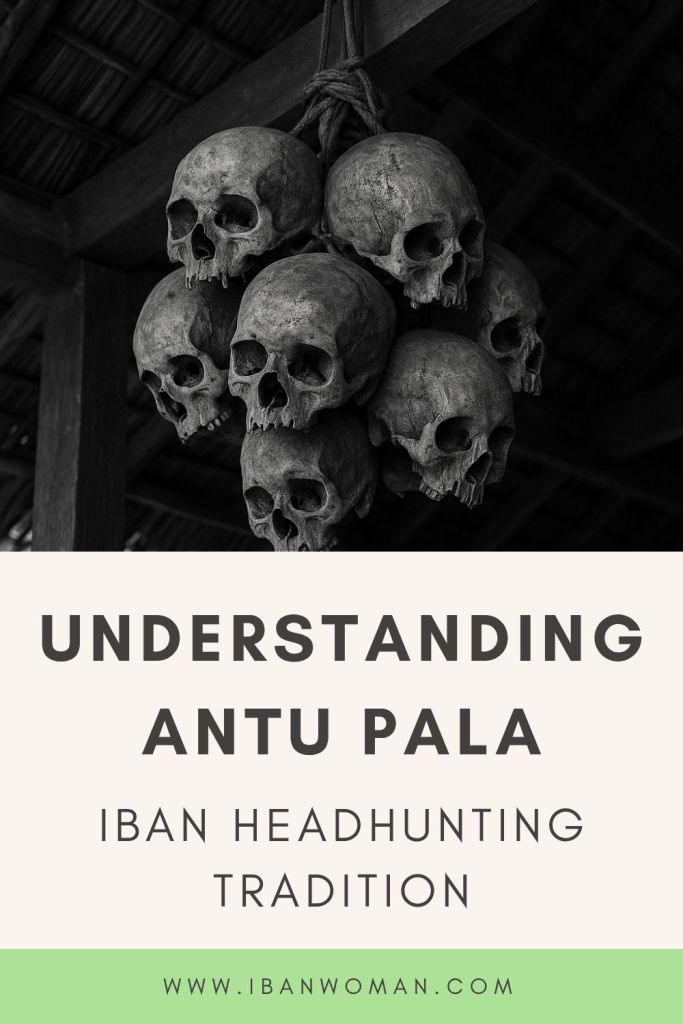
So, do antu pala still exist? Yes. Some Iban families keep them, like mine. They can be kept in the sadau (the top floor of the longhouse) or hung in groups called tampun on the roof. We don’t see them as trophies but as things that deserve respect. If you don’t take care of them, they can bring bad luck, so you must abide by strict rituals to keep them safe.

This picture shows a tampun that belonged to my ancestor, Unggang Lebur Menua, an Iban warrior from the late 18th century. It has 34 antu pala that are more than 200 years old, and is now kept by relatives at Rh. Panjang Matop, Paku, Betong. It serves as a reminder of a different time, when survival, belief, and identity were connected in ways that may be difficult for us to understand now.

I hope this helped you learn more about a part of Iban history that continues to live in our collective memory.

Image source: Youtube


I write about Iban culture, ancestral rituals, creative life, emotional truths, and the quiet transformations of love, motherhood, and identity. If this speaks to you, subscribe and journey with me.

Pengarap Lama Iban | Iban Animistic Beliefs

TL;DR:

A simplified overview of traditional Iban animistic beliefs, including the Supreme God (Petara), nature spirits, ancestral souls, and mystical beings like Kumang and Keling. These oral stories, once passed down generation to generation, are now slowly being archived here from my Threads posts for easier access and deeper reflection.

Prior to the arrival of Christianity and Islam, the Iban people practiced a form of animism. It’s a complex belief system where spirits existed in rivers, jungles, animals, dreams, and even illnesses. Though most Ibans today identify as Christians, many still observe traditional customs during weddings, festivals, and ancestral rites. It’s worth noting that the Iban never had a written system to record these beliefs. Every story and ritual was passed down orally from one generation to the next. Because of this, different river regions or divisions often have slightly different versions of the same story, each molded by the voices and landscapes that keep them alive. 

Here is a short, simple summary of this complex cosmology that you can use as a reference. I’ve been actively posting about Iban culture, legends, and folklore on Threads, but now I’m slowly fleshing them out and archiving them here for my readers. 

Note: I’ll touch more about the Sengalang Burong’s family when I write about Iban omens and augury. 

Core Beliefs

Iban animism is based on the idea that there are many spiritual beings that are part of everyday life and the afterlife. These include:

  • Supreme God, called Petara / Tuhan or Raja Entala
  • Deities and spirits, called Bunsu Petara – each with their own roles i.e Sengalang Burong
  • Spirits of ancestors, called Petara Aki Ini – often called upon during rites like Gawai Antu i.e roh nenek moyang
  • Spirits of nature, found in animals, plants, rivers, and forests and also include Bunsu Antu i.e jin, iblis
  • Mystical beings from the sky realm called Panggau Libau and Gelong i.e Kumang, Keling

Dreams were (and still are) taken seriously, often seen as spiritual messages. If a deity (i.e Sengalang Burong) or mystical being (i.e Kumang) appears in a dream, it’s treated as guidance that must be followed.

Categories of Gods and Spirits

1) Petara / Tuhan (Supreme God)

  • Also known as Raja Entala
  • Creator of all living things

2) Seven Main Deities / Bunsu Petara (Who live in the realm of Tangsang Kenyalang)

These seven deities are the children of Raja Jembu and Endu Endat Baku Kansat. Raja Jembu is the son of Raja Durong and Endu Kumang Cheremin Bintang. There is more to this lineage, but for simplicity, let’s just focus on Raja Jembu’s family. These seven deities or Bunsu Petara, are often invoked in Iban poetry, like pengap and timang

  • Sengalang Burong – God of war (Sengalang Burong’s wife is Endu Sudan Beringan Bungkong. They have eight children including a daughter, Endu Dara Tinchin Temaga)
  • Biku Bunsu Petara – God of resources
  • Sempulang Gana – God of agriculture
  • Selempandai – God of creation and procreation
  • Menjaya Manang – God of healing
  • Anda Mara – God of wealth
  • Ini Andan – Female spirit doctor and goddess of justice

3) Mystical Beings (Who live in the land above the sky, Panggau Libau and Gelong)

  • Kumang, Keling Gerasi Nading, Kelinah Indai Abang (Keling’s sister), Lulong, Laja, Pungga, Selinggar Matahari, Sempurai Bungai Nuing, Tutong (Kumang’s brother) – Divine beings who help humans succeed in life, especially warriors and brave people. Kumang and Keling appeared more in dreams compare to the rest.

4) Spirits of Nature

  • Bunsu Jelu – Animal spirits
  • Antu Utai Tumboh – Plant spirits
  • Bunsu Antu – Ghosts or restless spirits, some helpful, some harmful

5) Souls of Ancestors / Petara Aki Ini

  • Honored during rituals like Gawai Antu
  • Believed to offer blessings and protection when remembered properly

Copyright © Olivia JD 2025

All Rights Reserved.

I write about Iban culture, ancestral rituals, creative life, emotional truths, and the quiet transformations of love, motherhood, and identity. If this speaks to you, subscribe and journey with me.