My Ancestor | OKP Dana Bayang the Great Iban Headhunter & War Leader of Borneo

“The Orang Kaya Pemancha Dana Bayang of Saribas is now with me…the dreaded and the brave, as he is termed by the natives. He is small, plain-looking and old, with his left arm disabled, and his body scarred with spear wounds. I do not dislike the look of him, and of all chiefs’ of that river I believe he is the most honest and steers his course straight enough.”

— James Brooke, The White Rajah’s Diary, 1843

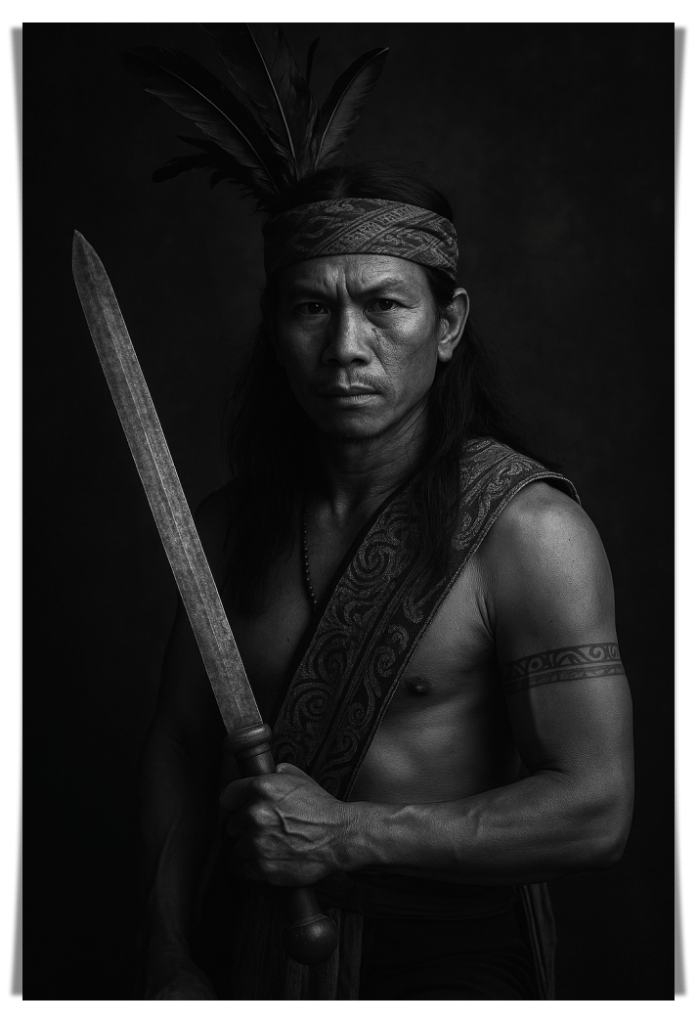
When I saw this prompt, I didn’t think twice. My favorite historical figure isn’t from faraway lands or great empires. He is my ancestor, Orang Kaya Pemancha Dana Bayang (or Dana Bayang), the legendary Iban war leader of the early 19th century.

Dana Bayang was from Padeh, a longhouse upriver in the Saribas. In addition to his prowess in battle, he was renowned for his ability to guide his people wisely at a period when preserving their way of life from both local and foreign dangers was essential to their survival. His warriors, loyal and fearless, served as the first line of defense. Among them was Sabok Gila Berani, his right-hand man who eventually established our longhouse (village), Stambak Ulu. Stambak Ulu was a strategic sentinel, not just a village. It sat along the river, watching for enemy warships approaching up the Layar. From there, word could be quickly transmitted upriver to alert Dana Bayang in Padeh. Stambak Ulu became a shield, protecting Dana’s people and territory.

Years later, Sabok’s son Mang adopted Dana’s granddaughter, Mindu—my great-great-grandmother—after her father, Aji, Dana’s successor, was defeated by Charles Brooke’s forces in 1858. Aji’s death was a turning point, as the old ways clashed with colonial ambition. Mindu’s mother, Dimah, died soon after, leaving her an orphan. 

When I think of Dana Bayang, I think of courage that was not for glory but for the preservation of a way of life, of the land, spirits, and community. His sons and warriors fought to keep their people free, to defend their beliefs, customs, and homeland. Nonetheless, they stood on the edge of change as the White Rajah’s army (colonialism) drove into Sarawak’s heart. The story of Dana and his warriors reminds me of what it means to belong to a people who refused to give up, who carried defiance and hope in equal measure.

You can even catch a glimpse of Dana Bayang in the 2021 Hollywood film Edge of the World, which offers a sneak peek of Brooke’s voyage of discovery to Sarawak in the 1800s.

This reflection ties closely to something I wrote earlier: Inheriting Courage From My Warrior Ancestors. The courage I speak of is not just in legends; it lives in the bloodline, in memory, in the quiet resistance of holding onto who we are.


A Chieftain’s Lament

Between the ritual’s demand and the crown’s decree
my once-steady hands falter in silence.
The nyabur rusts in my palm,
steel thirsting for blood,
now hushed by law.
The earth splits open—
Brooke’s foreign feet press into its cracks.

I hear signs, I dream dreams.
We need fertile grounds.
Blood must avenge blood.
But Brooke tells me to sheath my hunger,
swallow the sun, unlearn the hunt.
He asks me to bow, to bury my blade—
yet the wind whispers of battles still untold.

A fire stirs in the pit of my chest,
a pact with shadows, ancestors long gone.
Can we silence our spirits, break our bond?
Or will the old gods rise in the dust of our revolt?
I smell old skin burning,
the wild call of crows—
but I am chained to the unseen leash of kings
who promise peace with chains.

Note:
Nyabur – curved sword from Borneo, a headhunter’s weapon


©2024 Olivia JD


Olivia Writes offers printables, templates, and art designed to inspire reflection, healing, and creativity. Visit Olivia’s Atelier, Redbubble, and Teepublic for more.

Nights Beneath the Mosquito Net

It’s a memory so soft, so far away, it almost feels like I dreamed it. But it was real.

I was ten, maybe eleven. We were back at the longhouse, in our bilik, the apartment that was our family’s space within the longhouse. There were no bedrooms, no separate rooms. Just us, rolling out our mats, hanging mosquito nets, settling down for the night. There was no electricity then, so nights came early. A single oil lamp flickered in the middle of the room, casting shadows that danced along the wooden walls.

And this was when my grandmother would start telling her stories.

She didn’t sit up to tell them. She lay down, just as we did, her voice weaving through the silence. She spoke of people she had known, incidents long past, things that had happened when the world was younger. Her words filled the dark, mingling with the sounds of the jungle outside. We’d listen as sleep slowly pulled us under, her voice becoming part of our dreams.

I don’t remember the details of her stories. Decades have passed. But I remember the feeling. The peace. The comfort. The sense of being anchored to something larger, older, gentler.

Sometimes I wonder if my children will ever have moments like that. Moments where stories are not read from books or screens but spoken softly in the dark, meant only for their ears.

That memory, fragile as it is, is one of my favorites. Because in that moment, I felt safe. I felt home.


Visit Olivia’s Atelier for printables, reel templates, and planners made to support overwhelmed moms with gentle, soulful tools.
🕊️ Enjoy 50% off everything until June 30.

The Only Way I Know Not to Forget

The answer isn’t loud. It doesn’t arrive with flashy ambitions or bold declarations.

It’s silent. Steady. Rooted.

I am passionate about remembering and honoring.

I honor and remember not only to preserve personal memories but also as a way of fending off cultural erasure. It is also a sign of devotion to my ancestors, the land, and everything that made me.

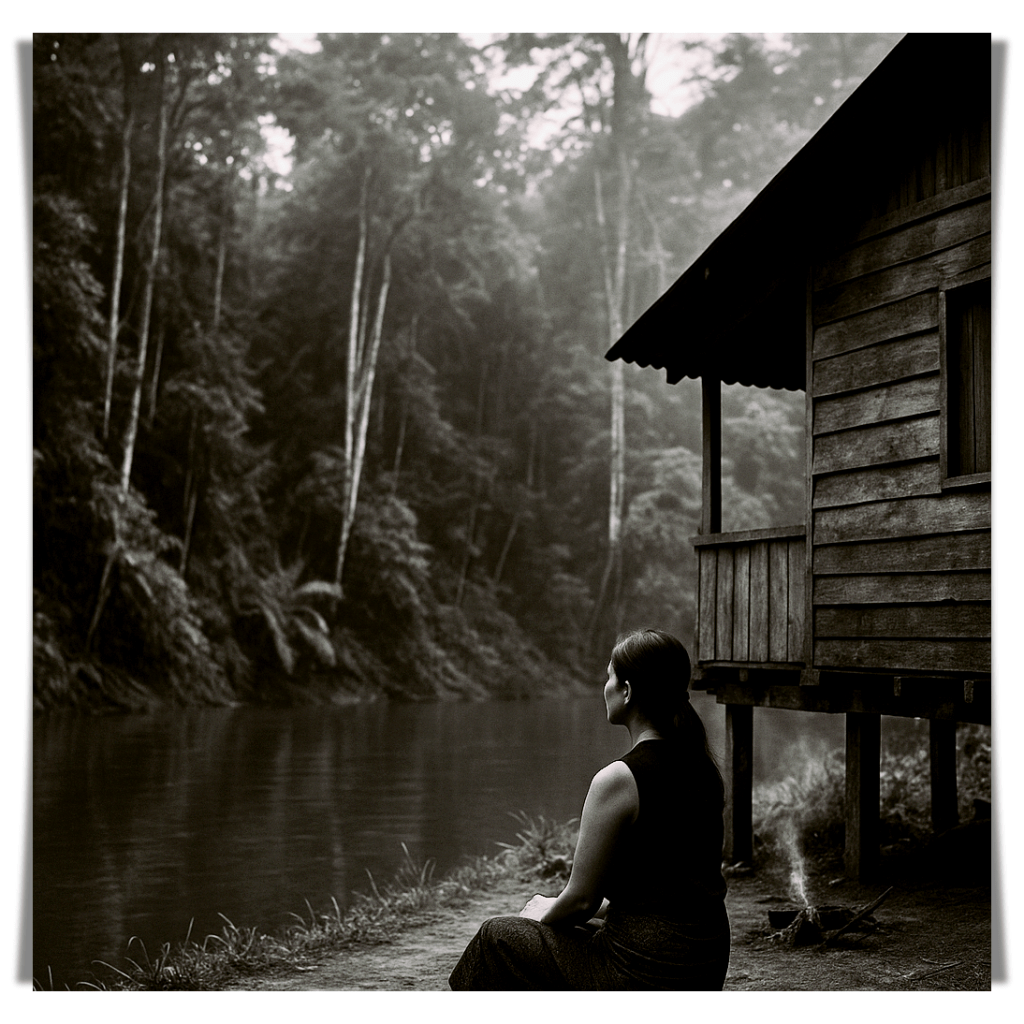
I didn’t grow up in the longhouse as my parents did. I was raised in the urban areas. But culture was never absent from my childhood. When my grandparents were still alive, we’d return to the longhouse for the holidays. It sat peacefully by the river, where the rainforest hold ancient tales and the air smelled of damp earth and woodsmoke. Our songs were sung in Iban. Our prayers were whispered into the land and borne by the wind. We spoke to the land as if it were family. Because it was.

At thirteen, I left home for boarding school, relocated to the big city, and then traveled to other countries for work. Over time, English became my dominant language, and I now speak it more fluently than Iban. I’ve raised my children in a world of shopping malls and neon lights, where the only rivers are highways and the jungle exists only in manicured, trimmed parks.

Will they recognize the sound of pantun sung at dusk?

Will they appreciate the taste of kasam ensabi or understand the beauty of our rich poetry and invocation to the deities who live in Panggau Libau, the land above the skies?

I am passionate about preserving these things. Even if it means teaching them clumsily. Even if I feel like a deteriorating bridge attempting to bear the weight of two worlds.

Why? Because culture isn’t something we simply inherit. It’s something we keep alive.

So I write and draw. I create poetry rooted in my heritage for my children and myself.

I do this not because I believe it will change the world.

But it’s the only way I know to avoid forgetting.

So that is my passion.

And that is how I love my people, my identity, my culture.

And that is how I love myself.


✨ Visit Olivia’s Atelier for printables, reel templates, and planners made to support overwhelmed moms with gentle, soulful tools.
🕊️ Enjoy 50% off everything until June 30.

Marriage Traditions of the Iban of Sarawak, Borneo

Marriage is a timeless union that binds two souls together. It also functions as a mirror, reflecting the core of a community’s culture and identity. My people, the Iban of Sarawak, Borneo, fill their traditional wedding rituals with deep meanings based on ancestral traditions. However, these traditional ceremonies are gradually disappearing as time passes.

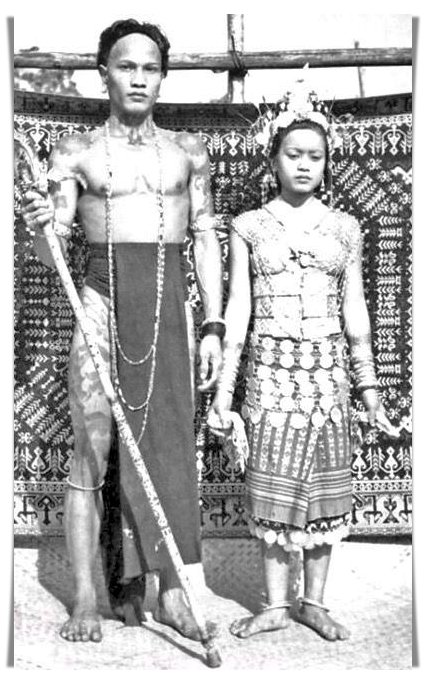
For the Iban, marriage was not just a bond between two individuals but a communion of families and communities. Traditionally, the groom’s parents carefully planned this arranged marriage. Ties of kinship often influence their choice of wife. Cousins were preferred matches because they preserved familial relationships while also reflecting the Iban’s value of unity within their extended network. When a bride was chosen, the groom’s parents would leave a rawai (silver girdle) or an ilang (sword) at her family’s home as proof of their dedication and intention.

Image source

The longhouse is the heart of Iban community life. During weddings, it becomes a lively epicenter. It was here that life and celebration collided, and the community joined together to honor the union. Careful planning is required days or weeks before the ceremony. This includes making tuak (rice wine) in enormous vats, preparing traditional buns and cookies, and selecting livestock for slaughter. Guests were invited with knotted strings to tally down the days till the celebration.

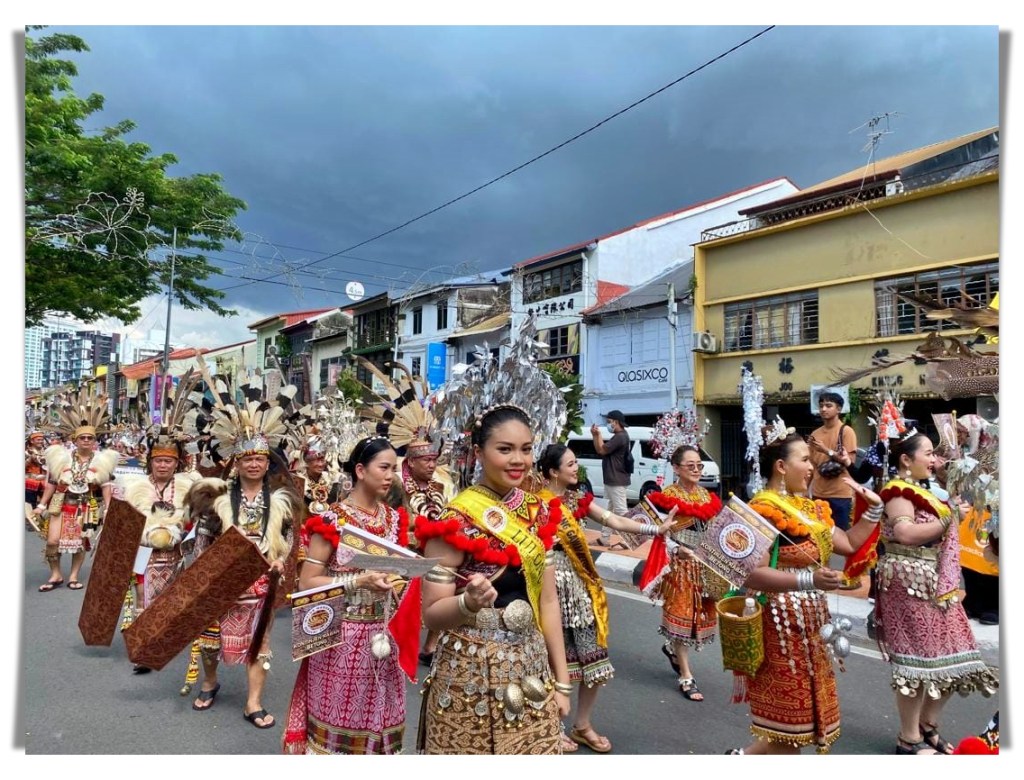
On the wedding day, the groom’s journey to the bride’s longhouse was a ceremony unto itself. The groom’s party traveled to the bride’s longhouse either by boat or on foot through the jungle. Guests were expected to dress in traditional ngepan (intricate traditional costumes), with women donning corsets or rawai (silver girdles) and men wearing armlets and feathers, among other traditional pieces. The groom’s party arrived to a joyous clash of gongs and the firing of brass cannons.

However, underneath the surface of celebration were rituals with deeper meanings. One of the most remarkable customs was the use of poetry or poetic language to provide the ceremony a sense of artistry and depth. When the official ceremony started, the host’s representative would offer the guest a drink, followed by a formal recitation inquiring about their purpose:

“I hesitate and feel nervous to talk in front of you all,
The reason I say so is because I realize that you are the mothers of porcupines,
Covered with cross-stripped white quills,
Pointed like bradawls.
I notice that you are the mothers of hornbills,
With tails striped,
crossing at right angles,
Which claim that they can fly to Brunei and return the same day.
I see that you are the mothers of bears,
Which have stout arms to make holes on the trunks of iron-wood trees.”

“We, therefore, have been sitting next to each other.
I would like to ask,
Which one of you is the mother of the hornbill?
For I am about to ask you to spit out the seeds of the belili tree,
In order that they can be picked up by a tall, unmarried lady,
So that they can be turned into the tusks of a pig,
As charms for the unripe ears left till the last in reaping,
With which we fill our padi bins.”
Poem source

These exchanges were rich in metaphor and eloquence. The poetic recitations continued throughout the ceremony, including a betusut (genealogical recitation) by an expert who detailed the bride and groom’s genealogy. This ritual not only validated the union but also ensured that the marriage respected cultural taboos and norms in order to avoid misfortune.

Image source

Elders sealed the union with feasting and storytelling, bestowing blessings and wisdom on the pair. They discussed respect, understanding, and the delicate balance required to navigate life together. Complex traditions and customs infused every action, from seating arrangements to gift exchange.

Today, such ceremonies are a rarity. The Iban embraced Christianity and Islam, abandoning many of their traditional practices in the process. The vibrant rituals of traditional Iban weddings now exist mostly in memory or retellings.

The ceremonies detailed here are not simply rituals. They depict a way of life that places a high priority on community, heritage, and balance. They remind us of the beauty of traditions that once connected people to their past while celebrating the present. The decline of this tradition is a loss not only for the Iban but also for the universal human story of connection, identity, and belonging.

The significance of the Iban wedding customs strikes me as I reflect on them. Marriage was never just about two people; it was about integrating their lives into the larger fabric of their community. It was about love, shared responsibility, and the power of a collective spirit.

Perhaps that is the true power of these traditions: their ability to touch something deep within us while also reminding us of the fragility and beauty of cultural heritage. And as we look forward, perhaps we have a tenacious hope that even as the old ways fade, their spirit will continue to shape the future in ways we may not fully comprehend.

Modern Iban weddingImage source.

Iban Culture | Gawai Antu @ Feast of the Dead – A Personal Journey Through Memory and Meaning

I don’t see a lot of articles anywhere that talk about the culture of my people, the Dayak Iban of Sarawak, Borneo. Maybe there are plenty in native languages, but so far not much is written in English, so I thought instead of lamenting about it, why not write it myself? I admit I don’t have a vast knowledge about my culture; however, it shouldn’t stop me from writing about what I know. In this post I’m going to talk about one aspect of our culture called Gawai Antu, or the Feast of the Dead. I believe the feast of the dead is widely celebrated worldwide across different countries and cultures. It’s no different with the Iban people. After all, who doesn’t want to memorialize and pay tribute to their departed loved ones?

The Iban people of Sarawak, Borneo, have a rich and deeply rooted culture that is shaped by mythology, oral traditions, and a close connection between the spiritual and physical worlds. At the heart of this culture are the many “gawai,” or feasts, that mark important moments in life, from celebrating a bountiful harvest (Gawai Dayak) to honoring the spirits of the departed (Gawai Antu). Each gawai carries its own meaning, traditions, and importance, but none have left a deeper impact on me than Gawai Antu, or the Feast of the Dead.

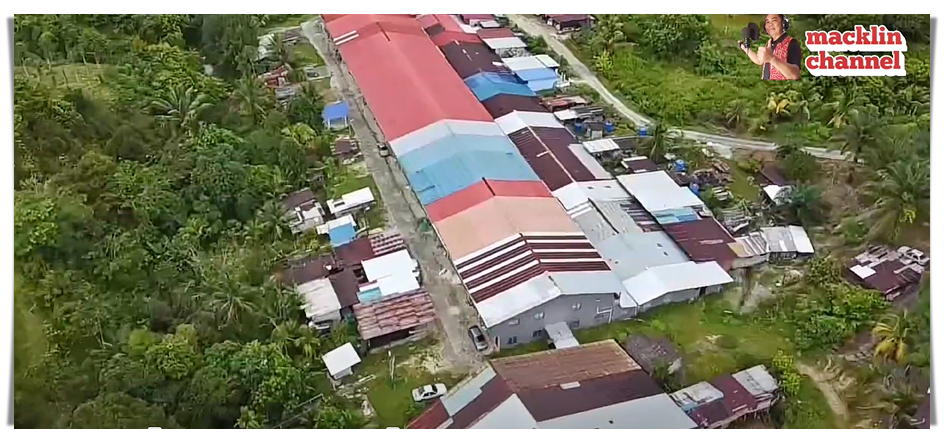
My father’s longhouse: Ng. Batang, Ulu Krian, Saratok. Image source: Youtube

I was ten years old when I first experienced Gawai Antu at my father’s longhouse in Ng. Batang, Ulu Krian, Saratok. At the time, I didn’t really understand its meaning. I just knew it was a rare and grand occasion that transformed the quiet longhouse into a place of celebration, ritual, and remembrance. Even now, decades later, I can still hear the loud gongs, see the elders in their ceremonial attire, and recall the haunting beauty of the invocations to the spirits and deities. It was a glimpse into something much bigger than myself, which was a connection between the living and the dead. This festival was deeply embedded into the very fabric of our identity.

Unlike Gawai Dayak, which is an annual celebration, Gawai Antu happens once in a generation. It is a collective effort that takes years of preparation, with families saving up to host this event in honor of their ancestors. This isn’t a normal feast. It’s an elaborate feast that symbolizes a final send-off for the souls of the departed. It’s a way of ensuring they are properly honored before moving on to the spirit world. It is both a farewell and a tribute, reinforcing the Iban belief that death is not an end but a transition to another realm.

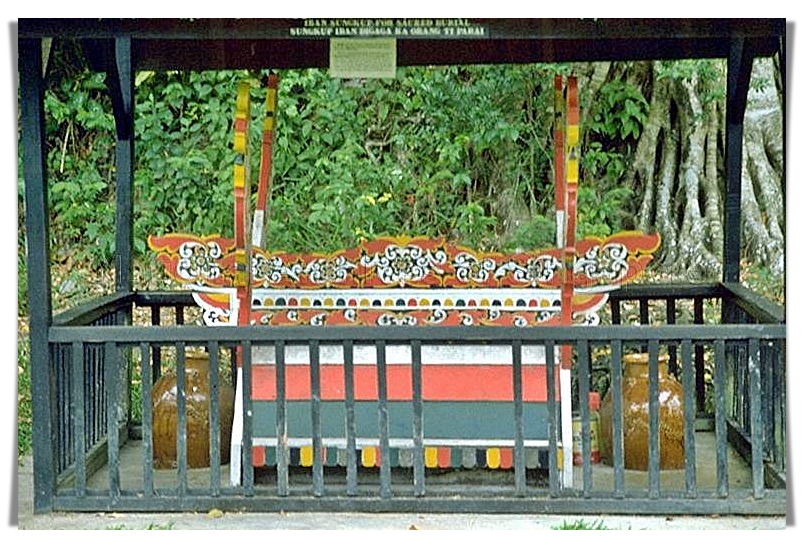
A “sungkup”. Image source: National Archives of Singapore

As a child, I was captivated by the sights and sounds of the festival. The longhouse came alive with music, laughter, and the smell of traditional food. Thousands of guests from neighboring longhouses (villages) gathered, filling the space with a sense of community and shared purpose. I watched as men skillfully built the “sungkup” (memorial huts) for the deceased, while women wove baskets called “garung” to hold the ceremonial rice wine, “tuak Indai Billai.”

One of the most mesmerizing rituals was “ngalu petara,” where men and women, dressed in their finest, marched through the longhouse to welcome the spirits of the dead. Another unforgettable moment was watching the “lemambang” (bards) chant poetic invocations while carrying bowls of “ai jalung” (special rice wine) from midnight until dawn. Their lyrics, which were passed down through generations, painted vivid images of the spirits’ journey from the afterlife back to their longhouse for one final feast with their loved ones. At 4 a.m., the honored “bujang berani” (men of valor) drank the “ai jalung” to symbolize a moment of pride and recognition.

Image source: My sister

It wasn’t until adulthood that I fully grasped the significance of Gawai Antu. It is a festival of remembrance and a reaffirmation of our roots. It’s a way of keeping our ancestors’ legacies alive. As an Iban living away from my homeland, these memories have become even more precious. They remind me of who I am and where I come from, especially in a world where modern life often pulls us away from traditional practices.

Writing about Gawai Antu feels like my own way of preserving this tradition. In many ways, storytelling serves the same purpose as the rituals. It honors the past by keeping memories alive and strengthening our sense of belonging. But I won’t lie; this responsibility sometimes feels overwhelming. I wonder if my children will ever truly understand the depth of these traditions, or if they will see them as outdated practices of a time long gone. Still, I hold onto hope that through stories, whether in poetry, essays, or simple conversations, I can spark their curiosity and encourage them to explore their roots.

“Bujang Berani”, a man of valor drinking the “ai jalung”. Image source: Gawai Antu documentary

If there is one thing Gawai Antu has taught me, it is the value of memory. In a society that sometimes stresses development over history, this feast is a reminder that our identity is both about who we are and where we came from. Honoring our ancestors involves acknowledging their difficulties, successes, and sacrifices, as well as understanding how they influence our lives now.

Decades after my first Gawai Antu, the memories are still fresh in my mind. The loud gongs, sacred chanting, and communal spirit are memories from my childhood as well as pieces of a greater story about connection, heritage, and meaning. Gawai Antu has taught me that remembering our ancestors means, in many ways, honoring ourselves, as we are the living continuation of their journey.

My poem, “Gawai Antu”.


Note:
A documentary about Gawai Antu was made several years ago, you may watch the trailer here:

I don’t have any photographs of Gawai Antu from my childhood. They are kept safely in my parents’ home in Sarawak. The photographs in this post are credited to the sources listed below each image. For more information on Gawai Antu, you may visit these sites:

The Gawai Antu
Gawai Antu – the documentary