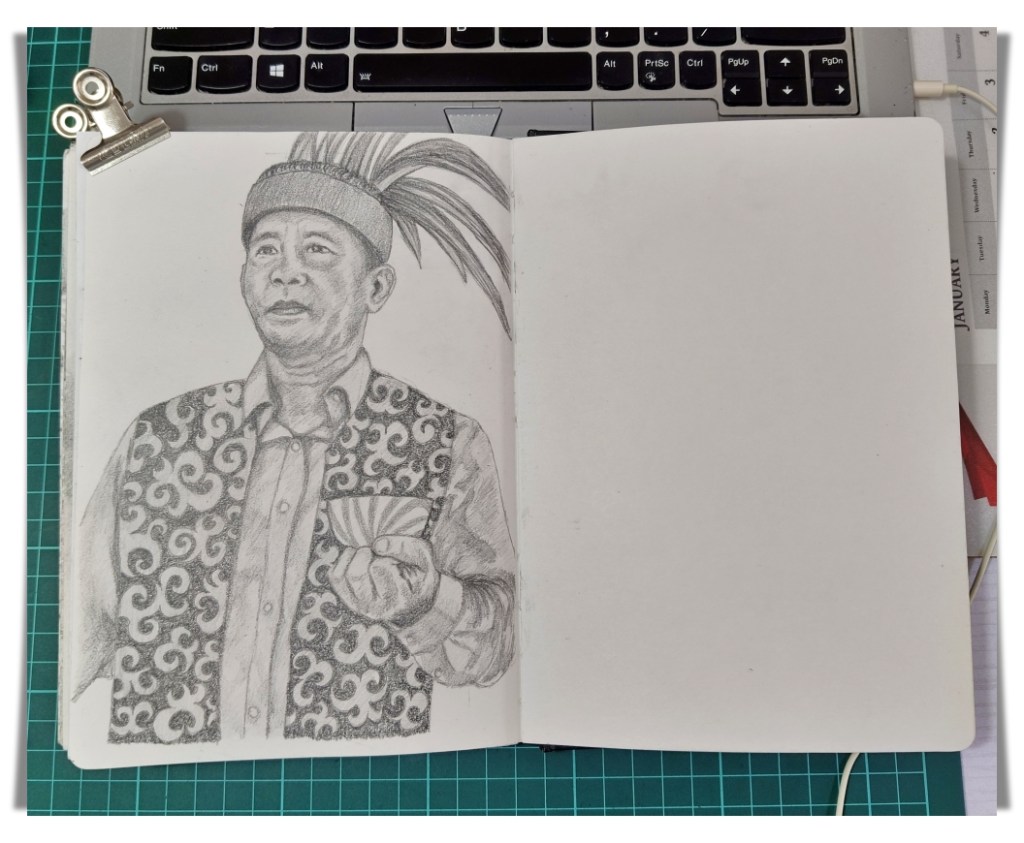
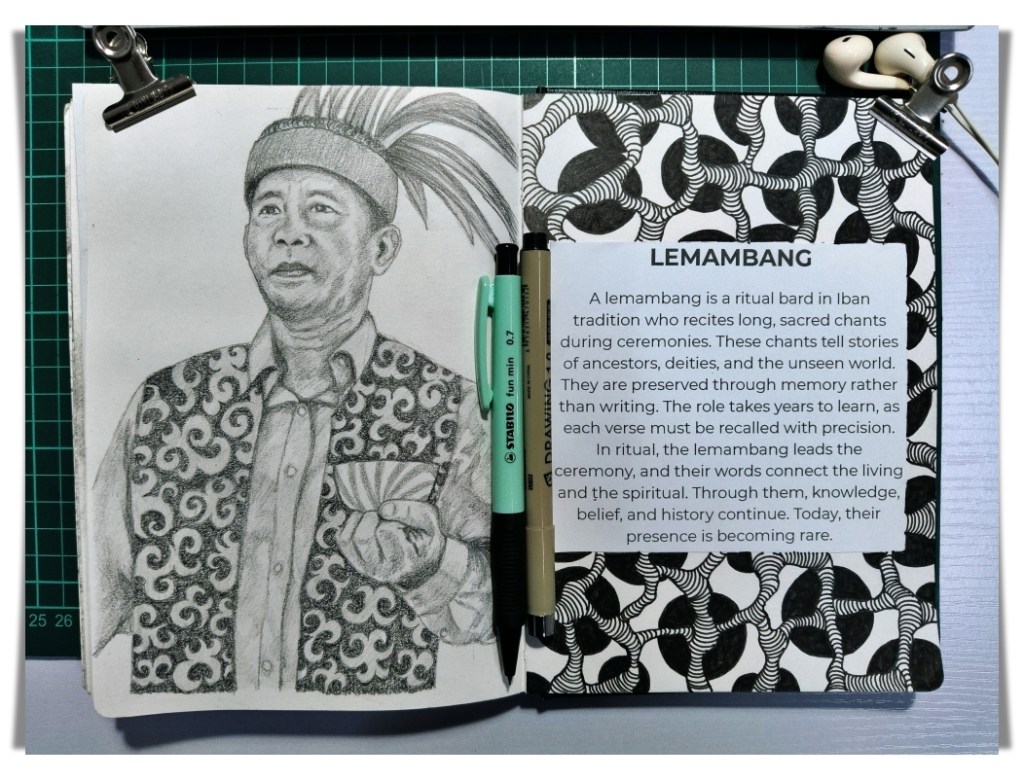
The Iban lemambang is a ritual bard who recites long, sacred chants or invocations at ceremonies or rituals. These chants are the stories of ancestors, deities, and the unseen realm. They are preserved through memory and passed down from one generation to the next.
The role of a lemambang takes years to learn. Each verse must be remembered with care and precision. During a ritual, the lemambang guides the ceremony through these chants that become part of the process that bridges the seen and the unseen. In some cases, papan turai was used as a guide. They are wooden boards carved to help the lemambang remember the sequence of their chants. These papan turai are memory aids, reinforcing what has previously been taught and internalized.
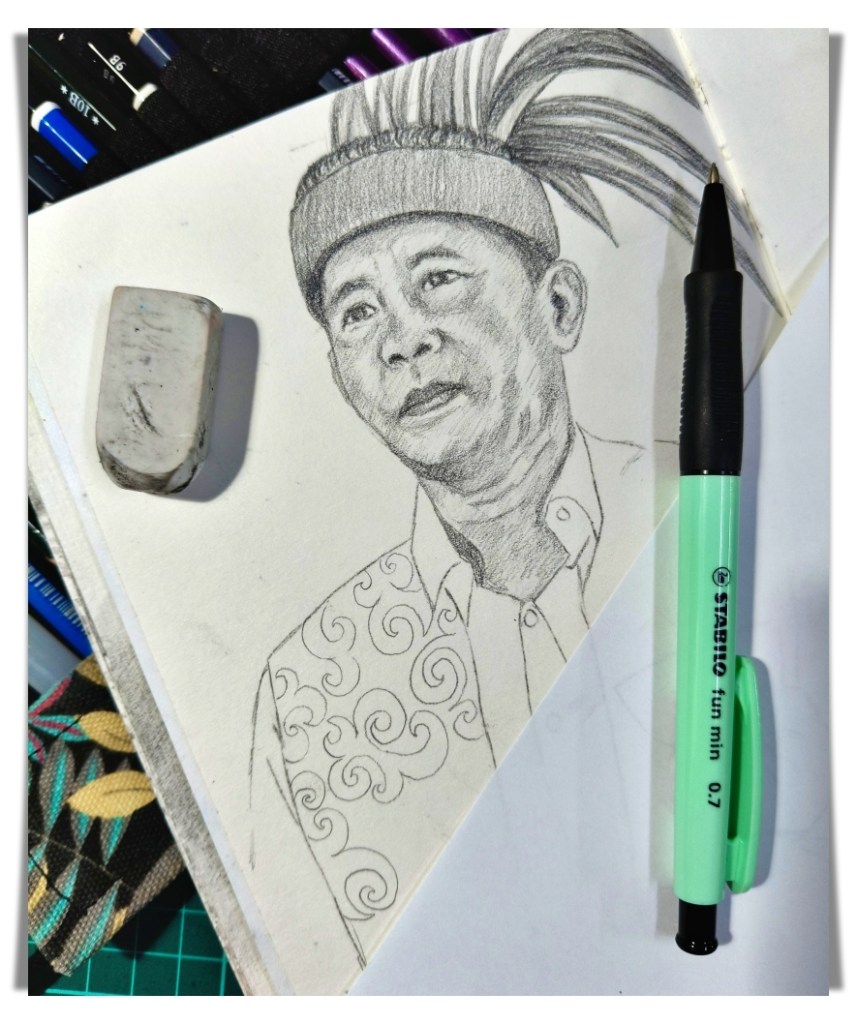
I drew this while working on a zine about Iban headhunting and its cultural origins. As I moved from one page to the next, I realized the zine was also about those who passed the knowledge forward. One of those figures was the group of people known as the lemambang. I wanted to place him (who represents this group) among the pages to acknowledge their big contribution as the guardian of Iban culture and heritage.
This way of preserving knowledge is different from how we learn today. It depends on discipline, repetition, and memory rather than written records. It also depends on a faith and trust that what is handed down will be remembered and passed on accurately.
Today the number of lemambang is getting smaller. The number of people who are learning to become lemambang is dwindling, and much of this knowledge is at risk of being lost with time. What remains are fragments, memories, and the efforts of those who persist in holding on to them. Writing and illustrating this page is a small way for me to honor them.
Here’s a video of a group of lemambang chanting during Gawai Antu or Festival of the Dead.
I write about Iban culture, ancestral rituals, creative life, emotional truths, and the quiet transformations of love, motherhood, and identity. If this speaks to you, subscribe and journey with me.
When I first read the CBC article on AI-generated Indigenous content, my stomach tightened. Not because I generated my content with AI, which I don’t, but because I understood how easy it would be for someone looking for Iban culture to find made-up “elders’ teachings” or made-up Iban phrases and think they were the real thing. I am an Iban woman living far from Sarawak and raising children of mixed heritage. While I utilize AI to assist in my writing process, I don’t generate it using an algorithm. My sources are from my family history and lived experiences. These are the datasets I train on. They are living memory and not predictive text.
The article quotes Michael Sherbert saying generative AI is “optimized for fluency, not for truth or for ethical or cultural responsibility.” I think about this every time I sit down to write a poem or draw cultural art. Cultural truth is difficult to tell and requires effort to check for accuracy. Telling cultural truth also means admitting I don’t know many things and need to learn from those who are more knowledgeable. I read all kinds of academic resources and cross-check my facts with family members before I post them on my blog or publish a new cultural zine. I avoid making assumptions, and when I am not sure of the accuracy, I admit that I don’t know and encourage others to share their experiences or information so we can all learn from one another.
Kaitlyn Lazore from the Mohawk community said something that stayed with me: “There’s no easy way to learn the language or gain culture without getting out in your community.” She is right. Still, I am raising my children far away from my homeland. I can’t take my children to a local social gathering to hear native speakers speak Iban. I can’t take them to Sungai Stambak and let the mud cling at their ankles like it did mine. So what do I do? I write and I draw. I make zines like Rituals and Rivers, Iban Women, and Iban Headhunters. I know that all these things are not substitutes for community. But they can turn into a perau, a small boat that will wait for them until they are ready to learn about their roots. They can launch it whenever they want. They can find their way to their roots through the names I’ve kept alive in my writings and art.
But I also do what the article emphasized: I am transparent. I include Iban words with definitions in most of the cultural poems I wrote. Every story distinguishes between traditional knowledge and my personal interpretation. I do not claim to be an elder. I am a mother and a learner who is learning to preserve her culture in her own ways.
The article talks about “pan-Indigenous representations that flatten distinct nations into one interchangeable identity.” This is very important to me. I am Iban, not a generic “Borneo culture” or simply an “Indigenous” group. When I write about details like the bungai terung tattoo motif, I name it instead of being vague. When I describe perau pengayau, I explain that they are tied to certain histories. My children are of mixed heritage, and I don’t want their Iban side becoming a blur; thus, I need to be more precise. Brian Ritchie of kama.ai said, “It can be difficult for any user to understand how responsible or accurate or authentic the information is.” That’s why I always mention my sources. I write down who my sources are: my family histories and Iban cultural experts or academicians. I don’t believe in vague statements like “tradition said this and this, so…”
My children may not grow up speaking Iban fluently. Some days, that thought breaks my heart. But they will know that their mother didn’t take the easy way out. She didn’t ask ChatGPT for a “traditional Iban sampi” and then copy and paste it. She had to deal with the pain of forgetting, so she read and conducted her own research to learn the real truth and facts.
A spread for an upcoming zine (still in progress)
At the end of the article, there is a reminder to use your judgment and ask for community vetting. This is what I would add: If you like my work, my poems, my art, or my zines, please also look for Iban elders or experts in Iban studies. Please use my work as an invitation to explore further. It should not be a replacement. I am just one voice who is trying to preserve my culture for the future generations.
My children observe me write. They see me struggle with information, memory, and the pain of being far away from my homeland. And I hope that when they are adults, they will know the difference between something that is made up and something that is real. The difference between a perau that really floats on water and one that only exists in a machine’s algorithm. I will keep making perau until then: one article, one poem, one drawing, and one zine at a time.
When They Are Ready for the ones I raise far from home
We build our lives on foreign soil, where rivers have no stories and the wind sighs emptily. My children’s tongues are borrowed, their laughter shaped by cities that have never heard a gong.
I tell them of the longhouse glow, the smell of rain, the river bends like an elder. They listen, but cannot feel the ancient soil that holds their roots.
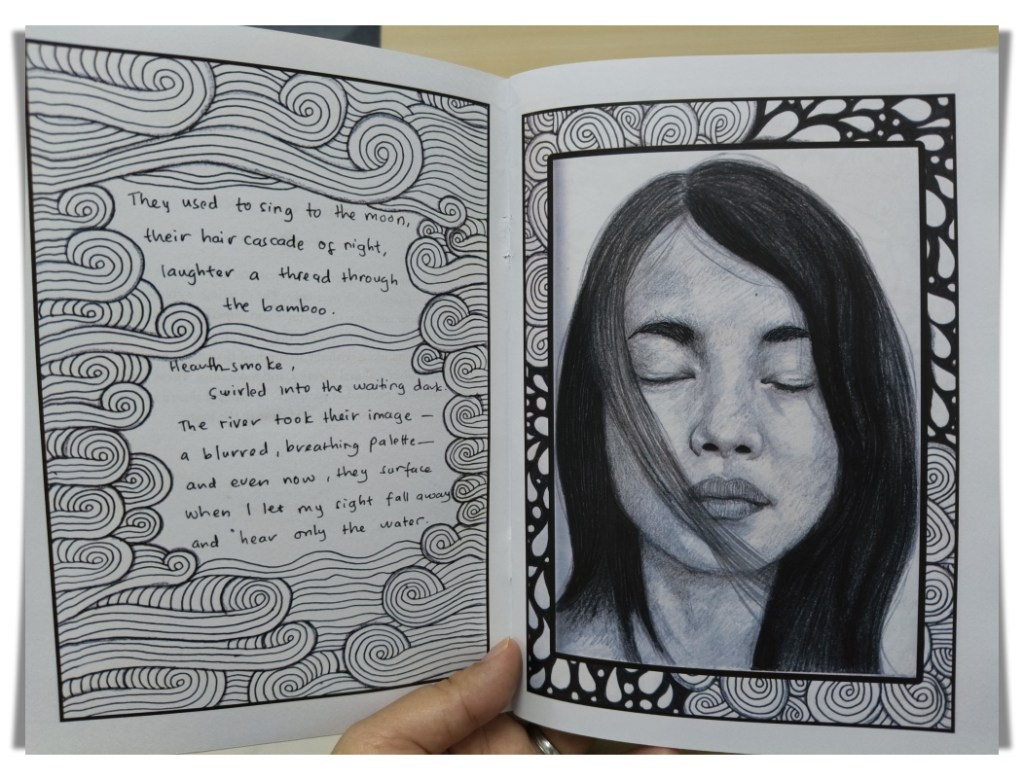
So I write these rivers into words, each poem a small perau waiting. When they are ready, they will launch them, navigate by the names I’ve kept alive and find, at the source, a home that never stopped calling.
(a poem from Rituals and Rivers)
I write about Iban culture, ancestral rituals, creative life, emotional truths, and the quiet transformations of love, motherhood, and identity. If this speaks to you, subscribe and journey with me.
People typically consider cultural preservation to be something that is conducted on a large scale. It is generally placed in the context of institutions, archives, or official documents. But it can also happen on a smaller, personal scale.
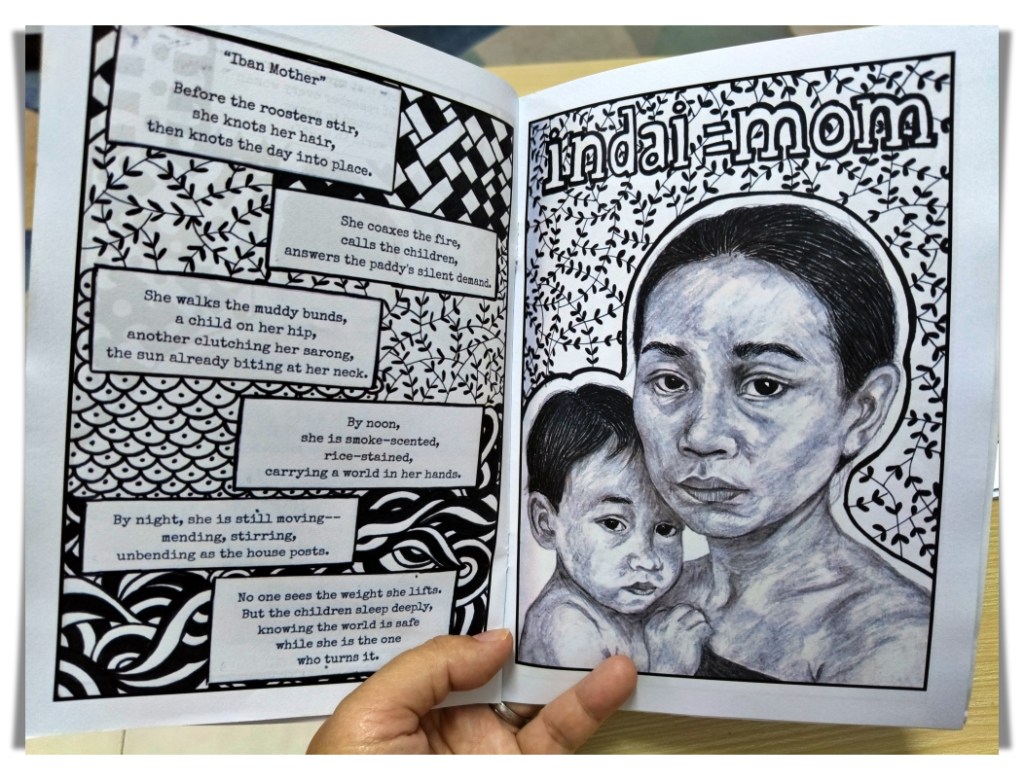
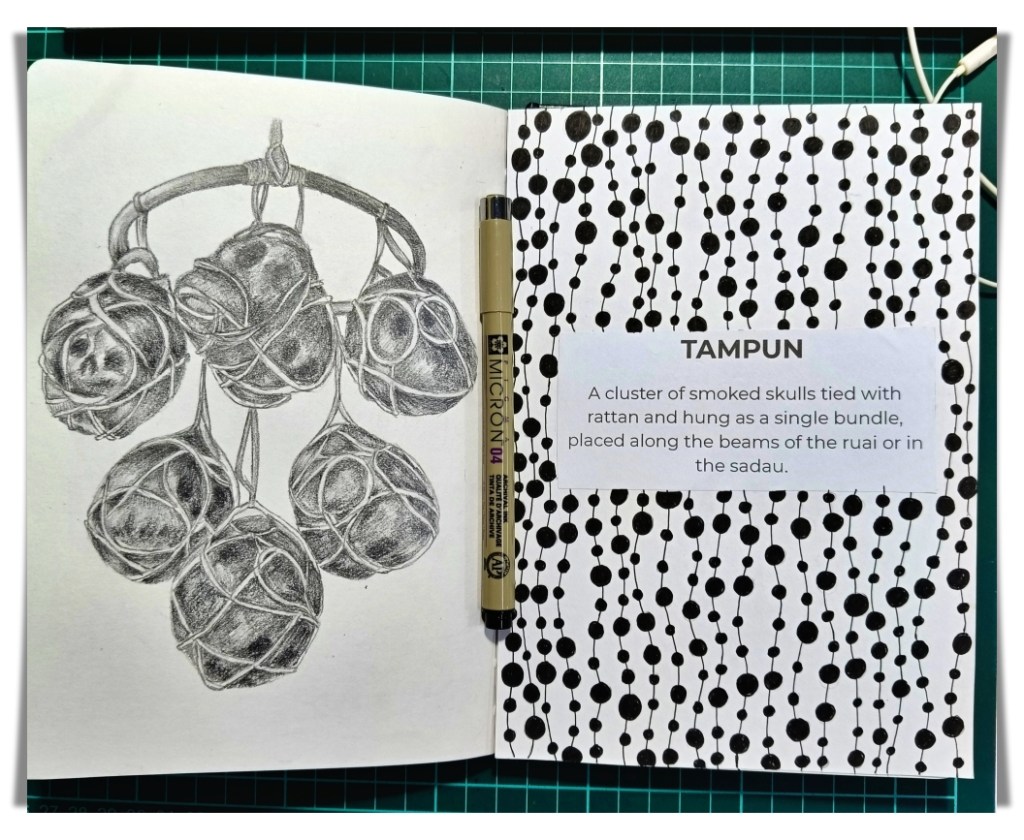
I have been making a series of handmade zines that are based on Iban culture and history. Each page of these zines pairs a drawing with a text of information or a poem. The drawings are hand-drawn, and the pages are put together painstakingly, one at a time. Every decision, from picture placement to word space, needs to be carefully considered. The whole thing is done entirely by hand.
While working on these pages, I learned that preservation is more than just keeping information intact. It also has to do with how that information is passed on. The information in these zines is not new. They have been told before, and they exist in oral histories, family accounts, and old literature. What I do is simply place them into a different form.
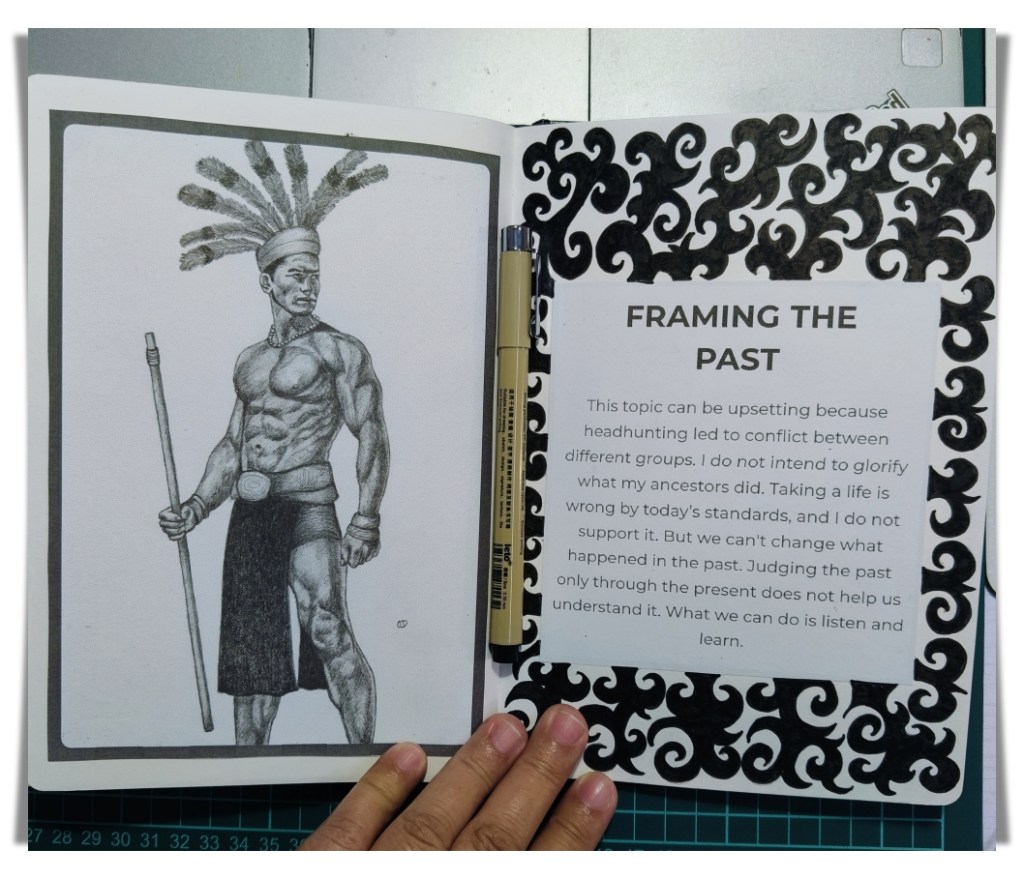
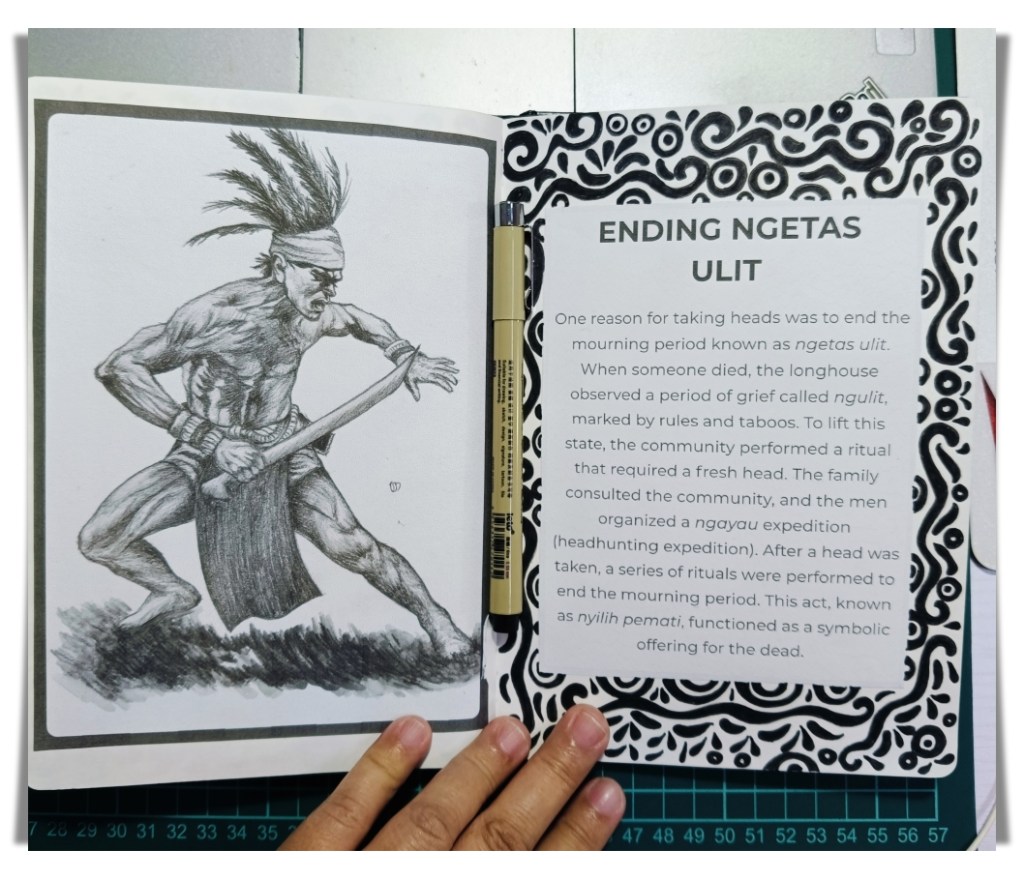
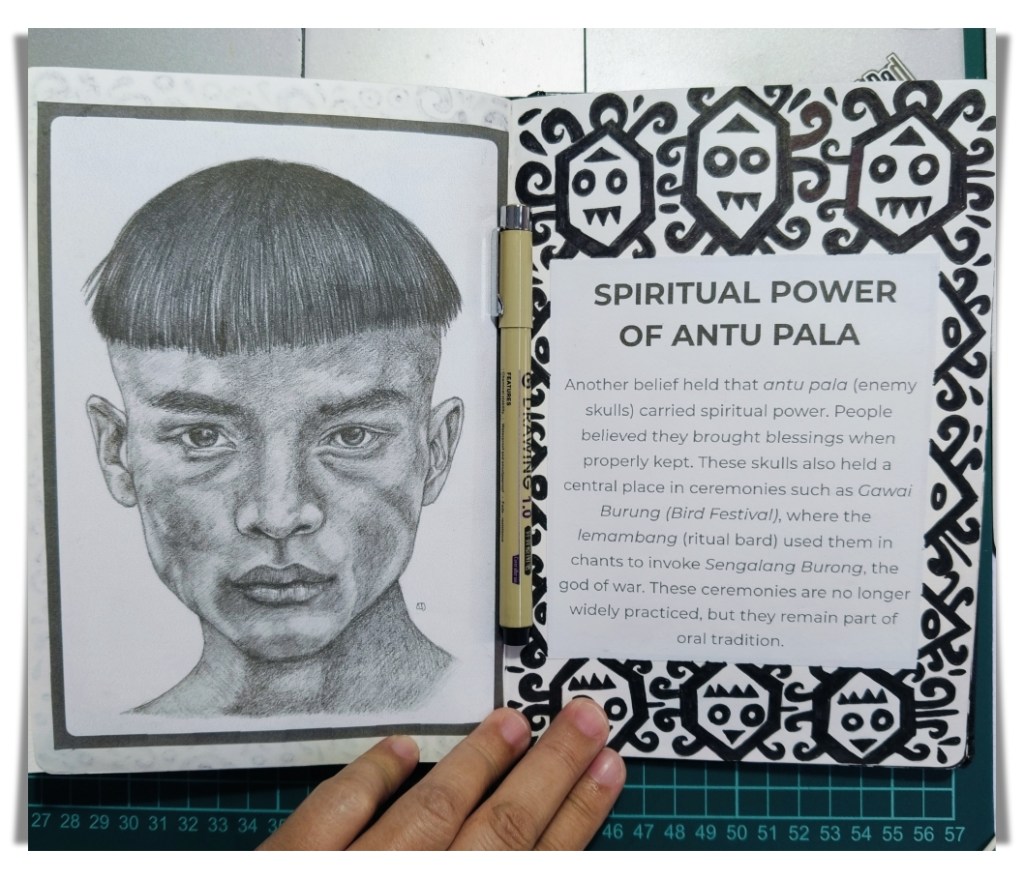
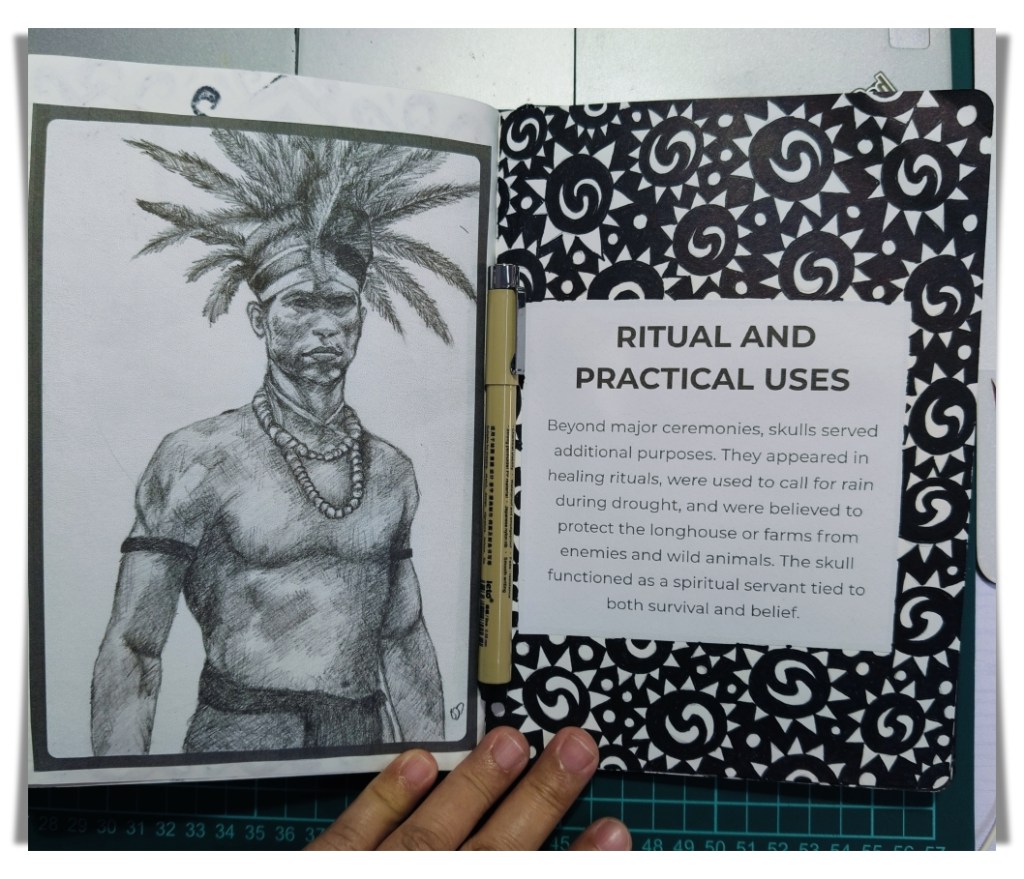
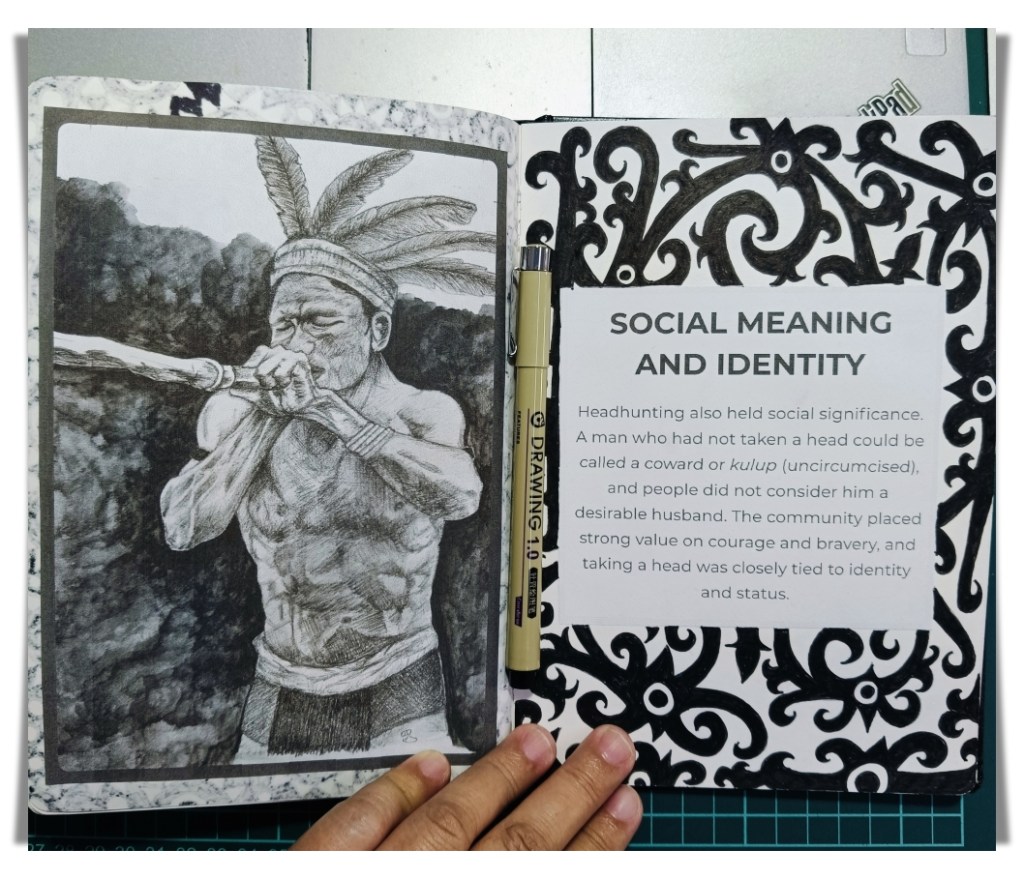
For instance, in these sketchbook pages, I talked about why the Ibans practiced headhunting in the past. It’s a difficult topic that people often misunderstand or only see one side of. I give it context instead of simplifying it. Each section describes a specific reason or belief and is paired with a hand-drawn drawing of an Iban warrior instead of an abstract idea. When I draw, it influences how I feel about the subject. When I sketch a figure, I pay attention to details that I would otherwise overlook.
This zine doesn’t attempt to be a full record of the Iban history. It keeps some parts of it. The imperfections in the pages are part of that process. They show that it was created by hand, with time and care. In this regard, preservation isn’t only about accuracy or completeness. It’s also about continuity, working with it, and allowing it to exist again in the present.
I write about Iban culture, ancestral rituals, creative life, emotional truths, and the quiet transformations of love, motherhood, and identity. If this speaks to you, subscribe and journey with me.