Fragments of Obsession V | What Remains of Him

This fragment of obsession is a continuation of Part 4. You can find the first four parts here: part 1, part 2, part 3, and part 4.


The Victims

They stay with him. That much I know. 

They weren’t merely evidence in sealed bags. They had names. They had voices. They were echoes in a room where someone had begged, bled, or died without being heard. They live somewhere behind his eyes, hidden deep down but never completely out of reach. 

He doesn’t discuss them. But I can sense it in the way he moves, sometimes too still like he’s bracing for the inevitable. I wonder which one visits him in sleep. Whose case file he opens up in his dream without meaning to. 

He must have a list in his head. A list of faces, some vaguely remembered, some impossible to forget. The girl with the red hoodie. The elderly man found with his hands tied. The body that no one claimed. 

I used to think that grief only belonged to families and those who loved them. However, there is a certain kind of pain that comes from being the last person to look at their picture, read their texts, or trace their final hour backwards. He carries that deep in his soul, mourning for people he never knew. 

Maybe it hardens something in him. Or maybe it makes him gentler in ways he doesn’t realize. The truth is I don’t know. I just know that he touches the evidence gently. And he blinks slower than usual when he stares at a photo too long. 

In my culture, the spirits—antu—linger when death is unresolved. Some say they roam, whispering into the ears of the living. He doesn’t fear ghosts or darkness. The ones that haunt him are printed on paper, kept in boxes, and saved on hard drives. There they remain. Always waiting. Always watching. 


The Walk

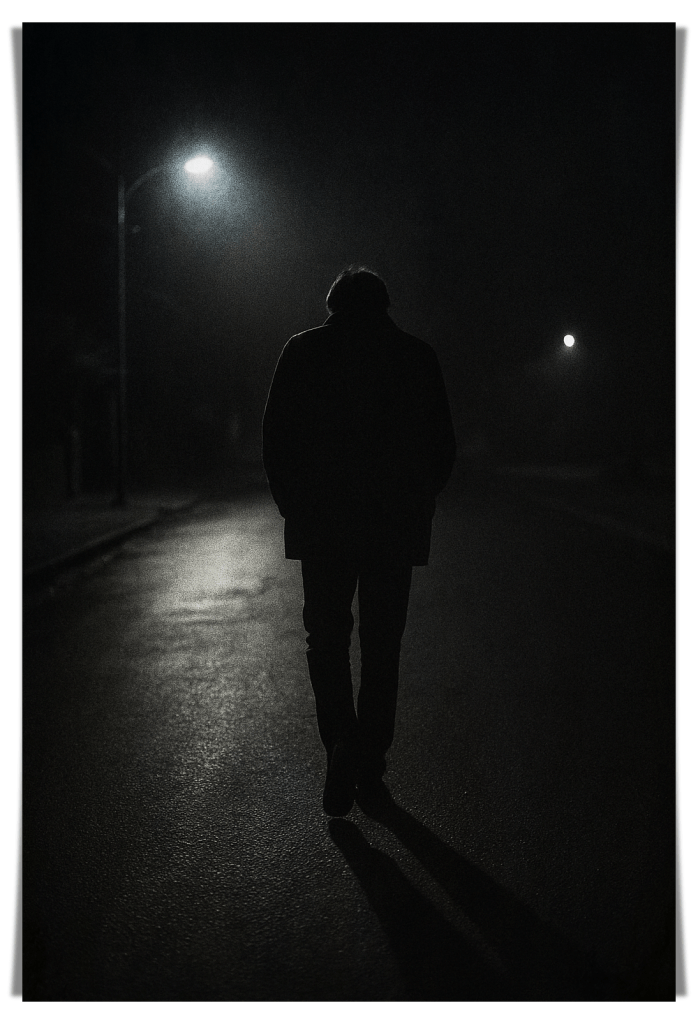
He walks at night, but not every night. Only on those when sleep is a stranger and the weight on his chest refuses to lift. He seeks the hour between two and four. That’s when the world goes quiet, signaling him to step out. 

He brings no phone, has no destination. Just his feet on the pavement, carrying his momentum through sleeping streets. He passed shuttered shops, empty lots, and the lonely glow of neon signs. In this slumber, the city is transformed—muted, and temporarily pacified. 

Is he trying to shake them off? The blood, the tragedies, and the ghosts that cling to the inside of his eyelids? Or is he chasing the silence he can’t find inside? Or maybe he just believes that if he walks long enough, the chaos in his head will have to settle.

Hands in pockets, shoulders a permanent slope. From afar, he’s just a man. But a closer look at his eyes would tell you everything. 

This is the unseen part. The aftermath, stripped of crime scenes and case files. There is no suspect to corner, no puzzle to solve. He’s a man alone with the night, waiting to feel human again.

In that moment, I don’t see the criminologist. I see a tired man who would rather move through the honest darkness of the streets than lie still in a loud, empty room.


Epilogue

All of this, I’ve only imagined. The desk. The scene. The interrogation. The victims. The walk. They’re a part of his life that I will never touch. He doesn’t talk about it much, at least not directly. A line may slip out from time to time, and that’s it. Most of it comes through in other ways, like when he gets too quiet and his hands stop moving. The tension in his jaw after a long day. The shadows beneath his eyes that no amount of sleep seems to erase. 

There are nights he startles awake. He never says why, just lies there, breathing heavily. I never ask either. I simply wait for his return. 

What he endures is his own. And I’ve stopped trying to reach for it. His work is an extension of who he is, bound to his bones. It affects how he sees the world and how he protects others without even thinking about it. 

However, there are times when it becomes apparent. Like when he touches me and listens to me even when I say something silly. Or how he holds silence like it’s sacred. 

I used to think he was distant. But now I understand: he was too full of things he could never say. I write these fragments not to know him better or to hope that he’ll find them. He won’t. The door closed two decades ago. These are the only pieces I kept. 


Copyright © Olivia JD 2025

All Rights Reserved.

I write about Iban culture, ancestral rituals, creative life, emotional truths, and the quiet transformations of love, motherhood, and identity. If this speaks to you, subscribe and journey with me.

Sarawak Folk Noir | Red Eyes at the Ara Tree

This story was inspired by a real event, a memory from my childhood. I’ve always loved noir—the sense of dread, the fatalism, the uncertainties, and the things left unsaid. But I couldn’t find any noir stories told in an indigenous voice from Borneo. So I wrote my own. Red Eyes at the Ara Tree is what I call Sarawak folk noir. It carries the core tenets of classic noir: unseen forces, a haunting past, and the slow unraveling of certainty; but roots them in a rural, post-colonial setting where belief and memory still shape the edges of reality. There is no detective here. Just a child, and the adult they become, trying to make sense of what cannot be explained. The crime is an intrusion of something ancient and watching. It’s of the unknown stepping into an ordinary life.


When I was seven years old, we lived on top of a hill in a government housing complex. It was a modest row of boxy flats nestled along the slope, built for civil servants like my dad. Thick jungle pressed in from all sides. People said that years ago, communists camped all over this hill and the jungle beyond it. I guess that rumor was true because one afternoon while I was playing near the black drain, I saw a group of soldiers going down the hill. The town lay below. It was quiet during the day, but after nightfall, it was ghostlike, as if it had shrunk back to the edges of the footpath at night. 

My parents kept chickens and grew vegetables like kangkung, changkok, and daun ubi in our small backyard. There was always the smell of dirt, raw chicken feed, and shit in the air. My siblings and I played barefoot in the yard after school, with the red earth staining our soles. Life was simple and boring back then, until it wasn’t.

There was an ara jejawi tree about three hundred meters down the road, on the slope of the hill. People said these trees were old, too old, and not all of them were empty. Spirits dwelt in such trees. They were not necessarily bad, but never to be disturbed. The tree was huge. Its roots stretched over the earth like petrified pythons. In the afternoons, the tree cast wide shadows that spread to the road. Every family on the hill passed it on their way to town. Most of us walked faster around it or crossed to the other side of the road. Some others, like my mom, muttered short prayers. 

Our kitchen faced the ara tree. There were two doors at the back. One was a solid wooden door with a metal latch, and the other a lighter screen door made of wood and mesh. We usually left the solid door open so the air could move through, but we kept the screen door closed to keep mosquitoes and flies out. I never gave that door much thought. It was simply part of the kitchen, like the tiled counter or the creaky faucet. 

That night, everything was normal. It hadn’t rained for weeks. The heat lingered on your skin long after the sun went down. The cicadas were shrieking in the trees, and the chickens were quiet. We had dinner. My dad was at the head of the table, my mom was next to him, and the rest of us were spread out around the small table. My eldest sister sat right across from the screen door, looking out to the backyard and the ara tree beyond it. 

I remember my spoon scraping the bottom of the plate. My mom asked if anyone wanted more sambal belacan. Someone knocked over a cup and somebody wondered out loud who would win the WWE match later tonight. My sister stood up to get another helping of rice.

She paused. 

That’s what I remember. Her hand hovered above the rice cooker. Her face had gone still. Almost blank. She didn’t utter a word. She shifted her gaze and quietly scooped her rice and went back to her seat. The conversation went on. None of us noticed anything strange. Not then. 

She didn’t say a word until later, when we were in the living room and the dishes were clean. My dad had switched on the TV to watch the evening news and my brothers were bickering about whose armpits stank the most. 

She said she had seen eyes. Big, red, staring right at her from the ara tree. Right through the screen door. The eyes didn’t blink or move; they grew. Larger and larger with radial blur around the edges. Even while they stayed still, it appeared like they were getting closer. She swore they pulsed, like slow breathing. 

We didn’t speak for a long time after she told us. My mom told her not to bring it up again. That night my dad closed the solid kitchen door and pulled the bolt tighter than usual. No one complained. 

The next morning, it was a Tuesday and like any school day, we got up early to go to school. However, my sister complained of feeling chilly, though her skin was hot. My mom instructed her to stay home and prescribed Panadol. By afternoon, her temperature continued to rise. Her brow was sticky with sweat and her eyes couldn’t focus. Her appetite disappeared. She lay curled on her thin foam mattress, sweating and mumbling, eyes drifting in and out of focus. The doctor called it a viral fever and sent her home with Panadol. But after two more days, my parents started asking around and were given a number to contact. He was a manang who lived in a village near the town. 

I remember the manang arriving late in the evening, when it was a little cooler. His rusty white Corolla E70 arrived at precisely 7PM. A balding man with two beady eyes emerged from the car. He shook hands with my parents and my dad invited him in. He didn’t say much. He took off his sandals at the door and nodded politely at us. One of my brothers started to point to a strange-looking bag he was carrying on his back. It was an old wooden cylinder bag that looked more like a box—lupong manang, his healing kit. I had never seen one before, but I knew better than to ask. 

The manang sat next to my sister and opened his bag. Inside were small vials of various sizes, each one containing suspicious-looking liquid. A smooth stone that sparkled under the light—batu ilau—my mom whispered—and a small bundle of dried plants, a small bowl, and a white armlet. He softly murmured words I couldn’t understand and touched my sister’s forehead. 

My parents prepared a piring on a tray with betel nut, leaf, tobacco, glutinous rice, salt, two chicken eggs, and a small glass of tuak. I don’t remember how long he stayed because I fell asleep halfway through the strange healing ritual. But by the next morning, her fever had subsided. It wasn’t completely gone, but it seemed like something had finally released its grasp. 

The fever broke after five days. My sister woke up as if from a long dream. She never talked about the eyes anymore and refused to sit in that chair again. No one wanted to sit at that chair so we ended up squeezing on one side of the table, our elbows touching as we scooped food into our mouths. And after that, every time we drove by the ara tree in dad’s mung bean green Datsun, she would look at the miding sprouting above the bush along the road and never ahead.  

After all these decades, it’s likely that the tree is still standing. I never returned to that town, though my siblings had visited on their various work trips. None of them bother to check on our old neighborhood or the ara tree. The last time I looked on Google Maps, the area had been cleared and developed. More houses and buildings. The surrounding jungle is still there, but less menacing, somehow tamed. Even now, as an adult, I don’t try to explain it away. Maybe the fever would’ve broken on its own. Maybe the manang did nothing at all. But something changed that week—and I’ve never looked at shadows the same since.

Whether the tree still stands or not, in my memory it always does. It stands motionless with its thick trunks and aerial roots guarding its inhabitant.

Watching. Waiting. 

Note:

  • Kangkung – water spinach
  • Changkok – pucuk manis (popular leafy vegetable native to Southeast Asia
  • Daun ubi – cassava leaves
  • Ara jejawi – banyan tree
  • Sambal belacan – shrimp paste
  • Manang – shaman
  • Lupong manang – shaman healing/medicine kit
  • Batu ilau – divining stone used by Iban shamans during healing rituals.
  • Piring – offering
  • Tuak – rice wine
  • Miding – a type of fern, Stenochlaena palustris, a popular edible plant in Malaysia and other Southeast Asian countries.

I write about Iban culture, ancestral rituals, creative life, emotional truths, and the quiet transformations of love, motherhood, and identity. If this speaks to you, subscribe and journey with me.
The Criminologist

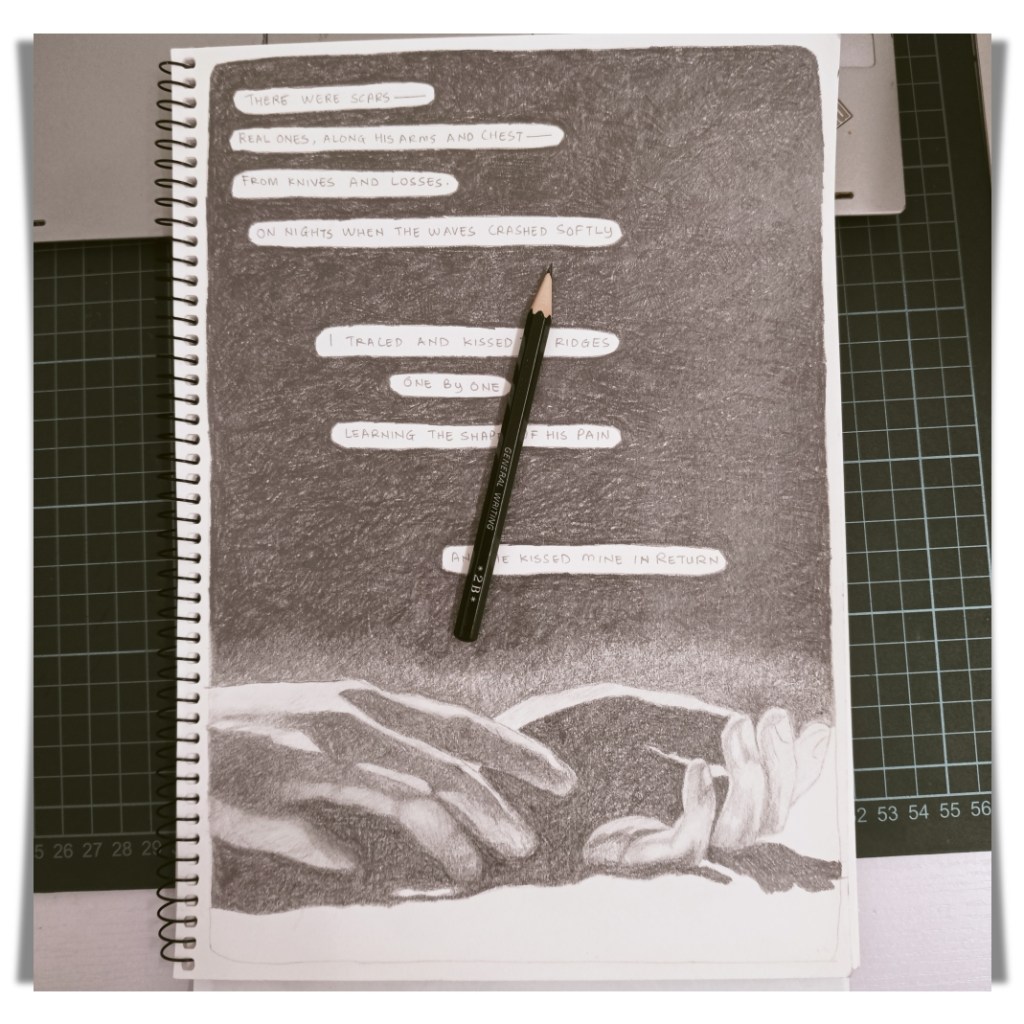
I worked on this piece over the weekend. The lines are taken from my poem, The Criminologist. So far, I have four of my poems published in online literary journals/art websites, but I hesitate to share the links here because that would expose my identity. I prefer to be anonymous for now so I can write more freely without my internal censors actively working to prevent me from writing truthfully. No explanation is needed for this piece; I just let the art and poem speak for themselves.

Copyright © Olivia JD 2025

All Rights Reserved.