
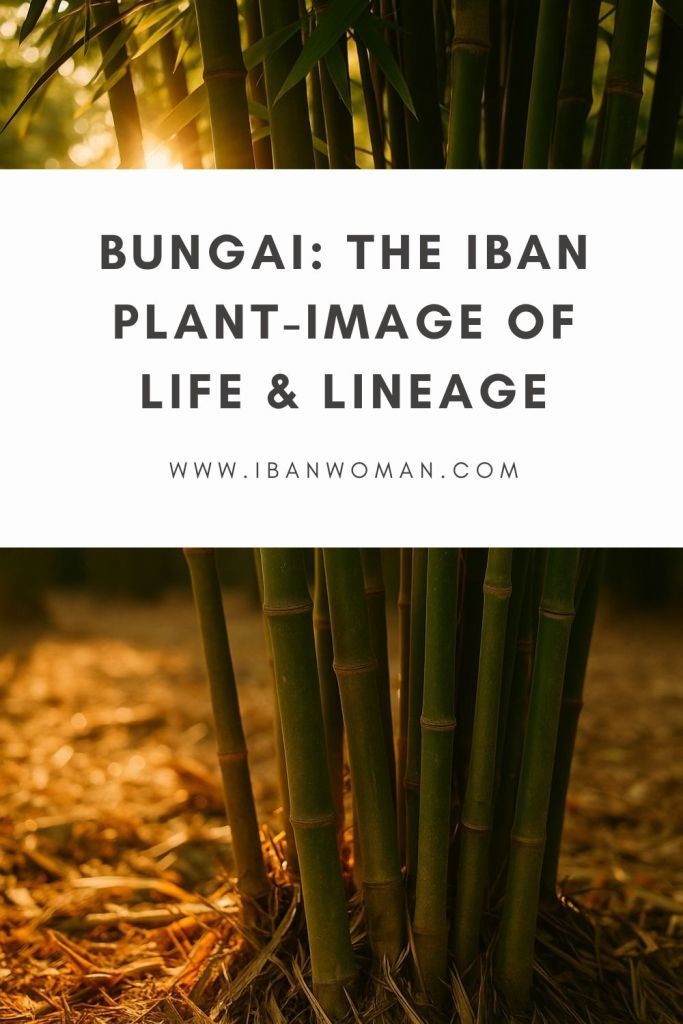
The Iban believe that the self is not limited to the body or the soul that wanders in dreams. Our ancestors believed that each person has a bungai, which is a plant-image that lives in the invisible world of Manang Menjaya, the god of healing. This plant-image takes the form of bamboo or banana and grows in clumps from a single rootstock. It is a powerful way of understanding human life. The bungai grows, strengthens, weakens, dies, and falls to the ground, just as a person does.
When I first heard about this idea, it stuck with me for days. It helped me see the forest differently and understand why the Iban imagine the community the way they do. In this worldview, no one grows alone. We rise from the same source. Relationships, ancestry, and connections we can’t see hold us together in ways that go far beyond our personal stories. This belief feels very grounding at a time when many of us feel adrift or disconnected.
The choice of bamboo and banana is meaningful. These plants do not grow by themselves. They grow in clumps, called bepumpun. A single shoot is part of a larger body that gets its nutrients from the same soil and root. Every shoot has its own height, shape, and direction, but they all come from the same source. This is how the Iban once understood family. A family is one clump. A longhouse community is made up of many clumps. The forest itself becomes a reflection of the social world.
This is not a metaphor for the sake of beauty. People who live close to the land learn its pattern by observing it daily. The Iban watched how plants behave, how they survive storms, and how they keep growing new shoots even after the old ones fall off. The Iban were shaped by the rainforest, and it was a teacher, a mirror, and a guide.
The bungai makes this idea clearer. It shows us that each person is both unique and part of a lineage. A child is a new shoot from an old rootstock. The state of one shoot affects the whole clump. The well-being of the entire garden reflects the condition of the longhouse. No one exists apart from the others who stand beside them. Even in the unseen world, the Iban imagined people living bepumpun, connected through generations, place, memory, and spiritual obligations.
I find this comforting. There were times in my life when I felt distant from my roots. Leaving home for school, work and marriage created gaps I did not understand at the time. I lived away from Sarawak for many years. I felt as though I was a shoot attempting to thrive in soil that was not my own. Learning about the bungai made me see that the rootstock never disappears. The connection stays even after we leave. We are still held by the unseen garden. It doesn’t matter how far someone travels; the lineage remains.
Another thing I appreciate about the bungai is how it reflects emotional and spiritual states. The bungai becomes weaker when a person is sick. It withers when the soul wanders. This worldview recognizes how closely the body, mind, and emotions are connected. It respects how complicated it is to be human. A withered feeling is not seen as weakness but as a sign that the self needs care, grounding, or healing. Manang Menjaya is responsible for this realm, taking care of the gardens of human life like a healer tends to the sick. It is a gentle belief shaped by compassion.
The idea that the bungai falls when someone dies is also meaningful. The clump remains alive and ready to push a new shoot upward for the next generation. The rootstock stays strong. The lineage continues. There is sorrow, but there is also continuity. The living remain connected to those who came before them.
When I reflect on this, I see how the bungai offers us a way to think about community in today’s world. Many of us live far from home. Some grow up with mixed heritage, navigating several identities at once. Some people don’t feel connected to their language, their land, or their family’s history. The bungai concept reminds us that belonging isn’t just about being close to someone physically. It also has to do with our shared ancestry, memories, and the unseen ties that still hold us together.
The forest shows us that we can’t survive alone. Bamboo stands because the clump stands. A community stays together because its roots are strong. Long before the words “ecology” or “sustainability” were even used, our ancestors knew this. They practiced it when they built longhouses, shared food, and worked the land. They lived in a world where the rhythms of nature and community supported each other.
Writing about the bungai feels like returning to a memory I never knew I had. It combines culture, spirituality, and nature in a way that feels very Iban. It makes me think of how our people used to observe the forest, learn its patterns, and keep it in balance. The bungai is more than just a spiritual idea. It is a way of looking at life that sees it as connected, continuous, and held by something greater than the self.
I want to honor this understanding as I continue working on my cultural projects. I want the Iban in the diaspora, those growing up with mixed heritage, and those rediscovering their language again to know that our roots are still alive, even when we feel far from them. The bungai reminds us that we come from the same source, and the clump endures.
One Clump
If we were bamboo,
we would be one rootstock.
Two shoots from the same source
fed by the same unseen tenderness
running under everything.
You would lean into me
when the wind turns,
and I would hold fast
with a strength drawn
from the ground we share.
A clump is a world.
A home where no stalk stands alone.
Each one rises
because the others do.
The root simply refuses
to forget a single one.
I want that with you—
a belonging without effort.
Our lives rising
from the same dark earth,
so that even Menjaya
counting lives in his garden,
would find us together.
If you falter, I stand closer.
If you bend, I become your spine.
We are two lives
shaped by each other’s nearness.
If we are a clump, love,
then we are one living thing—
one root,
one anchor,
one quiet refusal
to ever rise alone.
I write about Iban culture, ancestral rituals, creative life, emotional truths, and the quiet transformations of love, motherhood, and identity. If this speaks to you, subscribe and journey with me.

 Olivia's Atelier