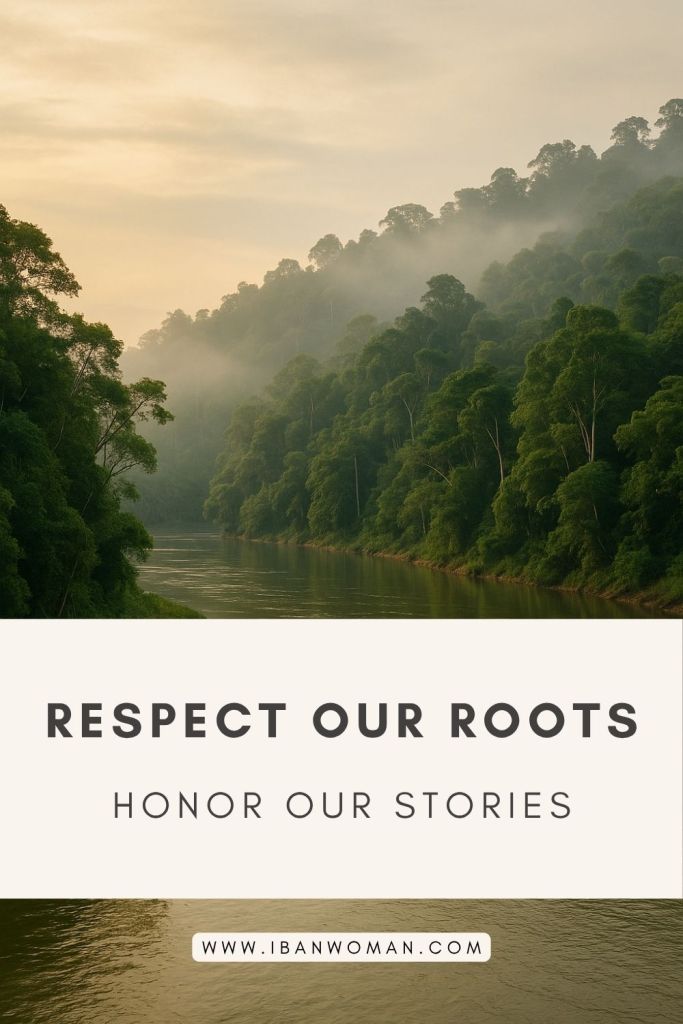
On Cultural Erasure and the Right to Be Ourselves | We Are Not Yours to Claim and Rename

This week, a man on social media told me that all Indigenous peoples of Borneo are Malay. He spoke as if it were an unbreakable truth, and a few confident sentences could change centuries of culture and memory. He talked like someone who was certain of his place in the world and couldn’t imagine that others might have histories older than his own.

I am Iban. You can’t claim and rename my people.

That one conversation was a sign of a much larger issue. It wasn’t just a rude comment but the same old narrative that keeps playing beneath the surface of national conversations. This idea that everything in the Nusantara archipelago belongs under the Malay umbrella is not unity. It is colonization in a new form that continues to erase the cultures that make this region truly diverse.

A thesis essay titled “Cultural Genocide Against Ethnic Groups in Sarawak” discusses this gradual erasure as a form of genocide that occurs through language, law, and land instead of war. It addresses what has been happening in Sarawak and all over Borneo for decades: the gradual disappearance of Indigenous ways of life. There won’t be any violence in the news, but you can see it in how children forget their native languages and how native stories are rewritten or how they are dismissed as myths.

The first impact is on the land. Large-scale logging, oil-palm plantations, and hydroelectric projects like the Bakun and Murum dams have forced Indigenous communities to evacuate ancestral lands they had occupied for generations. For many outsiders, these are symbols of progress. For the people who lived on that land, they are the loss of a living relative. Land isn’t just property; it’s a memory, a source of livelihood, and the center of our beliefs. When it is taken, the connection between people and their ancestors, between rituals and the land, ceases to exist.

The next impact is on language. Malay and English are the main languages spoken in classrooms and offices. Iban, Bidayuh, Penan, and other Indigenous languages, on the other hand, remain in private spaces. The national curriculum rarely acknowledges them. A language is more than just words; it also embodies every aspect of our heritage. When children grow up without it, they lose not only vocabulary but also the worldview embedded in those sounds. 

The third impact is spirituality. Before Christianity and Islam arrived, our ancestors believed in a cosmology that connected people, nature, and the unseen. The adat guided balance and respect. Several elements were based on Hindu-Buddhist beliefs from the Majapahit and Minangkabau traditions, but those influences became uniquely our own, shaped by our environment. If you call these beliefs primitive, you are ignoring how sophisticated they are. Long before the word existed, they taught people about law, ethics, and ecology. The suppression of these systems has shattered more than trust; it has destroyed the bridge between generations.

The last impact lies in invisibility. Bureaucracy rarely speaks the language of the natives. Many still struggle to gain recognition of their customary land rights or even simple documents like birth certificates and identity cards. People who don’t have these papers become ghosts in their own country—unseen in census numbers and uncounted in national decisions.

Taken together, these forces create the silent machinery of cultural genocide. It’s not about individual malice but about a system that values uniformity over diversity and control over respect. When progress is measured only by infrastructure and profit, it becomes a form of forgetting.

I write this not to sow division, but to call for honesty. Respect for Indigenous tribes and their histories is not charity but a moral obligation.  When you erase a culture, you do not create unity. You create emptiness. Real harmony happens when differences can exist side by side, without one overtaking the other.

If you have mixed roots and feel like you’re torn between two identities, know this: you’re not a poser. You are the result of two or more heritages coming together. You have the strength of several worlds inside you. You have every right to learn your ancestral language, honor both sides of your heritage, and talk about it with pride. You can still reach your roots and the journey begins with curiosity and grows through community.

And to those who continue to insist that “everyone is Malay,” listen up: you are not defending tradition; you are performing a modern version of the same colonial mindset you claim to oppose. Claiming and renaming others is not leadership. It’s theft. It is a refusal to accept that different roots can live together without merging into one trunk.

The Iban, Bidayuh, Kenyah, Penan, Lun Bawang, Melanau, Kelabit, and countless other groups are not extensions of a larger race. We are nations within a nation, with histories that predate borders. We have our own gods and deities, our own literature, our own rituals and way of life. We don’t need anyone to save us from ourselves.

So take care of your own culture and let us take care of ours. Guard your own identity and let us stay as ourselves. You don’t have to tell us what to believe, how to speak, or how to conduct our affairs. Preserve your own heritage and quit trying to claim ownership of what doesn’t belong to you.

This moment in our history calls for courage. We need courage to listen, fix what has been distorted, and return whatever is rightfully ours. We don’t need anyone’s permission to exist. Even when others pretend to forget, we remember. We will continue to speak, to write, to sing, and to exist in our own rhythm. We are not lesser branches of your tree. We are forests in our own right.


I write about Iban culture, ancestral rituals, creative life, emotional truths, and the quiet transformations of love, motherhood, and identity. If this speaks to you, subscribe and journey with me.
Headhunting | The Rituals and Care of Antu Pala

Disclaimer: This post is only for sharing purposes. I’m not an expert, just sharing what I know. The information here is general and may not cover every detail. For Iban readers who know more, feel free to add in the comments. This post is not meant to glorify the practice of headhunting but to share knowledge for better understanding.

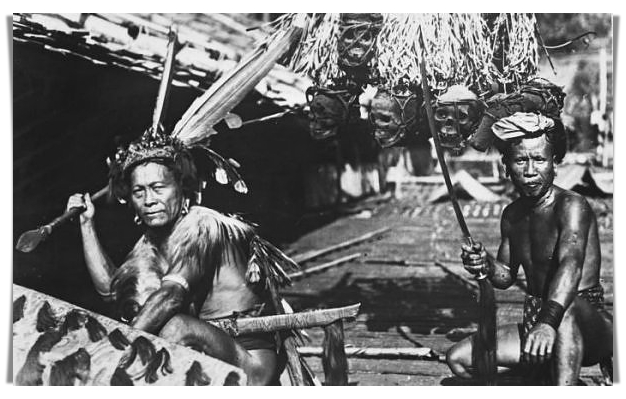
As I mentioned in my previous post, headhunting among the Iban was not random violence but part of specific mourning rituals. It was carried out to complete rites after the death of a family member. But after the warriors returned from ngayau (headhunting expedition), what happened to the severed heads? Were they hung immediately? The answer is no. Certain rituals had to be performed before the heads could be brought into the longhouse and later hung in the ruai (communal gallery).

The first thing the bujang berani (warriors) did upon returning was to manjung, which means to shout and announce their arrival. They could not enter the longhouse right away because it was taboo.  Specific rituals had to be followed. Practices varied from one Iban community to another, but what I’m sharing here is the way of the Saribas Iban from the Betong Division.

Image source

After announcing their arrival, the bujang berani stayed for a week in a small hut called langkau near the longhouse. During this time, they rested, cleansed themselves, and prepared the heads. This included cleaning and removing skin, flesh, and brain matter to prevent decay. The process took place by the river, where the heads were skewered on sticks, washed thoroughly, and boiled to loosen any remaining flesh. Once cleaned to bare skulls, they were smoked over the bedilang (hearth) until black and dry. At this stage, they were known as antu pala.

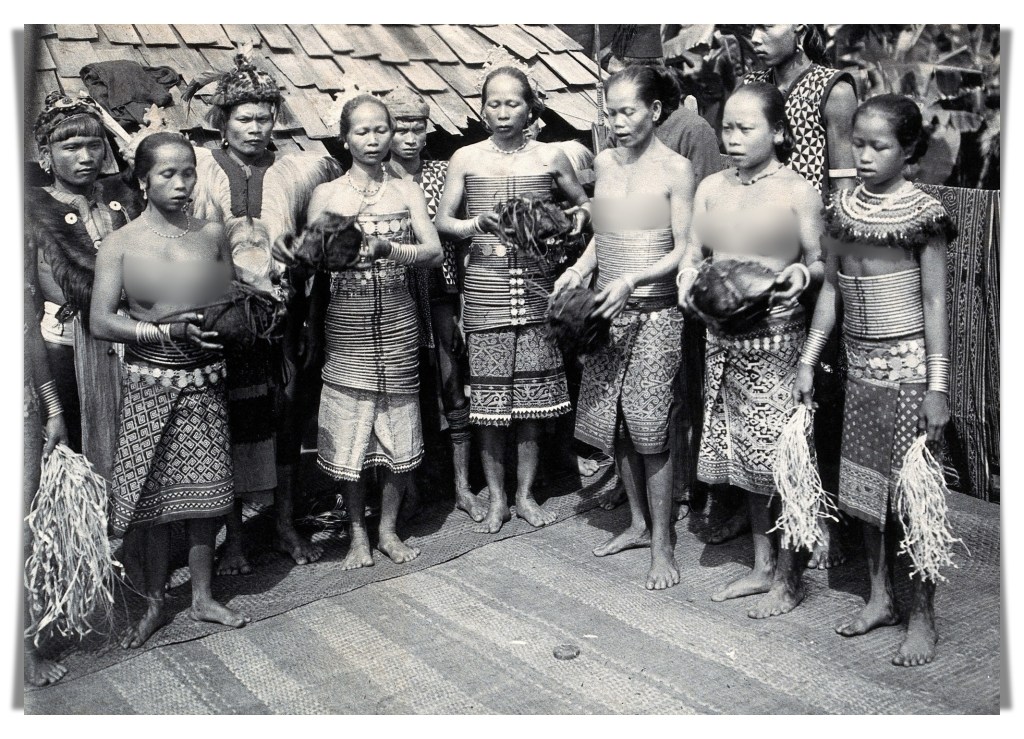
When the skulls were ready, the warriors prepared to re-enter the longhouse in full Iban regalia—baju gagong, ketapu or lanjang (headgear), sirat (loincloth), tumpa (silver armlets), and marik betaring (toothed beads). Only men who had gone on ngayau were permitted to wear the full attire. Those considered kulup (cowards) who had never participated in a headhunting expedition could only wear a sirat.

Image source

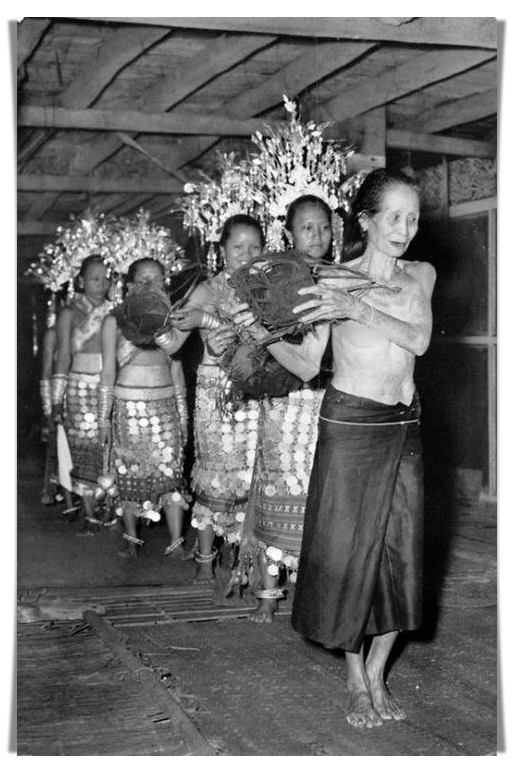
A procession called Mangka Ke Selaing was then held to welcome them home. The warriors were welcomed with panjung (victory shouts) and the beat of the Gendang Pampat. At the doorway, they were received by their mother or wife carrying a chapan (winnowing tray) covered with pua kumbu, a ceremonial textile woven only by the mother or wife of the warrior. The cleaned skulls were placed on the pua kumbu, not fresh or bloody as often imagined. The Iban always followed adat (custom) in their rituals, so there was never any confusion or disorder.

Image source

The mother or wife then played a key role in the Naku Antu Pala procession, carrying the tray of skulls along the ruai while nyangkah (chanting). The warriors marched behind the women to the rhythm of the Gendang Rayah. During this moment, they could not be touched or spoken to, as it was believed that the deities Keling and Kumang of Panggau Libau accompanied them. Disturbing them was said to cause one to faint.

The lemambang, or bards, were also present at the procession. They carried a garong, which is a bamboo container full of tuak, or rice wine. Only the bujang berani could drink this wine, and they drank it at the end of the procession. The ritual was over when the mother or wife performing Naku Antu Pala bit the skull, which meant that her spirit had won over the skull’s spirit. The antu pala then became the servant of its owner.

After the ritual, a feast called Gawai Enchaboh Arung was held in honor of Bujang Berani. There was food, ngajat (traditional dance), and happiness all night long. The mourning period came to an end with this feast. The antu pala was believed to nyilih pemati, to replace the soul of the deceased with that of the enemy, allowing the departed to rest peacefully in Sebayan (the afterlife).

Image source

Taking care of the antu pala also included different rituals, depending on the purpose. Whenever the skulls were moved or ceremonies were performed, miring or bedara’ was always required. Miring was a ceremony of prayers and offerings to Petara (God), the deities of Panggau Libau, and the ancestral spirits (Petara Aki Ini) for blessings, harmony, and protection from harm.

This was followed by bebiau, a rite using a fowl with accompanying prayers. Before it began, a piring (offering) was prepared, consisting of tobacco, betel nut, betel leaf, gambier, rice, salt, glutinous rice, rice flour, yellow rice, eggs, tuak, and chicken feathers dipped in blood from the sacrificed fowl. Larger ceremonies like Gawai Burong required even more offerings.

After miring, the antu pala had to be “fed.” This act was similar to the Chinese tradition of offering food to ancestors. Rice, water, and sometimes cigarettes were placed as offerings, and in some rituals, a pig was also sacrificed, especially when moving the antu pala to another location.

Not everyone was allowed to touch the antu pala. Only its owner or heirs could handle it. In some regions, this role was reserved for men. If a skull fell, it could not simply be picked up; a miring had to be done first, with a chicken offered before it was lifted and rehung.

These were only the basic practices. There are many more rituals surrounding the antu pala, each layered with meaning and guided by adat. These rituals may seem strange or even unsettling today, but they used to be crucial to the Iban’s understanding of life, death, and the spirit world. They show a community that was deeply guided by adat, a system that balanced courage with respect and ritual with meaning. 

If you have stories or knowledge passed down from your elders about antu pala or other old practices, I’d love to hear them in the comments. Every story adds another thread to our shared history. 

If you’d like to see a performance of the Naku Antu Pala procession, you can check out this video:


I write about Iban culture, ancestral rituals, creative life, emotional truths, and the quiet transformations of love, motherhood, and identity. If this speaks to you, subscribe and journey with me.

Why Malaysians Can’t Debate and What Literature Has to Do with It

I have been thinking about this sentence for days: Literature is vital to the development of civilization. It sounds lofty and almost too academic, but the truth of it becomes painfully clear when you look at what’s going on around us right now. In Malaysia, social media has become a chaotic place where people shout at each other, often without understanding what they are shouting about. The topics change every week, from the Israel-Palestine conflict to alcohol to race to religion, but the pattern stays the same. The loudest voices get the most attention, and the most aggressive ones dominate the space. It doesn’t feel like engaging in conversation and more like moral warfare.

Every time you scroll through Threads or Facebook, you see another argument about who’s right and who’s wrong. There are a lot of insults, accusations, and name-calling in the debates. Malaysian netizens have been calling each other kafir, Yahudi Laknatullah or Zionist sympathizers, pemabuk, tak sedar diri, and poyo just for saying something that doesn’t fit into the dominant narrative. The moral superiority that oozes from these posts is exhausting. Many Malays—though NOT ALL—seem to think that their views are the most righteous and anyone who questions them is automatically condemned. This behavior is so common that it is now seen as virtuous.

Seeing all of this happen has made me deeply weary. There are times when I want to say something, stand up for those who are insulted, and fight against racism and hypocrisy. But I never do. I stop myself every time I want to type a response. I know that trying to reason with people who don’t want to understand is a waste of time. I also know that entering a discussion driven by anger will only drain me. Still, I can’t help but think about why our public discourse is so shallow and why we as a society seem incapable of having difficult conversations without turning them into battles. I think the answer has to do with our relationship with reading and literature.

Literature teaches us how to think, to see beyond ourselves, and how to listen to others even when we disagree. It teaches patience, builds creativity and empathy.  Reading widely and deeply helps people learn to see things from multiple perspectives at the same time. They understand subtleties. They acknowledge there are no absolutes in life. In a society that values literature, debates are chances to learn and grow. But in a society that lacks interest in literature, discussions turn into shouting matches. Without the habit of reading, people struggle to form coherent arguments. They react with their feelings, not their brains. Instead of engaging, they attack. They want to be validated, not told the truth.

The lack of reading in Malaysia is not a new issue. We all know the statistics. In 2024, Malaysia ranks 6th among nine Southeast Asian countries in a survey by CEOWORLD magazine, with an average of only 5 books read per year. There are Malaysians who proudly say they haven’t read a book since school. Many bookstores close down, and libraries stay empty. People who do read often stick to light, motivational books that make them feel good without challenging them.  Literature that makes us think, makes us uncomfortable, and makes us question ourselves is deemed boring or irrelevant. When we lose the habit of reading such works, we lose something crucial: the ability to think beyond our experience. And when that happens on a large scale, it affects how a nation speaks, argues, and grows.

The decline of reading is not only a cultural issue; it is a civilizational one. A society that stops reading is easy to manipulate. It forgets how to ask questions, or how to separate truth from propaganda, and how to think for itself. That’s when people start using emotional slogans and moral policing to show who’s in power. We can see this now in how some Malaysians use religion and race as weapons to silence others. The line between being morally right and being self-righteous gets blurry. People get hooked on how good it feels to be right. They use religion to protect themselves and their identity to attack others. In that environment, there is no room for contemplation or compassion. The only thing that is left is the sense of supremacy or dominance.

I often think about how literature could change this landscape. One novel or poem can’t solve racism or fanaticism, but it can help. It can make us pause and remind us that every opinion comes from one individual with a story. When we read stories from perspectives different from ours, we are forced to see the world in a wider frame. That is the beginning of understanding. Civilization moves forward not through arguments or viral posts, but through the slow work of broadening our minds.

I have learned how to use my frustration to write. Instead of arguing online, I write essays, poems, and reflections about the things that are important to me, like memory, stories, experiences, identity, culture, and belonging. I write from my Iban perspective because that’s how I see the world. I know that my writing won’t go viral, and I’m okay with that. I do work that may seem trivial to others, but it is important to me. It is my way of preserving a voice that might go unheard in the noise of bickering Malaysia.

Some days I wonder if my work matters. Even though I’ve published some art-related books, exhibited my art a couple of times, been featured in a newspaper and a magazine and two radio interviews—I’m still relatively obscure. I don’t belong to any literary groups. I only have my blogs and a small space on social media. It might not seem like much. But the more I think about it, the more I realize that literature starts right here: in small feats of expression and the bravery to write the truth even when no one is paying attention. Civilization does not develop solely from great orations. It grows from regular people who choose to share their stories, write down their thoughts, and share what they know. My poems and essays may not reach many people right now, but they carry pieces of history, language, and culture that should live on.

Choosing not to argue online doesn’t mean you’re weak. I choose to protect my peace and integrity on purpose. I don’t want to give up insight for outrage. If you have to lose your dignity to win an argument, it’s not worth it. I want to put my energy into something that will last. For me, writing is a way to get that energy back. It lets me deal with the world without getting stuck in its noise. It reminds me that silence, when it comes from being aware, is not the same as being absent. It is a form of strength.

The past week has reminded me that Malaysia is still struggling to mature in its discourse. Racism, feeling morally superior, and needing to control others through shame all show how weak our collective thinking still is. But I also think that change starts with small steps. Anyone who reads with an open mind helps make that change happen. Every writer who doesn’t give up helps society become more thoughtful, even if it takes a long time.

Literature is not entertainment for the elite. It is the basis of empathy and the record of human complexity. It is also the space where we learn to think beyond survival. Without it, civilization loses its soul. We might still have cities, technology, and institutions, but we wouldn’t have the inner structure that allows a society to reflect and grow. That’s what I see happening around me now: a country that is loud but empty and full of opinionated people but sadly, uninformed.

I don’t expect everyone to understand why I write or why I stay quiet when things are crazy. I do it because I believe that words have a slow power and they move differently. Words help us to remember who we are and who we could be.

I hope that when the noise dies down and the arguments stop, what is left is not anger. I hope what is left is the persistency of those who kept writing and reading. Literature may not change everything, but it is still the soul of civilization. Without it, we lose not only our stories but also our ability to envision a wiser, kinder world.


I write about Iban culture, ancestral rituals, creative life, emotional truths, and the quiet transformations of love, motherhood, and identity. If this speaks to you, subscribe and journey with me.
Fragments of Obsession V | What Remains of Him

This fragment of obsession is a continuation of Part 4. You can find the first four parts here: part 1, part 2, part 3, and part 4.


The Victims

They stay with him. That much I know. 

They weren’t merely evidence in sealed bags. They had names. They had voices. They were echoes in a room where someone had begged, bled, or died without being heard. They live somewhere behind his eyes, hidden deep down but never completely out of reach. 

He doesn’t discuss them. But I can sense it in the way he moves, sometimes too still like he’s bracing for the inevitable. I wonder which one visits him in sleep. Whose case file he opens up in his dream without meaning to. 

He must have a list in his head. A list of faces, some vaguely remembered, some impossible to forget. The girl with the red hoodie. The elderly man found with his hands tied. The body that no one claimed. 

I used to think that grief only belonged to families and those who loved them. However, there is a certain kind of pain that comes from being the last person to look at their picture, read their texts, or trace their final hour backwards. He carries that deep in his soul, mourning for people he never knew. 

Maybe it hardens something in him. Or maybe it makes him gentler in ways he doesn’t realize. The truth is I don’t know. I just know that he touches the evidence gently. And he blinks slower than usual when he stares at a photo too long. 

In my culture, the spirits—antu—linger when death is unresolved. Some say they roam, whispering into the ears of the living. He doesn’t fear ghosts or darkness. The ones that haunt him are printed on paper, kept in boxes, and saved on hard drives. There they remain. Always waiting. Always watching. 


The Walk

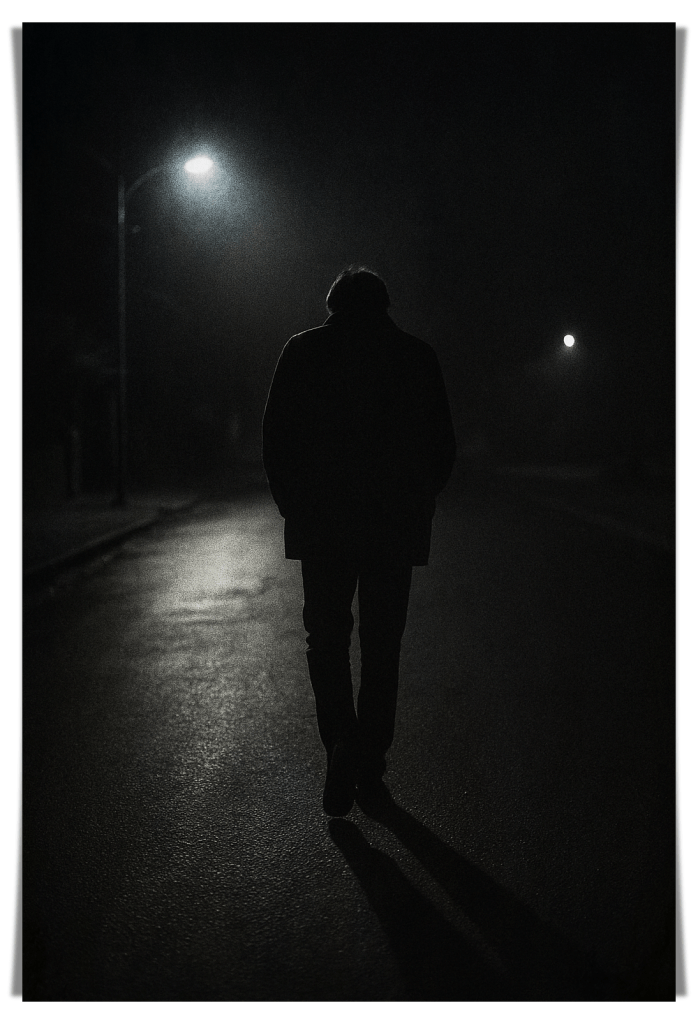
He walks at night, but not every night. Only on those when sleep is a stranger and the weight on his chest refuses to lift. He seeks the hour between two and four. That’s when the world goes quiet, signaling him to step out. 

He brings no phone, has no destination. Just his feet on the pavement, carrying his momentum through sleeping streets. He passed shuttered shops, empty lots, and the lonely glow of neon signs. In this slumber, the city is transformed—muted, and temporarily pacified. 

Is he trying to shake them off? The blood, the tragedies, and the ghosts that cling to the inside of his eyelids? Or is he chasing the silence he can’t find inside? Or maybe he just believes that if he walks long enough, the chaos in his head will have to settle.

Hands in pockets, shoulders a permanent slope. From afar, he’s just a man. But a closer look at his eyes would tell you everything. 

This is the unseen part. The aftermath, stripped of crime scenes and case files. There is no suspect to corner, no puzzle to solve. He’s a man alone with the night, waiting to feel human again.

In that moment, I don’t see the criminologist. I see a tired man who would rather move through the honest darkness of the streets than lie still in a loud, empty room.


Epilogue

All of this, I’ve only imagined. The desk. The scene. The interrogation. The victims. The walk. They’re a part of his life that I will never touch. He doesn’t talk about it much, at least not directly. A line may slip out from time to time, and that’s it. Most of it comes through in other ways, like when he gets too quiet and his hands stop moving. The tension in his jaw after a long day. The shadows beneath his eyes that no amount of sleep seems to erase. 

There are nights he startles awake. He never says why, just lies there, breathing heavily. I never ask either. I simply wait for his return. 

What he endures is his own. And I’ve stopped trying to reach for it. His work is an extension of who he is, bound to his bones. It affects how he sees the world and how he protects others without even thinking about it. 

However, there are times when it becomes apparent. Like when he touches me and listens to me even when I say something silly. Or how he holds silence like it’s sacred. 

I used to think he was distant. But now I understand: he was too full of things he could never say. I write these fragments not to know him better or to hope that he’ll find them. He won’t. The door closed two decades ago. These are the only pieces I kept. 


Copyright © Olivia JD 2025

All Rights Reserved.

I write about Iban culture, ancestral rituals, creative life, emotional truths, and the quiet transformations of love, motherhood, and identity. If this speaks to you, subscribe and journey with me.

The Cry of the Koklir | An Iban Ghost Story

Before I share my experiences, I’d want to clarify who the koklir is and what she represents in Iban belief.

People often think of the Iban people of Sarawak as headhunters, which is a part of our history, but it tends to eclipse the deeper aspects of who we are. However, our culture is not only based on headhunting. We have a strong spiritual connection to the natural world, which is rich in stories about spirits that live in rivers, lands, mountains, and dreams. Our folklores are alive with omens, taboos, and the spirits of people who have departed. Some spirits protect, some guide, and others, like the koklir, are said to return because something in their death was left unresolved.

In Iban culture, the koklir is one of the most feared spirits. She is believed to be the spirit of a woman who died during childbirth or shortly thereafter, specifically during the vulnerable bekindu period, which lasts for forty days of healing and recuperation. Her death is known as busong mati, or a spiritually unfortunate death, and her soul is considered to become jai (malevolent). Her soul is malevolent not because she did something wrong in life, but because her death was unnatural and tragic. Her spirit doesn’t cross over to the other side in peace; instead, it lingers behind, transformed by pain and grief.

As a ritual precaution, lime thorns (duri limau) are poked into her hands and soles before she is buried. It’s a symbolic act aimed at weakening her spirit and preventing her from becoming a koklir. Some people allege that her tongue is also pierced.

Then a prayer is being offered, asking her to rest and not come back to bother the living. But if the ritual isn’t done or if the death is really violent or sudden, people say she might still come back to haunt, seek, and punish.

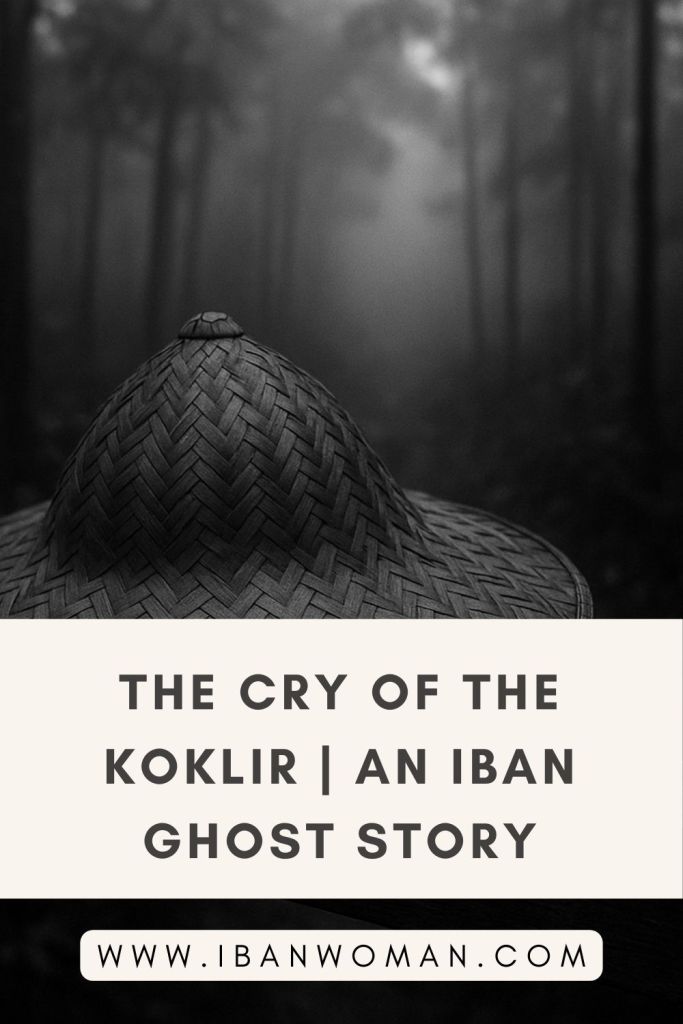
The koklir is believed to target men. Most of the time, you can hear her presence through a chilling cry that starts out like a hen calling her chicks: “kok, kok, kok…” and ends with a piercing, terrifying “haiiiiii waiiiiii!” Before she attacked her victim, she would scream “kokliiiiiiiiiiiiiiirrrrrrrrrr”. She sometimes takes the form of a beautiful woman, hiding her face with a tanggui serawong (woven sunhat) or a kubong leaf. Sometimes she manifests as an enturun, a shaggy, nocturnal bearcat with long claws. Some men say they’ve heard her voice in the jungle or by the river at night. Some people say they’ve seen her scratch at windows or doors with fingers that look like claws. The stories are shared quietly among men, usually late at night, and sometimes with fear or bravado.

I’ve never seen her. But would you believe me if I told you I heard her twice? And I remember it very well both times.

First Encounter

I was fourteen. It was the first day of the school break. Because my flight home was later that night, I was the only student left at the girls’ hostel at my boarding school. Everyone else had left throughout the day. The hostel was quiet and empty.

That morning, the warden told me to turn off the lights and close all the doors before I left. I said I would. After dinner, at about 6 PM, I took my bags outside and waited for my cousin to pick me up. It was getting dark already.

Before leaving, I went back in to do what I promised: turn off the lights and close the doors. I went up to the first floor, strolled through the empty corridor, and did what I had to do. The only sound was the rustling leaves blowing in the breeze. Everything else was still and quiet.

I heard something as I came back down, near the bathroom on the ground floor.

Kok… kok… kok…

It was soft and faint, exactly like a hen calling its chicks.

But this was a school compound. No nearby houses, no chickens. Just trees and a greenhouse. I stopped and listened again. I thought maybe I imagined it. I finished what I was doing and went back to the entrance. I stood there in the light of the corridor, looking out at the road. Everything else around me was dark.

Then, around 7PM, I heard it again.

Kok… kok… kok… kok…

It was slower and closer.

I felt chills and goosebumps all over my body. I was too scared to look around. I just kept my eyes on the road, expecting to see my cousin’s headlights. He came soon after that. I hastily loaded my bags into the car and drove away. I never looked back.

I didn’t see her, but I know what I heard. We believe that the koklir doesn’t harm girls or women because she only targets men. That gave me some comfort, but the sound stuck with me for years.

Second Encounter

I was still living in the same hostel a year later. I didn’t hear her voice this time, but I did hear something else. My bed was next to the door. Sometimes, I would wake up to a loud scratching sound at the door. I believed it was stray dogs trying to get in, so I went back to sleep.

However, I looked at the door one morning because I was curious. There were scratch marks, but they weren’t at the bottom where a dog could reach them. They were higher up, around chest height. That detail stuck with me. What kind of dog can scratch that high?

I didn’t say anything to anyone. I didn’t want to scare the others, especially the younger girls. But I remembered what the elders used to say: the koklir scratches at doors and windows with her long nails to find a way in.

After that, the scratching happened every now and then. I didn’t say anything about it until much later. I told the story years later in our WhatsApp group for former dormmates. I was surprised to learn that I wasn’t the only one. Others remembered the same sounds from the same door and that same feeling of unease. However, we all stayed quiet, but we were all scared.

Some people might not believe these stories. They can argue it’s merely animals, wind, imagination, or ridiculous stories from the natives. But I don’t think I made anything up since I know what I heard.

These encounters aren’t just stories about ghosts. She is a reminder of how deeply the Iban people see death and life as intertwined, how even grief has a place in our stories. As Iban people, we understand spiritual realms that involve death, grief, and the things that linger. The koklir is a reminder of women who died too young or too soon, often forgotten or feared, yet still searching for peace. She didn’t show herself to me. But I heard her cry and have never forgotten it, even after decades have passed.


I write about Iban culture, ancestral rituals, creative life, emotional truths, and the quiet transformations of love, motherhood, and identity. If this speaks to you, subscribe and journey with me.
How I’ve Been Moving My Own Goalposts

I’ve been creating and publishing my work for years, but if you heard me talk about my work, you might think I’m just getting started.

I have this strange habit that I’ve noticed. I always add a “but” to every milestone I reach. In 2015, I published my first coloring book. This was long before the age of AI and before everyone was selling and publishing coloring books in droves. It was a huge feat for me because I had no formal education in design or tools but in the back of my mind it wasn’t a big deal because it wasn’t a novel. I sold my art and designs to people all over the world, but it was only a few dollars at a time. I’ve been interviewed on the radio a couple of times…but they were only thirty minutes. I’ve been featured in a local newspaper (The Star) and magazines…but no one remembers them. Even my poems, two in a local online literary journal and one in an international one, also come with the quiet disclaimer that they weren’t in a fancy, hardbound anthology.

In 2018, two of my paintings were part of a group show in Lisbon, Portugal. At the time, I remember feeling honored…and then telling myself right away that they were only small pieces, as if that made it less important that people on the other side of the world had chosen and seen them.

My brain seems to be programmed to move the goalposts as soon as I score. Everything I’ve done immediately ceases to count because it wasn’t more extensive, profitable, or longer. It’s a silent erasure of my own work and not humility. And the more I consider it, the more I see how deeply ingrained it is. Somewhere along the way, I learned that worth could only be measured in extremes.

I think part of it stems from the way accomplishments are often celebrated. Best-sellers, award winners, and overnight sensations often make the headlines. Seldom do the slower, more steady steps receive the same attention. Perhaps that’s why I find it difficult to appreciate them in my own life because they’re not the kind of victories that garner much attention.

But lately, I’ve been thinking about the new voices I’ve seen online. People who are just starting out as artists or writers are celebrating their first novel draft, drawing, or Etsy sale. Their happiness is apparent. They aren’t comparing it to some unseen standard. They don’t say “but” after their announcement. I wish I could have that. And it makes me think about how many moments I’ve missed out on because I wouldn’t let myself be proud for more than a second.

The truth is that my creative life has been full. I’ve brought six coloring books from idea to market, my art and designs have traveled farther than I have, I’ve done an overseas group show, I’ve done radio interviews, print features, and years of steady blogging. It exists not because I waited for permission, but because I put it out there into the world. And yet, I’ve been the one who’s diminishing it.

Here’s another truth: I don’t share links to my interviews or published works on my blog or social media. They carry my real identity, but I want to stay anonymous for now. That gives me a sense of freedom because I can create without worrying about my name, my face, or the expectations that come with them. Without that attachment, I can try new things, explore, and even fail without worrying that my whole identity is at stake.

The price of this mindset, both the anonymity and the constant moving of the goalposts, isn’t just emotional. It seeps into motivation. You never feel like you’ve arrived when you keep moving the finish line. And without that rest and a moment of acknowledgement and gratitude, the trip starts to feel like an endless uphill climb.

I’ve been trying to change this by creating tangible reminders that my work is real and worth noticing, not by forcing myself to feel proud. I made a “Proof Folder.” I keep screenshots of kind messages from readers or buyers, pictures of my books and art in the world, sales confirmations, and links to features or interviews. It’s an effort to fight against my habit of forgetting. I’ll open the folder on days when the “but” tries to take over. I’ll remind myself that the work was done, that it mattered, and that it still does.

I don’t know if I’ll ever be able to completely silence the voice in my head that says, ‘It’s not enough.’ But I might be able to learn to say something more true: It’s all mine. I made it and that counts.


Olivia Atelier offers printables, templates, and art designed to inspire reflection, healing, and creativity. Visit Olivia’s Atelier for more.

Remembering Zara | What Boarding School Taught Me About Bullying

When I first read about Zara Qairina, I felt a sharp, sick pull in my chest. She was only thirteen.

They said she fell from the third floor of her dorm. Some concluded she had taken her own life. Others claimed she was bullied, and that her body had been placed on the ground to make it appear like she jumped. Her family believed there was more than met the eye. They said she had told them, more than once, that she was being bullied. And now she’s gone.

It brought me back to my own boarding school days. Like Zara, I was thirteen when I stepped into that world. I was still twelve when I received an offer to pursue my secondary education at one of the top schools in Sarawak. My parents didn’t want me to go, but I insisted. For three months, they said no—then, finally, they relented.

Back then, we didn’t use the word “bullying.” The term we heard more often was “ragging,” usually carried out by seniors. I can’t speak for others, and certainly not for what boys experienced, but I can tell you what I went through.

Had I ever been bullied? Yes. But I didn’t recognise it as bullying at the time. I wasn’t a timid student, though I was quiet. I always pushed back. So I didn’t label those moments as something serious. But they were.

The first time I was bullied was in Form 2, when I was fourteen. The girl who targeted me was also in Form 2 but from another class. She was one of the prettiest girls that year. I hadn’t paid much attention to her because I mostly kept to myself and my circle of friends.

We were both in PBSM (Red Cross, or Red Crescent in Malaysia). That year, there was a three-day camping event, and by chance, I ended up in the same group as a senior—a Form 4 boy she had a crush on. I didn’t think much of it. He was just another teammate. However, she was consumed with jealousy. She began spreading rumours about me and told others to avoid me. One by one, people pulled away. I didn’t notice at first, but eventually, it became clear. My belongings were misplaced. My cupboard was ransacked. I suspected someone had even read my diary.

Friends gave subtle hints, and my instincts pointed to her. They had proof, but none of them dared to confront her. Meanwhile, she continued to pursue the boy; however, it was unsuccessful. Then, one day, as quickly as it started, the bullying stopped. She became friendly again. I never asked why. Maybe she realised the boy was never going to be hers, or maybe she just grew tired. Eventually, we became friends throughout the school years. And guess what? We’re still in touch to this day. And yes, I forgave her.

The second time it happened, I was in Form 4. This time, it came from the boys in my class. They bullied everyone, and I was no exception. They called me names—some rude, some degrading. I was upset, of course. But again, I fought back. I reported them to the disciplinary teacher, and they were punished. The bullying stopped. And funny enough, we all became friends. Some of them now hold director-level positions in the public and private sectors. One of the most notorious is now a respectable police officer. I sometimes wonder if he remembers any of those incidents, but I’ve never bothered to ask.

So how did all of this affect me?

It taught me that the world can be a cruel place. It taught me that not everyone is your friend. It taught me that bullies often prey on the quiet ones. And it taught me that sometimes, the only way out is to speak up and push back.

I believe Zara was a brave girl, and I believe she fought back too. But the system failed her. Somewhere along the way, someone didn’t listen and take her seriously. And now, we are left with heartbreak and unanswered questions.

Many Malaysians are shaken by her death. The police are still investigating. Until the investigation concludes and all suspects are questioned, everything remains speculation. But whatever the outcome, I hope the truth surfaces and justice is served.

And I hope we learn something.

We cannot romanticize boarding schools as character-building institutions while ignoring the rot beneath. We cannot continue to let children suffer in silence because “that’s how it’s always been.” That was my mentality back then. I thought ragging was normal, just a part and parcel of school life. All I had to do was endure it and be courageous enough to fight back.

But I was wrong. Bullying, no matter the form—is never normal. It is cruel, and it should be recognized as a crime under any law.

We have to be better. Not just for Zara, but for the next thirteen-year-old girls or boys who still believe they are safe.


Olivia Atelier offers printables, templates, and art designed to inspire reflection, healing, and creativity. Visit Olivia’s Atelier for more.

When the Car Broke Down, So Did I | But Here’s What I Learned

The car broke down today. Again.

It’s my husband’s car, and this would be the third time this year. We’ve brought it to different workshops, different mechanics, each one poking around and shrugging like it’s just one of those ghosts in the machine. But today, the mechanics finally identified the issues: spark plugs, cooling gasket, weak battery, frayed cables, a clogged pipe, and a radiator that desperately needs cleaning.

RM2,000. That’s the estimate. We have savings, sure, but can we replenish that money in time? That question alone pulled me into a mental spiral I’ve come to know too well. A slow, heavy dread that swirls up in the pit of your stomach. But I caught myself. I reminded myself I had two choices: let that worry snowball and bury me, or breathe, look at the situation for what it is, and figure out what I can do.

We still need to fix the car and to keep living. And worrying, as familiar as it is, won’t do the fixing for me. What weighs heavier than the cost, though, is the guilt. There’s this stubborn voice inside whispering that I’m not doing enough. It keeps insisting I should be contributing more consistently. My husband works full-time, and I write, and I have small online hustles. Sometimes they bring in decent money but sometimes they don’t. But I squirrel away every ringgit I earn. And over the years, those small savings have paid for medical bills, groceries, furniture, school supplies, and, of course, rainy days that came without warning.

When I zoom out, I see that I’ve contributed steadily throughout the years. And yet, the guilt persists. Because we live in a world that ties a person’s worth to the size of their paycheck. Is that the only currency that matters? But what about everything else?

What about the sleepless nights, the emotional labor, the struggles of parenting and managing a household, especially when they are rarely acknowledged? What about the unpaid hours spent raising children into kind, curious humans? What about those people who hold things together behind the scenes? However, I’ve learned, slowly, not to compare. I tried not to look at working mothers and feel small. I make an intentional effort not to pit stay-at-home and working women against each other. We each make trade-offs and we all carry invisible costs. I’ve stopped wasting energy trying to measure myself against others. I’d rather pour that energy into things that feed my soul, like writing and making art.

Still, the financial anxiety is real. We’ve been living frugally for years. And yet, one broken part in a car can shake the balance. It’s a common story. Everywhere I look, people are stretched thin, in Malaysia or elsewhere around the world. Even in countries like the U.S., I read about 80-year-olds still working because they can’t afford not to. That article haunted me.

It reminded me how fragile things can be, how illness, aging, or a single emergency can drain years of careful saving. And it made me think, what kind of life do I want to build? What kind of resilience do I want to have? I don’t want to live in fear. So I’m choosing to stay patient, calm, and clear. I’m choosing to meet this setback with grace, even when it feels unfair. I tell myself this: take a deep breath. Don’t panic. Worry adds nothing. It just takes and drains. And right now, I need all my strength to stay grounded and keep creating and contributing, not just financially, but emotionally and meaningfully.

If you’re reading this in the middle of your own breakdown, whether mechanical or emotional, I want you to know: you’re not alone. It’s okay to feel overwhelmed and cry. It’s okay to spiral too. I did that often but  when the tears dry, try again. If you’re like me, you have people who are depending on you for survival, and no matter how unfair it might sound, we have to keep going even when we feel like falling apart. 

Sometimes, a broken car teaches you more than a working one ever could. It reminds you of what you’re capable of. And if you’re still standing after everything life has asked of you, then maybe you’re not broken at all. You’re probably just in the middle of building something unshakable.


Olivia Atelier offers printables, templates, and art designed to inspire reflection, healing, and creativity. Visit Olivia’s Atelier for more.

Why Andrea Gibson’s Death Hit Me Harder Than Our Movie K-Drama

This past week was hard because Andrea Gibson died, and I’m still trying to figure out what that means. I never met them, but their death feels strangely personal to me. But if you’ve read Andrea’s poems, you know exactly why. Andrea’s poems aren’t just pretty words but they are pieces of themselves they left behind. They are bloody, honest, and vulnerable.

I also watched Our Movie, a Korean drama about the slow, painful journey of dying and saying goodbye, that same week. The themes of death, memory, and love all fit together, but my response to each couldn’t have been more different.

Our Movie is exceptional. The cinematography is soft and dreamy. The acting is gentle, the soundtrack minimal. Namkoong Min plays Lee Je-ha, a quiet man who watches the woman he loves, Daeum (played by Jeon Yeo-been), die of a rare, incurable disease. She is calm, joyful, and completely at peace with dying. And he is steady, restrained, and almost stoic in the way he grieves. It’s not a bad drama; in fact, many people praise it for the gut-wrenching themes of death, dying, and hope. But for someone like me, who demands emotional rawness, it made me feel underfed.

I know the character choices were intentional. Daeum doesn’t fight her death because she is content and fulfilled. She has lived, loved, and achieved her dreams. She got what she wanted. Je-ha doesn’t break down or scream when he thinks of her. His grief is not outward but you still see it in his eyes and gestures. You see the grief, but you don’t feel it.

And maybe the show makers wanted to show us that some losses are quiet. Some people don’t break when they’re hurting. They simply retreat, bend inwards, and go still. But for me, that restraint made it hard to connect. I was waiting for something to break open. I wanted Je-ha to scream, cry, or do something that would show me how much Daeum meant to him besides memory flashbacks and stares into space. Oh, he did cry but  somehow I couldn’t connect with the way he grieves.

The drama wasn’t wrong. It’s just that I couldn’t connect with it emotionally. And that made me think of Andrea.

Andrea Gibson didn’t whisper about death. They roared and cried on stage. They made you feel uncomfortable because their truths were so intimate. Their words weren’t polished or pretty; they were rough with honesty. Andrea’s poems made you feel seen. And that’s why so many people are mourning their passing.

Andrea wasn’t afraid of being vulnerable and real. They weren’t afraid of naming the pain, sitting with it, and saying, “You’re not alone in this mess because I’m here too.”

And maybe that’s why their death feels more real than a fictional one. Andrea was there for us in the kind of grief that makes you feel like your heart is breaking and your voice is shaking, and it reminds you that this life is fragile, but it’s also worth feeling everything for.

I realized this week that I don’t just want beauty in art. I want pain and emotional bruises. I want to feel the grief and not just admire it from a safe distance. And I’m not ashamed of that anymore.

It’s not selfish to want art that speaks your emotional language. Our Movie was very well made but I think it’s okay to say that it didn’t satisfy me on the level that I had hoped for. The way I live—intensely, with longing, and an endless desire for truth—shapes my expectations. So when something falls short of that, I notice. And I’ve learned to be honest about it.

Maybe that’s the reflection for this week. This is not a review or critique. It’s just a simple truth that some stories observe grief and others enter it with you. And this week, Andrea Gibson reminded me that I will always need the latter.

I’m grateful for the reminder. And I hope that when my time comes, I’ve written even a little bit as honestly as Andrea did.

Rest gently, Andrea. And thank you for the gift of your words.

I leave this excerpt from Andrea’s poem, Love Letter From the Afterlife. You can read the complete poem on their Substack. Mind you, the imagery in this poem is breathtaking. 

“My love, I was so wrong. Dying is the opposite of leaving. When I left my body, I did not go away. That portal of light was not a portal to elsewhere, but a portal to here. I am more here than I ever was before. I am more with you than I ever could have imagined.”

And this poem, When Death Comes to Visit was written by Andrea years ago and released posthumously by their wife, Meg, today (25 July 2025).

© 2025 Olivia JD


Olivia Atelier offers printables, templates, and art designed to inspire reflection, healing, and creativity. Visit Olivia’s Atelier for more.

Things I Was Told Not to Say (But I’m Saying Them Anyway)

Like everyone else, I was raised to be polite, to lower my gaze, and to keep my mouth shut before it bleeds arrogance or truth. But truth doesn’t always need to wait for permission and I’m done looking for it. 

This is a list of things I was told not to say because they are deemed shocking and inappropriate. But I’m saying them anyway, because being silent isn’t always safe. It was a slow suffocation and death.

I was told not to say:

  1. “I’m tired of being the emotional one, the one who feels things.”

But I am. It’s draining carrying the burden of my own feelings and everyone else’s. You say I’m too touchy. I say you need to be more sensitive.

  1. “Sometimes I don’t want to be a mother.”

It doesn’t mean I don’t love my children. It means I want to disappear sometimes. To be free of endless burdens and responsibilities. I want to just be me without being attached to roles and expectations, even just for a while. Just long enough to find myself again.

  1. “Marriage is lonely.”

Yes, even the good ones. Especially the good ones; when you’ve been together long enough, you know each other too much there are barely any surprises anymore. 

  1. “I still think about the one who left.”

No, I don’t want him back. But he lives in the hallways of my memory, like when I stop to think about certain songs or street names or places. That’s not being unfaithful. It’s my memory and the only way to forget it is if I lost my memories to dementia or brain damage. Otherwise the memory remains. And I’m allowed to carry it.

  1. “I don’t want to go to this church anymore.”

I believe in God. But I don’t believe in being controlled and being silenced. I don’t want to pretend everything’s fine when my spirit is clearly not. I’m not giving up on faith; I’m moving toward the truth.

  1. “I feel ugly on some days.”

No amount of affirmations makes it disappear. There are days when I can’t stand my body. Some days I don’t even notice it at all. Both truths exist.

  1. “I envy women who get to choose their identity.”

Because I never did. I was born into roles before I could choose which ones I liked. Wife and mother. Good girl. Christian. I played every one of them. But now I want to rewrite the script where the real me can finally be set free. 

  1. “I don’t want to be grateful all the time.”

Gratitude is holy. But forced gratitude is performance. I don’t owe anyone a smile when I’m breaking inside. I can be grateful and grieving at the same time.

  1. “I want more.”

More silence. More passion. More space to create without guilt. More people who see me without needing me to explain myself. I want more than I was told I should ask for.

And yes, sometimes I want to be desired and not just needed. There’s a difference. And I feel it every time I’m touched with obligation instead of longing. 

I was told not to say all of this. They are taboo and a good Christian woman, a wife and a mother, shouldn’t entertain these sinful thoughts. 

I was told to play it safe. To keep my life neat, soft, godly. I was told not to stumble others in their faith.

But truth isn’t always soft. Truth can hurt and burn sometimes. And I’d rather burn than spend another decade in silence.

Call me whatever you want. A premenopausal woman in the heat of a midlife crisis. A delusional Christian woman being lured by the devil. These are some of my truths and I’ll not stop writing about them and shrink myself for others’s comfort. I’m so done with being prim and proper and always saying the right things all the time. I’m done with lying. It’s time for me to proclaim my truths and make them known to others. 

The Things That Undid Me

I cooked my love down to tar,
a black syrup in the bottom of the pot.
It taste like a lie
but I said nothing.
I was raised to chew my
tongue for supper.

I sewn myself into the good wife’s dress,
blessed and above reproach,
but I swallowed my own teeth
like communion wafers.

My children pressed their ears to my palms
and heard singing.
But some nights,
my fingers were fists
full of burnt letters.
I’m no witch,
only a woman
who learned too late
that silence is murder.

The pastor preached be pure.
But I loved the smell of rain
in my dirty hair,
my body wanting
without shame.

God, forgive me–
not for sinning
but for the way I loved it:
the unwashed sheets,
the stains on the hymns,
the animal in me
that refused to kneel.

I’m not sorry for the smoke,
or the fire I’ve become.
I’m sorry it took me
this long to strike the match.

© 2025 Olivia JD


Olivia Atelier offers printables, templates, and art designed to inspire reflection, healing, and creativity. Visit Olivia’s Atelier for more.