
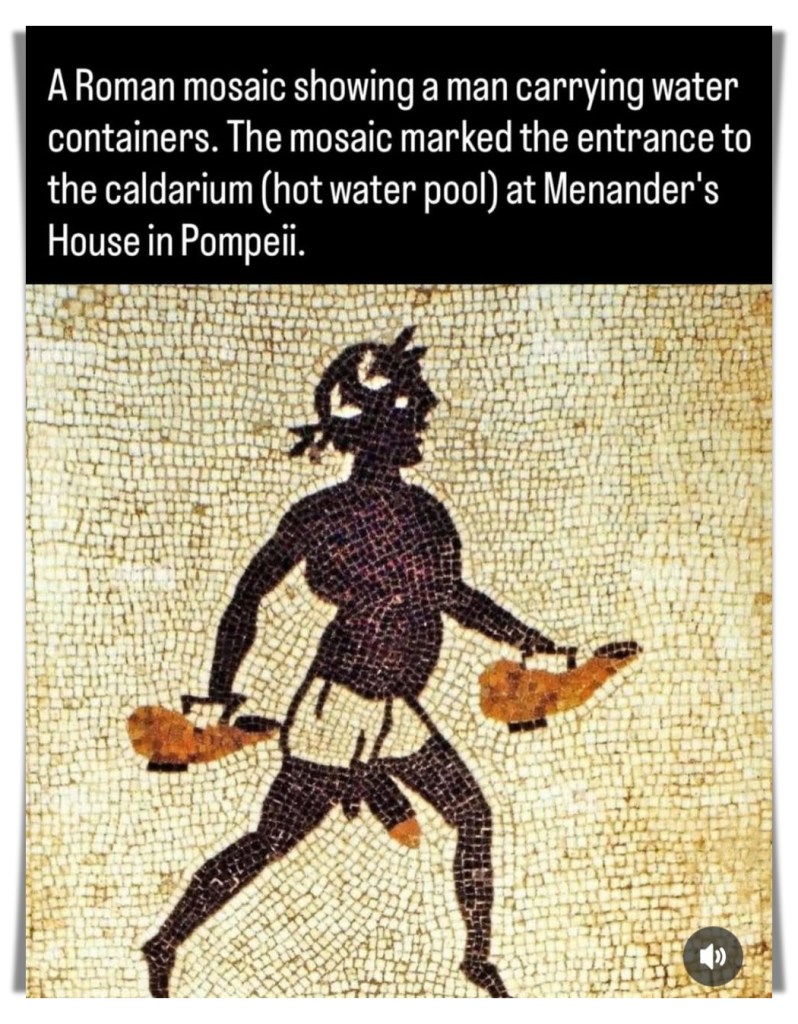
This is my 102nd post on this blog. I could’ve gone deep and reflective, writing about growth or gratitude or my journey so far. Instead, I’m giving you a man with water jugs and what appears to be a very confident, very unnecessary “thing” between his legs.
I was just going about my day when I came across a picture of this Roman mosaic while scrolling through Instagram. It was a harmless scroll and the account is offering historical tidbits. I thought I would see broken pottery, ruins, and maybe a few faded frescoes or ancient skulls and stuff. I didn’t expect this guy would be there.
It was a mosaic of a man carrying water jugs with the confidence of someone who knows he’s being watched. His muscles flexed, and his hips are a little tilted. I guess he is the original water influencer? But what really caught my attention and shamelessly wouldn’t let go?
His private part. Yup.
It was not a bulge smacked in between his legs. It was exposed. Damn. How scandalous. A big, bold mushroom swinging like a pendulum between his thighs. I looked at the screen for a long time, about thirty seconds, before whispering to myself, “But why?”
Was it supposed to be a symbol? A warning? A flex? A symbol of fertility? Or was it an inside joke from an ancient Roman tile maker who was just trying to make a boring work order more spicy? Imagine the scenario. The customer probably said, “Make it tasteful.” The artist replied, “Got it.”
The mosaic seems to have been the entrance to the caldarium, or hot water pool, in Menander’s House in Pompeii. That makes it even better. Can you picture walking into a spa and being met by a man with jugs in hand and a strange mushroom situation?
Welcome to the ancient Roman hot baths, where the water isn’t the only thing that’s hot. This might seem a little out of character for me, since I usually write about personal reflection and cultural memory. But really? Sometimes life puts a mushroom between your legs and dares you not to laugh. And at that point, you just give in and be silly. So just chill.
But after I stopped laughing (and I mean really stopped; it took a while), I became curious. Why would a Roman artist make a mosaic of this? Sure it wasn’t just for fun, right? So I asked ChatGPT and this is where things get interesting:
Art historians think that what we’re laughing at could be a waterskin, which is a leather pouch used to hold liquids. They were often shaped like penises (I don’t know why) and people carried them between their legs to keep their hands free.
So, no, it might not be an ancient anatomical exaggeration but a useful accessory. But still, they could have shaped it differently. I think many people are aware that the Romans were no strangers to sexual symbols. Their art, buildings, and even things around the house often included:
- Phallic symbols as a sign of fertility, power, or protection (yewww).
- Mosaics of sex in bathhouses, bedrooms, and garden walls (cringe).
- And a general cultural comfort with the human body that was much less squeamish than our modern-day society.
Some historians say that mosaics like this at the entrance to the caldarium could have been:
- A fun reference to the sensuality of bathing culture.
- A good luck charm that kept evil spirits away (phallic images were thought to do this. Imagine a wife saying this to her hubby, “Honey, I think the place is haunted; why don’t you strip down?”) But I digress.
Romans weren’t shy. Their bathhouses were shared, their jokes were dirty, and their art was often obscene. So, it could be a waterskin or a nod to something more suggestive. The fact that it’s not clear might be the whole point.
And you know what? That makes me love this mosaic even more. Maybe it wasn’t just meant for wall decoration. It could have been a reminder to not take life too seriously. We should own our stride, haul our jugs with pride, and march into the steam with a suspiciously shaped mushroom and not a hint of shame in our hearts.
Olivia Atelier offers printables, templates, and art designed to inspire reflection, healing, and creativity. Visit Olivia’s Atelier for more.
 Olivia's Atelier