Fragments of Obsession VI: The Art of Lingering

This is one of the things I did for fun and did it with only my memory and imagination as company. It’s an old habit: writing fragments of obsession that I started years ago and keep coming back to when I’m feeling heavy or restless. When I finished Fragments of Obsession V: What Remains of Him, I knew there was still more to figure out—more shadows, more tenderness, and more moments haunted by tragedy. So I let myself return to his rooms, his silences, and his gaze, and I wrote a few more. This is what play looks like for me now. This is not an escape but a way for me to process past experiences and to turn them into gentle longing, finally tame and set free. 

Riverside

I fall behind pretending I care about the river, when all I really want to do is watch him move ahead. He never misses anything. His hands in his pockets and his shoulders tight. But then he slows down, turns around, and gives me that look, like he’s been waiting for me all his life. I see that half-smile he only gives me. It almost feels private, something he keeps to himself and lets slip just for me.

I could live in that space between us just for the thrill of him staying still and making me want to get closer. He doesn’t say my name. He never does. He stands there with his boots on, the city and river catching in the leather of his jacket, making him look both real and unattainable.

He watches every step I take. He doesn’t fill the gap. He makes me feel the anguish of wanting to be closer. He let me reach him and let me be the one to move first. He tilts his head, keeps his eyes focused and drawls softly, “Took you long enough.”

I can’t help it. I smile. Because I know I’ll always keep chasing him, and he’ll always let me find him.

His Apartment

His apartment is nothing like I imagined, though in some ways it’s exactly what I expected. There are books all over the place. Some were stacked, some were abandoned in the middle of a thought, and some had bent pages where he stopped reading. When he isn’t looking, I run my fingers along the spines and read the titles like clues. I wonder about the books he returns to, those he doesn’t finish, and the ones he holds close. I try to picture which lines he remembered and which sentences he underlined in his mind.

His boots are next to the door, with the laces loose and the toes pointing out like he kicked them off without thinking. There’s a mug on the table with a faint coffee ring drying at the bottom. I pick it up, turn it slowly, and picture his mouth there. I always do that—touch the things he touched, like maybe I can learn something from him that he doesn’t say.

A jacket hangs off the chair, slumped over and heavy in the shoulders. It looks worn out. I wonder how long it’s been carrying him like that. A scarf draped carelessly over the back, still holding the shape of his neck. I don’t touch it. I don’t want to change how he left it.

There are pictures by the window. I look at them when he’s in the other room. Family. People I don’t know. I study them for too long, trying to remember their faces and figure out where he came from and what made him who he is now. He doesn’t explain them. I don’t ask. But my mind keeps going around and around them, restless and unfulfilled. I want to know who he was before he learned how to hold back.

In the morning, sunlight spills over the rug, revealing dust, creases, and the signs of the days he’s lived without me. I see everything. The fact that he always puts his keys in the same place. The small pile of my belongings that have started to gather—a pen, a hair tie, and a notebook that I left on purpose and pretended was an accident. He never moves them.

When I sit on his couch, I pull the blanket over my legs and breathe in his scent. His smell is faint but stubbornly sticking to the fabric. There are dents in the pillows. I press my hand into the hollow and imagine how he fell asleep there on the nights he was too exhausted to care.

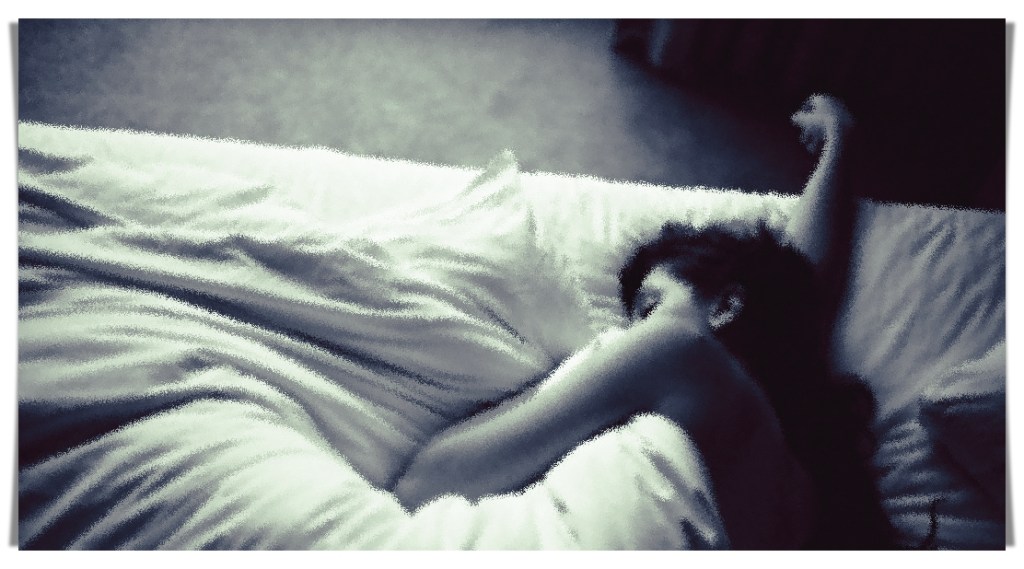
In his bedroom, the bed is never made. The sheets were twisted, and the blankets were half fallen to the floor. A shirt is hanging over the chair, and the sleeves are knotted like it was taken off in a hurry. I lie there and stare at the ceiling, counting the cracks and listening to the city breathe outside. Here, my body relaxes in a way it doesn’t anywhere else. Here, his hands don’t have to hold evidence, or grief, or anything but me.

At night, I watch him sleep. I memorize how he breathes, the slight pause before it settles. I tell myself that I will remember it later. That’s what I always think. Like memory is something I can stockpile.

In the morning, the light climbs the wall slowly, indifferent. I know I’ll be leaving again. I do it all the time. But I also know that I leave parts of myself behind that are too small to see but impossible to take back. A strand of hair in his bed. A warmth that stays even after my body is gone. A familiarity he’ll feel later and not know why.

His apartment is not mine. But my desire is everywhere in it. And every time I leave, I can’t help but think that I know him better through his absence than his words.

Haunted

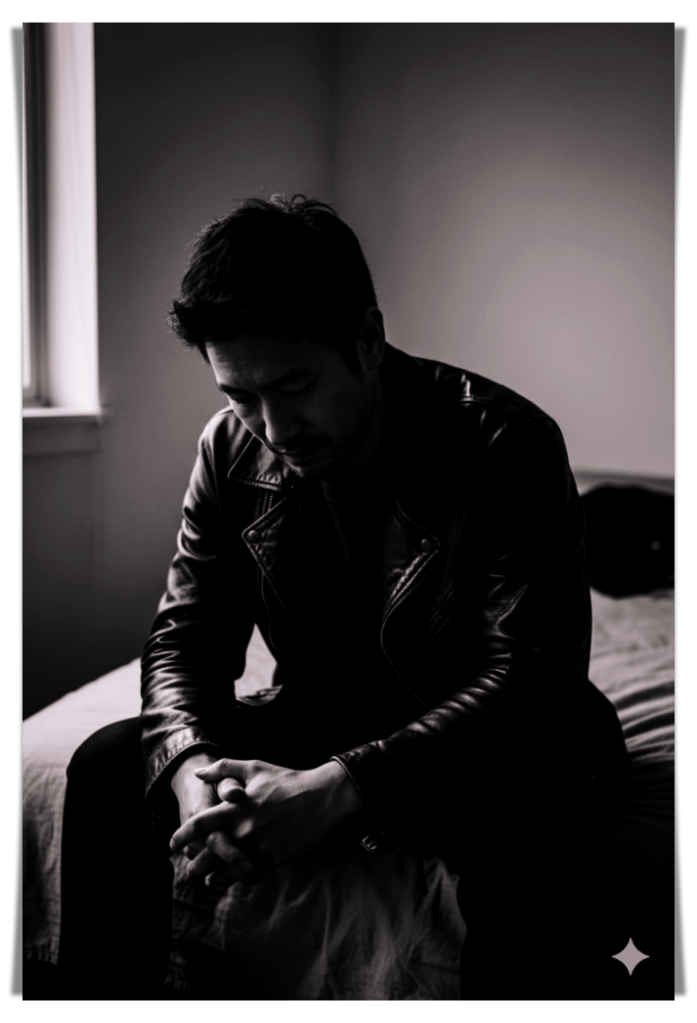
He comes in late, and the door closes quietly behind him. He doesn’t turn on the main lights; instead, he lets the dusk hang softly between us. His shoulders are hunched under the old leather jacket, and I know right away that something heavy followed him home. I can tell by the way he takes off his boots and the silence he carries with him.

He sits on the couch, elbows on his knees, head bowed, and hands dangling. There is blood on the edge of his shirt cuff, but it might not be his. I see how his fingers flex and how he runs a hand through his hair. He’s not with me yet. Still stuck in whatever he saw and can’t say out loud.

This is how I remember him: the hollows under his eyes, the day-old stubble on his jaw, the cut on his knuckle from a door he probably shouldn’t have punched. I look at him and see the small tremor in his hands and the shallow breaths he inhaled. He stares at the wall instead of me.

He doesn’t talk about work, at least not the real stuff. But the story always creeps into the room, clinging to his skin, hair, and the distance between us. I want to reach out to him, pull the darkness off his back, and hold all the sorrow he tries to hide. But I don’t. I just watch and let myself memorize him when he’s like this: unreachable, falling apart, but still here.

He finally looks up, and there’s something wild in his eyes. A flash of pain that isn’t meant for me but finds me anyway. I take it all at once. I tell myself that if I can remember him like this, haunted and broken, then nothing the world throws at us will ever make me forget him.

So I keep watching. I let my eyes linger, wanting to see every scar and every unnamed pain. I keep watching until he starts to come back, when his breathing slows and his hands stop shaking. And when he finally looks me in the eye, it feels like apologies and resignation to survive.


I write about Iban culture, ancestral rituals, creative life, emotional truths, and the quiet transformations of love, motherhood, and identity. If this speaks to you, subscribe and journey with me.
Fragments of Obsession V | What Remains of Him

This fragment of obsession is a continuation of Part 4. You can find the first four parts here: part 1, part 2, part 3, and part 4.


The Victims

They stay with him. That much I know. 

They weren’t merely evidence in sealed bags. They had names. They had voices. They were echoes in a room where someone had begged, bled, or died without being heard. They live somewhere behind his eyes, hidden deep down but never completely out of reach. 

He doesn’t discuss them. But I can sense it in the way he moves, sometimes too still like he’s bracing for the inevitable. I wonder which one visits him in sleep. Whose case file he opens up in his dream without meaning to. 

He must have a list in his head. A list of faces, some vaguely remembered, some impossible to forget. The girl with the red hoodie. The elderly man found with his hands tied. The body that no one claimed. 

I used to think that grief only belonged to families and those who loved them. However, there is a certain kind of pain that comes from being the last person to look at their picture, read their texts, or trace their final hour backwards. He carries that deep in his soul, mourning for people he never knew. 

Maybe it hardens something in him. Or maybe it makes him gentler in ways he doesn’t realize. The truth is I don’t know. I just know that he touches the evidence gently. And he blinks slower than usual when he stares at a photo too long. 

In my culture, the spirits—antu—linger when death is unresolved. Some say they roam, whispering into the ears of the living. He doesn’t fear ghosts or darkness. The ones that haunt him are printed on paper, kept in boxes, and saved on hard drives. There they remain. Always waiting. Always watching. 


The Walk

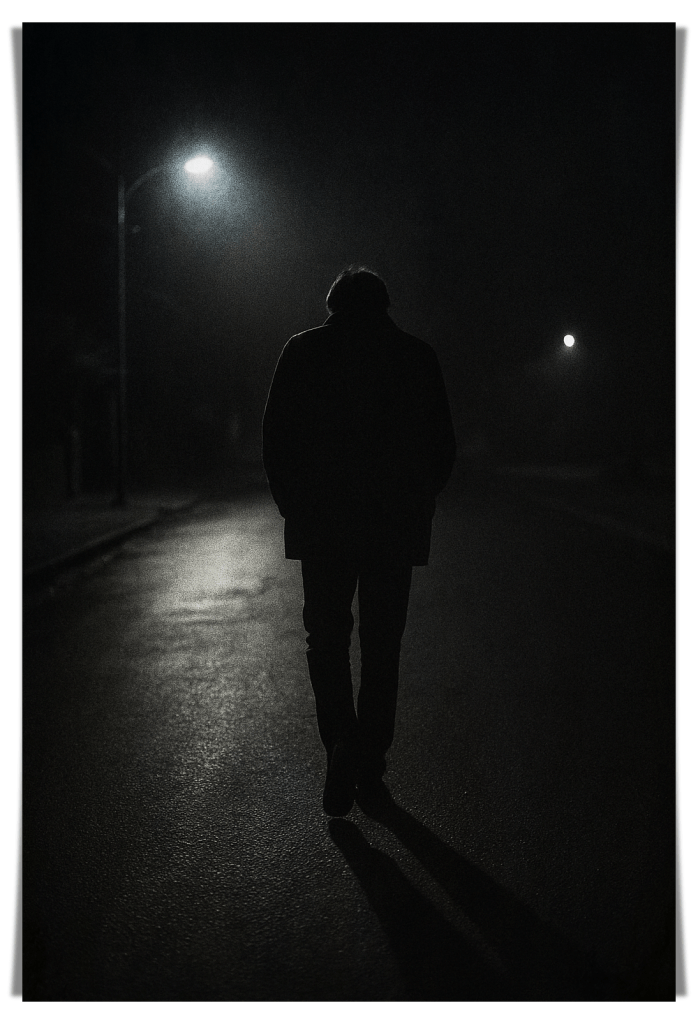
He walks at night, but not every night. Only on those when sleep is a stranger and the weight on his chest refuses to lift. He seeks the hour between two and four. That’s when the world goes quiet, signaling him to step out. 

He brings no phone, has no destination. Just his feet on the pavement, carrying his momentum through sleeping streets. He passed shuttered shops, empty lots, and the lonely glow of neon signs. In this slumber, the city is transformed—muted, and temporarily pacified. 

Is he trying to shake them off? The blood, the tragedies, and the ghosts that cling to the inside of his eyelids? Or is he chasing the silence he can’t find inside? Or maybe he just believes that if he walks long enough, the chaos in his head will have to settle.

Hands in pockets, shoulders a permanent slope. From afar, he’s just a man. But a closer look at his eyes would tell you everything. 

This is the unseen part. The aftermath, stripped of crime scenes and case files. There is no suspect to corner, no puzzle to solve. He’s a man alone with the night, waiting to feel human again.

In that moment, I don’t see the criminologist. I see a tired man who would rather move through the honest darkness of the streets than lie still in a loud, empty room.


Epilogue

All of this, I’ve only imagined. The desk. The scene. The interrogation. The victims. The walk. They’re a part of his life that I will never touch. He doesn’t talk about it much, at least not directly. A line may slip out from time to time, and that’s it. Most of it comes through in other ways, like when he gets too quiet and his hands stop moving. The tension in his jaw after a long day. The shadows beneath his eyes that no amount of sleep seems to erase. 

There are nights he startles awake. He never says why, just lies there, breathing heavily. I never ask either. I simply wait for his return. 

What he endures is his own. And I’ve stopped trying to reach for it. His work is an extension of who he is, bound to his bones. It affects how he sees the world and how he protects others without even thinking about it. 

However, there are times when it becomes apparent. Like when he touches me and listens to me even when I say something silly. Or how he holds silence like it’s sacred. 

I used to think he was distant. But now I understand: he was too full of things he could never say. I write these fragments not to know him better or to hope that he’ll find them. He won’t. The door closed two decades ago. These are the only pieces I kept. 


Copyright © Olivia JD 2025

All Rights Reserved.

I write about Iban culture, ancestral rituals, creative life, emotional truths, and the quiet transformations of love, motherhood, and identity. If this speaks to you, subscribe and journey with me.

Fragments of Obsession IV | The Criminologist

Some time ago I began writing Fragments of Obsession, brief glimpses into a private world of desire and distance. These new pieces pick up where the last ones left off, but they explore a darker area: the world of a criminologist.

I can’t sit at his desk or walk with him into the places he inhabits. All I have are fragments, imagined through the silence between us. They’re not about the crimes themselves but rather the places around them: his desk, the crime scene, and the interrogation room.

What interests me is not the evidence he gathers, but the burden that persists afterward. These pieces are how I watch from the outside and write about things I’ll never see. They belong to the same map of longing I began tracing in the first three Fragments of Obsession — part 1, part 2, part 3


The Desk

I never stood in front of it, but I know it like I’ve touched its surface a thousand times in my mind. A desk that holds the stories that no one wants to tell, and even fewer want to hear. Its top is scratched, probably from years of people dropping folders, forgotten coffee cups, and constant shuffles of pens and clips. Sturdy but with scars like him.

On one side, there is an uneven stack of papers threatening to tumble. Case notes, autopsy reports, and transcripts of late-night interviews with men who lie easily and women who have given up on getting justice. I imagine the edges fading from being read too often, held in worn hands. Underneath them, photographs turned face down, and the victim’s eyes still burning even when hidden. 

The other side is neater. A computer. A notebook with a page full of his neat, small handwriting. His pen would sometimes rest diagonally across it, with ink smudges on the margins where he applied pressure too hard. I imagine him hesitating mid-thought, his brows furrowing. 

There must be a hidden gun nearby. Cold, clinical, and within his reach. The barrel pointing nowhere, a constant reminder of how violence is always a part of his life. My people never lived with guns except for the ones that were passed down to us. My grandfather’s shotgun passed to my father and now to my eldest brother. A hunting tool, not for murder. Unloaded but heavy with potential, lingering like a sinister presence at the periphery of every thought. 

I can see his hand, with raised veins and long fingers, tracing the tabletop absentmindedly when fatigue creeps in. A gesture that seems almost loving, as if he were anchoring himself. He’s a man who has read too many lies in too many statements. He doesn’t stop. He keeps returning to this desk, like a man returning to his menua, the land he was born in, where his roots are waiting for him, no matter how far he has gone.

I’ll never sit across from him there. I only know it through imagination. This distance allows me to observe things that others may overlook: the silence around him, the way the desk has become an extension of his body, his determination, and his solitude. 


The Crime Scene

I picture it as the opposite of his desk. No order, no familiar scratches, no steady ground. There was chaos sealed off by yellow tape. It’s a place where a life has ended and everything normal—shoes by the door, a half-empty cup on the table, a curtain in the wind—suddenly feels obscene. 

The air is thick with things that can’t be cleaned. The iron tang of blood and the sour staleness of fear. A house where someone used to laugh is now silent. He goes through it methodically, but I know he notices everything. The scattered belongings. How things look wrong when they aren’t where they belong. The imprint of violence that remains like smoke after a fire. 

He kneels by the details others step over. A broken clasp. Mud tracked across the tiles. Fibers snagged on a nail. His hand hovers above them, never in a hurry or careless. He bends down low to collect evidence. I imagine how his eyes narrow as he gathers pieces that the rest of us can’t see. 

Somewhere close, a camera flashes, officers talk, and someone fills in a logbook. He moves like none of them are there. The scene is speaking to him. It tells him what to look for, what to doubt, and what doesn’t belong. 

And maybe he thinks of the victim too. Not just as a body drawn in chalk, but as a person who went barefoot over this floor and brushed their teeth at that sink. He’s seen too many of them. Each scene digs into him like a thumbnail. 

According to my people, when someone dies tragically, the place becomes restless. You don’t linger there long unless you want to carry that darkness home. He has to stay. He lets the silence seep into him and the darkness push against his skin. This is the only way to read what the dead left behind. The chaos doesn’t stay behind when he finally steps back over the tape. It follows him and becomes the real evidence he can never log. 


The Interrogation Room

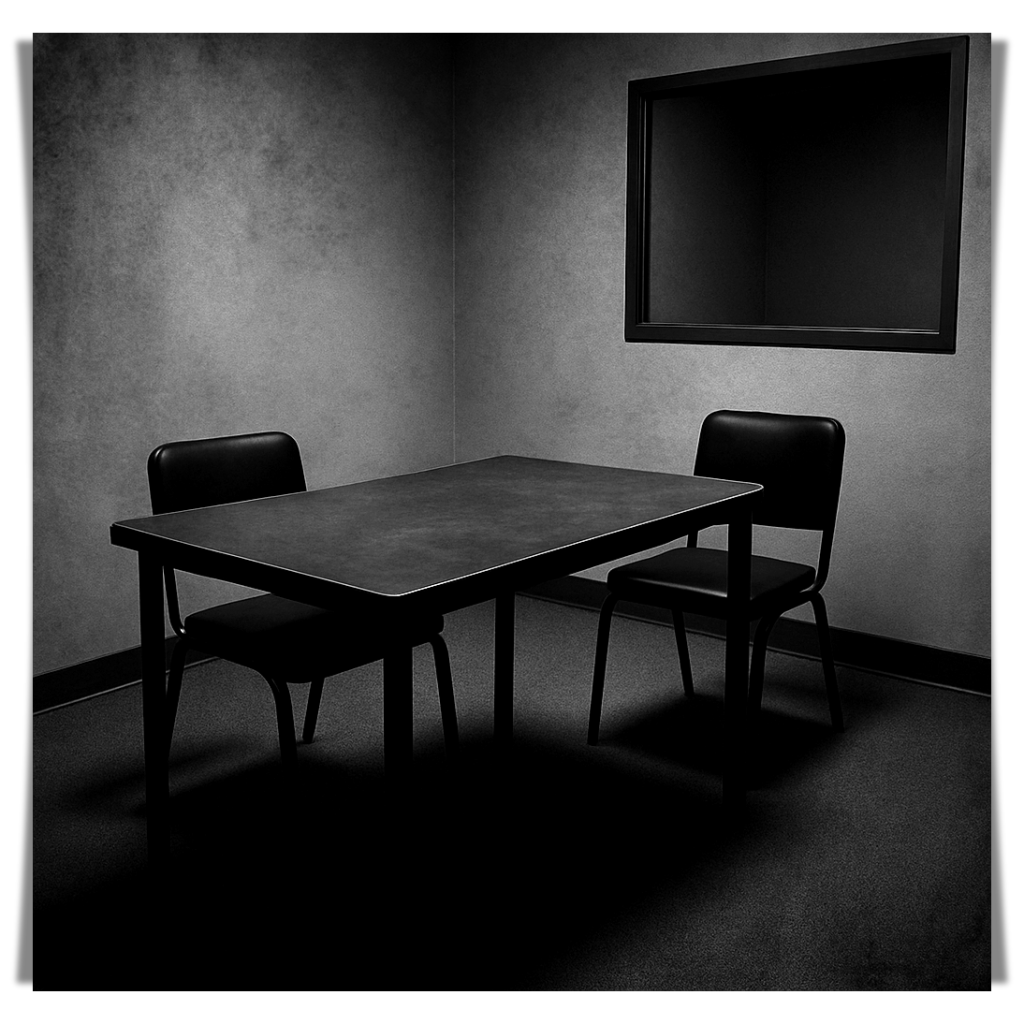
I can see it clearly, even though I’ve never been inside. The walls are bare and dull gray with faint finger prints on the paint from palms dragged in terror, boredom, or defiance. A single table in the center with uneven legs. One chair on each side but only one feels in charge. 

I imagine the air stale with breath and the absence of sunlight. There are no windows to the outside world. Only a dark pane of glass on one wall. He knows they’re watching. He doesn’t care. His focus is always here. This is a space where people stall, spin, crack, or burn. 

He sits across from them. Calm. Still like the river at dusk before swallowing the last light. He doesn’t raise his voice. He waits and lets them fill the silence with their own guilt. Lets them fidget, lie, and repeat themselves. Lets them feel uncomfortable about what they said. 

There’s always a file in front of him. Sometimes it’s closed. Sometimes it’s open to a photo or a sentence scribbled in red. He doesn’t look at it much. He stares at them, watches how their jaw moves, how they scratch their nose, and how their eyes dart to the door when they think no one’s watching. 

I wonder if he thinks of the victim while he listens. If he remembers the angle of the neck, the bruise on the cheek, and the time of death. If he keeps those pieces in his pockets like charms, reminding him of who he’s really speaking for. 

In my people’s old way of life, truth wasn’t pried out in rooms like these. We invoked Ini Andan, the goddess of justice, and waited for signs. Now there are only fluorescent lights and CCTV. The ritual remains the same. Watching. Listening. Putting the soul on a scale. 

He doesn’t need to catch them lying. They’ll hand it over eventually. Little by little, like decaying meat falling apart in their hands. 


Note:

I’m still working through two more fragments—The Victims and The Walk. They’ll come when they’re ready, and together they’ll complete this small sequence of obsession.


Copyright © Olivia JD 2025

All Rights Reserved.
I write about Iban culture, ancestral rituals, creative life, emotional truths, and the quiet transformations of love, motherhood, and identity. If this speaks to you, subscribe and journey with me.
Sarawak Folk Noir | Red Eyes at the Ara Tree

This story was inspired by a real event, a memory from my childhood. I’ve always loved noir—the sense of dread, the fatalism, the uncertainties, and the things left unsaid. But I couldn’t find any noir stories told in an indigenous voice from Borneo. So I wrote my own. Red Eyes at the Ara Tree is what I call Sarawak folk noir. It carries the core tenets of classic noir: unseen forces, a haunting past, and the slow unraveling of certainty; but roots them in a rural, post-colonial setting where belief and memory still shape the edges of reality. There is no detective here. Just a child, and the adult they become, trying to make sense of what cannot be explained. The crime is an intrusion of something ancient and watching. It’s of the unknown stepping into an ordinary life.


When I was seven years old, we lived on top of a hill in a government housing complex. It was a modest row of boxy flats nestled along the slope, built for civil servants like my dad. Thick jungle pressed in from all sides. People said that years ago, communists camped all over this hill and the jungle beyond it. I guess that rumor was true because one afternoon while I was playing near the black drain, I saw a group of soldiers going down the hill. The town lay below. It was quiet during the day, but after nightfall, it was ghostlike, as if it had shrunk back to the edges of the footpath at night. 

My parents kept chickens and grew vegetables like kangkung, changkok, and daun ubi in our small backyard. There was always the smell of dirt, raw chicken feed, and shit in the air. My siblings and I played barefoot in the yard after school, with the red earth staining our soles. Life was simple and boring back then, until it wasn’t.

There was an ara jejawi tree about three hundred meters down the road, on the slope of the hill. People said these trees were old, too old, and not all of them were empty. Spirits dwelt in such trees. They were not necessarily bad, but never to be disturbed. The tree was huge. Its roots stretched over the earth like petrified pythons. In the afternoons, the tree cast wide shadows that spread to the road. Every family on the hill passed it on their way to town. Most of us walked faster around it or crossed to the other side of the road. Some others, like my mom, muttered short prayers. 

Our kitchen faced the ara tree. There were two doors at the back. One was a solid wooden door with a metal latch, and the other a lighter screen door made of wood and mesh. We usually left the solid door open so the air could move through, but we kept the screen door closed to keep mosquitoes and flies out. I never gave that door much thought. It was simply part of the kitchen, like the tiled counter or the creaky faucet. 

That night, everything was normal. It hadn’t rained for weeks. The heat lingered on your skin long after the sun went down. The cicadas were shrieking in the trees, and the chickens were quiet. We had dinner. My dad was at the head of the table, my mom was next to him, and the rest of us were spread out around the small table. My eldest sister sat right across from the screen door, looking out to the backyard and the ara tree beyond it. 

I remember my spoon scraping the bottom of the plate. My mom asked if anyone wanted more sambal belacan. Someone knocked over a cup and somebody wondered out loud who would win the WWE match later tonight. My sister stood up to get another helping of rice.

She paused. 

That’s what I remember. Her hand hovered above the rice cooker. Her face had gone still. Almost blank. She didn’t utter a word. She shifted her gaze and quietly scooped her rice and went back to her seat. The conversation went on. None of us noticed anything strange. Not then. 

She didn’t say a word until later, when we were in the living room and the dishes were clean. My dad had switched on the TV to watch the evening news and my brothers were bickering about whose armpits stank the most. 

She said she had seen eyes. Big, red, staring right at her from the ara tree. Right through the screen door. The eyes didn’t blink or move; they grew. Larger and larger with radial blur around the edges. Even while they stayed still, it appeared like they were getting closer. She swore they pulsed, like slow breathing. 

We didn’t speak for a long time after she told us. My mom told her not to bring it up again. That night my dad closed the solid kitchen door and pulled the bolt tighter than usual. No one complained. 

The next morning, it was a Tuesday and like any school day, we got up early to go to school. However, my sister complained of feeling chilly, though her skin was hot. My mom instructed her to stay home and prescribed Panadol. By afternoon, her temperature continued to rise. Her brow was sticky with sweat and her eyes couldn’t focus. Her appetite disappeared. She lay curled on her thin foam mattress, sweating and mumbling, eyes drifting in and out of focus. The doctor called it a viral fever and sent her home with Panadol. But after two more days, my parents started asking around and were given a number to contact. He was a manang who lived in a village near the town. 

I remember the manang arriving late in the evening, when it was a little cooler. His rusty white Corolla E70 arrived at precisely 7PM. A balding man with two beady eyes emerged from the car. He shook hands with my parents and my dad invited him in. He didn’t say much. He took off his sandals at the door and nodded politely at us. One of my brothers started to point to a strange-looking bag he was carrying on his back. It was an old wooden cylinder bag that looked more like a box—lupong manang, his healing kit. I had never seen one before, but I knew better than to ask. 

The manang sat next to my sister and opened his bag. Inside were small vials of various sizes, each one containing suspicious-looking liquid. A smooth stone that sparkled under the light—batu ilau—my mom whispered—and a small bundle of dried plants, a small bowl, and a white armlet. He softly murmured words I couldn’t understand and touched my sister’s forehead. 

My parents prepared a piring on a tray with betel nut, leaf, tobacco, glutinous rice, salt, two chicken eggs, and a small glass of tuak. I don’t remember how long he stayed because I fell asleep halfway through the strange healing ritual. But by the next morning, her fever had subsided. It wasn’t completely gone, but it seemed like something had finally released its grasp. 

The fever broke after five days. My sister woke up as if from a long dream. She never talked about the eyes anymore and refused to sit in that chair again. No one wanted to sit at that chair so we ended up squeezing on one side of the table, our elbows touching as we scooped food into our mouths. And after that, every time we drove by the ara tree in dad’s mung bean green Datsun, she would look at the miding sprouting above the bush along the road and never ahead.  

After all these decades, it’s likely that the tree is still standing. I never returned to that town, though my siblings had visited on their various work trips. None of them bother to check on our old neighborhood or the ara tree. The last time I looked on Google Maps, the area had been cleared and developed. More houses and buildings. The surrounding jungle is still there, but less menacing, somehow tamed. Even now, as an adult, I don’t try to explain it away. Maybe the fever would’ve broken on its own. Maybe the manang did nothing at all. But something changed that week—and I’ve never looked at shadows the same since.

Whether the tree still stands or not, in my memory it always does. It stands motionless with its thick trunks and aerial roots guarding its inhabitant.

Watching. Waiting. 

Note:

  • Kangkung – water spinach
  • Changkok – pucuk manis (popular leafy vegetable native to Southeast Asia
  • Daun ubi – cassava leaves
  • Ara jejawi – banyan tree
  • Sambal belacan – shrimp paste
  • Manang – shaman
  • Lupong manang – shaman healing/medicine kit
  • Batu ilau – divining stone used by Iban shamans during healing rituals.
  • Piring – offering
  • Tuak – rice wine
  • Miding – a type of fern, Stenochlaena palustris, a popular edible plant in Malaysia and other Southeast Asian countries.

I write about Iban culture, ancestral rituals, creative life, emotional truths, and the quiet transformations of love, motherhood, and identity. If this speaks to you, subscribe and journey with me.

Flash Fiction | Before the Sun Takes Me

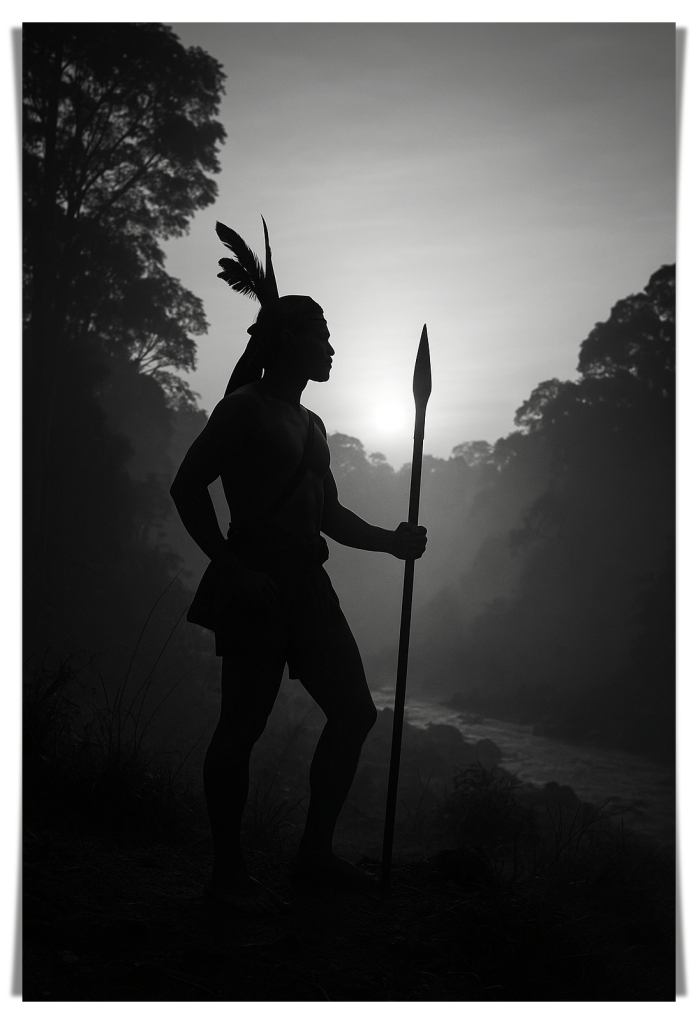
The night sky stretched out like a thick dark veil that would never end. The stars blinked, their usual brightness faded, seemingly taking the brunt of the choice I had to make. My warriors remained silent. Their eyes were full of trust in me. And yet, my heart roared with doubt. 

The dream from the night before clung to me like a second skin. Kumang had appeared. Her face sorrowful and her voice clear: “Do not strike at dawn. To do so would mean your death.”

I was raised to heed such signs. Dreams are not dismissed in our way of life. They come from the realm above the sky, Panggau Libau and Gelong, where spirits still keep watch and gods whisper their warnings to those willing to listen. 

But how could I pause now? I am Aji Apai Limpa, son of Dana Bayang. I carry the weight of my lineage and the blood of warriors. I have a duty to protect our land from those orang putih who pretend to come in peace but seek to conquer it. The White Rajah’s men moved through our rivers and jungles like relentless mold beneath the rotten bark. I had promised my people to fight back. 

Doubt wound around me like a snake, growing tighter with each passing second. I thought about each consequence carefully. If I held back, people might think I was weak and couldn’t handle the challenges of war. And yet, to march forward meant possibly embracing the death that Kumang had warned me of. It’s not just my life but the lives of those who depended on me for safety. 

The fire beside me crackled softly, radiating out small bursts of warmth that couldn’t reach the cold in my bones. I thought of my father and the things he taught me. I could almost hear his voice now. “Son, a leader’s strength isn’t measured by how loud he yells or how many people he kills, but by how deeply he listens to the land and the spirits.”

There was only silence tonight.

I stared into the embers and saw our longhouse. The ruai filled with children’s laughter. I saw the old ones with rheumy eyes by the bedilang, telling stories even as war crept closer. I saw my people, worn out and wounded but still holding on. Could I really ask them to wait and trust in the dreams and omens that only I heard and saw?

I thought of Kumang’s face again. Her expression softened and a gentle acceptance shone in her eyes. Was she trying to test me? Did she see the path that I couldn’t? Or was this simply the fate of every leader to make choices in the shadows? 

I looked to the heavens for answers but none came. There was only an unrelenting silence. The river sprang to mind. It doesn’t resist the earth but bends and curves, following the land it loves. Maybe this was the lesson Kumang wanted to teach me. Sometimes strength is not found in striking but in knowing when not to. 

Still, I couldn’t look away from what the morning would bring. I couldn’t stop seeing flames that had burned our longhouses and fields. I’m haunted by the blood and the lifeless bodies of my warriors. I couldn’t ask my warriors to retreat into silence when everything within them was ready to rise. 

I gripped my sangkuh, finding strength on its solid surface. Death is never far from a warrior. If Kumang’s vision was true, my demise awaited me at daybreak. But what about it? My life has never been mine alone. It belongs to this land, the spirits, and the people who look to me for courage. 

Still, doubt gnawed at me. Would my death make any difference? Would it make my men fight harder, or would it break their spirits, making them vulnerable to the enemy’s advances? Such questions couldn’t be answered tonight. 

I closed my eyes and prayed for the strength to choose. I got up when the horizon began to pale with the morning sun. My men stirred and looked at me. No one said a word. They only waited for my voice. 

I took a deep breath, letting the air of our land fill me one last time. 

“Kitai mupuk udah makai pagi,” I said. The words tasted bitter. It carried the sorrow of defying a goddess. But these words were mine and the resolve of a man who had chosen. 

I looked up at the sky one more time as the warriors were getting their weapons ready. I half-expected to see Kumang’s face among the clouds. But there was only the rising sun shining over the land I loved. 

I would meet it standing, no matter if it marked my beginning or my end. 


Footnote:

This flash fiction is inspired by the life of my great-great-great-grandfather, Aji Apai Limpa, a well-known war leader of the Iban people of Borneo in the mid-nineteenth century. From 1854 to 1858, Aji commanded his warriors in resistance to the White Rajah’s forces. He died in a fierce battle at Sg. Langit (Langit River) in 1858. Aji’s courage and valor have been immortalized in Iban poetry, which is passed down through generations by bards.

The Iban people of Borneo were traditionally animists, believing that spirits, animals, nature, and other aspects of the earth are living and interrelated. Even though most Ibans are now Christians or Muslims, animist ideas are still very much a part of our traditional beliefs and customs. One of these traditions is augury, which is the practice of interpreting god’s signs based on the behavior of certain birds that are thought to be divine messengers. Along with dream interpretation, augury is an important part of Iban divination. These practices are based on a way of thinking that sees the sacred in nature and gives guidance and warnings to those who can read its signs.

Translation of Iban words

  • Ruai: the communal open area or covered verandah that runs along the length of a traditional longhouse.
  • Bedilang – hearth
  • Sangkuh – spear
  • “Kitai mupuk udah makai pagi” – we make a move after breakfast
  • Kumang – a supreme goddess of the Iban from the realm above the sky, Panggau Libau and Gelong
  • Orang putih – white men

Fragments of Obsession III

Obsession is not just in longing; it’s also loving him in fragments. Here’s a series of short fragmented thoughts about him—scattered images, sensations, memories, desires. They are pieces of my obsession.

Part one – Fragments of Obsession | Part two – Fragments of Obsession 2

Image source

  • His hair gently brushing his forehead, blown by the fan as he sleeps on our bed.
  • Him standing on the kitchen sink washing the dishes after dinner. The slope of his bare shoulders, the muscles on his back, the scratches I made, naked except for his dark boxers.
  • The way he hums as he unloads the laundry.
  • He sits on the couch, shirtless, scrolling through the reels, smirking, chuckling depending on what he watches.
  • His prolonged silence after I uttered some cutting remarks.
  • The way my eyes drift lower, tracing the shift of fabric, wondering what lies beneath.
  • As he passes me on the way to the bathroom, I reach out, my fingers grazing over him in a teasing touch.
  • The curve of his shoulder in the half-light when we took a nap in the afternoon.
  • The way he stares at me, intense and serious, before he smiles.
  • The way his voice cracks when he’s tired, rough and tender at the edges.
  • The smell of earth and salt on his skin after rain.
  • As he shifts in his sleep, the fabric rides up, revealing just enough to make my breath catch.
  • The smell of his skin after a shower.
  • His hands, always his hands, calloused and tender, mapping my body in the late afternoon while the curtain gently blew by the breeze.
  • His gentle snores, and sometimes he snorted while sleeping. Depending on how tired I am, it either amuses me or annoys me.
  • The way he looks at me when he thinks I am not watching.
  • I gently kiss his scars on his arms and chest.
  • The taste of his lips.
  • The heat of his body against mine. The weight of his arm across my waist while spooning.
  • The sound of his key in the door. I could hear it jangle as he exited the lift.
  • The shadow of his stubble in the morning.
  • The sound of his footsteps faded down the hall.
  • The way he holds my legs and rests them on his shoulders, his breath mingling with mine as we dissolve into one another.
  • The way his mouth finds me, his tongue teasing, drawing a gasp from my lips.
  • The way he looks at the ocean and squeezes my hand gently.
  • The way his eyes turn dark after a desperate “I love you” right before he shatters.
  • The way he says “look at me” right before I unravel.
  • The way he moves through a room.
  • His pain and grief over the people he couldn’t save.
  • The emptiness he leaves behind, a hollow I carry with me, a shape I can’t stop trying to fill.

Copyright © Olivia JD 2025

All Rights Reserved.

Fragments of Obsession II

Obsession doesn’t always announce itself. Sometimes, it exists in the way his fingers grasp my arm and let go too slowly, or in the way I watch him without speaking. It’s in the moments I don’t say aloud. The glances stolen across a dinner table, or the scent of his cologne in a silent car ride home. I don’t need to explain this love. I only need to describe it—as it exists in my memory, in my body, in every small, quiet way it consumes me.

Part one – Fragments of Obsession

Image source

I didn’t like the things he said to me, so I retorted. He stared at me, raised his cup to his lips, and kept eating. We continued to eat amidst the clinks of cutlery and conversations around us. We finished our food, got up from our chairs, paid for it, and left. The air was balmy as we walked to the car. Nothing moved, not even a leaf. He switched the ignition; I reached for the AC, and seconds later, the radio. The DJ chattered on about a celebrity’s antics that I had no interest in, but I listened intently. When the ad came on, I kept listening. It was a promotion for a new fragrance. I thought about my almost empty perfume bottle at home. I glanced his way, taking a quick look at his jaw, hair, nose, lips, and eyes. Especially his eyes. He navigated the traffic cautiously, signaled before switching lanes, and braked when he needed to stop. The DJ continued to talk, the AC continued to hum—diffusing the heat between us.


It was late evening. The sky was deep navy, and the moon peeked gently over the clouds. I didn’t expect to see the stars, but a few dotted the sky. We had been sitting on the park bench right after leaving the cafe. We were in no rush to go home, though it was getting late. He wanted to walk me home, and I said okay. Trees lined the street. Their branches swaying softly in the breeze. Suddenly I misstepped slightly on the uneven sidewalk and stumbled. His hand darted out to steady me. His fingers wrapped around my arm, and he asked if I was okay. His grasp was firm, and after ensuring I was alright, his grip loosened but lingered slightly longer than necessary. I didn’t say anything but continued to walk, secretly hoping I would stumble again.


I love him so intensely that it aches. My heart clenches at the mere thought of him—and I think of him constantly. Never in my life have I experienced such overwhelming love for someone. Never did I believe such a love was possible. I don’t even know how to put my feelings for him into words, but I’m trying. Maybe not by proclaiming to the world how much he means to me or delving into philosophical debates about the nature of our love. My own thoughts feel jumbled and incoherent, so why bother explaining them to anyone else? Instead, why not simply describe the love itself? Describe the actions, the moments, and the way it unfolds in my memory?

He rarely talks about his work. I know he analyzes criminal behavior and patterns, making critical decisions based on his findings. I know he works long hours and is often gone for days at a time. He spares me the details, and I never ask. Not because I don’t care, but because I don’t want to be the one to remind him of the darkness he faces. Still, I can’t help but imagine it.

On the days he is with me, I see his eyes—the shadows lurking in their depths that he tries to hide. Sometimes, he stares into the distance, to a place I will never reach. I hear his quiet sighs. And at night, when we sleep, I feel his muscles tense as he thrashes in his dreams. On nights like these, I gently grasp his wrist and call his name, coaxing him back to me. His forehead and brows are damp with sweat, soaking his pillow. He wakes, startled, before his eyes focus and relief washes over him. On nights like these, I hold him in my arms, rocking him like a frightened child. He clings to me without a word, and we stay like that until we fall asleep. On nights like these, I pray—shamelessly, desperately—for God to pull him from the abyss, from demons I can neither see nor fight.

Copyright © Olivia JD 2025

All Rights Reserved.

Fragments of Obsession

What began as a single moment never really left me. It lives in fragments of touch, of distance, of memory, and of time.

Image source

There are days he couldn’t come to me. He is always needed wherever he is. He analyzes patterns, behaviors, minds. But does anyone truly know him? On the days he is with me—the late evening light reflected on his disheveled hair. The contour of his tired shoulders. His long, calloused fingers. His moans echo in the shadows.


The light around him softened his expression into something tender. One hand held a book, the other blindly traced the tabletop. I paused mid-sentence, staring. His brows furrowed, his gentle eyes on the page. At that moment, my heart found shelter after endless wandering. He sensed my gaze and glanced up. Our eyes met—just for a moment—before he shifted away.


This is one of the nights when the apartment feels damp and cold. Thoughts ran through my mind while washing dishes, doing the laundry, and folding our clothes. Is he tailing someone right at this moment? Has he eaten? I tried listening to the audiobook, but nothing felt right. This book is too wordy. That one has a flat narrator’s tone. I closed the app and scrolled through YouTube to find a playlist to match my mood. In this playlist, the songs are too catchy. The other playlist is too sappy. I disconnected my earbuds and put my phone away. Even with all the lights on, the room feels darker. How many hours before tomorrow comes?


His hands are a map of everything I cherished. His light tan hands have carried pain and tenderness in equal measure. They have wielded weapons, sifted through crime evidence, cuffed wrists, and tenderly stroked the deepest part of me. His fingers are long and tapered; half moons peeked on his trimmed nails. Sometimes I noticed faint traces of blood and grime. When they brush against my skin, it’s like the first ray of sunlight after a long, cold night. His hands have built and mended, held and released. They’ve cupped my face, traced my curves, and held me in place. They’ve wiped away my tears and made obscene gestures in moments of anger or to stir my laughter. When I think of his hands, I’m reminded of the roots of the ancient trees or the ocean with their endless ebb and flow pulled by the moon.


The bed now is just a bed. The sheets are now crumpled into hollows that hold the shape of him. I run my fingers over the fabric and the pillows. They still smell faintly of his skin and the faint, sharp tang of his cologne. I press my face into it, trying to hold onto what’s left, but the scent is already fading. The white walls have absorbed the echo of his voice. The door clicked shut with a finality and stays closed until he returns. On the table, his cup sits lonely with the faint imprint of his lips. I leave it there to become a relic of our morning. His jacket hangs on the back of the chair, slouched in a way that feels so like him, as if it might come alive and shrug itself back into motion. The room has exhaled. It has moved on and is settling into the rhythm of my day, one that doesn’t include him.

Copyright © Olivia JD 2025

All Rights Reserved.