People typically consider cultural preservation to be something that is conducted on a large scale. It is generally placed in the context of institutions, archives, or official documents. But it can also happen on a smaller, personal scale.
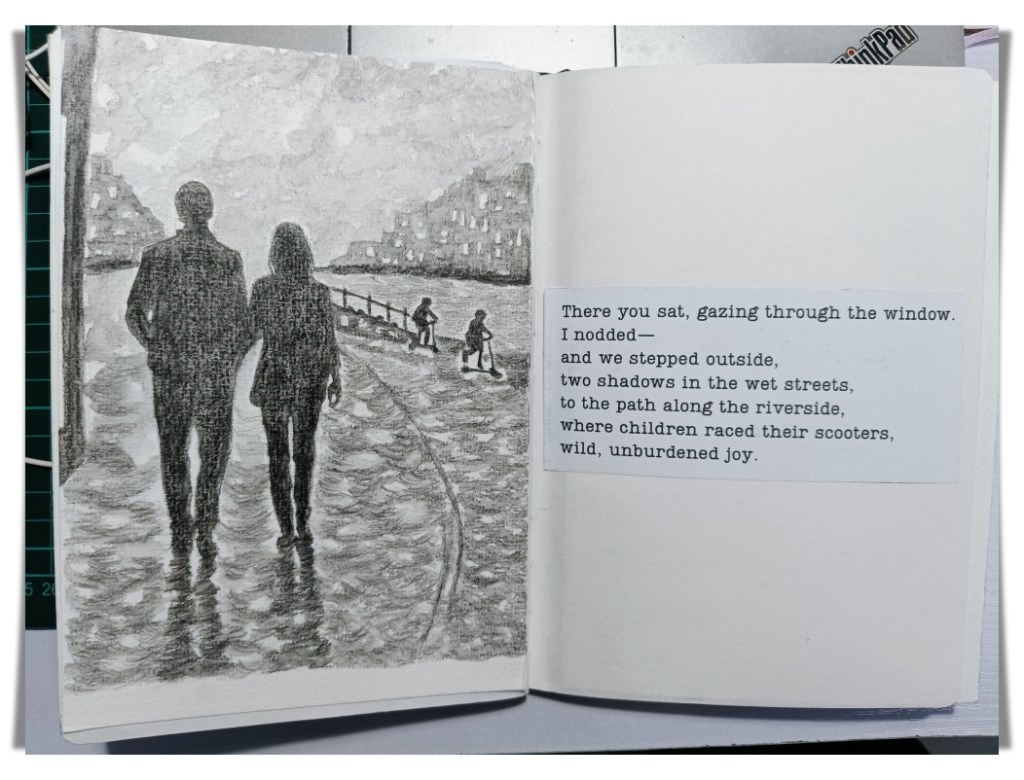
I have been making a series of handmade zines that are based on Iban culture and history. Each page of these zines pairs a drawing with a text of information or a poem. The drawings are hand-drawn, and the pages are put together painstakingly, one at a time. Every decision, from picture placement to word space, needs to be carefully considered. The whole thing is done entirely by hand.
While working on these pages, I learned that preservation is more than just keeping information intact. It also has to do with how that information is passed on. The information in these zines is not new. They have been told before, and they exist in oral histories, family accounts, and old literature. What I do is simply place them into a different form.
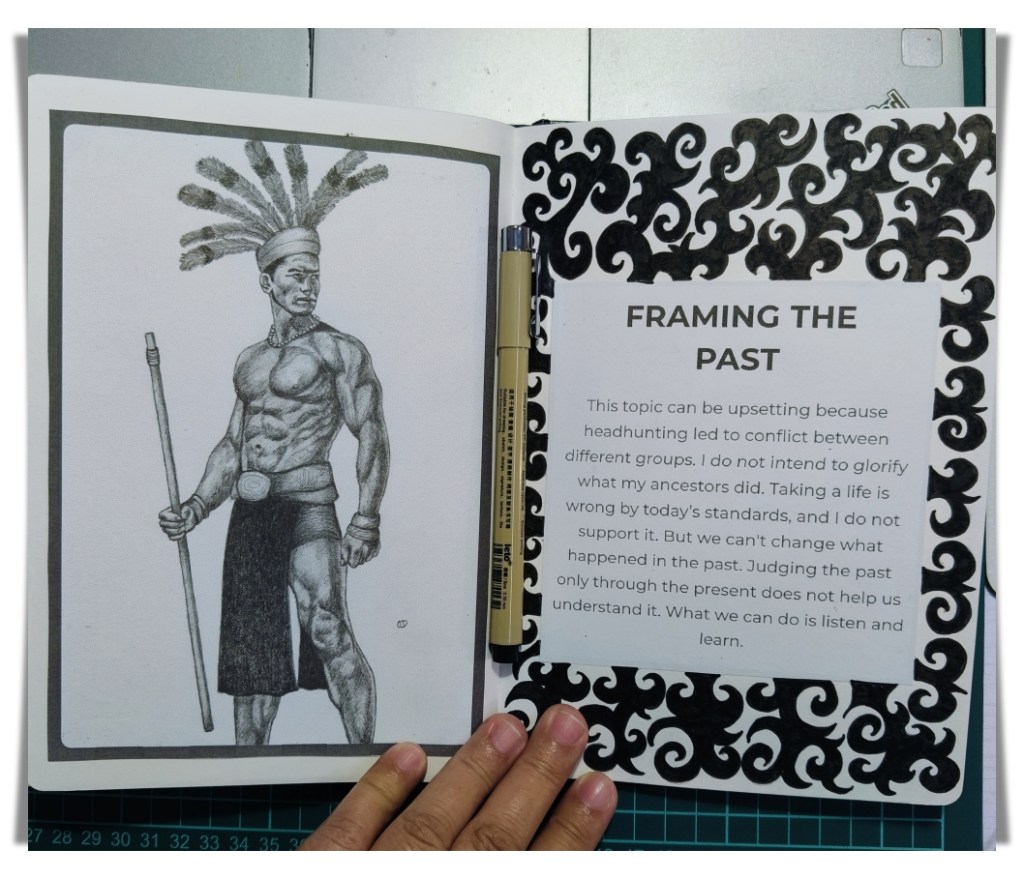
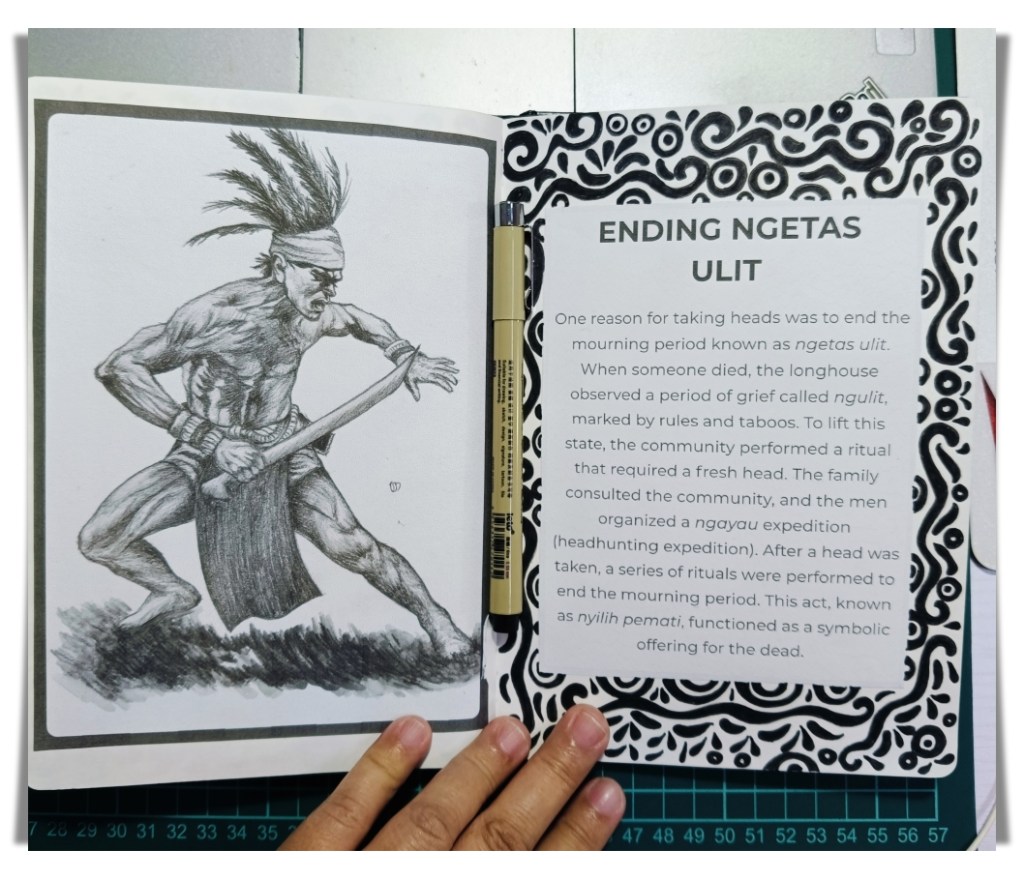
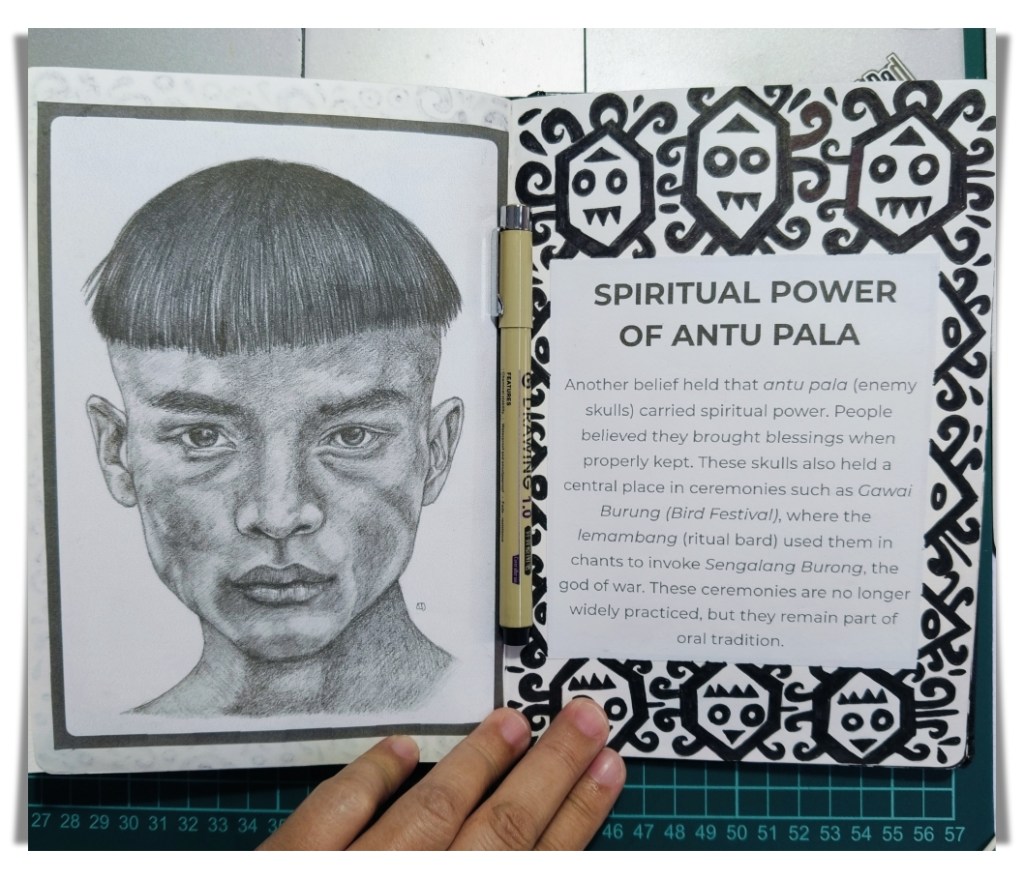
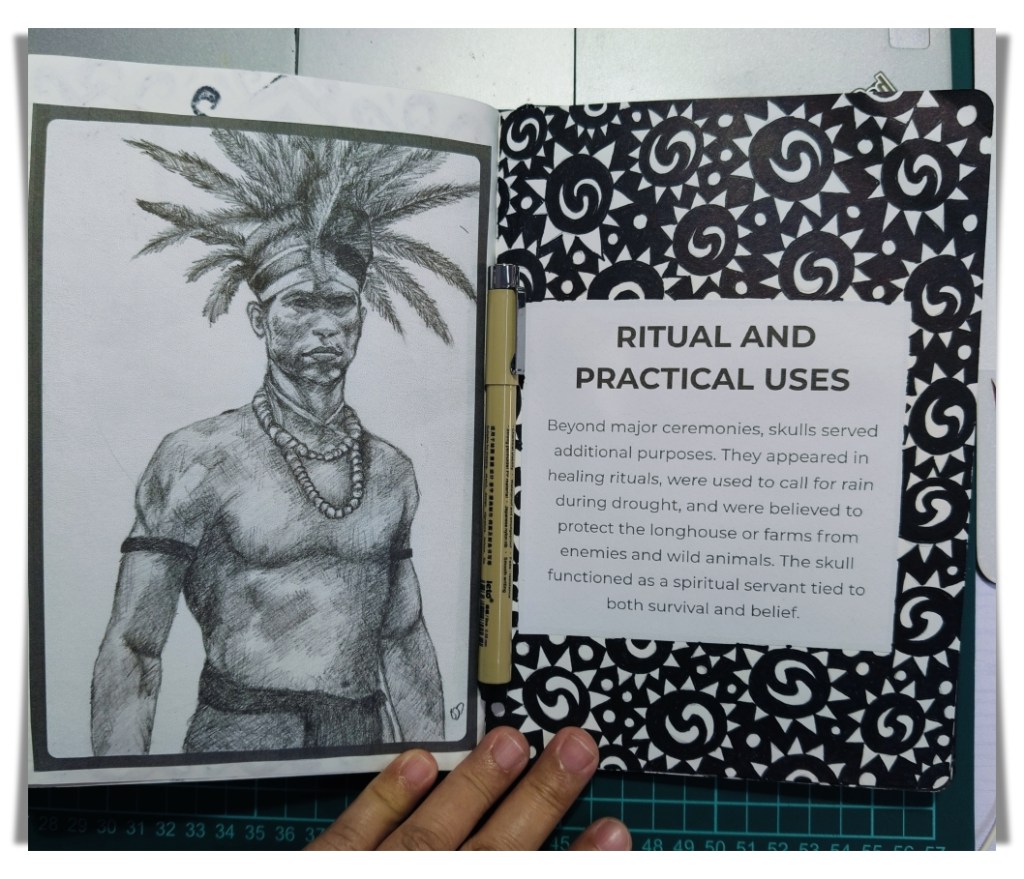
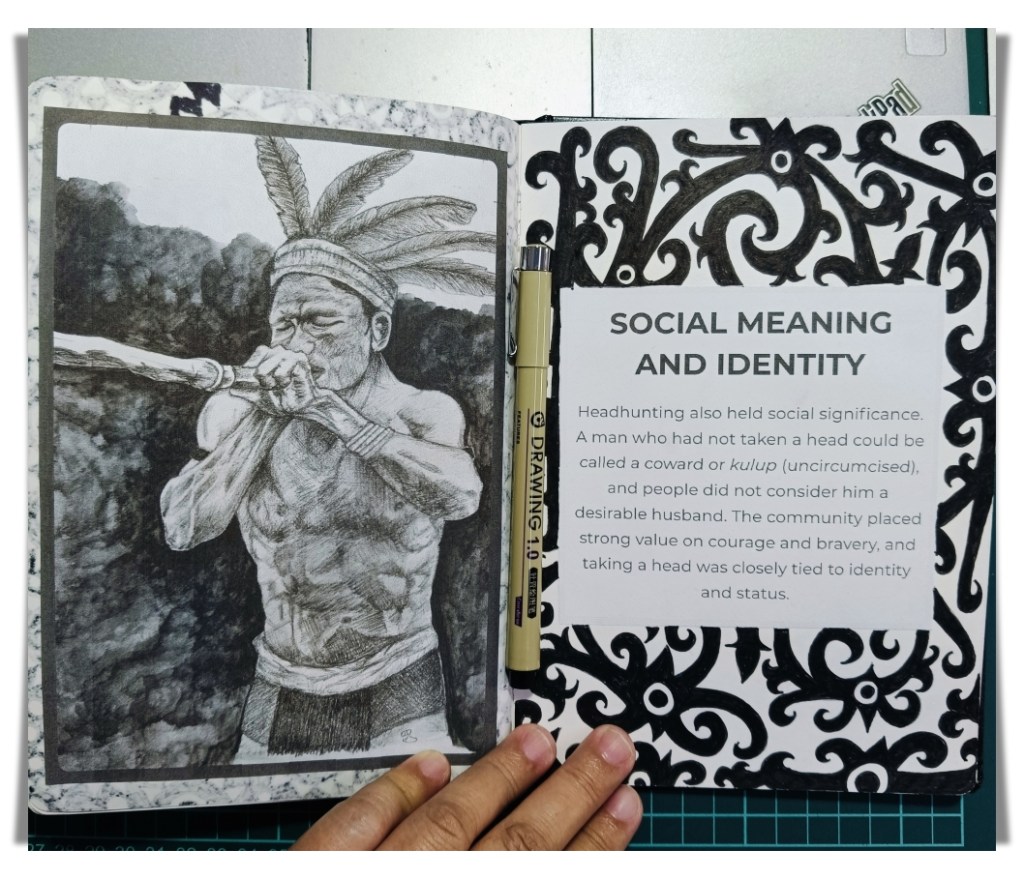
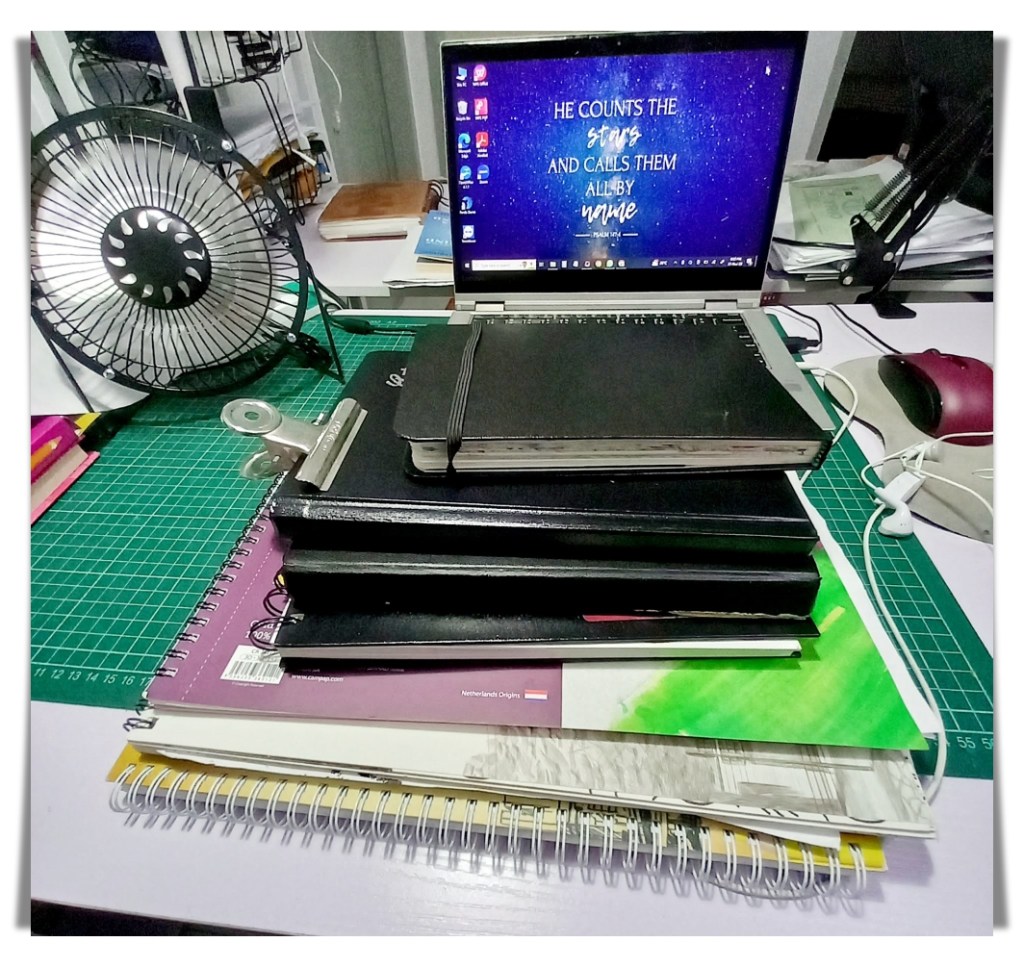
For instance, in these sketchbook pages, I talked about why the Ibans practiced headhunting in the past. It’s a difficult topic that people often misunderstand or only see one side of. I give it context instead of simplifying it. Each section describes a specific reason or belief and is paired with a hand-drawn drawing of an Iban warrior instead of an abstract idea. When I draw, it influences how I feel about the subject. When I sketch a figure, I pay attention to details that I would otherwise overlook.
This zine doesn’t attempt to be a full record of the Iban history. It keeps some parts of it. The imperfections in the pages are part of that process. They show that it was created by hand, with time and care. In this regard, preservation isn’t only about accuracy or completeness. It’s also about continuity, working with it, and allowing it to exist again in the present.
I write about Iban culture, ancestral rituals, creative life, emotional truths, and the quiet transformations of love, motherhood, and identity. If this speaks to you, subscribe and journey with me.
The ceiling fan’s constant, repetitive whirring used to fade into the background. But I notice it more these days, like everything else that is going on around me. I have noticed that the price of raw food at the wet market has increased slightly, goods everywhere have also become more expensive, and my Ringgit seems to disappear faster than it used to. I sit here on my desk staring at my screen. The familiar Web3 blogging interface is staring back at me. This site has been my digital home for the past 10 years. This platform rewarded my thoughts and ideas with cryptocurrency. However, the value of the reward has declined steadily lately.
I’ve been trying to make sense of it by connecting the news about happenings across the world with the worry I feel when I look at my bank account. The news articles I read today helped me understand the situation better. It explained that the volatility I’m sensing in both the global oil market and the cryptocurrency space isn’t a coincidence. It is part of a larger change.
The war between the US and Iran has disrupted the global oil supply. Markets respond to current events and what they anticipate could happen in the future as tensions increase in the Strait of Hormuz, where 25% of global daily oil consumption passes through. I can see the Strait of Hormuz on the map. It’s a tight chokepoint half the world away, but I can feel its impacts here on my desk. This uncertainty pushes oil prices up. In Malaysia, the effects are both softened and more complicated. We earn revenue from crude petroleum through PETRONAS, but we also import a significant amount of refined petroleum products from other countries. Higher import costs partly offset the increased revenue, while subsidies exert additional pressure on national spending. The result shows up in groceries, in transport, in daily life.
This environment also has an effect on another aspect of life. As global instability rises and inflation stays elevated, central banks keep interest rates high. When interest rates go up, borrowing becomes more expensive, and money moves toward safer assets. In this environment, riskier markets like cryptocurrencies become less appealing. Cryptocurrency prices go down as money flows out.
I remember when I believed cryptocurrency was a means to insulate myself from economic instability and generate value outside of the traditional economy. Now it becomes a risky asset. It rises with confidence and falls with caution. Geopolitical tensions, rising oil costs, inflation that won’t go away, and tight monetary conditions are all to blame for the present crisis. These conditions tighten the flow of money into the crypto market. I feel it in my income.
I feel the impact of this decline more keenly here on Web3. Unlike bigger cryptocurrencies (Bitcoin and Ethereum) that are backed by institutional investors, the token I earned is mostly run by its community. Changes in sentiment and liquidity have a bigger effect on its value. When the market as a whole gets weaker, it declines more quickly. I have seen it drop from stable levels to much lower ones, and I see why the decline feels so severe.
The experience on the Web3 site is different for everyone. Despite the decline in token prices, the ecosystem remains structured to reward those who consistently produce high-quality content. The system seems unstable, although certain aspects of it keep working behind the scenes. This is what keeps my income stable for now. Even if its value has declined, my high-quality writing and art, engagement, comments, and curation still bring in a little bit of money.
This situation has been a daily worry for me. I am a Malaysian woman, a mother, and a creator. As fuel costs go up, my expenses go up too. At the same time, my earnings that come from cryptocurrencies become less stable. Both sides are shifting at the same time.
In this situation, writing, creating artwork, posting, and engaging with the Web3 site community has become a way to adapt. I focus on keeping things moving steadily instead of hoping for quick growth. To cover my daily expenses, I have started converting my tokens into USDT and some into Ringgit even when the value is low. I am also looking for other streams of income, like turning old writing and artwork into physical products that I sell on various local and international markets. It is my way of connecting an uncertain digital economy with a more stable one.
This leads to a process of adjustment. Global events are changing the way economies and people work. Prices for oil go up, inflation follows, interest rates stay high, and risk markets shrink. As this contraction goes on, smaller Web3 systems grow weaker, yet they continue to function at a lower value.
This moment is a transition for me and the pressure is real. I keep going even if I don’t know what will happen, since if I quit, I will be more exposed to the same forces that are currently at work. What looks like a simple thing, just a woman typing at her computer, is actually a purposeful attempt to adapt to a world that is getting more expensive and less predictable. I keep writing and creating because it’s what I rely on the most in the middle of all this chaos.
I write about Iban culture, ancestral rituals, creative life, emotional truths, and the quiet transformations of love, motherhood, and identity. If this speaks to you, subscribe and journey with me.
The first hour of my day is quiet. The house is still asleep. I sit up in bed and reach for my phone. I tell myself I am just checking one thing. The time. Messages that arrived overnight. I hold the phone close to my face. The screen lights up the room. I scroll. I do not notice how long I stay there. It is already April. I turned 49 in February, and it has been almost two months. Lately I have been feeling like I am living in a fog.
I want to spend my time on meaningful things: reading, walking in nature, journaling, and reflecting. But somehow the hours slip away. I sit down to check one message, and then it is an hour later and I am watching a stranger argue about politics. I feel hollow afterward, as if I have given something away without intending to.
The word is “attention.” I am reading a book, Four Thousand Weeks by Oliver Burkeman. In one chapter it says attention is the beginning of devotion. Only with full focus can you truly love, care for, or experience something. I thought about my daughter telling me something sweet from her day while I nodded along, still scrolling. I let many such moments pass because I was too distracted. Am I even having these moments? The book asks: Can you have an experience you do not experience? That stopped me cold.
I knew social media was harmful. I knew I was the product being sold. But I did not fully understand that I am losing time. I am being systematically manipulated. The platforms use slot-machine psychology, variable rewards, and persuasive design. The author called it the “attention economy,” and we are the products, not the users. Their profits come from seizing our attention and selling it to advertisers. They track what I pay attention to, what makes me angry or afraid, and they feed me more of it. The author says we’re not even products anymore. We’re fuel like logs thrown on a fire and used up until there’s nothing left. They benefit from our resources, time, energy, and attention.
What struck me most is that the damage extends beyond the hour I lose on social media. It changes how I see the world. The book says social media distorts what we think matters, what threats we face, and how we see others. I have noticed I am more anxious now. More cynical. I catch myself assuming the worst about people, even friends whose politics I disagree with. The fear carries over to real life. And then I wonder: is this really me? Or has my attention been hijacked for so long that I’ve forgotten what I actually care about?
There is a line in the book about how attention cannot easily monitor itself. The only tool you have to see what is happening to your attention is your attention. If that is already captured, you may not notice anything is wrong. That was difficult to ignore. I have told myself for years that I am fine, that I am in control, and that scrolling is harmless. But what if that’s exactly what captured attention would say?
I also appreciated the honesty about our own role in this mess. The book says we give in willingly. Something in us wants distraction. I notice this when I sit down to write or draw. I feel restless. I often feel the urge to check my phone and deeply feel the need to do research on a topic. It feels like avoidance: avoiding solitude or being alone with myself. The distractions come from within, not outside.
There is also the political side. I see how outrage is rewarded. One scandal replaces the last, from the Epstein case to the US-Israel-Iran war. It feels difficult to have a grounded conversation. The book emphasizes this is part of the business model. I feel that deeply with steady exhaustion, yet I keep returning to it. I am tired of feeling like this. I am tired of feeling fractured. I would rather not look back in ten years and realize I spent my finite life scrolling through things I did not care about.
The chapter ends by saying political crises need political solutions, and we also need to understand our own role in this. I do not have a clear answer yet. But I can begin with admitting this: I am distracted and frustrated. I want to care about what matters to me. I want to want what I actually care about. And maybe by admitting it, it can be a perfect place to begin.
I write about Iban culture, ancestral rituals, creative life, emotional truths, and the quiet transformations of love, motherhood, and identity. If this speaks to you, subscribe and journey with me.
The first timeI saw him, it was raining. I was sitting in the corner of a small, quiet cafe that smells of burnt beans and old wood. I was busy with my notebook, trying to finish a thought, when the bell above the door rang. He looked like he had wandered in by mistake. His hair was damp, sticking to his forehead in uneven clumps, and his jacket was slightly oversized and hung off his shoulders. He looked like he had not slept in days. He didn’t stand out. He felt out of place in that cafe. I noticed him, then returned to my notebook.
The shift happened months later on a Tuesday evening. We were walking toward a bus stop, and the wind was biting. I was complaining about a lost pen, and he stopped walking. He did not look at me. He peered at a little crack in the sidewalk where a weed was growing. He reached into his pocket, pulled out a piece of candy, and placed the wrapper carefully back. He said, “Most people look at the sky when they’re lost, but the answers are usually stuck to the bottom of your shoe.”
After that, I began to notice him more closely.
He notices things that other people ignore. He can tell when someone is lying by the way their hand shakes or how the barista hides chipped mugs at the back of the shelf. In conversation, he does not speak in a conventional way. He observes. He waits for the silence to become uncomfortable, then asks a question that lands where it is difficult to respond. He says things casually, like “Life is just a series of things we survive until we don’t,” while chewing on a lollipop.
He often has something in his hand. A lollipop, a toothpick, a plastic stick. He keeps his mouth occupied so he does not need to smile. When he thinks no one is looking, he rubs his temples and stares into space with an expression of concentration. He looks worn in those moments, an exhaustion that sleep does not resolve.
He once told me, “Don’t bother remembering the things that don’t want to be found.” I return to that moment often because of how still he was when he said it. His eyes were distant, yet he seemed aware of everything around him. It felt like he was giving me permission to stop looking for parts of him he had chosen to keep hidden.
When I think of him now, I remember the smell of sugar and cold rain. He made me pause because he was the first person I met who seemed to be living in the aftermath of something significant, yet he never asked for sympathy. He existed within it and occasionally pointed out something he thought was worth mentioning.
If someone met him briefly, they would miss the sharpness. They would see a messy, eccentric man who cannot keep his hair combed and seems slow to respond. They might think he is lazy. With time, it becomes clear that he is always aware of what is happening around him and that he often knows what you are about to say before you finish your sentence.
If I had to describe what makes him unique in one sentence, it would be this: he observes things that most people ignore and keeps facing them, even when it makes him uncomfortable.
I write about Iban culture, ancestral rituals, creative life, emotional truths, and the quiet transformations of love, motherhood, and identity. If this speaks to you, subscribe and journey with me.
I came across The Dictionary of Obscure Sorrows several years ago. I found the Youtube channel first. I remember watching one video late at night. It was called Sonder: The Realization That Everyone Has A Story. The narrator’s voice was calm and unhurried. He described the word “sonder,” and I knew I had felt that feeling before but I couldn’t describe it. Here’s an excerpt taken from the book that describes sonder:
SONDER (the awareness that everyone has a story):
You are the main character. The protagonist. The star at the center of your own unfolding story. You’re surrounded by your supporting cast: friends and family hanging in your immediate orbit. Scattered a little further out, a network of acquaintances who drift in and out of contact over the years.
But there in the background, faint and out of focus, are the extras. The random passersby. Each living a life as vivid and complex as your own. They carry on invisibly around you, bearing the accumulated weight of their own ambitions, friends, routines, mistakes, worries, triumphs, and inherited craziness.
When your life moves on to the next scene, theirs flickers in place, wrapped in a cloud of backstory and inside jokes and characters strung together with countless other stories you’ll never be able to see. That you’ll never know exist. In which you might appear only once. As an extra sipping coffee in the background. As a blur of traffic passing on the highway. As a lighted window at dusk.
That word stayed in my mind and every time I’m out in the crowd watching strangers passing by, I would think of sonder.
Just like sonder, the rest of the words in that book describe small and specific experiences. They do not refer to objects or actions. They name moments that are easy to overlook because they do not demand attention. Reading them made me more aware of how much I move through life without naming what I feel.
Today’s prompt asks what I would want named after me. I thought about it for a while. I could not think of any place or object that felt right. Those things feel distant from how I experience my life day to day. And I do not relate to them in a meaningful way.
And I thought about the book. I would love to be an entry in such a book. A word feels closer because it can hold something that is lived but not always spoken. It can remain small and still carry meaning. It does not need visibility to exist.
I have been writing about living between places. I am Iban. I grew up in Sarawak, and I have lived in Kuala Lumpur for many years now. My life is here and I am raising my family here. I know the places, the roads, the routines, and the pace of this city.
When I return to the longhouse, I notice the difference. I’m fluent in Iban, but sometimes I pause to find the right word. The rhythm is familiar, but I am not fully inside it anymore. I am received with warmth, but there is also a sense that I have come from somewhere else.
That experience has remained with me, but it does not belong to a single location. It moves with me wherever I go. It shows up in small, ordinary moments like in the food I cook. In the stories I tell my children. In the way I think about the place where I come from.
Over time, I have come to see this as a connection that continues across distance. It is not always visible, but it is present. If I were to name that experience, I would keep it simple.
livselaka (n.) the quiet state of living between places, where connection remains even when belonging is incomplete
I write about Iban culture, ancestral rituals, creative life, emotional truths, and the quiet transformations of love, motherhood, and identity. If this speaks to you, subscribe and journey with me.
Most people don’t understand what it feels like to live between places. It is not exactly sadness. That is what I would want people to understand first. When they hear “between places,” they think of a wound, like a hole in the heart that never heals. That description does not fit. A “stretching” is more accurate.
I am Iban. My bones know the red earth of Sarawak. That is what my body recognizes first. But I have now lived in Kuala Lumpur longer than I ever lived there. I have a husband who grew up in Penampang, Sabah, and children who have only ever known this city as home. I pay the condo rent and fees. I navigate the highway to Puchong. I visit the Pasar Borneo in Seri Kembangan, where vendors sell dabai that has been flown in from Sarawak. My life is here but “here” does not feel like home in a complete way.
When I go back to the longhouse, I notice it in my cousins’ expressions. I am “the one from KL.” I speak the language, but sometimes the rhythm is slightly off. I have to pause to remember the right word for something I haven’t touched in years. I am welcomed, always, with warmth, food, and laughter, but there is a politeness to it. It’s a subtle sense that I am now a guest. My children, when they come with me, are treated with affection, but also with a gentle bewilderment. They are Iban, but they do not know how to be Iban in the way that is expected. I am no longer fully at home there either.
This leaves me in a scattered position. My identity is not a single point on a map. It is a thread that runs back and forth across the South China Sea. My children are the living proof of this stretch. Their identity extends across even more layers than mine. They are Iban-Kadazan by blood and suburban KL-ites by every lived experience. They eat nasi lemak for breakfast and request ayam pansoh or hinava for their birthday dinner. They speak English and Malay with a city accent and only understand a word or two of Iban or Kadazan. They are not disconnected from their heritage, I make sure of that, but they are also not rooted in it the way I once was. I see them working through their sense of being between places at school when asked where they’re “from.”
I used to feel guilty about this. As if I had not given them a single, stable foundation. I do not feel that way anymore. I have come to understand that geographical distance often reflects a connection, not a lack of it. I remain connected to my family through WhatsApp or Facebook.
Living between places means I am constantly translating language, meaning, belonging, and self. To my KL friends, I am the “exotic” one from Borneo, with the tattoos, living atop the trees, and the stories of the headhunter ancestors. To my family back home, I am the modern one, the city-dweller, and the one who left. Neither captures the full picture. The full truth is that I am both. People who have never left their home place might see this as a tragedy of loss. This misses something important. Staying in one place would have limited what I could carry with me.
I am not fully home in one place. The result is that I have made small homes in many. My identity is scattered like seeds. I am watching them grow, in my children and in the friendships I have built across this country.
It is a complicated way to live, but it is mine. It has made me capable of understanding something essential: that you can love a place deeply and still not belong to it entirely. That belonging can be a choice, a meal you cook, a story you tell, or a journey you make again and again. Many people do not understand what it feels like to live between places. But I do. And in that stretching I have found a form of wholeness I did not expect.
I write about Iban culture, ancestral rituals, creative life, emotional truths, and the quiet transformations of love, motherhood, and identity. If this speaks to you, subscribe and journey with me.
As I walked toward the bamboo grove, the morning air in Arashiyama was cool against my skin. At forty-nine, I have learned to cherish these quiet hours before the world awakens. I had risen before dawn, leaving my hotel while Kyoto still slept, hoping to find that peace between sleep and waking where the spirit feels most alive.
I am Iban, born in Sarawak, though I have lived away from my homeland for more years than I care to count. My journey has taken me far from my roots. I came to Kyoto for a brief getaway and to seek an elusive urging, perhaps a reminder that I am still connected to something larger than myself.
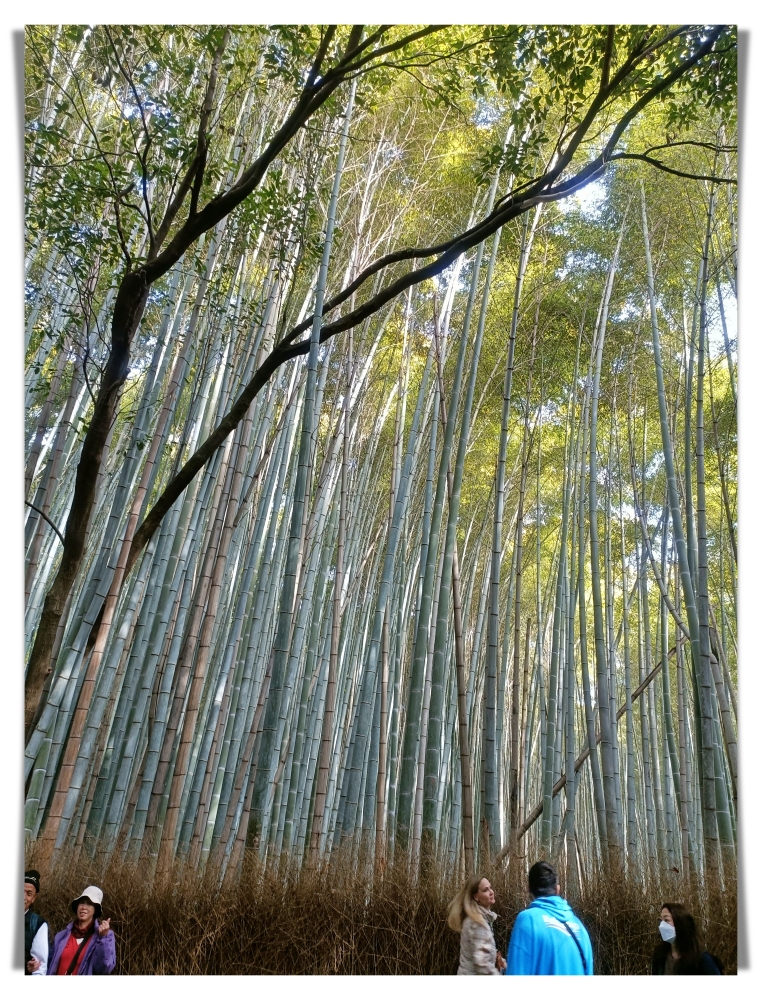
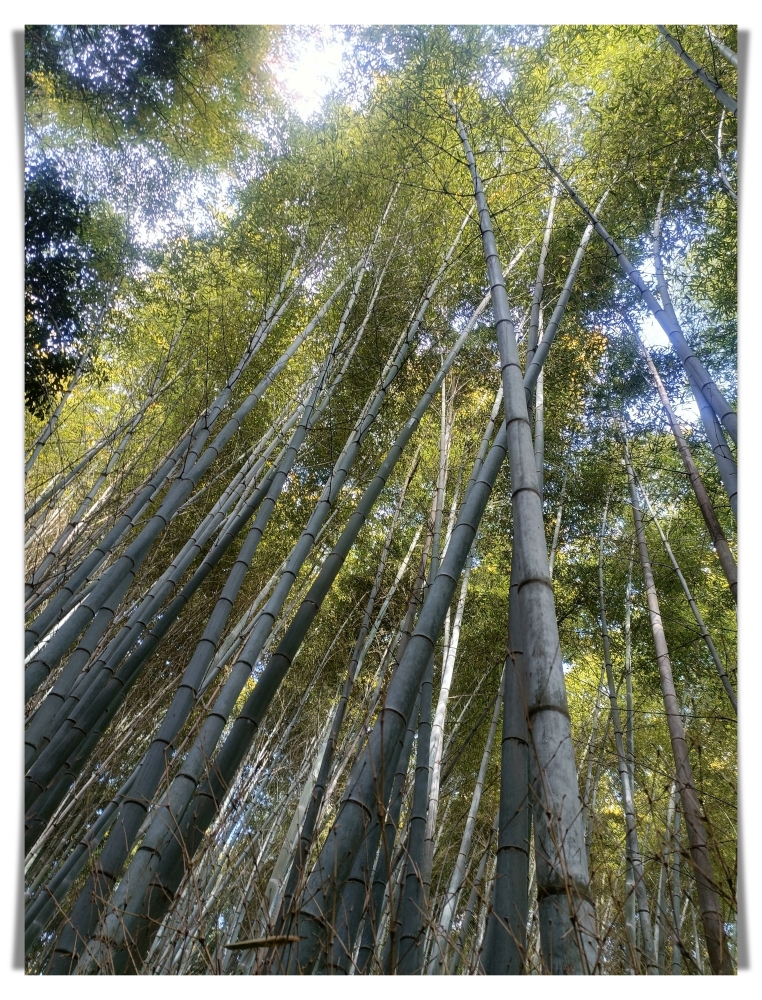
As I entered the grove, the first thing I noticed was the silence. Then the wind stirred. The rustling of the bamboo stalks, creaking and clicking against one another, filled the air with a sound so distinctive that the Japanese government has named it one of the “100 Soundscapes of Japan.” To me, it sounded like a longhouse at dusk, a murmur of voices blending into one.
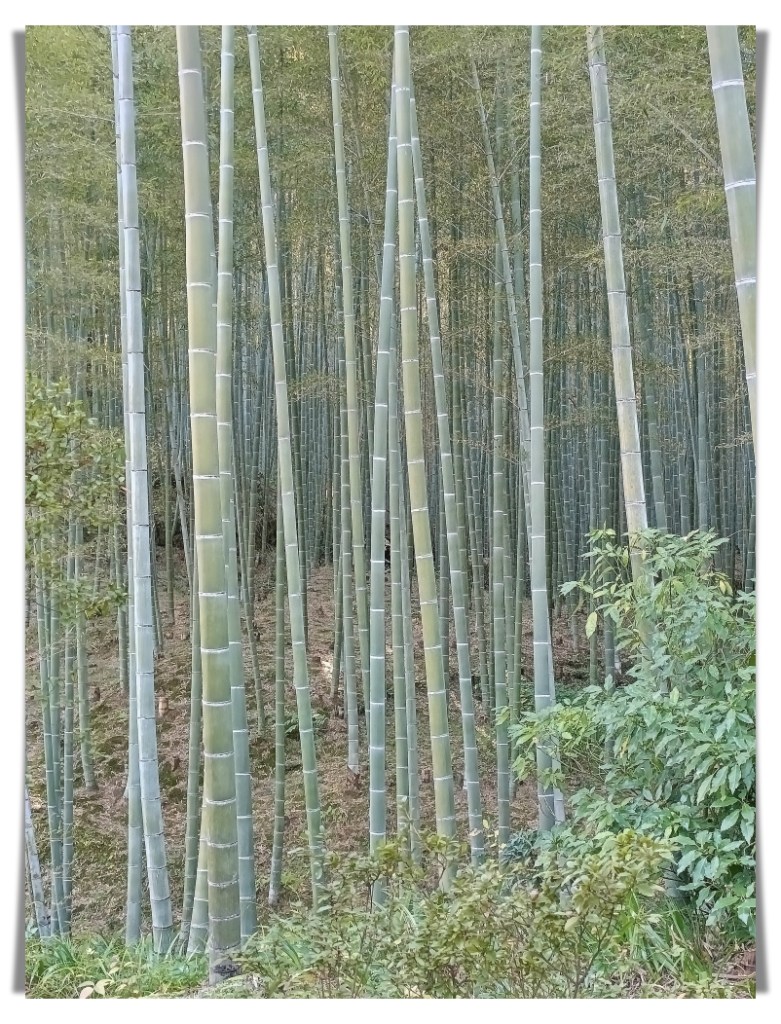
The Moso bamboo rose around me, some stalks reaching sixteen meters toward the sky. I walked slowly along the Chikurin-no-Komichi, the main path that runs for five hundred meters through the forest. The morning light filtered through the canopy, casting pale green shadows on the ground. I stopped and placed my palm against one of the stalks. It was cool and smooth, surprisingly solid for something that grows so tall and bends so easily in the wind.
This is when I remembered what my cousin in Kuching shared with me last year, the Iban traditional concept about the “bungai”. She had written to me about the bungai, a plant-image that lives in the invisible world of Manang Menjaya, the Iban god of healing. According to Iban traditional belief, each person has a bungai that takes the form of bamboo, growing in clumps from a single rootstock. The bungai grows, strengthens, weakens, dies, and falls, just as a person does.
Standing in that grove, surrounded by thousands of stalks rising from what I knew must be a shared underground network of roots, I understood this more clearly than before. The bamboo does not grow alone. Each shoot is part of a “pumpun”, a clump. Every stalk has its own height, direction, and shape. They all draw from the same roots and source. No one grows alone.
I thought of my own bungai, wherever it grows in the cosmic garden of Manang Menjaya. I imagined it as bamboo, tall, flexible, rooted in the same clump as my mother and my relatives who still live in the longhouse by the Layar River. For years I felt out of place, as if I were growing away from where I began. I left Sarawak for school, then for work and marriage. I felt disconnected, as though my stalk had been cut from the clump and planted somewhere it did not belong.
The bamboo shifted that understanding. Walking through that grove, I realized that the rootstock never disappears. The connection endures, no matter the distance. The clump remains, hidden but flourishing. My bungai is still there, nurtured by the unseen garden, sustained by the same roots that support my kin. Though I’ve been gone for years, the lineage continues.
I kept walking, finally arriving at the Nonomiya Shrine, a modest Shinto shrine tucked away in the grove. I stopped, feeling the familiar stirrings within me. Our ancestors recognized this pattern clearly when they chose bamboo for the bungai. These plants grow in clumps. They survive storms by bending rather than breaking. They send up new shoots even after the old ones fall. The Iban watched this pattern daily, living close to the land, and they recognized it as a mirror of human life.
This is how my people once understood family and community. A family is one clump. A longhouse community is many clumps standing together, sharing the same ground. The well-being of one shoot affects the whole. When someone is sick, the bungai weakens. When someone wanders, it withers. When someone dies, it falls, but the clump remains, ready to push new growth upward for the next generation.
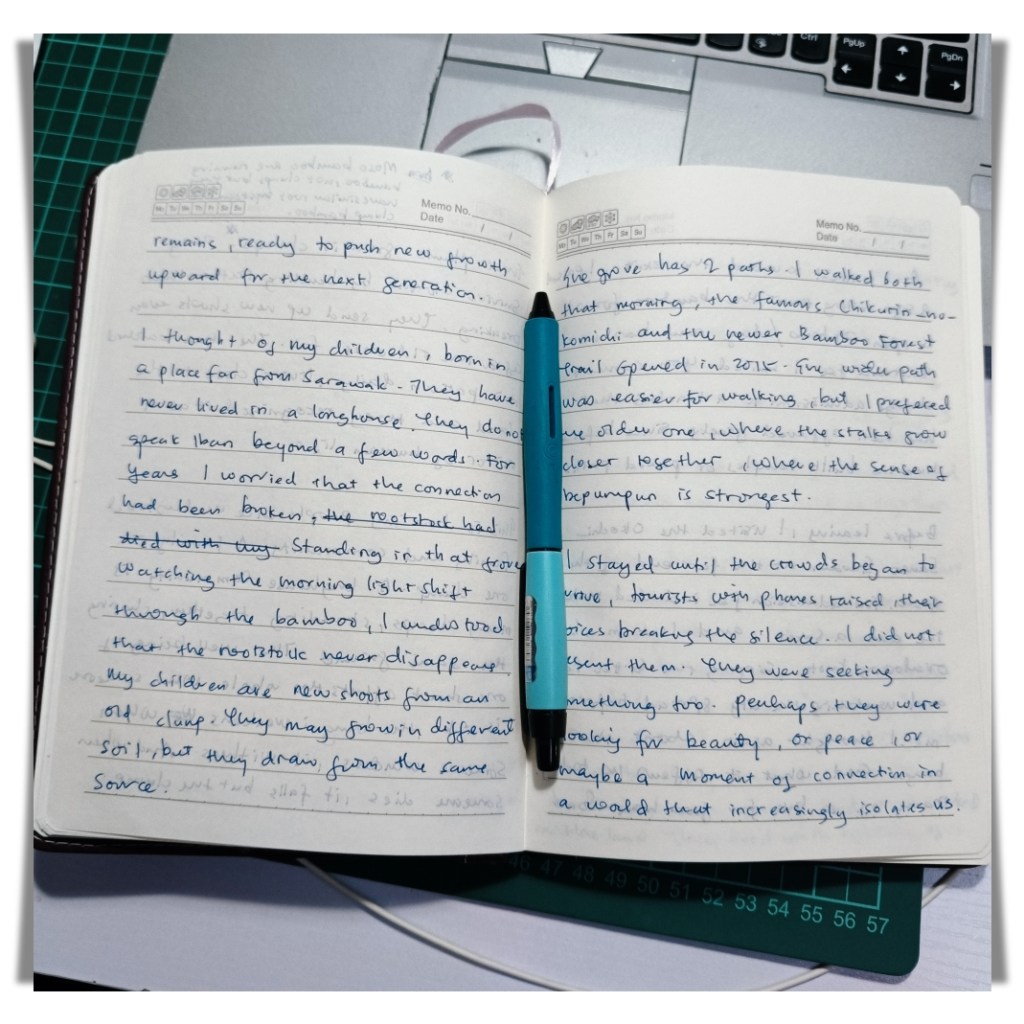
I thought of my own children, born in a place far from Sarawak. They have never lived in a longhouse. They do not speak Iban beyond a few words. For years I worried that the connection had been broken. Standing in that grove, watching the morning light shift through the bamboo, I understood that the rootstock never disappears. My children are new shoots from an old clump. They may grow in different soil, but they draw from the same source.
The grove has two paths. I walked both that morning, the famous Chikurin-no-Komichi and the newer Bamboo Forest Trail opened in 2015. The wider path was easier for walking, but I preferred the older one, where the stalks grow closer together, where the sense of bepumpun is strongest. I stayed until the crowds began to arrive, tourists with phones raised, their voices breaking the silence. I did not resent them. They were seeking something too. Perhaps they were looking for beauty, peace, or a moment of connection in a world that increasingly isolates us.
As I walked toward the exit, I passed a sign noting that the bamboo forest is open 24 hours a day and has no entrance fee. I smiled. You cannot charge admission to a teaching that has been offered freely since before humans built temples or paved paths.
Before leaving, I visited the Okochi-Sanso Garden at the far end of the grove. The admission fee included matcha tea and a sweet, and I sat on a bench overlooking Kyoto, sipping the bitter tea and watching the city spread out below me. I thought again about the bungai and what it offers us today. Many of us live far from home. Some grow up with mixed heritage, navigating several identities at once. Some have lost their language, their land, and their connection to family history. The bungai shows that belonging extends beyond physical closeness. It rests in memory, lineage, and the ties that remain.
The forest had shown me that I cannot survive alone. Bamboo stands because the clump stands. A community endures because its roots are strong. Long before the words “ecology” or “sustainability” were used, our ancestors knew this concept. They practiced it when they built longhouses, shared food, and worked the land. Their lives were intertwined with nature and community that supported each other. The bamboo reminded me of what I had forgotten: we are not alone. We grow in clumps, we sway together when the storm comes, and we push up fresh growth from roots that have endured for ages.
I left Arashiyama that morning with a clearer understanding. I am still a shoot from the old clump. The rootstock holds. The bungai grows, even when I cannot see it. I am connected to those who came before me and those who will come after. No matter how far I travel, my roots are in the garden of Manang Menjaya, where our lives rise from the same source and intertwine across generations.
This post is extracted from my journal entry
Note: Moso bamboos are running bamboos, but they have similar root systems to clump bamboos.
I write about Iban culture, ancestral rituals, creative life, emotional truths, and the quiet transformations of love, motherhood, and identity. If this speaks to you, subscribe and journey with me.
According to Oliver Burkeman, the average human lifespan is about 4,000 weeks. It sounds like a large number at first glance, but as I reflect, it starts to feel limited. I will not have time to do everything I want. Every “yes” comes at the expense of something else. The real issue is how often I fail to say no. I admit I don’t say no as often as I should.
I notice these patterns in small moments. For example, I sit at my computer with a task open in front of me. The work is clear and I know what I need to achieve. After a while, I reach for my phone without thinking. I open Instagram and start doomscrolling cat videos. A few minutes pass and sometimes it stretches to half an hour. When I finally look at the clock on the corner of my screen, I feel a small shock. Nothing important happened, but time is gone. This kind of “yes” feels harmless at the time and it happens more often than I realize. Over time, it detracts from the things I claim to care about.
When I was younger, I said yes more easily. I followed whatever felt more interesting at the time and left things unfinished. These were not always big decisions. Sometimes it was something small, like wanting to revise for an upcoming exam but I ended up reading a magazine instead. Repeated often enough, they eventually shaped how I used my time. But back then, I did not recognize them as choices.
Part of the difficulty is how easily my attention shifts. Technology makes distraction easy. But the pull is not only external. There is also an internal urge to avoid discomfort because it is easier to reach for something light than to stay with something that requires effort.
For a long time, I tried to do too many things at once. I thought being efficient meant I could fit more into my time. Instead, I felt stretched thin. I became exhausted, and over time, I felt anxious. I was trying to move everything forward without accepting that my time and energy are limited. It’s a paradox: that pattern created more pressure and not less.
When things didn’t work, I felt frustrated. That frustration sometimes turned into resentment. I blamed my lack of time on external things like my responsibilities, my family, and the situation around me. However, that was not the full picture. Things changed when I began to accept my limits more honestly. I can only do so much; moreover, most of what I do will not be significant on a larger scale.
That realization changed how I use my time. I started to value smaller, ordinary things more: cooking for my family, taking care of the home, and being present in simple moments. No matter how mundane these things are, they are part of my life. It also clarified what matters to me.
When my priorities are unclear, everything starts to feel urgent. It becomes harder to say no because everything feels important. When I know what I want to focus on, it is easier to step away from what does not support it. I still do not say no as often as I should but I notice it more now. I see it in the small decisions that do not seem important at first but if I pause, I can see where they lead.
I write about Iban culture, ancestral rituals, creative life, emotional truths, and the quiet transformations of love, motherhood, and identity. If this speaks to you, subscribe and journey with me.
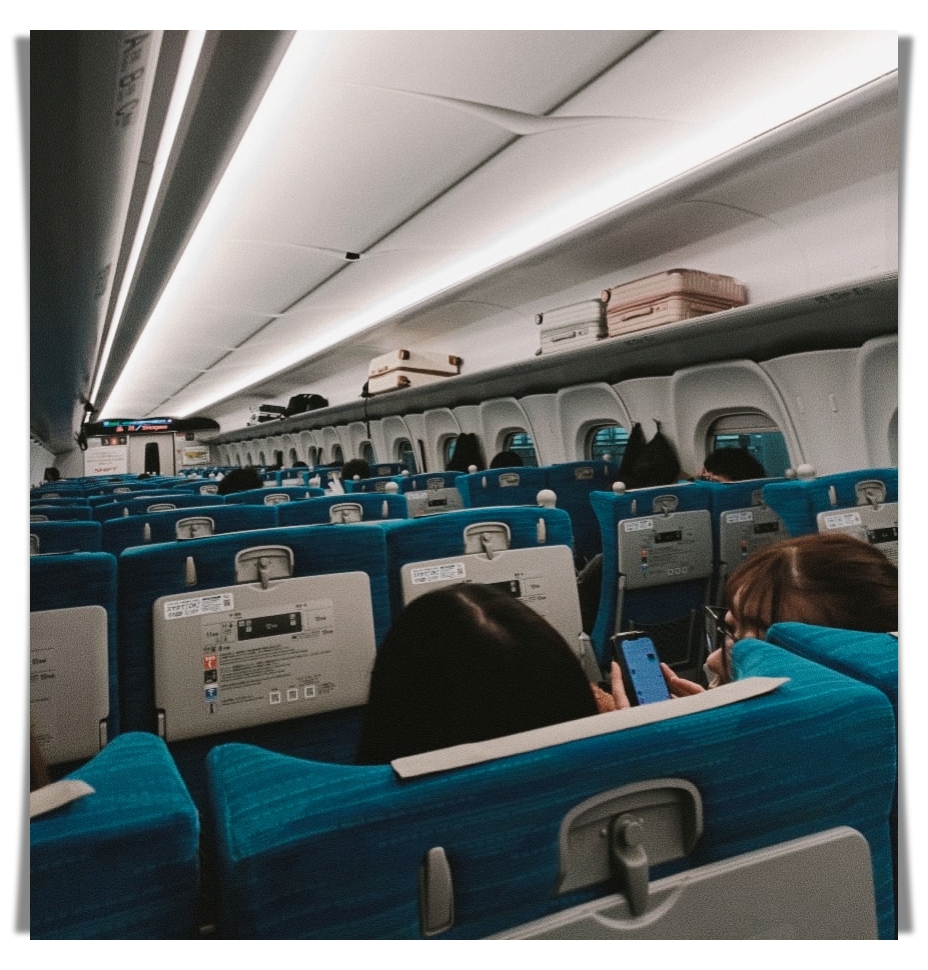
I am on a morning train in Japan, traveling from Tokyo to Kyoto without any hurry to get there. The shinkansen is quiet. There are empty seats on both sides of the aisle. I am seated by the window on the left. The glass is slightly blurred, with thin streaks of dried rain. The air conditioning hums overhead. I take out my tablet and try to read, but I am not really following the words. The train moves quickly past factories, houses, schools, and open fields.
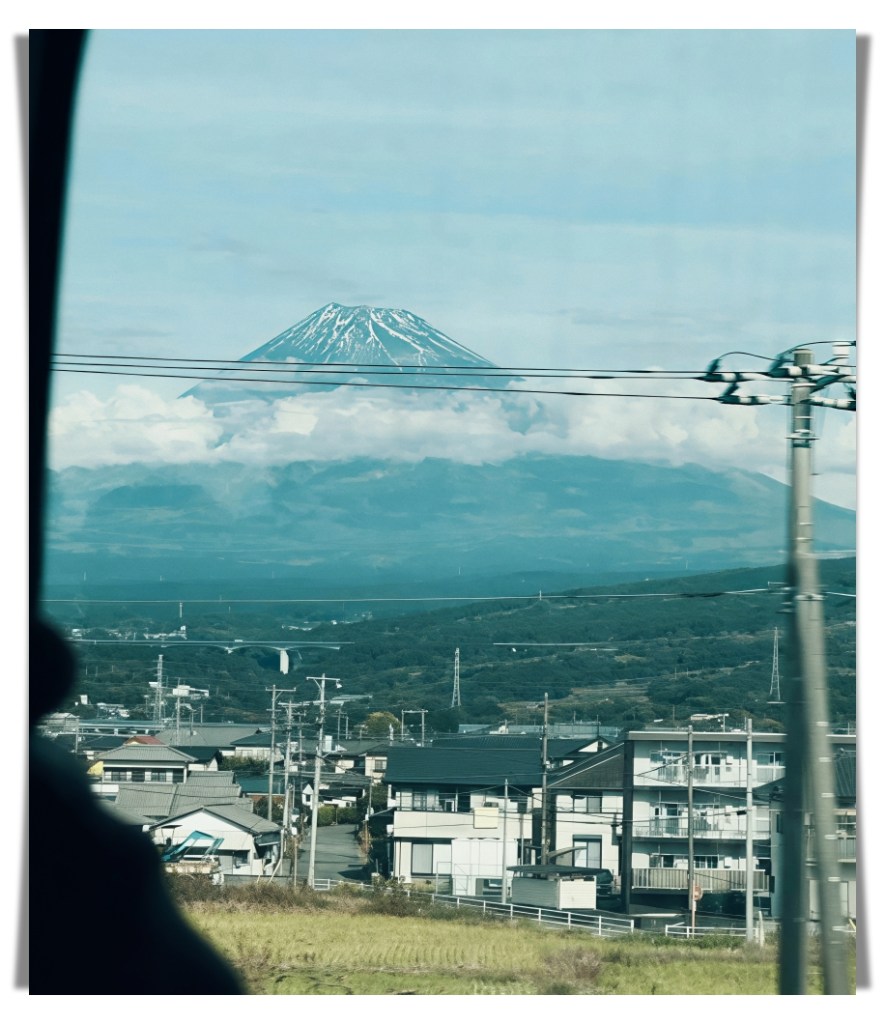
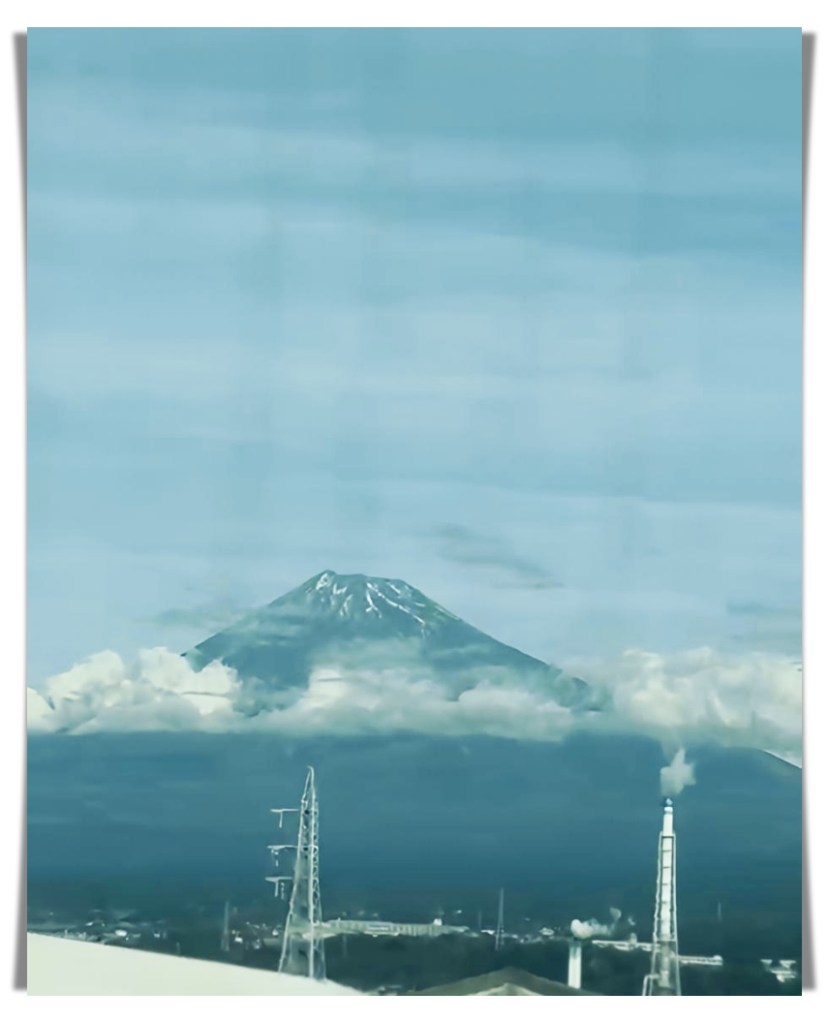
Mount Fuji appears in the distance. Clouds cover parts of it, but the top is still visible, white against a pale blue sky. At its base, the forest is dark and still. We pass rows of apartments. Laundry hangs outside, moving gently in the morning air. An ojisan adjusts his plants on a balcony. A woman walks slowly with a toddler, a shopping bag in her hand. Inside, a staff member pushes a cart down the aisle. The smell of food lingers faintly, a mix of sweet and savory. I reach into my bag for my notebook and pen. I pause and swallow.
I tend to stay with these small scenes longer than I need to. The man on the balcony. The woman and her child. The laundry moving in the same direction. I do not know them, but my mind fills in details without effort. Who they might be. What their days look like. How their lives move within these spaces I only pass through. This has been true for as long as I can remember.
People sometimes say I have a good memory. I can recall certain moments from a distant past with more detail than expected. I have always treated it as ordinary, something I do not pay much attention to. But it is not only memory. When I pass places I have never been before, I find myself imagining the lives inside them. A row of houses is no longer just a row of houses. It becomes a set of possible lives, each one carrying its routines and concerns and small moments no one else sees.
I do not do this intentionally. It happens without effort. The same way I noticed the man moving his plants, or the way the laundry shifts in the wind. I do not stop to question it. I stay with what is in front of me a little longer than I need to.
Because of this, I remember more than I expect to. Not everything. Just certain details that remain clear. A place. A movement. Something small that stays when I return to it later.
The train continues forward. Outside, the scenery changes without pause. Inside, I sit by the window, watching, and then writing it down before it fades.
I write about Iban culture, ancestral rituals, creative life, emotional truths, and the quiet transformations of love, motherhood, and identity. If this speaks to you, subscribe and journey with me.
I usually keep my meals simple. I prepare food that is easy and does not need a lot of time or attention. Cooking has never been something I enjoy. I find the act tiresome. The heat, the standing, and the continual movement in a hot kitchen. It wears me out quickly.
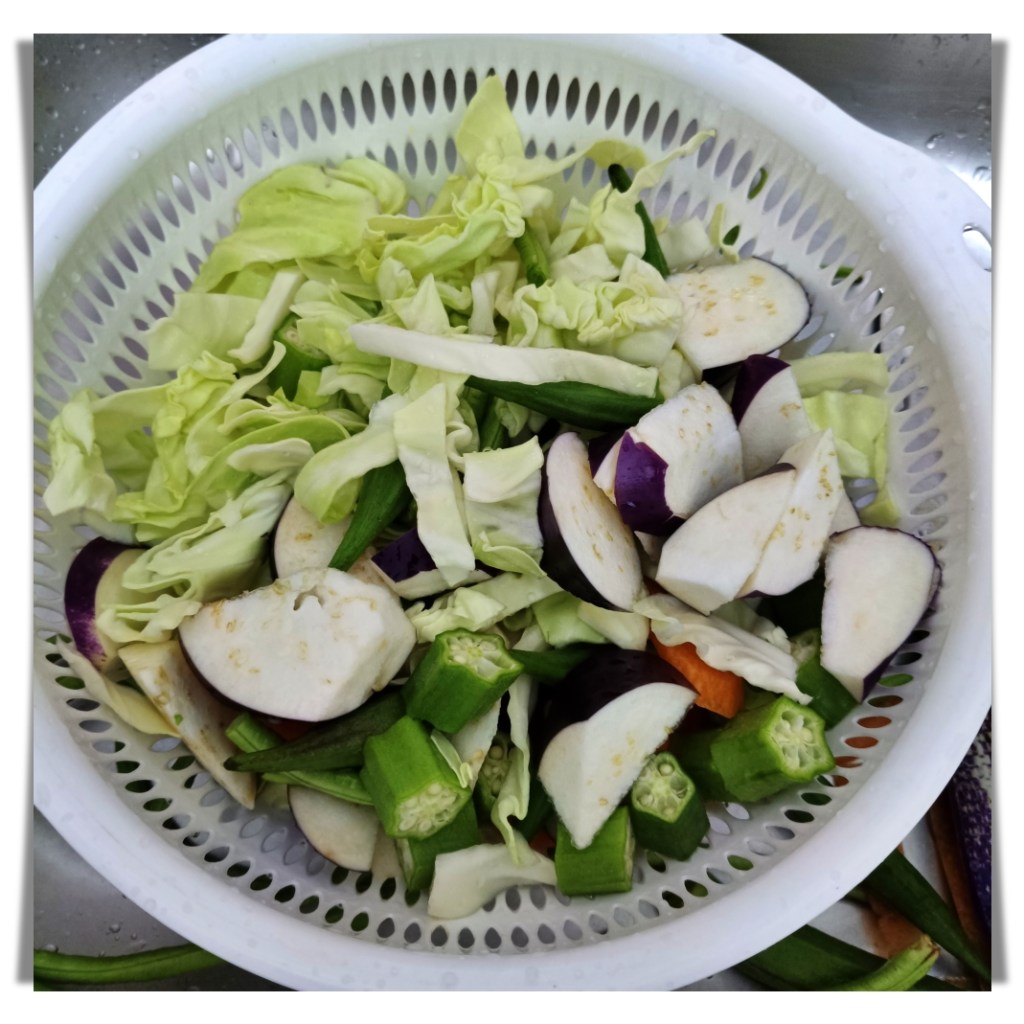
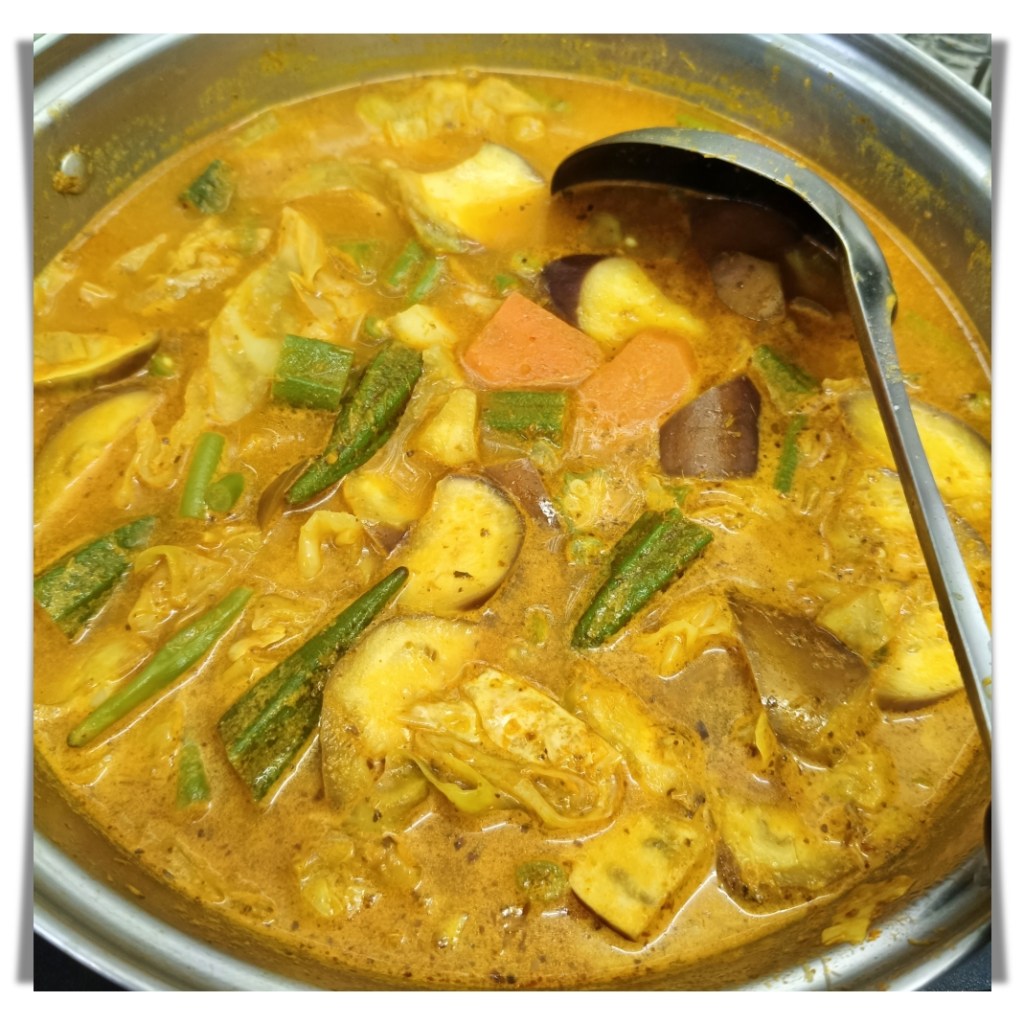
But today was different. I decided to prepare something special for the family. It was more than just a meal this time, a little more considered. I took my time, slicing the vegetables: eggplant, okra, and long beans. I observed the knife’s path, the way it transformed the surfaces as it went. Usually, I don’t focus on such details. Today I did.
The kitchen was hot. The heat was not only coming from the stove but also from the long, hot day. The sun was dazzling. The air felt still. As I stirred the pot, I could feel the heat descended on my skin and stay there. It made me feel sluggish.
I dislike this weather. If I could, I would always pick something cooler. Rain or a cloudy afternoon with gentle light and lighter air. My body moves more effortlessly on such days. Less clutter in my head.
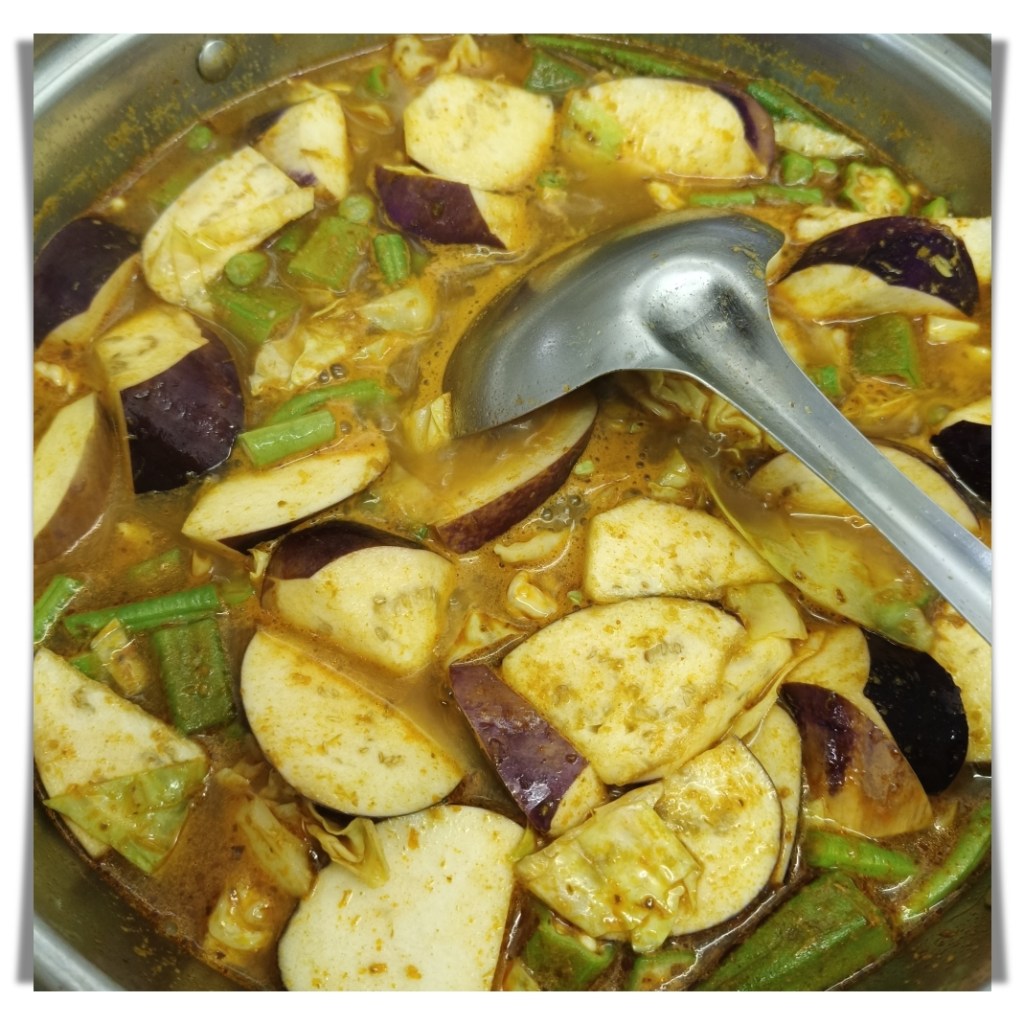
Today was not one of those days. It was bright and sunny outside, and I was preparing something spicy in a warm kitchen. The combination felt strange. The heat from the stove, the heat from the weather, and the heat from the food layered on top of each other. I stirred the curry and watched it thicken. The aroma and the warmth mixed as they spread through the room.
The heat persisted when I finally sat down to eat. In the air, on my skin, and in my food. The curry was delicious. A little spicy, but not too much. The veggies kept their form. The broth wasn’t overly thick.
I took my time eating. The spiciness stayed on my tongue. The warmth remained in my chest. Outside, the light had not softened yet.
I write about Iban culture, ancestral rituals, creative life, emotional truths, and the quiet transformations of love, motherhood, and identity. If this speaks to you, subscribe and journey with me.