Fragments of Obsession

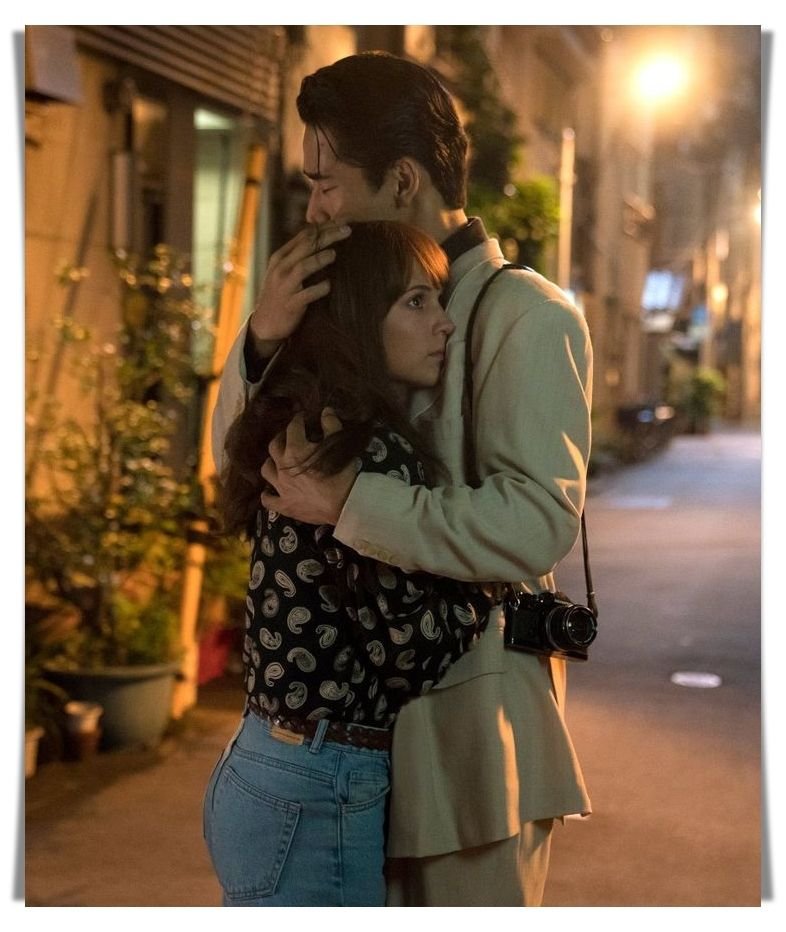
What began as a single moment never really left me. It lives in fragments of touch, of distance, of memory, and of time.

Image source

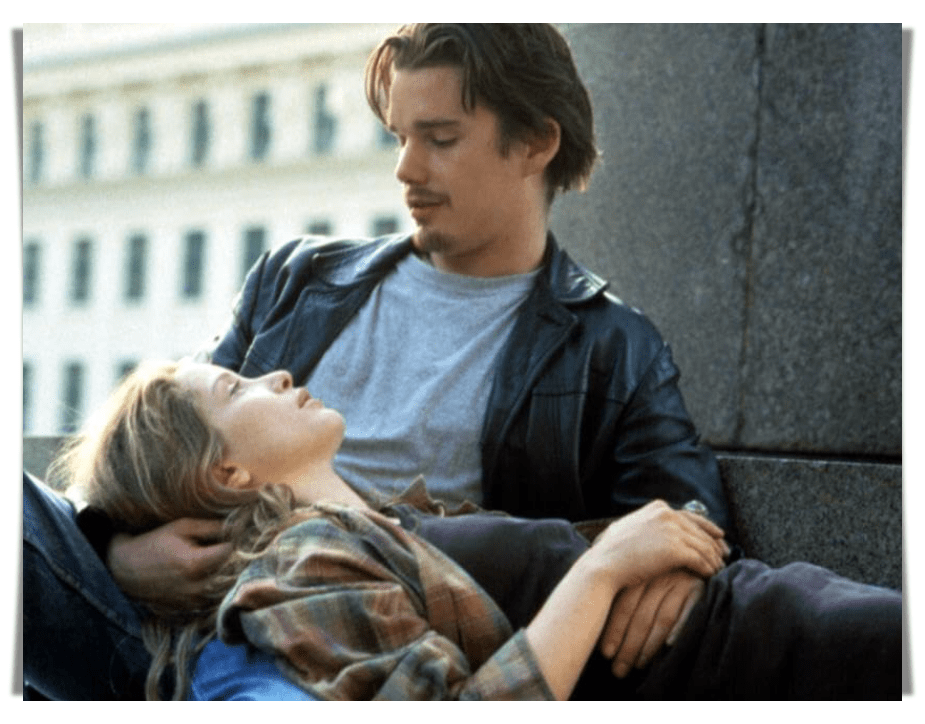
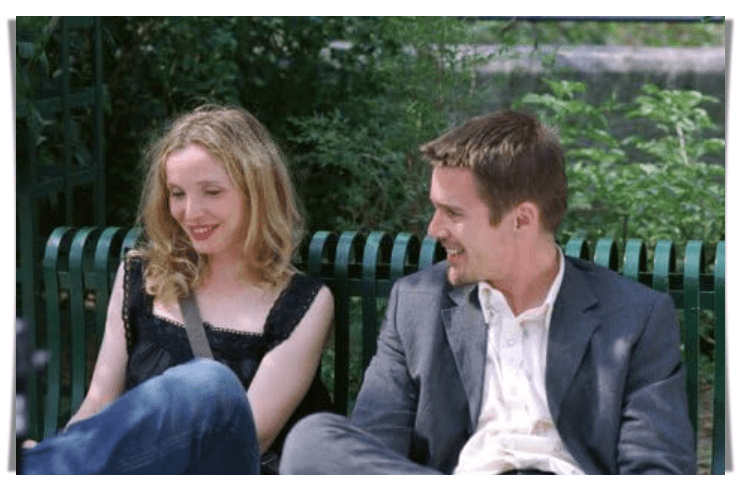
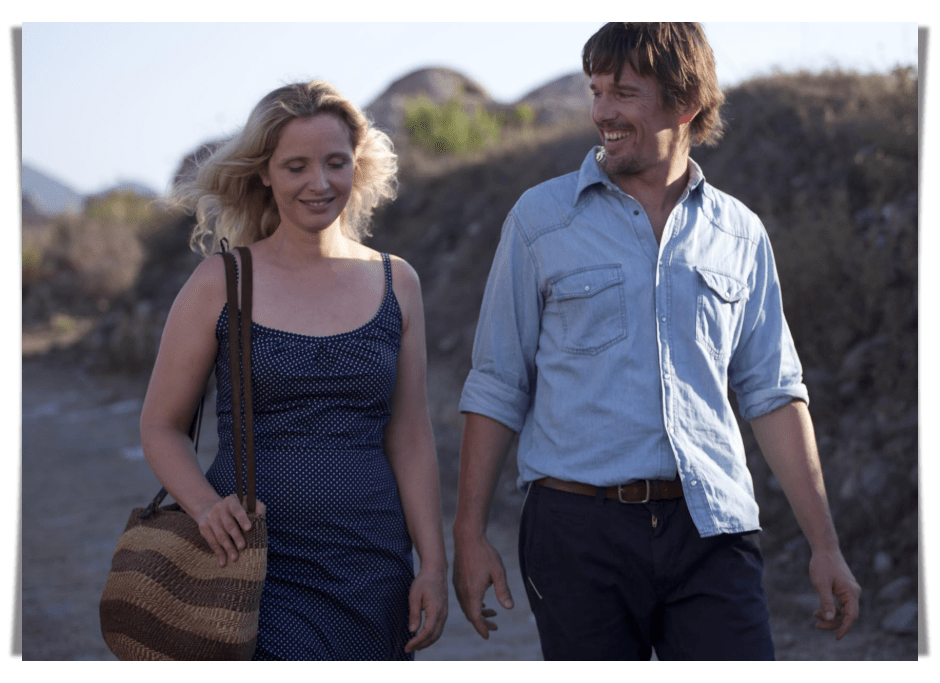
There are days he couldn’t come to me. He is always needed wherever he is. He analyzes patterns, behaviors, minds. But does anyone truly know him? On the days he is with me—the late evening light reflected on his disheveled hair. The contour of his tired shoulders. His long, calloused fingers. His moans echo in the shadows.


The light around him softened his expression into something tender. One hand held a book, the other blindly traced the tabletop. I paused mid-sentence, staring. His brows furrowed, his gentle eyes on the page. At that moment, my heart found shelter after endless wandering. He sensed my gaze and glanced up. Our eyes met—just for a moment—before he shifted away.


This is one of the nights when the apartment feels damp and cold. Thoughts ran through my mind while washing dishes, doing the laundry, and folding our clothes. Is he tailing someone right at this moment? Has he eaten? I tried listening to the audiobook, but nothing felt right. This book is too wordy. That one has a flat narrator’s tone. I closed the app and scrolled through YouTube to find a playlist to match my mood. In this playlist, the songs are too catchy. The other playlist is too sappy. I disconnected my earbuds and put my phone away. Even with all the lights on, the room feels darker. How many hours before tomorrow comes?


His hands are a map of everything I cherished. His light tan hands have carried pain and tenderness in equal measure. They have wielded weapons, sifted through crime evidence, cuffed wrists, and tenderly stroked the deepest part of me. His fingers are long and tapered; half moons peeked on his trimmed nails. Sometimes I noticed faint traces of blood and grime. When they brush against my skin, it’s like the first ray of sunlight after a long, cold night. His hands have built and mended, held and released. They’ve cupped my face, traced my curves, and held me in place. They’ve wiped away my tears and made obscene gestures in moments of anger or to stir my laughter. When I think of his hands, I’m reminded of the roots of the ancient trees or the ocean with their endless ebb and flow pulled by the moon.


The bed now is just a bed. The sheets are now crumpled into hollows that hold the shape of him. I run my fingers over the fabric and the pillows. They still smell faintly of his skin and the faint, sharp tang of his cologne. I press my face into it, trying to hold onto what’s left, but the scent is already fading. The white walls have absorbed the echo of his voice. The door clicked shut with a finality and stays closed until he returns. On the table, his cup sits lonely with the faint imprint of his lips. I leave it there to become a relic of our morning. His jacket hangs on the back of the chair, slouched in a way that feels so like him, as if it might come alive and shrug itself back into motion. The room has exhaled. It has moved on and is settling into the rhythm of my day, one that doesn’t include him.

Copyright © Olivia JD 2025

All Rights Reserved.

Fragmented Story | First Sight

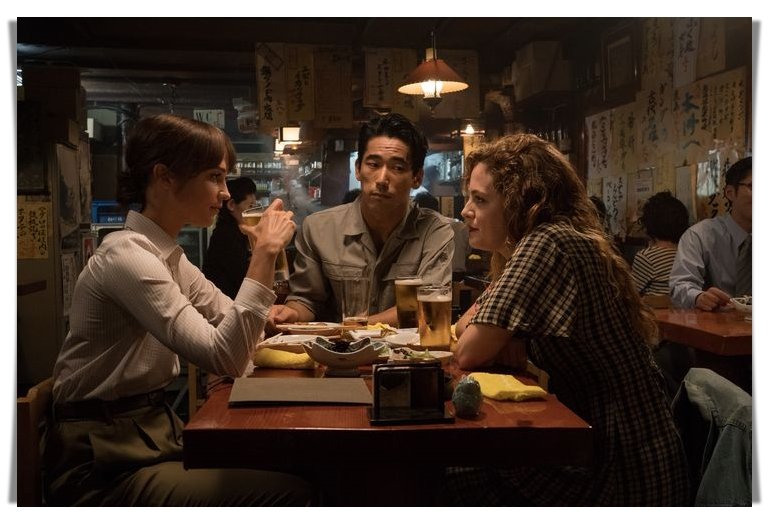
Some moments will never leave you. They creep into the silent corners of your memory and wait. It’s not love, but something more delicate and mysterious. I was eighteen when I first saw him. He wasn’t looking at me or even aware I existed. But then something changed. I didn’t realize it at the time, but that moment would stick with me, embedded into the fabric of my life and reappearing when I least anticipated. This is the fragmented story of an obsession that began before I had the words for it.


Image source

I was eighteen the first time I saw him. I was too young to fully comprehend how a single moment could change the course of time, but I was old enough to sense how important it was. He was twenty-two, though I didn’t know it then.  The light that late afternoon was soft and turned everything golden. It fell through the leaves as I walked home from class. A heavy bag hung across my shoulder, the monotonous rhythm of my day fading into the background.

Then I saw him.

He stood in the distance, partially obscured by the trees. There was something arresting about him that made him seem out of place in the moment. His jacket drew my attention right away. It was a deep brown, worn suede. The rich color seemed to absorb the light, making him stand out against the colors around him. His white trousers seemed an afterthought, subtle and plain. It was the type of look you don’t think about until later, when it won’t leave your mind.

I recall that he had a camera in his hand. He was working it with his fingers as he turned it in his hands. His dark, straight hair fell just above his brow, softening the harshness of his face. Serious. Intense. His posture was nonchalant as if he didn’t care that the world might be watching.

But I was watching.

I didn’t intend or want to be there, but there I was, fixed in place. “Who is that?” I asked my friend, and the question came out before I could rethink it. She chuckled as if it were clear, then mumbled his name with a mocking grin. “You should go talk to him.”

I didn’t or couldn’t. It wasn’t just insecurity; there was something else. It seemed like he was untouchable, and whatever he was focusing on in silence was not meant to be disrupted. So I walked away, thinking I’d left the moment behind.

But the image of him stayed with me for days or weeks. It kept going through my mind: him standing alone, with the trees casting a shadow as light gathering around him. I’d find myself wondering what he was thinking about as he carefully held that camera in his hands. It drove me crazy that someone I had never talked to could occupy a corner in my head.

Even now, decades later, I find myself going back to that day. It wasn’t love then. It was something more fragile. It was like an obsession that nestles deep in your chest and stays there, waiting for reasons you don’t yet comprehend.

Copyright © Olivia JD 2025

All Rights Reserved.

The Criminologist

I worked on this piece over the weekend. The lines are taken from my poem, The Criminologist. So far, I have four of my poems published in online literary journals/art websites, but I hesitate to share the links here because that would expose my identity. I prefer to be anonymous for now so I can write more freely without my internal censors actively working to prevent me from writing truthfully. No explanation is needed for this piece; I just let the art and poem speak for themselves.

Copyright © Olivia JD 2025

All Rights Reserved.

James Harrison Saved Lives—So Do Books and Storytellers

There’s a Facebook post circulating about James Harrison, an Australian man whose blood plasma donations saved 2.4 million babies. I never would have heard of this amazing man had I not stumbled upon this post on my newsfeed. So I did a quick Google search and found out he had passed away very recently at the age of 88. Harrison started donating his blood in 1954, and it was later discovered that his blood contained a high level of anti-D antibodies. I don’t know how to explain this, so I am going to quote Wikipedia verbatim:

Blood which contains a high level of anti-D antibodies can be processed to create immunoglobulin-based products used to prevent haemolytic disease of the newborn (HDN). These products are given to Rh(D) negative mothers of unknown or Rh(D) positive babies during and after pregnancy to prevent the creation of antibodies to the blood of the Rh(D) positive child. This antigen sensitization and subsequent incompatibility phenomenon causes Rh disease, the most common form of HDN. Source

Through his donations, he had provided countless doses of anti-D and helped prevent neonatal deaths and stillbirths. That is an extraordinary feat of kindness and human generosity.

Image source

However, underneath that Facebook post, a discussion erupted. Some commentators argued that he is more deserving of recognition than celebrities or authors who have won Nobel prizes. They said, after all, what is literature compared to saving human lives?

I beg to differ.

There is no doubt in anyone’s mind that saving a life through blood or plasma donation is unquestionably noble. His noble deed is tangible, irrefutable, with an immediate positive effect. But to dismiss the contributions of literature or to suggest that books and the written word (regardless of their form) do not save lives is to misunderstand the very essence of what it means to be human.

I was a reader long before I was an artist or a writer. Books have been my refuge since I was eight years old. They were my loyal and constant companions when the world felt too lonely, too loud, or too indifferent. And I believe with all my heart I am not alone in this. Across the world, people have found comfort in literature, be it in the carefully written stories of others or in poetry. There are countless, nameless people who stood on the edge of despair and were ready to give up their lives, only to find themselves pulled back from that edge by a book, a passage, a poem, or even a fictional character. All of these elements of literature become a reminder that they were never alone in facing their darkness.

My latest read. It’s a comforting read for those suffering from depression (MDD or dysthymia).

Books do not just entertain. They also bring healing to those who invest time reading them. I wrote a post about this a couple of months ago, where I discussed the transformative power of literature. Literature and the written word offer clarity where confusion resides. They offer hope where darkness lingers. They validate the lonely, challenge the complacent, and give voice to the voiceless.

If a blood donor saves a body, an author can save a mind, a heart, and a reason to keep going.

So, should James Harrison be honored? Absolutely. But so should the authors, the poets, and all storytellers who brought comfort to the broken souls. There is a reason for every good thing we accomplished in this world. Our life is not just about survival. We can do good things too, just like blood/plasma donors, or write something to encourage someone. And both groups of people play their parts in making the world a place worth living in.

Fragmented Story | Being In the Same Room Again

I wrote this introspective piece to capture unresolved emotions, the passage of time, and the delicate dance between nostalgia and moving forward. It’s about past love that is neither fully rekindled nor entirely lost. It’s fragmented because there is no backstory. It’s intentional because the absence of a backstory forces the reader to feel rather than just understand. However, it is related to another story I wrote previously – After All These Years.


Image source

The rain kept pouring, turning everything into a soft blend of grays and greens, like a painting that had come to life. It reflected the fog in my mind, the doubt that had brought me here. I didn’t want to go back at all. What was waiting for me when I got back to the city? Plenty of bills were sitting on the kitchen counter, ready for me to pick them up. There were tax notices in each envelope, and they kept coming on time. Of course, I was constantly getting glossy brochures from real estate agents advertising different homes for rent or sale, as if they could give me the security I really craved. They claimed that property was the foundation of our modern life. Have we forgotten what it means to belong in our quest for a place to call home?

The town was so different from the hectic pace of daily life that it felt like a different world. You could feel like time was moving slower here. When I walked into that little bookshop with its worn shelves and familiar atmosphere, it stirred up something deeper inside me. Not only did the past resurface again, but it also brought up something that hadn’t been resolved. Why does that feeling persist even after years of being apart? That question hung in the air.

Was it a spark that was about to go off again, or was it just the light of ashes from the past? To bring back an old love, you have to dig up what was hidden and accept both the joy and the pain that come with it. But could it be something else—a chance to put things to rest? Is it finally possible to break free from the maze of what-ifs and let the past rest?

There was also the issue of trust. Did it still matter that you understood instead of being validated after all this time? And even if it did, would that be enough to begin a new relationship? Maybe not love, but friendship for sure. We could have maintained a bright shared past, unaffected by the decisions we’ve made along the way.

I’ve learned that desire and lasting devotion aren’t the only things that define love. It was about the possibilities, the countless ways it could evolve, even after it had already slipped away from you once. With the sound of rain on the windows and the faint smell of books in the air, I stayed in that space and thought about whether love might just be being in the same room again after all this time and finding peace between us.

Copyright © Olivia JD 2025

All Rights Reserved.

Declining Population Trend In Malaysia | My Perspective

Image source

I recently read a Facebook post that talked about how Malaysia’s population is going down. But it didn’t really surprise me because the birth rate has been falling around the world. Professor Dr. Sharifa Ezat Wan Puteh, a local health expert, said that if this trend keeps up, Malaysia could have a population that is mostly made up of older people by 2030. As a woman, I see this trend as a sign of how our lives and expectations are changing because of changes in society, the economy, and culture. Let’s look into what caused this change in the population and what it means for Malaysia and other places.

Mindset Shift

In the past few years, I’ve seen a lot of women decide not to get married or have kids. The way people think about family life is changing. In Malaysia and many other places, the idea that women should be the main providers is being examined again. More and more women want freedom and equality, and this can be seen in the choices they make about marriage and family. Birth rates are going down because more people want to be independent, travel, and find self-fulfillment.

In 1970, Malaysian women aged 15 to 49 had an average of 4.9 children per woman. This rate had dropped a lot by 2021, when it was only 1.7. This big drop shows that people’s priorities have changed. Many women are now focusing on education and jobs, which can be hard to balance with a traditional nuclear family. Women are changing how they think about fulfillment and achievement, and it’s not always about having children and getting married.

Economic Pressures and Career Priorities

As traditional views on family life change, women in Malaysia and around the world are putting their jobs and personal growth first. Pressures from the economy are a big part of this trend. As a mother, I am very aware of these problems. The sharp rise in the cost of living has made it harder for families to raise kids. People in Malaysia are having a hard time with money because more people are moving to cities, and the prices of housing, schooling, and health care are going up. This has caused many people to think about how big their families should be.

Access to Family Planning and Education

Women today have the freedom to make decisions that fit their desires and way of life. This includes making well-informed choices about their sexual health. Women in Malaysia have more power over their reproductive choices thanks to efforts to make family planning programs and sex education easier to access. This gives women more power so they can plan their families in ways that fit with their personal and work goals. This makes the drop in birth rates even greater.

Implications and Future Directions

This drop in population has effects that reach far and wide. In terms of the economy, it could cause a lack of workers, which would mean that foreign workers are needed. It also puts more stress on social aid services because there are fewer young people to help an aging population. In terms of society, this change can affect how communities are formed and how families work together.

As women continue to shape the future, it is important to deal with the reasons why birth rates are going down and make policies that help people match their work goals with family obligations. To solve Malaysia’s demographic problems, they will need to make workplaces more supportive and flexible for parents, offer cheap child care, and encourage a culture that values both career and personal success.

In conclusion, the world’s population is going down. This is a complicated problem that is caused by economic challenges, shifting perceptions about family size, and advancements in family planning. As a woman, I think that knowing about these things is important for dealing with and creating the future. We can lessen the effects of this trend by addressing its causes and backing policies that are fair for everyone, even though it is clear that the birth rate will probably never reach the levels it had in the 1980s and 1990s.

💃 Happy International Women’s Day 2025 💃

Why Stories Matter | The Transformative Power of Literature

There is a quiet power in stories that goes beyond entertainment and escapism. At its core, literature is the act of giving voice to things that can’t be seen or touched. It forms our feelings, hopes, fears, and questions into something we can hold and share. Stories don’t just reflect our lives; they also hold the weight of human experience across time and space.

The first thing that comes to mind when I think about the power of literature is how it can bring people together. Reading a book is like crossing a bridge; it lets us see and feel the world through someone else’s eyes. In this way, it breaks down the walls that separate us. By fostering empathy, literature reminds us of our shared humanity and allows us to see through another’s eyes. Literature makes us face the idea that our experiences, no matter how unique they seem, are reflections of something bigger than ourselves. When I was young, I read Catcher in the Rye by J.D. Salinger, and it changed the way I thought about how people connect with each other. Holden Caulfield’s cynicism and vulnerability proved how stories can reflect our deepest desire for understanding.

Literature helps us understand not only other people but also ourselves. A story can be like a mirror, showing us things we would rather not see. It reveals our inner wants and fears, as well as our flaws. Reading is a paradox. It makes us lose ourselves in another world, only to find pieces of ourselves reflected back. The lasting power of literature lies in this duality—the simultaneous journey both inside and outside of oneself. Also, Salinger’s book helped me see myself in new ways. Holden’s struggles with authenticity and alienation are a lot like my desire for belonging and self-acceptance.

In the same way, stories live on forever and can transcend time. Because writing is timeless, the words of a writer or a poet who has died a long time ago remain relevant to people today. This doesn’t mean that stories stay unchanged. In fact, they change with each reading based on the reader’s views and their context. What a text meant to the original audience might be very different from what it means to us now. A story is alive in the way it changes with us. Different generations’ readings and reinterpretations enrich it further. One Hundred Years of Solitude by Gabriel García Márquez was recently adapted into a drama, which debuted on Netflix in December 2024. The magical realism in the book has kept readers intrigued for decades, but this version gives the story new life. It enables a new group of viewers to experience its themes of love, loss, and history through a fresh lens.

There is also a bravery that comes with writing. When writing, a writer has to be courageous and believe that their words will touch someone and stay with them. When people write, they often reveal parts of themselves that they wouldn’t share in any other way. They embedded pieces of their own truths into the plot of a story or the flow of a poem. Ralph Keyes’s book The Courage to Write talks about how the courage to write comes from being ready to face overwhelming fears and self-doubt. Writing is brave because it forces the writer to be honest and open, even if the outcome is unknown. It’s not because it leads to fame or admiration. For readers, this vulnerability can change everything. It creates a bond between the writer and the readers, fostering a mutual understanding that surpasses the written word.

But, of course, not every story is pleasant. Some show us harsh realities and make us question what we believe. Some stories force us to face uncomfortable truths. But these stories are still important. The hallmark of enduring literature is that it does not shy away from complexity. It recognizes that beauty and pain, hope and sorrow, often go hand in hand. So, stories help us deal with the complicated things that happen in life; they don’t give us easy answers but instead push us to think, ask questions, and grow.

Stories have the capacity to establish continuity in a world that often appears fragmented. They remind us that we are a part of a bigger story that began a long time ago and will go on after we die. Literature connects us to each other and to the huge, complicated web of human experience.

Why do I write? It comes back to the idea that stories matter. It’s not that they make big, dramatic changes to the world; it’s that they change us in small, subtle ways. They invite us to pause, contemplate, and feel. Indeed, this invitation represents a revolution in a world that demands speed and certainty all the time.

Book Review | The Courage to Write – How Writers Transcend Fear by Ralph Keyes

I returned to writing earlier last year after a decade-long hiatus to raise my children. Writing has always been my quiet refuge. It’s a space where I could slip away from the noise of daily life. But even in solitude, I have always sought connection and often reached for books on writing. These books are my source of advice, and I also seek reassurance and inspiration from those who have walked this path before me.

Years ago, I read Bird by Bird by Anne Lamott and Big Magic by Elizabeth Gilbert; both left a lasting impact on me. These are the kind of books that feel like old friends. Their words reveal new meanings with each reread. They have been my steady companions and also my source of encouragement whenever doubt crept in.

Three months ago, while browsing a secondhand bookshop, I stumbled upon The Courage to Write: How Writers Transcend Fear by Ralph Keyes. I had never heard of him before, but the title spoke directly to a truth I knew well—fear is an ever-present shadow in the creative process. It’s impossible to resist a book that promised to explore the relationship between the creative process and fear. Without hesitation, I added it to my cart, along with another classic, Natalie Goldberg’s Writing Down the Bones. The latter is familiar to many writers, though I have yet to read it myself.

Having finished The Courage to Write, I’ve spent some time reflecting on its message and how deeply it resonated with me. I’m currently halfway through Writing Down the Bones and will share my thoughts on it once I reach the final page. For now, I’ll concentrate on Keyes’ book, which explores what it means to write in the face of fear. It is a subject that feels intimately familiar to anyone who has ever confronted a blank page and wrestled with the enormity of creation.

A Conversation About Fear

The Courage to Write is not a how-to book. Instead, it reads like a conversation, which helps all writers deal with the fear, doubt, and anxiety they all feel. Keyes takes the mystery out of being creative and shines a light on the problems most writers experience but don’t talk about. He tells us to dig deep into our self-doubt and impostor syndrome to find the courage that’s hiding there. He believes that writing is both an honor and a duty that people who have never done it often don’t appreciate.

The Pros

The Courage to Write is so engaging because it is so honest. Keyes doesn’t romanticize writing; instead, he shows it as a deeply human activity that is full of uncertainty. “Am I good enough?” is a question that his book helps people deal with. Even the finest literary giants have had to deal with this question. Drawing on the experiences of writers like Virginia Woolf, Ernest Hemingway, and Anne Lamott, he shows us that anxiety is not a sign of failure but an important part of the process.

Keyes writes in a careful, even personal tone. His ideas seem to apply to everyone, which supports the idea that while writing can be isolating, the effort to overcome fear unites all authors.

One of the best things about the book is that it changes the way we think about anxiety. Anxiety is not a problem; it’s a vital force that makes insight sharper and pushes writers to be real. Keyes says that fear pushes us to write more honestly and dig deeper. This profound view tells writers to deal with their fears instead of battling them.

The Cons

Even though The Courage to Write has a lot of good points, it sometimes goes over familiar ground. If you’ve already read a lot on the subject, Keyes’ insights might not seem very new to you. A lot of the time, the stories are about well-known issues writers had, like how Hemingway drank to drown his fears or how Woolf questioned her own worth. A lot of writers are familiar with these stories.

Also, Keyes is great at acknowledging and validating anxiety, but his answers are more philosophical than practical. This book might not be right for you if you want to find real ways to deal with procrastination, perfectionism, or the problems that writers face every day. His core message that you should embrace your fear and let it lead you is powerful, but it comes up so often that some chapters feel like they’re just different takes on the same idea.

Final Thoughts

Reading The Courage to Write feels like wandering through a dense forest. Each tree represents a different fear, and the odd shaft of sunlight reminds you of how courageous you are. It’s not a guide. It gives you hope that the journey is worth continuing on, even if you can’t see the path. This book is for people who need to hear that fear is not the enemy but a voice telling us to be braver and write more deeply and honestly.

But this book might not be for everyone, just like a vast landscape can be both comforting and overwhelming. If you seek clear directions instead of reflection, you may want more concrete advice. The Courage to Write isn’t really about getting over your fears; it’s about learning how to live with them. And maybe that’s the most important lesson in and of itself. Writing, like life, is less about conquering every mountain and more about finding what it means to be human.

Fragmented Story | After All These Years

Some things are never fully lost. They stay in pieces, in corners of the mind, surfacing as the scent of rain, the pages of an old book, or a place you never intended to return to.

This fragmented story, After All These Years, reflects on such moments—small towns and bookstores, old love, and the what-ifs that never fade away. Nostalgic, like turning through an old book and discovering a dried flower between its pages. A memory of something once vibrant that has faded but is never fully gone.

There is no big resolution here. Just realizing that certain relationships change over time but never completely disappear. They settle into the crevices of life, becoming part of our identities. And maybe that is enough.


The rain poured down without mercy, chilling and drenching, seeping through every layer of clothing and skin. The town loomed in the distance. Its narrow path meanders through shadows created by bent lampposts and the subtle shape of a river in the distance. Though I never intended to stop here, I did. The rain was relentless, and I needed a refuge. This place was as good as anywhere with cafes and warmth.

Then I caught sight of it. A little worn-out sign swinging in the rain. I read the name and felt my throat seize. How long has it been? A lifetime has passed, but the heart maintains its own sense of time, unencumbered by the limitations of calendars and years.

I felt a strong instinct to turn away. I suppose it’s easier to face the storm outside than what lies within. But my curiosity drove me forward. Parking and gathering my stuff, I braved the downpour. On the cold iron doorknob, my hand trembled. The cold seeped into my flesh, and before I could think twice, the door softly cracked open.

The aroma of old paper and a subtle earthy tone greeted me first. The dim light created shadows on the walls, which were filled with books that appeared to go on forever. It was like entering a place that seemed to stand still in time.

And then I spotted him.

He sat behind the counter, buried in the pages of a book. In some ways, he looked the same. However, there were also signs of time. Strands of silver in his hair, a sweater frayed at the cuffs, and the faint heaviness of a life lived alone.

He didn’t notice me at first. For a brief moment I forgot how to breathe. The soft rustling of the page he turned brought me back to the moment. He glanced upward. Our eyes met, and then those years vanished in an instant. There was no dramatic pause or rush of words.

Time has passed as it inevitably does. It leads us into lives that are separate and distant from one another. But in the soft glow of this overlooked part of the world, that distance seemed trivial.

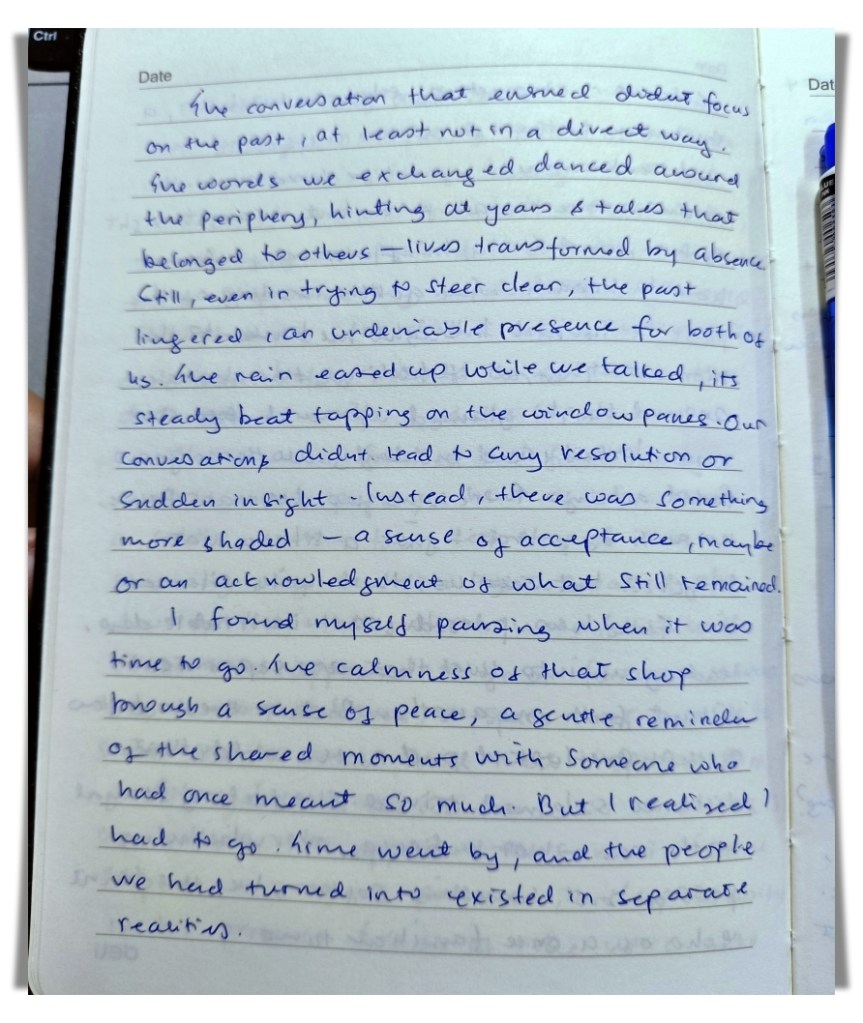
The conversation that ensued didn’t focus on the past, at least not in a direct way. Our discourse danced around the periphery, hinting at years and stories that belonged to others. Our separate lives had been transformed by the absence of the other. Despite our best efforts to distance ourselves, the past remained between us.

The rain subsided while we talked. Its steady beat taps against the windowpanes. Our conversation didn’t lead to any resolution or sudden insight. Instead, there was something more nuanced, perhaps a sense of acceptance or a hesitant acknowledgement of what remained.

I found myself hesitating when it was time to go. Our conversation brought a sense of peace, like a gentle reminder of the shared moments with someone who once meant so much. But I had to go. Time went by, and the people we had turned into existed in separate realities.

I stepped back into the drizzle and back in my car. My heart aches because it finally understood that some connections, no matter how changed by time, never really disappear. They stay, though no longer in their original form. They turned into echoes that tightly knotted into the essence of our being.

And maybe that was all it needed to be.

Related story: Being In the Same Room Again

Copyright © Olivia JD 2025

All Rights Reserved.

I Am the Keeper of Memories

I have always been known for my strong memory. Friends, family, and even casual acquaintances have commented on it over the years on how I can recall details from years, even decades ago, with a clarity that surprises them. It surprises me too because I always assumed everyone could remember past events with the same vividness. But that’s not true. Many of my ex-school friends barely remember incidents from our school life. I remember names too. When I look at past photos, even ones from decades ago, I can point out who is who. No, I don’t spend my time reminiscing or dwelling on the past. The details are just there, fresh in my mind, ready to be plucked whenever needed.

A photo with my school friends from 34 years ago. Many have become successful individuals in the community. One person has gone on to become the State Director of the Malaysia Public Works Department, and another, a pediatrician.

I don’t just remember past events. I remember the emotions and the atmosphere associated with those events. You could say that I’m a sensory person or someone with an eidetic memory because those vivid experiences still live within me. It could be anything—a song playing in the background, the scent of rain on warm pavement, the gentle breeze swaying the leaves, the color of the sky on a particular afternoon, or even the call of a lonesome nightbird that woke me up in the middle of the night when I was four.

Sometimes, it feels like a gift. It allows me to tell stories with depth and remember people and moments with an intimacy that others often lose to time.

Several months ago, my ex-schoolmate invited me into their chat group. I was delighted to reconnect with old friends I hadn’t spoken to in more than three decades. We talked about many past incidents, mostly funny moments from that time in our lives. I told stories as if they had just happened recently. Many friends come to me when they need to piece together an old memory, to recall things they’ve long since forgotten. In many ways, I have become the keeper of our shared histories.

However, it is not always easy to carry so much of the past. You might think nostalgia is a wistful feeling, but to me, it’s a lingering echo of what once was. Memories often return unbidden, resurfacing with the right song, a familiar scent, or a sudden shift in the wind. And sometimes, it feels like I am standing at the threshold of two worlds: one that has already been lived and one that I am trying to step into. Moving forward can be difficult when the past refuses to fade quietly.

I make art and write to make sense of it all. My poetry and art are more than just venues for self-expression—they are my way of processing, seeking closure. I have the habit of revisiting the same themes and emotions again and again until I have finally made peace with them. Only then can I move on, allowing the memory to rest. It is like closing a book. I don’t erase or discard these memories; they will always exist within me. They just no longer hold power over me.

Perhaps, through all of this, I am learning how to honor the past without being held captive by it. My memories shape the person I am, but they do not confine me. And maybe, in sharing these stories—putting words or images to what lingers—I can find a way to move forward without leaving anything behind.

The handwritten draft of this post.