Yours, Once

Daily writing prompt
What tattoo do you want and where would you put it?

Image source

The Past

I found the tattoo parlor while wandering aimlessly through one of the narrow, lantern-lit streets of Datong District. The parlor looked old, tucked between a toy store and a Chinese medicine hall.

The needle vibrated and pierced. I closed my eyes and welcomed the sting. I imagined the ink seeping in, letter by letter.

Yours.

It was on my left breast, right above my heart.


Days later, his lips are on my skin. When he reaches the ink, he stops. His fingers tighten ever so slightly against my ribs. He exhales slowly. No questions asked. No words uttered. He kisses it tenderly at first, then again, firmer this time. His tongue traces the letters.

That night, it is different. Neither rough nor fast.

Just intense.


The Present

It’s been years. I have gray hairs now, mostly at my temples. I don’t think of him often—at least, not like I used to. But today, I catch a glimpse of myself in the mirror. Bare skin. My body is softer now, but there it is.

Yours.

My fingers brush over the letters, the ghost of his lips flickering behind my eyes. I should get it removed. I tell myself that sometimes.

But I won’t.


Back then, his fingertips grazed the ink absentmindedly. While the night bird called in the distance, he’d press his lips against it and whisper—mine.

Now, my fingers trace the letters, following the path his touch once took. The ink remains, but his touch is long gone. I keep waiting for the pain to dull, but it never does.

Back then, it was a vow.

Now, it’s just a relic.

Someone new notices it once. His fingertips pause over the letters.

“Who did this belong to?”

I hesitate. And then I say, “Me.”

Copyright © Olivia JD 2025

All Rights Reserved.

If I Could Speak Every Language

Daily writing prompt
What’s a secret skill or ability you have or wish you had?

Image source

He often walked me home, and sometimes we ended up on the rooftop of my apartment. I never invited him to my apartment. It was too soon for that.

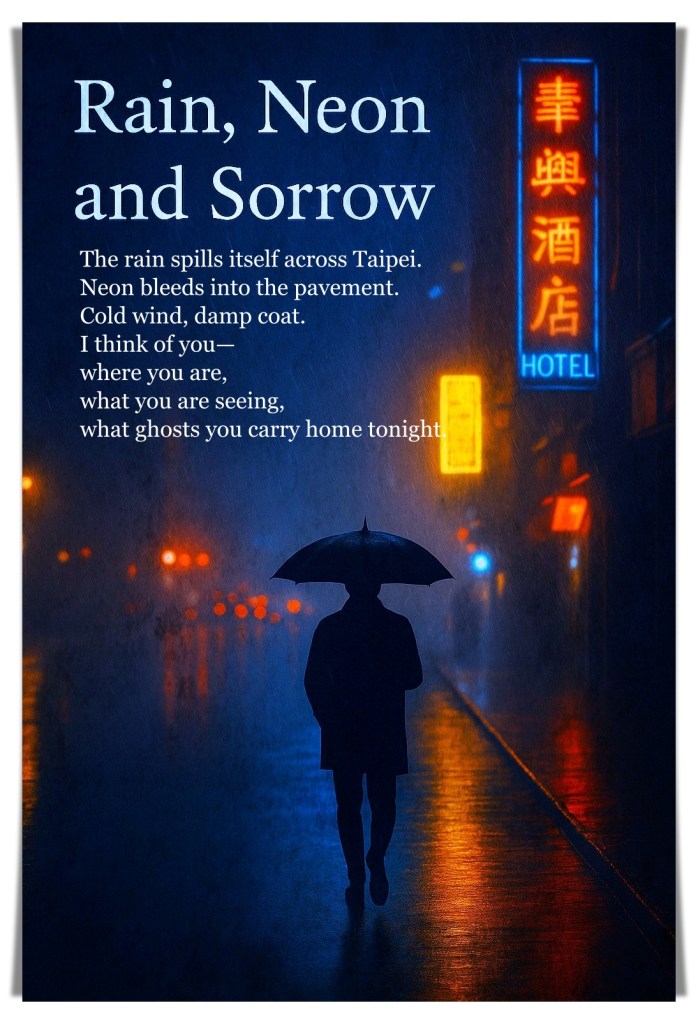
From the rooftop, the city shimmered like a galaxy spilled across the earth. Neon light—electric blue and fiery red—streaked through the darkness. I can hear the distant traffic and feel the cool breeze carrying the faint scent of a nearby night market. Above, Taipei 101 tower pierced the sky, glowing against the stars. He leaned against the railing, gazing into the distance.

We talked about anything. There was no rush of pressure with him, just a gentle assurance that he would hold whatever I shared with care.

Tonight, I asked him what he would do if he woke up one day able to speak every language, even those of animals.

I watched the way the wind played with his hair.

He smirked. A small, knowing curve appeared on his lips.

“That’s a very you question. What would you do with it?”

I thought for a moment.

“I’d talk to the stray cats near the cafe. I’d ask them if they’re hungry or safe. Maybe they’d tell me where they hide when it rains.”

“You’d befriend all the strays. What else?”

I talked about my culture.

“The Burung Bubut* isn’t just a bird; it’s a messenger of omens. Its eerie call is thought to announce the passing of a soul to the realm of the dead. I’d ask it if it truly carries omens or if it knows when a soul is about to pass.”

“I’d also ask the Malayan tiger and the Bornean orangutan how they feel about losing their home. I’d listen to the stories that humans never hear.”

He tilted his head, considering.

“You think animals would trust us with their truths?”

The distant wail of a cat in heat cut through the night. It echoed down the narrow alley and off the damp brick walls like an eerie plea. I thought briefly about that pitiful, horny creature before answering.

“Maybe they wouldn’t trust us at first. But if they did, we could offer help. Imagine knowing what an endangered species really needs instead of assuming. Conservation would be a collaboration and not just a human effort.”

His fingers tapped idly against the metal railing.

“And humans? What about all the dying languages?”

“I’d want to preserve them. Speak to the last few speakers and hear their stories before they’re lost forever, like the language of Orang Kanaq that has fewer than 35 speakers left. If I could learn and document their language, maybe it wouldn’t disappear. And what would it be like if I could speak to the Sentinelese in the Andaman Sea? Maybe we’d find common ground without breaking their solitude.”

I could hear a couple arguing somewhere in the distance, probably further down the alley.

He looked at me with a gentle smile.

“Imagine cooperating with animals to make art. Bird melodies for songwriting. Dance movements from the dolphins. Poems inspired by the haunting cries of the whales.”

I nodded and smiled at the possibility.

He exhaled and was quiet for a while.

“You don’t have to speak to them all the time. You want to listen too.”

“Yeah. I’d love to sit peacefully next to an orange stray cat who basked lazily under the sun.”

Our gaze met, and I quickly averted my eyes. We stayed silent while the city stretched endlessly before us. In that moment, perched on the edge of the rooftop, it felt like the world was alive with voices—rising, falling, each one clamoring to be heard and to be understood.


Note:

  • Burung Bubut—Greater Coucal. In Iban culture, it is believed that when the bird calls, someone has passed away.
  • Orang Kanaq—One of the 18 Orang Asli ethnic groups in Malaysia. They are classified under the Proto-Malay people group, which forms the three major people groups of the Orang Asli. (source: wikipedia)

Copyright © Olivia JD 2025

All Rights Reserved.

The Word He Chose for Me

Daily writing prompt
What is one word that describes you?

I’ve never been able to describe myself in just one word. Maybe because I am too many things at once. Or maybe because I don’t see myself the way others do. The way I feel changes depending on the circumstances in my life, and often these circumstances involve family and those I hold dear. My feelings also shift depending on the things that weigh heavily on my mind. They could be anything—the weather, financial challenges, the news, or health issues. Some days, I am quiet and contemplative. Other days, I am restless with anxiety, burning with the need to create, to write, or to complete whatever in my to-do list. How could I ever reduce myself to a single word?

As an INFJ, I am made of many layers, each one revealing itself to different people in different ways. To some, I am reserved and intense. To others, I am something else entirely. I exist in fragments—never fully visible all at once. Perhaps that’s why I struggle to define myself. I am never just one thing.

So I asked him.

One word that describes me without hesitation. I want him to tell me the first thing that comes to mind when he thinks of me.


The room is quiet. The late afternoon light is slipping through the curtains and spilling across the floorboards. It illuminates the dust dancing in the air. The breeze blows the curtain gently, playing with the edge, lifting it, and letting it fall. It cools down my skin where the sweat still clings. His chest rises and falls under my cheek. The sheets lie twisted. Half are on the floor, while the remaining ones are still clinging to us.

I don’t know why I ask, but the question comes out before I can stop them.

Tell me. One word only. What’s one word to describe me?”

He pauses for a second. “Unforgettable.”

I didn’t expect that. I don’t move or look up. I let it sink into me before curiosity bubbles up.

Why?”

Because once someone knows you, they can’t go back to a time before you.”

The curtain lifts again. The breeze is brushing over us. His hand moves to my back, caressing. The light is fading now. I close my eyes and press my cheek closer to his heart.


Unforgettable.

It caught me off guard because I had never thought of myself that way. I had never thought that I could leave an impression on someone so deeply that the idea of me could never be erased. It made me wonder how much of myself I have left behind—in the places I’ve been, in the people I’ve met and loved. It made me question if I truly see my worth and accept and love myself as I truly am.

We all go through many things in life that alter our perceptions of ourselves. And our brains have ‘negativity bias,’ where they are wired to process negative information more intensely than positive ones. So it is safe to say we internalized unflattering things about ourselves, including lies, more than our good qualities.

And maybe other people see us differently than how we perceive ourselves. And maybe that’s the tragedy of it—we spend our lives searching for the words to best describe ourselves when all along we are already leaving our impact in ways we don’t even realize.

Unforgettable is not a word I would have chosen for myself. But maybe he is right after all.

Copyright © Olivia JD 2025

All Rights Reserved.

Reflection | Writing Between Emotion and Detachment

I discovered Annie Ernaux’s writing pretty recently and at a time when I was learning to trust my own voice. I’ve been writing for a long time, but apart from blog updates, I almost never published my work. (I published 4 poems in online literary journals last year). Though I love writing, I spent the last 15 years focusing on my art, pushing writing to the back burner.

Image source: My Everand subscription

I write poetry and short stories now and then. They are nothing grand or serious because I don’t feel compelled to write a whole book with a complete plotline and characters. I collected my short stories; some are purely fiction, and some are based on true experiences and stories. I have never met anyone who writes like me until I came across Annie Ernaux’s work.

Reading Ernaux was like finding a mirror I never knew existed. Ernaux, like me, dissects the past obsessively. She revisits memories repeatedly, searching for meaning in fragmented events of the past. But there was a difference I couldn’t ignore. Ernaux writes with a stark, almost clinical detachment. She lays out the details of her life as if she is simply recording facts. She does not romanticize or dramatize; she just records the experiences. Her writing reads like an autopsy of the past, as if she had already processed it, wrapped it up, and put it on a shelf labeled “This happened in the past.” She records the details of her love affairs, including the lurid moments, without nostalgia, shame, or guilt. This is what she wrote about one of her lovers:

“The man for whom I had learned them had ceased to exist in me, and I no longer cared whether he was alive or dead.” ~ Getting Lost

And that, I realized, is where she and I diverge.

I don’t just remember the past—I relive it. Every emotion returns, undiluted by time. I don’t just recall what happened; I feel it as if it’s still unfolding inside me. The joy, the pain, the longing, the grief—they rush back in full force. Because of this, my writing is anything but detached. When I write essays, blog posts, poems, or stories inspired by past events, they carry the pulse of my emotions. They are raw and undiminished. And for a long, long time, I felt ashamed of my voice and lacked confidence in expressing myself. I thought that was a flaw.

Image source: My Everand subscription

I admired Ernaux’s ability to write without apology or hesitation. I wondered if I needed to learn detachment and strip my words of emotions so they could be seen as more “literary” and taken more seriously. After all, isn’t that what makes writing powerful—the ability to observe without being consumed? But the more I wrote, the more I realized: I don’t have to be like her. I don’t have to sever myself from my emotions to be a writer.

I realized that I don’t have to strive to be as detached as Ernaux. I can learn to be confident in my voice and embrace my own way of writing. My writing is where memory stays alive, where emotions breathe between the lines, unfiltered, unsoftened.

My words do not have to be clinical to be valid. They do not have to be detached to hold power. I am learning to write without shame, guilt, and hesitation. I will not erase the emotions—I will let them exist freely.

Perhaps I will never reach the kind of distance Ernaux has from her past. But that’s okay; my voice is mine, and it is enough.

So I wonder—must we detach from memory to write about it? Or is feeling everything deeply has its own power?

Fragments of Obsession III

Obsession is not just in longing; it’s also loving him in fragments. Here’s a series of short fragmented thoughts about him—scattered images, sensations, memories, desires. They are pieces of my obsession.

Part one – Fragments of Obsession | Part two – Fragments of Obsession 2

Image source

  • His hair gently brushing his forehead, blown by the fan as he sleeps on our bed.
  • Him standing on the kitchen sink washing the dishes after dinner. The slope of his bare shoulders, the muscles on his back, the scratches I made, naked except for his dark boxers.
  • The way he hums as he unloads the laundry.
  • He sits on the couch, shirtless, scrolling through the reels, smirking, chuckling depending on what he watches.
  • His prolonged silence after I uttered some cutting remarks.
  • The way my eyes drift lower, tracing the shift of fabric, wondering what lies beneath.
  • As he passes me on the way to the bathroom, I reach out, my fingers grazing over him in a teasing touch.
  • The curve of his shoulder in the half-light when we took a nap in the afternoon.
  • The way he stares at me, intense and serious, before he smiles.
  • The way his voice cracks when he’s tired, rough and tender at the edges.
  • The smell of earth and salt on his skin after rain.
  • As he shifts in his sleep, the fabric rides up, revealing just enough to make my breath catch.
  • The smell of his skin after a shower.
  • His hands, always his hands, calloused and tender, mapping my body in the late afternoon while the curtain gently blew by the breeze.
  • His gentle snores, and sometimes he snorted while sleeping. Depending on how tired I am, it either amuses me or annoys me.
  • The way he looks at me when he thinks I am not watching.
  • I gently kiss his scars on his arms and chest.
  • The taste of his lips.
  • The heat of his body against mine. The weight of his arm across my waist while spooning.
  • The sound of his key in the door. I could hear it jangle as he exited the lift.
  • The shadow of his stubble in the morning.
  • The sound of his footsteps faded down the hall.
  • The way he holds my legs and rests them on his shoulders, his breath mingling with mine as we dissolve into one another.
  • The way his mouth finds me, his tongue teasing, drawing a gasp from my lips.
  • The way he looks at the ocean and squeezes my hand gently.
  • The way his eyes turn dark after a desperate “I love you” right before he shatters.
  • The way he says “look at me” right before I unravel.
  • The way he moves through a room.
  • His pain and grief over the people he couldn’t save.
  • The emptiness he leaves behind, a hollow I carry with me, a shape I can’t stop trying to fill.

Copyright © Olivia JD 2025

All Rights Reserved.

Fragments of Obsession II

Obsession doesn’t always announce itself. Sometimes, it exists in the way his fingers grasp my arm and let go too slowly, or in the way I watch him without speaking. It’s in the moments I don’t say aloud. The glances stolen across a dinner table, or the scent of his cologne in a silent car ride home. I don’t need to explain this love. I only need to describe it—as it exists in my memory, in my body, in every small, quiet way it consumes me.

Part one – Fragments of Obsession

Image source

I didn’t like the things he said to me, so I retorted. He stared at me, raised his cup to his lips, and kept eating. We continued to eat amidst the clinks of cutlery and conversations around us. We finished our food, got up from our chairs, paid for it, and left. The air was balmy as we walked to the car. Nothing moved, not even a leaf. He switched the ignition; I reached for the AC, and seconds later, the radio. The DJ chattered on about a celebrity’s antics that I had no interest in, but I listened intently. When the ad came on, I kept listening. It was a promotion for a new fragrance. I thought about my almost empty perfume bottle at home. I glanced his way, taking a quick look at his jaw, hair, nose, lips, and eyes. Especially his eyes. He navigated the traffic cautiously, signaled before switching lanes, and braked when he needed to stop. The DJ continued to talk, the AC continued to hum—diffusing the heat between us.


It was late evening. The sky was deep navy, and the moon peeked gently over the clouds. I didn’t expect to see the stars, but a few dotted the sky. We had been sitting on the park bench right after leaving the cafe. We were in no rush to go home, though it was getting late. He wanted to walk me home, and I said okay. Trees lined the street. Their branches swaying softly in the breeze. Suddenly I misstepped slightly on the uneven sidewalk and stumbled. His hand darted out to steady me. His fingers wrapped around my arm, and he asked if I was okay. His grasp was firm, and after ensuring I was alright, his grip loosened but lingered slightly longer than necessary. I didn’t say anything but continued to walk, secretly hoping I would stumble again.


I love him so intensely that it aches. My heart clenches at the mere thought of him—and I think of him constantly. Never in my life have I experienced such overwhelming love for someone. Never did I believe such a love was possible. I don’t even know how to put my feelings for him into words, but I’m trying. Maybe not by proclaiming to the world how much he means to me or delving into philosophical debates about the nature of our love. My own thoughts feel jumbled and incoherent, so why bother explaining them to anyone else? Instead, why not simply describe the love itself? Describe the actions, the moments, and the way it unfolds in my memory?

He rarely talks about his work. I know he analyzes criminal behavior and patterns, making critical decisions based on his findings. I know he works long hours and is often gone for days at a time. He spares me the details, and I never ask. Not because I don’t care, but because I don’t want to be the one to remind him of the darkness he faces. Still, I can’t help but imagine it.

On the days he is with me, I see his eyes—the shadows lurking in their depths that he tries to hide. Sometimes, he stares into the distance, to a place I will never reach. I hear his quiet sighs. And at night, when we sleep, I feel his muscles tense as he thrashes in his dreams. On nights like these, I gently grasp his wrist and call his name, coaxing him back to me. His forehead and brows are damp with sweat, soaking his pillow. He wakes, startled, before his eyes focus and relief washes over him. On nights like these, I hold him in my arms, rocking him like a frightened child. He clings to me without a word, and we stay like that until we fall asleep. On nights like these, I pray—shamelessly, desperately—for God to pull him from the abyss, from demons I can neither see nor fight.

Copyright © Olivia JD 2025

All Rights Reserved.

The Truth Hurts, But It Heals

Writing requires an intimacy few are ready for. To write with vulnerability on the page is to bare your soul, to peel back what protects you, to expose the raw truths of your life, some of which you may not, in fact, fully grasp yourself. It’s frightening, messy, and gut-wrenchingly human. But instead, it is that vulnerability that makes writing not just words on a page but a lifeline that connects us to other people. This is the fundamental truth of vulnerability that enables stories to resonate, yet achieving it is not effortless.

For the majority of us, the fear of being judged is ever present. Vulnerability means revealing your fears, desires, and truths—and thus relinquishing control over how others see you. You are declaring to the world, “This is who I am,” and inviting the world to respond. Do they embrace you, or do they consider your words mere piffle and your truths undesirable? This fear silences many writers, imprisoning their deepest truths.

“Write what disturbs you, what you fear, what you have not been willing to speak about. Be willing to be split open.” ~ Natalie Goldberg

I know this fear very well because I am still struggling with it. And I want to dig deep; I want to uncover what is beneath the surface. But whenever I come close to it, I waver. What happens if I face judgment? What if what I expose is too much? And yet, I also recognized that my writing without vulnerability will never touch the depths I so admire in others.

Recently, I wrote in my journal about this struggle, attempting to give shape to my thoughts. Here is an excerpt:

I have a muse, and I don’t know how long this affair with him will last. Let’s call him a “he.” He has inspired me in ways I never anticipated, uncovering memories and stories I had buried deep within myself for nearly 30 years. These memories are ripe with potential, rich material for my writing. But they are also deeply personal. Writing them down makes me feel exposed, as if I’ve peeled back the protective layers I’ve spent decades building.

For so long, I felt compelled to bury these memories, weighed down by a profound sense of shame. Even though many of these experiences were beautiful in their time, I couldn’t separate them from the shame I carried. Now, as I write them down one by one, I’m finally allowing myself to face them. If you ever read these stories, you may think of them as trash, boring, or mediocre. That’s okay. It doesn’t matter. What matters is that I am writing them as honestly as I can. I’m capturing the vulnerability, the yearning, the fear, the exhilaration, the fantasy, the lust, the love. I don’t know where these words will take me, but for now, I’m writing for myself. I’m writing the truth.

Reading back on this, I see how much I have hidden myself over the years. No one taught me to embrace vulnerability. Instead, I learned to shield myself, to appear strong and impervious. But writing requires the opposite. It invites you to soften, to let down your defenses, and to allow the world in. For me, this process resembles the gradual opening of a long-closed door.

Writing with vulnerability is akin to navigating a narrow path. It asks you to face your own truths without self-censorship and resist the temptation to embellish or dramatize for effect. Authentic vulnerability is subtle; it doesn’t shout, “Look at me!” It tells truths—truths that ring true because they’re passionately felt.

And despite this knowledge, vulnerability remains elusive. Writing for myself, as I have done with my journal, is one thing; it’s another to share that writing with others. This process of exposing your vulnerability is analogous to entering a stage naked under the bright glare of a spotlight. It is terrifying, but it is also necessary.

I frequently reflect on my reasons for writing. Do I write to make myself heard, to understand others, or just to connect? Perhaps it’s all three. What I do know is that the writers I admire most are those who are unafraid to be vulnerable. Their words linger, because they have the bravery to speak their truths, however flawed or uncomfortable. This is the kind of writer I aspire to be—one who writes with honesty and heart, one who has enough courage to be exposed.

The process of getting to this level of openness is ongoing. There are days when I feel courageous enough to face my truths and days when I slink back, too scared to face judgment. But every word I write brings me a little closer to that ideal. Vulnerability is not weakness but strength, I tell myself. It’s what makes us human, and it’s what makes writing worth reading.

So here I am, writing my truths, one hesitant word at a time. I don’t know where I’ll go from here, but I do know that I’m finally beginning to embrace the vulnerability that once terrified me. And in doing so, I hope to uncover not only the stories within me but also the courage to share them with the world.

Reflection | On Being Enough As I Am

I spent years believing I had to measure up to something or to someone. Like many people, the idea that I wasn’t good enough was planted early by well-meaning adults who thought comparisons were a form of encouragement. I believe the term was “reverse psychology.” This is especially prevalent in Asian households. Asian parents love comparing their kids to their peers. We have to study hard so we can be at the top of the class or outshine so-and-so’s son or daughter. We have to be more obedient, more successful, and more beautiful. The adults meant well, but what they didn’t realize was that they reinforced the belief that being “enough” is conditional. It’s exhausting. I spent years trying to prove I was enough. But enough for who?

I remember hints of comparison were occasionally discussed among the adults. I was a plain-looking child and didn’t resemble my siblings. My mom was a beauty in her younger days. And there was I, an awkward, sullen, pimply, tomboyish teenager who always scowled. I wasn’t graceful or dainty; I hated skirts and dresses. I was always wearing sneakers. I believed I was lacking in so many ways. To compensate for my perceived lack, I vowed to excel in school and get good grades—which I did, graduating magna cum laude with a BSc. (Hons) in Information Technology in 2002. And later on career successes and many other achievements. They became the measure of my worth.

After these impressive achievements, did I feel enough? Not even close. When I inevitably fell short, the voice in my head whispered, “See? You’re still not enough.”

It took me well into my 40s to realize that no finish line existed. I wish I could say that I woke up one day and felt instantly enlightened—“Stop this b******t. I am enough as I am!” No. The realization came gradually.

This happened after years of some pretty impressive achievements—publishing books, radio interviews, being featured in magazines and a newspaper, collaborating on projects with artists worldwide, and publishing my poems. Despite all of that, I always felt a huge void in my heart because I felt I needed to achieve more and more things in life. No final achievement or external approval would ever silence the feeling of not being enough. Even when I reached milestones, the goalposts moved. Even when I improved, it still wasn’t enough—because the world always demands more. I was completely burned out. I had reached my lowest point and required months of counseling to achieve a breakthrough. Writing and making art helped. I channeled my frustrations and heartbreak into my work.

Then I quit.

I quit chasing an undefined version of “more.” I quit tying my worth to productivity, praise, validation, or comparisons. Along with that decision, I asked myself, “What if I was enough exactly as I am?”

I started to ask myself, what does being enough mean to me? Not according to the eyes of society, family, or anyone else, but me? This is what I discovered: enough is waking up and existing with all my flaws, my fears, my joys, and my struggles. Enough is embracing my experiences, my voice, my thoughts, my pace, my perspectives, and my opinions—without feeling ashamed and the need for external validation. Enough is understanding that I don’t have to prove my worth or anything to anyone because I exist simply as I am, complete as God intended me to be.

It’s a radical shift but a necessary one. And believe me, it doesn’t happen overnight. Some days the negative thoughts return, but I’m learning to meet them with kindness and grace. I keep reminding myself every day, like a mantra—even when I’m unproductive, have no achievements, think lustful thoughts, write explicit fictions, gain weight, have more and more gray hairs, financially struggle, be perimenopausal, not pray or read my Bible, curse, hate, or love—I am still enough.

Change is not sustainable without changing old habits. This includes rewiring my brain to speak kindly to myself. Instead of chastising myself for not doing better, I remind myself, “That was a good experience. You’re learning, and that is enough.”  I also started to be mindful of my excuses and my sense of guilt and shame. I stop over-explaining things to people or bending to meet expectations that don’t align with me. And most important of all, I give myself the love, kindness, and grace to be fully human. I am not a robot. I have emotions, I make mistakes, and I get tired. It’s okay if I can’t anymore. I am free to rest without guilt.

There is nothing more exhausting than trying to justify your existence. And nothing more freeing than realizing you never had to. Here is a poem I wrote months ago that encapsulates this whole thing.

Enough

I peel the mask,
layers like sunburned skin—
soft, blistered—beneath
the face forgotten in mirrors.

Naked,
I walk into the jaws of daylight,
each step a confession,
bones rattling truth
like marbles in a jar,
heavy with silence,
weighted with breath.

I wear the scars like medals,
silvered lines map the wars
I never won—
but here,
in the raw air—
I am enough.

I am enough, as I am. And so are you.

Copyright © Olivia JD 2025

All Rights Reserved.

Fragmented Story | First Date

This piece captures the meaningful moments of a young narrator, an 18-year-old girl, as she deals with the unexpected shift in her reality. The clipped sentences show her youthful hesitancy. There is no over-explanation, only feeling—raw and unfiltered—told in a voice still learning how to express the depth of its own desire.

Image source

At first he was just another presence in the background, like a page in a book that I kept flipping back to without knowing why. He was handsome, though I had never given it much thought. Until one day the words slipped out before I could stop them.

I hadn’t expected it to become anything more. But my friend decided otherwise. She took my offhand comment and made sure it reached him.

Days passed before I learned what she had done. It was a casual mention, out of my silent observation, but now it had become something larger. But much to my relief, nothing came of it. No reaction. No acknowledgment. Life moved on, and that one blunder faded into the stream of ordinary days.

Then one afternoon, everything completely changed.

The bus ride home was a blur of exhaustion. The lull of the engine hummed in the background. My thoughts drifted aimlessly as the scenery flickered past the window. And then, he was there.

The bus was pretty empty, with plenty of free seats, but he walked up to where I was sitting and took the seat next to mine. For a second I froze, my breath catching in my throat. The entire world had shifted on its axis.

I risked a glance in his direction. He had a black jacket on top of a navy blue t-shirt, dark trousers, and brown shoes. His short, straight black hair framed his face. His hands were tucked into his pockets.

The silence stretched between us, saved for the sounds of late afternoon traffic and the occasional ring of the bell.

And then, a simple invitation.

I wasn’t prepared for it or expecting it, but the answer left my lips before doubt could take hold. And with that, the path was set. The bus rattled forward as if nothing had changed. But everything had.

When we arrived at our stop, he met my gaze. Then he turned towards the street. Without hesitation, I followed.

We walked side by side in silence. The long shadows of the streetlights lay on the pavement, and the faint chatter of office workers rushing home floated in the air. Once we reached the door, he stepped ahead and held it open for me. His hands rested lightly against the frame.

I stepped inside. The warmth of the cafe wrapped around us. For a moment, I wasn’t able to even look at him. A flurry of emotions brewed in my chest; my heart pounded. But when I finally looked up, there he was, a slight smile on his lips.

And in that moment, I felt it. A soft, trembling hope for something I didn’t know if I was ready for, but I couldn’t help wanting it anyway.

Related story: First Sight

Copyright © Olivia JD 2025

All Rights Reserved.

Book Review | Simple Passion by 2022 Nobel Laureate, Annie Ernaux

I have been wanting to read books by the French author, Annie Ernaux, since she was awarded the Nobel Prize in Literature in 2022, but I never got around to it until about a week ago. I was scrolling through my reading list on Everand and came across Ernaux’s book, Simple Passion. Since the book is short, 80 pages, I gave it a go. It took me one afternoon, in between daily routines, to finish it.

I’ve been a Scribd, and later Everand’s subscriber since 2018.

I’m blown away. Some books tell a story. Simple Passion does not. Instead, it captures her obsession with a man in its purest form. In this book, Ernaux presents a raw, unembellished account of her affair with a married man. This is an autofiction. Yes, it’s autobiographical with elements of fiction woven into the story.

The affair took place in the 80s, and I made a quick calculation. Ernaux would be in her late 40s when these events took place. Ernaux was divorced with two sons. The man was a lot younger, and I thought that was hot, but I digress.

Ernaux’s writing is fragmented, which surprised me. They bear resemblance to my (fiction) writing style. Ernaux’s narrative is not chronological. It’s like she’s jotting down memories and insights as they come to her. This rawness is what makes Simple Passion so devastatingly honest. She confesses:

I am incapable of describing the way in which my passion for A developed day by day. I can only freeze certain moments in time and single out isolated symptoms of a phenomenon whose chronology remains uncertain—as in the case of historical events.

Like I mentioned, this is my first Ernaux book. I wouldn’t say I love the language (perhaps the translation from French loses something), but I do admire the way she lays her experience bare. Ernaux wrote without using big, bombastic words and without self-pity. She stripped unnecessary details, and it’s brutal in the best way.

Her grief after her lover leaves for his home country is palpable. However, Ernaux doesn’t indulge us with the details of her feelings. She shows us instead through her actions, through her emptiness in her daily routine, and through the strange ways she tries to keep him close even in his absence.

One day, lying on my stomach, I gave myself an orgasm; somehow I felt that it was his orgasm.

It’s as if they were one entity, inseparable, even when apart.

And then there’s the bargaining. The desperate, irrational belief that she could will him back:

If he calls me before the end of the month, I’ll give five hundred francs to a charity.

She clings to the past by recreating moments as if reliving them could make moments repeat themselves:

If I went somewhere I had been to last year, when he was here—to the dentist or a staff meeting—I would wear the same suit as before, trying to convince myself that identical circumstances produce identical effects and that he would call me that evening.

Her lover did end up calling her one day, a week after the Gulf War was declared. After months of grieving for her lover, she finally got her closure. They had one last moment together, and that was the end of it. What remains now is her grief—for him and for the person she was when she was with him.

I had decided to learn his language. I kept, without washing it, a glass from which he had drunk.

I grieved with her. Not because I have lived her story, but because I have lived a version of it. I, too, have known an all-consuming love that was never meant to last. I have felt the bittersweet ache of moving forward without someone who once defined my existence. I have wondered, in private moments, what life would have been like if it had been him. If our child had been his. If he remembers me in passing thoughts, or comparing others to me. These are the kinds of things we don’t speak aloud, not even to our closest friends, but they remain, surfacing in the most unexpected moments.

One of the most striking passages in the book is this:

I do not wish to explain my passion, that would imply that it was a mistake or some disorder I need to justify—I just want to describe it.

In my opinion, this is what makes Ernaux’s writing so powerful. She does not seek redemption or understanding. She does not attempt to explain away her feelings. She simply describes them, and in doing so, she gives permission to readers to experience them in their own terms.

Ernaux did not write this book to boast about herself or her lover. She wrote it as a gift to those who have felt this same kind of passion and loss. In her own words, it’s an offering. As all great writers do, Ernaux knew that certain experiences are universal no matter how unique they seem.

I haven’t written a book about him, neither have I written a book about myself. All I have done is translate into words the way in which his existence has affected my life. An offering of a sort, bequeathed to others.

And that is exactly what Simple Passion feels like to me—an offering. It lingers in my mind even days after I turned the final page.

Note: There is a movie adaptation if you are interested. It was released in 2020. I haven’t watch it but here’s the trailer. In the novel, Ernaux described that her lover look a bit like Alain Delon which was wow.