A Gentle Offering to the Quiet Ones

Daily writing prompt
How would you improve your community?

Image source

I don’t have a community in the traditional sense. There’s no physical space to which I belong where people gather on a regular basis to exchange pleasantries and check in on one another. However, I have a discreet online presence where I build a slow-growing digital connection through words, art, and vulnerability.

If I could improve any community, it would be the invisible one. Women who write in the darkness. The silent creatives. Mothers who are stretched thin. Those who carry shame in their bodies, fear in their voices, and tenderness that they rarely express.

I want to spread gentleness where the world has been harsh. 

I hope that my honest, imperfect, emotionally raw writing may help others feel less alone. They can breathe a bit better knowing that someone else understands how they feel. I aim to create a body of work that not only informs but also offers understanding. I want it to be a place where truth may exist unpolished.

My poetry, art, blog posts, essays, and even my online presence aren’t intended to impress. They are invitations to everyone to slow down, to feel, and to remember. 

I come from a culture that seldom discusses grief, shame, or women’s private lives. By sharing my truths, I hope to offer people the freedom to explore their own. I want to be a part of a peaceful movement promoting honesty. It’s a movement in which we say to each other, “You are not broken. You are just human.”

So, how can I improve my community? By showing up with words, with heart, and with everything I used to hide. I don’t set out to fix anyone, but to say:

I see you. I’m still here and I understand. 

The Color Called Olivia

Daily writing prompt
If you could have something named after you, what would it be?

If something carried my name, it would not be a star, a street, or a species of bird. No, I believe it would be more intimate. I’m not always sure how to define myself. Sometimes I feel like a color. It is not a solid color you find in stores or on paint charts. It’s a blend of several shades at once. It burns slowly before softening into something else.

This poem is the first piece of a new series of poetry, stories, and art called Color Studies: Olivia. It’s a way for me to trace the shape of who I am through emotion, memory, and metaphor. This first piece is the closest I’ve come to naming the in-between shade I carry in my heart.


The Color Called Olivia

There’s a shade I carry
that no one’s ever named.
Not even the sky has a word for it.
It comes after the burn,
before the skin peels.
It’s not plum. Not violet.
It happens after violet,
when the bruise turns philosophical.

I wear it like breath—
soft, unnoticed, until it’s gone.
I’ve been called gentle.
But they don’t see
how my gentleness and sorrow
are barbed wire wrapped in silk.

My laugh has layers
echoing through my ribs.
They hear it—
but not the hush
that comes before.

I’m the shade of ink
tainted with memory,
of bruised hibiscus on the windowsill,
of dusk pressed between diary pages.
I’m the color of
“I want but I shouldn’t,”
of loving him in fragments
because whole is too dangerous.

They’ll never sell me in stores.
Bottle me up. Claim me.
I’m the color of dusk
over a foreign city,
where no one knows my name.
I could be anyone.
I could be no one.


I’ve always felt as if I exist in between what I desire and what I allow myself to have. Writing this helped me identify that feeling, not with a label, but with a color. I don’t think any of us consist of “solid colors.” We are many things: bruises, washes, and layers. I’m slowly discovering what shades I am, and this is the first one.

If you were a color, what would it be? Or what color do you become when someone sees you?

Copyright © Olivia JD 2025
All Rights Reserved.

The Way I Laugh

Daily writing prompt
What makes you laugh?

Some people can make you laugh without even trying. It’s not a loud or showy laugh, but the type of laugh that catches you off guard.

This is a mini story about that kind of laughter and a poem I wrote to accompany this story.


Image source

It started with the way he looked at the tea I made.

“You put mushrooms in this?” he asked, peering into the mug. 

I fought a smile. “It’s reishi. It’s good for your liver. Just drink it.”

He leaned in and sniffed, suspicion all over his face. “It smells like regret.”

That got a laugh out of me. “Don’t be such a baby.”

He narrowed his eyes, took a dramatic sip, and instantly recoiled. “Are you trying to kill me? Admit it. This is revenge for the pen.”

“You stole it,” I said.

“I borrowed it indefinitely.”

He drank another sip, dramatically clutching his chest. “If I die from this, please delete my browser history.”

I burst out laughing again.

He looked pleased with himself. 

I tried to change the subject, flipping through a magazine on the table. He leaned over, peering at a photo of a hairless cat. 

“Is that a testicle with whiskers?”

I almost choked on my tea.

“That’s it. Get out of my apartment.” I was still laughing.

He held up his hands. “I’ll go. But only if you admit that laugh means you’re secretly in love with me.”

I threw a cushion at him. He caught it midair and hugged it to his chest. “Even your cushion loves me.”

“You’re so full of yourself.”

He wandered over to my bookshelf, checking the titles. “Didn’t peg you for a Murakami girl.”

“Didn’t peg you for someone who uses the word ‘peg.’”

He smirked. “Careful. You’re laughing again.”

And I was.

Later, when the conversation slowed, we sat on the couch. I didn’t want him to leave. Not just yet. He retrieved a pen from my desk and held it in front of him. 

“This one yours too?”

“Maybe.”

“Should I take it? Just in case I need another reason to come back.”

He didn’t need a reason.

But I let him have it anyway.


I Gave You Tea

I gave you tea
for healing.
You drank it.
Your fingers brushed mine
when I handed you the cup,
and neither of us flinched.

You made a face,
said it tasted like regret.

I laughed.
And laughed again.

See, love—
I don’t laugh easily,
like something that escapes
from deep inside,
and betrays the body.

I gave you bad tea.
And you
say things that unmake me
in all the right places.

Copyright © Olivia JD 2025
All Rights Reserved.

When I Was Five, I Was Just Trying to Survive 5 Languages

Daily writing prompt
When you were five, what did you want to be when you grew up?

Anne Sexton, one of my favorite poets. Image source.

I don’t remember what I wanted to be when I was five.

Maybe that’s because nobody asked. Or maybe because the word “ambition” didn’t exist in my world yet. It wasn’t a concept that came naturally to me. At five, I was navigating five languages all at once.

I started kindergarten at five, never dreaming of jobs or what I wanted to be when I grew up. I didn’t see it as something odd back then, but living in a multicultural country, I (and every Malaysian kid) was already exposed to different languages at a young age. My mother tongue was Iban and Malay was the national language. However, I was sent to a Chinese (Mandarin) speaking kindergarten. At the same time, I was learning English, my third language. On top of all that, many of my classmates spoke in another dialect—Sarawak Malay, which sounded nothing like the formal Malay I read in books. At the tender age of five, I was exposed to five different languages or dialects all at once: Iban, Malay, Mandarin, English, and Sarawak Malay.

I was grappling with words. My head was full of unfamiliar sounds, new rules, and foreign grammar. Maybe I didn’t have space for dreams then because I was too busy trying to understand the world through different languages.

Things started to shift when I turned eight. That’s when my mother made me a library card.

I was too young to go to the library on my own, so every couple of weeks, she borrowed two books for me—one in Malay, the other in English. I don’t remember what the first books were, but I remember how it felt—the excitement of holding stories in my hands. This is when I learned to lose myself in other people’s words and slowly began to find my own. I was a voracious reader and continued to devour books after books in the years to come.

I didn’t know I wanted to be a writer until my teens. And even then, it wasn’t ambition—it was longing. Since the age of 10, I had started to write poems and stories on the side. I never imagined it could be more than a hobby. I come from a place where literature isn’t part of daily life, where writing isn’t seen as a real path. Writers, I believed, didn’t make money and there was no future in it. So I studied computing instead because it was practical and could land me a great career—which it did.

But I kept writing. Privately. For fun.

Then the era of the Internet came, and with it, a different kind of freedom. I started blogging in 2008, but when the children came, I had to set it aside to raise them. However, I went back to it in 2017 and wrote actively on a platform for years. I gained a decent following (2000+) and was getting paid for my work. It was a very nice side gig until the platform’s new policy made me rethink my direction. When you were using a platform that wasn’t yours, you had to endure the whims of those in charge. So I started this little home here, in my own corner of the internet.

Since the pandemic, I’ve published four poems in literary journals and am currently working on a novella. I’m writing more poems and submitting them to literary journals for publication.

Writing may not pay the bills, but it pays in ways that matter more. It connects me to myself and gives me the courage to face my truths and share them with the world. Writing fills me in the ways that matter most.

So no, I don’t remember what I wanted to be when I was five.

But maybe I’m becoming it now.

The Loneliness That Lives Inside Love

Daily writing prompt
What’s something most people don’t understand?

Image source

Most people don’t understand that you can love someone deeply, share a life with them, raise children together, sleep side by side every night—and still feel alone.

You still feel alone—not because they don’t love you or they don’t try. It’s because they can’t meet some of your deepest needs. Again, this is not because they’re unwilling or are dense but because that’s not how they’re built. That’s not who they are. You can’t force people to be what they are not. 

This post is not meant to bash my husband.

My husband and I had been together for 26 years. That’s a long time to share a life. Throughout our marriage, he carries many burdens. He works hard and often under tremendous pressure. He provides and makes sure we have what we need. The kids and I never lack anything and I see that and never take it for granted. Every time he comes home from work, no matter how exhausted he is, he still smiles and gives me a warm hug. When the kids were little, they would race to the door to greet him. And sometimes they still do, even as teenagers. I know what that kind of weight does to a person—the pressure of being the provider and the silent burden of responsibility.

But I carry a lot of weight too. And most of them are invisible. It’s emotional and mental load. The labor of noticing, of anticipating needs, of asking questions to diffuse stress, soothing tensions, bridging gaps.

People rarely see that part. They think that if a marriage lasts, it must be balanced. But many don’t realize that love doesn’t always mean symmetry. 

My husband is a sweet, sweet man. He is not cruel or careless. He simply wasn’t taught how to sit inside discomfort and witness pain without attempting to fix or fleeing from it. He tries in his own way by cracking awkward jokes, physical closeness, showing up with food or spoiling me rotten. And I’ve learned, over the years, to see the love in those things.

But I must be honest and as a writer, confronting my deepest truth is necessary. I want more than physical efforts or gestures. I want to be seen and not just supported. I want conversations that delve deep and not just coexistence. I want someone to meet me at the door of my inner world and not be afraid to come in. 

Am I being bitter and writing all these down under the cloak of anonymity? Certainly not. We discussed this many times and he’s admitted he can’t meet me there because he is who he is and not built that way. And I acknowledge and accept him as who he truly is. And with acceptance, there is peace. Because I know I haven’t met all of his needs either. Marriage always goes both ways.

Most people don’t understand that kind of grief. It’s the grief that comes with loving someone who can’t meet you where you are. It’s bittersweet and lonely. That loneliness doesn’t scream—it’s just there, aches, and lingers.

But even within that grief, there is love. There’s kindness, history, forgiveness, effort, sacrifice, and acceptance of all that is good and bad. I love him so much. We are trying. Maybe not always in the same way, but still—we try each and every day. 

We both carry weight. His is visible, important, and perhaps measurable in the eyes of the world. Mine is not. And that’s what most people don’t understand. 


I wrote this poem to accompany this post. Here you go:

Marriage

I fold the laundry—
his shirts, inside out,
boxers with holes,
T-shirts over-stretched,
but we wear them anyway—
like this marriage—
flawed, warm in its own weather.

My mind jumbled with lists—
he doesn’t see them.

He brings home groceries
but forgets the eggs.
The kale is yellowing on the edges.
When good mood returns
he touches my hip like a question,
but never waits for the answer.

Still, he comes home.

Every night,
hanging his silence next to mine.
We sit.
We eat.
Scroll through our newsfeed.

I carry the emotional X-rays,
the careful calibration of my moods
to his weather.

But he carries things too—
numbers, bills,
the fear of shame
of not being the man
his father never taught him to be.

We are not broken,
only bruised by expectation.

And still,
he holds the child when I break,
warms the bed before I slip in.
Calls me “babe”.
In return,
I still reach for his length
to soothe myself to sleep.

So no—
I don’t need rescue.
This is the truthful
opening of the hearts
of two people
carrying what they can.

He lifts the roof.
I hold the floor.

And in the middle,
we meet.

Copyright © Olivia JD 2025
All Rights Reserved.

You are welcome to subscribe to my blog if my words resonate with you. Thank you.

When I Am an Older Woman, I Shall Continue to Write with AI

Daily writing prompt
How has technology changed your job?

I know my title is going to ruffle some feathers, but hear me out. 

“When I am an old woman, I shall wear purple…” Jenny Joseph wrote these words in her best-loved poem, Warning. She wrote it as a form of rebellion and a declaration that she no longer needed permission to be who she is. She used the poem to assert her freedom to live, dress, and speak on her own terms. 

I found this poem after stumbling upon a video of Helena Bonham Carter reading it.

As someone in her late 40s, I think about that poem more often these days. No, I don’t feel old (well, slightly). I’m no spring chicken anymore, but I think of that poem because I feel done. Done asking for permission, done explaining myself, done seeking validation—to and from anyone. This sentiment is especially true when it comes to how I write. 

Here is my declaration: I use AI, and I am not ashamed of it.

I’ve written about this before—here—when I discussed the growing tendency to shame people for using AI in their creative work. I’ve watched from the sidelines as creatives everywhere bickered among themselves about who is original versus who is not (read: cheaters). Right versus wrong.

It’s as if we’re all secretly cheating on some literary or art exam, as if the tools we use somehow invalidate the core essence or soul of what we’re trying to say or illustrate.

Let me be clear: I don’t condone copying and pasting from a chatbot and claiming it as your own. That’s not my message. I advocate for the ethical use of AI—as a thinking partner, a sounding board, a tool that helps me do the work I’ve always done, just faster and more efficiently. 

I’m a portrait artist too. This is one of my past works.

AI helps me brainstorm. It guides me in structuring my ideas, refining my voice, and clarifying my points. It helps me generate new angles I might have overlooked when I’m struggling with perimenopausal brain fog. AI also reminds me to be grateful that I live in an era where I have access to high-tech tools and that my creativity doesn’t have to work alone.

Could I do all these things without AI? Absolutely. But it would take me days. And often, time is a luxury I can’t afford—not with work, family, responsibilities, and a thousand other things that make up my life. I’ve written this before and I’m repeating it again:

AI is helping more people to express themselves than ever before. Why are we writing? We write to express our emotions, share stories, and communicate ideas. I enjoy writing, and I do so on a daily basis. I want everyone to have that right and that joy, regardless of their circumstances. We can’t all go on long writing retreats by the sea, with our spouses pouring us delicious cups of coffee. The reality for most of us is that writing can be difficult. Maybe we have kids tugging at our clothes, maybe we’re exhausted from a full-time job, maybe we didn’t have great opportunities in school. Maybe English isn’t our first language—like me, an indigenous woman from an obscure tribe in Borneo—or maybe we’re fighting dyslexia, ADHD, or arthritis just to get the words on the page.

So I use what’s available, with intention and discernment. And I keep writing and making art. 

AI is a tool, just like Photoshop is to photographers. No one accuses a skilled photographer of cheating when they enhance their work using Photoshop. The tool doesn’t make the art, but it helps bring the artist’s vision to life. It’s the same with me. I brainstorm and discuss my ideas with a chatbot (ChatGPT, Gemini, DeepSeek) before writing my own work. Then I refine it using tools like QuillBot or Grammarly. Others might prefer ProWriting Aid. These are just part of the process—like spellcheck, revision, or editing.

To my fellow middle-aged friends—especially those of us who’ve lived long enough to know what we want but are still figuring out how to say it—don’t be afraid of AI or feel ashamed of using it. Never let someone else’s discomfort dictate how you create. We have to speak boldly, not shrink.

The truth is, AI is here to stay. We can’t put it back in the box and pretend it doesn’t exist. There is no going back to a world before it. And if you can’t go against it, make it your ally. Use it wisely, and with integrity.

That’s what Jenny Joseph was really talking about, wasn’t she? The unapologetic freedom.

When I am an older woman—well, older than I am now—I shall continue to write with AI. I shall ignore the gatekeepers and the purists. I shall write freely, fiercely, authentically, and without shame. And I shall wear purple.

Just because I can.

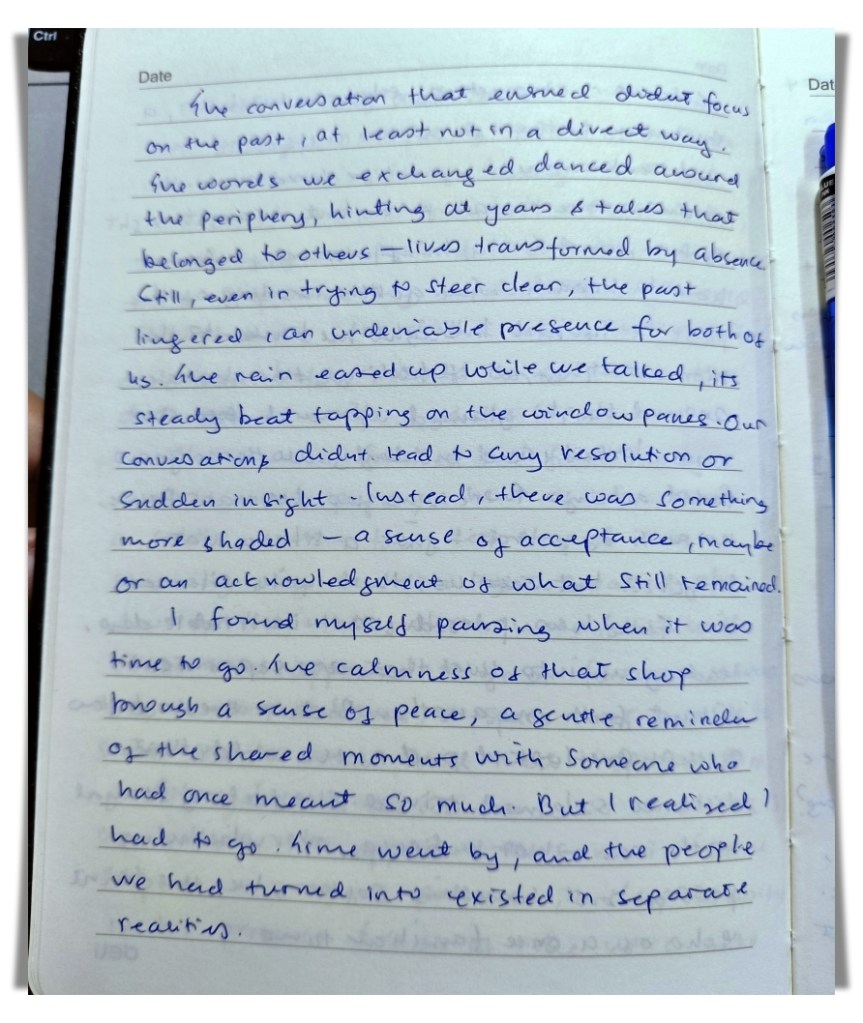
I handwrote all of my writing, including this blog post, before editing it using QuillBot.

Reflection | A Rebellion Beneath My Breasts

Daily writing prompt
How often do you say “no” to things that would interfere with your goals?

Image source

I don’t usually say “no” out loud. Not like people imagine—with steely resolve or loud announcements.

But I speak quietly—in small decisions, in between invitations, or when I left several trivial texts unanswered.

When I moved to Taipei two decades ago (for work), I didn’t have a set list of goals. I arrived with curiosity and a bag full of lonely ambition. The first several months felt like a jumble of polite conversations and an endless stream of data on spreadsheets. I attended dinners with coworkers because I had to, not because I wanted to. I replied yes because of responsibility but no in my heart.

However, I gradually began to make other choices.

I stopped wasting my evenings with pointless nonsense. I found cafes with fogged-up windows and dim lighting where I could write. I stopped accepting weekend plans simply to avoid being alone. I began declining activities that diverted my attention away from what was important: reflection, art, and authentic experiences.

Some people express “no” by closing doors. I say it while slowly walking in the opposite direction.

I may not always know where I’m heading, but I do know what I’m no longer willing to participate in. That’s a start.

These days, my “no” does not imply rejection. It’s a diversion or a simple acknowledgment of the space I require to breathe, create, and exist.

I recall the moment I nodded and allowed him to sit across from me in that café. It was hardly anything. However, it was pregnant with meaning.

I had always said no to strangers, spontaneous encounters, and anything that threatened the careful solitude I had built around myself like armor. But that day, I didn’t.

I didn’t say “yes” aloud. I simply didn’t say “no”.

And sometimes, that’s okay.


Quiet Nod

It wasn’t a yes.
Just a twitch in my neck
and a rebellion beneath my breasts—
a dare whispered to the
soft animal of my body:
Stay.

You dragged the chair
and stirred something feral
I’d buried beneath work
and loneliness.

You sat and
asked nothing.
Still, I answered
by not running.

And maybe that’s how it starts—
without longing,
but with the smallest betrayal
of your own solitude.

Maybe the truest ‘no’ is the one we say to fear—so that something else can finally answer yes.

Copyright © Olivia JD 2025
All Rights Reserved.

Lover’s Bridge | An Excerpt from My Novella-in-Progress

This is a short excerpt from my novella-in-progress. The story unfolds through fragments and moments that shape the narrative from beginning to end. It follows two people (a foreign woman and a local man) who meet by chance in Taipei, Taiwan, and how their bond deepens through small, ordinary exchanges.

This scene takes place at Tamsui Fisherman’s Wharf, on a cold spring Sunday.

I chose to strip this piece (and the whole novella) of unnecessary description, leaving only the essentials—just enough for the reader to fill in the rest.

English is my third language. I used to think I needed big words or beautiful sentences to be taken seriously. But I don’t believe that anymore. This quote by Haruki Murakami reminds me why I write the way I do:

“Writing in a foreign language, with all the limitations that it entailed, removed this obstacle. It also led me to the realisation that I could express my thoughts and feelings with a limited set of words and grammatical structures, as long as I combined them effectively and linked them together in a skilful manner. Ultimately, I learned that there was no need for a lot of difficult words – I didn’t have to try to impress people with beautiful turns of phrase.”

I hope this piece lingers with you in its simplicity. If anything I write resonates with you, feel free to subscribe for updates on the novella and future posts.


Image source

It was a Sunday when he texted.

“Do you want to go somewhere you’ve never been?”

I stared at the message for a while. It was after three in the afternoon. The sky was cloudy, and it was quiet and dreary outside. I had just finished folding laundry, still in my shorts and tank top.

“Okay. But where?”

He picked me up at four. The car was warm, and the radio was set to low. We didn’t say anything on the journey to Tamsui. The windows blurred a little from the cold, and he touched the heater with the back of his knuckle. I remember watching the skyline thin out as the river widened.

It was a chilly spring day; it was slightly sunny, but the light appeared warmer than it actually was. I pulled the jacket around me as we strolled along the wharf. Couples were everywhere, holding hands and snapping photos, while children laughed with sticky hands.

When the cool breeze began to blow, he stayed close.

We went past the food kiosks, which offered grilled squid, fried sweet potatoes, and sugar-coated strawberries on skewers. He stopped at a freezer cart and bought us two soft-serve cones: one matcha and one black sesame.

I gave him a look. “Ice cream?”

He smirked. “Trust me.”

We sat on a bench facing the docks, eating silently. The ice cream quickly melted and dripped onto his wrist. He licked it clean without a word. I giggled. He looked at me and smiled.

As twilight drew near, we strolled toward the bridge.

The Lover’s Bridge arched across the river, its pale structure gleaming in the late afternoon sun. Tourists passed us, cameras in hand, but we strolled slowly, side by side, as if we had all the time in the world.

We stopped midway.

From there, the view widened. The water below shimmered with long strokes of orange and pink. The sun fell lower beneath the horizon. Boats bobbed softly in the harbor.

I stood silently beside him. The breeze brushed a loose strand of hair across my cheek.

We did not talk because there was no need for words.

I could feel him beside me, and that was enough.

We neither touch nor lean in.

But somehow, in that hush of twilight, we felt closer than we had before.

When we eventually turned to go, he said nothing. Neither did I.

But I believe we both realized something had changed.

Even if we weren’t quite ready to admit it.

Copyright © Olivia JD 2025
All Rights Reserved.

After the Rain | When He Returns—in the light, the puddles, the sky

Daily writing prompt
What is your favorite type of weather?

My favorite weather is right after it rains—when the sky turns clear and blue, and the air feels cool against my skin. There’s something about that moment that always makes me think of him.

This poem is my response to the blogging prompt “What is your favorite type of weather?” For me, it’s not solely about the weather but the memories it brings back: the cafe we used to go to, neon reflections in rain puddles, our walks by the riverside, his glance when I turned slightly toward him, then looked away. And that one moment I’ll never forget—when love became something sacred between us.

I wrote this to hold onto all of that. Maybe you’ll feel a bit of it too.

Image source

After the Rain

After the rain,
a sky reborn in blue and cool air—
where I miss you most.

I remember the café,
between raindrops and neon on puddles—
pink, yellow, red, blue—
of cooled steel and second chances.

You were always most beautiful in that light—
when the clouds shifted
to make way for clarity.
There you sat, gazing through the window.
I nodded—
and we stepped outside,
two shadows in the wet streets,
to the path along the riverside,
where children raced their scooters,
wild, unburdened joy.

Your hands in your pockets.
I turned just enough to meet your gaze,
then looked away.

And then,
in the aftermath, unbound by the gentle drizzle,
I found you—
on bended knees,
where I was both altar and sinner,
reminding me that love,
in its truest form,
is its own sacred weather.

Do you remember
how even the storm became a confession,
and every clear sky
revealed the beauty
of our impermanence?

I still wander in the clear wake—
a pilgrim of rain and neon dreams,
and every breath of cool air
carries the wonder of you.

Copyright © Olivia JD 2025

All Rights Reserved.

Little Things I Wish I Had More Time For

Daily writing prompt
What do you wish you could do more every day?

Image source

Waking up before dawn

The darkness is soft, almost porous. I lie on my bed for a moment, in half-light, listening to the world exhale. The refrigerator hums in the kitchen. Somewhere above, a toilet flushes. And far away, in my mind, a train shudders along its tracks.

Then—silence.

This silence is my companion. I want to sit with it longer and let it wrap around me like a blanket. But the world is already stirring. The koel calls for its mate. A muezzin’s call to prayer rises in the cool morning air. The day’s demands creep in like the first rays of sun.

I answer, always, because I must. The world moves, and I move with it.


Being a flâneur

Flâneur. It’s called being a flâneur. Wandering aimlessly without a destination or agenda. Just feet on pavement and hands in my pockets, watching people, and life. I’d notice things—sunlight cracking through the sidewalk, ants hauling crumbs from a toppled trash can. I go nowhere in particular, but in that nowhere, I find everything.

But being a flâneur is a luxury. Everyone wakes already moving. Our minds rushing three steps ahead, ticking off tasks, rehearsing conversations, calculating time. Even before our feet touch the ground. There’s no space for aimless wandering. Even when we try to slow down, something reminds us: idle time is wasted time.


Writing before the world intrudes

I write every day, carving out one to three hours, but what I long for is unhurried time, quiet hours where the mind is soft and open and the words flow smoothly. I have so much to say. But the day rushes in, relentless and loud. Its noise chips away at the focus I try to guard.


Reading without guilt

One page, one sentence, savored for the sheer pleasure of it. Like stealing time in a world that never stops asking. But the books pile up like a reminder of the time I don’t have or the attention I can’t spare.

What do you wish you could do more of every day?