
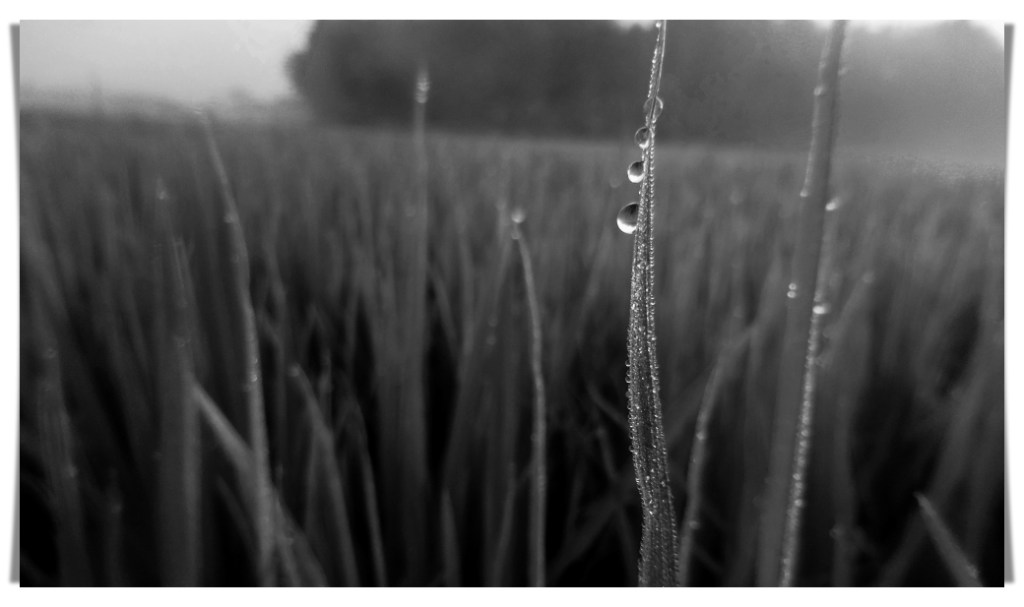
Some mornings begin with a calm sense of familiarity. The air is still cool from the night when I step outside. Dew gathers on the grass, clinging to each blade as if it has been waiting there. In Iban, we call it ambun, and I grew up believing that it is more than moisture. We believe that ambun holds memories and also the substance of our ancestors that find their way back into the living world. The elders in my family often spoke about the cycle of the soul. This belief is deeply held among the Saribas Iban, where my ancestors lived. When someone dies, their soul travels to Sebayan, the land of the dead, traditionally believed to be located at Batang Mandai in Kapuas, West Kalimantan, Borneo. Life in Sebayan mirrors life here. Souls continue living in longhouses, planting rice, raising families, and keeping the same rhythms they once had on earth.
This cycle is not eternal. The soul is believed to live and die seven times. After the seventh death, whatever remains dissolves into a fine mist that falls back to earth as ambun. The dew is especially meaningful at the end of the dry season, when families complete their planting and the land waits for water. The ambun nourishes the young paddy shoots, feeding the next generation. It is a beautiful belief, one I never questioned when I was young. I simply accepted that those who had gone before us returned quietly each morning. When I saw thick dew on the grass, I thought of people I loved who were no longer here, finding their way back to us through the rice we depended on.
I have been thinking about this belief again today because of a simple question from a blog prompt: If you could meet a historical figure, who would it be, and why? It is a straightforward question for most people, but for me, it brings up a feeling I can only describe as longing. In the history of the Iban, the figure I would choose is not distant. He is not a king, a philosopher, or someone from a faraway land. He is my ancestor. My great-great-great-grandfather, Aji Apai Limpa.
Aji was a well-known war leader of the Saribas Iban in the mid-nineteenth century. Between 1854 and 1858, he led his warriors against the advancing rule of the second White Rajah, Charles Brooke. His resistance was fierce and relentless. He died in 1858 in a battle at Sg. Langit. His bravery was not only remembered; it was immortalized in the oral traditions of the Iban. The lemambang (bards) recited his name in their ritual poetry. His courage became part of the narrative of our people, carried through chants and invocations, passed from one generation to the next.
If I could meet him, I would not meet him as a historical figure. I would meet him as an ancestor whose choices shaped the path that eventually led to me. I wonder what he was like as a person outside of battle. I wonder what he feared, what he hoped for, and what drove him to carry responsibility that heavy. The written records focus on warfare and resistance, but I imagine a man who also worried about his people, who made decisions that weighed on him, a man who had moments of doubt and understood that his actions would have consequences beyond his lifetime.
I would ask him what courage meant to him. I would ask him what it felt like to stand in front of his warriors and lead them into danger. I would ask him how he held his ground when the world around him was changing. And I would want to know what he thought about the legacy he would leave behind. There are times when people describe me as sharp or strong-willed, and I think about where those traits may have come from. Perhaps those traits were passed down from him to me, just as ambun returns to nourish the young paddy shoots without anyone noticing.
I think about the belief in Sebayan and how it shapes the way I imagine meeting him. I do not picture a physical meeting. I see it more as a recognition, something that happens inwardly through the echoes that live within us. When I feel the urge to protect my roots or speak about my heritage, I think that he might be part of that voice. The belief that the soul returns as dew makes the idea of connection feel less abstract. If ambun holds the last traces of our ancestors, we may encounter them repeatedly through the land, the rice, and the aspects of ourselves that seem older than our years.
The blog prompt seems simple, but it opens a deeper reflection for me. Meeting a historical figure means meeting someone who has shaped the world you inherited. For me, that figure is not distant or symbolic. He is the ancestor whose bloodline runs through mine, whose story lives on in my people’s poetry, and whose bravery still affects how I live my life.
When the ambun is heavy on the grass in the morning, I think about the souls who have traveled their full journey through Sebayan and returned to nourish the living. I imagine Aji among them. I think that in some small way, he is still here, still part of the cycle that continues without end. And in that sense, the meeting I long for might already be happening in the early morning, when the world is still and the dew falls softly on the ground.
I write about Iban culture, ancestral rituals, creative life, emotional truths, and the quiet transformations of love, motherhood, and identity. If this speaks to you, subscribe and journey with me.
 Olivia's Atelier